
South Korea UV-Curable Resins Market (2024-2029)

The South Korea UV-Curable Resins Market was valued at $266.8 Million in 2024 and projected to reach to $375.9 Million by 2029, representing a compound annual growth rate of 7.1%. South Korea's UV-curable resins market is poised for sustained growth, expanding from USD 266.8 million in 2024 to USD 375.9 million by 2029 at a CAGR of 7.1%.


| Market Size in | USD 26.32 MN |
| Market Forecast in | |
| CAGR | |
| Forecast Period | |
| Units Considered | Value (USD MN) |
South Korea UV-Curable Resins Market Trends and Insights
- This represents a compound annual growth rate (CAGR) of 7.1% over the forecast period.
- South Korea's advanced manufacturing base, particularly in electronics, semiconductors, and automotive sectors, drives demand for high-performance UV-curable coating and adhesive solutions. The South Korea market benefits from strong industrial infrastructure and technological innovation capabilities.
- South Korea's investment in 3D printing, printed electronics, and precision manufacturing has accelerated adoption of UV-curable resins across multiple end-use industries.
- The country's focus on sustainable manufacturing practices and eco-friendly formulations further supports market expansion through 2029. South Korea's position as a global electronics and automotive hub ensures continued demand for UV-curable resins in protective coatings, encapsulation, and adhesive applications.
- Market growth is supported by increasing R&D spending and the presence of leading chemical manufacturers operating within South Korea's competitive landscape..
Key Market Statistics
- CAGR (2024-2029) 7.1% CAGR
- Market Size, 2024 ~USD 266.8 Million
- Forecast, 2029 ~USD 375.9 Million
- Country South Korea
South Korea UV-Curable Resins Market Overview
Market Valuation :
South Korea's UV-curable resins market reached USD 266.8 million in 2024, with strong growth trajectory driven by domestic manufacturing excellence and technological innovation across multiple industrial sectors.
Electronics & Semiconductor Dominance :
The electronics and semiconductor industries are primary growth drivers in South Korea, leveraging UV-curable resins for precision coating, adhesives, and encapsulation applications in high-tech manufacturing.
Automotive Sector Expansion :
South Korea's robust automotive industry increasingly adopts UV-curable resins for advanced coatings, adhesives, and protective applications, supporting the market's 7.1% CAGR through 2029.
Advanced Manufacturing Infrastructure :
South Korea's world-class manufacturing capabilities and R&D investments position the country as a key hub for UV-curable resin applications, supporting consistent market expansion and innovation.
South Korea UV-Curable Resins Market Dynamics
- This growth is underpinned by the country's leadership in electronics, semiconductors, and automotive manufacturing, where UV-curable resins are essential for high-performance applications.
- The market benefits from South Korea's strong technological infrastructure, continuous innovation, and export-oriented manufacturing base. Looking ahead, the South Korean market will be shaped by increasing demand for eco-friendly formulations, miniaturization trends in electronics, and advanced automotive applications.
- Government support for green manufacturing and the country's commitment to sustainable industrial practices will further accelerate adoption of UV-curable resins.
- Strategic investments by local manufacturers and growing collaborations with global players will enhance market competitiveness and drive product innovation through 2029..
Market Ecosystem
Related Ecosystem
Adhesives And Sealants
- Alkyd Resins
- Polyurethane Resin
- Epoxy Resin
- Polyester Resin
- Polyolefin
- 3M COMPANY
- Henkel ag and co. kgaa
- H.B. Fuller Company
- Sika ag
- DOW CHEMICAL COMPANY
Paints And Coatings
- Polyurethane Resin
- Alkyd Resins
- Epoxy Resin
- Polyester Resin
- Acrylics
- Basf se
- JOTUN
- PPG Industries, Inc.
- DOW CHEMICAL COMPANY
- Akzonobel n.v.
Resins And Polymers
- Polycarbonate
- Acrylonitrile Butadiene Styrene (ABS)
- Epoxy Resin
- Light Commercial Vehicles (LCVs)
- Polypropylene (PP)
- Basf se
- DOW CHEMICAL COMPANY
- Solvay sa
- Saudi arabia basic industries corporation (sabic)
- DuPont de Nemours, Inc.
Key Takeaways
- South Korea's UV-curable resins market is valued at USD 266.8 million in 2024 and is forecast to reach USD 375.9 million by 2029, growing at a CAGR of 7.1%.
- South Korea's electronics and semiconductor industries are primary drivers of UV-curable resin demand for coatings, adhesives, and encapsulation applications.
- South Korea's commitment to sustainable manufacturing and eco-friendly formulations is accelerating market adoption across industrial sectors.
- South Korea's advanced R&D capabilities and presence of global chemical manufacturers position the country as a key regional growth hub through 2029.
UV-Curable Resins Market Report Scope
| Report Metric | Details |
|---|---|
| Base Year | 2024 |
| Fastest Growing Segment | WATERBORNE UV RESINS (Technology) |
| Forecast Period | 2024-2029 |
| Growth Rate | CAGR of 7.5% from 2024 to 2029 |
| Largest Segment | OLIGOMERS (Composition) |
| Market Size Base Year (Billions) | ~USD 6.48 (2024) |
| Revenue Forecast (Billions) | ~USD 9.31 (2029) |
| Segments Covered | Composition, Chemistry, Application, Technology, End-Use Industry |
South Korea UV-Curable Resins Market Report Segmentation
5 segment dimensions are covered across the global market.
By Composition
- Additives
- Monomers
- Oligomers
- Photoinitiators
By Chemistry
- Acrylate Oligomers
- Epoxy Acrylates
- Non-Acrylated Oligoamines
- Polyester/Polyether Acrylates
- Urethane Acrylates
By Application
- 3D Printing
- Adhesives
- Coatings
- Other Applications
- Overprint Varnish
- Printing Inks
By Technology
- 100% Solid Uv Resins
- Powder Uv Resins
- Solventborne Uv Resins
- Waterborne Uv Resins
By End-Use Industry
- Automotive
- Building & Construction
- Electrical & Electronics
- Other End-Use Industries
- Paper & Packaging
- Wood & Furniture
Target Audience
- Chemical Manufacturers & Suppliers : South Korean and international chemical companies need market intelligence to optimize product portfolios, identify growth segments, and develop competitive strategies for the expanding UV-curable resins market.
- Electronics & Semiconductor Companies : Major South Korean electronics and semiconductor manufacturers require detailed market data to source high-quality UV-curable resins, evaluate supplier options, and plan production scaling through 2029.
- Automotive Industry Players : South Korean automotive manufacturers and suppliers need insights into UV-curable resin applications, market trends, and supplier capabilities to enhance product performance and manufacturing efficiency.
- Investment & Private Equity Firms : Investors targeting South Korea's advanced manufacturing sector need comprehensive market analysis to identify acquisition targets, growth opportunities, and valuation benchmarks in the UV-curable resins market.
- Market Consultants & Business Strategists : Consulting firms and business strategists require country-specific market data to advise clients on market entry, competitive positioning, and growth strategies within South Korea's UV-curable resins sector.
Reasons to Buy this Report
- Market-Specific Growth Insights : Gain detailed understanding of South Korea's 7.1% CAGR trajectory and the specific drivers within electronics, semiconductors, and automotive sectors that differentiate this market from global trends.
- Competitive Landscape Analysis : Identify key South Korean manufacturers, local market leaders, and competitive positioning strategies specific to the country's advanced manufacturing ecosystem and export-focused industries.
- Sector-Specific Demand Patterns : Understand application-specific demand across South Korea's dominant industries, including precision electronics coating, semiconductor encapsulation, and automotive protective applications.
- Investment & Expansion Opportunities : Identify high-potential market segments and geographic regions within South Korea for business expansion, partnership development, and strategic investment in the growing UV-curable resins sector.
- Regulatory & Sustainability Compliance : Navigate South Korea's environmental regulations, green manufacturing initiatives, and sustainability requirements that shape product development and market entry strategies through 2029.
Frequently asked questions
What is the current market size of UV-curable resins in South Korea?
South Korea's UV-curable resins market was valued at USD 266.8 million in 2024 according to verified market data.
What is the projected market size for UV-curable resins in South Korea by 2029?
South Korea's UV-curable resins market is forecast to reach USD 375.9 million by 2029, representing growth from the 2024 baseline.
What is the CAGR for South Korea's UV-curable resins market?
South Korea's UV-curable resins market is expected to grow at a compound annual growth rate (CAGR) of 7.1% between 2024 and 2029.
Which industries drive demand for UV-curable resins in South Korea?
South Korea's electronics, semiconductors, automotive, and 3D printing industries are the primary drivers of UV-curable resin demand for coatings, adhesives, and encapsulation.
What factors support growth in South Korea's UV-curable resins market?
South Korea's advanced manufacturing infrastructure, R&D investment, sustainability initiatives, and global competitiveness in electronics and automotive sectors support market expansion through 2029.
RESEARCH METHODOLOGY
The study involves two major activities in estimating the current market size for the UV-curable resins market. Exhaustive secondary research was done to collect information on the market, peer market, and parent market. The next step was to validate these findings, assumptions, and sizing with industry experts across the value chain through primary research. Both top-down and bottom-up approaches were employed to estimate the complete market size. After that, market breakdown and data triangulation were used to estimate the market size of segments and subsegments.
Secondary Research
Secondary sources referred to for this research study include financial statements of companies offering UV-curable resins and information from various trade, business, and professional associations. Secondary research has been used to obtain critical information about the industry’s value chain, the total pool of key players, market classification, and segmentation according to industry trends to the bottom-most level and regional markets. The secondary data was collected and analyzed to arrive at the overall size of the UV-curable resins market, which was validated by primary respondents.
Primary Research
Extensive primary research was conducted after obtaining information regarding the UV-curable resins market scenario through secondary research. Several primary interviews were conducted with market experts from both the demand and supply sides across major countries of North America, Europe, Asia Pacific, the Middle East & Africa, and South America. Primary data was collected through questionnaires, emails, and telephonic interviews. The primary sources from the supply side included various industry experts, such as Chief X Officers (CXOs), Vice Presidents (VPs), Directors from business development, marketing, product development/innovation teams, and related key executives from UV-curable resins industry vendors; system integrators; component providers; distributors; and key opinion leaders. Primary interviews were conducted to gather insights such as market statistics, data on revenue collected from the products and services, market breakdowns, market size estimations, market forecasting, and data triangulation. Primary research also helped in understanding the various trends related to type, storage & distribution and transportation, manufacturing process, function, end-use industry, and region. Stakeholders from the demand side, such as CIOs, CTOs, CSOs, and installation teams of the customer/end users who are using UV-curable resins, were interviewed to understand the buyer’s perspective on the suppliers, products, component providers, and their current usage of UV-curable resins and future outlook of their business which will affect the overall market.
The Breakup of Primary Research:

To know about the assumptions considered for the study, download the pdf brochure
Market Size Estimation
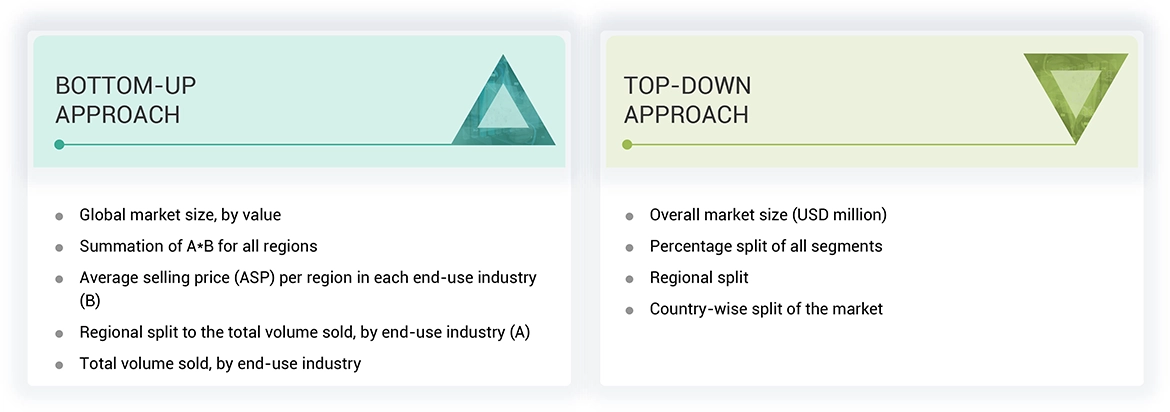
The research methodology used to estimate the size of the UV-curable resins market includes the following details. The market sizing of the market was undertaken from the demand side. The market was upsized based on procurements and modernizations in UV-curable resins in different end-use industries at a regional level. Such procurements provide information on the demand aspects of the UV-curable resins industry for each application. For each application, all possible segments of the UV-curable resins market were integrated and mapped.
Data Triangulation
After arriving at the overall size from the market size estimation process explained above, the total market was split into several segments and subsegments. The data triangulation and market breakdown procedures explained below were implemented, wherever applicable, to complete the overall market engineering process and arrive at the exact statistics for various market segments and subsegments. The data was triangulated by studying various factors and trends from the demand and supply sides. Along with this, the market size was validated using both the top-down and bottom-up approaches.
Market Definition
UV-curable formulated products primarily include coatings, inks, and adhesives. These products are composed of a base resin (oligomers) formulated with monomers, additives, and photoinitiators. Oligomers have moderately low molecular weight and impart most of the basic properties to the UV curing formulations. Reactive monomers are primarily used in a formulation as reactive diluents and crosslinking agents to modify the properties of oligomers. The UV curing process describes the use of UV or visible light to polymerize a combination of oligomers and monomers onto a substrate. Subsequently, the UV material resins can be formulated into coatings, printing inks, adhesives, or other products. The process is also called radiation curing, as UV light is used as a radiant energy source. Energy sources that are typically used for UV cure include pulsed xenon lamps, medium medium-pressure mercury lamps, light-emitting diodes (LEDs), and lasers.
Stakeholders
- Manufacturers of radiation-curable coatings
- Manufacturers of resins, additives, pigments, and other feedstock chemicals
- Manufacturers of industrial coatings, overprint varnishes, adhesives, printing inks, and 3D printing
- Traders, distributors, and suppliers of radiation-curable coatings
- Regional manufacturer associations and general radiation curable associations
- Government and regional agencies and research organizations
Report Objectives
- To define, describe, and forecast the UV-curable resins market size in terms of volume and value
- To provide detailed information regarding the key factors, such as drivers, restraints, opportunities, and challenges influencing market growth
- To analyze and project the global UV-curable resins market by composition, chemistry, technology, application, end-use industry, and region
- To forecast the market size concerning five main regions (along with country-level data), namely, North America, Europe, Asia Pacific, South America, and the Middle East & Africa, and analyze the significant region-specific trends
- To strategically analyze micro markets with respect to individual growth trends, prospects, and contributions of the submarkets to the overall market
- To analyze the market opportunities and the competitive landscape for stakeholders and market leaders
- To assess recent market developments and competitive strategies, such as agreements, contracts, acquisitions, and new product developments/new product launches, to draw the competitive landscape
- To strategically profile the key market players and comprehensively analyze their core competencies
Get the Full UV-Curable Resins Market Report
Full forecast, segment splits, and company analysis for all UV-Curable Resins Market.
- US UV-Curable Resins Market
- Canada UV-Curable Resins Market
- Mexico UV-Curable Resins Market
- France UV-Curable Resins Market
- Germany UV-Curable Resins Market
- Italy UV-Curable Resins Market
- Spain UV-Curable Resins Market
- Sweden UV-Curable Resins Market
- Belgium UV-Curable Resins Market
- UK UV-Curable Resins Market
- Russia UV-Curable Resins Market
- China UV-Curable Resins Market
- Japan UV-Curable Resins Market
- India UV-Curable Resins Market
- South Africa UV-Curable Resins Market
- Brazil UV-Curable Resins Market
- Argentina UV-Curable Resins Market
- Rest Of Europe UV-Curable Resins Market
- Rest Of Asia Pacific UV-Curable Resins Market
- GCC Countries UV-Curable Resins Market
- -Rest Of GCC UV-Curable Resins Market
- Rest Of South America UV-Curable Resins Market
Need a Tailored Report?
Customize this report to your needs
Get 10% FREE Customization
Customize This Report
