
South Korea UV Curing System Market (2026-2031)

The South Korea UV Curing System Market was valued at $153.7 Million in 2026 and projected to reach to $300.3 Million by 2031, representing a compound annual growth rate of 11.8%. South Korea's UV curing system market is positioned for exceptional expansion through 2031, driven by the country's dominant position in global semiconductor and electronics manufacturing.


| Market Size in | USD 26.32 MN |
| Market Forecast in | |
| CAGR | |
| Forecast Period | |
| Units Considered | Value (USD MN) |
South Korea UV Curing System Market Trends and Insights
- Valued at USD 153.7 million in 2026, South Korea's market is projected to nearly double to USD 300.3 million by 2031, reflecting a compound annual growth rate of 11.8%—significantly outpacing global expansion.
- This accelerated growth in South Korea underscores the nation's critical role in precision electronics production and its increasing adoption of UV curing technologies across manufacturing processes. South Korea's semiconductor and electronics sectors are leveraging UV curing systems for enhanced production efficiency, quality control, and miniaturization capabilities.
- The market expansion in South Korea is supported by substantial investments in R&D, technological innovation, and the presence of leading global manufacturers.
- Between 2026 and 2031, South Korea is expected to capture increasing market share as demand for advanced curing solutions intensifies across printed circuit boards, optoelectronics, and semiconductor packaging applications..
Key Market Statistics
- CAGR (2026-2031) 11.8% CAGR
- Market Size, 2026 ~USD 153.7 Million
- Forecast, 2031 ~USD 300.3 Million
- Country South Korea
South Korea UV Curing System Market Overview
Exceptional Growth Trajectory :
South Korea's UV curing system market is projected to nearly double from USD 153.7 million in 2026 to USD 300.3 million by 2031, with a CAGR of 11.8%—significantly exceeding the global growth rate of 8.3%.
Advanced Manufacturing Hub :
South Korea's world-leading semiconductor and electronics manufacturing sector drives demand for precision UV curing technologies, positioning the country as a critical market within Asia Pacific.
Regional Market Leadership :
South Korea's UV curing system market outpaces broader regional trends, reflecting the country's technological sophistication and heavy investment in advanced production processes.
Strategic Industry Applications :
Growing adoption across semiconductor fabrication, PCB manufacturing, and display panel production creates sustained demand for high-performance UV curing solutions in South Korea.
South Korea UV Curing System Market Dynamics
- The 11.8% CAGR reflects strong demand from leading chipmakers, display manufacturers, and electronics component producers investing in advanced production technologies.
- Government support for semiconductor industry growth and continuous technological innovation in UV curing systems further accelerate market expansion. The market's outperformance relative to global trends underscores South Korea's strategic importance in the UV curing sector.
- Increasing complexity in semiconductor miniaturization and rising quality standards in electronics manufacturing necessitate more sophisticated curing solutions.
- Investment in next-generation manufacturing facilities and R&D initiatives will sustain robust growth momentum through the forecast period, positioning South Korea as a key revenue driver for global UV curing system suppliers..
Market Ecosystem
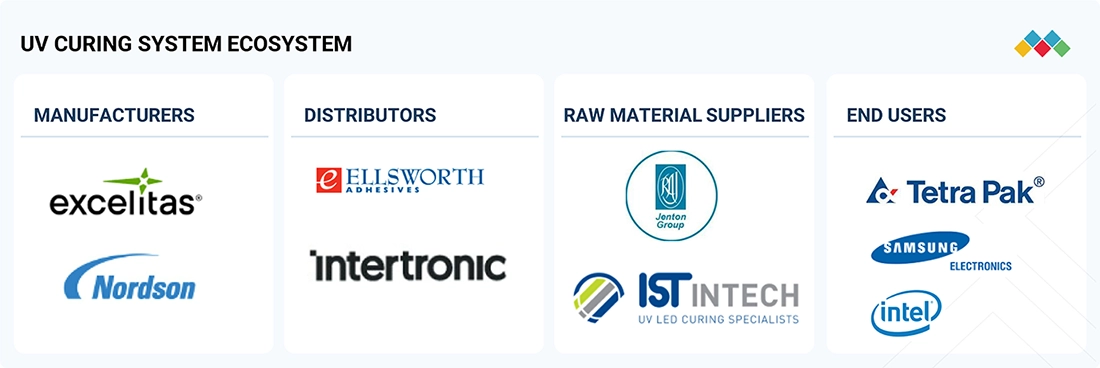
UV CURING SYSTEM MARKET SIZE, SHARE & INDUSTRY TRENDS: COMMERCIAL USE CASES ACROSS INDUSTRIES
| COMPANY | USE CASE DESCRIPTION | BENEFITS |
|---|---|---|
 |
Provide UV LED and conventional UV curing systems for adhesives, coatings, and electronic assembly applications | Solutions to support spot, flood, and conveyor-based curing across industrial and medical manufacturing lines | High precision curing with low heat output and long system lifespan |
 |
Offer integrated UV curing solutions used in automated dispensing, coating, and bonding processes across electronics, automotive, and packaging industries | Systems designed for seamless integration into high-speed production lines | Improved production efficiency and consistent curing quality |
 |
Develop high-intensity UV and LED curing systems for printing, coatings, and industrial surface finishing applications | Known for large-scale curing platforms and customized line integration | High throughput curing with excellent process reliability |
 |
Supply UV curing systems for printing, packaging, and converting applications, including LED and hybrid solutions optimized for web and sheet-fed processes | Energy efficient curing with reduced operating costs |
 |
Specialize in UV curing systems for medical devices, electronics, and precision assembly, focusing on spot curing and localized bonding applications | Fast curing with high accuracy for small and sensitive components |
Logos and trademarks shown above are the property of their respective owners. Their use here is for informational and illustrative purposes only.
Related Ecosystem
Electronics System And Components
- Sensors
- Temperature Sensors
- Pressure Sensors
- Actuators
- Image Sensors
- Lenovo
- Samsung
- Texas Instruments Incorporated
- HONEYWELL INTERNATIONAL INC.
- Teledyne Technologies Incorporated
Key Takeaways
- South Korea's UV curing system market will nearly double from USD 153.7M (2026) to USD 300.3M (2031) at an 11.8% CAGR.
- South Korea's growth rate significantly exceeds the global average of 8.3%, positioning the country as a high-growth regional hub.
- South Korea's advanced semiconductor and electronics manufacturing ecosystem drives sustained demand for precision UV curing technologies.
- South Korea's market expansion is supported by continuous R&D investment and adoption of next-generation manufacturing processes through 2031.
UV Curing System Market Report Scope
| Report Metric | Details |
|---|---|
| Base Year | 2026 |
| Fastest Growing Segment | LOW (Pressure Type) |
| Forecast Period | 2026–2031 |
| Growth Rate | CAGR of 8.3% from 2026 to 2031 |
| Largest Segment | MEDIUM (Pressure Type) |
| Market Size Base Year (Billions) | ~USD 3.01 (2026) |
| Revenue Forecast (Billions) | ~USD 4.48 (2031) |
| Segments Covered | Technology, System Type, Pressure Type |
South Korea UV Curing System Market Report Segmentation
3 segment dimensions are covered across the global market.
By Technology
- Conventional Uv/Mercury Lamp Curing
- Hybrid Curing
- Uv Led Curing
By System Type
- Conveyor/Inline System
- Flood Curing System
- Portable/Handheld Curing System
- Spot Curing System
By Pressure Type
- High
- Medium
Target Audience
- UV Curing System Manufacturers : Manufacturers need South Korea-specific market data to identify growth opportunities, assess competitive dynamics, and develop localized product strategies for the region's advanced manufacturing sector.
- Semiconductor & Electronics Companies : South Korean chipmakers and electronics producers require market intelligence to evaluate UV curing technology investments, benchmark supplier capabilities, and optimize production processes.
- Equipment Suppliers & Distributors : Distributors and equipment suppliers need detailed market forecasts and application insights to plan inventory, identify key accounts, and develop sales strategies targeting South Korea's manufacturing base.
- Investment & Private Equity Firms : Investors evaluating opportunities in South Korea's semiconductor and electronics sectors require market-specific data to assess growth potential, identify acquisition targets, and support due diligence.
- Technology & Innovation Consultants : Consultants advising manufacturing clients need South Korea market insights to recommend technology adoption strategies, identify emerging trends, and support competitive positioning in the region.
Key Companies in the South Korea UV Curing System Market
| Company | HQ | Ownership | Strongest segments |
|---|---|---|---|
| HOYA CORPORATION | Japan | Public Company | Eyeglasses and Contact Lenses (incl. Eyecity retail),Intraocular Lenses and Surgical Ophthalmology,Endoscopes and Laparoscopic Surgical Instruments, |
| NORDSON CORPORATION | United States | Public Company | Industrial Precision Solutions,Advanced Technology Solutions,Medical and Fluid Solutions, |
| HOENLE AG | Germany | Public Company | Curing (surface drying, paints, varnishes, coatings, printing and packaging),Adhesive Systems (industrial adhesives and curing systems),Disinfection (water, surface, air, special lamps, microbiologic services), |
HOYA CORPORATION
HOYA Corporation is a Japanese public company founded in 1941 that employs 37,752 people. The company operates as a major multinational corporation with significant global operations.
NORDSON CORPORATION
Nordson Corporation is a U.S.-based public company founded in 1909 with 8,200 employees. The company has maintained operations for over a century as a publicly traded enterprise.
HOENLE AG
HOENLE AG is a German public company founded in 1976 with 528 employees. The company operates as a publicly traded enterprise in Germany.
Reasons to Buy this Report
- Market-Specific Growth Intelligence : Gain detailed insights into South Korea's 11.8% CAGR trajectory and understand the unique drivers propelling the market to USD 300.3 million by 2031, enabling precise investment and expansion decisions.
- Competitive Landscape Analysis : Identify leading UV curing system suppliers, manufacturers, and technology providers operating in South Korea's advanced semiconductor and electronics ecosystem to benchmark competitive positioning.
- Sector-Specific Demand Drivers : Understand application-specific growth in semiconductor fabrication, PCB manufacturing, and display production—critical segments where South Korea maintains global leadership and sustained investment.
- Strategic Market Entry Planning : Leverage comprehensive South Korea market data to develop targeted go-to-market strategies, identify partnership opportunities, and optimize resource allocation in this high-growth regional market.
- Forecast-Driven Decision Making : Access validated projections through 2031 to support long-term business planning, capital allocation, and product development roadmaps aligned with South Korea's market expansion trajectory.
Frequently asked questions
What is the current size of South Korea's UV curing system market?
South Korea's UV curing system market is valued at USD 153.7 million in 2026 and is projected to reach USD 300.3 million by 2031.
What is the growth rate for South Korea's UV curing system market?
South Korea's UV curing system market is growing at a compound annual growth rate (CAGR) of 11.8% from 2026 to 2031.
How does South Korea's market growth compare to global trends?
South Korea's 11.8% CAGR significantly outpaces the global average of 8.3%, reflecting the country's strategic importance in semiconductor and electronics manufacturing.
What industries drive UV curing system demand in South Korea?
South Korea's semiconductor, electronics, printed circuit board, optoelectronics, and semiconductor packaging industries are primary drivers of UV curing system adoption.
What factors support market growth in South Korea through 2031?
South Korea's market growth is supported by advanced manufacturing infrastructure, substantial R&D investments, technological innovation, and increasing demand for precision production processes.
RESEARCH METHODOLOGY
This study involves the usage of extensive secondary sources, directories, and databases such as Hoovers, Bloomberg BusinessWeek, Factiva, and OneSource to identify and collect information useful for this technical, market-oriented, and commercial study of the UV curing system market. Primary sources include several industry experts from the core and related industries, along with preferred suppliers, manufacturers, distributors, service providers, and technology developers. In-depth interviews have been conducted with key industry participants, subject matter experts (SMEs), C-level executives of key companies operating in the UV curing system market, and industry consultants, among other experts, to obtain and verify qualitative and quantitative information, as well as to assess prospects. The following illustrative figure shows the market research methodology applied in making this report on the UV curing system market.
Secondary Research
In the secondary research, various secondary sources are used for identifying and collecting information relevant to this study on the UV curing system market. The secondary sources included annual reports, press releases & investor presentations of companies, white papers, certified publications & articles by recognized authors, directories, and databases.
The global size of the UV curing system market is obtained from the secondary data made available through paid and unpaid sources. It is determined by analyzing the product portfolios of the leading companies and rating them based on the quality of their offerings.
Secondary research is used to gather key information about the supply chain, the monetary chain, the total number of key players, and market segmentation according to the industry trends to the bottom-most level, geographic markets, and key developments from both the market- and technology-oriented perspectives. It identifies and analyzes the industry trends and key developments undertaken from market and technology perspectives.
Primary Research
In the primary research process, various primary sources were interviewed to obtain the qualitative and quantitative information related to the market across four main regions—Asia Pacific, North America, Europe, and RoW (the Middle East, Africa, and South America). Primary sources from the supply side include industry experts such as CEOs, vice presidents, marketing directors, technology directors, and some other related key executives from major companies and organizations operating in the UV curing system market or related markets.
After completing market engineering, primary research was conducted to gather information and verify and validate critical numbers obtained from other sources. Primary research was conducted to identify various market segments, industry trends, key players, competitive landscape, market dynamics, and key strategies adopted by market players. Most of the primary interviews were conducted with the supply side of the market. This primary data was collected through questionnaires, emails, and telephonic interviews.
Market Size Estimation
The top-down and bottom-up approaches have been used extensively in the market engineering process. Several data triangulation methods helped to forecast and estimate market segments and subsegments in the report. Multiple qualitative and quantitative analyses have been performed on the market engineering process to gain key insights throughout the report.
Secondary research has been used to identify the key players of the UV curing system market. The revenues of those key players are determined through primary and secondary research. The revenues are identified geographically and market segment-wise, using financial statements and analyzing annual reports of the key market players. Interviews with CEOs, VPs, directors, and marketing executives were conducted to gain insights into the key players and the UV curing system market. All the market shares are estimated using secondary and primary research. This data has been consolidated, supplemented with detailed inputs & analysis by experts at MarketsandMarkets, and presented in this report.
Data Triangulation
After arriving at the overall market size from the market size estimation process explained above, the total market has been then split into several segments and sub-segments. The data triangulation procedure has been employed to complete the market engineering process and arrive at the exact statistics for all segments and sub-segments. The data has been triangulated by studying various factors and trends from both the demand and supply sides. Along with this, the market has been validated using both the top-down and bottom-up approaches.
Study Objectives
- To describe and forecast the UV curing system market, in terms of value, segmented by technology, type, pressure type, application, vertical, and region
- To provide detailed information regarding the drivers, restraints, opportunities, and challenges influencing the growth of the market
- To analyze the emerging applications/use cases and standards in the UV curing system market
- To analyze the manufacturers of UV curing systems, their strategies, and new production plans to understand the ecosystem/supply chain consisting of material & component suppliers and manufacturers
- To strategically analyze micromarkets1 concerning individual growth trends, prospects, and contributions to the overall market
- To analyze market opportunities for stakeholders and provide details of the competitive landscape of the market
- To analyze competitive developments in the UV curing system market, such as collaborations, partnerships, acquisitions, and product launches & developments
- To strategically profile key players and comprehensively analyze their market share analysis & ranking core competencies2
Report Scope
The report covers the demand- and supply-side segmentation of the UV curing system market. The supply-side market segmentation includes the pressure type, technology, and type, whereas the demand-side market segmentation includes application, industry and region. The following figure represents an overview of the micromarkets covered in the report.
Available Customizations
With the given market data, MarketsandMarkets offers customizations according to the specific requirements of companies. The following customization options are available for this report:
Regional Analysis
- Country-wise breakdown of the UV curing system market for North America, Europe, APAC, and RoW
Company Information
- Detailed analysis and profiling of additional market players (up to 5)
Get the Full UV Curing System Market Report
Full forecast, segment splits, and company analysis for all UV Curing System Market.
- US UV Curing System Market
- Canada UV Curing System Market
- Mexico UV Curing System Market
- Germany UV Curing System Market
- UK UV Curing System Market
- France UV Curing System Market
- Spain UV Curing System Market
- Italy UV Curing System Market
- Netherlands UV Curing System Market
- Belgium UV Curing System Market
- China UV Curing System Market
- Japan UV Curing System Market
- India UV Curing System Market
- Australia UV Curing System Market
Need a Tailored Report?
Customize this report to your needs
Get 10% FREE Customization
Customize This Report
