
Japan UV Stabilizers Market (2024-2029)

The Japan UV Stabilizers Market was valued at $15292.4 Million in 2024 and projected to reach to $17443.8 Million by 2029, representing a compound annual growth rate of 6.49%. Japan's UV stabilizers market demonstrates steady growth driven by the country's mature and technologically advanced manufacturing ecosystem.


| Market Size in | USD 26.32 MN |
| Market Forecast in | |
| CAGR | |
| Forecast Period | |
| Units Considered | Value (USD MN) |
Japan UV Stabilizers Market Trends and Insights
- Japan's demand for UV stabilizers is driven by the country's robust plastics, coatings, and automotive industries, which require advanced stabilization solutions to enhance product durability and performance.
- The market in Japan reflects strong adoption of high-performance UV stabilizers across polymers, adhesives, and protective coatings used in consumer electronics and industrial applications. Japan's commitment to sustainability and stringent regulatory standards are shaping the UV stabilizers landscape, with manufacturers increasingly focusing on eco-friendly and compliant formulations.
- The forecast period through 2029 indicates steady growth in Japan as end-use industries expand their production capacities and invest in advanced material technologies.
- Japan's position as a leading chemical and materials hub in Asia Pacific continues to support market expansion, with innovation in hindered amine light stabilizers (HALS) and other next-generation stabilizer chemistries driving competitive differentiation..
Key Market Statistics
- CAGR (2024-2029) 6.49% CAGR
- Market Size, 2024 ~USD 15292.4 Million
- Forecast, 2029 ~USD 17443.8 Million
- Country Japan
Japan UV Stabilizers Market Overview
Market Valuation :
Japan's UV stabilizers market is valued at USD 15,292.4 million in 2024, reflecting strong demand from domestic manufacturing sectors and export-oriented industries.
Growth Trajectory :
The market is projected to reach USD 17,443.8 million by 2029, expanding at a CAGR of 6.49%, outpacing many developed economies due to Japan's advanced industrial base.
Key Driver Industries :
Japan's robust plastics, coatings, and automotive sectors are primary demand drivers, requiring high-performance UV stabilizers for durability, weather resistance, and product longevity.
Technological Innovation :
Japanese manufacturers prioritize advanced stabilization solutions that meet stringent quality standards and environmental regulations, supporting premium product development and export competitiveness.
Japan UV Stabilizers Market Dynamics
- The automotive and electronics industries continue to invest in high-performance materials that require superior UV protection, particularly for exterior components and coatings exposed to harsh environmental conditions.
- Japan's commitment to sustainability and circular economy principles is spurring demand for eco-friendly stabilizer formulations that maintain product performance while reducing environmental impact. Looking ahead, the market will benefit from Japan's ongoing investments in next-generation plastics and composite materials for electric vehicles and renewable energy applications.
- The country's stringent regulatory framework and quality standards position Japanese manufacturers as premium suppliers in global markets, supporting sustained demand for advanced UV stabilizer technologies through 2029..
Market Ecosystem
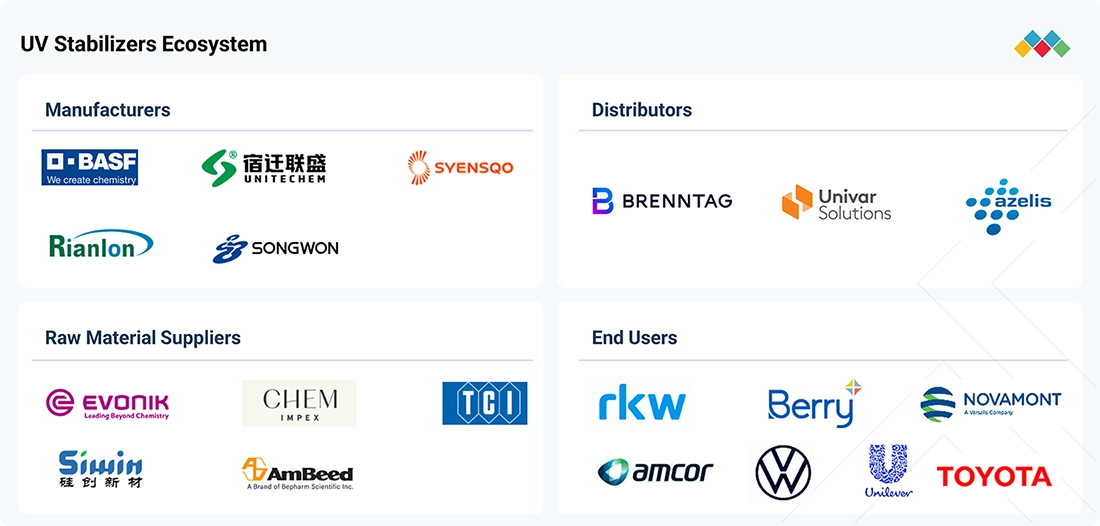
UV STABILIZERS MARKET: COMMERCIAL USE CASES ACROSS INDUSTRIES
| COMPANY | USE CASE DESCRIPTION | BENEFITS |
|---|---|---|
 |
Uses UV-stabilized polypropylene and other polymer materials in exterior automotive components, including bumpers and exterior trims. HALS-based stabilization helps these components withstand prolonged sunlight and weathering while maintaining surface appearance and mechanical properties. | Improved resistance to surface chalking, gloss loss, discoloration, and UV-induced degradation; longer service life of exterior plastic components and improved vehicle appearance. |
 |
Uses BASF Tinuvin light stabilizer technology in its Waterborne Fine Coat Silicon architectural coating system. The stabilization system is incorporated to improve the durability of coatings exposed to outdoor conditions on building exteriors. | Enhanced weatherability of exterior coatings, improved color and surface durability, reduced degradation from UV exposure, and longer-lasting building appearance. |
 |
Uses UV-stabilized plastic end caps in its PF20PLUS formwork beams and shuttering panels used on construction sites. The UV stabilizer protects the plastic end reinforcements from outdoor exposure while maintaining their protective function under varying temperatures. | Better resistance to outdoor weathering, improved durability of plastic components, maintained mechanical performance, and extended useful life of construction equipment. |
 |
Uses BASF Chimassorb 2020 light stabilizer in PP non-woven fabrics used to cover crops, plants, and vegetables. The stabilizer protects thin PP filaments from UV-induced degradation during prolonged agricultural exposure. | Longer service life of agricultural fabrics, improved resistance to sunlight and heat, maintained material strength during outdoor use, and greater durability of crop-protection products. |
Logos and trademarks shown above are the property of their respective owners. Their use here is for informational and illustrative purposes only.
Related Ecosystem
Automotive Materials
- Light Commercial Vehicles (LCVs)
- Battery Electric Vehicle (BEV)
- Hybrid Electric Vehicle (HEV)
- Fuel Cell Electric Vehicle (FCEV)
- Agricultural Tractors
- GORKOVSKY AVTOMOBILNY ZAVOD
- AISIN CORPORATION
- Continental ag
- Basf se
- BOSCH LIMITED
Automotive Systems
- Light Commercial Vehicles (LCVs)
- Battery Electric Vehicle (BEV)
- Hybrid Electric Vehicle (HEV)
- Agricultural Tractors
- Fuel Cell Electric Vehicle (FCEV)
- BOSCH LIMITED
- DENSO Corporation
- ZF FRIEDRICHSHAFEN AG
- Continental ag
- GORKOVSKY AVTOMOBILNY ZAVOD
Speciality Chemicals
- Corrosion Inhibitors
- Polyetheretherketone (PEEK)
- Acrylonitrile Butadiene Styrene (ABS)
- Epoxy Resin
- Polycarbonate
- Basf se
- DOW CHEMICAL COMPANY
- Evonik industries ag
- Clariant ag.
- Solvay sa
Key Takeaways
- Japan's UV stabilizers market reaches USD 15,292.4 million in 2024 with projected growth to USD 17,443.8 million by 2029.
- Japan's market expands at a 6.49% CAGR, driven by demand from automotive, plastics, and coatings sectors.
- Japan's regulatory environment and sustainability focus are accelerating adoption of advanced and eco-friendly UV stabilizer formulations.
- Japan's position as a regional chemical hub supports innovation in HALS and specialty stabilizer technologies through 2029.
UV Stabilizers Market Report Scope
| Report Metric | Details |
|---|---|
| Base Year | 2024 |
| Fastest Growing Segment | AUTOMOTIVE (Application) |
| Forecast Period | 2024–2029 |
| Growth Rate | CAGR of 6.76% from 2024 to 2029 |
| Largest Segment | HALS (Type) |
| Market Size Base Year (Billions) | ~USD 2.51 (2024) |
| Revenue Forecast (Billions) | ~USD 3.72 (2029) |
| Segments Covered | Type, Application |
Japan UV Stabilizers Market Report Segmentation
2 segment dimensions are covered across the global market.
By Type
- Hals
- Quenchers
- Uv Absorbers
By Application
- Adhesives & Sealants
- Agriculture
- Automotive
- Building & Construction
- Other Applications
- Packaging
- Personal Care, Cosmetics & Sunscreens
Target Audience
- Chemical Manufacturers & Suppliers : UV stabilizer producers need Japan-specific market data to identify growth opportunities, benchmark competitive positioning, and develop localized product strategies for this premium market.
- Automotive & Plastics OEMs : Japanese and international manufacturers require detailed market insights to optimize material sourcing decisions, evaluate supplier capabilities, and ensure compliance with Japan's quality standards.
- Investment & Private Equity Firms : Investors evaluating opportunities in Japan's chemicals sector need comprehensive market analysis to assess growth potential, competitive dynamics, and valuation benchmarks for M&A activities.
- Market Research & Consulting Firms : Research organizations require Japan-specific cutout data to support client advisory services, competitive analysis, and strategic planning for chemical and materials industry stakeholders.
- Government & Trade Organizations : Japanese trade bodies and policy makers need market intelligence to support industry development initiatives, export promotion strategies, and regulatory framework optimization.
Key Companies in the Japan UV Stabilizers Market
| Company | HQ | Ownership | Strongest segments |
|---|---|---|---|
| POLYONE CORPORATION | United States | Public Company | HALS,UV Absorbers,Quenchers, |
| PLASTIKA KRITIS | Greece | Public Company | HALS-based UV masterbatches,UV absorber masterbatches,Quencher-based and specialty UV systems, |
| BASF SE | Germany | ||
| RIANLON CORPORATION | China | Public Company | HALS (Hindered Amine Light Stabilizers),UV Absorbers,Quenchers and Related Light Stabilizers, |
| ARKEMA | France | ||
| SUQIAN UNITECH CORP., LTD. | China | Public Company | HALS (Hindered Amine Light Stabilizers),UV Absorbers,Quenchers and related stabilizing additives, |
| SONGWON INDUSTRIAL CO., LTD. | South Korea | ||
| ADEKA CORPORATION | Japan | ||
| EVERLIGHT CHEMICAL INDUSTRIAL CORPORATION | Taiwan | Public Company | HALS,UV Absorbers,Quenchers, |
| CLARIANT AG | Switzerland | Public Company | HALS,UV Absorbers,Quenchers, |
POLYONE CORPORATION
PolyOne Corporation is a U.S.-based public company founded in 1885 with approximately 9,000 employees. The company specializes in polymer materials and services for various industrial applications.
PLASTIKA KRITIS
Plastika Kritis is a Greek public company founded in 1970 with 1,266 employees. The company manufactures plastic products and materials for industrial and consumer applications.
BASF SE
BASF SE is a German multinational chemical company and one of the world's largest producers of chemicals, plastics, and related products.
RIANLON CORPORATION
Rianlon Corporation is a Chinese public company founded in 2003 with 3,068 employees. The company manufactures specialty chemicals and chemical additives for industrial applications.
ARKEMA
Arkema is a French specialty chemicals company that produces a wide range of chemical products and materials for various industrial sectors.
SUQIAN UNITECH CORP., LTD.
Suqian Unitech Corp., Ltd. is a Chinese public company founded in 1997 with 1,333 employees. The company specializes in the production of specialty chemicals and chemical additives.
SONGWON INDUSTRIAL CO., LTD.
Songwon Industrial Co., Ltd. is a South Korean company that manufactures specialty chemicals and additives for the plastics and chemical industries.
ADEKA CORPORATION
Adeka Corporation is a Japanese company that produces specialty chemicals, plastics, and related chemical products for industrial applications.
EVERLIGHT CHEMICAL INDUSTRIAL CORPORATION
Everlight Chemical Industrial Corporation is a Taiwanese public company founded in 1972 with 1,004 employees. The company manufactures specialty chemicals and chemical products for industrial use.
CLARIANT AG
Clariant AG is a Swiss public company founded in 1886 with approximately 9,998 employees. The company is a leading producer of specialty chemicals serving diverse industries worldwide.
Reasons to Buy this Report
- Japan-Specific Market Sizing : Access precise valuation data for Japan's UV stabilizers market with detailed 2024-2029 forecasts, enabling accurate budgeting and investment decisions tailored to the Japanese market landscape.
- Competitive Intelligence : Understand Japan's unique competitive dynamics, local manufacturer strategies, and market consolidation trends specific to the country's automotive, plastics, and coatings sectors.
- Regulatory & Compliance Insights : Navigate Japan's stringent environmental regulations and quality standards that shape product development requirements and create differentiation opportunities for UV stabilizer suppliers.
- Industry-Specific Demand Analysis : Identify growth opportunities within Japan's key end-use sectors including electric vehicles, consumer electronics, and export-oriented manufacturing requiring advanced stabilization solutions.
- Strategic Market Entry Planning : Develop targeted go-to-market strategies for Japan with insights into distribution channels, customer preferences, and growth drivers specific to this high-value developed market.
Frequently asked questions
What is the current size of Japan's UV stabilizers market in 2024?
Japan's UV stabilizers market is valued at USD 15,292.4 million in 2024.
What is the projected market size for Japan's UV stabilizers by 2029?
Japan's UV stabilizers market is forecast to reach USD 17,443.8 million by 2029.
What is the CAGR for Japan's UV stabilizers market?
Japan's UV stabilizers market is expected to grow at a CAGR of 6.49% from 2024 to 2029.
Which industries drive demand for UV stabilizers in Japan?
Japan's automotive, plastics processing, coatings, consumer electronics, and industrial adhesive sectors are primary drivers of UV stabilizer demand.
What regulatory factors influence Japan's UV stabilizers market?
Japan's stringent environmental regulations and sustainability mandates are pushing manufacturers toward eco-friendly and compliant UV stabilizer formulations.
RESEARCH METHODOLOGY
The study involved four major activities in estimating the market size for UV stabilizers. Exhaustive secondary research was done to collect information on the market, the peer market, and the parent market. The next step was to validate these findings, assumptions, and sizing with industry experts across the value chain through primary research. Both top-down and bottom-up approaches were employed to estimate the complete market size. After that, the market breakdown and data triangulation procedures were used to estimate the market size of the segments and subsegments.
Secondary Research
Secondary sources used in this study included annual reports, press releases, and investor presentations of companies; white papers; certified publications; articles from recognized authors; and gold-standard and silver-standard websites, such as Factiva, ICIS, Bloomberg, and others. The findings of this study were verified through primary research, which involved conducting extensive interviews with key officials, including CEOs, VPs, directors, and other executives. The breakdown of profiles of the primary interviewees is illustrated in the figure below:
Primary Research
The UV stabilizers market comprises several stakeholders, such as raw material suppliers, end-product manufacturers, and regulatory organizations in the supply chain. Various primary sources from both the supply and demand sides of the market were interviewed to obtain qualitative and quantitative information.
BREAKDOWN OF PRIMARY PARTICIPANTS
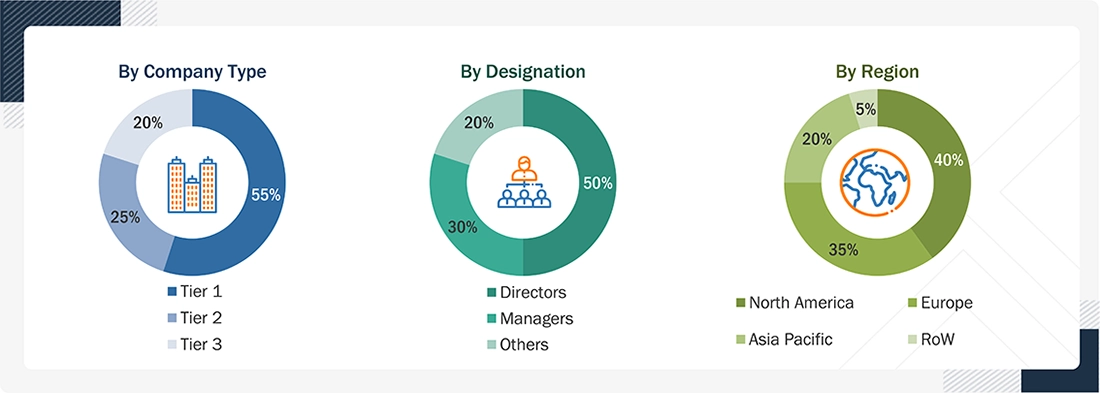
Notes: Tier 1, Tier 2, and Tier 3 companies are classified based on their market revenue in 2025, available in the public domain, product portfolios, and geographical presence.
Other designations include consultants and sales, marketing, and procurement managers.
|
COMPANY NAME |
DESIGNATION |
|
BASE SE |
Senior Manager |
|
SABO S.p.A. |
Innovation Manager |
|
ADEKA Corporation |
Vice President |
|
Clariant AG |
Production Supervisor |
|
SI Group, Inc. |
Sales Manager |
To know about the assumptions considered for the study, download the pdf brochure
Market Size Estimation
Both top-down and bottom-up approaches were used to estimate and validate the total size of the UV stabilizers market. These methods were also used extensively to estimate the size of various subsegments in the market. The research methodology used to estimate the market size includes the following:
- The key players in the industry have been identified through extensive secondary research.
- The supply chain of the industry has been determined through primary and secondary research.
- All percentage shares, splits, and breakdowns have been determined using secondary sources and verified through primary sources.
- All possible parameters that affect the markets covered in this research study have been accounted for, viewed in extensive detail, verified through primary research, and analyzed to obtain the final quantitative and qualitative data.
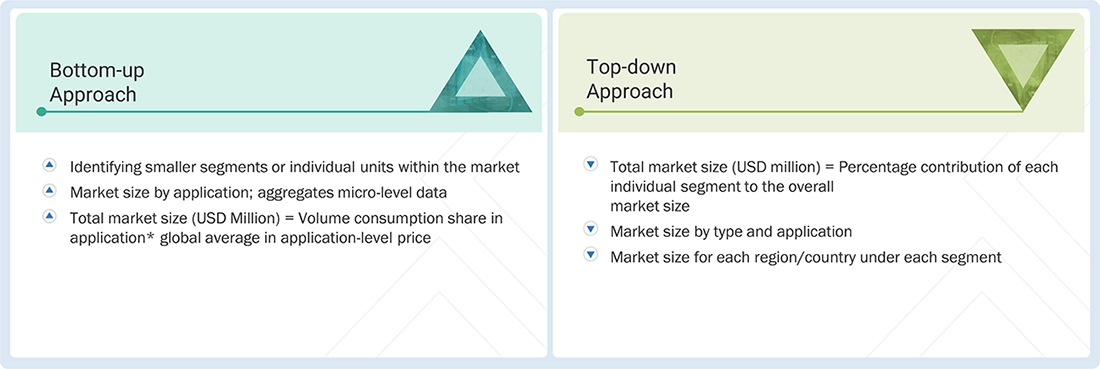
Data Triangulation
After determining the overall market size using the market size estimation processes explained above, the market was divided into several segments and subsegments. To complete the overall market engineering process and determine the exact statistics for each market segment and subsegment, data triangulation and market breakdown procedures were employed, as applicable. The data was triangulated by studying various factors and trends from both the demand and supply sides in the UV stabilizers industry.
Market Definition
According to the Plastics Industry Association, “a UV stabilizer is a chemical additive that protects materials such as plastics, coatings, polymers and textiles from ultraviolet (UV) degradation. UV light breaks down chemical bonds in a material, leading to its discoloration, cracking, brittleness, and loss of mechanical strength, thereby impacting its aesthetic properties and functionalities. UV stabilizers prevent these kinds of damage by reflecting, absorbing, or neutralizing UV radiation, thereby extending the lifespan of UV-exposed products. UV stabilizers comprise HALS, UV absorbers, and quenchers.”
Key Stakeholders
- UV Stabilizer Manufacturers
- UV Stabilizer Distributors
- Raw Material Suppliers
- Service Providers
- Industry Associations
- Government and Research Organizations
Report Objectives
- To analyze and forecast the UV stabilizers market in terms of value and volume
- To provide detailed information about the key factors (drivers, restraints, opportunities, and challenges) influencing market growth
- To define, segment, and project the size of the global UV stabilizers market based on type and application
- To project the market size for five main regions: North America, Europe, Asia Pacific, the Middle East & Africa, and South America, with their key countries
- To analyze the micromarkets concerning individual growth trends, prospects, and their contribution to the overall market
- To analyze opportunities in the market for stakeholders and provide a competitive landscape of the market leaders
- To track and analyze R&D and competitive developments such as expansions, product launches, collaborations, investments, partnerships, agreements, developments, collaborations, and mergers & acquisitions in the UV stabilizers market
Available customizations:
Along with the given market data, MarketsandMarkets offers customizations according to the company’s specific needs. The following customization options are available for the report:
Regional Analysis
- Further breakdown of a region with respect to a particular country or additional end-use industry
Company Information
- Detailed analysis and profiles of additional market players (up to five)
Get the Full UV Stabilizers Market Report
Full forecast, segment splits, and company analysis for all UV Stabilizers Market.
- China UV Stabilizers Market
- India UV Stabilizers Market
- South Korea UV Stabilizers Market
- Malaysia UV Stabilizers Market
- Thailand UV Stabilizers Market
- Canada UV Stabilizers Market
- Mexico UV Stabilizers Market
- US UV Stabilizers Market
- Germany UV Stabilizers Market
- Italy UV Stabilizers Market
- France UV Stabilizers Market
- UK UV Stabilizers Market
- Turkey UV Stabilizers Market
- Spain UV Stabilizers Market
- Brazil UV Stabilizers Market
- UAE UV Stabilizers Market
- Saudi Arabia UV Stabilizers Market
- South Africa UV Stabilizers Market
- Rest Of Europe UV Stabilizers Market
- Rest Of Asia Pacific UV Stabilizers Market
- Rest Of South America UV Stabilizers Market
Need a Tailored Report?
Customize this report to your needs
Get 10% FREE Customization
Customize This Report
