
Europe Vaccine Adjuvants Market (2024-2029)

The Europe Vaccine Adjuvants Market was valued at $207.7 Million in 2024 and projected to reach to $282.3 Million by 2029, representing a compound annual growth rate of 6.3%. Europe's vaccine adjuvants market is positioned for sustained growth driven by robust healthcare infrastructure, stringent regulatory frameworks, and continuous investment in immunization programs.


| Market Size in | USD 26.32 MN |
| Market Forecast in | |
| CAGR | |
| Forecast Period | |
| Units Considered | Value (USD MN) |
Europe Vaccine Adjuvants Market Trends and Insights
- Europe maintains a mature and well-regulated immunization infrastructure, driving steady demand for advanced adjuvant technologies across both routine and pandemic-response vaccination programs.
- The region's strong pharmaceutical manufacturing base and emphasis on vaccine efficacy enhancement position Europe as a key market for next-generation adjuvant formulations. Growth in Europe's vaccine adjuvants market is underpinned by increasing investment in immunization initiatives, rising prevalence of infectious diseases, and regulatory support for novel vaccine development.
- Europe's aging population and heightened focus on preventive healthcare further accelerate adoption of adjuvanted vaccines.
- Between 2024 and 2029, Europe is expected to see accelerated innovation in adjuvant platforms, particularly for respiratory and seasonal influenza vaccines, supported by both public health mandates and private sector R&D..
Key Market Statistics
- CAGR (2024-2029) 6.3% CAGR
- Market Size, 2024 ~USD 207.7 Million
- Forecast, 2029 ~USD 282.3 Million
- Geography Europe
Europe Vaccine Adjuvants Market Overview
Market Valuation & Growth :
Europe's vaccine adjuvants market is valued at USD 207.7 million in 2024 and is projected to reach USD 282.3 million by 2029, representing a steady CAGR of 6.3% over the forecast period.
Regulatory Excellence :
Europe maintains a mature and well-regulated immunization infrastructure with stringent quality standards, driving consistent demand for advanced adjuvant technologies across routine and pandemic-response vaccination programs.
Market Leadership :
Germany leads the European market with USD 78.7 million in market size, followed by the UK at USD 65 million, reflecting strong pharmaceutical manufacturing and immunization capabilities in these nations.
Pandemic Preparedness :
Increased focus on pandemic preparedness and next-generation vaccine development across Europe is accelerating adoption of innovative adjuvant formulations to enhance vaccine efficacy and immunogenicity.
Europe Vaccine Adjuvants Market Dynamics
- The region's mature market benefits from established relationships between pharmaceutical manufacturers and healthcare authorities, ensuring steady demand for advanced adjuvant technologies.
- Ongoing research into novel adjuvant formulations and their application in emerging infectious disease vaccines will further propel market expansion.
- Additionally, Europe's commitment to vaccine self-sufficiency and pandemic preparedness initiatives will create sustained opportunities for adjuvant manufacturers through 2029..
Market Ecosystem
Related Ecosystem
Biotechnology
- Reagents
- Polymerase Chain Reaction (PCR)
- Stem Cells
- Assay Kits
- Flow Cytometers
- Thermo Fisher Scientific Inc.
- Merck KGaA
- Danaher Corporation
- Agilent Technologies, Inc.
- Bio-Rad Laboratories, Inc.
Key Takeaways
- Europe's vaccine adjuvants market is valued at USD 207.7 million in 2024 and will reach USD 282.3 million by 2029 at a 6.3% CAGR.
- Europe's mature regulatory framework and strong immunization infrastructure support consistent demand for advanced adjuvant technologies.
- Aging demographics and preventive healthcare priorities in Europe drive adoption of next-generation adjuvanted vaccine formulations.
- Innovation in adjuvant platforms for respiratory and seasonal vaccines is expected to accelerate across Europe through 2029.
Vaccine Adjuvants Market Report Scope
| Report Metric | Details |
|---|---|
| Base Year | 2024 |
| Fastest Growing Segment | PATHOGEN COMPONENTS (Product) |
| Forecast Period | 2024-2029 |
| Growth Rate | CAGR of 6.5% from 2024 to 2029 |
| Largest Segment | INFECTIOUS DISEASES (Disease Type) |
| Market Size Base Year (Billions) | ~USD 0.7 (2024) |
| Revenue Forecast (Billions) | ~USD 0.96 (2029) |
| Segments Covered | Product, Adjuvant Type, Route Of Administration, Disease Type, Application, Vaccine Type, Animal Type, Product Type |
Europe Vaccine Adjuvants Market Report Segmentation
8 segment dimensions are covered across the global market.
By Product
- Emulsion Adjuvants
- Other Adjuvants
- Particulate Adjuvants
- Pathogen Components
- Saponin-Based Adjuvants
By Adjuvant Type
- Inorganic Adjuvants
- Organic Adjuvants
By Route Of Administration
- Intramuscular
- Other Routes Of Administration
- Subcutaneous
By Disease Type
- Cancer
- Infectious Diseases
- Other Diseases
By Application
- Commercial Applications
- Infectious Diseases
- Research Applications
- Therapeutic
By Vaccine Type
- Human Vaccines
- Veterinary Vaccines
By Animal Type
- Companion Animals
- Livestock Animals
- Other Animals
By Product Type
- Adjuvant Emulsions
- Other Adjuvants
- Particulate Adjuvants
- Pathogen Components
- Saponin-Based Adjuvants
EUROPE: VACCINE ADJUVANTS MARKET, BY APPLICATION, 2022–2029
| Segment | 2022 | 2023 | 2024 | 2025 | 2026 | 2027 | 2028 | 2029 | CAGR (%) |
|---|---|---|---|---|---|---|---|---|---|
| COMMERCIAL APPLICATIONS | 125.3 | 71.6 | 75.4 | 79.7 | 84.7 | 89.8 | 95.1 | 100.7 | 5.9 |
| RESEARCH APPLICATIONS | 217.4 | 124.9 | 132.3 | 140.5 | 150.3 | 160.2 | 170.7 | 181.7 | 6.5 |
| TOTAL | 342.7 | 196.5 | 207.7 | 220.2 | 235 | 250.1 | 265.8 | 282.3 | 6.3 |
EUROPE: VACCINE ADJUVANTS MARKET FOR HUMAN VACCINES, BY APPLICATION,2022–2029
| Segment | 2022 | 2023 | 2024 | 2025 | 2026 | 2027 | 2028 | 2029 | CAGR (%) |
|---|---|---|---|---|---|---|---|---|---|
| INFECTIOUS DISEASES | 231.7 | 104.6 | 110.7 | 117.6 | 125.6 | 133.9 | 142.6 | 151.6 | 6.5 |
| THERAPEUTIC | 38.8 | 17.6 | 18.6 | 19.8 | 21.3 | 22.7 | 24.2 | 25.8 | 6.8 |
| TOTAL | 270.5 | 122.1 | 129.4 | 137.4 | 146.9 | 156.6 | 166.8 | 177.5 | 6.5 |
Target Audience
- Pharmaceutical Manufacturers : Vaccine and adjuvant producers require detailed European market data to optimize product portfolios, identify growth markets, and align manufacturing strategies with regional demand patterns.
- Healthcare Policy Makers : Government health agencies and immunization program directors need market intelligence to inform vaccination strategy, procurement decisions, and pandemic preparedness planning across Europe.
- Investment & Private Equity Firms : Investors evaluating opportunities in European healthcare and biotech sectors require comprehensive market sizing and growth forecasts to assess portfolio companies and acquisition targets.
- Medical Device & Biotech Companies : Organizations developing adjuvant technologies and vaccine delivery systems need regional market data to validate business cases and prioritize European market entry strategies.
- Healthcare Consultants & Analysts : Industry consultants and research firms require detailed European market segmentation and forecasts to support client advisory services and competitive intelligence reporting.
Countries within Europe - compare and drill down
| Country | 2025 size (native) |
|---|---|
| Germany | USD 78.7 Million |
| UK | USD 65 Million |
| France | USD 20.5 Million |
| Italy | USD 10.7 Million |
| Spain | USD 8.6 Million |
| Rest Of Europe | USD 24.3 Million |
Country market size visualization
Reasons to Buy this Report
- Country-Level Market Insights : Detailed market sizing for Germany, UK, France, Italy, Spain, and Rest of Europe enables targeted market entry strategies and competitive positioning in Europe's largest vaccine adjuvant markets.
- Regulatory & Compliance Intelligence : Comprehensive analysis of Europe's stringent regulatory landscape, including EMA approval pathways and quality standards, helps manufacturers align product development with regional requirements.
- Growth Opportunity Identification : Forecast data through 2029 identifies emerging opportunities in pandemic-response vaccines, next-generation immunization programs, and novel adjuvant formulations across European markets.
- Competitive Landscape Analysis : Strategic insights into market leaders, manufacturing capabilities, and distribution networks across Europe's pharmaceutical sector inform competitive strategy and partnership opportunities.
- Investment & Expansion Planning : Market projections and regional growth trends provide data-driven foundation for capital allocation, facility expansion, and market development initiatives across European territories.
Frequently asked questions
What is the current size of Europe's vaccine adjuvants market?
Europe's vaccine adjuvants market is valued at USD 207.7 million in 2024 and is expected to grow to USD 282.3 million by 2029.
What is the projected growth rate for Europe's vaccine adjuvants market?
Europe's vaccine adjuvants market is projected to grow at a compound annual growth rate (CAGR) of 6.3% from 2024 to 2029.
What factors are driving growth in Europe's vaccine adjuvants market?
Key drivers include Europe's aging population, increased investment in immunization programs, regulatory support for novel vaccines, and rising demand for enhanced vaccine efficacy.
Which vaccine types are most prominent in Europe's adjuvants market?
Respiratory and seasonal influenza vaccines represent significant segments in Europe, alongside routine immunization programs and pandemic-response vaccine development.
How does Europe's regulatory environment impact the adjuvants market?
Europe's mature and stringent regulatory framework ensures high safety and efficacy standards, supporting innovation and adoption of advanced adjuvant technologies across the region.
RESEARCH METHODOLOGY
The research study involved the wide use of secondary sources, directories, and databases to identify and collect valuable information for the analysis of the global vaccine adjuvants market. Widespread interviews were conducted with various primary participants, including key industry members, subject-matter experts (SMEs), C-level managers of leading market players, and industry consultants, to obtain and verify qualitative and quantitative information and evaluate the growth scenarios of the market. The global market size is estimated through secondary research (top-down and bottom-up) followed by data triangulation with inputs from industry experts to arrive at the final market size.
Secondary Research
Secondary research was used mainly to identify and collect information for the technical, market-oriented, and commercial study of the vaccine adjuvants market. The secondary sources used for this study include World Health Organization (WHO), Centers for Disease Control and Prevention (CDC), European Medicines Agency (EMA), U.S. Food and Drug Administration (FDA), National Institutes of Health (NIH), Health Canada, European Centre for Disease Prevention and Control (ECDC), Academic Journals and Company Websites, corporate & regulatory filings, such as annual reports, SEC filings, investor presentations, and financial statements; business magazines & research journals; press releases; and trade, business, and professional associations among others. These secondary sources were also used to obtain major information about key market players, and market segmentation corresponding to industry trends, regional/country-level markets, market developments, and technology prospects. Secondary data was collected and analysed to arrive at the market size of the global vaccine adjuvants market, which was further validated through primary research.
Primary Research
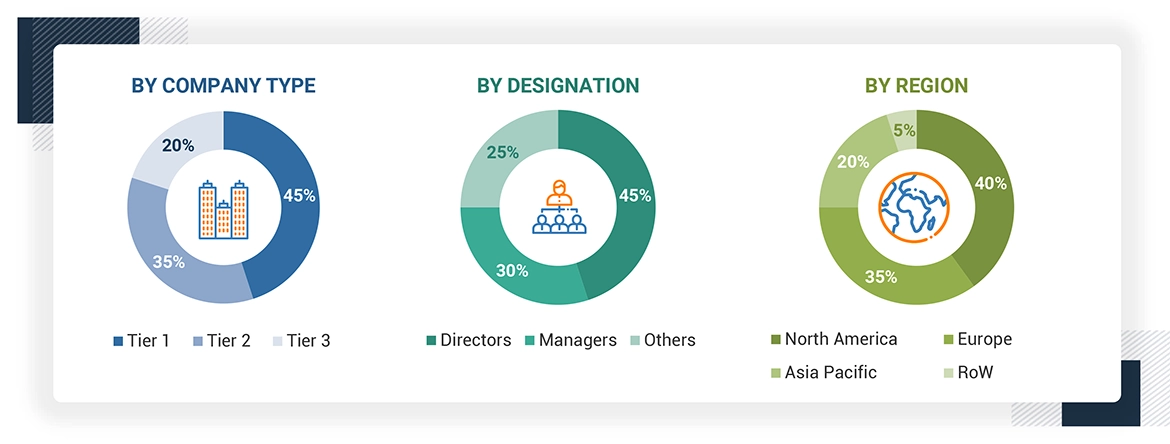
Extensive primary research was conducted after acquiring basic knowledge about the global vaccine adjuvants market scenario through secondary research. Several primary interviews were conducted with market experts from the demand side, such as pharmaceutical & biopharmaceutical industries from the supply side, such as C-level and D-level executives, product managers, marketing & sales managers of key manufacturers, distributors, and channel partners. The primary interviews were conducted across six major regions, including the North America, Europe, Asia Pacific, Latin America, Middle East and Africa. Approximately 65% and 35% of the primary interviews were conducted with supply-side and demand-side participants, respectively. This primary data was collected through questionnaires, e-mails, online surveys, personal interviews, and telephonic interviews.
The following is a breakdown of the primary respondents:
To know about the assumptions considered for the study, download the pdf brochure
Market Size Estimation
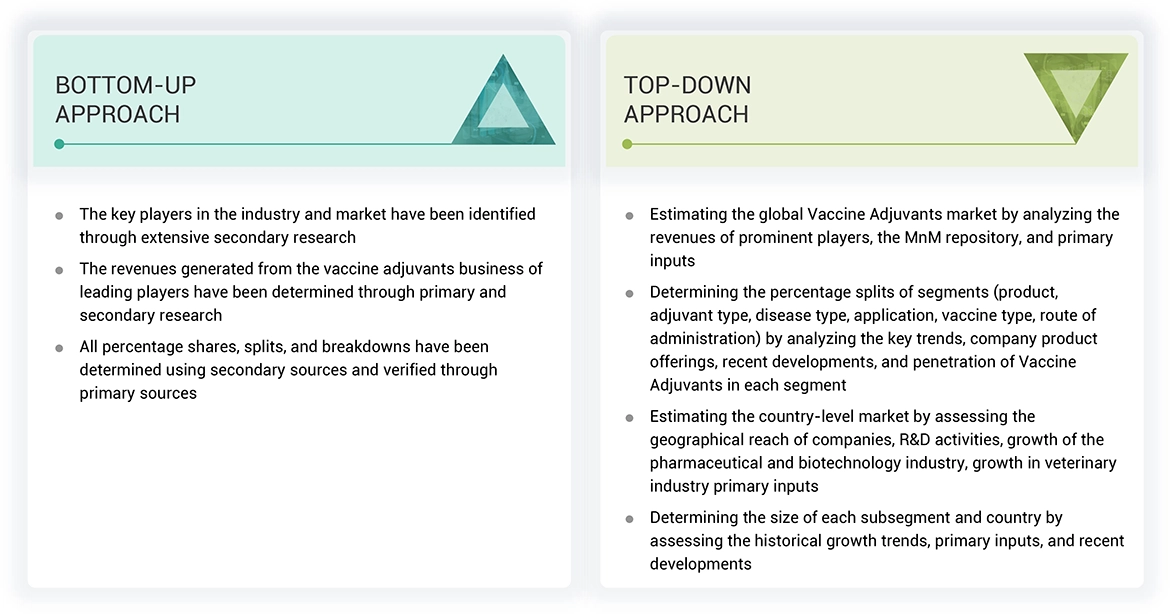
Both top-down and bottom-up approaches were used to estimate and validate the total size of the vaccine adjuvants market. These methods were also used extensively to estimate the size of various subsegments in the market. The research methodology used to estimate the market size includes the following:
Data Triangulation
After arriving at the market size from the market size estimation process explained above, the total market was divided into several segments and subsegments. To complete the overall market engineering process and arrive at the exact statistics for all segments and subsegments, data triangulation and market breakdown procedures were employed, wherever applicable. The data was triangulated by studying various factors and trends from both the demand and supply sides.
Market Definition
Vaccine adjuvants are substances added to vaccines to enhance the body's immune response to the vaccine's active ingredient (the antigen). They work by stimulating or modulating the immune system, helping to produce a stronger, longer lasting, or more specific immune response. The market size includes vaccine adjuvants produced by vaccine adjuvant manufacturers and utilized by key market players in vaccine development and production. However, vaccine adjuvants developed and used inhouse by companies for their own vaccine development and manufacturing are excluded from the scope.
Stakeholders
- Companies Providing Vaccine Adjuvants
- Research Institutes and Academic Centers
- Suppliers and Distributors of Vaccine adjuvants
- Pharmaceutical and Biotechnology Companies
- Veterinary companies
- Business Research and Consulting Service Providers
- Venture Capitalists
- Contract Research Organizations and Contract Development Manufacturing Organizations
- Market research and consulting firms
Report Objectives
- To define, describe, and forecast the vaccine adjuvants market by value by product, adjuvant type, application, route of administration, vaccine type, disease type and region
- To provide detailed information regarding the major factors influencing the market growth (such as drivers, restraints, opportunities, and challenges)
- To analyze the micromarkets1 with respect to individual growth trends, prospects, and contributions to the overall vaccine adjuvants market
- To analyze the opportunities for stakeholders and provide details of the competitive landscape for market leaders
- To forecast the size of the market segments with respect to six regions: North America, Europe, the Asia Pacific, Latin America, Middle East and Africa
- To profile the key players and analyze their market shares and core competencies2
- To track and analyze competitive developments, such as product launches, partnerships, agreements, collaborations, and expansions
- To benchmark players within the market using the proprietary “Company Evaluation Matrix” framework, which analyzes market players on various parameters within the broad categories of business and product excellence strategy
Get the Full Vaccine Adjuvants Market Report
Full forecast, segment splits, and company analysis for all Vaccine Adjuvants Market.
- Canada Vaccine Adjuvants Market
- US Vaccine Adjuvants Market
- Germany Vaccine Adjuvants Market
- UK Vaccine Adjuvants Market
- France Vaccine Adjuvants Market
- Italy Vaccine Adjuvants Market
- Spain Vaccine Adjuvants Market
- China Vaccine Adjuvants Market
- Japan Vaccine Adjuvants Market
- India Vaccine Adjuvants Market
- South Korea Vaccine Adjuvants Market
- Australia Vaccine Adjuvants Market
- Brazil Vaccine Adjuvants Market
- Mexico Vaccine Adjuvants Market
- Argentina Vaccine Adjuvants Market
- Rest Of Europe Vaccine Adjuvants Market
- Rest Of Asia Pacific Vaccine Adjuvants Market
- Rest Of Latin America Vaccine Adjuvants Market
- GCC Countries Vaccine Adjuvants Market
- Rest Of Middle East Vaccine Adjuvants Market
- Rest Of GCC Countries Vaccine Adjuvants Market
- Saudi Arabia (Ksa) Vaccine Adjuvants Market
- United Arab Emirates (UAE) Vaccine Adjuvants Market
Need a Tailored Report?
Customize this report to your needs
Get 10% FREE Customization
Customize This Report
