
Germany Vehicle Electrification Market (2025-2030)

The Germany Vehicle Electrification Market was valued at $12831.7 Million in 2025 and projected to reach to $30365.6 Million by 2030, representing a compound annual growth rate of 13.1%. Germany's vehicle electrification market is poised for exceptional expansion, driven by the country's commitment to carbon neutrality and leadership in automotive innovation.


| Market Size in | USD 26.32 MN |
| Market Forecast in | |
| CAGR | |
| Forecast Period | |
| Units Considered | Value (USD MN) |
Germany Vehicle Electrification Market Trends and Insights
- Germany's 13.1% compound annual growth rate significantly outpaces the global average of 7.1%, reflecting the country's strong commitment to electrification and stringent emissions regulations.
- Germany's automotive sector is leveraging advanced battery technologies, charging infrastructure investments, and government incentives to accelerate the transition from internal combustion engines to electric vehicles. The German market benefits from established OEM capabilities and a robust supply chain ecosystem.
- Germany's leadership in premium electric vehicle manufacturing and battery component production positions the country as a critical hub for European electrification.
- Between 2025 and 2030, Germany is expected to capture increasing market share through innovation in battery efficiency, autonomous driving integration, and sustainable manufacturing practices.
- Germany's regulatory framework and consumer demand for zero-emission vehicles continue to drive investment and technological advancement across the electrification value chain..
Key Market Statistics
- CAGR (2025-2030) 13.1% CAGR
- Market Size, 2025 ~USD 12831.7 Million
- Forecast, 2030 ~USD 30365.6 Million
- Country Germany
Germany Vehicle Electrification Market Overview
Market Leadership in Europe :
Germany's vehicle electrification market is valued at USD 12,831.7 million in 2025, positioning it as Europe's largest EV market. The country's automotive manufacturing expertise and infrastructure investments drive regional dominance.
Exceptional Growth Trajectory :
With a 13.1% CAGR through 2030, Germany's electrification market significantly outpaces the global average of 7.1%. This accelerated growth reflects aggressive government incentives and OEM commitments to EV production.
Regulatory Compliance Driving Adoption :
Germany's stringent EU emissions regulations and CO2 reduction targets mandate rapid electrification across the automotive sector. These regulatory pressures are compelling manufacturers to accelerate EV development and market penetration.
Projected Market Expansion :
The German market is forecast to reach USD 30,365.6 million by 2030, representing a 136% increase from 2025. This substantial growth reflects expanding EV model portfolios, improving battery technology, and rising consumer adoption rates.
Germany Vehicle Electrification Market Dynamics
- The 13.1% CAGR significantly exceeds global growth rates, reflecting strong government support through subsidies, charging infrastructure investments, and regulatory mandates.
- Major German OEMs including Volkswagen, BMW, and Mercedes-Benz are aggressively scaling EV production, creating competitive market dynamics and technological advancement. The forecast growth to USD 30.4 billion by 2030 underscores Germany's transformation into a global EV manufacturing hub.
- Expanding battery production capacity, supply chain localization, and emerging mobility solutions will further accelerate market penetration.
- Consumer acceptance continues strengthening as charging networks expand and vehicle affordability improves, positioning Germany as a critical market for electrification technology and sustainable transportation solutions..
Market Ecosystem
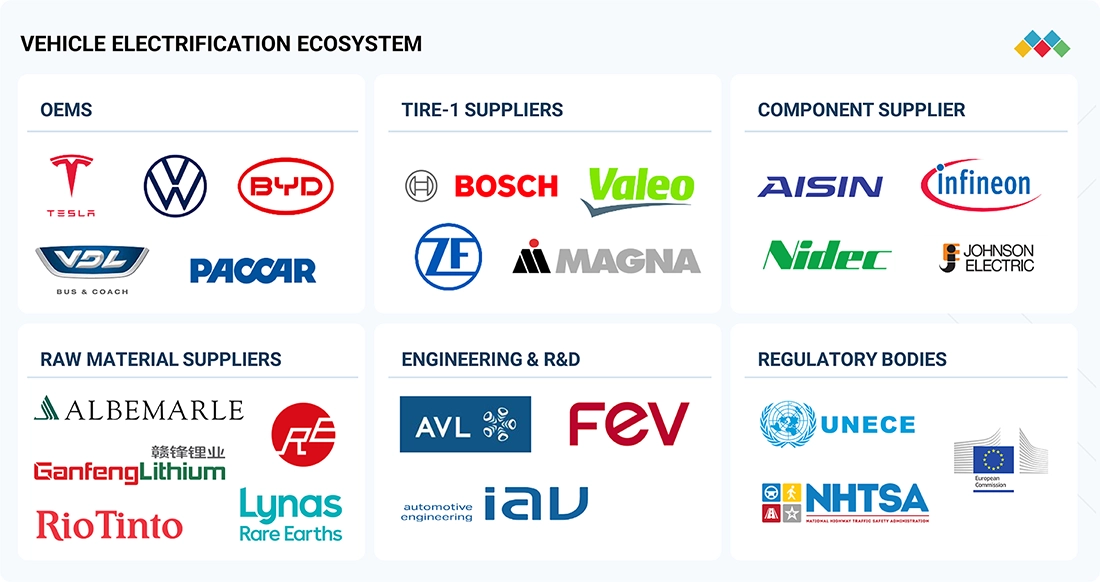
vehicle-electrification-market: COMMERCIAL USE CASES ACROSS INDUSTRIES
| COMPANY | USE CASE DESCRIPTION | BENEFITS |
|---|---|---|
 |
Replace hydraulic steering with a motor-driven, electronically-controlled steering assist (servo/EPS) that integrates with ADAS and steer-by-wire. Used across passenger cars and light commercial vehicles | Eliminates hydraulic pump parasitic losses, improves vehicle electrical efficiency. Enables easy integration with ADAS |
 |
Electrically-driven PTC liquid heaters (or PTC water heaters) provide fast cabin warm-up and local heating for battery thermal management in BEVs / PHEVs where engine waste heat is not available. | Fast cabin heating improves perceived range (less heater draw from HV battery at cold start). Precise thermal control for battery life & charge performance. |
 |
ISG replaces conventional starter & alternator with a single motor/generator that enables smooth start/stop, torque assist (mild hybrid), and regenerative energy capture. Common in 48V and high-voltage mild hybrids. | Improves fuel economy through longer engine-off operation and regenerative recovery. Seamless, fast restarts and added low-end torque for drivability. |
Logos and trademarks shown above are the property of their respective owners. Their use here is for informational and illustrative purposes only.
Related Ecosystem
Automotive Systems
- Light Commercial Vehicles (LCVs)
- Battery Electric Vehicle (BEV)
- Hybrid Electric Vehicle (HEV)
- Agricultural Tractors
- Fuel Cell Electric Vehicle (FCEV)
- BOSCH LIMITED
- DENSO Corporation
- Continental ag
- ZF FRIEDRICHSHAFEN AG
- GORKOVSKY AVTOMOBILNY ZAVOD
Key Takeaways
- Germany's vehicle electrification market will grow from USD 12.8B (2025) to USD 30.4B (2030), representing a 13.1% CAGR that exceeds global growth rates.
- Germany's stringent EU emissions standards and government subsidies are primary catalysts accelerating EV adoption and electrification infrastructure development.
- Germany's premium automotive manufacturers and battery suppliers position the country as Europe's electrification leader with significant competitive advantages.
- Germany's investment in charging networks and battery manufacturing capacity will support market expansion and supply chain resilience through 2030.
Vehicle Electrification Market Report Scope
| Report Metric | Details |
|---|---|
| Base Year | 2025 |
| Fastest Growing Segment | BEV (Degree Of Hybridization) |
| Forecast Period | 2025–2030 |
| Growth Rate | CAGR of 7.1% from 2025 to 2030 |
| Largest Segment | PASSENGER CAR (Vehicle Type) |
| Market Size Base Year (Billions) | ~USD 51.89 (2025) |
| Revenue Forecast (Billions) | ~USD 73.12 (2030) |
| Segments Covered | Propulsion And Product, Vehicle Type, Degree Of Hybridization, Product |
Germany Vehicle Electrification Market Report Segmentation
4 segment dimensions are covered across the global market.
By Propulsion And Product
- Electric A/C Compressor
- Electric Oil Pump
- Electric Power Steering
- Electric Vacuum Pump
- Electric Water Pump
- Electro-Hydraulic Power Steering
- Integrated Starter Generator
- Liquid Heater Ptc
- Start-Stop System
By Vehicle Type
- Bus
- Light Commercial Vehicle
- Passenger Car
- Truck
By Degree Of Hybridization
- Bev
- Hev
- ICE & Micro Hybrid Vehicle
- Phev
By Product
- Electric A/C Compressor
- Electric Oil Pump
- Electric Power Steering
- Electric Vacuum Pump
- Electric Water Pump
- Electro-Hydraulic Power Steering
- Integrated Starter Generator
- Liquid Heater Ptc
- Start-Stop System
Target Audience
- Automotive OEMs : German and international vehicle manufacturers need precise market data to guide EV production capacity planning, model portfolio development, and competitive positioning in Europe's largest electrification market.
- Battery & Component Suppliers : Battery manufacturers and EV component suppliers require Germany-specific market intelligence to forecast demand, plan manufacturing expansion, and secure partnerships with major German automotive producers.
- Investment & Private Equity Firms : Investors targeting the automotive electrification sector need detailed German market analysis to identify acquisition targets, assess growth potential, and evaluate returns in Europe's leading EV ecosystem.
- Charging Infrastructure Developers : EV charging network operators and infrastructure companies need market forecasts to plan network expansion, identify high-demand regions, and secure funding for Germany's rapidly growing charging ecosystem.
- Government & Policy Makers : German government agencies and policymakers require market data to evaluate electrification progress, assess regulatory effectiveness, and inform future incentive programs and infrastructure investments.
Key Companies in the Germany Vehicle Electrification Market
| Company | HQ | Ownership | Strongest segments |
|---|---|---|---|
| GAZ | Russia | Public Company | Gas business (upstream, midstream, sales),Oil and refined products,Electric power and heat, |
| THYSSENKRUPP AG | Germany | Public Company | Steel Europe,Materials Services,Automotive Technology, |
| ABB LTD | Switzerland | Public Company | Electrification,Motion,Automation, |
| ALLIED MOTION TECHNOLOGIES | United States | Public Company | Brushless, torque, coreless, and brush motors (including gear motors and integrated motor-drives),Servo control systems, motion controllers, digital servo amplifiers and drives,Nano precision positioning systems, |
| CUMMINS INC | United States | Public Company | Engine (on- and off-highway IC engines),Distribution, service, and aftermarket parts,Components (aftertreatment, turbo, fuel systems, transmissions, electronics), |
| TRW AUTOMOTIVE | United States | Private Company | Chassis Systems (braking, steering, suspension modules),Occupant Safety Systems (airbags, seat belts, steering wheels),Electronics (safety, chassis, RF, powertrain, ADAS), |
| VISTEON CORPORATION | United States | Public Company | Instrument clusters and information displays,Infotainment and connected car solutions,SmartCore domain controllers and middleware, |
| MCLAREN GROUP | United Kingdom | Private Company | GT,Supercars,Ultimate, |
| WILO SE | Germany | Private Company | Building Services Residential,Building Services Commercial,Original Equipment Manufacturers (OEM), |
| DAYCO | United States | Private Company | Light-duty OE engine and accessory drive systems,Aftermarket belts, tensioners, and pulleys,Heavy-duty truck and off-highway OE applications, |
| VOLEX GROUP | United Kingdom | Public Company | Complex cable assemblies, harnesses, and integrated manufacturing services,Power cords, plugs, connectors, and consumer power products,EV charging solutions and battery cables, |
| ROBERT BOSCH GMBH | Germany | Private Company | Mobility (powertrain, chassis, electronics, aftermarket, steering),Industrial Technology (drive, control, actuators, process & packaging),Energy and Building Technology (heating, heat pumps, security, building systems), |
| CONTINENTAL AG | Germany | Public Company | Passenger car and light truck tires,Truck, bus, and specialist vehicle tires,Industrial rubber products (hoses, conveyor belts, air and drive belts), |
| APTIV | Switzerland | Public Company | Electrical Distribution Systems,Engineered Components (Connection Systems and Interconnects),Advanced Safety and User Experience, |
| DENSO CORPORATION | Japan | Public Company | Thermal and HVAC systems,Powertrain systems (ICE, hybrid, EV, fuel cell),Safety and cockpit systems, |
| MITSUBISHI MOTORS CORPORATION | Japan | Public Company | SUVs & Crossovers,Pickup Trucks,EVs & PHEVs, |
| BORGWARNER INC. | United States | Public Company | Turbos & Thermal Technologies,Drivetrain & Morse Systems,PowerDrive Systems, |
| JOHNSON ELECTRIC HOLDINGS LIMITED | Hong Kong | Public Company | Automotive actuators, DC/EC motors, pumps, valves, starters, steerable wheel,Industrial and warehouse automation (gearmotors, motorized rollers, pumps, valves),Home technologies, appliances, HVAC, building automation, ventilation, |
| MAGNA INTERNATIONAL INC. | Canada | Public Company | Body Exteriors & Structures (incl. battery enclosures, hot stamping, frames),Power & Vision (ADAS, powertrain control, energy management),Seating Systems and Interior/Exterior Mechatronics, |
| AISIN CORPORATION | Japan | Public Company | Automatic, CVT, and manual transmissions,eAxle and electrified driveline components,Brakes, steering, and chassis systems, |
| NIDEC CORPORATION | Japan | Public Company | Small-size and precision motors, fans, and blowers,Automotive components and motor-related units/modules,Medium- and large-size motors and industrial machinery, |
| JTEKT CORPORATION | Japan | Public Company | Automotive steering systems and drivelines,Industrial and automotive bearings,Machine tools and control machines, |
| ZF FRIEDRICHSHAFEN AG | Germany | Private Company | Passenger car driveline, chassis, and safety systems,Commercial vehicle and fleet systems (truck, trailer, bus, LCV),Industrial applications (construction, agriculture, marine, wind, rail, material handling), |
| VALEO | France | Public Company | Power (thermal systems, EV cooling, battery thermal management, comfort and air quality),Brain (ADAS sensors, lidar, cameras, domain controllers, connectivity and access),Light (lighting systems and wiper systems), |
GAZ
GAZ is a Russian public company founded in 1993 that employs 468,000 people. It operates as a major industrial enterprise in Russia.
THYSSENKRUPP AG
ThyssenKrupp AG is a German public company founded in 1811 with 90,916 employees. It is a diversified industrial conglomerate with a long history of manufacturing and engineering.
ABB LTD
ABB Ltd is a Swiss public company founded in 1883 with 112,700 employees. It operates as a global technology and engineering company.
ALLIED MOTION TECHNOLOGIES
Allied Motion Technologies is a United States public company founded in 1939 with 2,478 employees. It operates in the motion technology sector.
CUMMINS INC
Cummins Inc is a United States public company founded in 1919 with 67,400 employees. It is a manufacturer of engines and related technologies.
TRW AUTOMOTIVE
TRW Automotive is a United States private company founded in 1904 with 66,900 employees. It is a major supplier to the automotive industry.
VISTEON CORPORATION
Visteon Corporation is a United States public company founded in 2000 with 10,500 employees. It operates as an automotive technology and components supplier.
MCLAREN GROUP
McLaren Group is a United Kingdom private company founded in 1963 with 2,627 employees. It operates in the automotive and motorsports sectors.
WILO SE
Wilo SE is a German private company founded in 1872 with 8,442 employees. It specializes in pump and fluid management systems.
DAYCO
Dayco is a United States private company founded in 2009 with 15,600 employees. It operates as a manufacturer of power transmission and fluid handling products.
VOLEX GROUP
Volex Group is a United Kingdom public company founded in 1892 with 13,000 employees. It operates as a manufacturer of connectivity solutions and cable assemblies.
ROBERT BOSCH GMBH
Robert Bosch GmbH is a German private company founded in 1886 with 412,774 employees. It is a global supplier of technology and services across multiple industries.
CONTINENTAL AG
Continental AG is a German public company founded in 1871 with 22,076 employees. It operates as a technology and manufacturing company.
APTIV
Aptiv is a Swiss public company founded in 2011 with 140,000 employees. It operates as a global technology and mobility solutions provider.
DENSO CORPORATION
Denso Corporation is a Japanese public company founded in 1949 with 154,716 employees. It is a major supplier of automotive components and systems.
MITSUBISHI MOTORS CORPORATION
Mitsubishi Motors Corporation is a Japanese public company founded in 1970 with 27,695 employees. It operates as an automotive manufacturer.
BORGWARNER INC.
BorgWarner Inc. is a United States public company founded in 1928 with 37,500 employees. It is a supplier of automotive powertrain technologies.
JOHNSON ELECTRIC HOLDINGS LIMITED
Johnson Electric Holdings Limited is a Hong Kong public company founded in 1959 with 30,000 employees. It manufactures electric motors and motion subsystems.
MAGNA INTERNATIONAL INC.
Magna International Inc. is a Canadian public company founded in 1957 with 156,000 employees. It is a global automotive supplier and parts manufacturer.
AISIN CORPORATION
Aisin Corporation is a Japanese public company founded in 1943 with 113,292 employees. It is a major supplier of automotive components and systems.
NIDEC CORPORATION
Nidec Corporation is a Japanese public company founded in 1973 with 104,285 employees. It manufactures electric motors and related products.
JTEKT CORPORATION
JTEKT Corporation is a Japanese public company founded in 1921 with 43,233 employees. It manufactures bearings, steering systems, and automotive components.
ZF FRIEDRICHSHAFEN AG
ZF Friedrichshafen AG is a German private company founded in 1915 with 145,909 employees. It is a global supplier of driveline and chassis technology.
VALEO
Valeo is a French public company founded in 1923 with 87,115 employees. It is a global automotive supplier specializing in powertrain and thermal systems.
Reasons to Buy this Report
- Strategic Market Sizing : Obtain precise market valuations for Germany's electrification sector with verified 2025 baseline (USD 12.8B) and 2030 projections (USD 30.4B), enabling accurate business planning and investment decisions.
- Competitive Intelligence : Understand Germany's 13.1% CAGR advantage over global markets (7.1%), identifying growth drivers and competitive opportunities within Europe's largest EV market and manufacturing ecosystem.
- Regulatory Landscape Insights : Gain clarity on how German emissions regulations and EU compliance requirements are reshaping the automotive sector, informing product development and market entry strategies.
- Investment Opportunity Assessment : Evaluate Germany's electrification market potential with comprehensive data on growth trajectories, infrastructure development, and OEM commitments to identify high-ROI investment opportunities.
- Supply Chain Optimization : Leverage detailed German market insights to optimize battery supply chains, charging infrastructure partnerships, and component sourcing strategies within Europe's leading EV manufacturing hub.
Frequently asked questions
What is the projected size of Germany's vehicle electrification market by 2030?
Germany's vehicle electrification market is projected to reach USD 30,365.6 million by 2030, growing from USD 12,831.7 million in 2025.
What is Germany's CAGR for the vehicle electrification market?
Germany's vehicle electrification market is expected to grow at a compound annual growth rate of 13.1% between 2025 and 2030.
Why is Germany's electrification market growing faster than the global average?
Germany's growth outpaces the global 7.1% CAGR due to stringent EU emissions regulations, government EV incentives, strong OEM capabilities, and high consumer demand for sustainable vehicles.
What are the key drivers of vehicle electrification in Germany?
Germany's key drivers include regulatory compliance with EU emissions standards, government subsidies for EV purchases, expanding charging infrastructure, and technological innovation from leading automotive manufacturers.
How does Germany's automotive sector support electrification growth?
Germany's established premium OEMs, advanced battery manufacturing capabilities, and robust supply chain ecosystem enable rapid scaling of electric vehicle production and electrification technologies.
RESEARCH METHODOLOGY
The research study involved various secondary sources, such as company annual reports/presentations, industry association publications, EV magazine articles, directories, technical handbooks, World Economic Outlook, trade websites, technical articles, and databases, which were used to identify and collect information for an extensive study of the vehicle electrification market. Primary sources—experts from related industries, automobile OEMs, and suppliers—were interviewed to obtain and verify critical information and assess prospects and market estimations.
Secondary Research
Secondary sources for this research study included the vehicle electrification industry association, internal databases, corporate filings (such as annual reports, investor presentations, and financial statements), and data from trade and business. Secondary data was collected and analyzed to determine the overall market size, further validated by primary research.
Primary Research
In the primary research process, several primary interviews were conducted with market experts from the demand and supply sides across major regions: North America, Europe, Asia Pacific, and the RoW. 32%, 40% and 26% of primary interviews were conducted with the OEMs, Tier 1 players, and Tier 2 players, respectively.
Primary data was collected through questionnaires, e-mails, and telephonic interviews. In the canvassing of primaries, various departments within organizations, such as sales, operations, and administration, were covered to provide a holistic viewpoint in the report. After interacting with industry experts, brief sessions were conducted with highly experienced independent consultants to validate the findings from the primaries. This and insights by in-house subject-matter experts led to the conclusions described in the remainder of this report.

Note: Others include sales, marketing, and product managers.
Source: Secondary Research, Primary Interviews, and MarketsandMarkets Analysis
To know about the assumptions considered for the study, download the pdf brochure
Market Size Estimation
- The bottom-up approach derived the market size based on volume and value. This was followed by primary interviews and feature mapping on a regional basis from the MarketsandMarkets repository.
- The market size was validated through in-depth interviews with industry experts—excerpts available in the discussion guide in the appendix—and secondary research. The report-writing phase begins after arriving at the final numbers for the market size.
Market Size Estimation Methodology-Bottom-up approach
The bottom-up approach was used to estimate and validate the size of the vehicle electrification market. In this approach, the country-level sales of each vehicle type (passenger cars, LCVs, trucks, and buses) was identified through country-level associations, paid databases like Marklines, EV Volumes, and non-profit organizations like OICA. The vehicle sales forecast in each country was carried out based on multiple factors, such as country-wise macroeconomic indicators, emission regulations, automotive industry growth, GDP growth, and government initiatives.
Further, determining the vehicle electrification market in terms of volume, country-level penetration/ installation trends for each electrified component in each vehicle type was identified through model mapping for each country. The number of electric components per vehicle type was derived through secondary research and validated by industry experts.
The country-level vehicle type sales was then multiplied by the country-level penetration/ installation trend of each electrified component in each vehicle type, and the number of electric components installed in each vehicle type gave the country-level vehicle electrification market by vehicle type and by product type in terms of volume.
The country-level average selling price of each component installed in each vehicle type was derived through secondary sources and further validated by industry experts. The country-level vehicle electrification market volume, by product type, was multiplied by the average selling price of component, gives the vehicle electrification market in terms of value (USD million) by vehicle type and product type.
Further, the summation of country-level markets provided the regional-level markets in terms of volume (thousand units) and value (USD million). A further summation of regional-level markets provided the global vehicle electrification market in terms of volume (thousand units) and value (USD million) by region and product type.
A similar methodology has been followed for the vehicle electrification market of EVs (BEV, HEV, and PHEV) based on component.
Vehicle Electrification Market : Top-Down and Bottom-Up Approach

Data Triangulation
All percentage shares, splits, and breakdowns were determined using secondary sources and verified through primary sources. All parameters expected to affect the markets covered in this research study were accounted for, viewed in extensive detail, verified through primary research, and analyzed to obtain the final quantitative and qualitative data. This data was consolidated, supplemented with detailed inputs and analysis from MarketsandMarkets, and presented in the report.
Market Definition
The electrification of the conventional mechanically operated systems and components in the vehicle can be referred to as vehicle electrification. Over the last ten years, the automotive sector has shifted its focus to vehicle electrification, owing to certain key influencing factors such as the increasing and volatile oil prices, deteriorating urban air quality, and climate change. The electrification of systems and components improves efficiency and helps reduce weight. Weight reduction further helps improve the fuel economy and reduce emissions.
Stakeholders
- Automotive sector associations, government authorities, and research organizations
- Automobile manufacturers
- Component manufacturers of various electrification products
- Raw material suppliers for electrification product manufacturers
- Traders, distributors, and suppliers of vehicle electrification systems/components
Report Objectives
-
To define, describe, and forecast the size of the global vehicle electrification market in terms of value (USD million) and volume (thousand units)
- By Vehicle Type (Passenger Car, LCV, Truck, Bus)
- By Degree of Hybridization (ICE & Micro Hybrid Vehicle, BEV, PHEV, HEV)
- By Propulsion & Product Type (ICE –[Start-Stop, EPS, EHPS, Liquid heater PTC, Electric A/C Compressor, Electric Vacuum Pump, Electric Oil Pump, Electric Water Pump, Integrated Starter Generator], BEV – [EHPS, Liquid heater PTC, Electric A/C Compressor, Electric Vacuum Pump, Electric Water Pump], PHEV – [Start-Stop, EPS, EHPS, Liquid heater PTC, Electric A/C Compressor, Electric Vacuum Pump, Electric Oil Pump, Electric Water Pump, Integrated Starter Generator], HEV – [Start-Stop, EPS, Liquid heater PTC, Electric A/C Compressor, Electric Vacuum Pump, Electric Oil Pump, Electric Water Pump, Integrated Starter Generator])
- Country-level analysis of product type segments (Asia Pacific, Europe, North America, and RoW)
- To understand the dynamics (drivers, restraints, opportunities, and challenges) of the market
- To strategically analyze the market with trade analysis, pricing analysis, case study analysis, patent analysis, technology analysis, regulatory analysis, key conferences and events, trends/disruptions impacting buyers, investment, and funding case scenario
- To analyze the competitive landscape of the global players in the market, along with their market share/ranking
- To analyze the competitive leadership mapping of the global and regional vehicle electrification product suppliers in the market
- To analyze a detailed listing of mergers & acquisitions, partnerships, collaborations, joint ventures, expansions, and product launches/developments undertaken by critical participants in the market
Available Customizations
Along with the market data, MarketsandMarkets offers customizations per company-specific needs.
The following customization options are available for the report:
Geographic Analysis as per Feasibility
- Vehicle Electrification market, by product type, at the country level
- Vehicle Electrification market, by propulsion type, at the country level
- Vehicle Electrification market, by vehicle type, at the country level
Get the Full Vehicle Electrification Market Report
Full forecast, segment splits, and company analysis for all Vehicle Electrification Market.
- China Vehicle Electrification Market
- Japan Vehicle Electrification Market
- India Vehicle Electrification Market
- South Korea Vehicle Electrification Market
- Canada Vehicle Electrification Market
- Mexico Vehicle Electrification Market
- US Vehicle Electrification Market
- Netherlands Vehicle Electrification Market
- France Vehicle Electrification Market
- UK Vehicle Electrification Market
- Spain Vehicle Electrification Market
- Italy Vehicle Electrification Market
- Brazil Vehicle Electrification Market
- South Africa Vehicle Electrification Market
Need a Tailored Report?
Customize this report to your needs
Get 10% FREE Customization
Customize This Report
