
US Veterinary Diagnostics Market (2025-2030)

The US Veterinary Diagnostics Market was valued at $1562.2 Million in 2025 and projected to reach to $2269.2 Million by 2030, representing a compound annual growth rate of 7.8%. The US veterinary diagnostics market is poised for sustained growth through 2030, supported by rising pet ownership, increased consumer willingness to invest in preventive and advanced animal healthcare, and technological innovations.


| Market Size in | USD 26.32 MN |
| Market Forecast in | |
| CAGR | |
| Forecast Period | |
| Units Considered | Value (USD MN) |
US Veterinary Diagnostics Market Trends and Insights
- This growth reflects increasing pet ownership, rising spending on animal healthcare, and advancing diagnostic technologies across US veterinary practices.
- The US market benefits from strong regulatory frameworks, high adoption of point-of-care testing, and growing demand for early disease detection in companion and livestock animals. Driving expansion in the US veterinary diagnostics sector are innovations in molecular diagnostics, immunoassays, and imaging technologies tailored to US veterinary standards.
- The US market is characterized by a mature infrastructure of veterinary clinics, diagnostic laboratories, and reference centers that support rapid technology adoption.
- Between 2025 and 2030, the US is expected to see heightened competition among diagnostic manufacturers and increased integration of digital health solutions in veterinary practice management..
Key Market Statistics
- CAGR (2025-2030) 7.8% CAGR
- Market Size, 2025 ~USD 1562.2 Million
- Forecast, 2030 ~USD 2269.2 Million
- Country US
US Veterinary Diagnostics Market Overview
Market Valuation :
The US veterinary diagnostics market is valued at $1,562.2 million in 2025, with projections reaching $2,269.2 million by 2030, representing substantial growth opportunities for stakeholders.
Consistent Growth Trajectory :
The US market expands at a CAGR of 7.8% through 2030, driven by increasing pet ownership rates, elevated consumer spending on animal healthcare, and adoption of advanced diagnostic technologies.
Regulatory Advantages :
Strong FDA regulatory frameworks and established quality standards in the US create a competitive advantage for diagnostic manufacturers and support market credibility and innovation.
Technology Integration :
US veterinary practices increasingly adopt point-of-care testing, digital pathology, and AI-powered diagnostic solutions, enhancing clinical efficiency and driving market expansion.
US Veterinary Diagnostics Market Dynamics
- Veterinary clinics across the US are modernizing their diagnostic capabilities with digital solutions and automated testing platforms.
- The market benefits from a mature healthcare infrastructure, strong purchasing power, and regulatory support that encourages product development and adoption of cutting-edge diagnostic tools..
Market Ecosystem
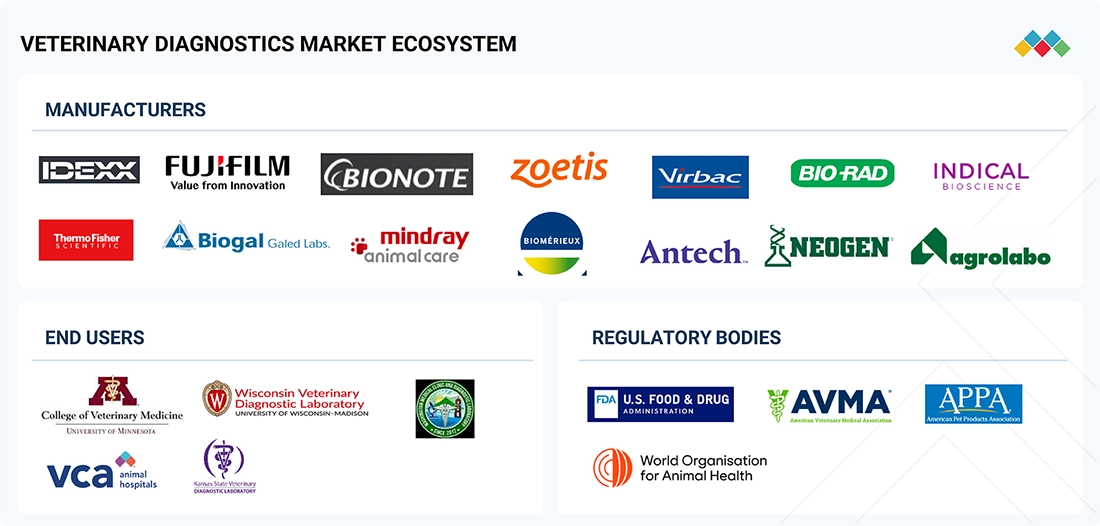
Veterinary Diagnostics Market: COMMERCIAL USE CASES ACROSS INDUSTRIES
| COMPANY | USE CASE DESCRIPTION | BENEFITS |
|---|---|---|
 |
Offers a wide range of in-clinic analyzers such as the Catalyst One Chemistry Analyzer and ProCyte One Hematology Analyzer, along with comprehensive reference laboratory services | Rapid and reliable results | Reduced reliance on external labs | Improved treatment outcomes | Enhanced workflow efficiency for clinics |
 |
Provides point-of-care diagnostic analyzers for blood chemistry, hematology, and immunoassays through its VETSCAN product line. These systems are designed for small animal, equine, and exotic practices, with cloud-based connectivity for seamless data sharing | Faster in-clinic decision-making | Enhanced connectivity with digital platforms | Reliable results across a broad range of species |
 |
Provides advanced molecular, histopathology, and genetic testing. Its KeyScreen GI Parasite PCR is a leading solution for comprehensive gastrointestinal parasite detection using molecular diagnostics | Highly sensitive detection | Early identification of parasites | Reduced misdiagnosis | Improved preventive care strategies |
 |
Offers rapid diagnostic test kits for companion animals and livestock, including solutions for diseases like parvovirus, feline leukemia, and bovine respiratory infections | Reliable point-of-care detection | Support for large-scale herd monitoring | Reduced disease transmission risks |
 |
Provides advanced in-house veterinary diagnostic analyzers such as the BC-5000Vet Hematology Analyzer and BS-240Vet Chemistry Analyzer, tailored for animal healthcare | Cost-effective diagnostics | Quick turnaround | Scalable solutions for different clinic sizes | Robust performance for high sample volumes |
Logos and trademarks shown above are the property of their respective owners. Their use here is for informational and illustrative purposes only.
Related Ecosystem
Animal Health
- Polymerase Chain Reaction (PCR) Tests
- Porcine
- Immunodiagnostics
- Lateral Flow Assays
- Microarrays
- Zoetis Inc.
- Patterson Companies, Inc.
- Virbac
- Elanco Animal Health Incorporated
- BOEHRINGER INGELHEIM GMBH
Medical Devices
- Polymerase Chain Reaction (PCR)
- Magnetic Resonance Imaging (MRI)
- Disposable Autoinjectors
- Pulse Oximeters
- Blood Pressure Monitors
- Medtronic plc
- Stryker Corporation
- Abbott Laboratories
- Becton, Dickinson and Company
- JOHNSON & JOHNSON
Key Takeaways
- The US veterinary diagnostics market will grow from $1,562.2M (2025) to $2,269.2M (2030) at a 7.8% CAGR.
- Rising pet ownership and increased spending on preventive animal healthcare are primary growth drivers in the US market.
- The US market is dominated by advanced point-of-care testing and molecular diagnostic technologies.
- Digital health integration and regulatory compliance remain critical competitive factors for US market participants.
Veterinary Diagnostics Market Report Scope
| Report Metric | Details |
|---|---|
| Base Year | 2025 |
| Fastest Growing Segment | POINT-OF-CARE/IN-HOUSE TESTING (End User) |
| Forecast Period | 2025–2030 |
| Growth Rate | CAGR of 7.8% from 2025 to 2030 |
| Largest Segment | INFECTIOUS DISEASE (Application) |
| Market Size Base Year (Billions) | ~USD 3.68 (2025) |
| Revenue Forecast (Billions) | ~USD 5.36 (2030) |
| Segments Covered | Product, Technology, Type, Animal Type, Application, End User |
US Veterinary Diagnostics Market Report Segmentation
6 segment dimensions are covered across the global market.
By Product
- Consumables
- Instruments
- Lateral Flow Rapid Tests
- Lateral Flow Strip Readers
By Technology
- Clinical Biochemistry
- Hematology
- Immunodiagnostics
- Molecular Diagnostics
- Other Technologies
- Urinalysis
By Type
- Allergen-Specific Immunodiagnostic Tests
- Bacterial Infection
- Blood Gas & Electrolyte Analysis
- Blood Gas & Electrolyte Analyzers
- Blood Gas & Electrolyte Reagent And Clips & Cartridges
- Blood Gas & Electrolyte Reagent Clips & Cartridges
- Blood Gas And Electrolyte Analysis
- Blood Glucose Strips
- Cats
- Cattle
- Clinical Chemistry Analysis
- Clinical Chemistry Analyzers
- Clinical Chemistry Reagent Clips & Cartridges
- Consumables
- Dogs
- Elisa Tests
- Glucose Monitoring
- Glucose Monitors
- Hematology Analyzers
- Hematology Cartridges
- Horses
- Immunoassay Analyzers
- Instruments
- Lateral Flow Assays
- Lateral Flow Rapid Tests
- Lateral Flow Strip Readers
- Microarrays
- Nucleic Acid Sequencing
- Other Companion Animals
- Other Immunodiagnostic Technologies
- Other Infections
- Other Livestock
- Other Livestock Animals
- Other Molecular Diagnostics Products
- Parasitic Infection
- Pig
- Polymerase Chain Reaction (Pcr) Tests
- Poultry
- Radioimmunoassays
- Urinalysis Clips & Cartridges/ Panel
- Urinalysis Clips & Cartridges/Panels
- Urine Analysers
- Urine Analyzers
- Urine Glucose Strips
- Urine Test Strips
- Viral Infection
By Animal Type
- Companion Animals
- Livestock
By Application
- Cardiology
- Endocrinology
- Infectious Disease
- Infectious Diseases
- Oncology
- Other Applications
By End User
- Poc/In-House Testing
- Point-Of-Care/In-House Testing
- Veterinary Hospitals & Clinics
- Veterinary Reference Laboratories
- Veterinary Research Institutes & Universities
US: VETERINARY DIAGNOSTICS MARKET, BY END USER, 2023–2030
| Segment | 2023 | 2024 | 2025 | 2026 | 2027 | 2028 | 2029 | 2030 | CAGR (%) |
|---|---|---|---|---|---|---|---|---|---|
| POC/IN-HOUSE TESTING | 193.2 | 209.3 | 230.1 | 253.2 | 278.7 | 306.8 | 337.8 | 371.9 | 10.1 |
| VETERINARY HOSPITALS & CLINICS | 363.5 | 382.9 | 409.3 | 437.9 | 468.6 | 501.5 | 536.7 | 574.5 | 7 |
| VETERINARY REFERENCE LABORATORIES | 713.5 | 755.9 | 812.9 | 874.9 | 941.7 | 1013.8 | 1091.4 | 1175.2 | 7.7 |
| VETERINARY RESEARCH INSTITUTES & UNIVERSITIES | 99.3 | 103.7 | 109.9 | 116.5 | 123.6 | 131.1 | 139.1 | 147.6 | 6.1 |
| TOTAL | 1369.5 | 1451.7 | 1562.2 | 1682.6 | 1812.7 | 1953.2 | 2104.9 | 2269.2 | 7.8 |
Target Audience
- Veterinary Diagnostic Manufacturers : Manufacturers need US market data to understand demand drivers, competitive positioning, regulatory requirements, and growth opportunities for diagnostic equipment and reagents.
- Veterinary Practice Owners : Practice owners require market insights to make informed decisions about diagnostic equipment investments, technology upgrades, and service expansion aligned with market trends.
- Healthcare Investment Firms : Investors need detailed US market analysis to evaluate investment opportunities, assess growth potential, and identify acquisition targets in the veterinary diagnostics sector.
- Veterinary Laboratory Service Providers : Laboratory operators need market intelligence to understand competitive dynamics, pricing trends, service demand, and expansion opportunities across US regions.
- Healthcare Consultants & Analysts : Consultants require comprehensive US market data to support client advisory services, strategic planning, and market assessments in the veterinary healthcare sector.
Key Companies in the US Veterinary Diagnostics Market
| Company | HQ | Ownership | Strongest segments |
|---|---|---|---|
| BECKMAN COULTER | United States | Private Company | Clinical diagnostics (chemistry, hematology, immunoassay, urinalysis, blood banking, hemostasis, integrated systems),Life science research and discovery (flow cytometry, centrifugation, genomics, liquid handling, research automation),Industrial and particle characterization (coulter counters, laser diffraction, surface area and pore size, electrochemistry), |
| HENRY SCHEIN | United States | Public Company | Global Distribution and Value-Added Services,Global Specialty Products,Global Technology, |
| HILL-ROM HOLDINGS, INC. | United States | Private Company | Patient Support Systems (beds, surfaces, mobility, IT, services),Front Line Care (monitoring, diagnostics, respiratory health),Surgical Solutions (tables, lights, pendants, positioning), |
| MINDRAY MEDICAL INTERNATIONAL LIMITED | China | Private Company | Patient Monitoring and Life Support Products,In-Vitro Diagnostic Products,Medical Imaging Systems, |
| PATTERSON COMPANIES, INC | United States | Private Company | Dental consumables and equipment,Dental software and practice optimization,Animal health products and services, |
| DIASORIN | Italy | Public Company | Immunodiagnostics – Infectious and Gastrointestinal Diseases,Immunodiagnostics – Endocrinology, Metabolic, Tumor Markers, Oncology,Molecular Diagnostics – Simplexa and LIAISON PLEX, |
| DANAHER CORPORATION | United States | Public Company | Biotechnology (Bioprocessing and Single-Use Solutions),Life Sciences Tools and Genomics,Diagnostics, |
| IDEXX LABORATORIES, INC. | United States | Public Company | Companion Animal Group (in-clinic instruments, SNAP assays, reference labs, telemedicine),Water Quality Products,Livestock, Poultry and Dairy diagnostics, |
| THERMO FISHER SCIENTIFIC INC. | United States | Public Company | Life Sciences Solutions,Analytical Instruments,Specialty Diagnostics, |
| BIOMÉRIEUX | France | Public Company | Clinical microbiology (VITEK, culture media, ID/AST, VIDAS, ETEST, API),Molecular diagnostics (BIOFIRE, SPOTFIRE, ARGENE, EMAG/NUCLISENS),Industrial applications (GENE-UP, VERIFLOW, BIOBALL, TEMPO, CHEMUNEX, ENDONEXT), |
| NEOGEN CORPORATION | United States | Public Company | Food Safety diagnostic kits and consumables,Animal Safety products (instruments, disposables, animal care, biosecurity),Genomics services for livestock and companion animals, |
| BIO-RAD LABORATORIES, INC. | United States | Public Company | Life Science,Clinical Diagnostics, |
| VIRBAC | France | Public Company | Companion animal parasiticides and anti-infectives,Companion animal specialty therapeutics and behavior,Companion animal nutrition and petfood, |
| FUJIFILM HOLDINGS CORPORATION | Japan | Public Company | Healthcare (medical systems, CDMO, pharma, regenerative medicine, cosmetics/supplements),Business Innovation (office equipment, document solutions, graphic communications),Electronics (display, semiconductor materials, storage media, industrial equipment, fine chemicals), |
| BIONOTE | South Korea | Public Company | Animal fluorescence immunoassay,Animal molecular diagnostics,Animal clinical biochemistry, |
BECKMAN COULTER
Beckman Coulter is a private American company founded in 1935 that employs 11,900 people. The company operates in the life sciences and diagnostics sector.
HENRY SCHEIN
Henry Schein is a public American company founded in 1932 with 25,000 employees. The company is a leading distributor of healthcare products and services.
HILL-ROM HOLDINGS, INC.
Hill-Rom Holdings, Inc. is a private American company founded in 1915 with 10,000 employees. The company manufactures medical devices and healthcare equipment.
MINDRAY MEDICAL INTERNATIONAL LIMITED
Mindray Medical International Limited is a private Chinese company founded in 1991 with 8,400 employees. The company develops and manufactures medical devices and diagnostic equipment.
PATTERSON COMPANIES, INC
Patterson Companies, Inc. is a private American company founded in 1877 with 7,600 employees. The company is a distributor of dental, animal health, and specialty products.
DIASORIN
DiaSorin is a public Italian company founded in 1968 with 3,242 employees. The company specializes in diagnostic testing and immunoassay products.
DANAHER CORPORATION
Danaher Corporation is a public American company founded in 1969 with 59,000 employees. The company operates across multiple sectors including life sciences, diagnostics, and environmental solutions.
IDEXX LABORATORIES, INC.
IDEXX Laboratories, Inc. is a public American company founded in 1983 with 11,000 employees. The company develops and manufactures diagnostic and software products for veterinary and water testing markets.
THERMO FISHER SCIENTIFIC INC.
Thermo Fisher Scientific Inc. is a public American company founded in 1956 with 125,000 employees. The company is a global leader in serving science with laboratory equipment, reagents, and analytical instruments.
BIOMÉRIEUX
bioMérieux is a public French company founded in 1963 with 14,894 employees. The company specializes in in vitro diagnostics and microbiology testing solutions.
NEOGEN CORPORATION
Neogen Corporation is a public American company founded in 1981 with 2,974 employees. The company develops and manufactures products for food and animal safety.
BIO-RAD LABORATORIES, INC.
Bio-Rad Laboratories, Inc. is a public American company founded in 1952 with 7,450 employees. The company manufactures and distributes life science research and clinical diagnostics products.
VIRBAC
Virbac is a public French company founded in 1968 with 6,442 employees. The company develops and markets veterinary pharmaceutical and diagnostic products.
FUJIFILM HOLDINGS CORPORATION
Fujifilm Holdings Corporation is a public Japanese company founded in 1934 with 73,526 employees. The company operates across imaging, information, and document solutions with healthcare and diagnostics divisions.
BIONOTE
BioNote is a public South Korean company founded in 2003 with 298 employees. The company develops diagnostic testing solutions.
Reasons to Buy this Report
- Market Size & Growth Data : Access precise valuation figures for the US market ($1,562.2M in 2025) and detailed forecasts through 2030, enabling accurate financial planning and investment decisions.
- Regional Competitive Intelligence : Understand US-specific market dynamics, regulatory environment, and competitive landscape to identify opportunities and benchmark performance against regional competitors.
- Technology Adoption Trends : Gain insights into US veterinary practices' adoption of advanced diagnostics, digital pathology, and AI solutions to align product development and marketing strategies.
- Consumer Spending Patterns : Analyze US pet owner behavior, healthcare spending trends, and willingness to invest in premium diagnostic services for informed market positioning and pricing strategies.
- Strategic Market Entry : Leverage comprehensive US market data to develop go-to-market strategies, identify high-growth segments, and optimize resource allocation for market penetration.
Frequently asked questions
What is the current size of the US veterinary diagnostics market?
The US veterinary diagnostics market is estimated at $1,562.2 million in 2025.
What is the projected size of the US veterinary diagnostics market by 2030?
The US veterinary diagnostics market is forecast to reach $2,269.2 million by 2030.
What is the growth rate of the US veterinary diagnostics market?
The US veterinary diagnostics market is expected to grow at a compound annual growth rate (CAGR) of 7.8% from 2025 to 2030.
What are the main drivers of growth in the US veterinary diagnostics market?
Key drivers include rising pet ownership, increased spending on preventive animal healthcare, technological advancements in diagnostic tools, and growing demand for early disease detection across US veterinary practices.
Which diagnostic technologies dominate the US veterinary market?
Point-of-care testing, molecular diagnostics, immunoassays, and advanced imaging technologies are the leading diagnostic modalities in the US veterinary market.
RESEARCH METHODOLOGY
This study involved the extensive use of both primary and secondary sources. The research process involved the study of various factors affecting the industry to identify the segmentation types, industry trends, key players, competitive landscape, fundamental market dynamics, and key player strategies.
Secondary Research
This research study used widespread secondary sources; directories, databases such as Dun & Bradstreet, Bloomberg BusinessWeek, and Factiva; white papers; annual reports; and companies’ house documents. Secondary research was used to identify and collect information for this extensive, technical, market-oriented, and commercial study of the global pulse oximeters market. It was also used to obtain important information about the top players, market classification, and segmentation according to industry trends, to the bottom-most level, geographic markets, and key developments related to the market and technology perspectives. A database of the key industry leaders was also prepared using secondary research.
Primary Research
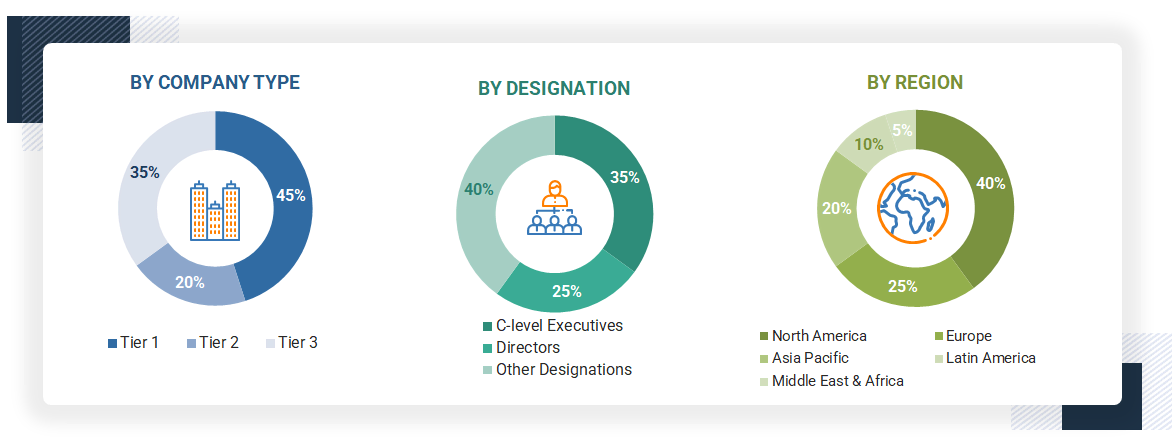
In the primary research process, various supply and demand sources were interviewed to obtain qualitative and quantitative information for this report. Primary sources from the supply side include project/sales/marketing/business development managers, presidents, CEOs, vice presidents, chairpersons, chief operating officers, chief strategy officers, directors, chief information officers, and chief medical information officers related to the veterinary diagnostic market. Primary sources from the demand side include veterinary healthcare professionals from hospitals, clinics, reference laboratories, and research institutes.
A breakdown of the primary respondents is provided below:
To know about the assumptions considered for the study, download the pdf brochure
Market Size Estimation
The research methodology used to estimate the size of the veterinary diagnostics market includes the following details.
The market sizing was undertaken from the global side.
Country-level Analysis: The size of the veterinary diagnostics market was obtained from the annual presentations of leading players and secondary data available in the public domain. The share of products and services in the overall veterinary diagnostics market was obtained from secondary data and validated by primary participants to arrive at the total veterinary diagnostics market. Primary participants further validated the numbers.
Geographic market assessment (by region & country): The geographic evaluation was done using the following approaches:
Approach 1: Geographic revenue contributions/splits of leading players in the market (wherever available) and respective growth trends
Approach 2: Geographic adoption trends for individual product segments by end users and growth prospects for each of the segments (assumptions and indicative estimates validated from primary interviews)
At each point, industry experts contacted during primary research validated the assumptions and approaches. Considering the limitations of data available from secondary research, revenue estimates for individual companies (for the overall veterinary diagnostics market and geographic market assessment) were ascertained based on a detailed analysis of their respective product offerings, geographic reach/strength (direct or through distributors or suppliers), and the shares of the leading players in a particular region or country.
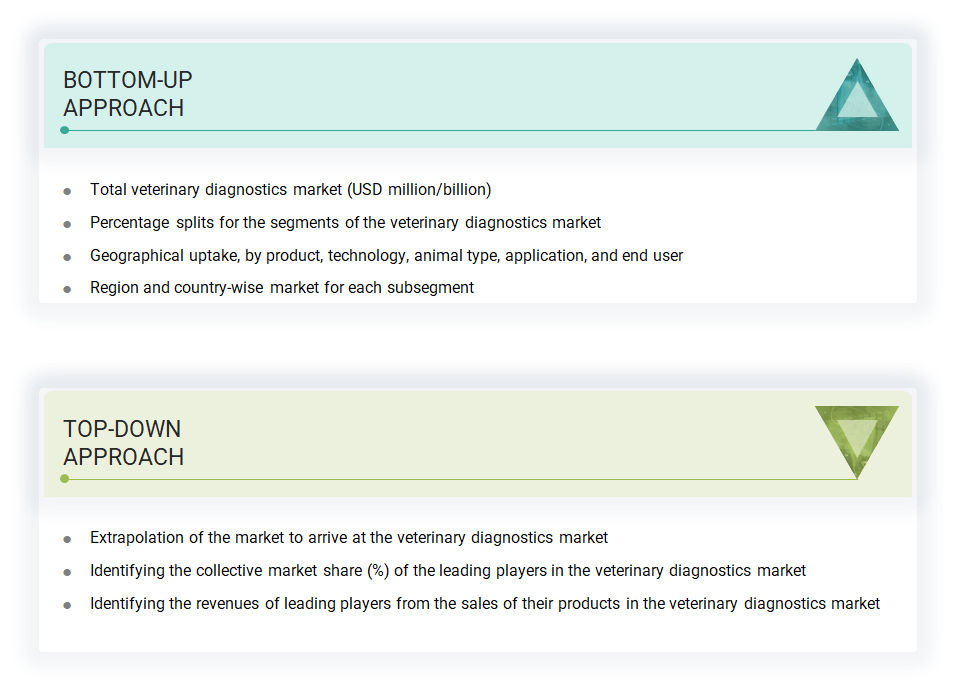
Global Veterinary Diagnostics Market Size: Top-Down & Bottom-Up Approach
Data Triangulation
After arriving at the overall size from the market size estimation process explained above, the total market was split into several segments and subsegments. Where applicable, the data triangulation and market breakdown procedures described below were implemented to complete the overall market engineering process and arrive at the exact statistics for various market segments and subsegments. The data was triangulated by studying different factors and trends from the demand and supply sides. The market size was also validated using both the top-down and bottom-up approaches.
Market Definition
Veterinary diagnostics refers to the diagnosis of animal diseases and disorders using various veterinary diagnostic test kits, tools, and instruments such as clinical chemistry analyzers, hematology analyzers, glucose monitoring systems, urine analyzers, blood gas-electrolyte analyzers, and ELISA test kits.
The veterinarian mainly orders veterinary diagnostic tests to identify parasites, bacteria, viruses, and other disease-causing microbes in companion animals or livestock. Improvements in consumables enable precise detection despite limitations observed by other tests. For instance, a diagnostic test using a new, improved fecal detection test kit by IDEXX Laboratories eliminates the limitations of egg shedding identification. It reduces false-positive cases when diagnosing hookworm antigens in the companion animal intestine. Thus, veterinary diagnostic tests are ordered for all kinds of ailments to enable effective detection and help in treatment planning and decision making by the veterinarian and the companion animal owner.
Stakeholders
- Senior Management
- Veterinary Diagnostic Companies
- Veterinary Clinics & Hospitals
- Pet Owners and Livestock Farmers
- Reference Laboratories
- Veterinarians & Veterinary Technicians
- Animal Health Organizations and NGOs
- Regulatory Authorities
- Research Institutes & Universities
- Distributors & Supply Chain Partners
- Investors & Strategic Partners
Report Objectives
- To define, describe, and forecast the veterinary diagnostics market by product, technology, animal type, application, end user, and region.
- To provide detailed information about the key factors influencing market growth, such as drivers, restraints, opportunities, challenges, and industry trends
- To strategically analyze the regulatory scenario, Porter’s five forces analysis, value chain analysis, supply chain analysis, ecosystem map, recession impact, and patent analysis
- To analyze micromarkets with respect to individual growth trends, prospects, and contributions to the overall veterinary diagnostics market
- To analyze market opportunities for stakeholders and provide details of the competitive landscape for key players.
- To strategically profile the key players in this market and comprehensively analyze their market shares and core competencies.
- To strategically analyze the veterinary diagnostics market in five regions: North America, Europe, the Asia Pacific, Latin America, and the Middle East & Africa
- To track & analyze competitive developments such as acquisitions, product launches, partnerships, and expansions in the veterinary diagnostics market.
Get the Full Veterinary Diagnostics Market Report
Full forecast, segment splits, and company analysis for all Veterinary Diagnostics Market.
- Canada Veterinary Diagnostics Market
- Germany Veterinary Diagnostics Market
- UK Veterinary Diagnostics Market
- France Veterinary Diagnostics Market
- Italy Veterinary Diagnostics Market
- Spain Veterinary Diagnostics Market
- Netherlands Veterinary Diagnostics Market
- China Veterinary Diagnostics Market
- Japan Veterinary Diagnostics Market
- India Veterinary Diagnostics Market
- Australia Veterinary Diagnostics Market
- South Korea Veterinary Diagnostics Market
- New Zealand Veterinary Diagnostics Market
- Vietnam Veterinary Diagnostics Market
- Brazil Veterinary Diagnostics Market
- Mexico Veterinary Diagnostics Market
- United Arab Emirates Veterinary Diagnostics Market
Need a Tailored Report?
Customize this report to your needs
Get 10% FREE Customization
Customize This Report
