
UK Virtual Production Market (2025-2030)

The UK Virtual Production Market was valued at $194.9 Million in 2025 and projected to reach to $770.7 Million by 2030, representing a compound annual growth rate of 31.6%. The UK virtual production market is poised for substantial growth through 2030, driven by the country's world-renowned creative industries and commitment to digital innovation.


| Market Size in | USD 26.32 MN |
| Market Forecast in | |
| CAGR | |
| Forecast Period | |
| Units Considered | Value (USD MN) |
UK Virtual Production Market Trends and Insights
- The UK's advanced digital infrastructure and strong creative industries position it as a leading hub for virtual production adoption across film, television, and gaming sectors.
- UK-based studios and broadcasters are increasingly investing in LED volume stages, real-time rendering engines, and motion capture technologies to enhance production efficiency and reduce costs. Driven by the UK's world-class talent pool and government incentives for digital innovation, the market is expected to grow at a compound annual growth rate of 31.6% through 2030.
- The UK's established post-production ecosystem and partnerships with major streaming platforms accelerate virtual production deployment.
- Key sectors including entertainment, advertising, and corporate communications are leveraging UK-based virtual production capabilities to create immersive content at scale..
Key Market Statistics
- CAGR (2025-2030) 31.6% CAGR
- Market Size, 2025 ~USD 194.9 Million
- Forecast, 2030 ~USD 770.7 Million
- Country UK
UK Virtual Production Market Overview
Rapid Market Growth :
The UK virtual production market is expanding at a CAGR of 31.6%, growing from $194.9 million in 2025 to $770.7 million by 2030, significantly outpacing many other European markets.
Creative Industry Leadership :
The UK's established film, television, and gaming sectors are driving adoption of virtual production technologies, with London and other creative hubs becoming centers of innovation for LED volume stages and real-time rendering solutions.
Digital Infrastructure Advantage :
Advanced digital infrastructure and high-speed connectivity across the UK enable seamless integration of virtual production tools, supporting both independent studios and major broadcasters in adopting cutting-edge technologies.
Investment in LED Volume Technology :
UK-based studios and production companies are increasingly investing in LED volume stages and in-camera visual effects, reducing post-production costs and accelerating content delivery timelines across multiple sectors.
UK Virtual Production Market Dynamics
- Major broadcasters, independent production studios, and gaming companies are rapidly adopting virtual production technologies to enhance efficiency and reduce production costs.
- The UK's strong talent pool in visual effects and real-time graphics, combined with government support for digital media initiatives, creates a favorable environment for market expansion. Key growth drivers include increasing demand for high-quality content across streaming platforms, the cost-effectiveness of virtual production compared to traditional methods, and the integration of AI and real-time rendering technologies.
- As UK studios continue to invest in LED volume stages and in-camera VFX capabilities, the market is expected to attract both domestic and international production companies, further solidifying the UK's position as a global virtual production hub..
Market Ecosystem
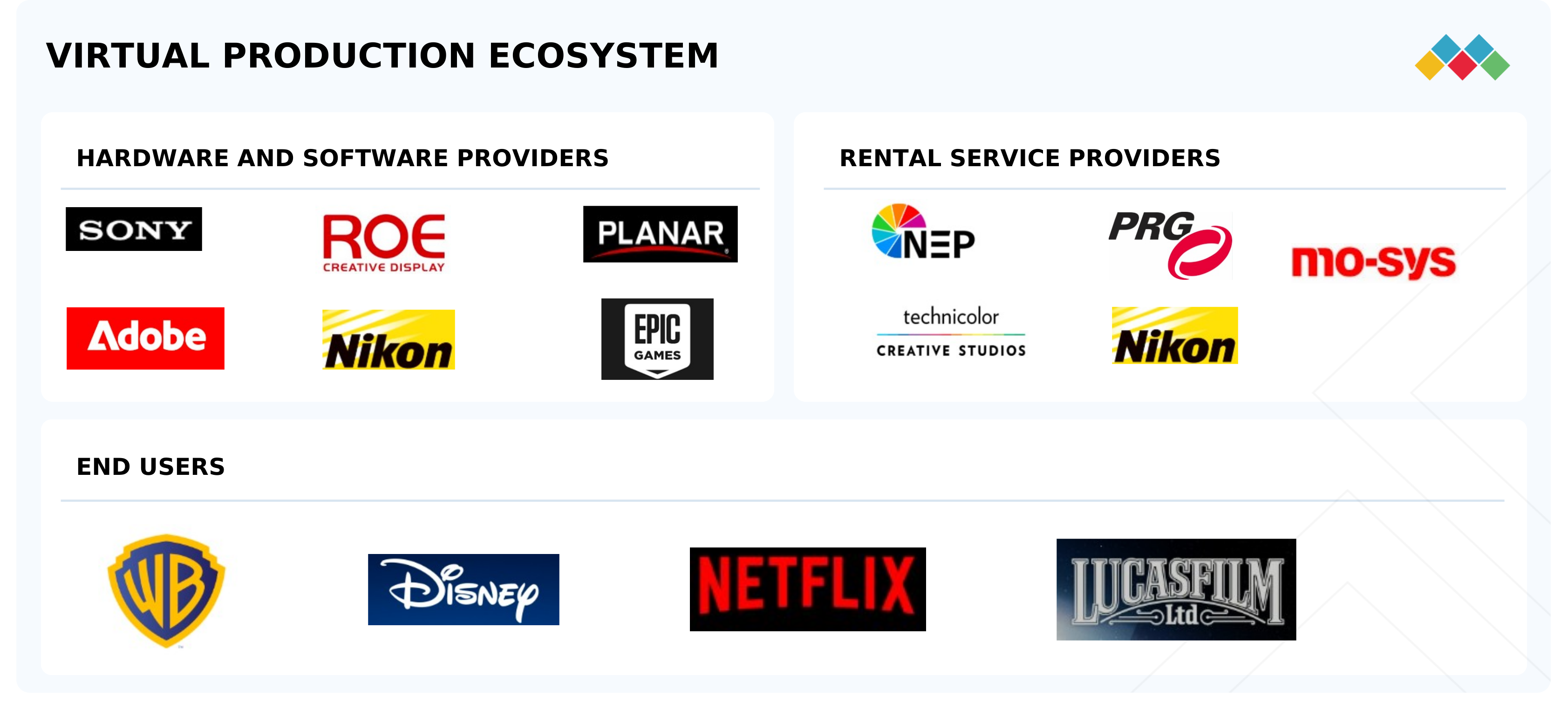
Virtual Production Market Growth: COMMERCIAL USE CASES ACROSS INDUSTRIES
| COMPANY | USE CASE DESCRIPTION | BENEFITS |
|---|---|---|
 |
Uses large-scale LED volumes and in-camera VFX for blockbuster franchises such as The Mandalorian and Marvel films | Reduces reliance on on-location shoots | Accelerates post-production | Improves creative control with immersive environments |
 |
Employs cloud-based virtual production workflows and LED stages for original series and films | Enables remote collaboration | Shortens production timelines | Ensures consistent quality | Lowers global filming costs |
 |
Integrates virtual production hardware and rental LED stages for Prime Video originals | Enhances storytelling flexibility | Scales productions efficiently | Reduces the carbon footprint of international shoots |
 |
Deploys VP software and LED wall rentals in hybrid productions across films and advertising | Improves cost efficiency | Supports creative experimentation | Enables faster turnaround of high-quality content |
 |
Uses VP solutions for television series and live broadcasting | educes set-building costs | Enhances broadcast visuals | Supports more sustainable production workflows |
Logos and trademarks shown above are the property of their respective owners. Their use here is for informational and illustrative purposes only.
Related Ecosystem
Display Technology
- Augmented Reality
- Liquid Crystal Display (LCD)
- Sensors
- Virtual Reality Devices
- Liquid Crystal on Silicon (LCOS)
- VIVITEK CORPORATION
- Samsung
- Lenovo
- Panasonic Holdings Corporation
- Lg corp
Key Takeaways
- The UK virtual production market will grow from $194.9M (2025) to $770.7M (2030) at a 31.6% CAGR.
- The UK's creative industries and digital infrastructure make it a leading virtual production hub in Europe.
- UK studios are adopting LED volumes and real-time rendering to reduce production timelines and costs.
- Government support and streaming platform partnerships are key growth catalysts for the UK market.
Virtual Production Market Report Scope
| Report Metric | Details |
|---|---|
| Base Year | 2025 |
| Fastest Growing Segment | PRE-PRODUCTION (Type) |
| Forecast Period | 2025-2030 |
| Growth Rate | CAGR of 33.1% from 2025 to 2030 |
| Largest Segment | MOVIES (End User) |
| Market Size Base Year (Billions) | ~USD 2.1 (2025) |
| Revenue Forecast (Billions) | ~USD 8.76 (2030) |
| Segments Covered | Offering, Type, End User |
UK Virtual Production Market Report Segmentation
3 segment dimensions are covered across the global market.
By Offering
- Hardware
- Rental Services
- Software
By Type
- Post-Production
- Pre-Production
- Production
By End User
- Commercial Advertisements
- Movies
- Online Videos
- Other End Users
- Television Series
UK: VIRTUAL PRODUCTION MARKET, BY END USER, 2025–2030
| Segment | 2025 | 2026 | 2027 | 2028 | 2029 | 2030 | CAGR (%) |
|---|---|---|---|---|---|---|---|
| COMMERCIAL ADVERTISEMENTS | 21.6 | 28.5 | 37.2 | 48 | 61.2 | 77.1 | 29 |
| MOVIES | 100.3 | 135.5 | 180.9 | 238.6 | 311 | 400.8 | 31.9 |
| ONLINE VIDEOS | 8.8 | 11.1 | 13.8 | 17 | 20.6 | 24.7 | 22.8 |
| OTHER END USERS | 15.3 | 20.3 | 26.4 | 33.8 | 42.4 | 52.4 | 27.9 |
| TELEVISION SERIES | 48.9 | 67.5 | 91.8 | 123.5 | 164.2 | 215.8 | 34.6 |
| TOTAL | 194.9 | 262.9 | 350.2 | 460.8 | 599.3 | 770.7 | 31.6 |
Target Audience
- Production Studios & Broadcasters : UK-based film, television, and content production companies need detailed market insights to justify capital investments in virtual production infrastructure, benchmark against competitors, and optimize technology adoption strategies.
- Technology Vendors & Solution Providers : Virtual production software, LED volume manufacturers, and real-time rendering platform providers require UK-specific market data to identify growth opportunities, target customers, and develop localized product strategies.
- Investment & Private Equity Firms : Investors evaluating opportunities in the UK digital media and creative technology sectors need comprehensive market sizing and growth forecasts to assess portfolio companies, identify acquisition targets, and allocate capital effectively.
- Government & Policy Organizations : UK media agencies, cultural organizations, and government bodies need market intelligence to inform digital media policies, funding initiatives, and support programs for the creative industries and technology innovation.
- Consultants & Strategic Advisors : Management consultants and business advisors serving UK creative and technology clients require detailed market analysis to support strategic recommendations, business case development, and competitive positioning advice.
Reasons to Buy this Report
- Market Size & Growth Validation : Obtain precise UK market valuation ($194.9M in 2025) and verified 5-year forecast ($770.7M by 2030) to support investment decisions, business planning, and competitive positioning in the rapidly expanding virtual production sector.
- UK-Specific Strategic Insights : Access detailed analysis of UK market dynamics, including adoption rates across film, television, and gaming sectors, enabling targeted go-to-market strategies and partnership opportunities within the British creative industry.
- Technology Adoption Trends : Understand UK-specific adoption patterns for LED volume stages, real-time rendering, and in-camera VFX solutions, helping technology providers and studios align product development with local market demands and preferences.
- Competitive Landscape Intelligence : Identify key UK-based virtual production vendors, studios, and broadcasters driving market growth, enabling informed competitive analysis and partnership identification within the regional ecosystem.
- Investment & Funding Opportunities : Leverage comprehensive UK market data to identify high-growth segments, emerging opportunities, and investment targets within the virtual production value chain, supporting venture capital and M&A decision-making.
Frequently asked questions
What is the current size of the UK virtual production market?
The UK virtual production market is valued at $194.9 million in 2025 and is projected to reach $770.7 million by 2030.
What is the growth rate of the UK virtual production market?
The UK virtual production market is expected to grow at a compound annual growth rate (CAGR) of 31.6% from 2025 to 2030.
Which industries are driving virtual production adoption in the UK?
Film, television, gaming, advertising, and corporate communications sectors are primary drivers of virtual production adoption in the UK.
What technologies are UK studios investing in for virtual production?
UK studios are investing in LED volume stages, real-time rendering engines, motion capture technologies, and advanced post-production tools.
Why is the UK a leading market for virtual production?
The UK benefits from advanced digital infrastructure, a world-class creative talent pool, government innovation incentives, and established partnerships with major streaming platforms.
RESEARCH METHODOLOGY
The research study involved four main activities in estimating the size of the virtual production market. Extensive secondary research was conducted to gather important information about the market and related markets. The validation of these findings, assumptions, and sizing was then carried out through primary research with industry experts across the entire value chain. Both top-down and bottom-up approaches were used to estimate the market size. The market segmentation and data triangulation were employed to determine the market sizes of different segments sub-segments.
Secondary Research
In the secondary research process, various secondary sources were used to identify and gather information for this study. These sources include annual reports, press releases, investor presentations, white papers, and articles by reputable authors. The secondary research mainly aimed to gather key information about the market’s value chain, leading market players, market segmentation based on industry trends, regional outlooks, and developments in both market and technology perspectives.
In the virtual production market report, the global market size has been estimated using both top-down and bottom-up approaches, along with several other related submarkets. The major players in the market were identified through extensive secondary research, and their presence was confirmed using both secondary and primary research. All percentage shares, splits, and breakdowns have been determined from secondary sources and verified through primary sources.
Primary Research
Extensive primary research has been conducted after gaining an understanding of the virtual production market scenario through secondary research. Several primary interviews have been carried out with key opinion leaders from demand- and supply-side vendors across four major regions—Americas, Europe, Asia Pacific, and the Rest of the World. About 25% of the primary interviews have involved demand-side vendors, while 75% have involved supply-side vendors. Most primary data collection has been done through telephonic interviews, accounting for 80% of all primary interviews; questionnaires and emails have also been used to gather information data.
After successful interactions with industry experts, brief sessions were held with highly experienced independent consultants to reinforce the findings of our primary research. This, along with the opinions of in-house subject matter experts, has led us to the findings described in the report.
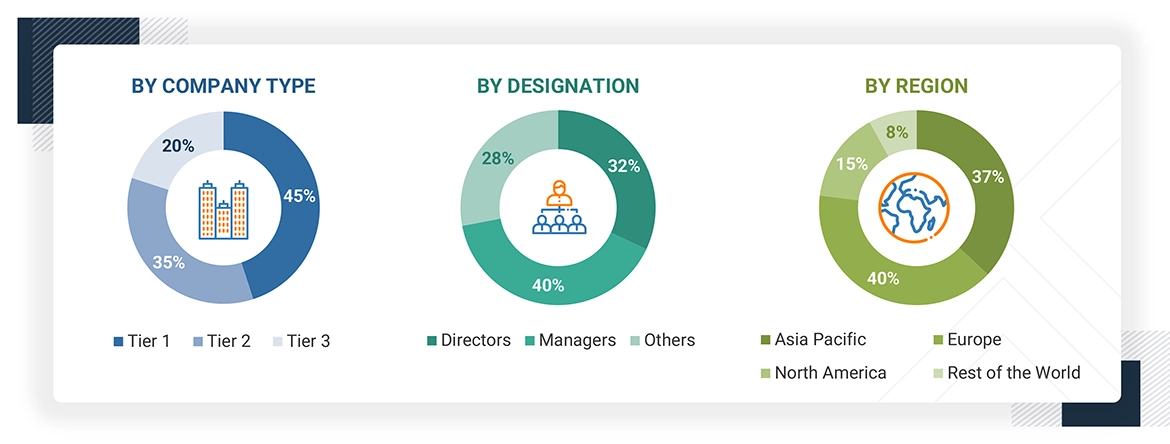
Note: Others include sales, marketing, and product managers
To know about the assumptions considered for the study, download the pdf brochure
Market Size Estimation
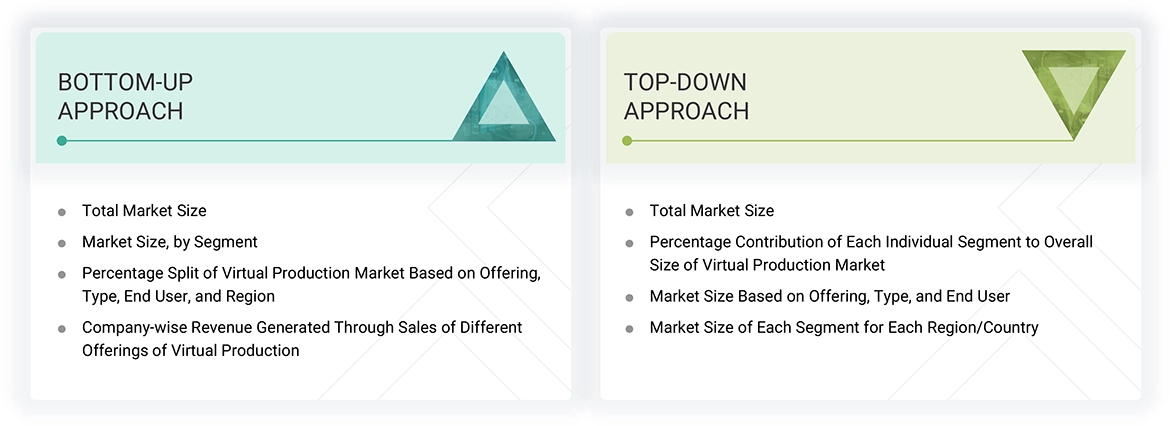
In the market engineering process, both top-down and bottom-up approaches, along with data triangulation methods, are used to estimate and validate the size of the virtual production market and other related areas submarkets. The research methodology used to estimate the market sizes includes the following:
- Identifying top-line investments and spending in the ecosystem and considering segment-level splits and significant market developments
- Identifying different stakeholders in the virtual production market that influence the entire market, along with participants across the supply chain
- Analyzing major manufacturers and rental service providers in the virtual production market and studying their product portfolio
- Analyzing trends related to the adoption of virtual production products
- Monitoring recent and upcoming market developments, including investments, R&D activities, product launches, expansions, acquisitions, partnerships, collaborations, agreements, and investments, as well as projecting the market size based on these developments and other critical factors
- Carrying out multiple discussions with key opinion leaders to identify the adoption trends of virtual production
- Segmenting the overall market into various other market segments
- Validating the estimates at every level through discussions with key opinion leaders, such as chief executives (CXOs), directors, and operations managers, and finally with the domain experts at MarketsandMarkets
Virtual Production Market : Top-Down and Bottom-Up Approach
Data Triangulation
After determining the overall market size using the estimation process described in the previous section, the virtual production market has been divided into multiple segments and subsegments. To complete the whole market analysis and obtain precise statistics for all segments, data triangulation and market breakdown methods have been applied where suitable. The data has been triangulated by analyzing various factors and trends from both demand and supply perspectives. In addition to data triangulation and market breakdown, the market has been validated through top-down and bottom-up approaches.
Market Definition
The virtual production market includes the ecosystem of technologies, solutions, and services that combine real-time computer graphics with traditional filmmaking methods to create a seamless blend of physical and digital worlds in content creation. Instead of using conventional green screens, virtual production employs LED walls or volumes, where hyper-realistic, computer-generated environments respond dynamically to camera movements, enabling directors and cinematographers to capture final-quality shots during filming.
The virtual production market is divided based on offering, type, end user, and region. By offering, it includes hardware, software, and rental services. Hardware consists of LED volumes, advanced cameras, and motion capture systems that form the main infrastructure of immersive workflows, while software features real-time rendering engines, tracking solutions, and editing platforms that seamlessly combine digital and physical elements. Rental services increase access by offering short-term use of high-cost equipment to smaller studios and independent creators. By type, the market is categorized into pre-production, production, and post-production. Pre-production is gaining popularity with tools like virtual location scouting, digital set design, and pre-visualization, which enable cost savings and creative flexibility. The production phase holds the largest share, driven by the use of LED walls, real-time rendering, and tracking systems that reduce reshoots and speed up filming schedules. Post-production also benefits from virtual workflows through real-time editing, VFX integration, and collaborative pipelines. By end user, the market includes movies, television series, commercial advertisements, online videos, and others, such as live events, theater, and concerts. Movies lead the market due to extensive VP adoption in blockbuster filmmaking. Television series are quickly increasing their use to meet the demand for cinematic-quality episodic content, while advertising, online videos, and live entertainment segments are increasingly using VP for faster turnaround and immersive experiences.
Key Stakeholders
- System Integrators
- Original Equipment Manufacturers (OEMs)
- Integrated Device Manufacturers (IDMs)
- Original Design Manufacturers (ODMs)
- Content Studios and Production Houses
- Suppliers and Distributors
- Governments and Other Regulatory Bodies
- Research Institutes and Organizations
- Market Research and Consulting Firms
Report Objectives
- To describe and forecast the size of the virtual production market based on offering, type, and end user in terms of value
- To describe and forecast the size of the market based on hardware offerings in terms of value and volume
- To describe and forecast the size of various segments of the market for four main regions, namely, North America, the Asia Pacific, Europe, and the Rest of the World, in terms of value
- To provide detailed information regarding drivers, restraints, opportunities, and challenges influencing the growth of the market
- To study the complete supply chain and related industry segments and perform a supply chain analysis of the market landscape
- To strategically analyze the ecosystem, Porter’s Five Forces, key stakeholders & buying criteria, technology analysis, key conferences & events, tariffs and regulations, patent landscape, trade landscape, and case studies pertaining to the market under study
- To analyze the impact of AI/Gen AI and the impact of the 2025 US tariff on the virtual production market.
- To strategically analyze micromarkets with respect to individual growth trends, prospects, and their contributions to the overall market
- To analyze opportunities for the stakeholders by identifying high-growth segments in the market
- To strategically profile the key players and provide a detailed competitive landscape of the market
- To analyze strategic approaches adopted by the leading players in the market, including product launches/developments and acquisitions
Available Customizations
With the given market data, MarketsandMarkets offers customizations according to the specific requirements of companies. The following customization options are available for the report:
Country-wise Information:
- Country-wise breakdown for North America, Europe, the Asia Pacific, and the Rest of the World
Company Information:
- Detailed analysis and profiling of additional market players (up to five)
Get the Full Virtual Production Market Report
Full forecast, segment splits, and company analysis for all Virtual Production Market.
- US Virtual Production Market
- Canada Virtual Production Market
- Mexico Virtual Production Market
- Germany Virtual Production Market
- France Virtual Production Market
- China Virtual Production Market
- Japan Virtual Production Market
- South Korea Virtual Production Market
- India Virtual Production Market
- Rest Of Europe Virtual Production Market
- Rest Of Asia Pacific Virtual Production Market
Need a Tailored Report?
Customize this report to your needs
Get 10% FREE Customization
Customize This Report
