
Asia Pacific Waste Management Market (2024-2029)

The Asia Pacific Waste Management Market was valued at $403149.7 Million in 2024 and projected to reach to $543354 Million by 2029, representing a compound annual growth rate of 6.2%. The Asia Pacific waste management market is positioned for sustained expansion, with a 6.2% CAGR outpacing the global average of 5.6%.


| Market Size in | USD 26.32 MN |
| Market Forecast in | |
| CAGR | |
| Forecast Period | |
| Units Considered | Value (USD MN) |
Asia Pacific Waste Management Market Trends and Insights
- Asia Pacific's waste management sector is driven by rapid urbanization, industrialization, and increasing regulatory pressures across the region.
- The 6.2% compound annual growth rate reflects Asia Pacific's commitment to sustainable waste handling practices and infrastructure development. Asia Pacific's waste management market benefits from rising environmental awareness and government initiatives promoting circular economy principles.
- Between 2024 and 2029, Asia Pacific is expected to see significant investments in waste-to-energy technologies, recycling facilities, and landfill management systems.
- Asia Pacific's growing middle class and consumer spending are generating higher waste volumes, necessitating advanced waste management solutions across municipal, industrial, and hazardous waste segments. Asia Pacific's competitive landscape includes both multinational corporations and regional players adapting to local regulatory frameworks and sustainability goals.
- The region's diverse economic development levels create varied market opportunities, with Asia Pacific emerging markets showing particularly strong demand for modern waste management infrastructure and services..
Key Market Statistics
- CAGR (2024-2029) 6.2% CAGR
- Market Size, 2024 ~USD 403149.7 Million
- Forecast, 2029 ~USD 543354 Million
- Geography Asia Pacific
Asia Pacific Waste Management Market Overview
Rapid Urbanization Driving Growth :
Asia Pacific's accelerating urbanization is generating unprecedented waste volumes, compelling governments and private sectors to invest in advanced waste management infrastructure and technologies across the region.
Regulatory Compliance Expansion :
Stringent environmental regulations and waste management policies implemented across Asia Pacific nations are pushing industries to adopt sustainable practices and certified waste disposal solutions.
Industrial Sector Momentum :
Rapid industrialization in emerging Asia Pacific economies is creating significant demand for specialized waste management services, including hazardous waste handling and recycling solutions.
Sustainability Commitment :
Asia Pacific's growing focus on circular economy principles and carbon neutrality targets is spurring investment in waste-to-energy facilities, recycling infrastructure, and innovative waste treatment technologies.
Asia Pacific Waste Management Market Dynamics
- This regional outperformance reflects Asia Pacific's unique combination of demographic pressures, economic growth, and environmental policy evolution.
- Key drivers include rapid urbanization creating higher waste generation rates, industrial expansion requiring specialized waste solutions, and increasingly stringent regulatory frameworks across major economies. Looking ahead to 2029, the market's projected growth to USD 543,354 million underscores Asia Pacific's critical role in global waste management innovation.
- Investment in smart waste systems, digital tracking technologies, and integrated waste-to-resource solutions will accelerate.
- China and Japan will continue leading technological advancement, while emerging markets like India present substantial growth opportunities as infrastructure development accelerates..
Market Ecosystem
Related Ecosystem
Decarbonization
- Battery Electric Vehicle (BEV)
- Energy Management Systems
- Fuel Cell
- Fuel Cell Electric Vehicle (FCEV)
- Geographical Information System (GIS)
- TotalEnergies SE
- Siemens ag
- Mitsui & Co., Ltd.
- General Electric Company
- Thyssenkrupp ag
Key Takeaways
- Asia Pacific's waste management market will grow from USD 403.1 billion in 2024 to USD 543.4 billion by 2029, representing a 6.2% CAGR.
- Rapid urbanization and industrialization in Asia Pacific are driving demand for advanced waste management infrastructure and services.
- Asia Pacific governments are implementing stricter environmental regulations and circular economy initiatives to support sustainable waste practices.
- Asia Pacific's emerging markets present significant opportunities for waste-to-energy, recycling, and hazardous waste management solutions.
Waste Management Market Report Scope
| Report Metric | Details |
|---|---|
| Base Year | 2024 |
| Fastest Growing Segment | E-WASTE (Waste Type) |
| Forecast Period | 2024-2029 |
| Growth Rate | CAGR of 5.6% from 2024 to 2029 |
| Largest Segment | INDUSTRIAL (Source) |
| Market Size Base Year (Billions) | ~USD 1216.98 (2024) |
| Revenue Forecast (Billions) | ~USD 1598.1 (2029) |
| Segments Covered | Waste Type, Disposal Method, Source, Source Type |
Asia Pacific Waste Management Market Report Segmentation
4 segment dimensions are covered across the global market.
By Waste Type
- Construction And Demolition Waste
- E-Waste
- Hazardous Waste
- Medical Waste
- Municipal Solid Waste
- Non-Hazardous Industrial Waste
By Disposal Method
- Compositing And Anaerobic Digestion
- Incineration/ Combustion
- Incineration/Combustion
- Landfills
- Open Dumping
- Recycling
By Source
- Commercial
- Industrial
- Residential
By Source Type
- Construction, Renovation, And Demolition Waste
- Hospitals
- Offices And Retail Stores
- Other Commercial Sources
- Other Industrial Sources
- Process Industries
- Restaurants
- Rural
- Urban
Target Audience
- Waste Management Companies : Operators and service providers need Asia Pacific market data to expand operations, identify acquisition targets, and develop region-specific service offerings aligned with local regulatory requirements.
- Investment Firms & Private Equity : Investors require detailed market sizing and growth projections for Asia Pacific to evaluate portfolio opportunities, assess risk-return profiles, and identify high-potential waste management assets.
- Technology & Equipment Manufacturers : Suppliers of waste management equipment and solutions need Asia Pacific insights to target market segments, understand adoption rates, and develop products meeting regional environmental standards.
- Government & Policy Makers : Regulatory bodies and government agencies utilize market data to inform waste management policy development, infrastructure planning, and sustainability initiatives across Asia Pacific nations.
- Consulting & Strategy Firms : Consultants advising clients on market entry, expansion, or strategic positioning in Asia Pacific require comprehensive regional data to develop informed recommendations and business cases.
Countries within Asia Pacific - compare and drill down
| Country | 2025 size (native) |
|---|---|
| China | USD 445550.3 Million |
| Japan | USD 47000.1 Million |
| India | USD 19560.7 Million |
| Australia | USD 6520.2 Million |
| South Korea | USD 8150.3 Million |
| Rest Of Asia Pacific | USD 16572.3 Million |
Country market size visualization
Reasons to Buy this Report
- Regional Market Segmentation : Gain detailed insights into Asia Pacific's waste management landscape with country-level breakdowns, enabling targeted market entry strategies and localized business development across diverse regulatory environments.
- Growth Opportunity Identification : Identify high-growth segments and emerging markets within Asia Pacific where the 6.2% CAGR presents substantial investment opportunities, particularly in waste-to-energy and advanced recycling technologies.
- Competitive Intelligence : Understand competitive dynamics specific to Asia Pacific, including market leaders in China, Japan, and India, and emerging players in developing economies to inform strategic positioning.
- Regulatory Landscape Analysis : Access comprehensive data on Asia Pacific's evolving waste management regulations and compliance requirements, critical for operational planning and risk mitigation across the region.
- Investment Decision Support : Leverage market forecasts and trend analysis to support capital allocation decisions, partnership evaluations, and M&A strategies within the Asia Pacific waste management sector.
Frequently asked questions
What is the current size of the Asia Pacific waste management market?
The Asia Pacific waste management market was valued at USD 403,149.7 million in 2024 and is projected to reach USD 543,354 million by 2029.
What is the expected growth rate for Asia Pacific's waste management market?
Asia Pacific's waste management market is expected to grow at a compound annual growth rate (CAGR) of 6.2% from 2024 to 2029.
What are the primary drivers of growth in Asia Pacific's waste management sector?
Key drivers include rapid urbanization, industrialization, increasing regulatory pressures, rising environmental awareness, and government initiatives promoting circular economy principles across Asia Pacific.
Which waste management segments are growing fastest in Asia Pacific?
Waste-to-energy technologies, recycling facilities, and hazardous waste management systems are among the fastest-growing segments in Asia Pacific's waste management market.
How is Asia Pacific addressing waste management challenges?
Asia Pacific is addressing waste challenges through government regulations, infrastructure investments, circular economy initiatives, and adoption of advanced waste management technologies and services.
RESEARCH METHODOLOGY
The study involved major activities in estimating the current size of the waste management market. Exhaustive secondary research was done to collect information on the peer and parent markets. The next step was to validate these findings, assumptions, and sizing with industry experts across the value chain through primary research. Both top-down and bottom-up approaches were employed to estimate the total market size. Thereafter, market breakdown and data triangulation were used to estimate the market size of the segments and subsegments.
Secondary Research
This research study on the waste management market involved the use of extensive secondary sources, directories, and databases, such as Eurostat (Luxembourg), The Organisation for Economic Co-operation and Development (OECD) (France), The World Bank Group (US), Food and Agriculture Organization of the United Nations (FAO) (Italy), United Nations Environment Programme (UNEP), UNIDO United Nations Industrial Development Organization (Austria) to collect and identify information useful for a technical, market-oriented, and commercial study of the waste management market. The other secondary sources included annual reports, press releases & investor presentations of companies, white papers, certified publications, articles by recognized authors, manufacturer associations, trade directories, and databases.
Primary Research
The waste management market comprises several stakeholders, such as waste management manufacturers, technology providers, and technical support providers in the supply chain. The demand side of this market is characterized by the rising demand for waste management in various sources such as residential, industrial, and commercial sectors. The supply side is characterized by rising demand for contracts from the industrial sector and mergers & acquisitions among big players. Various primary sources from both the supply and demand sides of the market were interviewed to obtain qualitative and quantitative information. Following is the breakdown of primary respondents:
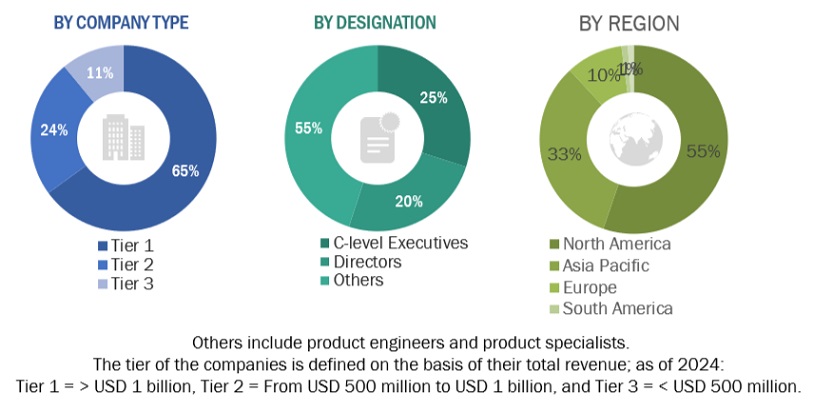
To know about the assumptions considered for the study, download the pdf brochure
Market Size Estimation
Both top-down and bottom-up approaches were used to estimate and validate the total size of the waste management market. These methods were also used extensively to estimate the size of various subsegments in the market. The research methodology used to estimate the market size includes the following:
- The key players in the industry and market have been identified through extensive secondary research, and their market share has been determined through primary and secondary research.
- The industry’s value chain and market size, in terms of value, have been determined through both primary and secondary research processes.
- All percentage shares, splits, and breakdowns have been determined using secondary sources and verified through primary sources.
Waste management Market Size: Top-Down Approach
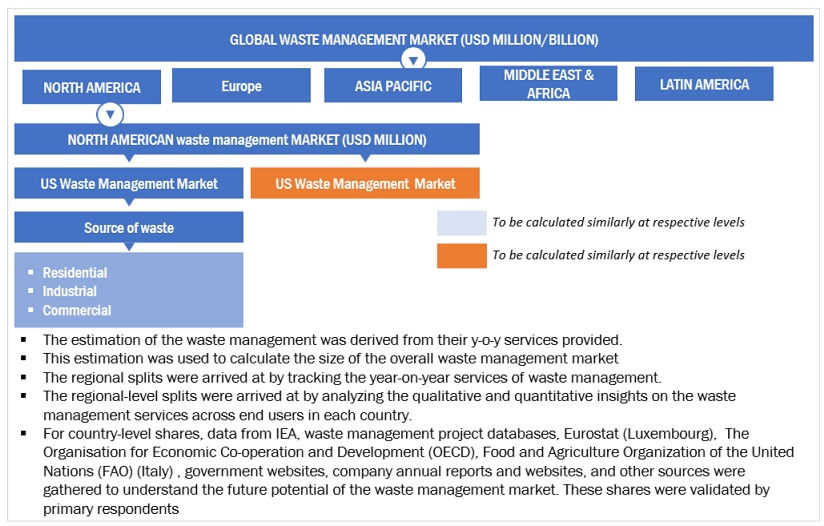
To know about the assumptions considered for the study, Request for Free Sample Report
Waste management Market Size: Bottom-Up Approach
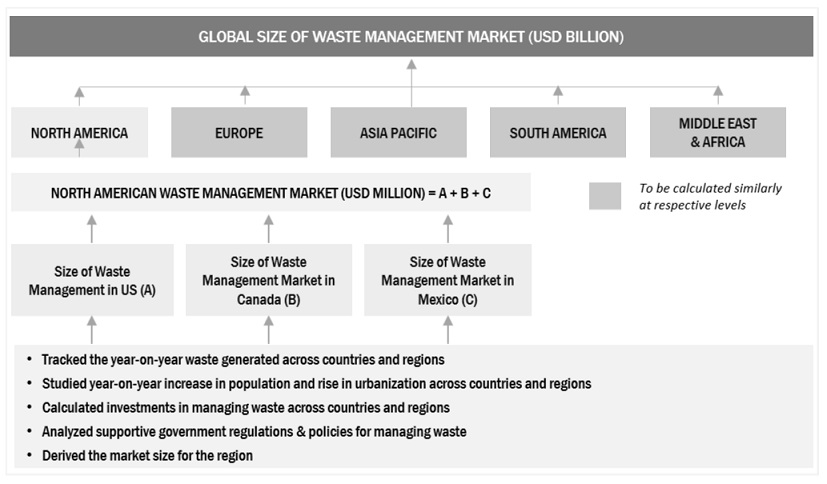
Data Triangulation
After arriving at the overall market size from the above estimation process, the total market has been split into several segments and subsegments. Data triangulation and market breakdown processes have been employed to complete the overall market engineering process and arrive at the exact statistics for all the segments and sub-segments, wherever applicable. The data has been triangulated by studying various factors and trends from both the demand- and supply sides. Along with this, the market has been validated using both the top-down and bottom-up approaches.
Market Definition
Waste management refers to the various schemes and strategies used to manage and dispose of different types of waste, including industrial, biological, household, municipal, organic, biomedical, and radioactive wastes. It encompasses processes such as waste collection, transport, treatment, and disposal, as well as monitoring and regulation of the waste management process and waste-related laws, technologies, and economic mechanisms. It involves the implementation of comprehensive strategies to efficiently manage waste, including methods such as recycling, composting, incineration, landfills, bioremediation, waste to energy, and waste minimization.
Key Stakeholders
- Maintenance and other major service providers
- Waste management component manufacturers
- Government and research organizations
- Institutional investors
- National and local government organizations
- Waste management equipment manufacturers
- Waste management manufacturing companies
- Technology standard organizations, forums, alliances, and associations
State and national regulatory authorities Objectives of the Study
- To define, describe, segment, and forecast the size of the waste management market based on waste type, disposal method and by source in terms of value.
- To describe and forecast the market for five key regions: Asia Pacific, North America, Europe, Latin America, and Middle East & Africa, along with their country-level market sizes in terms of value.
- To forecast the waste management market by region, in terms of volume
- To provide detailed information regarding key drivers, restraints, opportunities, and challenges influencing the growth of the market.
- To strategically analyze micro markets with respect to individual growth trends, prospects, and contributions to the overall market size.
- To provide the supply chain analysis, trends/disruptions impacting the customer’s business, market map, pricing analysis, and regulatory analysis of the waste management market.
- To analyze opportunities for stakeholders in the waste management market and draw a competitive landscape of the market.
- To strategically analyze the ecosystem, tariffs and regulations, patent landscape, trade landscape, Porter’s five forces, and case studies pertaining to the market under study.
- To benchmark market players using the company evaluation quadrant, which analyzes market players on broad categories of business and product strategies adopted by them.
- To compare key market players with respect to product specifications and applications.
- To strategically profile key players and comprehensively analyze their market rankings and core competencies.
- To analyze competitive developments, such as contracts & agreements, investments & expansions, mergers & acquisitions, new product launches, partnerships, joint ventures & collaborations, in the waste management market.
Available Customizations:
With the given market data, MarketsandMarkets offers customizations according to the specific requirements of companies. The following customization options are available for the report:
Product Analysis
- Product Matrix, which provides a detailed comparison of the product portfolio of each company
Company Information
- Detailed analyses and profiling of additional market players
Get the Full Waste Management Market Report
Full forecast, segment splits, and company analysis for all Waste Management Market.
- US Waste Management Market
- Canada Waste Management Market
- Mexico Waste Management Market
- France Waste Management Market
- Germany Waste Management Market
- UK Waste Management Market
- Spain Waste Management Market
- Russia Waste Management Market
- China Waste Management Market
- Japan Waste Management Market
- India Waste Management Market
- Australia Waste Management Market
- South Korea Waste Management Market
- Brazil Waste Management Market
- Argentina Waste Management Market
- Chile Waste Management Market
- UAE Waste Management Market
- South Africa Waste Management Market
- Rest Of Europe Waste Management Market
- Rest Of Asia Pacific Waste Management Market
- GCC Waste Management Market
- Rest Of South America Waste Management Market
- Rest Of GCC Waste Management Market
Need a Tailored Report?
Customize this report to your needs
Get 10% FREE Customization
Customize This Report
