
UAE Waste Management Market (2024-2029)

The UAE Waste Management Market was valued at $744.7 Million in 2024 and projected to reach to $922.6 Million by 2029, representing a compound annual growth rate of 4.4%. The UAE waste management market is poised for steady expansion as the nation continues its ambitious sustainability agenda and urban development projects.


| Market Size in | USD 26.32 MN |
| Market Forecast in | |
| CAGR | |
| Forecast Period | |
| Units Considered | Value (USD MN) |
UAE Waste Management Market Trends and Insights
- The UAE's rapid urbanization, population growth, and stringent environmental regulations are driving demand for advanced waste management solutions across residential, commercial, and industrial sectors.
- The UAE government's commitment to sustainability and circular economy initiatives has positioned the nation as a regional leader in waste management innovation and infrastructure development. In 2024, the UAE waste management market reflects strong investment in waste-to-energy facilities, recycling infrastructure, and digital waste tracking systems.
- By 2029, the UAE is expected to see increased adoption of smart waste management technologies and enhanced regulatory compliance frameworks.
- The market growth is supported by the UAE's Vision 2021 and Net Zero by 2050 strategic initiatives, which emphasize resource efficiency and environmental stewardship across all emirates. The UAE waste management sector benefits from high per capita income, robust construction activity, and tourism-driven waste generation.
- Market participants in the UAE are increasingly focusing on public-private partnerships and technology integration to optimize waste collection, treatment, and disposal operations throughout the forecast period..
Key Market Statistics
- CAGR (2024-2029) 4.4% CAGR
- Market Size, 2024 ~USD 744.7 Million
- Forecast, 2029 ~USD 922.6 Million
- Country UAE
UAE Waste Management Market Overview
Market Valuation :
The UAE waste management market is valued at USD 744.7 million in 2024 and is projected to reach USD 922.6 million by 2029, representing steady growth driven by infrastructure development and regulatory compliance.
Urbanization & Population Growth :
Rapid urbanization across Dubai, Abu Dhabi, and other emirates, coupled with increasing population and tourism, is generating higher waste volumes and creating demand for sophisticated waste management infrastructure and services.
Regulatory Environment :
Stringent environmental regulations and sustainability initiatives from UAE authorities are mandating advanced waste segregation, recycling, and treatment solutions across residential, commercial, and industrial sectors.
Growth Rate :
The UAE market is expanding at a CAGR of 4.4% through 2029, driven by government investments in smart waste systems, circular economy initiatives, and private sector participation in waste management operations.
UAE Waste Management Market Dynamics
- Government initiatives promoting circular economy principles, coupled with investments in smart waste collection and treatment facilities, are reshaping the sector.
- The increasing adoption of digital technologies for waste tracking and optimization is enhancing operational efficiency across emirates. Private sector involvement and public-private partnerships are accelerating infrastructure modernization, particularly in waste-to-energy and recycling facilities.
- With tourism and commercial activities driving waste generation, coupled with strict environmental compliance requirements, the market will experience sustained demand for integrated waste management solutions through 2029..
Market Ecosystem
Related Ecosystem
Decarbonization
- Battery Electric Vehicle (BEV)
- Energy Management Systems
- Fuel Cell
- Fuel Cell Electric Vehicle (FCEV)
- Geographical Information System (GIS)
- TotalEnergies SE
- Siemens ag
- Mitsui & Co., Ltd.
- General Electric Company
- Thyssenkrupp ag
Key Takeaways
- The UAE waste management market is valued at USD 744.7 million in 2024 and will reach USD 922.6 million by 2029 at a 4.4% CAGR.
- The UAE's government-backed sustainability initiatives and Net Zero by 2050 commitment are accelerating investment in advanced waste management infrastructure.
- Smart waste management technologies and waste-to-energy solutions are gaining significant traction in the UAE market between 2024 and 2029.
- The UAE's high urbanization rate and tourism sector drive consistent waste generation, supporting steady market expansion through 2029.
Waste Management Market Report Scope
| Report Metric | Details |
|---|---|
| Base Year | 2024 |
| Fastest Growing Segment | E-WASTE (Waste Type) |
| Forecast Period | 2024-2029 |
| Growth Rate | CAGR of 5.6% from 2024 to 2029 |
| Largest Segment | INDUSTRIAL (Source) |
| Market Size Base Year (Billions) | ~USD 1216.98 (2024) |
| Revenue Forecast (Billions) | ~USD 1598.1 (2029) |
| Segments Covered | Waste Type, Disposal Method, Source, Source Type |
UAE Waste Management Market Report Segmentation
4 segment dimensions are covered across the global market.
By Waste Type
- Construction And Demolition Waste
- E-Waste
- Hazardous Waste
- Medical Waste
- Municipal Solid Waste
- Non-Hazardous Industrial Waste
By Disposal Method
- Compositing And Anaerobic Digestion
- Incineration/ Combustion
- Incineration/Combustion
- Landfills
- Open Dumping
- Recycling
By Source
- Commercial
- Industrial
- Residential
By Source Type
- Construction, Renovation, And Demolition Waste
- Hospitals
- Offices And Retail Stores
- Other Commercial Sources
- Other Industrial Sources
- Process Industries
- Restaurants
- Rural
- Urban
Target Audience
- Waste Management Companies : Operators and service providers need UAE-specific market data to evaluate expansion opportunities, assess competitive positioning, and develop localized service offerings for residential, commercial, and industrial segments.
- Government & Municipal Authorities : UAE federal and emirate-level authorities require market intelligence to inform infrastructure planning, procurement strategies, and policy development aligned with sustainability targets and population growth.
- Investment & Private Equity Firms : Investors seeking exposure to UAE's waste management sector need detailed market analysis, growth forecasts, and opportunity identification to make informed investment decisions and structure deals.
- Technology & Equipment Providers : Manufacturers of waste management equipment and digital solutions require market insights to identify demand drivers, target customer segments, and develop products suited to UAE's regulatory and operational requirements.
- Consulting & Advisory Firms : Strategy consultants and business advisors need comprehensive UAE market data to support client engagements, feasibility studies, and strategic recommendations in the waste management sector.
Reasons to Buy this Report
- Market-Specific Insights : Gain detailed understanding of UAE's waste management landscape, including emirate-specific trends, regulatory frameworks, and growth drivers unique to the region's rapid development and sustainability goals.
- Investment Opportunity Assessment : Identify high-potential segments and investment opportunities in UAE's waste management sector, including waste-to-energy, recycling infrastructure, and smart waste technologies with clear growth trajectories.
- Competitive Landscape Analysis : Understand key players operating in the UAE market, their market positioning, service offerings, and strategic initiatives to benchmark against competitors and identify partnership opportunities.
- Regulatory & Policy Guidance : Access comprehensive information on UAE environmental regulations, government sustainability initiatives, and compliance requirements essential for market entry and operational planning in the emirates.
- Demand Forecasting : Leverage accurate market projections through 2029 to plan capacity expansion, resource allocation, and service development aligned with anticipated waste volumes and sector growth in UAE.
Frequently asked questions
What is the current size of the UAE waste management market in 2024?
The UAE waste management market is valued at USD 744.7 million in 2024, reflecting strong demand for waste collection, treatment, and disposal services across the emirates.
What is the projected market size for UAE waste management by 2029?
The UAE waste management market is projected to reach USD 922.6 million by 2029, representing growth of approximately USD 177.9 million over the five-year forecast period.
What is the CAGR for the UAE waste management market?
The UAE waste management market is expected to grow at a compound annual growth rate (CAGR) of 4.4% from 2024 to 2029.
What are the main drivers of growth in the UAE waste management market?
Key growth drivers in the UAE include rapid urbanization, population growth, stringent environmental regulations, government sustainability initiatives, and increased investment in waste-to-energy and recycling infrastructure.
Which technologies are transforming the UAE waste management sector?
Smart waste management systems, digital waste tracking, waste-to-energy facilities, and advanced recycling technologies are transforming the UAE waste management landscape between 2024 and 2029.
RESEARCH METHODOLOGY
The study involved major activities in estimating the current size of the waste management market. Exhaustive secondary research was done to collect information on the peer and parent markets. The next step was to validate these findings, assumptions, and sizing with industry experts across the value chain through primary research. Both top-down and bottom-up approaches were employed to estimate the total market size. Thereafter, market breakdown and data triangulation were used to estimate the market size of the segments and subsegments.
Secondary Research
This research study on the waste management market involved the use of extensive secondary sources, directories, and databases, such as Eurostat (Luxembourg), The Organisation for Economic Co-operation and Development (OECD) (France), The World Bank Group (US), Food and Agriculture Organization of the United Nations (FAO) (Italy), United Nations Environment Programme (UNEP), UNIDO United Nations Industrial Development Organization (Austria) to collect and identify information useful for a technical, market-oriented, and commercial study of the waste management market. The other secondary sources included annual reports, press releases & investor presentations of companies, white papers, certified publications, articles by recognized authors, manufacturer associations, trade directories, and databases.
Primary Research
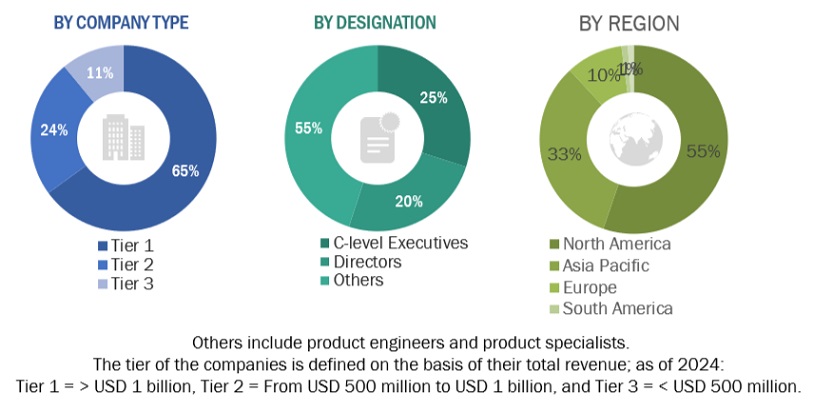
The waste management market comprises several stakeholders, such as waste management manufacturers, technology providers, and technical support providers in the supply chain. The demand side of this market is characterized by the rising demand for waste management in various sources such as residential, industrial, and commercial sectors. The supply side is characterized by rising demand for contracts from the industrial sector and mergers & acquisitions among big players. Various primary sources from both the supply and demand sides of the market were interviewed to obtain qualitative and quantitative information. Following is the breakdown of primary respondents:
To know about the assumptions considered for the study, download the pdf brochure
Market Size Estimation
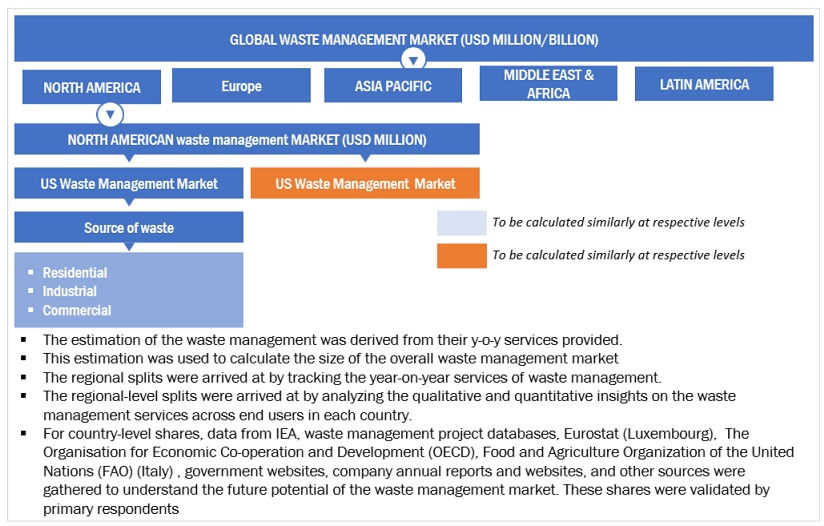
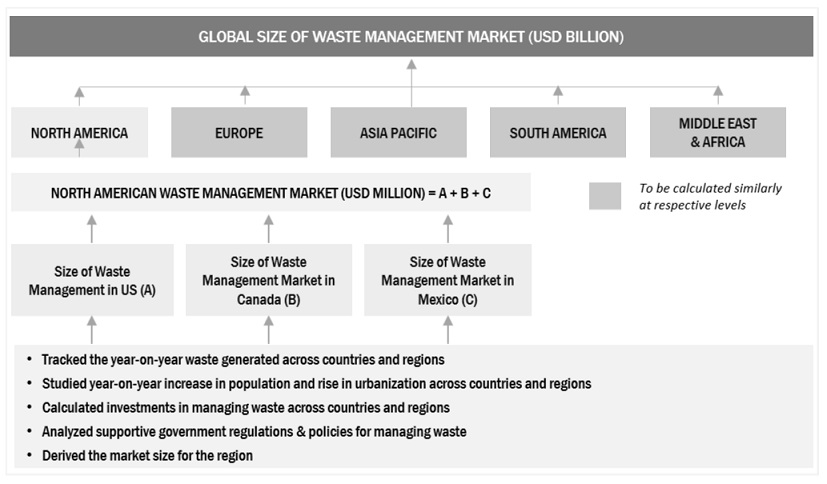
Both top-down and bottom-up approaches were used to estimate and validate the total size of the waste management market. These methods were also used extensively to estimate the size of various subsegments in the market. The research methodology used to estimate the market size includes the following:
- The key players in the industry and market have been identified through extensive secondary research, and their market share has been determined through primary and secondary research.
- The industry’s value chain and market size, in terms of value, have been determined through both primary and secondary research processes.
- All percentage shares, splits, and breakdowns have been determined using secondary sources and verified through primary sources.
Waste management Market Size: Top-Down Approach
To know about the assumptions considered for the study, Request for Free Sample Report
Waste management Market Size: Bottom-Up Approach
Data Triangulation
After arriving at the overall market size from the above estimation process, the total market has been split into several segments and subsegments. Data triangulation and market breakdown processes have been employed to complete the overall market engineering process and arrive at the exact statistics for all the segments and sub-segments, wherever applicable. The data has been triangulated by studying various factors and trends from both the demand- and supply sides. Along with this, the market has been validated using both the top-down and bottom-up approaches.
Market Definition
Waste management refers to the various schemes and strategies used to manage and dispose of different types of waste, including industrial, biological, household, municipal, organic, biomedical, and radioactive wastes. It encompasses processes such as waste collection, transport, treatment, and disposal, as well as monitoring and regulation of the waste management process and waste-related laws, technologies, and economic mechanisms. It involves the implementation of comprehensive strategies to efficiently manage waste, including methods such as recycling, composting, incineration, landfills, bioremediation, waste to energy, and waste minimization.
Key Stakeholders
- Maintenance and other major service providers
- Waste management component manufacturers
- Government and research organizations
- Institutional investors
- National and local government organizations
- Waste management equipment manufacturers
- Waste management manufacturing companies
- Technology standard organizations, forums, alliances, and associations
State and national regulatory authorities Objectives of the Study
- To define, describe, segment, and forecast the size of the waste management market based on waste type, disposal method and by source in terms of value.
- To describe and forecast the market for five key regions: Asia Pacific, North America, Europe, Latin America, and Middle East & Africa, along with their country-level market sizes in terms of value.
- To forecast the waste management market by region, in terms of volume
- To provide detailed information regarding key drivers, restraints, opportunities, and challenges influencing the growth of the market.
- To strategically analyze micro markets with respect to individual growth trends, prospects, and contributions to the overall market size.
- To provide the supply chain analysis, trends/disruptions impacting the customer’s business, market map, pricing analysis, and regulatory analysis of the waste management market.
- To analyze opportunities for stakeholders in the waste management market and draw a competitive landscape of the market.
- To strategically analyze the ecosystem, tariffs and regulations, patent landscape, trade landscape, Porter’s five forces, and case studies pertaining to the market under study.
- To benchmark market players using the company evaluation quadrant, which analyzes market players on broad categories of business and product strategies adopted by them.
- To compare key market players with respect to product specifications and applications.
- To strategically profile key players and comprehensively analyze their market rankings and core competencies.
- To analyze competitive developments, such as contracts & agreements, investments & expansions, mergers & acquisitions, new product launches, partnerships, joint ventures & collaborations, in the waste management market.
Available Customizations:
With the given market data, MarketsandMarkets offers customizations according to the specific requirements of companies. The following customization options are available for the report:
Product Analysis
- Product Matrix, which provides a detailed comparison of the product portfolio of each company
Company Information
- Detailed analyses and profiling of additional market players
Get the Full Waste Management Market Report
Full forecast, segment splits, and company analysis for all Waste Management Market.
- US Waste Management Market
- Canada Waste Management Market
- Mexico Waste Management Market
- France Waste Management Market
- Germany Waste Management Market
- UK Waste Management Market
- Spain Waste Management Market
- Russia Waste Management Market
- China Waste Management Market
- Japan Waste Management Market
- India Waste Management Market
- Australia Waste Management Market
- South Korea Waste Management Market
- Brazil Waste Management Market
- Argentina Waste Management Market
- Chile Waste Management Market
- South Africa Waste Management Market
- Rest Of Europe Waste Management Market
- Rest Of Asia Pacific Waste Management Market
- GCC Waste Management Market
- Rest Of South America Waste Management Market
- Rest Of GCC Waste Management Market
Need a Tailored Report?
Customize this report to your needs
Get 10% FREE Customization
Customize This Report
