
US Wearable Injectors Market (2025-2030)

The US Wearable Injectors Market was valued at $2894 Million in 2025 and projected to reach to $4684.7 Million by 2030, representing a compound annual growth rate of 10.1%. The US wearable injectors market is poised for sustained expansion through 2030, reaching $4,684.7 million as healthcare providers and patients increasingly embrace self-administered therapies.


| Market Size in | USD 26.32 MN |
| Market Forecast in | |
| CAGR | |
| Forecast Period | |
| Units Considered | Value (USD MN) |
US Wearable Injectors Market Trends and Insights
- The US market is driven by increasing adoption of self-administered drug delivery systems, rising prevalence of chronic diseases, and growing patient preference for convenient, home-based treatment options.
- In the US, regulatory support from the FDA and advances in microneedle and patch injection technologies are accelerating market penetration across therapeutic areas including biologics and specialty pharmaceuticals. The US wearable injectors market benefits from a mature healthcare infrastructure, high healthcare spending, and strong reimbursement frameworks that facilitate adoption.
- US manufacturers and innovators are leading product development, with significant investments in smart wearable devices that integrate connectivity and dose tracking.
- The US market's 10.1% compound annual growth rate reflects sustained demand from both patients and healthcare providers seeking improved medication adherence and reduced clinical burden..
Key Market Statistics
- CAGR (2025-2030) 10.1% CAGR
- Market Size, 2025 ~USD 2894 Million
- Forecast, 2030 ~USD 4684.7 Million
- Country US
US Wearable Injectors Market Overview
Market Valuation :
The US wearable injectors market is valued at $2,894.0 million in 2025, demonstrating strong market maturity and significant commercial opportunity across pharmaceutical and biotech sectors.
Robust Growth Trajectory :
With a CAGR of 10.1% through 2030, the US market is expanding faster than many adjacent healthcare segments, driven by technological innovation and shifting patient preferences toward self-administration.
FDA Regulatory Support :
The US benefits from proactive FDA guidance on wearable injector development and approval pathways, creating a favorable regulatory environment that accelerates product launches and market penetration.
Chronic Disease Prevalence :
Rising incidence of diabetes, rheumatoid arthritis, and biologics-dependent conditions in the US population fuels demand for convenient, patient-centric drug delivery solutions that wearable injectors provide.
US Wearable Injectors Market Dynamics
- Key drivers include the growing prevalence of chronic diseases requiring frequent dosing, technological advancements in device miniaturization and connectivity, and strong reimbursement support from major US payers.
- The market benefits from established pharmaceutical partnerships and a mature healthcare infrastructure that facilitates rapid adoption. Looking ahead, the US market will be shaped by continued innovation in smart wearable devices, integration with digital health platforms, and expansion into new therapeutic areas beyond biologics.
- Competitive dynamics will intensify as major medical device manufacturers and emerging startups vie for market share, while regulatory clarity from the FDA continues to streamline approval processes and reduce time-to-market for novel wearable injector solutions..
Market Ecosystem
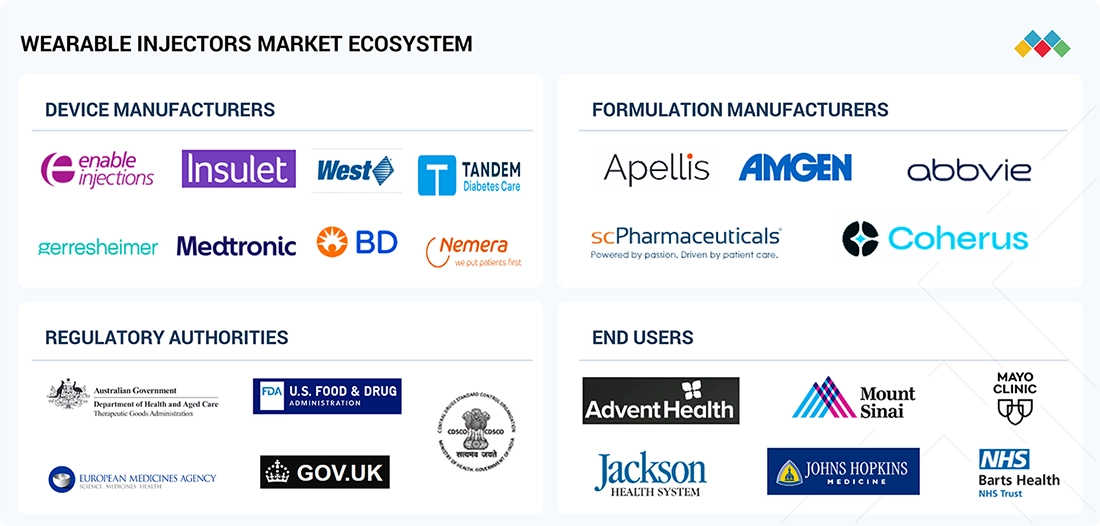
WEARABLE INJECTORS MARKET: GROWTH, SIZE, SHARE, AND TRENDS: COMMERCIAL USE CASES ACROSS INDUSTRIES
| COMPANY | USE CASE DESCRIPTION | BENEFITS |
|---|---|---|
 |
Wearable injector (BD Libertas) for biologics and biosimilars used in chronic disease treatment. | Prefilled, ready-to-use device requiring minimal training and offering hands-free administration for improved patient convenience. |
 |
Automated wearable insulin pump system (MiniMed 780G) integrated with glucose monitoring. | Tubeless, wearable, automated insulin delivery improves glucose control and supports real-time monitoring. |
 |
Wearable injector (Neulasta Onpro Kit) for oncology drug administration at home. | Enables self-delivery of high-volume oncology medications, reducing hospital visits and increasing treatment adherence. |
 |
Wearable injector (Skyrizi) for autoimmune disease management, including psoriasis and Crohn’s disease. | Convenient at-home biologic administration improving patient compliance and reducing clinic dependency. |
 |
Wearable, tubeless insulin delivery system (Omnipod). | Disposable device enabling consistent insulin dosing and supporting comfortable, home-based diabetes management. |
Logos and trademarks shown above are the property of their respective owners. Their use here is for informational and illustrative purposes only.
Related Ecosystem
Drug Delivery Devices
- Disposable Autoinjectors
- Reusable Autoinjectors
- Insulin Pumps
- Pen Injectors
- Transdermal Patches
- Becton, Dickinson and Company
- Novo nordisk a/s
- Terumo Corporation
- Medtronic plc
- Nipro Corporation
Medical Devices
- Polymerase Chain Reaction (PCR)
- Magnetic Resonance Imaging (MRI)
- Disposable Autoinjectors
- Pulse Oximeters
- Blood Pressure Monitors
- Medtronic plc
- Abbott Laboratories
- Stryker Corporation
- Becton, Dickinson and Company
- JOHNSON & JOHNSON
Key Takeaways
- The US wearable injectors market is valued at $2,894.0 million in 2025 and is forecast to reach $4,684.7 million by 2030, representing a 10.1% CAGR.
- The US market is propelled by FDA regulatory support, technological innovation in microneedle and patch delivery systems, and strong healthcare infrastructure.
- US patient preference for self-administered, home-based therapies is driving adoption across chronic disease management and specialty pharmaceutical applications.
- The US competitive landscape features significant investment in smart wearable devices with integrated connectivity, dose tracking, and digital health integration capabilities.
Wearable Injectors Market Report Scope
| Report Metric | Details |
|---|---|
| Base Year | 2025 |
| Fastest Growing Segment | INFECTIOUS DISEASES (Therapeutic Application) |
| Forecast Period | 2025-2030 |
| Growth Rate | CAGR of 10.8% from 2025 to 2030 |
| Largest Segment | DISPOSABLE (Usage) |
| Market Size Base Year (Billions) | ~USD 11.32 (2025) |
| Revenue Forecast (Billions) | ~USD 18.91 (2030) |
| Segments Covered | Type, Delivery Method, End User, Formulation End User, Technology, Therapeutic Application, Usage, Product, Device End User |
US Wearable Injectors Market Report Segmentation
9 segment dimensions are covered across the global market.
By Type
- Off-Body Wearable Injector
- On-Body Wearable Injector
By Delivery Method
- Bolus-Only
- Programmed /Continuous Infusion
- Programmed/ Continuous Infusion
By End User
- Biotechnology Companies
- Contract Development & Manufacturing Organizations (Cdmos)
- Device End User
- Formulation End User
- Pharmaceutical Companies
By Formulation End User
- Home Care Settings
- Hospitals & Clinics
- Other Formulation End Users
- Specialty Infusion Centers/ Ambulatory Surgery Centers
- Specialty Infusion Centers/Ambulatory Surgery Centers
By Technology
- Expanding Battery Technology
- Motor-Driven Technology
- Other Technologies
- Rotary Pump Technology
- Spring-Based Technology
By Therapeutic Application
- Autoimmune Diseases
- Cardiovascular Diseases
- Diabetes
- Infectious Diseases
- Oncology
- Other Therapeutic Applications
- Rare/Orphan Diseases
By Usage
- Disposable
- Reusable
By Product
- Off-Body Wearable Injector
- On-Body Wearable Injector
By Device End User
- Biotechnology Companies
- Contract Development & Manufacturing Organizations (Cdmo)
- Pharmaceutical Companies
US: WEARABLE INJECTORS MARKET, BY END USER, 2023–2030
| Segment | 2023 | 2024 | 2025 | 2026 | 2027 | 2028 | 2029 | 2030 | CAGR (%) |
|---|---|---|---|---|---|---|---|---|---|
| DEVICE END USER | 958.7 | 1152 | 1263.5 | 1383.4 | 1513.9 | 1658.1 | 1816 | 1985 | 9.5 |
| FORMULATION END USER | 2634.1 | 3217.7 | 3587.8 | 3993.5 | 4442.5 | 4946.3 | 5507.2 | 6119.7 | 11.3 |
| TOTAL | 3592.8 | 4369.7 | 4851.3 | 5376.9 | 5956.4 | 6604.3 | 7323.1 | 8104.7 | 10.8 |
Target Audience
- Pharmaceutical & Biotech Companies : Require detailed US market data to evaluate wearable injector adoption for their drug portfolios, assess competitive threats, and develop go-to-market strategies for self-administered therapies.
- Medical Device Manufacturers : Need comprehensive US market intelligence to identify growth opportunities, benchmark against competitors, and make informed decisions on product development and market expansion investments.
- Healthcare Investors & PE Firms : Seek reliable US market forecasts and growth metrics to evaluate investment opportunities in wearable injector companies, assess portfolio company performance, and identify acquisition targets.
- Healthcare Consultants & Advisors : Utilize US-specific market data to support client strategy development, competitive analysis, and market entry planning for wearable injector solutions and related healthcare technologies.
- Payers & Healthcare Systems : Need market insights to understand wearable injector adoption trends, reimbursement implications, and patient outcomes data to inform coverage policies and procurement decisions.
Reasons to Buy this Report
- Market Size & Growth Data : Access precise US market valuation ($2,894M in 2025) and 5-year forecast ($4,684.7M by 2030) with 10.1% CAGR to inform strategic planning, investment decisions, and competitive positioning.
- Regulatory Landscape Intelligence : Understand FDA approval pathways, regulatory support mechanisms, and compliance requirements specific to the US market to accelerate product development and market entry strategies.
- Competitive Benchmarking : Identify market leaders, emerging players, and competitive dynamics within the US wearable injectors space to assess market positioning and identify partnership or acquisition opportunities.
- Patient & Payer Insights : Gain actionable intelligence on US patient adoption drivers, reimbursement trends, and payer preferences to optimize product development, pricing strategies, and market access initiatives.
- Therapeutic Area Opportunities : Discover high-growth therapeutic segments within the US market (diabetes, rheumatoid arthritis, biologics) to prioritize R&D investments and commercial expansion efforts.
Frequently asked questions
What is the current size of the US wearable injectors market?
The US wearable injectors market is valued at $2,894.0 million in 2025 and is projected to grow to $4,684.7 million by 2030.
What is the growth rate of the US wearable injectors market?
The US wearable injectors market is expected to grow at a compound annual growth rate (CAGR) of 10.1% from 2025 to 2030.
What are the primary drivers of growth in the US wearable injectors market?
Key drivers in the US include increasing chronic disease prevalence, patient preference for self-administered therapies, FDA regulatory support, technological advances in microneedle and patch technologies, and strong healthcare reimbursement frameworks.
Which therapeutic areas are leading adoption of wearable injectors in the US?
The US market is seeing significant adoption in biologics delivery, specialty pharmaceuticals, diabetes management, and autoimmune disease treatment, driven by the need for frequent dosing and patient convenience.
How is digital integration influencing the US wearable injectors market?
US manufacturers are increasingly incorporating connectivity features, dose tracking, and digital health integration into wearable injectors to improve medication adherence, enable remote monitoring, and support real-world evidence collection.
RESEARCH METHODOLOGY
This study extensively used both primary and secondary sources. The research involved studying various factors affecting the industry to identify segmentation types, industry trends, key players, competitive landscape, key market dynamics, and key player strategies.
Secondary Research
This research study involved the usage of comprehensive secondary sources; directories; databases such as Bloomberg Business, Factiva, and Dun & Bradstreet; white papers; annual reports; company house documents; investor presentations; and SEC filings of companies. Secondary research was used to identify and collect information useful for an extensive, technical, market-oriented, and commercial study of the wearable injectors market. It was also used to identify key players in the market and classify and segment the industry based on trends to the most detailed level. Additionally, significant developments related to market and technology perspectives were noted. A database of the primary industry leaders was also created using secondary research.
Primary Research
In the primary research process, various sources from both the supply and demand sides were interviewed to obtain qualitative and quantitative information for this report. Primary sources from the supply side include project/sales/marketing/business development managers, presidents, CEOs, vice presidents, chairpersons, chief operating officers, chief strategy officers, directors, chief information officers, and chief medical information officers related to the wearable injectors market. Primary sources from the demand side include healthcare professionals from hospitals, nursing care facilities, long-term health centers, and ambulatory surgery centers.
A breakdown of the primary respondents is provided below:
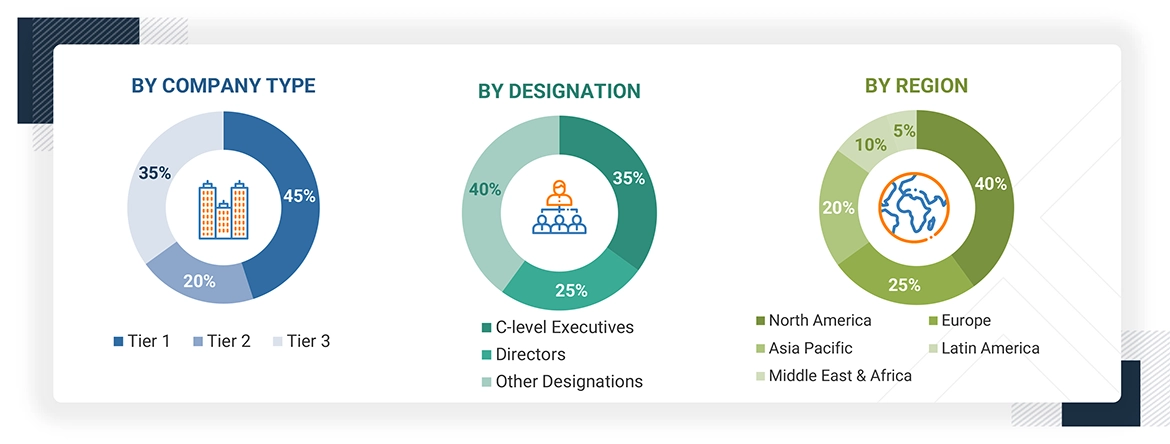
Note 1: C-level executives include CEOs, COOs, CTOs, and VPs.
Note 2: Other designations include sales, marketing, and product managers.
Note 3: Tiers are defined based on a company’s total revenue. As of 2024: Tier 1 = >USD 1 billion, Tier 2 = USD 500 million to USD 1 billion, and Tier 3 = < USD 500 million.
To know about the assumptions considered for the study, download the pdf brochure
Market Size Estimation
The total size of the wearable injectors market was determined after data triangulation from three approaches, as mentioned below. After each approach, the weighted average of the three approaches was taken based on the level of assumptions used in each approach.
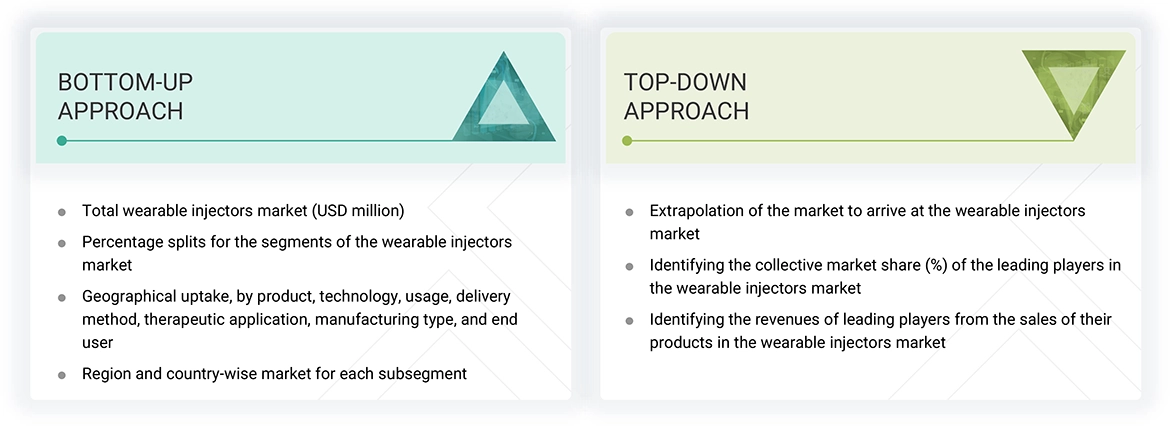
Data Triangulation
After arriving at the market size, the total market was divided into several segments and subsegments. Data triangulation and market breakdown procedures were employed wherever applicable to complete the overall market engineering process and arrive at the exact statistics for all segments and subsegments.
Market Definition
Wearable injectors refer to the market for drug delivery devices that are designed to administer large-volume biologics or medications subcutaneously over an extended period, typically ranging from minutes to hours. These compact, lightweight, and body-worn devices enhance patient compliance by enabling self-administration outside clinical settings, particularly for chronic conditions like diabetes, oncology, autoimmune disorders, and cardiovascular diseases. Wearable injectors are engineered to deliver high-viscosity drugs safely and accurately with minimal discomfort, reducing the need for frequent hospital visits and manual injections. The market encompasses a wide range of device types, including on-body and off-body injectors, bolus injectors, and patch pumps, powered by electromechanical or mechanical systems.
Stakeholders
- Medical device manufacturers and distributors
- Wearable injector manufacturers
- Wearable injector finished formulation manufacturing companies
- Suppliers and distributors of wearable injectors
- Hospitals and clinics
- Ambulatory surgery centers
- Home healthcare agencies
- Research and consulting firms
- Contract manufacturing organizations
- Venture capitalists
Report Objectives
- To define, describe, segment, and forecast the wearable injectors market by product, technology, usage, delivery method, therapeutic application, manufacturing type, end user, and region
- To provide detailed information about the factors influencing market growth (such as drivers, restraints, opportunities, and challenges)
- To analyze micromarkets with respect to individual growth trends, prospects, and contributions to the overall wearable injectors market
- To analyze market opportunities for stakeholders and provide details of the competitive landscape for key players
- To forecast the size of the wearable injectors market in five main regions (along with their respective key countries): North America, Europe, the Asia Pacific, Latin America, and the Middle East & Africa
- To profile the key players in the wearable injectors market and comprehensively analyze their core competencies and market shares
- To track and analyze competitive developments such as acquisitions, product launches, expansions, collaborations, agreements, and partnerships
Get the Full Wearable Injectors Market Report
Full forecast, segment splits, and company analysis for all Wearable Injectors Market.
- Canada Wearable Injectors Market
- Germany Wearable Injectors Market
- UK Wearable Injectors Market
- France Wearable Injectors Market
- Italy Wearable Injectors Market
- Spain Wearable Injectors Market
- Netherlands Wearable Injectors Market
- China Wearable Injectors Market
- Japan Wearable Injectors Market
- India Wearable Injectors Market
- Australia Wearable Injectors Market
- Thailand Wearable Injectors Market
- Vietnam Wearable Injectors Market
- South Korea Wearable Injectors Market
- Indonesia Wearable Injectors Market
- Brazil Wearable Injectors Market
- Mexico Wearable Injectors Market
- Rest Of Europe Wearable Injectors Market
- Rest Of Asia Pacific Wearable Injectors Market
- Rest Of Latin America Wearable Injectors Market
- GCC Countries Wearable Injectors Market
- Rest Of Mea Wearable Injectors Market
- Kingdom Of Saudi Arabia (Ksa) Wearable Injectors Market
- Rest Of GCC Countries Wearable Injectors Market
- United Arab Emirates (UAE) Wearable Injectors Market
Need a Tailored Report?
Customize this report to your needs
Get 10% FREE Customization
Customize This Report
