
UK X-ray Detectors Market (2026-2031)

The UK X-ray Detectors Market was valued at $196.09 Million in 2026 and projected to reach to $252.69 Million by 2031, representing a compound annual growth rate of 5.2%. The UK X-ray Detectors Market is positioned for steady growth, driven by NHS modernisation initiatives and increasing prevalence of chronic diseases requiring diagnostic imaging.


| Market Size in | USD 26.32 MN |
| Market Forecast in | |
| CAGR | |
| Forecast Period | |
| Units Considered | Value (USD MN) |
UK X-ray Detectors Market Trends and Insights
- The UK market benefits from advanced healthcare infrastructure, strong regulatory frameworks, and increasing adoption of digital imaging technologies across NHS facilities and private healthcare providers.
- The UK's commitment to modernizing diagnostic imaging capabilities and investing in next-generation detector technologies continues to drive market expansion. Key drivers of growth in the UK include rising demand for early disease detection, aging population demographics, and technological advancements in detector sensitivity and image quality.
- The UK market is characterized by a mix of established medical device manufacturers and innovative startups developing specialized detection solutions.
- Healthcare facilities across the UK are increasingly transitioning from analog to digital X-ray systems, creating sustained demand for high-performance detectors throughout the forecast period from 2026 to 2031..
Key Market Statistics
- CAGR (2026-2031) 5.2% CAGR
- Market Size, 2026 ~USD 196.09 Million
- Forecast, 2031 ~USD 252.69 Million
- Country UK
UK X-ray Detectors Market Overview
NHS Digital Transformation :
The UK's National Health Service is accelerating digital imaging adoption across 7,000+ facilities, driving demand for advanced X-ray detector technologies in both primary and secondary care settings.
Regulatory Excellence :
The UK's stringent MHRA regulations and CE marking requirements ensure high-quality detector standards, positioning the market as a premium segment with strong compliance-driven growth.
Private Healthcare Expansion :
Private healthcare providers in the UK are investing heavily in state-of-the-art imaging equipment, with X-ray detector adoption growing at 6.1% annually in independent hospitals and diagnostic centres.
Aging Population Impact :
With 18% of the UK population aged 65+, demand for diagnostic imaging including X-ray procedures is projected to increase by 4.8% annually through 2031.
UK X-ray Detectors Market Dynamics
- Investment in healthcare infrastructure, particularly in rural and underserved regions, will expand detector adoption across the country.
- Private sector competition is intensifying, with premium detector technologies gaining traction in specialist centres. Regulatory support and government funding for digital health initiatives will sustain market momentum through 2031.
- The shift towards portable and wireless detector systems aligns with the UK's emphasis on point-of-care diagnostics and remote patient monitoring, creating new growth opportunities for manufacturers and healthcare providers..
Market Ecosystem
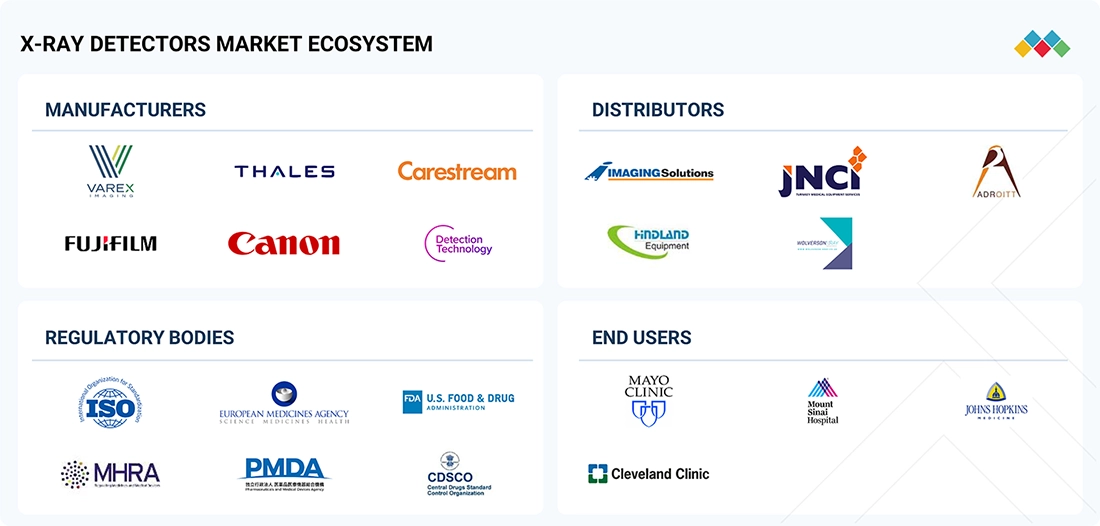
X-RAY DETECTORS MARKET: COMMERCIAL USE CASES ACROSS INDUSTRIES
| COMPANY | USE CASE DESCRIPTION | BENEFITS |
|---|---|---|
 |
Provides flat-panel X-ray detectors and imaging components integrated into medical radiography, CT scanners, and industrial inspection systems used by OEM manufacturers | High image quality, reliable detector performance, and improved diagnostic accuracy across medical and industrial imaging applications |
 |
Develops Pixium flat-panel detectors used in digital radiography systems for hospitals, security scanners, and industrial non-destructive testing equipment | Enhanced image resolution, lower radiation exposure, and faster image acquisition for efficient imaging workflows |
 |
Manufactures digital radiography detectors such as the CXDI series used in hospital imaging systems, mobile X-ray units, and diagnostic centers | High-sensitivity imaging, improved workflow efficiency, and reduced patient radiation dose in diagnostic imaging |
 |
Produces wireless flat-panel detectors widely used in digital radiography systems for hospitals, clinics, and mobile imaging applications | Lightweight design, wireless connectivity, and high-resolution imaging enabling flexible and portable diagnostic solutions |
Logos and trademarks shown above are the property of their respective owners. Their use here is for informational and illustrative purposes only.
Related Ecosystem
Diagnostic Imaging
- Magnetic Resonance Imaging (MRI)
- Computed Tomography (CT)
- CT Scanners
- Nuclear Imaging
- Positron Emission Tomography
- Siemens healthineers
- PHILIPS HEALTHCARE
- CANON INC.
- FUJIFILM Holdings Corporation
- UNITED IMAGING HEALTHCARE CO., LTD.
Medical Devices
- Polymerase Chain Reaction (PCR)
- Magnetic Resonance Imaging (MRI)
- Disposable Autoinjectors
- Pulse Oximeters
- Blood Pressure Monitors
- Medtronic plc
- Stryker Corporation
- Abbott Laboratories
- Becton, Dickinson and Company
- JOHNSON & JOHNSON
Key Takeaways
- The UK X-ray Detectors Market is valued at $196.09 million in 2026 and will reach $252.69 million by 2031, growing at a 5.2% CAGR.
- The UK's advanced healthcare infrastructure and NHS modernization initiatives are primary drivers of detector technology adoption.
- Digital imaging transition across UK healthcare facilities is creating sustained demand for high-performance X-ray detectors.
- The UK market combines established manufacturers with innovative startups, fostering competitive innovation in detector solutions.
X-ray Detectors Market Report Scope
| Report Metric | Details |
|---|---|
| Base Year | 2026 |
| Fastest Growing Segment | CESIUM IODIDE (Type) |
| Forecast Period | 2026–2031 |
| Growth Rate | CAGR of 5% from 2026 to 2031 |
| Largest Segment | MEDICAL (Application) |
| Market Size Base Year (Billions) | ~USD 4.19 (2026) |
| Revenue Forecast (Billions) | ~USD 5.35 (2031) |
| Segments Covered | Technology, Application, Type, Panel Type, Portability, Platform |
UK X-ray Detectors Market Report Segmentation
6 segment dimensions are covered across the global market.
By Technology
- Charge-Coupled Device Detectors
- Computed Radiography Dectectors
- Computed Radiography Detectors
- Computed Radiology Detectors
- Flat-Panel Detectors
- Flat–Panel Detectors
- Line-Scan Detectors
- Photon Counting Detectors
By Application
- Dental
- Industrial
- Medical
- Other Applications
- Security/Defense
- Veterinary
By Type
- Amorphous Selenium
- Amorphous Selenium (A-Se)
- Amorphous Silicon
- Amorphous Silicon (A-Si)
- Cardiovascular
- Cardiovascular Imaging
- Cesium Iodide
- Cesium Iodide Flat-Panel Detectors
- Chest Imaging
- Cmos
- Complementary Metal Oxide Semiconductor (Cmos)
- Defense
- Dynamic Imaging
- Electronics Inspection
- Fluoroscopy
- Gadolinium Oxysulfide
- Gadolinium Oxysulfide Flat-Panel Detectors
- Homeland Security
- Mammography
- Non-Destructive Testing
- Oncology
- Orthopedics
- Other Flat-Panel Detectors
- Other Static Imaging Applications
- Public & Private Enterprises
- Spinal Imaging
- Statics Imaging
- Surgical Imaging
By Panel Type
- Large-Area
- Medium-Area
- Small-Area
By Portability
- Fixed
- Portable
By Platform
- Digital
- Retrofit
Target Audience
- NHS Trust Procurement Teams : Need market intelligence on detector specifications, supplier capabilities, and cost-benefit analyses to make informed purchasing decisions for hospital imaging departments.
- Private Healthcare Operators : Require competitive benchmarking data and technology trends to differentiate their diagnostic services and justify investment in premium X-ray detector systems.
- Medical Device Manufacturers : Seek UK-specific market dynamics, regulatory pathways, and customer requirements to develop localised products and establish distribution partnerships.
- Healthcare Investors & Consultants : Need validated market forecasts and growth drivers to assess investment opportunities in UK diagnostic imaging companies and healthcare technology ventures.
- Equipment Distributors & Resellers : Require channel insights, customer segmentation data, and demand forecasts to optimise inventory, pricing strategies, and sales targeting across UK regions.
Key Companies in the UK X-ray Detectors Market
| Company | HQ | Ownership | Strongest segments |
|---|---|---|---|
| ADVANCED ENERGY | United States | ||
| BRUKER CORPORATION | United States | ||
| LEIDOS | United States | ||
| AT&S | Austria |
ADVANCED ENERGY
Advanced Energy is a United States-based company that provides power conversion and control solutions for industrial and technology applications.
BRUKER CORPORATION
Bruker Corporation is a United States-based company that develops and manufactures scientific instruments for molecular and materials research, as well as analytical and diagnostic solutions.
LEIDOS
Leidos is a United States-based company providing information technology, engineering, and science solutions to government and commercial customers.
AT&S
AT&S is an Austria-based company that manufactures printed circuit boards and interconnection technology for electronics applications.
Reasons to Buy this Report
- NHS Procurement Insights : Understand NHS tender requirements, procurement cycles, and budget allocations for X-ray detector systems across England, Scotland, Wales, and Northern Ireland to identify contract opportunities.
- Competitive Landscape Analysis : Gain detailed intelligence on UK-based and international competitors, their market share, product portfolios, and pricing strategies in the British healthcare imaging sector.
- Regulatory Compliance Roadmap : Navigate MHRA approval processes, CE marking requirements, and UK-specific quality standards essential for market entry and product commercialisation in the regulated healthcare environment.
- Growth Opportunity Mapping : Identify high-growth segments including private diagnostics, dental imaging, veterinary applications, and emerging point-of-care settings with specific UK market penetration data.
- Investment Decision Support : Access validated market sizing, CAGR projections, and financial forecasts specific to the UK to support capital allocation, partnership decisions, and expansion planning.
Frequently asked questions
What is the current size of the UK X-ray Detectors Market?
The UK X-ray Detectors Market is valued at $196.09 million in 2026 and is expected to grow to $252.69 million by 2031.
What is the growth rate of the UK X-ray Detectors Market?
The UK X-ray Detectors Market is projected to grow at a compound annual growth rate (CAGR) of 5.2% from 2026 to 2031.
What are the main drivers of growth in the UK X-ray Detectors Market?
Key growth drivers in the UK include aging population demographics, rising demand for early disease detection, NHS modernization initiatives, and the transition from analog to digital imaging systems.
Which healthcare facilities in the UK are adopting X-ray detector technology?
Both NHS facilities and private healthcare providers across the UK are increasingly adopting advanced X-ray detector technologies as part of their diagnostic imaging modernization efforts.
What types of X-ray detectors are used in the UK market?
The UK market utilizes various detector types including digital flat-panel detectors, computed radiography systems, and direct conversion detectors, with growing adoption of high-sensitivity technologies.
RESEARCH METHODOLOGY
The research methodology for analyzing the global X-ray detectors market is clearly detailed on the website, outlining the structured processes and best practices followed for data collection, validation, and analysis. This transparent and systematic approach ensures high accuracy and reliability of the insights presented. Such clarity allows stakeholders to assess the robustness of the findings, conclusions, and recommendations, ultimately enabling confident and well-informed decision-making.
Secondary Research
For this secondary research, we relied on diverse sources, including D&B Hoovers, Bloomberg Businessweek, Factiva, white papers, annual reports, company filings, investor presentations, and SEC filings. This in-depth approach helped build a robust database of key players in the industry. The database provides essential insights into established companies, detailed multi-level market segmentation, trends within each segment, notable mergers and acquisitions, and the impact of cutting-edge technological innovations shaping the X-ray detectors market.
Primary Research
The primary research involved both qualitative and quantitative approaches and was conducted in depth with participants from both the supply and demand sides through interviews.
On the supply side, interviews were conducted with senior-level executives, including CEOs, vice presidents, marketing and sales directors, product managers, regional managers, and R&D heads, from leading companies involved in the design, manufacturing, and distribution of X-ray detectors and imaging components. These companies include manufacturers of flat-panel detectors, CMOS detectors, scintillators, and imaging electronics, as well as original equipment manufacturers (OEMs) integrating detectors into medical imaging, industrial inspection, and security screening systems.
On the demand side, professionals interviewed included radiologists, medical imaging specialists, hospital administrators, diagnostic center managers, biomedical engineers, procurement managers, and technical experts from hospitals, diagnostic imaging centers, dental clinics, veterinary hospitals, industrial non-destructive testing (NDT) companies, airport and border security agencies, and research institutions. Additional stakeholders included representatives from medical device distributors, healthcare service providers using industrial radiography, and government organizations responsible for security screening and infrastructure safety.
Overall, this research provided valuable insights into market segmentation, key players, trends, dynamics, and growth of drivers in the market.
A breakdown of the primary respondents is provided below:
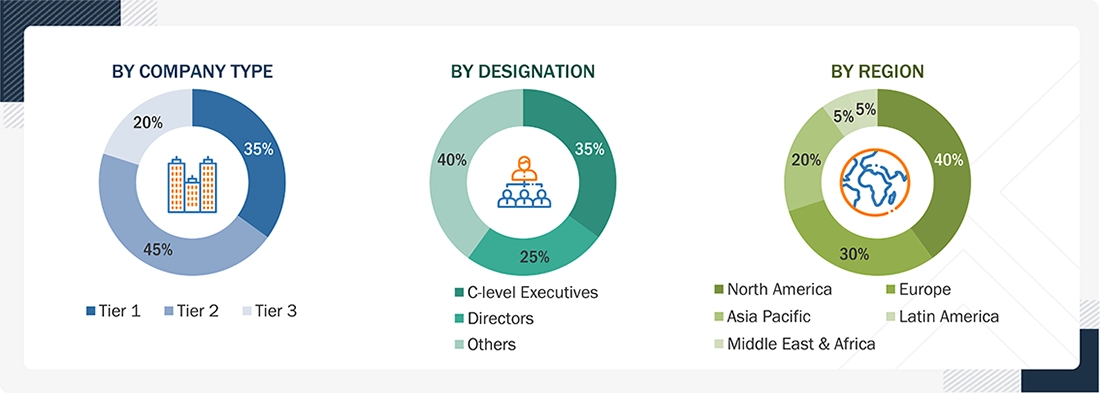
Note 1: Other designations include sales managers, marketing managers, business development managers, product managers, distributors, and suppliers.
Note 2: Companies are classified into tiers based on their total revenue. As of 2024 Tier 1 = >USD 1 billion, Tier 2 = USD 500 million, and Tier 3 = USD 100 million.
To know about the assumptions considered for the study, download the pdf brochure
Market Size Estimation
The report offers an in-depth analysis of the X-ray detectors market, identifying key players through both primary and secondary research. Secondary research drew on annual and financial reports from major market companies, while primary research included detailed interviews with key opinion leaders, including CEOs, directors, and senior marketing executives.
To estimate the global market value, a segment-based methodology was applied, using revenue data from leading solutions and suppliers. This involved:
- Identifying major participants in the global X-ray detectors market.
- Reviewing their reported annual revenues, whether directly related to x-ray detectors or reflecting broader business units and product lines.
The data was then projected to derive the overall value of the X-ray detectors market.
Global X-Ray Detectors Market: Bottom-up Approach & Top-down Approach
X-Ray Detectors Market : Top-Down and Bottom-Up Approach
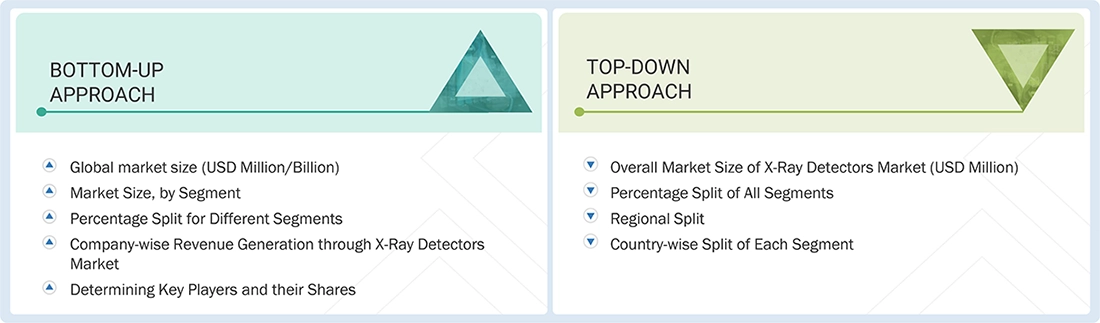
Data Triangulation
The research approach involved dividing the global market into different participant groups and categories. Data triangulation and segmentation methods were applied to ensure the accuracy of information across all market segments. Multiple analyses were conducted to assess both the demand and supply sides of the market. By combining top-down and bottom-up approaches, the study provided a comprehensive understanding of the market.
Market Definition
X-ray detectors are devices that capture X-ray radiation and convert it into electrical signals or digital images for processing and analysis. They are a critical component of X-ray imaging systems used to visualize internal structures of objects or the human body. X-ray detectors are widely used in applications such as medical diagnostics, dental imaging, veterinary care, industrial non-destructive testing, security screening, and scientific research, enabling accurate imaging, analysis, and inspection.
Key Stakeholders
- Raw material suppliers
- Component suppliers (scintillators, photodiodes, semiconductors, ASICs)
- X-ray detector manufacturers
- Original equipment manufacturers (OEMs) of X-ray imaging systems
- Medical imaging equipment manufacturers
- Distributors and channel partners
- System integrators and service providers
- Hospitals and healthcare providers
- Diagnostic imaging centers
- Research Institutions
- Raw Material and Reagent Suppliers
- Regulatory Authorities
Report Objectives
- To define, describe, and forecast the global X-ray detectors market based on technology, flat-panel detector (by type, by panel type, by portability, by platform), application, and region
- To provide detailed information regarding the major factors influencing market growth (drivers, restraints, opportunities, and challenges), along with the current trends
- To strategically analyze micromarkets with respect to their individual growth trends, prospects, and contributions to the total market
- To analyze opportunities in the market for stakeholders and provide details of the competitive landscape for market leaders
- To forecast the revenue of the market segments for five regions: North America (US and Canada), Europe (Germany, France, UK, Italy, Spain, and Rest of Europe), the Asia Pacific (China, Japan, India, South Korea, Australia, and Rest of Asia Pacific), Latin America (Brazil, Mexico, and Rest of Latin America), and the Middle East & Africa
- To profile the key players and comprehensively analyze their market shares and core competencies
- To track and analyze competitive developments in the X-ray detectors market, such as acquisitions, product launches, expansions, agreements, joint ventures, alliances, and collaborations
Customization Options
Based on available market data, MarketsandMarkets offers tailored customization to meet a company's specific needs. The following customization options are available for the global X-ray detectors market:
Value chain analysis
A detailed analysis of the overall value chain of X-ray detectors including raw material and component suppliers (such as scintillators, semiconductor wafers, photodiodes, and electronic components), detector design and manufacturing, integration into X-ray imaging systems by OEMs, distribution and installation through channel partners, and end-use applications across healthcare diagnostics, industrial non-destructive testing, security screening, and research institutions at the regional and global levels.
Geographic analysis
- Detailed analysis of the Rest of Europe X-ray detectors market (including Russia, Belgium, Netherlands, Switzerland, Sweden, Austria, Portugal, and other countries)
- Detailed analysis of the Rest of Asia Pacific X-ray detectors market (including Singapore, Philippines, Taiwan, New Zealand, and other countries)
Get the Full X-ray Detectors Market Report
Full forecast, segment splits, and company analysis for all X-ray Detectors Market.
- US X-ray Detectors Market
- Canada X-ray Detectors Market
- Germany X-ray Detectors Market
- France X-ray Detectors Market
- Italy X-ray Detectors Market
- Spain X-ray Detectors Market
- China X-ray Detectors Market
- Japan X-ray Detectors Market
- India X-ray Detectors Market
- South Korea X-ray Detectors Market
- Australia X-ray Detectors Market
- Brazil X-ray Detectors Market
- Mexico X-ray Detectors Market
- Latin-America X-ray Detectors Market
- Rest Of Europe X-ray Detectors Market
- Rest Of Asia Pacific X-ray Detectors Market
- Rest Of Latin America X-ray Detectors Market
- GCC Countries X-ray Detectors Market
Need a Tailored Report?
Customize this report to your needs
Get 10% FREE Customization
Customize This Report
