
Brazil Yeast Market (2024-2029)

The Brazil Yeast Market was valued at $270.5 Million in 2024 and projected to reach to $410.3 Million by 2029, representing a compound annual growth rate of 8.7%. Brazil's yeast market is poised for significant expansion through 2029, driven by the country's established position as a leading food and beverage manufacturer in South America.


| Market Size in | USD 26.32 MN |
| Market Forecast in | |
| CAGR | |
| Forecast Period | |
| Units Considered | Value (USD MN) |
Brazil Yeast Market Trends and Insights
- This expansion reflects Brazil's strong position as a leading food and beverage producer in South America, where yeast applications span bakery, brewing, and fermentation industries.
- Brazil's growing middle class and increasing demand for processed foods are driving consumption of yeast-based products across both industrial and artisanal segments. The Brazilian yeast market benefits from the country's established agricultural infrastructure and expertise in fermentation technologies, particularly in ethanol and beer production.
- Between 2024 and 2029, Brazil is expected to maintain an 8.7% compound annual growth rate, outpacing many regional peers.
- This growth is supported by rising consumer preference for natural and clean-label ingredients, coupled with expanding bakery and confectionery sectors throughout Brazil. Brazil's competitive landscape includes both multinational yeast manufacturers and regional players capitalizing on local market knowledge.
- The forecast period through 2029 positions Brazil as a critical growth market within South America's yeast sector, driven by innovation in fermentation solutions and increasing export demand for Brazilian food products..
Key Market Statistics
- CAGR (2024-2029) 8.7% CAGR
- Market Size, 2024 ~USD 270.5 Million
- Forecast, 2029 ~USD 410.3 Million
- Country Brazil
Brazil Yeast Market Overview
Market Valuation :
Brazil's yeast market is valued at USD 270.5 million in 2024, with strong growth trajectory positioning it as a key market in South America's food and beverage sector.
Robust CAGR Growth :
The Brazilian yeast market is expanding at a CAGR of 8.7% from 2024 to 2029, outpacing many regional competitors and reflecting sustained demand across multiple applications.
Diverse Application Base :
Brazil's yeast market benefits from diverse end-use sectors including bakery products, brewing and beverages, biofuels, and fermentation industries, reducing market concentration risk.
Rising Consumer Demand :
Growing middle-class expansion and increasing consumption of processed foods, craft beverages, and artisanal bakery products are driving yeast demand across Brazil's urban centers.
Brazil Yeast Market Dynamics
- The projected growth from USD 270.5 million to USD 410.3 million reflects increasing industrialization of food production and rising consumer preference for quality bakery and fermented products.
- Brazil's sugarcane-based bioethanol industry also presents untapped opportunities for yeast applications in fermentation processes.
- The market benefits from favorable demographics, with a growing middle class driving demand for premium and processed food products that rely on yeast as a key ingredient..
Market Ecosystem
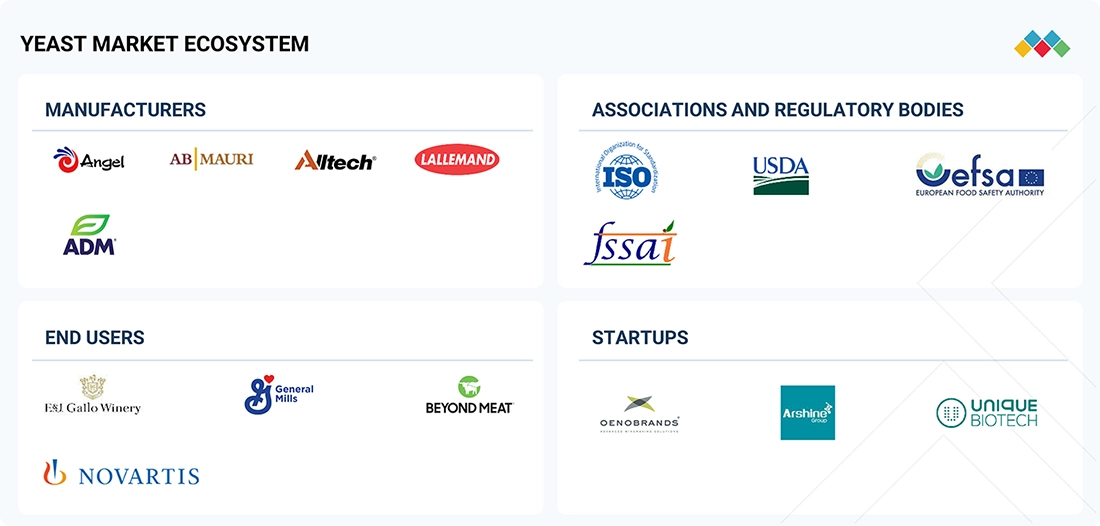
YEAST MARKET: COMMERCIAL USE CASES ACROSS INDUSTRIES
| COMPANY | USE CASE DESCRIPTION | BENEFITS |
|---|---|---|
 |
Angel Yeast has expanded its line of yeast by developing specialty yeast strains and yeast-based products for brewing, food, and health applications. To meet the demand for functional ingredients and improve brewing efficiency, the company focuses on high-performance fermentation strains, yeast extracts, and derivatives that are high in beta-glucan. | These programs help breweries make better beer by improving fermentation stability, flavor consistency. They also let food and nutraceutical companies use yeast-derived functional ingredients that support immune health and clean-label formulations. |
 |
The Associated British Foods AB Mauri division formulates advanced user-specific fermentation yeast solutions for both the food and beverage industries. The strong focus on fermentation performance, yeast strain optimization, and dialed-in specific strains for varying brewing styles and industrial fermentation processes makes AB Mauri a leader in their field. | These solutions help manufacturers improve fermentation efficiency, maintain consistent product quality, and develop differentiated flavor profiles. Customized yeast strains also support product innovation in craft brewing and specialty beverages. |
 |
ADM leverages its fermentation and bio-ingredient expertise to develop yeast-based ingredients such as yeast extracts, beta-glucans, and functional fermentation products for food, beverage, and nutrition markets. The company integrates fermentation technology with its broader ingredient portfolio to expand yeast applications. | ADM’s yeast-derived ingredients enhance flavor, nutritional value, and functionality in food and beverage formulations while supporting immune health and gut health applications. This diversification helps expand brewer’s yeast usage into high-value functional and nutraceutical markets. |
Logos and trademarks shown above are the property of their respective owners. Their use here is for informational and illustrative purposes only.
Related Ecosystem
Fandb Ingredients
Key Takeaways
- Brazil's yeast market will grow from USD 270.5M (2024) to USD 410.3M (2029) at an 8.7% CAGR.
- Brazil's fermentation expertise and agricultural infrastructure position it as South America's yeast market leader.
- Rising demand for clean-label and natural ingredients is accelerating yeast adoption across Brazil's food sector.
- Brazil's bakery, brewing, and ethanol industries are primary growth drivers through 2029.
Yeast Market Report Scope
| Report Metric | Details |
|---|---|
| Base Year | 2024 |
| Fastest Growing Segment | FRESH (Form) |
| Forecast Period | 2024–2029 |
| Growth Rate | CAGR of 8.9% from 2024 to 2029 |
| Largest Segment | SACCHAROMYCES (Genus) |
| Market Size Base Year (Billions) | ~USD 5.55 (2024) |
| Revenue Forecast (Billions) | ~USD 8.5 (2029) |
| Segments Covered | Type, Application, Subapplication, Form, Genus |
Brazil Yeast Market Report Segmentation
5 segment dimensions are covered across the global market.
By Type
- Baker’S Yeast
- Brewer’S Yeast
- Other Types
- Probiotic Yeast
- Wine Yeast
By Application
- Feed
- Food
- Food & Beverages
- Other Applications
By Subapplication
- Bakery
- Bakery Products
- Beverages
- Cattle
- Other Feed Applications
- Other Food Applications
- Poultry
- Prepared Meals
- Swine
By Form
- Active
- Fresh
- Instant
By Genus
- Kluyveromyces
- Other Genera
- Saccharomyces
BRAZIL: YEAST MARKET, BY APPLICATION, 2024–2029
| Segment | 2024 | 2025 | 2026 | 2027 | 2028 | 2029 | CAGR (%) |
|---|---|---|---|---|---|---|---|
| FEED | 60.7 | 65.7 | 71.2 | 77.2 | 84 | 91.5 | 8.5 |
| FOOD & BEVERAGES | 153.6 | 166.5 | 180.9 | 196.9 | 214.7 | 234.5 | 8.8 |
| OTHER APPLICATIONS | 56.3 | 60.8 | 65.7 | 71.3 | 77.4 | 84.2 | 8.4 |
| TOTAL | 270.5 | 293 | 317.8 | 345.4 | 376.1 | 410.3 | 8.7 |
Target Audience
- Food & Beverage Manufacturers : Brazilian bakery, brewing, and fermentation companies need market intelligence to optimize yeast sourcing, forecast demand, and plan capacity expansion aligned with projected 8.7% CAGR growth.
- Yeast Producers & Suppliers : Global and regional yeast manufacturers require Brazil-specific market data to assess market opportunity, competitive positioning, and develop localized product portfolios for this high-growth market.
- Investment & Private Equity Firms : Investors evaluating opportunities in Brazil's food and beverage sector need detailed market sizing and growth forecasts to assess portfolio companies and identify acquisition targets in the yeast supply chain.
- Market Research & Consulting Teams : Research professionals and consultants require verified Brazil yeast market data to support client advisory work, competitive benchmarking, and strategic planning initiatives across South America.
- Government & Trade Organizations : Brazilian trade bodies, agricultural agencies, and export promotion organizations need market intelligence to support industry development, policy-making, and international trade negotiations.
Key Companies in the Brazil Yeast Market
| Company | HQ | Ownership | Strongest segments |
|---|---|---|---|
| ANGELYEAST CO., LTD. | China | Public Company | Baker’s yeast and baking ingredients,Yeast extracts and flavor ingredients,Human, animal, and plant nutrition products, |
| ASSOCIATED BRITISH FOODS PLC | United Kingdom | Public Company | Retail (Primark/Penneys),Grocery,Ingredients, |
| ADM | United States | Public Company | Ag Services and Oilseeds,Carbohydrate Solutions,Nutrition, |
| NISSHIN SEIFUN GROUP INC. | Japan | Public Company | Flour milling and wheat-related ingredients,Premixes, pasta, and sauces (retail and foodservice),Prepared dishes, frozen foods, and fresh noodles, |
| KOTHARI FERMENTATION AND BIOCHEM LTD. | India | Public Company | Fresh compressed baker’s yeast,Instant baker’s yeast (including SUPER FAST INSTANT YEAST),Distiller’s instant yeast (ALCOMAX), |
| ICC | Thailand | Public Company | Cosmetics, Toiletries & Perfumeries,Women’s Apparel,Men’s Apparel, |
ANGELYEAST CO., LTD.
AngelYeast Co., Ltd. is a public company founded in 1986 in China and employs 12724 people.
ASSOCIATED BRITISH FOODS PLC
Associated British Foods PLC is a public company founded in 1934 in the United Kingdom with 138000 employees.
ADM
ADM is a public company founded in 1902 in the United States and employs 41147 people.
NISSHIN SEIFUN GROUP INC.
Nisshin Seifun Group Inc. is a public company founded in 1900 in Japan with 9624 employees.
KOTHARI FERMENTATION AND BIOCHEM LTD.
Kothari Fermentation and Biochem Ltd. is a public company founded in 1990 in India with 204 employees.
ICC
ICC is a public company founded in 1964 in Thailand with 7454 employees.
Reasons to Buy this Report
- Market Size & Growth Data : Access precise valuation metrics for Brazil's yeast market with verified 2024 baseline (USD 270.5M) and 2029 forecasts (USD 410.3M), enabling accurate business planning and investment decisions.
- Competitive Positioning : Understand Brazil's market dynamics relative to global trends (8.7% vs 8.9% global CAGR) to identify competitive advantages and market entry strategies specific to the Brazilian landscape.
- Sector-Specific Insights : Gain detailed intelligence on yeast applications across Brazil's bakery, brewing, biofuel, and fermentation sectors to tailor product development and marketing strategies effectively.
- Consumer Trend Analysis : Leverage insights on Brazil's growing middle class and processed food consumption patterns to identify emerging opportunities in premium and specialty yeast products.
- Strategic Market Entry : Utilize comprehensive Brazil-focused data to develop localized go-to-market strategies, partnership opportunities, and distribution channel optimization for maximum market penetration.
Frequently asked questions
What is the current size of Brazil's yeast market?
Brazil's yeast market was valued at USD 270.5 million in 2024 and is projected to reach USD 410.3 million by 2029.
What is the expected growth rate for yeast in Brazil?
Brazil's yeast market is expected to grow at a compound annual growth rate (CAGR) of 8.7% between 2024 and 2029.
Which industries drive yeast demand in Brazil?
Brazil's primary yeast-consuming sectors include bakery and confectionery, brewing, ethanol production, and fermentation-based food manufacturing.
What factors are accelerating yeast market growth in Brazil?
Key growth drivers in Brazil include rising consumer demand for clean-label products, expanding middle-class consumption, and growth in processed food manufacturing.
How does Brazil's yeast market compare to other South American countries?
Brazil represents the largest and fastest-growing yeast market in South America, leveraging its agricultural expertise, fermentation heritage, and established food processing infrastructure.
RESEARCH METHODOLOGY
The study involved two major segments in estimating the current size of the yeast market. Exhaustive secondary research was done to collect information on the market, peer, and parent markets. The next step was to validate these findings, assumptions, and sizing with industry experts across the value chain through primary research. Both top-down and bottom-up approaches were employed to estimate the complete market size. After that, market breakdown and data triangulation were used to estimate the market size of segments and subsegments.
Secondary Research
This research study involved the extensive use of secondary sources—directories and databases such as Bloomberg Businessweek and Factiva—to identify and collect information useful for a technical, market-oriented, and commercial study of the market.
In the secondary research process, various sources such as annual reports, press releases & investor presentations of companies, white papers, food journals, certified publications, articles from recognized authors, directories, and databases, were referred to identify and collect information.
Secondary research was mainly used to obtain key information about the industry’s supply chain, the total pool of key players, and market classification and segmentation as per the industry trends to the bottom-most level, regional markets, and key developments from both market- and technology-oriented perspectives.
Primary Research
Extensive primary research was conducted after obtaining information regarding the Yeast market scenario through secondary research. Several primary interviews were conducted with market experts from both the demand and supply sides across major countries of North America, Europe, Asia Pacific, South America, and the Rest of the World. Primary data was collected through questionnaires, emails, and telephonic interviews. The primary sources from the supply side included various industry experts, such as Chief X Officers (CXOs), Vice Presidents (VPs), Directors, from business development, marketing, research, and development teams, and related key executives from distributors, and key opinion leaders. Primary interviews were conducted to gather insights such as market statistics, data on revenue collected from the products and services, market breakdowns, market size estimations, market forecasting, and data triangulation. Primary research also helped in understanding the various trends related to yeast, type, form, application, and region. Stakeholders from the demand side, such as processed food and functional food products manufacturers who manufacture the products, were interviewed to understand the buyer’s perspective on the suppliers, products, and their current usage of yeast and the outlook of their business, which will affect the overall market.
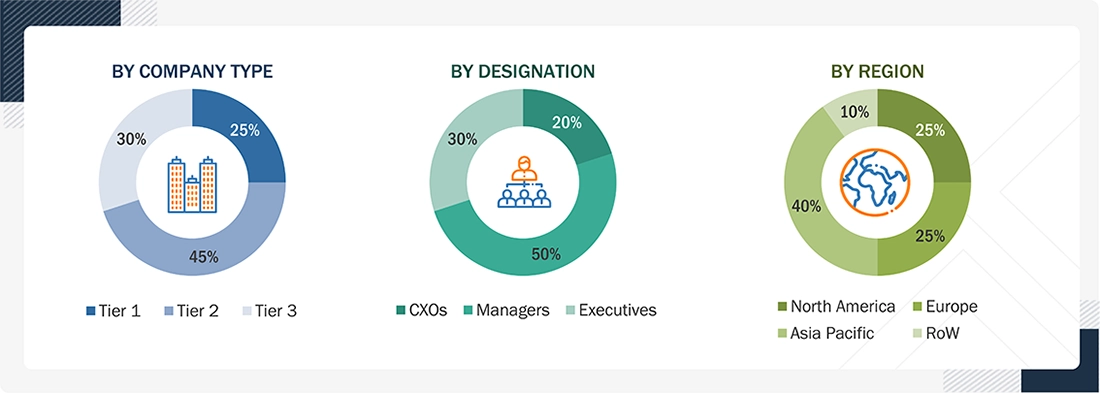
Note: The three tiers of the companies are defined based on their total revenues in 2021 or 2022, as per the availability of financial data: Tier 1: Revenue > USD 1 billion; Tier 2: USD 100 million ≤ Revenue ≤ USD 1 billion; Tier 3: Revenue < USD 100 million.
|
COMPANY NAME |
designation |
|
ADM (US) |
General Manager |
|
Associated British Foods plc (UK) |
Sales Manager |
|
Alltech (Kentucky) |
Manager |
|
AngelYeast Co., Ltd (China) |
Head, Processing Department |
|
Lallemand Inc. (Canada) |
Marketing Manager |
|
Leiber (Germany) |
Sales Executive |
To know about the assumptions considered for the study, download the pdf brochure
Market Size Estimation
Both the top-down and bottom-up approaches were used to estimate and validate the total size of the yeast market. These approaches were also used extensively to determine the size of various subsegments in the market. The research methodology used to estimate the market size includes the following details:
- The key players in the industry and the overall markets were identified through extensive secondary research.
- All shares, splits, and breakdowns were determined using secondary sources and verified through primary sources.
- All possible parameters that affect the market covered in this research study were accounted for, viewed in extensive detail, verified through primary research, and analyzed to obtain final quantitative and qualitative data.
- The research included the study of reports, reviews, and newsletters of top market players, along with extensive interviews for opinions from leaders, such as CEOs, directors, and marketing executives.
Data Triangulation
After arriving at the overall market size from the estimation process explained above, the total market was split into several segments and subsegments. Data triangulation and market breakdown procedures were employed to estimate the yeast market and arrive at the exact statistics for all segments and subsegments. The data was triangulated by studying numerous factors and trends from the demand and supply sides. The market size was also validated using both the top-down and bottom-up approaches.
Market Definition
According to the FAO, yeast is a unicellular fungus that reproduces asexually by budding or division, particularly the genus Saccharomyces, which is important in food fermentations. It is used in the preparation of food products, animal nutrition, and pet nutrition products, which help in improving the health and performance of animals. According to Lallemand Inc., “the ban of antibiotic growth promoters in feed for production of animal foods in the European Union has led to increased interest in evaluating the effect of yeast products on the gastrointestinal ecosystem, rumen microbial populations, and overall animal performance.”
Furthermore, the large-scale industrial production and commercial use of yeasts were initiated around the end of the 19th century. Yeasts approved for use in food products are rich in nutrition, proteins, enzymes, and vitamins. Hence, yeast can be used in the food industry as a nutritional supplement. Yeast is used in basic cultures for manufacturing specific fermented food products, such as dairy, bakery, fermented meat and vegetable products, and vinegar.
Key Stakeholders
- Yeast manufacturers
- Yeast importers and exporters
- Yeast traders, distributors, and suppliers
-
Food additive manufacturers, importers, and exporters
Feed manufacturers - Food associations of several countries
- Intermediary suppliers, including traders and distributors of food & beverage, feed, and bio-ethanol products
- Research organizations and associations such as the Food and Agriculture Organization (FAO), Food and Drug Administration (FDA), European Animal Protein Association (EAPA), Food Standards Australia New Zealand (FSANZ), European Food Safety Authority (EFSA), and United States Department of Agriculture (USDA)
- Regulatory bodies such as
- US Food and Drug Administration (FDA)
- European Commission (EC)
- United States Department of Agriculture (USDA)
- Commercial research & development (R&D) institutions and financial institutions
- Food and Agriculture Organization (FAO)
Report Objectives
- To determine and project the size of the yeast market with respect to the type, applications, form, genus, yeast extract (qualitative), and region in terms of value and volume over five years, ranging from 2026 to 2031
- To identify the attractive opportunities in the market by determining the largest and fastest-growing segments across regions
- To provide detailed information about the key factors influencing market growth (drivers, restraints, opportunities, and challenges)
- To analyze the opportunities in the market for stakeholders and provide details of the competitive landscape for market leaders
- To analyze the micro-markets with respect to individual growth trends, prospects, and their contribution to the total market
- To identify and profile the key players in the yeast market
- To understand the competitive landscape and identify the major growth strategies adopted by players across the key regions
- To provide insights into key product innovations and investments in the yeast market
Available customizations:
With the given market data, MarketsandMarkets offers customizations according to company-specific scientific needs.
The following customization options are available for the report:
Product Analysis
- Product Matrix, which gives a detailed comparison of the product portfolio of each company.
Geographic Analysis
With the given market data, MarketsandMarkets offers customizations according to company-specific scientific needs.
- Further breakdown of the European Yeast market into its key countries, the Netherlands, Russia, Switzerland, Greece, and Poland.
- Further breakdown of the Rest of Asia Pacific Yeast market into its key countries, the Philippines, Indonesia, Malaysia, Vietnam, Singapore, and Thailand.
Company Information
- Detailed analyses and profiling of additional market players (up to five)
Get the Full Yeast Market Report
Full forecast, segment splits, and company analysis for all Yeast Market.
Need a Tailored Report?
Customize this report to your needs
Get 10% FREE Customization
Customize This Report
