
Europe Zinc Oxide Market (2026-2031)

The Europe Zinc Oxide Market was valued at $1223.2 Million in 2026 and projected to reach to $1522.8 Million by 2031, representing a compound annual growth rate of 4.5%. Europe's zinc oxide market is positioned for moderate but stable growth through 2031, driven by sustained demand from established end-use industries including pharmaceuticals, cosmetics, and rubber manufacturing.


| Market Size in | USD 26.32 MN |
| Market Forecast in | |
| CAGR | |
| Forecast Period | |
| Units Considered | Value (USD MN) |
Europe Zinc Oxide Market Trends and Insights
- Europe maintains a significant share of global zinc oxide demand, driven by established manufacturing sectors and stringent regulatory frameworks that favor high-quality chemical inputs.
- The region's market growth is supported by robust demand from rubber, ceramics, pharmaceuticals, and cosmetics industries, where zinc oxide serves as a critical raw material and functional additive. During the forecast period from 2026 to 2031, Europe's zinc oxide market will benefit from increasing industrial applications and sustainability initiatives across the continent.
- Europe's commitment to circular economy principles and environmental compliance is reshaping production and consumption patterns, encouraging manufacturers to adopt advanced processing technologies.
- The region's mature industrial base and innovation-driven economy position Europe as a stable and competitive market for zinc oxide, with steady demand from both traditional and emerging end-use sectors..
Key Market Statistics
- CAGR (2026-2031) 4.5% CAGR
- Market Size, 2026 ~USD 1223.2 Million
- Forecast, 2031 ~USD 1522.8 Million
- Geography Europe
Europe Zinc Oxide Market Overview
Established Manufacturing Base :
Europe's zinc oxide market benefits from a mature industrial infrastructure with strong pharmaceutical, cosmetics, and rubber manufacturing sectors that drive consistent demand for high-purity zinc oxide products.
Regulatory Compliance Advantage :
Stringent EU chemical regulations and quality standards create barriers to entry, favoring established suppliers and driving demand for premium-grade zinc oxide that meets rigorous compliance requirements.
Steady Growth Trajectory :
Europe's zinc oxide market is projected to grow from USD 1,223.2 million in 2026 to USD 1,522.8 million by 2031, representing a 4.5% CAGR, slightly below the global average of 5.3%.
Germany Leads Regional Demand :
Germany dominates Europe's zinc oxide consumption with USD 316.6 million in market size, supported by its robust chemical, automotive, and pharmaceutical industries requiring consistent zinc oxide supply.
Europe Zinc Oxide Market Dynamics
- The region's mature market dynamics and stringent regulatory environment support premium product positioning and stable pricing structures.
- Key growth drivers include increasing adoption in advanced coating applications and continued investment in manufacturing efficiency across EU member states. The market's 4.5% CAGR reflects Europe's status as a developed, consolidated market with limited high-growth opportunities compared to emerging regions.
- However, the region maintains strategic importance due to its technological sophistication, quality standards, and role as a hub for specialty chemical production.
- Sustainability initiatives and circular economy policies are expected to create new opportunities for innovative zinc oxide applications and recycling-based supply chains..
Market Ecosystem
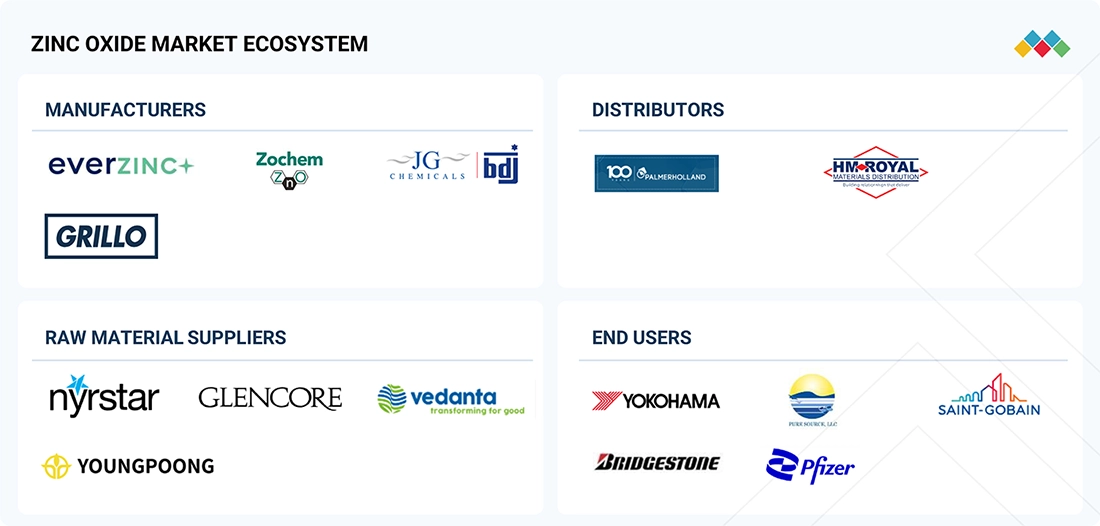
ZINC OXIDE MARKET: COMMERCIAL USE CASES ACROSS INDUSTRIES
| COMPANY | USE CASE DESCRIPTION | BENEFITS |
|---|---|---|
 |
RUBAMIN developed low-dust zinc oxide in MicroPrills and palletized forms to reduce airborne particles during handling and processing in industrial environments. | Improves worker health and safety by minimizing inhalation risks, enhances shop-floor efficiency through free-flowing material, reduces material loss from dusting, and supports automation in weighing and conveying systems. |
 |
Sustainable product ECO ZINC developed. Zinc oxide produced with ECO ZINC integrates recycled and low-carbon raw materials into industrial applications such as chemicals, rubber, paints, and energy systems. | Reduces carbon footprint through climate-neutral production, supports circular economy practices, ensures high product quality and reliability, and enables sustainable manufacturing across multiple industries. |
|
|
High surface area zinc oxide engineered for removing sulfur compounds from fuels and hydrocarbon feedstocks, enabling cleaner refining operations. | Enhances sulfur removal efficiency, supports compliance with stringent emission standards, improves catalyst performance and lifespan, and contributes to cleaner fuels and reduced environmental pollution. |
Logos and trademarks shown above are the property of their respective owners. Their use here is for informational and illustrative purposes only.
Related Ecosystem
Bulk Chemicals And Inorganics
- Corrosion Inhibitors
- Glycol Ethers
- Acetic Acid
- Acetone
- Ammonium Nitrate
- Basf se
- DOW CHEMICAL COMPANY
- Exxon Mobil Corporation
- AZELIS HOLDINGS SA
- Sinopec limited
Key Takeaways
- Europe's zinc oxide market is estimated at USD 1,223.2 million in 2026 and will reach USD 1,522.8 million by 2031, representing a 4.5% CAGR.
- Europe's regulatory environment and focus on sustainability are driving demand for high-purity zinc oxide across pharmaceuticals, cosmetics, and industrial applications.
- The region's mature manufacturing base in rubber and ceramics continues to support steady zinc oxide consumption throughout the forecast period.
- Europe's commitment to circular economy principles is encouraging innovation in zinc oxide production and recycling technologies.
Zinc Oxide Market Report Scope
| Report Metric | Details |
|---|---|
| Base Year | 2026 |
| Fastest Growing Segment | USP (Grade) |
| Forecast Period | 2026–2031 |
| Growth Rate | CAGR of 5.3% from 2026 to 2031 |
| Largest Segment | INDIRECT (Process) |
| Market Size Base Year (Billions) | ~USD 6.31 (2026) |
| Revenue Forecast (Billions) | ~USD 8.17 (2031) |
| Segments Covered | Process, Grade, Application |
Europe Zinc Oxide Market Report Segmentation
3 segment dimensions are covered across the global market.
By Process
- Direct
- Indirect
- Wet-Chemical
By Grade
- Fcc
- Other Grades
- Standard
- Treated
- Usp
By Application
- Agriculture
- Ceramics
- Chemical
- Cosmetics & Personal Care
- Other Applications
- Pharmaceuticals
- Rubber
EUROPE: ZINC OXIDE MARKET, BY APPLICATION, 2025–2031
| Segment | 2025 | 2026 | 2027 | 2028 | 2029 | 2030 | 2031 | CAGR (%) |
|---|---|---|---|---|---|---|---|---|
| AGRICULTURE | 108 | 113.1 | 118.5 | 124.1 | 130 | 136.2 | 142.7 | 4.8 |
| CERAMICS | 231.3 | 240.5 | 250.1 | 260.1 | 270.5 | 281.3 | 292.6 | 4 |
| CHEMICAL | 118.6 | 123.7 | 129 | 134.6 | 140.4 | 146.4 | 152.8 | 4.3 |
| COSMETICS & PERSONAL CARE | 127.2 | 132.6 | 138.2 | 144 | 150.1 | 156.4 | 163 | 4.2 |
| OTHER APPLICATIONS | 29 | 30.3 | 31.7 | 33.2 | 34.7 | 36.3 | 38 | 4.6 |
| PHARMACEUTICALS | 72.7 | 76.4 | 80.2 | 84.3 | 88.5 | 93 | 97.7 | 5 |
| RUBBER | 483.9 | 506.5 | 530.1 | 554.8 | 580.7 | 607.7 | 636 | 4.7 |
| TOTAL | 1170.8 | 1223.2 | 1277.9 | 1335.2 | 1395 | 1457.5 | 1522.8 | 4.5 |
Target Audience
- Chemical Manufacturers & Suppliers : Zinc oxide producers and distributors need Europe-specific market data to optimize production capacity, identify high-growth country markets, and develop targeted sales strategies across EU regions.
- Pharmaceutical & Cosmetics Companies : End-use manufacturers require detailed European market insights to forecast zinc oxide procurement needs, evaluate supplier reliability, and plan product development aligned with regional demand trends.
- Investment & Private Equity Firms : Investors evaluating M&A opportunities in Europe's chemical sector need market sizing, growth projections, and competitive analysis to assess acquisition targets and portfolio company valuations.
- Market Research & Consulting Professionals : Analysts and consultants serving European industrial clients require granular market data, country-level breakdowns, and forecast accuracy to support client advisory and strategic planning engagements.
- Government & Trade Organizations : EU regulatory bodies, trade associations, and economic development agencies use market intelligence to inform policy decisions, trade negotiations, and industry development initiatives across member states.
Key Companies in the Europe Zinc Oxide Market
| Company | HQ | Ownership | Strongest segments |
|---|---|---|---|
| SYNTHOS S.A | Poland | Private Company | Styrene-butadiene and butadiene rubbers (KER, KRALEX, SYNTECA, NBR),EPS/XPS and polystyrene (InSphere, Inpacto, Silver, Synthos XPS PRIME, SYNTHOS PS),Water-based dispersions, latex, adhesives (Osakryl, Synexil, WOODMAX, PAPERMAX), |
| UNILEVER PLC | United Kingdom | Public Company | Beauty & Wellbeing,Personal Care,Home Care, |
| LANXESS | Germany | Public Company | Specialty Additives,Advanced Intermediates,Consumer Protection, |
| JG CHEMICALS LIMITED | India | Public Company | Zinc oxide – rubber and tires,Zinc oxide – ceramics, paints, and coatings,Zinc sulphate – agrochemicals and animal feed, |
SYNTHOS S.A
SYNTHOS S.A is a Polish private company founded in 1945 with 2,975 employees.
UNILEVER PLC
Unilever PLC is a British public company founded in 1860 with 93,732 employees.
LANXESS
Lanxess is a German public company founded in 1863 with 11,630 employees.
JG CHEMICALS LIMITED
JG Chemicals Limited is an Indian public company founded in 1975 with 64 employees.
Countries within Europe - compare and drill down
| Country | 2025 size (native) |
|---|---|
| Germany | USD 316.6 Million |
| France | USD 302.3 Million |
| Spain | USD 280.6 Million |
| Italy | USD 189.1 Million |
| Russia | USD 176.8 Million |
| UK | USD 48.1 Million |
| Rest Of Europe | USD 209.3 Million |
Country market size visualization
Reasons to Buy this Report
- Country-Level Market Breakdown : Access detailed market sizing for Germany, France, Spain, Italy, UK, Russia and Rest of Europe, enabling precise regional investment and expansion strategies tailored to specific European markets.
- Competitive Landscape Intelligence : Understand market consolidation patterns, supplier positioning, and competitive dynamics specific to Europe's regulated chemical sector to identify partnership and acquisition opportunities.
- Regulatory & Compliance Insights : Navigate EU chemical regulations, REACH compliance requirements, and quality standards that differentiate European market dynamics from global competitors and impact product positioning.
- End-Use Industry Analysis : Identify growth opportunities across Europe's pharmaceutical, cosmetics, rubber, and coating industries with quantified demand forecasts and application-specific market trends through 2031.
- Strategic Growth Planning : Leverage 5-year forecasts and CAGR projections to develop evidence-based market entry strategies, capacity planning, and resource allocation decisions for European operations.
Frequently asked questions
What is the current market size of zinc oxide in Europe?
Europe's zinc oxide market is valued at USD 1,223.2 million in 2026 and is expected to grow to USD 1,522.8 million by 2031.
What is the projected growth rate for zinc oxide in Europe?
Europe's zinc oxide market is projected to grow at a compound annual growth rate (CAGR) of 4.5% from 2026 to 2031.
Which industries drive zinc oxide demand in Europe?
Europe's zinc oxide demand is primarily driven by rubber manufacturing, ceramics, pharmaceuticals, cosmetics, and chemical processing industries.
How does Europe's regulatory environment impact the zinc oxide market?
Europe's stringent environmental and quality regulations favor high-purity zinc oxide products and encourage sustainable production practices across the region.
What role does sustainability play in Europe's zinc oxide market?
Europe's circular economy initiatives and environmental compliance standards are driving innovation in zinc oxide recycling and advanced production technologies.
RESEARCH METHODOLOGY
The study involved four major activities to estimate the current size of the global zinc oxide market. Exhaustive secondary research was carried out to collect information on the market, the peer product market, and the parent product group market. The next step was to validate these findings, assumptions, and sizes with the industry experts across the value chain of zinc oxide through primary research. The top-down and bottom-up approaches were employed to estimate the overall size of the zinc oxide market. After that, market breakdown and data triangulation procedures were used to determine the size of different segments of the market.
Secondary Research
The market for companies offering zinc oxide was arrived at by studying the secondary data available through paid and unpaid sources, analyzing the product portfolios of the major companies in the ecosystem, and rating the companies by their performance and quality. Various secondary sources, such as Business Standard, Bloomberg, World Bank, and Factiva, were referred to identify and collect information for this study on the zinc oxide market. In the secondary research process, various secondary sources were referred to identify and collect information related to the study. Secondary sources included annual reports, press releases, investor presentations, zinc oxide vendors, forums, certified publications, and white papers. The secondary research was used to obtain critical information on the industry’s value chain, the total pool of key players, market classification, and segmentation from the market and technology-oriented perspectives.
Primary Research
In the primary research process, various primary sources from the supply and demand sides were interviewed to obtain qualitative and quantitative information for this report. The primary sources from the supply side included industry experts, such as Chief Executive Officers (CEOs), Vice Presidents (VPs), marketing directors, technology and innovation directors, and related key executives from several key companies and organizations operating in the zinc oxide market. After the complete market engineering (calculations for market statistics, market breakdown, market size estimations, market forecasting, and data triangulation), extensive primary research was conducted to gather information and verify and validate the critical numbers arrived at. Primary research was also conducted to identify the segmentation types, industry trends, competitive landscape of zinc oxide offered by various market players, and key market dynamics, such as drivers, restraints, opportunities, challenges, industry trends, and key player strategies. In the complete market engineering process, the top-down and bottom-up approaches and several data triangulation methods were extensively used to perform the market estimation and market forecasting for the overall market segments and subsegments listed in this report. Extensive qualitative and quantitative analysis was performed on the complete market engineering process to list the key information/insights throughout the report.
The following is a breakdown of the primary respondents:
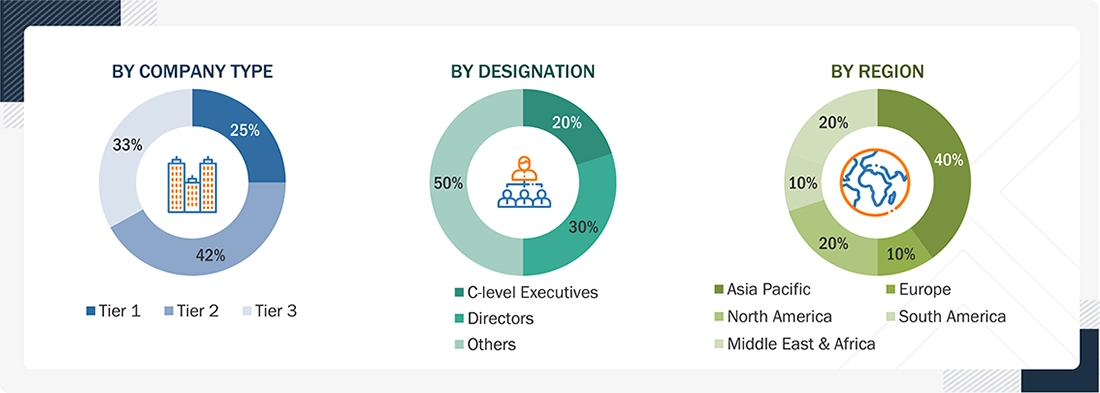
Others include sales, marketing, and product managers.
Tier 1: > USD 1 billion; Tier 2: USD 500 million–1 billion; and Tier 3: < USD 500 million
To know about the assumptions considered for the study, download the pdf brochure
Market Size Estimation
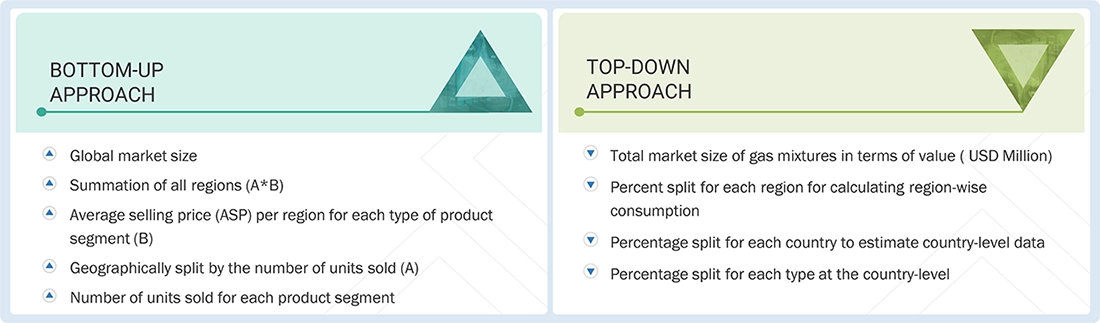
The top-down and bottom-up approaches were used to estimate and validate the size of the global zinc oxide market. These approaches were also used extensively to estimate the size of various dependent market segments.
The research methodology used to estimate the market size included the following approaches:
Data Triangulation
After arriving at the overall market size using the market size estimation processes, the market was split into several segments and subsegments. The data triangulation and market breakup procedures were employed, wherever applicable, to complete the overall market engineering process and arrive at the exact statistics of each market segment and subsegment. The data was triangulated by studying various factors and trends from both the demand and supply sides.
Market Definition
Zinc oxide is an inorganic compound composed of zinc and oxygen, in general appearing as a white, odorless powder that is insoluble in water. It is generally used as a functional additive due to its key properties, including UV absorption, antimicrobial activity, chemical stability, and catalytic behavior. Because of these characteristics, it is extensively applied across industries such as rubber (for vulcanization), pharmaceuticals (ointments and creams), cosmetics (sunscreens), ceramics, paints, and agriculture (micronutrient fertilizers).
Report Objectives
- To define, describe, and forecast the size of the global zinc oxide market based on process, grade, application, and region in terms of value and volume
- To provide detailed information on the significant drivers, restraints, opportunities, and challenges influencing the market
- To strategically analyze micro markets concerning individual growth trends, prospects, and their contribution to the market
- To assess the growth opportunities in the market for stakeholders and provide details on the competitive landscape for market leaders
- To forecast the market size of segments for North America, Europe, Asia Pacific, South America, and the Middle East & Africa
- To strategically profile key players and comprehensively analyze their market shares and core competencies
- To analyze competitive developments, such as expansions, partnerships, and acquisitions, in the zinc oxide market
- To provide the impact of AI on the zinc oxide market
Key Stakeholders
- Raw Material Suppliers
- Regulatory Bodies
- Government and Consulting Firms
- End Users
- Research and Development Organizations
- Zinc Oxide Manufacturers, Dealers, Traders, and Suppliers
Available customizations:
With the given market data, MarketsandMarkets offers customizations according to client-specific needs.
The following customization options are available for the zinc oxide report:
Product Analysis
A product matrix that gives a detailed comparison of the product portfolio of each company
Regional Analysis
A further breakdown of the zinc oxide market for additional countries
Company Information
Detailed analysis and profiling of additional market players (up to five)
Get the Full Zinc Oxide Market Report
Full forecast, segment splits, and company analysis for all Zinc Oxide Market.
- China Zinc Oxide Market
- India Zinc Oxide Market
- Japan Zinc Oxide Market
- US Zinc Oxide Market
- Canada Zinc Oxide Market
- Mexico Zinc Oxide Market
- Germany Zinc Oxide Market
- UK Zinc Oxide Market
- France Zinc Oxide Market
- Italy Zinc Oxide Market
- Spain Zinc Oxide Market
- Russia Zinc Oxide Market
- South Africa Zinc Oxide Market
- Brazil Zinc Oxide Market
- Argentina Zinc Oxide Market
- Rest Of Europe Zinc Oxide Market
- Rest Of Asia Pacific Zinc Oxide Market
Need a Tailored Report?
Customize this report to your needs
Get 10% FREE Customization
Customize This Report
