



Land Mobile Radio Market Size, Share & Trends
Report Code
SE 4007
Published in
Nov, 2025, By MarketsandMarkets™
Land Mobile Radio Market Size, Share & Trends by Type (Hand Portable, In-Vehicle), Technology (Analog, Digital (Terrestrial Trunked Radio (TETRA), Digital Mobile Radio (DMR), Project 25 (P25)); Frequency (25-174 MHz, 200-512 MHz, 700 MHZ & above) - Global Forecast to 2030

USD 32.24 BN
MARKET SIZE, 2030

CAGR 10.7%
(2025-2030)

270
REPORT PAGES

216
MARKET TABLES
LAND MOBILE RADIO MARKET OVERVIEW
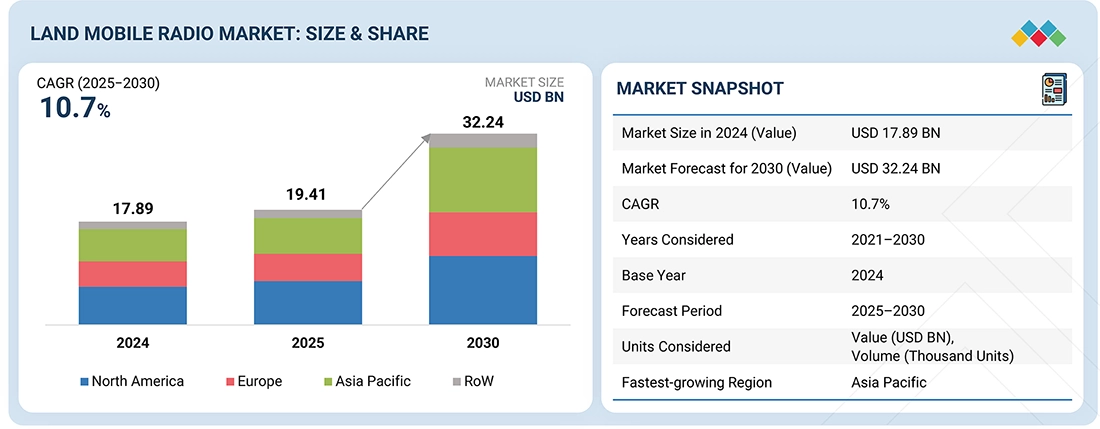
According to Marketsandmarkets, the land mobile radio market size is projected to reach USD 32.24 billion by 2030, growing from USD 19.41 billion in 2025 at a CAGR of 10.7% from 2025 to 2030. Market growth is driven by the increasing demand for reliable and secure communication systems across critical sectors, such as public safety, defense, transportation, and utilities. The transition from analog to digital technologies, including TETRA, DMR, and P25, is enhancing voice clarity, data transmission, and interoperability among agencies. At the same time, the integration of broadband and LTE capabilities with traditional LMR systems is expanding operational efficiency, thereby fueling market expansion.
The land mobile radio market size is witnessing steady expansion as demand for mission-critical communication systems continues to increase across public safety, defense, transportation, and utility sectors. The growing need for secure and reliable voice communication systems among emergency services such as police, fire departments, and disaster response teams is driving the expansion of the land mobile radio industry. Additionally, the increasing deployment of portable radios, base stations, repeaters, and vehicle-mounted systems is strengthening the land mobile radio market share across multiple sectors that require uninterrupted communication networks.
Several evolving land mobile radio market trends are shaping the future of the land mobile radio industry. One of the most significant trends is the transition from analog systems to advanced digital technologies such as TETRA, DMR, and P25, which improve voice clarity, encryption, and data transmission capabilities. Integration of broadband and LTE networks with traditional LMR systems is also enhancing operational efficiency, further accelerating land mobile radio market growth. North America currently holds a significant land mobile radio market share due to strong investments in public safety communication infrastructure, while Asia Pacific is emerging as a fast-growing region driven by urbanization and modernization of emergency communication systems. As governments and commercial organizations increasingly invest in resilient communication networks, the land mobile radio market size is expected to expand steadily, reinforcing the importance of the land mobile radio industry in mission-critical communication worldwide.
REPORT SCOPE
| REPORT METRIC | DETAILS |
|---|---|
| Market Size in 2025 (Value) | USD 19.41 billion |
| Market Forecast in 2030 (Value) | USD 32.24 billion |
| Growth Rate | CAGR of 10.7% from 2025–2030 |
| Years Considered | 2021–2030 |
| Base Year | 2024 |
| Forecast Period | 2025–2030 |
| Units Considered | Value (USD Million), Volume (Thousand Units) |
| Report Coverage | Revenue forecast, company ranking, competitive landscape, growth factors, and trends |
| Top Companies |
|
| Growth Driver |
|
| Segments Covered |
|
| Regions Covered | North America, Europe, Asia Pacific, Rest of the World |
Market Size & Forecast
• 2025 Market Size: USD 19.41 Billion
• 2030 Projected Market Size: USD 32.24 Billion
• CAGR (2025-2030): 10.7%
• Digital segment: Highest CAGR
• Asia Pacific: Fastest Growing Region
LAND MOBILE RADIO MARKET KEY TAKEAWAYS
-
By RegionBy region, North America accounted for a market share of 38.6% in 2024.
-
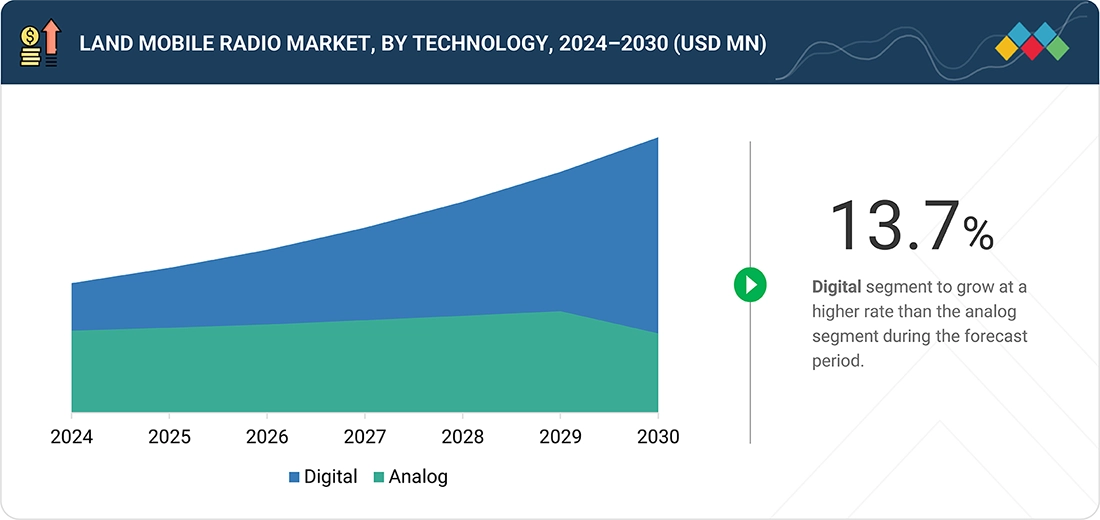
By TechnologyBy technology, the digital segment is projected to register a higher CAGR (13.7%) than the analog segment during the forecast period.
-
By TypeBy type, the hand-portable segment is projected to grow at a higher rate than the in-vehicle (mobile) segment from 2025 to 2030.
-
By FrequencyBy frequency, the 200–512 MHz (UHF) segment is projected to grow at the highest rate during the forecast period.
-
By ApplicationBy application, the commercial segment is projected to dominate the land mobile radio market during the forecast period. It is projected to grow at the highest CAGR of 12.3% in the same period.
-
Competitive LandscapeCompanies Relay, Inc.; Zetron; goTenna; and Weavix have distinguished themselves among startups and SMEs by securing strong footholds in specialized niche areas, underscoring their potential as emerging market leaders.
The land mobile radio market share is witnessing steady growth, driven by the rising need for reliable, mission-critical communication across sectors, such as public safety, defense, transportation, and utilities. Additionally, the shift from analog to digital LMR technologies—including TETRA, DMR, and P25—is enhancing communication efficiency through better voice clarity, data transfer, and encryption capabilities. Moreover, market dynamics are being reshaped by strategic developments, such as Motorola Solutions’ continued expansion of its ASTRO P25 portfolio, Hytera’s launch of next-generation DMR terminals, and JVCKENWOOD’s partnerships for LTE-integrated LMR solutions. These factors are further propelling growth in the market. Moreover, the convergence of LMR with broadband and LTE networks is paving the way for hybrid communication ecosystems, ensuring seamless connectivity and interoperability for field operations.
Source: Secondary Research, Interviews with Experts, MarketsandMarkets Analysis
TRENDS & DISRUPTIONS IMPACTING CUSTOMERS' CUSTOMERS
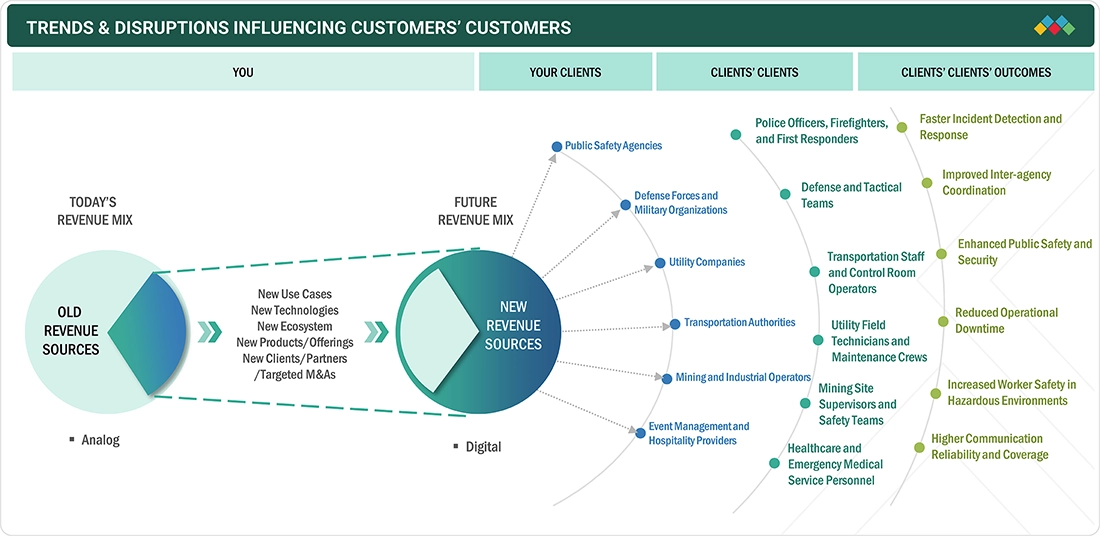
Current revenue streams in the land mobile radio market trends, traditionally driven by voice-centric communication and analog systems, are evolving toward data-enabled, broadband-integrated, and software-driven solutions. As a result, the market is transitioning as organizations seek interoperable, secure, and intelligent communication platforms that combine digital LMR, LTE, and 5G capabilities. Additionally, emerging opportunities are centered around hybrid LMR-LTE systems, AI-assisted dispatch and analytics, cloud-based radio management, and network virtualization, which are redefining how mission-critical communication is deployed and managed. These advancements are enabling transformative applications in public safety networks, utility, transportation, and defense, supporting capabilities, such as real-time situational awareness, IoT-based asset monitoring, and seamless voice-data integration. As the ecosystem matures, revenue is gradually shifting toward software, broadband services, and managed communication platforms, reflecting the growing importance of intelligent, connected, and resilient communication infrastructure.
Source: Secondary Research, Interviews with Experts, MarketsandMarkets Analysis
LAND MOBILE RADIO MARKET DYNAMICS

Drivers
Impact
Level
Level
-
Transition from analog to digital LMR technologies

-
Rising adoption of hybrid LMR–LTE/5G systems for seamless communication


RESTRAINTS
Impact
Level
Level
-
High deployment and maintenance costs for large-scale LMR infrastructure

-
Limited spectrum availability and regulatory constraints


OPPORTUNITIES
Impact
Level
Level
-
Integration of LMR with IoT, GPS, and data analytics for advanced field operations

-
Expansion in emerging markets driven by smart city and infrastructure projects


CHALLENGES
Impact
Level
Level
-
Interoperability issues between multi-vendor and multi-technology systems

-
Cybersecurity risks in digital and hybrid communication environments

Source: Secondary Research, Interviews with Experts, MarketsandMarkets Analysis
Driver: Transition from analog to digital LMR technologies
The ongoing transition from analog to digital land mobile radio (LMR) systems is a key driver of growth. Digital technologies, such as TETRA, DMR, and P25, offer superior audio clarity, enhanced data capabilities, improved spectrum efficiency, and advanced features like encryption and GPS integration. This shift enables more reliable and secure communication, especially in mission-critical environments, such as public safety, utilities, and transportation. As end users seek systems that support both voice and data transmission, digital LMR adoption continues to accelerate globally, replacing legacy analog networks and driving overall market modernization.
Restraint: High deployment and maintenance costs for large-scale LMR infrastructure
Large-scale LMR deployments involve substantial initial capital investment and ongoing maintenance expenses. The costs associated with network infrastructure, base stations, repeaters, and spectrum licensing can be prohibitive, particularly for smaller agencies or emerging economies. Moreover, maintaining system interoperability and ensuring regular upgrades add to the financial burden. These high costs often delay modernization initiatives and limit adoption in cost-sensitive markets, posing a significant restraint on widespread LMR deployment.
Opportunity: Integration of LMR with IoT, GPS, and data analytics for advanced field operations
The integration of LMR systems with emerging technologies, such as IoT, GPS, and data analytics, presents a strong growth opportunity for the market. By connecting radios to IoT sensors and analytics platforms, organizations can achieve real-time situational awareness, predictive maintenance, and optimized asset tracking. GPS-enabled LMRs enhance field visibility and coordination, particularly in emergency response and logistics operations. Such convergence of communication and data intelligence is enabling next-generation, connected ecosystems that improve efficiency, safety, and decision-making across industries.
Challenge: Interoperability issues between multi-vendor and multi-technology systems
Interoperability remains a critical challenge in the land mobile radio market, particularly as networks expand across regions and incorporate diverse technologies and vendors. Differences in communication protocols, frequency bands, and standards often hinder seamless communication between systems, complicating coordination among agencies or departments using different platforms. Although digital standards like P25 and TETRA have improved compatibility, achieving full cross-technology interoperability remains difficult. Addressing these issues requires collaborative standardization efforts and increased investment in unified communication frameworks to ensure consistent, mission-critical connectivity.
LAND MOBILE RADIO MARKET SIZE, SHARE & GROWTH: COMMERCIAL USE CASES ACROSS INDUSTRIES
| COMPANY | USE CASE DESCRIPTION | BENEFITS |
|---|---|---|
 |
Deployment of a next-generation digital LMR communication system in Oakland County to establish a unified, interoperable platform for public safety agencies | Enable seamless voice and data communication |real-time coordination; and secure information exchange during emergencies | Enhanced emergency response efficiency, faster incident resolution, and improved situational awareness across agencies | The solution strengthens network reliability, expands coverage in remote areas, and supports future scalability for advanced communication applications such as GPS tracking and data-driven dispatch. |
 |
Implementation of the NEXEDGE digital radio system to enable secure, high-quality, and real-time communication across all operational and construction teams at Istanbul New Airport | Improved coordination and safety across airport operations, enhanced communication reliability over large distances, secure and interference-free voice transmission, and optimized management of large-scale airport activities through seamless team connectivity. |
 |
Deployment of Codan’s HF-based communication solution to ensure reliable, long-range connectivity and seamless coordination for the Royal Malaysia Police across challenging and remote regions | Enhanced coverage and network reliability, improved real-time coordination and emergency response, greater communication security, and strengthened operational readiness for law enforcement missions across Malaysia |
 |
Implementation of Sepura’s SINE RAKEL system to establish a reliable, interoperable, and wide-coverage communication network connecting Finland’s emergency service agencies for seamless coordination and rapid response | Improved interoperability and network reliability across emergency services, enhanced coverage in remote areas, faster and more coordinated response during crises, and a strengthened national emergency communication infrastructure supporting mission-critical operations |
 |
Implementation of Thales software-defined radios to enable flexible, secure, and interoperable communication for the Irish Defence Forces across diverse operational environments and mission requirements | Enhanced operational effectiveness through secure and adaptive communication, improved interoperability across joint and allied forces, reduced hardware obsolescence through software-based upgrades, and strengthened readiness for modern digital defense operations |
Logos and trademarks shown above are the property of their respective owners. Their use here is for informational and illustrative purposes only.
LAND MOBILE RADIO MARKET ECOSYSTEM
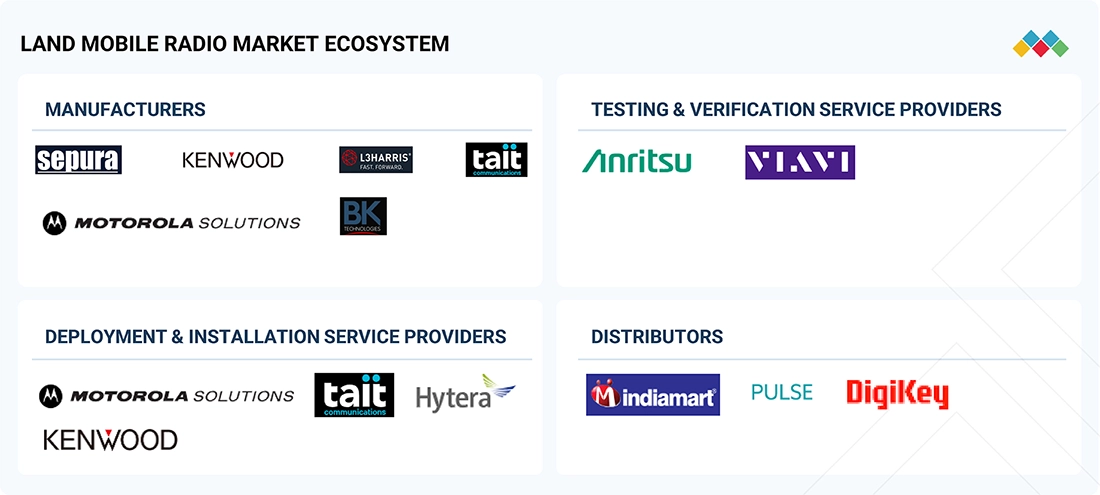
The land mobile radio market ecosystem comprises a diverse network of players that collectively enable the design, production, testing, deployment, and distribution of mission-critical communication systems. Manufacturers such as Sepura, Kenwood, L3Harris, Motorola Solutions, Tait Communications, and BK Technologies develop and produce advanced LMR equipment, including TETRA, DMR, and P25 radios, used across public safety, transportation, and defense sectors. Testing & verification service providers like Anritsu and Viavi Solutions ensure that these systems meet stringent performance, interoperability, and reliability standards before deployment. Deployment & installation service providers, including Motorola Solutions, Kenwood, Tait Communications, and Hytera, handle system integration, installation, and maintenance, ensuring seamless operation across large communication networks. Finally, distributors such as IndiaMART, Pulse, and Digi-Key supply LMR devices, components, and accessories to end users and integrators worldwide. Together, these stakeholders form a robust ecosystem that drives reliability, scalability, and innovation in professional and mission-critical radio communications.
Logos and trademarks shown above are the property of their respective owners. Their use here is for informational and illustrative purposes only.
LAND MOBILE RADIO MARKET SEGMENTS
Source: Secondary Research, Interviews with Experts, MarketsandMarkets Analysis
Land Mobile Radio Market, By Technology
The digital segment is projected to achieve significant growth during the forecast period. The availability of data services within digital technology doubles the capacity in existing licensed channels, due to which the market for the digital technology is projected to witness a higher growth than the analog segment during the forecast period. Moreover, the advanced functionalities offered by digital technologies, such as enhanced voice quality, integration of 4G/LTE, call recording, and group chats, is further expected to drive the growth of the digital technology segment.
Land Mobile Radio Market, By Type
The hand-portable segment is projected to witness a higher growth than the in-vehicle (mobile) segment during the forecast period. An increase in the need for compact sized, featherweight, and portable means of communication particularly in the public safety and business sector has led to the growth of this segment. Additionally, their growing adoption is further aided by battery life improvements as well as their durable nature.
Land Mobile Radio Market, By Frequency
The 700 MHz & above segment is projected to account for the largest share during the forecast period, primarily due to the long-range capability of this frequency band, which enables operators to broadcast over extended distances.
Land Mobile Radio, By Application
The public safety segment is projected to achieve a large market share throughout the forecast period. LMR systems are adopted across applications. These systems help establish interoperability between applications and dispatch centers. Additionally, LMR systems have a wide range that extends over long distance. They may be utilized in areas devoid of any mobile phone signal or those with an erratic pattern of cell connectivity. Public safety departments are progressively employing these systems on the most essential lines of communication.
LAND MOBILE RADIO MARKET REGION
Asia Pacific to be fastest-growing region in land mobile radio market during forecast period
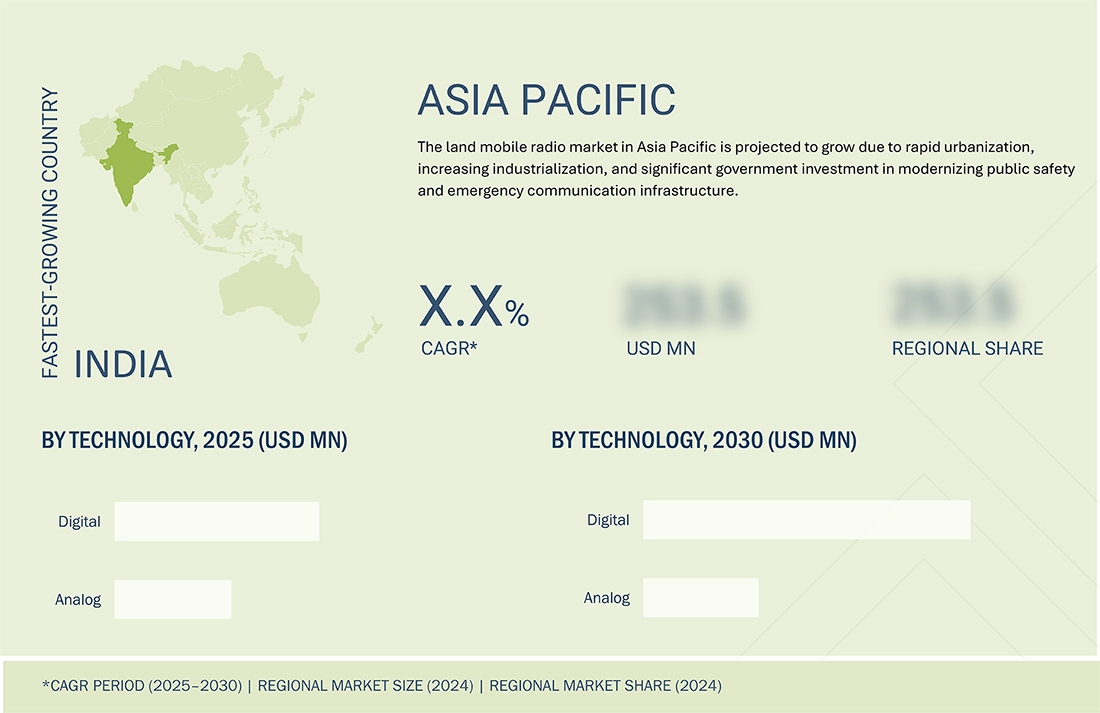
The Asia Pacific land mobile radio industry is growing quickly due to urbanization and rising public safety concerns in countries like China, Japan, and South Korea. The growth of this market is also driven by the increased usage of land mobile radios in industries, such as construction, manufacturing, mining and public safety. In China and Japan, a great demand for LMR solutions is being witnessed, especially in the transportation, energy, and public security sectors. The growth of this regional market can also be attributed to the presence of emerging players accompanied by the onset of new technologies. Some of the major players operating in Asia Pacific land mobile radio market are Hytera Communications Corporation Limited (China), Simoco Wireless Solutions (UK), and Tait Communications (New Zealand).
LAND MOBILE RADIO MARKET SIZE, SHARE & GROWTH: COMPANY EVALUATION MATRIX
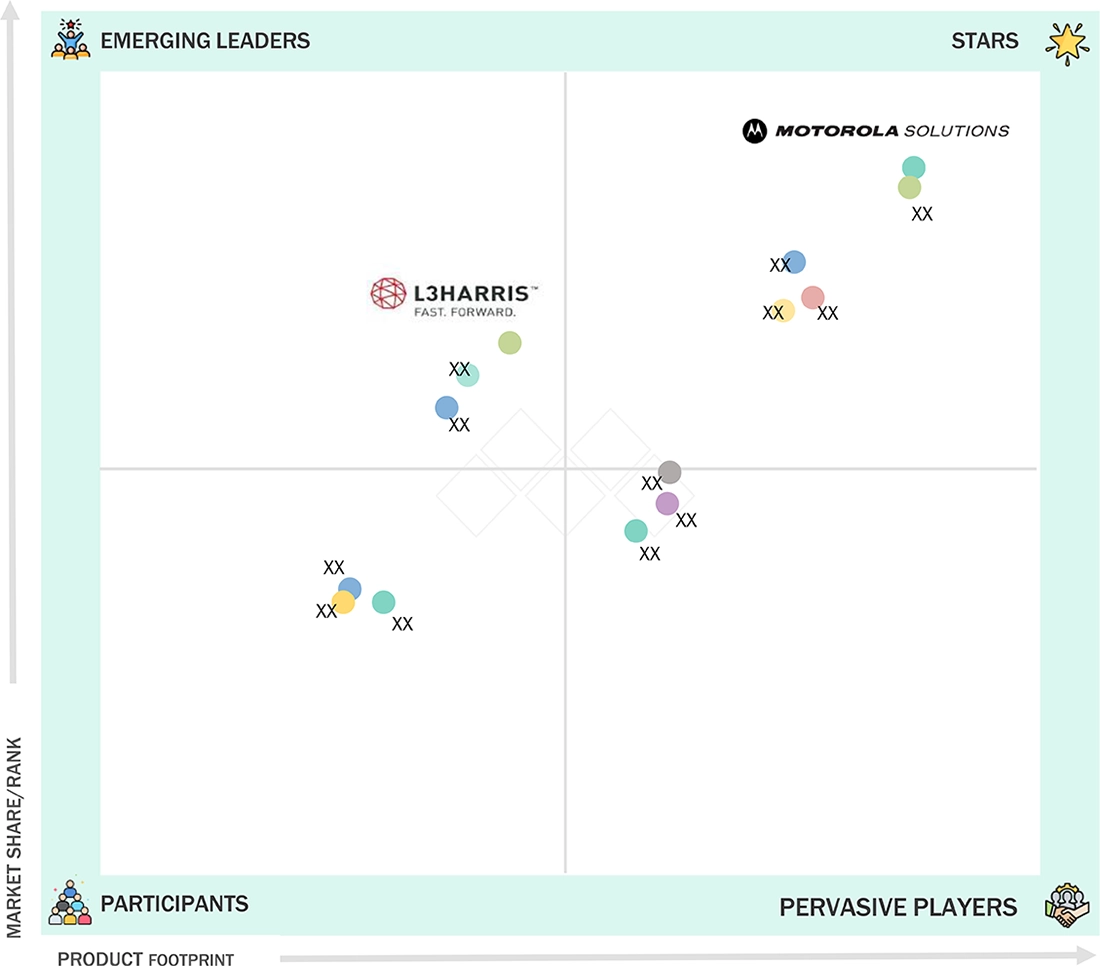
In the land mobile radio companies matrix, Motorola Solutions (Star) holds a leading position with a dominant market share, extensive product portfolio, and strong global presence across public safety, defense, and commercial sectors. The company’s success is driven by its advanced ASTRO P25, TETRA, and MOTOTRBO digital radio systems, complemented by integrated command center software, broadband solutions, and lifecycle management services. Motorola's long-standing relationships with government and emergency service agencies, coupled with its continuous innovation in hybrid LMR-LTE and AI-enabled communication platforms, reinforce its market leadership. On the other hand, L3Harris Technologies (Emerging Leader) is rapidly expanding its footprint with cutting-edge P25 and software-defined radio (SDR) solutions, offering high levels of interoperability, encryption, and field adaptability. The company's growing involvement in defense and tactical communication programs positions it as a strong challenger. It is steadily advancing toward the leaders’ quadrant as global demand rises for secure, interoperable, and broadband-integrated mission-critical communication systems.
Source: Secondary Research, Interviews with Experts, MarketsandMarkets Analysis
LAND MOBILE RADIO MARKET KEY PLAYERS
WHAT IS IN IT FOR YOU: land-professional-mobile-radio-market REPORT CONTENT GUIDE
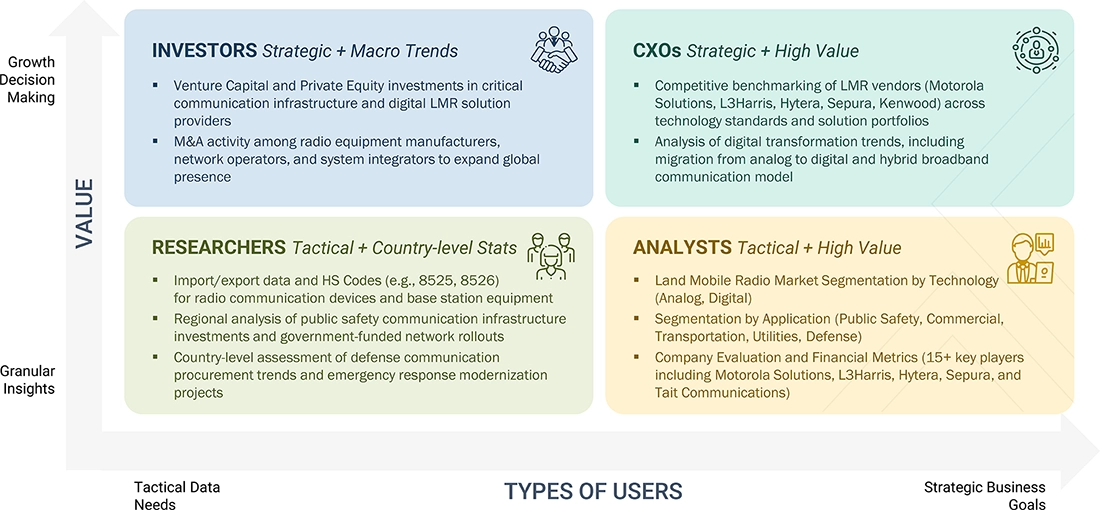
DELIVERED CUSTOMIZATIONS
We have successfully delivered the following deep-dive customizations:
| CLIENT REQUEST | CUSTOMIZATION DELIVERED | VALUE ADDS |
|---|---|---|
| LMR Manufacturer | Competitive profiling of leading LMR vendors, including Motorola Solutions, L3Harris Technologies, Hytera, Sepura, Kenwood, and Tait Communications | Benchmarking technology portfolios across analog, DMR, TETRA, and P25 standards |
| System Integrator/Deployment Service Provider | Benchmarking deployment and installation strategies for large-scale LMR systems | Evaluating performance optimization for multi-agency networks and regional coverage expansion |
| Public Safety Agency/Defense Organization | Comparative evaluation of LMR technologies based on reliability, encryption, and interoperability standards | Assessment of broadband and LMR network convergence for mission-critical communication |
| Component Supplier/Semiconductor Vendor | Mapping demand for RF components, semiconductors, power amplifiers, and encryption modules in digital LMR systems | Forecasting technology trends in SDR-based LMR platforms |
| Distributor/Channel Partner | Market mapping of authorized distributors, dealers, and value-added resellers across North America, Europe, and Asia Pacific | Tracking sales performance, regional coverage, and customer engagement models |
| CLIENT REQUEST | CUSTOMIZATION DELIVERED | VALUE ADDS |
| LMR Manufacturer | Competitive profiling of leading LMR vendors including Motorola Solutions, L3Harris Technologies, Hytera, Sepura, Kenwood, and Tait Communications | Benchmarking technology portfolios across analog, DMR, TETRA, and P25 standards |
| System Integrator / Deployment Service Provider | Benchmarking deployment and installation strategies for large-scale LMR systems | Evaluating performance optimization for multi-agency networks and regional coverage expansion |
| Public Safety Agency / Defense Organization | Comparative evaluation of LMR technologies based on reliability, encryption, and interoperability standards | Assessment of broadband and LMR network convergence for mission-critical communication |
| Component Supplier / Semiconductor Vendor | Mapping demand for RF components, semiconductors, power amplifiers, and encryption modules in digital LMR systems | Forecasting technology trends in SDR-based LMR platforms |
| Distributor / Channel Partner | Market mapping of authorized distributors, dealers, and value-added resellers across North America, Europe, and Asia Pacific | Tracking sales performance, regional coverage, and customer engagement models |
RECENT DEVELOPMENTS
- July 2026: Motorola Solutions, Inc. (Public) (US) announced that its APX NEXT XN P25 smart radio became the first fire radio to receive NFPA 1930 certification. The latest model combines land mobile radio (LMR), broadband, and low-Earth-orbit satellite connectivity, adding multi-bearer communications for resilient voice and data connectivity in areas beyond traditional cellular coverage.
- June 2025: Thales (France) secured a contract to supply 600 SYNAPS-V vehicle radios to the Belgian Ministry of Defence. The V/UHF software-defined radios are designed for vehicle-based military communications and are being integrated into Belgium's SCORPION vehicle fleet, directly representing a new land-radio procurement for Thales.
- June 2025: L3Harris Technologies, Inc. (US) introduced new communications capabilities for the U.S. Army's next-generation command-and-control architecture, including a tactical voice gateway adaptor and expanded support for P25, an established digital land mobile radio technology. The new gateway enables tactical radios to interoperate with 5G/4G, Wi-Fi, and other networks while retaining P25 and P25-trunking capabilities for secure interoperability.
- March 2025: JVCKENWOOD Corporation (Japan) announced that its radio-related subsidiary Radio Activity S.r.l. secured a €17.3 million contract to supply and install DMR digital radio systems for fire departments across 10 Italian regions. The system uses DMR-compatible simulcast repeaters and supports analog-to-digital migration while expanding coverage and strengthening encrypted emergency communications.
- February 2025: Motorola Solutions, Inc. (Public) (US) secured a 10-year, AUD $500 million contract extension with the Victorian Government to maintain and enhance the Metropolitan Mobile Radio (MMR) network used by Victoria's emergency services. The agreement extends operation of the P25-based LMR network through 2035 and adds capabilities including SmartConnect for switching between LMR, broadband, Wi-Fi, and satellite connectivity.
Table of Contents
 Exclusive indicates content/data unique to MarketsandMarkets and not available with any competitors.
TITLE
PAGE NO
1
INTRODUCTION
27
2
EXECUTIVE SUMMARY
32
3
PREMIUM INSIGHTS
37
4
MARKET OVERVIEW
Digital LMR shifts and hybrid adoption drive secure, government-backed communication evolution amidst high costs.
41
4.1
INTRODUCTION
4.2
MARKET DYNAMICS
4.2.1
DRIVERS
4.2.1.1
TRANSITION FROM ANALOG TO DIGITAL LMR TECHNOLOGIES
4.2.1.2
ADOPTION OF HYBRID LMR–LTE/5G SYSTEMS FOR SEAMLESS COMMUNICATION
4.2.1.3
GROWING GOVERNMENT INVESTMENTS IN PUBLIC SAFETY AND DEFENSE COMMUNICATION NETWORKS
4.2.1.4
INCREASING DEMAND FOR SECURE AND ENCRYPTED COMMUNICATION CHANNELS
4.2.2
RESTRAINTS
4.2.2.1
HIGH DEPLOYMENT AND MAINTENANCE COSTS OF LARGE-SCALE LMR INFRASTRUCTURE
4.2.2.2
LIMITED SPECTRUM AVAILABILITY AND REGULATORY CONSTRAINTS
4.2.3
OPPORTUNITIES
4.2.3.1
INTEGRATION OF LMR WITH IOT, GPS, AND DATA ANALYTICS FOR ADVANCED FIELD OPERATIONS
4.2.3.2
EXPANSION IN EMERGING MARKETS DRIVEN BY SMART CITY AND INFRASTRUCTURE PROJECTS
4.2.4
CHALLENGES
4.2.4.1
INTEROPERABILITY ISSUES BETWEEN MULTI-VENDOR AND MULTI-TECHNOLOGY SYSTEMS
4.2.4.2
CYBERSECURITY RISKS IN DIGITAL AND HYBRID COMMUNICATION ENVIRONMENTS
4.3
UNMET NEEDS AND WHITE SPACES
4.3.1
UNMET NEEDS IN LAND MOBILE RADIO MARKET
4.4
INTERCONNECTED MARKETS AND CROSS-SECTOR OPPORTUNITIES
4.4.1
INTERCONNECTED MARKETS
4.4.2
CROSS-SECTOR OPPORTUNITIES
4.5
STRATEGIC MOVES BY TIER 1/2/3 PLAYERS
4.5.1
STRATEGIC MOVES BY TIER 1/2/3 PLAYERS
5
INDUSTRY TRENDS
Navigate industry shifts with strategic insights from LMR pricing trends and competitive dynamics.
51
5.1
INTRODUCTION
5.2
PORTER’S FIVE FORCES ANALYSIS
5.2.1
THREAT FROM NEW ENTRANTS
5.2.2
THREAT FROM SUBSTITUTES
5.2.3
BARGAINING POWER OF SUPPLIERS
5.2.4
BARGAINING POWER OF BUYERS
5.2.5
INTENSITY OF COMPETITIVE RIVALRY
5.3
MACROECONOMIC OUTLOOK
5.3.1
INTRODUCTION
5.3.2
GDP TRENDS AND FORECAST
5.3.3
TRENDS IN GLOBAL LAND MOBILE RADIO (LMR) MARKET
5.4
VALUE CHAIN ANALYSIS
5.5
ECOSYSTEM ANALYSIS
5.6
PRICING ANALYSIS
5.6.1
AVERAGE SELLING PRICE TREND OF LAND MOBILE RADIO TYPES, BY KEY PLAYER
5.6.2
AVERAGE SELLING PRICE TREND OF LAND MOBILE RADIOS, BY FREQUENCY
5.6.3
AVERAGE SELLING PRICE TREND OF LAND MOBILE RADIOS, BY APPLICATION
5.6.4
AVERAGE SELLING PRICE TREND, BY REGION
5.7
TRADE ANALYSIS
5.7.1
IMPORT DATA (HS CODE 852560)
5.7.2
EXPORT DATA (HS CODE 852560)
5.8
KEY CONFERENCES & EVENTS, 2025–2026
5.9
TRENDS/DISRUPTIONS IMPACTING CUSTOMER BUSINESS
5.10
INVESTMENT & FUNDING SCENARIO
5.11
CASE STUDY ANALYSIS
5.11.1
MOTOROLA HELPED OAKLAND COUNTY IMPLEMENT ADVANCED COMMUNICATION SOLUTION TO BOOST OPERATIONAL EFFICIENCY
5.11.2
ISTANBUL NEW AIRPORT IMPLEMENTED DIGITAL RADIO SYSTEM TO ENSURE RELIABLE AND SECURE COMMUNICATION ACROSS AIRPORT
5.11.3
CODON RADIO SOLUTIONS ASSISTED ROYAL MALAYSIA POLICE IN IMPLEMENTING NEW COMMUNICATION SYSTEM TO IMPROVE COVERAGE AND RELIABILITY
5.11.4
NESA IMPLEMENTED SEPURA SINE RAKEL SYSTEM TO PROVIDE IMPROVED COVERAGE AND INTEGRATION CAPABILITIES
5.11.5
THALES APPROVED IRISH DEFENSE FORCES’ SOFTWARE-DEFINED RADIOS TO EXPEDITE DIGITAL TRANSFORMATION
5.12
US 2025 TARIFF
5.12.1
KEY TARIFF RATES
5.12.2
PRICE IMPACT ANALYSIS
5.12.3
IMPACT OF REGION/COUNTRY
5.12.3.1
US
5.12.3.2
EUROPE
5.12.3.3
ASIA PACIFIC
5.12.4
IMPACT ON KEY APPLICATIONS
5.12.4.1
COMMERCIAL
5.12.4.2
PUBLIC SAFETY
6
STRATEGIC DISRUPTION THROUGH TECHNOLOGY, PATENTS, DIGITAL, AND AI ADOPTION
Harness strategic growth by leveraging AI and patents in the evolving land mobile radio market.
73
6.1
KEY TECHNOLOGIES
6.1.1
DIGITAL SIGNAL PROCESSING
6.1.2
TRUNKED RADIO SYSTEMS
6.1.3
PUSH-TO-TALK OVER CELLULAR
6.2
COMPLEMENTARY TECHNOLOGIES
6.2.1
ENCRYPTION
6.3
ADJACENT TECHNOLOGIES
6.3.1
IOT
6.4
TECHNOLOGY ROADMAP
6.5
PATENT ANALYSIS
6.6
IMPACT OF AI ON LAND MOBILE RADIO MARKET
6.6.1
TOP USE CASES AND MARKET POTENTIAL
6.6.2
BEST PRACTICES IN LAND MOBILE RADIO MARKET
6.6.3
CLIENTS’ READINESS TO ADOPT AI IN LAND MOBILE RADIO MARKET
6.7
INTERCONNECTED ADJACENT MARKET ECOSYSTEM AND IMPACT ON MARKET PLAYERS
7
REGULATORY LANDSCAPE
Navigate complex global regulations with insights into regional compliance and key regulatory bodies.
80
7.1
REGIONAL REGULATIONS AND COMPLIANCE
7.1.1
REGULATORY BODIES, GOVERNMENT AGENCIES, AND OTHER ORGANIZATIONS
7.1.2
INDUSTRY STANDARDS
7.1.3
REGULATIONS
8
CUSTOMER LANDSCAPE & BUYER BEHAVIOR
Uncover critical stakeholder influences and unmet needs shaping buyer decisions in diverse verticals.
84
8.1
DECISION-MAKING PROCESS
8.2
KEY STAKEHOLDERS AND BUYING EVALUATION CRITERIA
8.2.1
KEY STAKEHOLDERS IN BUYING PROCESS
8.2.2
BUYING CRITERIA
8.3
ADOPTION BARRIERS & INTERNAL CHALLENGES
8.4
UNMET NEEDS FROM VARIOUS VERTICALS
9
LAND MOBILE RADIO MARKET, BY TYPE
Market Size & Growth Rate Forecast Analysis to 2030 in USD Million and Units | 8 Data Tables
89
9.1
INTRODUCTION
9.2
HAND-PORTABLE
9.2.1
GROWING DEMAND FOR HAND-PORTABLE AND EASY-TO-USE MOBILE COMMUNICATION TO DRIVE MARKET
9.3
IN-VEHICLE (MOBILE)
9.3.1
PRESSING NEED FOR SECURED OPERATIONS AND CONSTANT CONNECTIVITY TO BOOST DEMAND
10
LAND MOBILE RADIO MARKET, BY TECHNOLOGY
Market Size & Growth Rate Forecast Analysis to 2030 in USD Million and Units | 20 Data Tables
94
10.1
INTRODUCTION
10.2
ANALOG
10.2.1
GROWING USE OF ANALOG LAND MOBILE RADIO SYSTEMS IN PUBLIC SAFETY SECTOR TO BOOST DEMAND
10.3
DIGITAL
10.3.1
IMPROVED VOICE CLARITY AND ENHANCED DATA CAPABILITIES TO FOSTER MARKET GROWTH
10.3.2
TETRA
10.3.2.1
ABILITY TO OFFER ADVANCED FUNCTIONALITIES TO BOOST DEMAND
10.3.3
DIGITAL MOBILE RADIO
10.3.3.1
INCREASING NEED FOR DMR IN DOMESTIC AND SHORT-RANGE INDUSTRIAL SETTINGS TO BOOST DEMAND
10.3.4
PROJECT 25
10.3.4.1
ABILITY TO OFFER BACKWARD COMPATIBILITY AND INTEROPERABILITY WITH OTHER SYSTEMS TO DRIVE MARKET
10.3.5
OTHER DIGITAL TECHNOLOGIES
11
LAND MOBILE RADIO MARKET, BY FREQUENCY
Market Size & Growth Rate Forecast Analysis to 2030 in USD Million and Units | 10 Data Tables
104
11.1
INTRODUCTION
11.2
25–174 MHZ (VHF)
11.2.1
RISING USE IN FM BROADCASTING AND MISSION-CRITICAL COMMUNICATIONS TO DRIVE MARKET
11.3
200–512 MHZ (UHF)
11.3.1
ABILITY TO OFFER ENHANCED MOBILITY AND IMPROVED SOUND QUALITY IN ADVERSE WEATHER CONDITIONS TO SPUR DEMAND
11.4
700 MHZ & ABOVE (SHF)
11.4.1
INCREASING USE IN COMMERCIAL, INDUSTRIAL, AND MILITARY SECTORS TO FOSTER MARKET GROWTH
12
LAND MOBILE RADIO MARKET, BY APPLICATION
Market Size & Growth Rate Forecast Analysis to 2030 in USD Million and Units | 36 Data Tables
110
12.1
INTRODUCTION
12.2
COMMERCIAL
12.2.1
RETAIL
12.2.1.1
GROWING DEMAND FOR MULTI-LANGUAGE SETTINGS TO DRIVE MARKET
12.2.2
TRANSPORTATION
12.2.2.1
RISING FOCUS ON SECURITY ACROSS LAND, AIR, AND SEA TRANSPORT TO BOOST DEMAND
12.2.3
UTILITY
12.2.3.1
FOCUS ON REGULATING POWER OUTAGE TO FOSTER GROWTH
12.2.4
MINING
12.2.4.1
PRESSING NEED FOR IMPROVED COMMUNICATION AND SAFETY TECHNOLOGIES AT MINING SITES TO ACCELERATE DEMAND
12.2.5
OTHER COMMERCIAL APPLICATIONS
12.3
PUBLIC SAFETY
12.3.1
MILITARY & DEFENSE
12.3.1.1
ABILITY TO OFFER ENCRYPTED CHANNELS AND SECURED COMMUNICATION TO BOOST DEMAND
12.3.2
HOMELAND SECURITY
12.3.2.1
ADVENT OF NEW TECHNOLOGY STANDARDS TO DRIVE MARKET
12.3.3
EMERGENCY & MEDICAL SERVICES
12.3.3.1
INTEGRATION OF DIGITAL AND TRUNKED SYSTEMS TO ACCELERATE DEMAND
12.3.4
FIRE DEPARTMENT
12.3.4.1
RISING DEMAND FOR RELIABLE AND UNINTERRUPTED RADIO COMMUNICATION TOOLS TO FOSTER MARKET GROWTH
12.3.5
OTHER PUBLIC SAFETY APPLICATIONS
13
LAND MOBILE RADIO MARKET, BY REGION
Comprehensive coverage of 11 Regions with country-level deep-dive of 11 Countries | 150 Data Tables.
127
13.1
INTRODUCTION
13.2
NORTH AMERICA
13.2.1
MACROECONOMIC OUTLOOK
13.2.2
US
13.2.2.1
ADVANCEMENTS IN WIDEBAND TECHNOLOGY TO OFFER LUCRATIVE GROWTH OPPORTUNITIES
13.2.3
CANADA
13.2.3.1
RISING EMPHASIS ON DEVELOPING DIGITAL TRUNKING SYSTEMS AND NARROWBAND TECHNOLOGIES TO DRIVE MARKET
13.2.4
MEXICO
13.2.4.1
GOVERNMENT-LED INITIATIVES TO MODERNIZE COMMUNICATION INFRASTRUCTURE TO SPUR DEMAND
13.3
EUROPE
13.3.1
MACROECONOMIC OUTLOOK
13.3.2
GERMANY
13.3.2.1
GROWING SHIFT FROM ANALOG TO DIGITAL COMMUNICATION SYSTEMS TO BOOST DEMAND
13.3.3
UK
13.3.3.1
RISING DEMAND FOR RELIABLE AND SECURE COMMUNICATION SYSTEMS IN TRANSPORTATION AND UTILITIES SECTORS TO DRIVE MARKET
13.3.4
FRANCE
13.3.4.1
INCREASING DEPLOYMENT OF STANDARDIZED TECHNOLOGIES TO OFFER LUCRATIVE GROWTH OPPORTUNITIES
13.3.5
ITALY
13.3.5.1
DIGITAL TRANSFORMATION AND PUBLIC SAFETY MODERNIZATION TO DRIVE GROWTH
13.3.6
REST OF EUROPE
13.4
ASIA PACIFIC
13.4.1
MACROECONOMIC OUTLOOK
13.4.2
CHINA
13.4.2.1
LOW COST OF DIGITAL TERMINALS TO BOOST DEMAND
13.4.3
JAPAN
13.4.3.1
GROWING APPLICATION OF LMR TECHNOLOGY IN RAILWAYS TO SPUR DEMAND
13.4.4
SOUTH KOREA
13.4.4.1
ONGOING DEVELOPMENTS IN MOBILE COMMUNICATION DEVICES TO ACCELERATE DEMAND
13.4.5
INDIA
13.4.5.1
ONGOING DEVELOPMENTS IN MOBILE COMMUNICATION TO ACCELERATE DEMAND
13.4.6
REST OF ASIA PACIFIC
13.5
ROW (REST OF THE WORLD)
13.5.1
MACROECONOMIC OUTLOOK
13.5.2
MIDDLE EAST & AFRICA
13.5.2.1
RISING NEED TO ENHANCE SECURITY AND EMERGENCY RESPONSE CAPABILITIES TO ACCELERATE DEMAND
13.5.2.2
GCC COUNTRIES
13.5.2.3
REST OF MIDDLE EAST
13.5.3
SOUTH AMERICA
13.5.3.1
GROWING PRIVATIZATION OF TELECOMMUNICATION SERVICES TO DRIVE MARKET
14
COMPETITIVE LANDSCAPE
Discover key strategies and market shares defining the competitive edge in land mobile radio.
182
14.1
OVERVIEW
14.2
KEY PLAYER STRATEGIES/RIGHT TO WIN, 2021–2025
14.3
REVENUE ANALYSIS, 2021–2024
14.4
MARKET SHARE ANALYSIS, 2024
14.5
COMPANY VALUATION AND FINANCIAL METRICS
14.6
BRAND/PRODUCT COMPARISON
14.7
COMPANY EVALUATION MATRIX: KEY PLAYERS, 2024
14.7.1
STARS
14.7.2
EMERGING LEADERS
14.7.3
PERVASIVE PLAYERS
14.7.4
PARTICIPANTS
14.7.5
COMPANY FOOTPRINT: KEY PLAYERS, 2024
14.7.5.1
COMPANY FOOTPRINT
14.7.5.2
REGIONAL FOOTPRINT
14.7.5.3
APPLICATION FOOTPRINT
14.7.5.4
TECHNOLOGY FOOTPRINT
14.7.5.5
TYPE FOOTPRINT
14.8
COMPANY EVALUATION MATRIX: STARTUPS/SMES, 2024
14.8.1
PROGRESSIVE COMPANIES
14.8.2
RESPONSIVE COMPANIES
14.8.3
DYNAMIC COMPANIES
14.8.4
STARTING BLOCKS
14.8.5
COMPETITIVE BENCHMARKING: STARTUPS/SMES, 2024
14.8.5.1
DETAILED LIST OF KEY STARTUPS/SMES
14.8.5.2
COMPETITIVE BENCHMARKING OF KEY STARTUPS/SMES
14.9
COMPETITIVE SCENARIO
14.9.1
PRODUCT LAUNCHES/DEVELOPMENTS
14.9.2
DEALS
15
COMPANY PROFILES
In-depth Company Profiles of Leading Market Players with detailed Business Overview, Product and Service Portfolio, Recent Developments, and Unique Analyst Perspective (MnM View)
200
15.1
KEY PLAYERS
15.1.1
SEPURA LIMITED
15.1.1.1
BUSINESS OVERVIEW
15.1.1.2
PRODUCTS/SOLUTIONS/SERVICES OFFERED
15.1.1.3
RECENT DEVELOPMENTS
15.1.1.3.1
PRODUCT LAUNCHES/DEVELOPMENTS
15.1.1.3.2
DEALS
15.1.1.4
MNM VIEW
15.1.1.4.1
KEY STRENGTHS
15.1.1.4.2
STRATEGIC CHOICES
15.1.1.4.3
WEAKNESSES AND COMPETITIVE THREATS
15.1.2
MOTOROLA SOLUTIONS, INC.
15.1.3
L3HARRIS TECHNOLOGIES, INC.
15.1.4
JVCKENWOOD CORPORATION
15.1.5
THALES
15.1.6
ICOM INC.
15.1.7
BK TECHNOLOGIES
15.1.8
HYTERA COMMUNICATIONS CORPORATION LIMITED
15.1.9
LEONARDO S.P.A.
15.1.10
CODAN LIMITED
15.2
OTHER PLAYERS
15.2.1
WEAVIX
15.2.2
REPLAY INC
15.2.3
GOTENNA
15.2.4
TALKPOD TECHNOLOGY CO., LTD.
15.2.5
QUANZHOU YANTON ELECTRONICS CO., LTD
15.2.6
KMOBILE COMMUNICATION CO., LTD (ESTALKY)
15.2.7
COMMCRETE
15.2.8
ESCHAT
15.2.9
BOTTLE
15.2.10
BEARTOOTH
15.2.11
AIRACOM LIMITED
15.2.12
TELDIO CORPORATION
15.2.13
COMMUNICATIONS-APPLIED TECHNOLOGY
15.2.14
ZETRON
15.2.15
POWERTRUNK
16
RESEARCH METHODOLOGY
251
16.1
RESEARCH DATA
16.1.1
SECONDARY DATA
16.1.1.1
LIST OF KEY SECONDARY SOURCES
16.1.1.2
KEY DATA FROM SECONDARY SOURCES
16.1.2
PRIMARY DATA
16.1.2.1
LIST OF KEY INTERVIEW PARTICIPANTS
16.1.2.2
BREAKDOWN OF PRIMARIES
16.1.2.3
KEY DATA FROM PRIMARY SOURCES
16.1.2.4
KEY INDUSTRY INSIGHTS
16.1.3
SECONDARY AND PRIMARY RESEARCH
16.2
MARKET SIZE ESTIMATION
16.2.1
BOTTOM-UP APPROACH
16.2.1.1
APPROACH TO ESTIMATE MARKET SIZE USING BOTTOM-UP ANALYSIS (SUPPLY SIDE)
16.2.2
TOP-DOWN APPROACH
16.2.2.1
APPROACH TO ESTIMATE MARKET SIZE USING TOP-DOWN ANALYSIS (DEMAND SIDE)
16.3
DATA TRIANGULATION
16.4
RESEARCH ASSUMPTIONS
16.5
RISK ASSESSMENT
16.6
RESEARCH LIMITATIONS
17
APPENDIX
262
17.1
DISCUSSION GUIDE
17.2
KNOWLEDGESTORE: MARKETSANDMARKETS’ SUBSCRIPTION PORTAL
17.3
CUSTOMIZATION OPTIONS
17.4
RELATED REPORTS
17.5
AUTHOR DETAILS
LIST OF TABLES
TABLE 1
LAND MOBILE RADIO MARKET: PORTER’S FIVE FORCES ANALYSIS
TABLE 2
GDP PERCENTAGE CHANGE, BY KEY COUNTRY, 2021–2030
TABLE 3
ROLE OF PLAYERS IN LAND MOBILE RADIO MARKET ECOSYSTEM
TABLE 4
AVERAGE SELLING PRICE TREND OF LAND MOBILE RADIOS, BY TYPE, 2021–2024 (USD)
TABLE 5
AVERAGE SELLING PRICE TREND OF LAND MOBILE RADIOS, BY FREQUENCY, 2021–2024 (USD)
TABLE 6
AVERAGE SELLING PRICE TREND OF LAND MOBILE RADIOS, BY APPLICATION, 2021–2024 (USD)
TABLE 7
AVERAGE SELLING PRICE TREND, BY REGION, 2021–2024 (USD)
TABLE 8
IMPORT DATA FOR HS CODE 852560-COMPLIANT PRODUCTS, BY COUNTRY, 2020–2024 (USD MILLION)
TABLE 9
EXPORT DATA FOR HS CODE 852560-COMPLIANT PRODUCTS, BY COUNTRY, 2020–2024 (USD MILLION)
TABLE 10
KEY CONFERENCES & EVENTS, 2025–2026
TABLE 11
RECIPROCAL TARIFF RATES ADJUSTED BY US
TABLE 12
LIST OF PATENTS APPLIED/GRANTED, JUNE 2021–NOVEMBER 2025
TABLE 13
TOP USE CASES AND MARKET POTENTIAL
TABLE 14
BEST PRACTICES: COMPANIES IMPLEMENTING AI IN LAND MOBILE RADIO MARKET
TABLE 15
INTERCONNECTED ADJACENT MARKET ECOSYSTEM AND IMPACT ON MARKET PLAYERS
TABLE 16
NORTH AMERICA: REGULATORY BODIES, GOVERNMENT AGENCIES, AND OTHER ORGANIZATIONS
TABLE 17
EUROPE: REGULATORY BODIES, GOVERNMENT AGENCIES, AND OTHER ORGANIZATIONS
TABLE 18
ASIA PACIFIC: REGULATORY BODIES, GOVERNMENT AGENCIES, AND OTHER ORGANIZATIONS
TABLE 19
ROW: REGULATORY BODIES, GOVERNMENT AGENCIES, AND OTHER ORGANIZATIONS
TABLE 20
INFLUENCE OF STAKEHOLDERS ON BUYING PROCESS FOR APPLICATIONS
TABLE 21
KEY BUYING CRITERIA FOR APPLICATIONS
TABLE 22
UNMET NEEDS IN LAND MOBILE RADIO MARKET, BY APPLICATION
TABLE 23
LAND MOBILE RADIO MARKET, BY TYPE, 2021–2024 (USD MILLION)
TABLE 24
LAND MOBILE RADIO MARKET, BY TYPE, 2025–2030 (USD MILLION)
TABLE 25
LAND MOBILE RADIO MARKET, BY TYPE, 2021–2024 (THOUSAND UNITS)
TABLE 26
LAND MOBILE RADIO MARKET, BY TYPE, 2025–2030 (THOUSAND UNITS)
TABLE 27
HAND-PORTABLE: LAND MOBILE RADIO MARKET, BY REGION, 2021–2024 (USD MILLION)
TABLE 28
HAND-PORTABLE: LAND MOBILE RADIO MARKET, BY REGION, 2025–2030 (USD MILLION)
TABLE 29
IN-VEHICLE (MOBILE): LAND MOBILE RADIO MARKET, BY REGION, 2021–2024 (USD MILLION)
TABLE 30
IN-VEHICLE (MOBILE): LAND MOBILE RADIO MARKET, BY REGION, 2025–2030 (USD MILLION)
TABLE 31
LAND MOBILE RADIO MARKET, BY TECHNOLOGY, 2021–2024 (USD MILLION)
TABLE 32
LAND MOBILE RADIO MARKET, BY TECHNOLOGY, 2025–2030 (USD MILLION)
TABLE 33
LAND MOBILE RADIO MARKET, BY TECHNOLOGY, 2021–2024 (THOUSAND UNITS)
TABLE 34
LAND MOBILE RADIO MARKET, BY TECHNOLOGY, 2025–2030 (THOUSAND UNITS)
TABLE 35
ANALOG: LAND MOBILE RADIO MARKET, BY REGION, 2021–2024 (USD MILLION)
TABLE 36
ANALOG: LAND MOBILE RADIO MARKET, BY REGION, 2025–2030 (USD MILLION)
TABLE 37
DIGITAL: LAND MOBILE RADIO MARKET, BY REGION, 2021–2024 (USD MILLION)
TABLE 38
DIGITAL: LAND MOBILE RADIO MARKET, BY REGION, 2025–2030 (USD MILLION)
TABLE 39
DIGITAL: LAND MOBILE RADIO MARKET, BY TYPE, 2021–2024 (USD MILLION)
TABLE 40
DIGITAL: LAND MOBILE RADIO MARKET, BY TYPE, 2025–2030 (USD MILLION)
TABLE 41
DIGITAL: LAND MOBILE RADIO MARKET, BY TYPE, 2021–2024 (THOUSAND UNITS)
TABLE 42
DIGITAL: LAND MOBILE RADIO MARKET, BY TYPE, 2025–2030 (THOUSAND UNITS)
TABLE 43
TETRA: LAND MOBILE RADIO MARKET, BY REGION, 2021–2024 (USD MILLION)
TABLE 44
TETRA: LAND MOBILE RADIO MARKET, BY REGION, 2025–2030 (USD MILLION)
TABLE 45
DMR: LAND MOBILE RADIO MARKET, BY REGION, 2021–2024 (USD MILLION)
TABLE 46
DMR: LAND MOBILE RADIO MARKET, BY REGION, 2025–2030 (USD MILLION)
TABLE 47
P25: LAND MOBILE RADIO MARKET, BY REGION, 2021–2024 (USD MILLION)
TABLE 48
P25: LAND MOBILE RADIO MARKET, BY REGION, 2025–2030 (USD MILLION)
TABLE 49
OTHER DIGITAL TECHNOLOGIES: LAND MOBILE RADIO MARKET, BY REGION, 2021–2024 (USD MILLION)
TABLE 50
OTHER DIGITAL TECHNOLOGIES: LAND MOBILE RADIO MARKET, BY REGION, 2025–2030 (USD MILLION)
TABLE 51
LAND MOBILE RADIO MARKET, BY FREQUENCY, 2021–2024 (USD MILLION)
TABLE 52
LAND MOBILE RADIO MARKET, BY FREQUENCY, 2025–2030 (USD MILLION)
TABLE 53
LAND MOBILE RADIO MARKET, BY FREQUENCY, 2021–2024 (THOUSAND UNITS)
TABLE 54
LAND MOBILE RADIO MARKET, BY FREQUENCY, 2025–2030 (THOUSAND UNITS)
TABLE 55
25–174 MHZ (VHF): LAND MOBILE RADIO MARKET, BY REGION, 2021–2024 (USD MILLION)
TABLE 56
25–174 MHZ (VHF): LAND MOBILE RADIO MARKET, BY REGION, 2025–2030 (USD MILLION)
TABLE 57
200–512 MHZ (UHF): LAND MOBILE RADIO MARKET, BY REGION, 2021–2024 (USD MILLION)
TABLE 58
200–512 MHZ (UHF): LAND MOBILE RADIO MARKET, BY REGION, 2025–2030 (USD MILLION)
TABLE 59
700 MHZ & ABOVE (SHF): LAND MOBILE RADIO MARKET, BY REGION, 2021–2024 (USD MILLION)
TABLE 60
700 MHZ & ABOVE (SHF): LAND MOBILE RADIO MARKET, BY REGION, 2025–2030 (USD MILLION)
TABLE 61
LAND MOBILE RADIO MARKET, BY APPLICATION, 2021–2024 (USD MILLION)
TABLE 62
LAND MOBILE RADIO MARKET, BY APPLICATION, 2025–2030 (USD MILLION)
TABLE 63
LAND MOBILE RADIO MARKET, BY APPLICATION, 2021–2024 (THOUSAND UNITS)
TABLE 64
LAND MOBILE RADIO MARKET, BY APPLICATION, 2025–2030 (THOUSAND UNITS)
TABLE 65
COMMERCIAL: LAND MOBILE RADIO MARKET, BY REGION, 2021–2024 (USD MILLION)
TABLE 66
COMMERCIAL: LAND MOBILE RADIO MARKET, BY REGION, 2025–2030 (USD MILLION)
TABLE 67
COMMERCIAL: LAND MOBILE RADIO MARKET, BY TYPE, 2021–2024 (USD MILLION)
TABLE 68
COMMERCIAL: LAND MOBILE RADIO MARKET, BY TYPE, 2025–2030 (USD MILLION)
TABLE 69
COMMERCIAL: LAND MOBILE RADIO MARKET, BY TYPE, 2021–2024 (THOUSAND UNITS)
TABLE 70
COMMERCIAL: LAND MOBILE RADIO MARKET, BY TYPE, 2025–2030 (THOUSAND UNITS)
TABLE 71
RETAIL: LAND MOBILE RADIO MARKET, BY REGION, 2021–2024 (USD MILLION)
TABLE 72
RETAIL: LAND MOBILE RADIO MARKET, BY REGION, 2025–2030 (USD MILLION)
TABLE 73
TRANSPORTATION: LAND MOBILE RADIO MARKET, BY REGION, 2021–2024 (USD MILLION)
TABLE 74
TRANSPORTATION: LAND MOBILE RADIO MARKET, BY REGION, 2025–2030 (USD MILLION)
TABLE 75
UTILITY: LAND MOBILE RADIO MARKET, BY REGION, 2021–2024 (USD MILLION)
TABLE 76
UTILITY: LAND MOBILE RADIO MARKET, BY REGION, 2025–2030 (USD MILLION)
TABLE 77
MINING: LAND MOBILE RADIO MARKET, BY REGION, 2021–2024 (USD MILLION)
TABLE 78
MINING: LAND MOBILE RADIO MARKET, BY REGION, 2025–2030 (USD MILLION)
TABLE 79
OTHER COMMERCIAL APPLICATIONS: LAND MOBILE RADIO MARKET, BY REGION, 2021–2024 (USD MILLION)
TABLE 80
OTHER COMMERCIAL APPLICATIONS: LAND MOBILE RADIO MARKET, BY REGION, 2025–2030 (USD MILLION)
TABLE 81
PUBLIC SAFETY: LAND MOBILE RADIO MARKET, BY REGION, 2021–2024 (USD MILLION)
TABLE 82
PUBLIC SAFETY: LAND MOBILE RADIO MARKET, BY REGION, 2025–2030 (USD MILLION)
TABLE 83
PUBLIC SAFETY: LAND MOBILE RADIO MARKET, BY TYPE, 2021–2024 (USD MILLION)
TABLE 84
PUBLIC SAFETY: LAND MOBILE RADIO MARKET, BY TYPE, 2025–2030 (USD MILLION)
TABLE 85
PUBLIC SAFETY: LAND MOBILE RADIO MARKET, BY TYPE, 2021–2024 (THOUSAND UNITS)
TABLE 86
PUBLIC SAFETY: LAND MOBILE RADIO MARKET, BY TYPE, 2025–2030 (THOUSAND UNITS)
TABLE 87
MILITARY & DEFENSE: LAND MOBILE RADIO MARKET, BY REGION, 2021–2024 (USD MILLION)
TABLE 88
MILITARY & DEFENSE: LAND MOBILE RADIO MARKET, BY REGION, 2025–2030 (USD MILLION)
TABLE 89
HOMELAND SECURITY: LAND MOBILE RADIO MARKET, BY REGION, 2021–2024 (USD MILLION)
TABLE 90
HOMELAND SECURITY: LAND MOBILE RADIO MARKET, BY REGION, 2025–2030 (USD MILLION)
TABLE 91
EMERGENCY & MEDICAL SERVICES: LAND MOBILE RADIO MARKET, BY REGION, 2021–2024 (USD MILLION)
TABLE 92
EMERGENCY & MEDICAL SERVICES: LAND MOBILE RADIO MARKET, BY REGION, 2025–2030 (USD MILLION)
TABLE 93
FIRE DEPARTMENT: LAND MOBILE RADIO MARKET, BY REGION, 2021–2024 (USD MILLION)
TABLE 94
FIRE DEPARTMENT: LAND MOBILE RADIO MARKET, BY REGION, 2025–2030 (USD MILLION)
TABLE 95
OTHER PUBLIC SAFETY APPLICATIONS: LAND MOBILE RADIO MARKET, BY REGION, 2021–2024 (USD MILLION)
TABLE 96
OTHER PUBLIC SAFETY APPLICATIONS: LAND MOBILE RADIO MARKET, BY REGION, 2025–2030 (USD MILLION)
TABLE 97
LAND MOBILE RADIO MARKET, BY REGION, 2021–2024 (USD MILLION)
TABLE 98
LAND MOBILE RADIO MARKET, BY REGION, 2025–2030 (USD MILLION)
TABLE 99
LAND MOBILE RADIO MARKET, BY REGION, 2021–2024 (THOUSAND UNITS)
TABLE 100
LAND MOBILE RADIO MARKET, BY REGION, 2025–2030 (THOUSAND UNITS)
TABLE 101
NORTH AMERICA: LAND MOBILE RADIO MARKET, BY TYPE, 2021–2024 (USD MILLION)
TABLE 102
NORTH AMERICA: LAND MOBILE RADIO MARKET, BY TYPE, 2025–2030 (USD MILLION)
TABLE 103
NORTH AMERICA: LAND MOBILE RADIO MARKET, BY TYPE, 2021–2024 (THOUSAND UNITS)
TABLE 104
NORTH AMERICA: LAND MOBILE RADIO MARKET, BY TYPE, 2025–2030 (THOUSAND UNITS)
TABLE 105
NORTH AMERICA: LAND MOBILE RADIO MARKET, BY TECHNOLOGY, 2021–2024 (USD MILLION)
TABLE 106
NORTH AMERICA: LAND MOBILE RADIO MARKET, BY TECHNOLOGY, 2025–2030 (USD MILLION)
TABLE 107
NORTH AMERICA: LAND MOBILE RADIO MARKET, BY TECHNOLOGY, 2021–2024 (THOUSAND UNITS)
TABLE 108
NORTH AMERICA: LAND MOBILE RADIO MARKET, BY TECHNOLOGY, 2025–2030 (THOUSAND UNITS)
TABLE 109
NORTH AMERICA: LAND MOBILE RADIO MARKET FOR DIGITAL, BY TYPE, 2021–2024 (USD MILLION)
TABLE 110
NORTH AMERICA: LAND MOBILE RADIO MARKET FOR DIGITAL, BY TYPE, 2025–2030 (USD MILLION)
TABLE 111
NORTH AMERICA: LAND MOBILE RADIO MARKET FOR DIGITAL, BY TYPE, 2021–2024 (THOUSAND UNITS)
TABLE 112
NORTH AMERICA: LAND MOBILE RADIO MARKET FOR DIGITAL, BY TYPE, 2025–2030 (THOUSAND UNITS)
TABLE 113
NORTH AMERICA: LAND MOBILE RADIO MARKET, BY FREQUENCY, 2021–2024 (USD MILLION)
TABLE 114
NORTH AMERICA: LAND MOBILE RADIO MARKET, BY FREQUENCY, 2025–2030 (USD MILLION)
TABLE 115
NORTH AMERICA: LAND MOBILE RADIO MARKET, BY FREQUENCY, 2021–2024 (THOUSAND UNITS)
TABLE 116
NORTH AMERICA: LAND MOBILE RADIO MARKET, BY FREQUENCY, 2025–2030 (THOUSAND UNITS)
TABLE 117
NORTH AMERICA: LAND MOBILE RADIO MARKET, BY APPLICATION, 2021–2024 (USD MILLION)
TABLE 118
NORTH AMERICA: LAND MOBILE RADIO MARKET, BY APPLICATION, 2025–2030 (USD MILLION)
TABLE 119
NORTH AMERICA: LAND MOBILE RADIO MARKET FOR COMMERCIAL, BY TYPE, 2021–2024 (USD MILLION)
TABLE 120
NORTH AMERICA: LAND MOBILE RADIO MARKET FOR COMMERCIAL, BY TYPE, 2025–2030 (USD MILLION)
TABLE 121
NORTH AMERICA: LAND MOBILE RADIO MARKET FOR COMMERCIAL, BY TYPE, 2021–2024 (THOUSAND UNITS)
TABLE 122
NORTH AMERICA: LAND MOBILE RADIO MARKET FOR COMMERCIAL, BY TYPE, 2025–2030 (THOUSAND UNITS)
TABLE 123
NORTH AMERICA: LAND MOBILE RADIO MARKET FOR PUBLIC SAFETY, BY TYPE, 2021–2024 (USD MILLION)
TABLE 124
NORTH AMERICA: LAND MOBILE RADIO MARKET FOR PUBLIC SAFETY, BY TYPE, 2025–2030 (USD MILLION)
TABLE 125
NORTH AMERICA: LAND MOBILE RADIO MARKET FOR PUBLIC SAFETY, BY TYPE, 2021–2024 (THOUSAND UNITS)
TABLE 126
NORTH AMERICA: LAND MOBILE RADIO MARKET FOR PUBLIC SAFETY, BY TYPE, 2025–2030 (THOUSAND UNITS)
TABLE 127
NORTH AMERICA: LAND MOBILE RADIO MARKET, BY COUNTRY, 2021–2024 (USD MILLION)
TABLE 128
NORTH AMERICA: LAND MOBILE RADIO MARKET, BY COUNTRY, 2025–2030 (USD MILLION)
TABLE 129
US: LAND MOBILE RADIO MARKET, BY TYPE, 2021–2024 (USD MILLION)
TABLE 130
US: LAND MOBILE RADIO MARKET, BY TYPE, 2025–2030 (USD MILLION)
TABLE 131
US: LAND MOBILE RADIO MARKET, BY TYPE, 2021–2024 (THOUSAND UNITS)
TABLE 132
US: LAND MOBILE RADIO MARKET, BY TYPE, 2025–2030 (THOUSAND UNITS)
TABLE 133
US: LAND MOBILE RADIO MARKET, BY TECHNOLOGY, 2021–2024 (USD MILLION)
TABLE 134
US: LAND MOBILE RADIO MARKET, BY TECHNOLOGY, 2025–2030 (USD MILLION)
TABLE 135
US: LAND MOBILE RADIO MARKET, BY TECHNOLOGY, 2021–2024 (THOUSAND UNITS)
TABLE 136
US: LAND MOBILE RADIO MARKET, BY TECHNOLOGY, 2025–2030 (THOUSAND UNITS)
TABLE 137
US: LAND MOBILE RADIO MARKET FOR DIGITAL, BY TYPE, 2021–2024 (USD MILLION)
TABLE 138
US: LAND MOBILE RADIO MARKET FOR DIGITAL, BY TYPE, 2025–2030 (USD MILLION)
TABLE 139
US: LAND MOBILE RADIO MARKET FOR DIGITAL, BY TYPE, 2021–2024 (THOUSAND UNITS)
TABLE 140
US: LAND MOBILE RADIO MARKET FOR DIGITAL, BY TYPE, 2025–2030 (THOUSAND UNITS)
TABLE 141
US: LAND MOBILE RADIO MARKET, BY FREQUENCY, 2021–2024 (USD MILLION)
TABLE 142
US: LAND MOBILE RADIO MARKET, BY FREQUENCY, 2025–2030 (USD MILLION)
TABLE 143
US: LAND MOBILE RADIO MARKET, BY FREQUENCY, 2021–2024 (THOUSAND UNITS)
TABLE 144
US: LAND MOBILE RADIO MARKET, BY FREQUENCY, 2025–2030 (THOUSAND UNITS)
TABLE 145
US: LAND MOBILE RADIO MARKET, BY APPLICATION, 2021–2024 (USD MILLION)
TABLE 146
US: LAND MOBILE RADIO MARKET, BY APPLICATION, 2025–2030 (USD MILLION)
TABLE 147
US: LAND MOBILE RADIO MARKET, BY APPLICATION, 2021–2024 (THOUSAND UNITS)
TABLE 148
US: LAND MOBILE RADIO MARKET, BY APPLICATION, 2025–2030 (THOUSAND UNITS)
TABLE 149
US: LAND MOBILE RADIO MARKET FOR COMMERCIAL, BY TYPE, 2021–2024 (USD MILLION)
TABLE 150
US: LAND MOBILE RADIO MARKET FOR COMMERCIAL, BY TYPE, 2025–2030 (USD MILLION)
TABLE 151
US: LAND MOBILE RADIO MARKET FOR COMMERCIAL, BY TYPE, 2021–2024 (THOUSAND UNITS)
TABLE 152
US: LAND MOBILE RADIO MARKET FOR COMMERCIAL, BY TYPE, 2025–2030 (THOUSAND UNITS)
TABLE 153
US: LAND MOBILE RADIO MARKET FOR PUBLIC SAFETY, BY TYPE, 2021–2024 (USD MILLION)
TABLE 154
US: LAND MOBILE RADIO MARKET FOR PUBLIC SAFETY, BY TYPE, 2025–2030 (USD MILLION)
TABLE 155
US: LAND MOBILE RADIO MARKET FOR PUBLIC SAFETY, BY TYPE, 2021–2024 (THOUSAND UNITS)
TABLE 156
US: LAND MOBILE RADIO MARKET FOR PUBLIC SAFETY, BY TYPE, 2025–2030 (THOUSAND UNITS)
TABLE 157
EUROPE: LAND MOBILE RADIO MARKET, BY TYPE, 2021–2024 (USD MILLION)
TABLE 158
EUROPE: LAND MOBILE RADIO MARKET, BY TYPE, 2025–2030 (USD MILLION)
TABLE 159
EUROPE: LAND MOBILE RADIO MARKET, BY TYPE, 2021–2024 (THOUSAND UNITS)
TABLE 160
EUROPE: LAND MOBILE RADIO MARKET, BY TYPE, 2025–2030 (THOUSAND UNITS)
TABLE 161
EUROPE: LAND MOBILE RADIO MARKET, BY TECHNOLOGY, 2021–2024 (USD MILLION)
TABLE 162
EUROPE: LAND MOBILE RADIO MARKET, BY TECHNOLOGY, 2025–2030 (USD MILLION)
TABLE 163
EUROPE: LAND MOBILE RADIO MARKET, BY TECHNOLOGY, 2021–2024 (THOUSAND UNITS)
TABLE 164
EUROPE: LAND MOBILE RADIO MARKET, BY TECHNOLOGY, 2025–2030 (THOUSAND UNITS)
TABLE 165
EUROPE: LAND MOBILE RADIO MARKET FOR DIGITAL, BY TYPE, 2021–2024 (USD MILLION)
TABLE 166
EUROPE: LAND MOBILE RADIO MARKET FOR DIGITAL, BY TYPE, 2025–2030 (USD MILLION)
TABLE 167
EUROPE: LAND MOBILE RADIO MARKET FOR DIGITAL, BY TYPE, 2021–2024 (THOUSAND UNITS)
TABLE 168
EUROPE: LAND MOBILE RADIO MARKET FOR DIGITAL, BY TYPE, 2025–2030 (THOUSAND UNITS)
TABLE 169
EUROPE: LAND MOBILE RADIO MARKET, BY FREQUENCY, 2021–2024 (USD MILLION)
TABLE 170
EUROPE: LAND MOBILE RADIO MARKET, BY FREQUENCY, 2025–2030 (USD MILLION)
TABLE 171
EUROPE: LAND MOBILE RADIO MARKET, BY FREQUENCY, 2021–2024 (THOUSAND UNITS)
TABLE 172
EUROPE: LAND MOBILE RADIO MARKET, BY FREQUENCY, 2025–2030 (THOUSAND UNITS)
TABLE 173
EUROPE: LAND MOBILE RADIO MARKET, BY APPLICATION, 2021–2024 (USD MILLION)
TABLE 174
EUROPE: LAND MOBILE RADIO MARKET, BY APPLICATION, 2025–2030 (USD MILLION)
TABLE 175
EUROPE: LAND MOBILE RADIO MARKET, BY APPLICATION, 2021–2024 (THOUSAND UNITS)
TABLE 176
EUROPE: LAND MOBILE RADIO MARKET, BY APPLICATION, 2025–2030 (THOUSAND UNITS)
TABLE 177
EUROPE: LAND MOBILE RADIO MARKET FOR COMMERCIAL, BY TYPE, 2021–2024 (USD MILLION)
TABLE 178
EUROPE: LAND MOBILE RADIO MARKET FOR COMMERCIAL, BY TYPE, 2025–2030 (USD MILLION)
TABLE 179
EUROPE: LAND MOBILE RADIO MARKET FOR COMMERCIAL, BY TYPE, 2021–2024 (THOUSAND UNITS)
TABLE 180
EUROPE: LAND MOBILE RADIO MARKET FOR COMMERCIAL, BY TYPE, 2025–2030 (THOUSAND UNITS)
TABLE 181
EUROPE: LAND MOBILE RADIO MARKET FOR PUBLIC SAFETY, BY TYPE, 2021–2024 (USD MILLION)
TABLE 182
EUROPE: LAND MOBILE RADIO MARKET FOR PUBLIC SAFETY, BY TYPE, 2025–2030 (USD MILLION)
TABLE 183
EUROPE: LAND MOBILE RADIO MARKET FOR PUBLIC SAFETY, BY TYPE, 2021–2024 (THOUSAND UNITS)
TABLE 184
EUROPE: LAND MOBILE RADIO MARKET FOR PUBLIC SAFETY, BY TYPE, 2025–2030 (THOUSAND UNITS)
TABLE 185
EUROPE: LAND MOBILE RADIO MARKET, BY COUNTRY/REGION, 2021–2024 (USD MILLION)
TABLE 186
EUROPE: LAND MOBILE RADIO MARKET, BY COUNTRY/REGION, 2025–2030 (USD MILLION)
TABLE 187
ASIA PACIFIC: LAND MOBILE RADIO MARKET, BY TYPE, 2021–2024 (USD MILLION)
TABLE 188
ASIA PACIFIC: LAND MOBILE RADIO MARKET, BY TYPE, 2025–2030 (USD MILLION)
TABLE 189
ASIA PACIFIC: LAND MOBILE RADIO MARKET, BY TYPE, 2021–2024 (THOUSAND UNITS)
TABLE 190
ASIA PACIFIC: LAND MOBILE RADIO MARKET, BY TYPE, 2025–2030 (THOUSAND UNITS)
TABLE 191
ASIA PACIFIC: LAND MOBILE RADIO MARKET, BY TECHNOLOGY, 2021–2024 (USD MILLION)
TABLE 192
ASIA PACIFIC: LAND MOBILE RADIO MARKET, BY TECHNOLOGY, 2025–2030 (USD MILLION)
TABLE 193
ASIA PACIFIC: LAND MOBILE RADIO MARKET, BY TECHNOLOGY, 2021–2024 (THOUSAND UNITS)
TABLE 194
ASIA PACIFIC: LAND MOBILE RADIO MARKET, BY TECHNOLOGY, 2025–2030 (THOUSAND UNITS)
TABLE 195
ASIA PACIFIC: LAND MOBILE RADIO MARKET FOR DIGITAL, BY TYPE, 2021–2024 (USD MILLION)
TABLE 196
ASIA PACIFIC: LAND MOBILE RADIO MARKET FOR DIGITAL, BY TYPE, 2025–2030 (USD MILLION)
TABLE 197
ASIA PACIFIC: LAND MOBILE RADIO MARKET FOR DIGITAL, BY TYPE, 2021–2024 (THOUSAND UNITS)
TABLE 198
ASIA PACIFIC: LAND MOBILE RADIO MARKET FOR DIGITAL, BY TYPE, 2025–2030 (THOUSAND UNITS)
TABLE 199
ASIA PACIFIC: LAND MOBILE RADIO MARKET, BY FREQUENCY, 2021–2024 (USD MILLION)
TABLE 200
ASIA PACIFIC: LAND MOBILE RADIO MARKET, BY FREQUENCY, 2025–2030 (USD MILLION)
TABLE 201
ASIA PACIFIC: LAND MOBILE RADIO MARKET, BY FREQUENCY, 2021–2024 (THOUSAND UNITS)
TABLE 202
ASIA PACIFIC: LAND MOBILE RADIO MARKET, BY FREQUENCY, 2025–2030 (THOUSAND UNITS)
TABLE 203
ASIA PACIFIC: LAND MOBILE RADIO MARKET, BY APPLICATION, 2021–2024 (USD MILLION)
TABLE 204
ASIA PACIFIC: LAND MOBILE RADIO MARKET, BY APPLICATION, 2025–2030 (USD MILLION)
TABLE 205
ASIA PACIFIC: LAND MOBILE RADIO MARKET, BY APPLICATION, 2021–2024 (THOUSAND UNITS)
TABLE 206
ASIA PACIFIC: LAND MOBILE RADIO MARKET, BY APPLICATION, 2025–2030 (THOUSAND UNITS)
TABLE 207
ASIA PACIFIC: LAND MOBILE RADIO MARKET FOR COMMERCIAL, BY TYPE, 2021–2024 (USD MILLION)
TABLE 208
ASIA PACIFIC: LAND MOBILE RADIO MARKET FOR COMMERCIAL, BY TYPE, 2025–2030 (USD MILLION)
TABLE 209
ASIA PACIFIC: LAND MOBILE RADIO MARKET FOR COMMERCIAL, BY TYPE, 2021–2024 (THOUSAND UNITS)
TABLE 210
ASIA PACIFIC: LAND MOBILE RADIO MARKET FOR COMMERCIAL, BY TYPE, 2025–2030 (THOUSAND UNITS)
TABLE 211
ASIA PACIFIC: LAND MOBILE RADIO MARKET FOR PUBLIC SAFETY, BY TYPE, 2021–2024 (USD MILLION)
TABLE 212
ASIA PACIFIC: LAND MOBILE RADIO MARKET FOR PUBLIC SAFETY, BY TYPE, 2025–2030 (USD MILLION)
TABLE 213
ASIA PACIFIC: LAND MOBILE RADIO MARKET FOR PUBLIC SAFETY, BY TYPE, 2021–2024 (THOUSAND UNITS)
TABLE 214
ASIA PACIFIC: LAND MOBILE RADIO MARKET FOR PUBLIC SAFETY, BY TYPE, 2025–2030 (THOUSAND UNITS)
TABLE 215
ASIA PACIFIC: LAND MOBILE RADIO MARKET, BY COUNTRY/REGION, 2021–2024 (USD MILLION)
TABLE 216
ASIA PACIFIC: LAND MOBILE RADIO MARKET, BY COUNTRY/REGION, 2025–2030 (USD MILLION)
TABLE 217
ROW: LAND MOBILE RADIO MARKET, BY TYPE, 2021–2024 (USD MILLION)
TABLE 218
ROW: LAND MOBILE RADIO MARKET, BY TYPE, 2025–2030 (USD MILLION)
TABLE 219
ROW: LAND MOBILE RADIO MARKET, BY TYPE, 2021–2024 (THOUSAND UNITS)
TABLE 220
ROW: LAND MOBILE RADIO MARKET, BY TYPE, 2025–2030 (THOUSAND UNITS)
TABLE 221
ROW: LAND MOBILE RADIO MARKET, BY TECHNOLOGY, 2021–2024 (USD MILLION)
TABLE 222
ROW: LAND MOBILE RADIO MARKET, BY TECHNOLOGY, 2025–2030 (USD MILLION)
TABLE 223
ROW: LAND MOBILE RADIO MARKET, BY TECHNOLOGY, 2021–2024 (THOUSAND UNITS)
TABLE 224
ROW: LAND MOBILE RADIO MARKET, BY TECHNOLOGY, 2025–2030 (THOUSAND UNITS)
TABLE 225
ROW: LAND MOBILE RADIO MARKET FOR DIGITAL, BY TYPE, 2021–2024 (USD MILLION)
TABLE 226
ROW: LAND MOBILE RADIO MARKET FOR DIGITAL, BY TYPE, 2025–2030 (USD MILLION)
TABLE 227
ROW: LAND MOBILE RADIO MARKET FOR DIGITAL, BY TYPE, 2021–2024 (THOUSAND UNITS)
TABLE 228
ROW: LAND MOBILE RADIO MARKET FOR DIGITAL, BY TYPE, 2025–2030 (THOUSAND UNITS)
TABLE 229
ROW: LAND MOBILE RADIO MARKET, BY FREQUENCY, 2021–2024 (USD MILLION)
TABLE 230
ROW: LAND MOBILE RADIO MARKET, BY FREQUENCY, 2025–2030 (USD MILLION)
TABLE 231
ROW: LAND MOBILE RADIO MARKET, BY FREQUENCY, 2021–2024 (THOUSAND UNITS)
TABLE 232
ROW: LAND MOBILE RADIO MARKET, BY FREQUENCY, 2025–2030 (THOUSAND UNITS)
TABLE 233
ROW: LAND MOBILE RADIO MARKET, BY APPLICATION, 2021–2024 (USD MILLION)
TABLE 234
ROW: LAND MOBILE RADIO MARKET, BY APPLICATION, 2025–2030 (USD MILLION)
TABLE 235
ROW: LAND MOBILE RADIO MARKET, BY APPLICATION, 2021–2024 (THOUSAND UNITS)
TABLE 236
ROW: LAND MOBILE RADIO MARKET, BY APPLICATION, 2025–2030 (THOUSAND UNITS)
TABLE 237
ROW: LAND MOBILE RADIO MARKET FOR COMMERCIAL, BY TYPE, 2021–2024 (USD MILLION)
TABLE 238
ROW: LAND MOBILE RADIO MARKET FOR COMMERCIAL, BY TYPE, 2025–2030 (USD MILLION)
TABLE 239
ROW: LAND MOBILE RADIO MARKET FOR COMMERCIAL, BY TYPE, 2021–2024 (THOUSAND UNITS)
TABLE 240
ROW: LAND MOBILE RADIO MARKET FOR COMMERCIAL, BY TYPE, 2025–2030 (THOUSAND UNITS)
TABLE 241
ROW: LAND MOBILE RADIO MARKET FOR PUBLIC SAFETY, BY TYPE, 2021–2024 (USD MILLION)
TABLE 242
ROW: LAND MOBILE RADIO MARKET FOR PUBLIC SAFETY, BY TYPE, 2025–2030 (USD MILLION)
TABLE 243
ROW: LAND MOBILE RADIO MARKET, BY REGION, 2021–2024 (USD MILLION)
TABLE 244
ROW: LAND MOBILE RADIO MARKET, BY REGION, 2025–2030 (USD MILLION)
TABLE 245
MIDDLE EAST & AFRICA: LAND MOBILE RADIO MARKET, BY REGION, 2021–2024 (USD MILLION)
TABLE 246
MIDDLE EAST & AFRICA: LAND MOBILE RADIO MARKET, BY REGION, 2025–2030 (USD MILLION)
TABLE 247
OVERVIEW OF STRATEGIES ADOPTED BY LAND MOBILE RADIO PROVIDERS
TABLE 248
LAND MOBILE RADIO MARKET SHARE ANALYSIS, 2024
TABLE 249
LAND MOBILE RADIO MARKET: REGIONAL FOOTPRINT, 2024
TABLE 250
LAND MOBILE RADIO MARKET: APPLICATION FOOTPRINT, 2024
TABLE 251
LAND MOBILE RADIO MARKET: TECHNOLOGY FOOTPRINT, 2024
TABLE 252
LAND MOBILE RADIO MARKET: TYPE FOOTPRINT, 2024
TABLE 253
LAND MOBILE RADIO MARKET: LIST OF KEY STARTUPS/SMES, 2024
TABLE 254
LAND MOBILE RADIO MARKET: COMPETITIVE BENCHMARKING OF KEY STARTUPS/SMES, 2024
TABLE 255
LAND MOBILE RADIO MARKET: PRODUCT LAUNCHES/DEVELOPMENTS, JANUARY 2021−SEPTEMBER 2025
TABLE 256
LAND MOBILE RADIO MARKET: DEALS, JANUARY 2021−SEPTEMBER 2025
TABLE 257
SEPURA LIMITED: COMPANY OVERVIEW
TABLE 258
SEPURA LIMITED: PRODUCTS/SOLUTIONS/SERVICES OFFERED
TABLE 259
SEPURA LIMITED: PRODUCT LAUNCHES/DEVELOPMENTS
TABLE 260
SEPURA LIMITED: DEALS
TABLE 261
MOTOROLA SOLUTIONS, INC.: COMPANY OVERVIEW
TABLE 262
MOTOROLA SOLUTIONS, INC.: PRODUCTS/SOLUTIONS/SERVICES OFFERED
TABLE 263
MOTOROLA SOLUTIONS, INC.: PRODUCT LAUNCHES/DEVELOPMENTS
TABLE 264
MOTOROLA SOLUTIONS, INC.: DEALS
TABLE 265
L3HARRIS TECHNOLOGIES, INC.: COMPANY OVERVIEW
TABLE 266
L3HARRIS TECHNOLOGIES, INC.: PRODUCTS/SOLUTIONS/SERVICES OFFERED
TABLE 267
L3HARRIS TECHNOLOGIES, INC.: PRODUCT LAUNCHES/DEVELOPMENTS
TABLE 268
L3HARRIS TECHNOLOGIES, INC.: DEALS
TABLE 269
JVCKENWOOD CORPORATION: COMPANY OVERVIEW
TABLE 270
JVCKENWOOD CORPORATION: PRODUCTS/SOLUTIONS/SERVICES OFFERING
TABLE 271
JVCKENWOOD CORPORATION: PRODUCT LAUNCHES/DEVELOPMENTS
TABLE 272
JVCKENWOOD CORPORATION: DEALS
TABLE 273
THALES: COMPANY OVERVIEW
TABLE 274
THALES: PRODUCTS/SOLUTIONS/SERVICES OFFERED
TABLE 275
THALES: PRODUCT LAUNCHES/DEVELOPMENTS
TABLE 276
THALES: DEALS
TABLE 277
THALES: OTHER DEVELOPMENTS
TABLE 278
ICOM INC.: COMPANY OVERVIEW
TABLE 279
ICOM INC.: PRODUCTS/SOLUTIONS/SERVICES OFFERED
TABLE 280
ICOM INC.: DEALS
TABLE 281
BK TECHNOLOGIES: COMPANY OVERVIEW
TABLE 282
BK TECHNOLOGIES: PRODUCTS/SOLUTIONS/SERVICES OFFERED
TABLE 283
BK TECHNOLOGIES: PRODUCT LAUNCHES/DEVELOPMENTS
TABLE 284
BK TECHNOLOGIES: DEALS
TABLE 285
HYTERA COMMUNICATIONS CORPORATION LIMITED: COMPANY OVERVIEW
TABLE 286
HYTERA COMMUNICATIONS CORPORATION LIMITED: PRODUCTS/SOLUTIONS/ SERVICES OFFERED
TABLE 287
HYTERA COMMUNICATIONS CORPORATION LIMITED: PRODUCT LAUNCHES/DEVELOPMENTS
TABLE 288
HYTERA COMMUNICATIONS CORPORATION LIMITED: DEALS
TABLE 289
LEONARDO S.P.A.: COMPANY OVERVIEW
TABLE 290
LEONARDO S.P.A.: PRODUCTS/SOLUTIONS/SERVICES OFFERED
TABLE 291
CODAN LIMITED: COMPANY OVERVIEW
TABLE 292
CODAN LIMITED: PRODUCTS/SOLUTIONS/SERVICES OFFERED
TABLE 293
WEAVIX: COMPANY OVERVIEW
TABLE 294
RELAY INC: COMPANY OVERVIEW
TABLE 295
GOTENNA: COMPANY OVERVIEW
TABLE 296
TALKPOD TECHNOLOGY CO., LTD.: COMPANY OVERVIEW
TABLE 297
QUANZHOU YANTON ELECTRONICS CO., LTD: COMPANY OVERVIEW
TABLE 298
KMOBILE COMMUNICATION CO., LTD (ESTALKY): COMPANY OVERVIEW
TABLE 299
COMMCRETE: COMPANY OVERVIEW
TABLE 300
ESCHAT: COMPANY OVERVIEW
TABLE 301
BOTTLE: COMPANY OVERVIEW
TABLE 302
BEARTOOTH: COMPANY OVERVIEW
TABLE 303
AIRACOM LIMITED: COMPANY OVERVIEW
TABLE 304
TELDIO CORPORATION: COMPANY OVERVIEW
TABLE 305
COMMUNICATIONS-APPLIED TECHNOLOGY: COMPANY OVERVIEW
TABLE 306
ZETRON: COMPANY OVERVIEW
TABLE 307
POWERTRUNK: COMPANY OVERVIEW
LIST OF FIGURES
FIGURE 1
MARKET SEGMENTATION AND REGIONAL SCOPE
FIGURE 2
MARKET SCENARIO
FIGURE 3
GLOBAL LAND MOBILE RADIO MARKET, 2025–2030 (USD MILLION)
FIGURE 4
MAJOR STRATEGIES ADOPTED BY KEY PLAYERS IN LAND MOBILE RADIO MARKET (2021–2025)
FIGURE 5
DISRUPTIONS INFLUENCING LAND MOBILE RADIO MARKET GROWTH
FIGURE 6
HIGH-GROWTH SEGMENTS IN LAND MOBILE RADIO MARKET, 2024
FIGURE 7
ASIA PACIFIC TO REGISTER HIGHEST GROWTH DURING FORECAST PERIOD
FIGURE 8
INCREASING DEMAND FOR SECURE AND ENCRYPTED COMMUNICATION CHANNELS TO DRIVE MARKET
FIGURE 9
DIGITAL SEGMENT TO ACHIEVE HIGHER CAGR THAN ANALOG SEGMENT DURING FORECAST PERIOD
FIGURE 10
HAND-PORTABLE SEGMENT TO LEAD MARKET DURING FORECAST PERIOD
FIGURE 11
700 MHZ & ABOVE (SHF) SEGMENT TO ACCOUNT FOR LARGEST MARKET SIZE DURING FORECAST PERIOD
FIGURE 12
COMMERCIAL SEGMENT TO WITNESS HIGHER GROWTH THAN PUBLIC SAFETY SEGMENT DURING FORECAST PERIOD
FIGURE 13
ASIA PACIFIC TO BE FASTEST-GROWING MARKET DURING FORECAST PERIOD
FIGURE 14
CHINA TO RECORD HIGHEST CAGR DURING FORECAST PERIOD
FIGURE 15
LAND MOBILE RADIO MARKET: DRIVERS, RESTRAINTS, OPPORTUNITIES, AND CHALLENGES
FIGURE 16
IMPACT ANALYSIS OF MARKET DRIVERS
FIGURE 17
IMPACT ANALYSIS OF MARKET RESTRAINTS
FIGURE 18
IMPACT ANALYSIS OF MARKET OPPORTUNITIES
FIGURE 19
IMPACT ANALYSIS OF MARKET CHALLENGES
FIGURE 20
LAND MOBILE RADIO MARKET: PORTER’S FIVE FORCES ANALYSIS
FIGURE 21
LAND MOBILE RADIO MARKET: VALUE CHAIN ANALYSIS
FIGURE 22
LAND MOBILE RADIO MARKET: ECOSYSTEM ANALYSIS
FIGURE 23
AVERAGE SELLING PRICE TREND OF LAND MOBILE RADIO TYPES, BY KEY PLAYER, 2024 (USD)
FIGURE 24
AVERAGE SELLING PRICE TREND OF LAND MOBILE RADIOS, BY TYPE, 2021–2024 (USD)
FIGURE 25
AVERAGE SELLING PRICE TREND OF LAND MOBILE RADIOS, BY FREQUENCY 2021–2024 (USD)
FIGURE 26
AVERAGE SELLING PRICE TREND OF LAND MOBILE RADIOS, BY APPLICATION, 2021–2024 (USD)
FIGURE 27
AVERAGE SELLING PRICE TREND, BY REGION, 2021–2024 (USD)
FIGURE 28
IMPORT DATA FOR HS CODE 852560-COMPLIANT PRODUCTS, BY KEY COUNTRY, 2020–2024 (USD MILLION)
FIGURE 29
EXPORT DATA FOR HS CODE 852560-COMPLIANT PRODUCTS, BY KEY COUNTRY, 2020–2024 (USD MILLION)
FIGURE 30
REVENUE SHIFTS AND NEW REVENUE POCKETS FOR LAND MOBILE RADIO MARKET PLAYERS
FIGURE 31
INVESTMENT & FUNDING SCENARIO, 2021–2024 (USD MILLION)
FIGURE 32
EVOLUTION OF LAND MOBILE RADIO TECHNOLOGIES
FIGURE 33
PATENTS APPLIED AND GRANTED, 2013–2024
FIGURE 34
LAND MOBILE RADIO MARKET: FACTORS INFLUENCING DECISION-MAKING
FIGURE 35
INFLUENCE OF STAKEHOLDERS ON BUYING PROCESS FOR APPLICATIONS
FIGURE 36
KEY BUYING CRITERIA FOR APPLICATIONS
FIGURE 37
ADOPTION BARRIERS & INTERNAL CHALLENGES
FIGURE 38
HAND-PORTABLE SEGMENT TO ACCOUNT FOR LARGER MARKET SHARE THAN IN-VEHICLE (MOBILE) SEGMENT BY 2030
FIGURE 39
DIGITAL SEGMENT TO EXHIBIT SIGNIFICANT GROWTH DURING FORECAST PERIOD
FIGURE 40
700 MHZ & ABOVE (SHF) SEGMENT TO ACCOUNT FOR LARGEST SHARE IN 2025
FIGURE 41
PUBLIC SAFETY SEGMENT TO LEAD MARKET IN 2025
FIGURE 42
NORTH AMERICA TO ACCOUNT FOR LARGEST MARKET IN 2030
FIGURE 43
NORTH AMERICA: LAND MOBILE RADIO MARKET SNAPSHOT
FIGURE 44
US TO ACCOUNT FOR LARGEST MARKET IN 2025
FIGURE 45
EUROPE: LAND MOBILE RADIO MARKET SNAPSHOT
FIGURE 46
GERMANY TO ACCOUNT FOR LARGEST MARKET IN 2025
FIGURE 47
ASIA PACIFIC: LAND MOBILE RADIO MARKET SNAPSHOT
FIGURE 48
CHINA TO ACCOUNT FOR LARGEST SHARE IN 2030
FIGURE 49
MIDDLE EAST & AFRICA TO LEAD LAND MOBILE RADIO MARKET IN 2030
FIGURE 50
REVENUE ANALYSIS OF TOP FOUR PLAYERS, 2021–2024 (USD MILLION)
FIGURE 51
LAND MOBILE RADIO MARKET: MARKET SHARE OF KEY PLAYERS
FIGURE 52
COMPANY VALUATION, 2025 (USD BILLION)
FIGURE 53
FINANCIAL METRICS (EV/EBITDA), 2025
FIGURE 54
BRAND/PRODUCT COMPARISON
FIGURE 55
LAND MOBILE RADIO MARKET: COMPETITIVE EVALUATION MATRIX (KEY PLAYERS), 2024
FIGURE 56
LAND MOBILE RADIO MARKET: COMPANY FOOTPRINT, 2024
FIGURE 57
LAND MOBILE RADIO MARKET: COMPANY EVALUATION MATRIX (STARTUPS/SMES), 2024
FIGURE 58
MOTOROLA SOLUTIONS, INC.: COMPANY SNAPSHOT
FIGURE 59
L3HARRIS TECHNOLOGIES, INC.: COMPANY SNAPSHOT
FIGURE 60
JVCKENWOOD CORPORATION: COMPANY SNAPSHOT
FIGURE 61
THALES: COMPANY SNAPSHOT
FIGURE 62
ICOM INC.: COMPANY SNAPSHOT
FIGURE 63
BK TECHNOLOGIES: COMPANY SNAPSHOT
FIGURE 64
LEONARDO S.P.A.: COMPANY SNAPSHOT
FIGURE 65
CODAN LIMITED: COMPANY SNAPSHOT
FIGURE 66
LAND MOBILE RADIO MARKET: RESEARCH DESIGN
FIGURE 67
LAND MOBILE RADIO MARKET: RESEARCH FLOW
FIGURE 68
LAND MOBILE RADIO MARKET: BOTTOM-UP APPROACH
FIGURE 69
MARKET SIZE ESTIMATION METHODOLOGY (SUPPLY SIDE): REVENUE GENERATED BY LAND MOBILE RADIO MANUFACTURERS
FIGURE 70
LAND MOBILE RADIO MARKET: TOP-DOWN APPROACH
FIGURE 71
DATA TRIANGULATION
Methodology
The research process for this study included systematic gathering, recording, and analysis of data about customers and companies operating in the land mobile radio market. This process involved the extensive use of secondary sources, directories, and databases (Factiva, Oanda, and OneSource) for identifying and collecting valuable information for the comprehensive, technical, market-oriented, and commercial study of the land mobile radio market. In-depth interviews were conducted with primary respondents, including experts from core and related industries and preferred manufacturers, to obtain and verify critical qualitative and quantitative information as well as to assess growth prospects. Key players in the land mobile radio market were identified through secondary research, and their market rankings were determined through primary and secondary research. This research included studying annual reports of top players and interviewing key industry experts, such as CEOs, directors, and marketing executives.
Secondary Research
In the secondary research process, various sources were used to identify and collect information important for this study. These included annual reports, press releases & investor presentations of companies, white papers, technology journals, certified publications, articles by recognized authors, directories, and databases. Secondary research was mainly used to obtain key information about the industry’s value chain, the total pool of market players, the classification of the market according to industry trends to the bottom-most level, regional markets, and key developments from the market and technology-oriented perspectives.
Primary Research
Primary research was conducted to identify segmentation types, key players, competitive landscape, and key market dynamics, such as drivers, restraints, opportunities, challenges, and industry trends. It was also used to identify key strategies adopted by players operating in the land mobile radio market. Extensive qualitative and quantitative analyses were performed on the complete market engineering process to list key information and insights throughout the report.
Extensive primary research was conducted after acquiring knowledge about the land mobile radio market scenario through secondary research. Several primary interviews were conducted with experts from the demand side (application and region) and supply side (type, technology, and frequency) across four major geographic regions, namely North America, Europe, Asia Pacific, and RoW. Approximately 80% and 20% of primary interviews were conducted from the supply and demand sides, respectively. Data was collected through questionnaires, emails, and telephonic interviews.
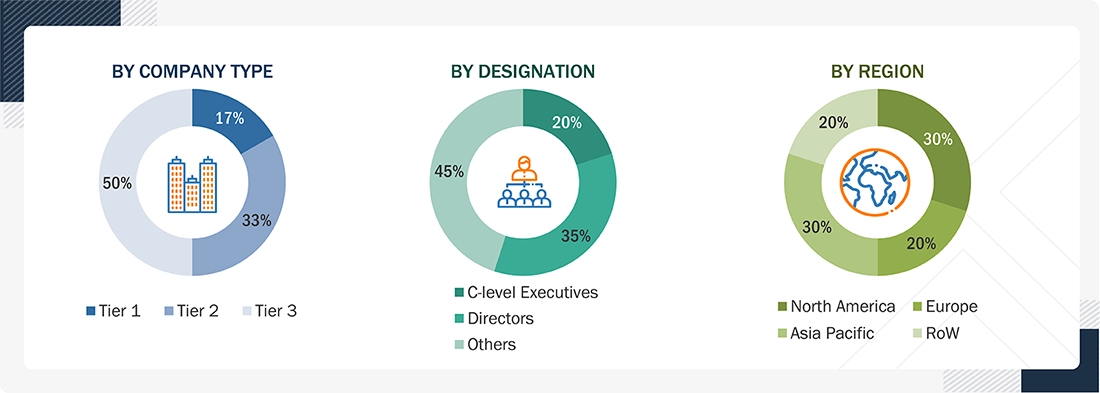
Others included Technology Heads, Media Analysts, Sales Managers, Marketing Managers, and Product Managers.
The three tiers of the companies were based on their total revenues as of 2024. Given below is the classification: Tier 1: > USD 1 billion; Tier 2: USD 500 million–1 billion; and Tier 3: USD 500 million
To know about the assumptions considered for the study, download the pdf brochure
Market Size Estimation
In the complete market engineering process, top-down and bottom-up approaches were implemented, along with several data triangulation methods, to estimate and validate the size of the land mobile radio market and various other dependent submarkets. Key players in the market were identified through secondary research, and their market share in the respective regions was determined through primary and secondary research. This entire research methodology included the study of annual and financial reports of the top players, as well as interviews with experts (such as CEOs, VPs, directors, and marketing executives) for key insights (quantitative and qualitative).
All percentage shares, splits, and breakdowns were determined using secondary sources and verified through primary sources. All the possible parameters that affect the markets covered in this research study were accounted for, viewed in detail, verified through primary research, and analyzed to obtain the final quantitative and qualitative data. This data was consolidated and supplemented with detailed inputs and analysis from MarketsandMarkets and presented in this report.
Bottom-Up Approach
The following steps were involved in market size estimation using the bottom-up approach:
- Identifying key countries contributing the majority share in each region based on LMR adoption in commercial and public safety applications
- Segmenting the market in each country by type, technology, frequency, and application
- Collecting country-level data from primary and secondary sources, including semiconductor adoption reports, industry databases, government electronics reports, budget reports, company financials, and expert interviews
- Aggregating the country-wise estimates to derive regional market sizes
- Summing up regional values to estimate the global LMR market size (in USD Million).
- Verifying and cross-checking the estimate at every level, from discussions with key opinion leaders such as CXOs, directors, and operations managers, and finally with the domain experts at MarketsandMarkets
- Studying various paid and unpaid sources of information, such as annual reports, press releases, white papers, and databases
Top-Down Approach
The following steps were involved in market size estimation using the top-down approach:
- Identifying major players actively offering LMR solutions, various offerings
- Analyzing company revenues from LMR product lines through annual reports, investor briefings, and third-party databases
- Estimating the percentage contribution of LMR within broader semiconductor and communications product offerings usages
- Aggregating LMR-specific revenues of key companies to estimate the collective market contribution at a global level
- Segmenting the market in each country by type, technology, frequency, and application
- Validating regional splits using macroeconomic indicators, primary and secondary analysis
- Conducting interviews with stakeholders, including LMR product managers, solution architects, sales directors, and regional heads, to validate product-level revenue contribution toward LMR
- Triangulating data using company reports, third-party databases, and expert insights to extrapolate the global LMR market size and forecast
- Cross-verifying estimates at every level with key opinion leaders, semiconductor consultants, and industry analysts
Land Mobile Radio Market: Top-Down and Bottom-Up Approach
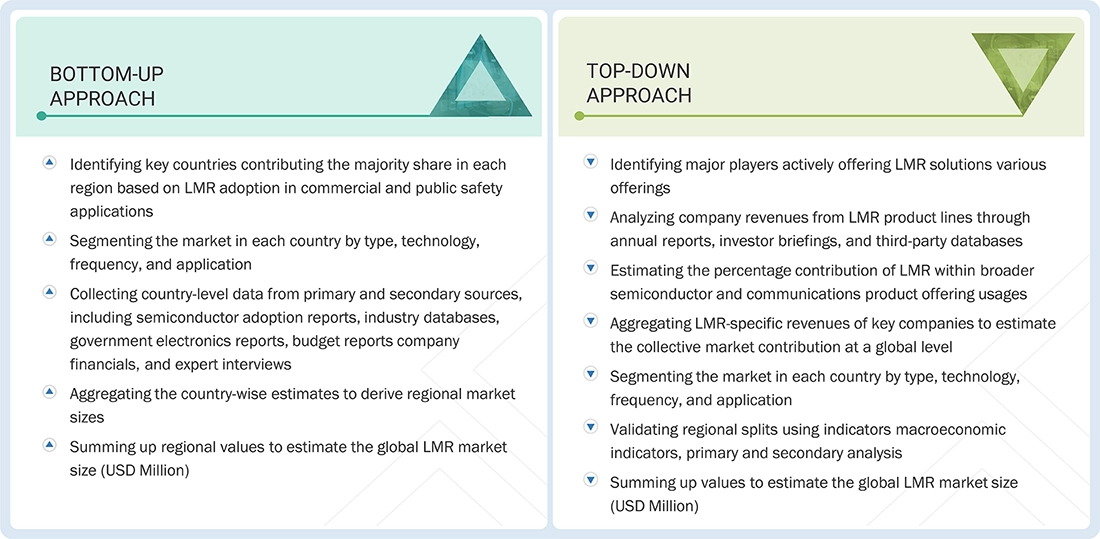
Data Triangulation
After arriving at the overall market size, the market was split into several segments and subsegments using the market size estimation processes explained above. Data triangulation and market breakdown procedures were employed to complete the entire market engineering process and determine each market segment’s and subsegment's exact statistics. The data collected was triangulated by studying various factors and trends from the demand and supply sides in the land mobile radio market.
Market Definition
Land mobile radio (LMR) is a wireless communication system applied by organizations in public safety, government agencies, and enterprises for two-way voice communication. LMR systems serve in mobile use by users in cars or on foot and offer dependable, safe, and frequently mission-critical messages over distances that can be short or long. These systems use specific frequency bands through which they coordinate various activities in many sectors, such as public safety, transportation, utilities, and manufacturing, where immediate and effective communication is essential.
Key Stakeholders
- Suppliers of raw material and manufacturing equipment
- OEMs providing land mobile radio instruments
- Asset management consultants specializing in physical asset management
- Research institutes and organizations
- Associations and regulatory authorities related to plant maintenance
- Government bodies, venture capitalists, and private equity firms
Report Objectives
- To define, describe, and forecast the land mobile radio market, in terms of value and volume, by type, technology, frequency, application, and region
- To forecast the size of the market segments for four major regions—North America, Europe, Asia Pacific, and the Rest of the World (RoW)
- To provide detailed information regarding the major factors (drivers, restraints, opportunities, and challenges) influencing the growth of the market. To provide ecosystem analysis, case study analysis, patent analysis, technology analysis, pricing analysis, Porter’s Five Forces analysis, and regulations pertaining to the market
- To give a detailed overview of the value chain of the land mobile radio market ecosystem
- To strategically analyze micromarkets with respect to individual growth trends, prospects, and contributions to the total market
- To strategically profile key players and comprehensively analyze their market share and core competencies
- To analyze the opportunities in the market for stakeholders and describe the competitive landscape of the market
- To study competitive developments, such as collaborations, partnerships, product developments, and acquisitions, in the market
- To understand the impact of AI on the land mobile radio market
- To understand and analyze the impact of the 2025 US trump tariff on the land mobile radio market
Customization Options
With the given market data, MarketsandMarkets offers customizations according to the company’s specific needs. The following customization options are available for the report:
Company Information
- Detailed analysis and profiling of additional market players (up to 5)
Key Questions Addressed by the Report
What is the current size of the Land Mobile Radio (LMR) Market?
The global Land Mobile Radio (LMR) Market was valued at USD 19.41 billion in 2025 and is projected to reach USD 32.24 billion by 2030.
What is the projected market size of the LMR Market by 2030?
The market is expected to reach USD 32.24 billion by 2030, driven by increasing demand for mission-critical communications across public safety, transportation, utilities, and defense sectors.
What is the CAGR of the LMR Market during the forecast period?
The Land Mobile Radio Market is projected to grow at a CAGR of 10.7% from 2025 to 2030.
What are the major growth drivers of the LMR Market?
Key growth drivers include rising investments in public safety communication networks, modernization of emergency response systems, increasing demand for secure communications, and growing adoption of digital radio technologies.
Which technology segment is expected to witness significant growth in the LMR Market?
Digital Land Mobile Radio (DMR) technology is experiencing strong growth due to its enhanced voice quality, spectrum efficiency, data transmission capabilities, and interoperability features.
Which end-use industry generates the highest demand for LMR systems?
Public safety agencies, including police, fire departments, and emergency medical services, account for a significant share of the market due to the need for reliable mission-critical communication networks.
Which trend is shaping the future of the LMR Market?
The integration of LTE and broadband technologies with traditional LPMR networks is a major trend, enabling advanced data services, video transmission, and improved situational awareness for first responders.
Which region dominates the Land Mobile Radio Market?
North America holds the largest market share due to extensive investments in public safety infrastructure, advanced communication systems, and the presence of major market players.
Who are the leading companies operating in the LMR Market?
Major market participants include Motorola Solutions, L3Harris Technologies, JVCKENWOOD Corporation, Hytera Communications Corporation Limited, Tait Communications, and BK Technologies Corporation.
What opportunities are highlighted in the LMR Market report?
Significant opportunities include the deployment of next-generation public safety networks, expansion of smart city projects, increasing demand from transportation and utility sectors, and integration of AI-enabled communication and monitoring solutions.
Fact checked
Personalize This Research
- Triangulate with your Own Data
- Get Data as per your Format and Definition
- Gain a Deeper Dive on a Specific Application, Geography, Customer or Competitor
- Any level of Personalization
Let Us Help You
- What are the Known and Unknown Adjacencies Impacting the Land Mobile Radio Market
- What will your New Revenue Sources be?
- Who will be your Top Customer; what will make them switch?
- Defend your Market Share or Win Competitors
- Get a Scorecard for Target Partners

Custom Market Research Services
We Will Customise The Research For You, In Case The Report Listed Above Does Not Meet With Your Requirements
Get 10% Free CustomisationTESTIMONIALS

Tetsuya Ohhira
Business Development Manager-Technology Business
Nikon Corporation,
Leading Japanese MNC specializing in optics and imaging productswww.nikon.com
MarketsandMarkets™ response
is quick. Their attitude is flexible and positive. Analyst Insights are globally considered and
significant. Client Services quickly respond to our inquiry and demand. Their wide range of global
surveys help us make our strategic plan.
We hope Knowledge Store will be easier to search
for a report.
VP - Marketing & Business Development
Leading Provider of Process Control Solutions
We engaged with MarketsandMarkets on a study to perform an analysis and recommend a Go-To-Market strategy for metrology and process control in the semiconductor market. The study was tailored to our targets and needs with well-defined milestones. Our overall experience with the MarketsandMarkets team was very good throughout the project in all aspects including the analysis methodologies used, the quality and depth of primary and secondary data sets, the professionalism and flexibility of the team and the ability to meet the target schedule and milestones. We want to thank MarketsandMarkets team for a job well done.
Growth opportunities and latent adjacency in Land Mobile Radio Market






Jeffrey
Apr, 2026
How much revenue can my company realistically capture in the next 3–5 years?.
Edwin
Apr, 2026
If I invest in LMR or upgrade to digital systems, what ROI can I expect?.
Marc
Jan, 2019
I am interested in using the report as part of my research in order to fulfil my undergraduate degree..
Vladislav
Jan, 2016
My specific interest is in market size and trends in handheld radio, especially multiband with data transmission functionality, so is this a part of your report?.
Donald
Apr, 2026
Does the report clearly highlight which segments will generate the highest ROI between 2025–2030?.
Raymond
Apr, 2026
How accurately does the report estimate pricing trends and margins across different LMR technologies.
Danny
Apr, 2026
How will emerging technologies like 5G integration and IoT-enabled LMR systems impact future revenue models?.
Erica
Mar, 2019
We are interested in locating research analyzing the customers who purchase Digital Mobile Radio (DMR) and portable radio products and industry reports which include customer profiles (industry, size, location, technology use, etc.) for DMRs, two-way radios and other such push-to-talk communication devices..
User
Feb, 2020
Who is the leading supplier of this technology? .
Sam
Jul, 2019
Hello, I'm a student doing market research on the mobile land radio industry and I'm looking for data and information to learn about the industry..
Christopher
Jul, 2017
Could you kindly provide a table of contents for this report? Also, does this report provide the size and growth rate of the MANET (mobile ad hoc network) market? If so, what data relating to this does this report provide?.
Anton
Jun, 2019
Need to estimate 2018 LMR size for public safety (PPDR), Transport (Trains, Metro, LiteRail, Ports and Airports), the size of Utility and Industrial market and the size of Consumer/Personal Radio market..
Conor
Apr, 2018
What are the new trends for Land Mobile Radio Market in North America. It would be good to get a sense of what detail you go into for market tables.