



Liquid Biopsy Market Size, Growth, Share & Trends Analysis
Report Code
MD 4456
Published in
Apr, 2025, By MarketsandMarkets™
Liquid Biopsy Market by Product & Service (Kits, Instruments), Circulating Biomarker (ctDNA, cfDNA, CTC), Technology (NGS, PCR), Application (Lung, Breast, Prostate Cancer), Sample Type (Blood, Urine, CSF), End User (Hospitals) - Global Forecast to 2030

USD 7.05 BN
MARKET SIZE, 2030

CAGR 11.8%
(2025-2030)

395
REPORT PAGES

487
MARKET TABLES
OVERVIEW
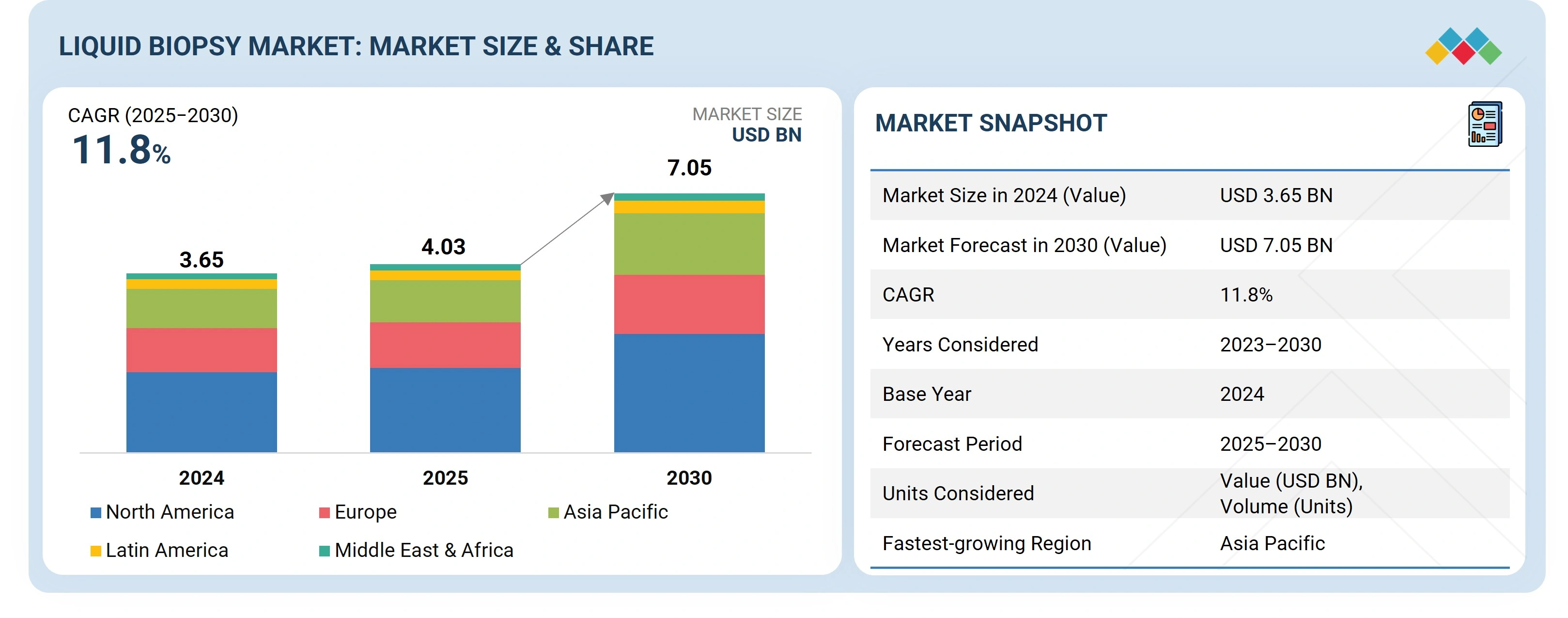
Source: Secondary Research, Interviews with Experts, MarketsandMarkets Analysis
The liquid biopsy market is estimated at USD 4.03 billion in 2025 and is projected to reach USD 7.05 billion by 2030, growing at a CAGR of 11.8% during the forecast period. The liquid biopsy market is witnessing strong growth due to the rising global burden of cancer and increasing awareness of the importance of early detection, supported by initiatives from leading health organizations. Liquid biopsy provides several advantages over traditional tissue biopsy procedures, including being minimally invasive, offering faster results, and allowing real-time monitoring of disease progression and treatment response. These benefits make liquid biopsy an increasingly preferred option for both clinicians and patients. Additionally, advancements in molecular technologies and the expanding adoption of personalized medicine are further enhancing the appeal of liquid biopsy as a reliable and efficient diagnostic tool across various cancer types.
KEY TAKEAWAYS
-
BY PRODUCT & SERVICEBased on product and service, the liquid biopsy market is segmented into assay kits, instruments, and services. Among these, assay kits continue to see the widest use, as they are routinely required and frequently replenished by end users. Their role in enabling reliable testing, coupled with the growing adoption of liquid biopsy across oncology and other clinical applications, is reinforcing their demand. Furthermore, the need for highly specific and sensitive assays to support early cancer detection, treatment monitoring, and companion diagnostics is expected to strengthen the growth of this segment in the years ahead.
-
BY CIRCULATING BIOMARKER TYPECategorized by circulating biomarker type, the liquid biopsy market is segmented into circulating tumour cells, circulating tumour DNA (ctDNA), cell-free DNA, extracellular vesicles, and other biomarkers. Among these, ctDNA is gaining rapid traction owing to its growing role in cancer detection, treatment monitoring, and identification of minimal residual disease. By providing detailed genetic insights from a simple blood draw, ctDNA serves as a less invasive and more practical alternative to tissue biopsies. Its ability to track tumour evolution over time also makes it highly valuable in guiding therapy choices. With increasing clinical adoption and expanding regulatory support, ctDNA-based applications are expected to play an increasingly central role in cancer care.
-
BY TECHNOLOGYThe liquid biopsy market covers technologies such as multi-gene parallel analysis using next-generation sequencing (NGS) and single-gene analysis with PCR & microarrays. NGS-based multi-gene analysis is seeing rapid uptake because it enables the simultaneous detection of multiple genetic alterations, offering detailed molecular profiling with high accuracy. Its high-throughput nature and adaptability make it well suited for identifying complex genomic changes, which is essential for applications like therapy selection and monitoring treatment response. With its growing role in personalized medicine and increasing incorporation into routine diagnostics, NGS continues to strengthen its position in cancer care.
-
BY APPLICATIONThe liquid biopsy market is divided into cancer and non-cancer applications, with cancer applications driving the majority of adoption. The rising global incidence of cancer and the growing focus on oncology research have positioned liquid biopsy as a vital tool in cancer management. Its ability to track tumor progression in real time, detect minimal residual disease, and address the limitations of traditional tissue biopsies makes it especially valuable. The increasing integration with companion diagnostics and continuous technological advancements are further expanding its role in guiding treatment decisions and improving patient outcomes.
-
BY CLINICAL APPLICATIONBased on clinical application, the liquid biopsy market is segmented into early cancer screening, therapy selection, treatment monitoring, and recurrence monitoring. Therapy selection represents the largest application area, supported by liquid biopsy’s ability to provide detailed molecular insights that guide personalized treatment decisions. By detecting actionable genetic alterations, these tests help match patients with targeted therapies, enhancing treatment effectiveness and outcomes. The rising adoption of precision medicine and the demand for minimally invasive methods to determine therapy suitability are further driving growth in this segment. In addition, ongoing advancements and the integration of liquid biopsy with companion diagnostics continue to reinforce its importance in oncology care.
-
BY SAMPLE TYPELiquid biopsy samples are primarily classified into blood and other types, with blood being the most widely used due to its ease of collection, minimal invasiveness, and ability to provide comprehensive molecular insights from biomarkers such as ctDNA, cfDNA, and CTCs. A simple blood draw offers critical information for cancer detection, therapy selection, treatment monitoring, and recurrence assessment, making it practical for routine clinical use. Compared with traditional tissue biopsies, blood-based sampling is safer, faster, and more acceptable to patients, driving its broad adoption in both diagnostic and research settings. Ongoing technological advancements and increasing regulatory support are expected to keep blood as the preferred sample type in liquid biopsy applications.
-
BY END USERThe liquid biopsy market caters to a range of end users, including reference laboratories, hospitals and physician laboratories, academic & research centers, and other healthcare settings. Reference laboratories are the primary users, owing to their high testing volumes, advanced infrastructure, and ability to perform complex molecular analyses. These laboratories play a crucial role in supporting oncology diagnostics, companion diagnostics, and clinical research studies. Hospitals, physician laboratories, and academic institutes also contribute to adoption by offering decentralized testing and specialized services. The growing demand for minimally invasive cancer diagnostics and the increasing use of liquid biopsy in clinical and research applications are driving market uptake across all end-user segments.
The liquid biopsy market is set to experience substantial growth in the coming years, driven by the increasing global burden of cancer, rising awareness of early detection, and ongoing advancements in molecular diagnostic technologies. Minimally invasive liquid biopsy techniques, including circulating tumor DNA (ctDNA) and circulating tumor cell (CTC) analyses, are being increasingly utilized to provide rapid and accurate insights into disease status, enabling timely clinical decisions and personalized treatment planning. Expanding adoption of liquid biopsy is supported by its advantages over traditional tissue biopsies, such as reduced risk, faster results, and the ability to monitor disease progression in real time. Moreover, growing emphasis on precision medicine and the integration of companion diagnostics are further accelerating uptake, while continuous technological innovation and expanding accessibility across hospitals, clinics, and specialized testing centers are enhancing the efficiency, reliability, and clinical impact of liquid biopsy solutions.
TRENDS & DISRUPTIONS IMPACTING CUSTOMERS' CUSTOMERS
The liquid biopsy market is witnessing rapid growth, driven by the increasing prevalence of cancer, a stronger focus on early detection, and ongoing advancements in molecular diagnostic technologies. Liquid biopsy solutions are primarily utilized by reference laboratories, hospitals, physician laboratories, and academic and research institutes. The adoption of minimally invasive testing, combined with the integration of companion diagnostics and innovations in multi-gene and targeted assays, is transforming clinical workflows and improving patient management. This rising demand is boosting the use of assay kits, instruments, and associated services, promoting wider implementation of liquid biopsy across healthcare and research settings.
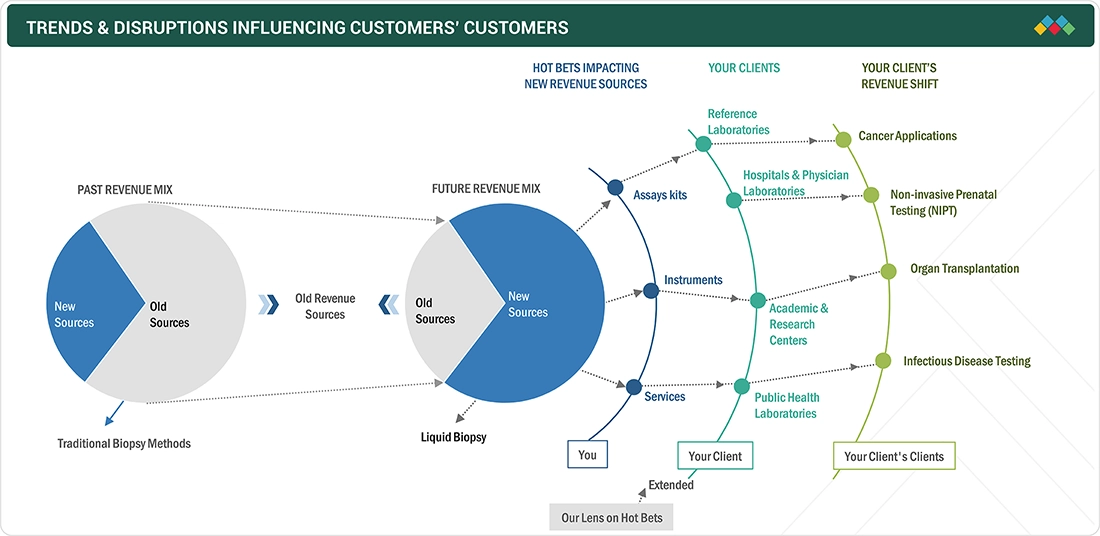
Source: Secondary Research, Interviews with Experts, MarketsandMarkets Analysis
MARKET DYNAMICS

Drivers
Impact
Level
Level
-
Increasing burden of cancer

-
Cancer awareness initiatives undertaken by global health organizations


RESTRAINTS
Impact
Level
Level
-
Lower sensitivity of certain liquid biopsy procedures


OPPORTUNITIES
Impact
Level
Level
-
Growing significance of companion diagnostics

-
Growth potential of emerging economies


CHALLENGES
Impact
Level
Level
-
Unfavourable reimbursement scenario

Source: Secondary Research, Interviews with Experts, MarketsandMarkets Analysis
Driver: Increasing burden of cancer
The rising global incidence and prevalence of cancer is a key driver of the liquid biopsy market. As cancer cases continue to increase, there is a growing need for diagnostic solutions that enable early detection, treatment guidance, and monitoring of disease progression. Liquid biopsy provides a minimally invasive and repeatable alternative to traditional tissue biopsies, allowing detection of circulating tumor DNA (ctDNA), circulating tumor cells (CTCs), and other biomarkers. Its suitability for repeated monitoring and early diagnosis makes it particularly valuable in oncology care. With cancer becoming more widespread, healthcare systems are increasingly adopting technologies that facilitate timely and accurate clinical decision-making, further boosting the demand for liquid biopsy products and services.
Restraint: Lower sensitivity of certain liquid biopsy procedures
Lower sensitivity and specificity in certain liquid biopsy procedures remain a notable limitation, especially when detecting circulating tumor DNA (ctDNA). In some cases, the concentration of ctDNA in plasma may be extremely low, making it difficult to detect and potentially leading to false-negative results. Such limitations reduce the diagnostic and clinical reliability of liquid biopsy, as the test may fail to identify existing cancer-related biomarkers. Statistical and sampling challenges further exacerbate this issue, particularly in early-stage cancers or minimal residual disease monitoring. Consequently, delayed detection of tumor recurrence or progression can occur, potentially impacting treatment decisions and patient outcomes.
Opportunity: Growing significance of companion diagnostics
The growing importance of companion diagnostics offers significant opportunities for the liquid biopsy market. As precision medicine continues to expand, companion diagnostics are increasingly used to identify patients who are most likely to benefit from specific therapies. Liquid biopsy, with its ability to non-invasively detect actionable biomarkers, is well-suited to serve this role. This has fostered collaboration between pharmaceutical and diagnostic companies, enabling the co-development of targeted therapies and accelerating the adoption of liquid biopsy in personalized cancer care.
Challenge: Unfavourable reimbursement scenario
Uncertainty in the reimbursement landscape presents a significant challenge for the adoption of liquid biopsy. High-cost molecular tests, particularly newer technologies, often face complex and inconsistent coverage policies. Interpreting these tests requires specialized expertise, and the associated costs are frequently unclear to physicians, pathologists, and patients until after billing or reimbursement. While some payers may cover multi-gene panels, reimbursement is sometimes limited to single-gene analysis, restricting the test’s clinical utility. This lack of clarity can make diagnostics unaffordable for many patients, underscoring the need for healthcare providers and stakeholders to stay informed about evolving reimbursement policies to ensure access and affordability.
Liquid Biopsy Market: COMMERCIAL USE CASES ACROSS INDUSTRIES
| COMPANY | USE CASE DESCRIPTION | BENEFITS |
|---|---|---|
 |
Provides liquid biopsy solutions for cancer detection, therapy selection, minimal residual disease monitoring, and recurrence tracking. | Non-invasive and highly sensitive testing, supports early detection and ongoing monitoring, enables personalized treatment decisions, scalable for clinical and research use, integrated with companion diagnostics. |
 |
Offers ctDNA-based liquid biopsy tests for comprehensive genomic profiling and therapy guidance in multiple cancer types. | Rapid and reliable tumor profiling, minimally invasive, supports precision medicine and treatment selection, allows real-time monitoring of treatment response and disease progression, widely adopted in clinical oncology. |
 |
Supplies liquid biopsy assays for cancer risk assessment, therapy selection, and treatment monitoring across diverse oncology indications. | High reproducibility and accuracy, integration with companion diagnostics, supports early detection and therapy optimization, improves patient management, enhances research and clinical trial capabilities. |
 |
Provides NGS-based liquid biopsy platforms for multi-gene profiling, biomarker discovery, and personalized cancer genomics research. | High-throughput and precise sequencing, supports multi-gene and targeted analysis, enables comprehensive tumor characterization, facilitates clinical decision-making, enhances development of personalized oncology therapies. |
 |
Offers liquid biopsy assays and integrated platforms for oncology applications, including therapy selection, monitoring, and recurrence detection. | Accurate and reproducible results, supports multiplex testing and multi-biomarker analysis, compatible with clinical workflows, non-invasive and minimally disruptive, enables timely treatment decisions and continuous patient monitoring. |
Logos and trademarks shown above are the property of their respective owners. Their use here is for informational and illustrative purposes only.
MARKET ECOSYSTEM
The liquid biopsy market serves a variety of end users, including reference laboratories, hospitals and physician laboratories, academic and research centers, and other healthcare settings. Testing primarily focuses on the non-invasive detection of cancer biomarkers, therapy selection, treatment monitoring, and recurrence assessment. Adoption is being driven by advancements in multi-gene and targeted assays, NGS-based platforms, and integrated testing workflows, which improve accuracy, turnaround time, and clinical utility. Growing emphasis on precision medicine, increasing awareness of early cancer detection, and the integration of liquid biopsy with companion diagnostics are further supporting the uptake of these solutions across diverse end-user segments.
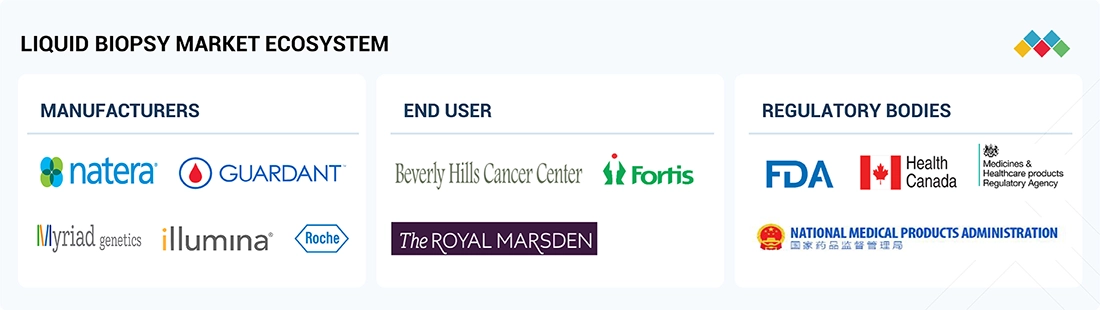
Logos and trademarks shown above are the property of their respective owners. Their use here is for informational and illustrative purposes only.
MARKET SEGMENTS
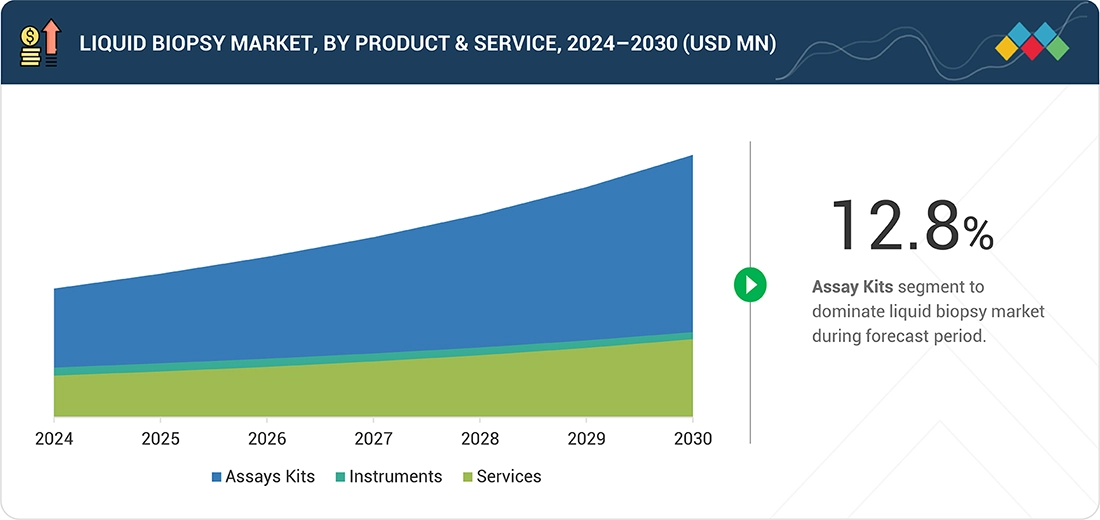
Source: Secondary Research, Interviews with Experts, MarketsandMarkets Analysis
Liquid Biopsy Market, By Product & Service
Based on product and service, the liquid biopsy market is segmented into assay kits, instruments, and services. Among these, assay kits continue to see the widest use, as they are routinely required and frequently replenished by end users. Their role in enabling reliable testing, coupled with the growing adoption of liquid biopsy across oncology and other clinical applications, is reinforcing their demand. Furthermore, the need for highly specific and sensitive assays to support early cancer detection, treatment monitoring, and companion diagnostics is expected to strengthen the growth of this segment in the years ahead.
Liquid Biopsy Market, By Circulating Biomarker Type
Categorized by circulating biomarker type, the liquid biopsy market is segmented into circulating tumour cells, circulating tumour DNA (ctDNA), cell-free DNA, extracellular vesicles, and other biomarkers. Among these, ctDNA is gaining rapid traction owing to its growing role in cancer detection, treatment monitoring, and identification of minimal residual disease. By providing detailed genetic insights from a simple blood draw, ctDNA serves as a less invasive and more practical alternative to tissue biopsies. Its ability to track tumour evolution over time also makes it highly valuable in guiding therapy choices. With increasing clinical adoption and expanding regulatory support, ctDNA-based applications are expected to play an increasingly central role in cancer care.
Liquid Biopsy Market, By Technology
The liquid biopsy market covers technologies such as multi-gene parallel analysis using next-generation sequencing (NGS) and single-gene analysis with PCR & microarrays. NGS-based multi-gene analysis is seeing rapid uptake because it enables the simultaneous detection of multiple genetic alterations, offering detailed molecular profiling with high accuracy. Its high-throughput nature and adaptability make it well suited for identifying complex genomic changes, which is essential for applications like therapy selection and monitoring treatment response. With its growing role in personalized medicine and increasing incorporation into routine diagnostics, NGS continues to strengthen its position in cancer care.
Liquid Biopsy Market, By Application
The liquid biopsy market is divided into cancer and non-cancer applications, with cancer applications driving the majority of adoption. The rising global incidence of cancer and the growing focus on oncology research have positioned liquid biopsy as a vital tool in cancer management. Its ability to track tumor progression in real time, detect minimal residual disease, and address the limitations of traditional tissue biopsies makes it especially valuable. The increasing integration with companion diagnostics and continuous technological advancements are further expanding its role in guiding treatment decisions and improving patient outcomes.
Liquid Biopsy Market, By Clinical Application
Based on clinical application, the liquid biopsy market is segmented into early cancer screening, therapy selection, treatment monitoring, and recurrence monitoring. Therapy selection represents the largest application area, supported by liquid biopsy’s ability to provide detailed molecular insights that guide personalized treatment decisions. By detecting actionable genetic alterations, these tests help match patients with targeted therapies, enhancing treatment effectiveness and outcomes. The rising adoption of precision medicine and the demand for minimally invasive methods to determine therapy suitability are further driving growth in this segment. In addition, ongoing advancements and the integration of liquid biopsy with companion diagnostics continue to reinforce its importance in oncology care.
Liquid Biopsy Market, By Sample type
Liquid biopsy samples are primarily classified into blood and other types, with blood being the most widely used due to its ease of collection, minimal invasiveness, and ability to provide comprehensive molecular insights from biomarkers such as ctDNA, cfDNA, and CTCs. A simple blood draw offers critical information for cancer detection, therapy selection, treatment monitoring, and recurrence assessment, making it practical for routine clinical use. Compared with traditional tissue biopsies, blood-based sampling is safer, faster, and more acceptable to patients, driving its broad adoption in both diagnostic and research settings. Ongoing technological advancements and increasing regulatory support are expected to keep blood as the preferred sample type in liquid biopsy applications.
Liquid Biopsy Market, By End User
The liquid biopsy market caters to a range of end users, including reference laboratories, hospitals and physician laboratories, academic & research centers, and other healthcare settings. Reference laboratories are the primary users, owing to their high testing volumes, advanced infrastructure, and ability to perform complex molecular analyses. These laboratories play a crucial role in supporting oncology diagnostics, companion diagnostics, and clinical research studies. Hospitals, physician laboratories, and academic institutes also contribute to adoption by offering decentralized testing and specialized services. The growing demand for minimally invasive cancer diagnostics and the increasing use of liquid biopsy in clinical and research applications are driving market uptake across all end-user segments.
REGION
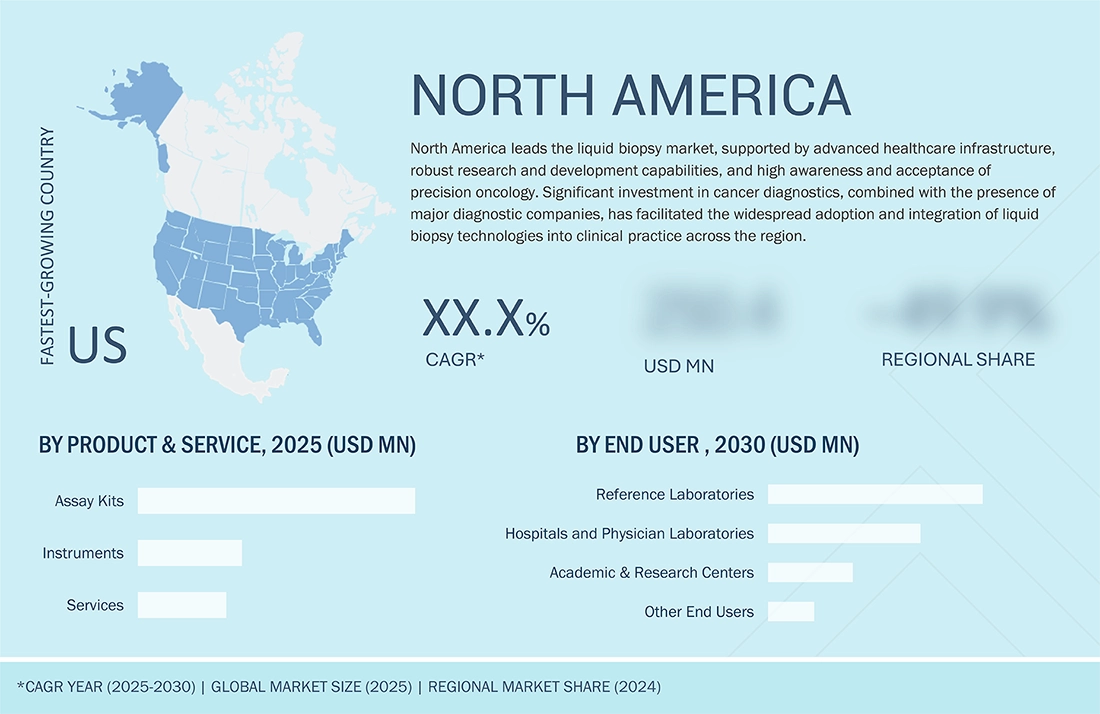
North America accounted for the largest share of the global liquid biopsy market during the forecast period.
The liquid biopsy market in North America is growing due to advanced healthcare infrastructure, increasing awareness of early cancer detection, and the rapid adoption of precision oncology solutions. Strong research and development capabilities, significant investment in cancer diagnostics, and the presence of leading diagnostic companies further support the uptake of liquid biopsy technologies. These factors are driving adoption across hospitals, reference laboratories, physician laboratories, and academic research institutes, enabling non-invasive cancer detection, therapy selection, and ongoing monitoring.
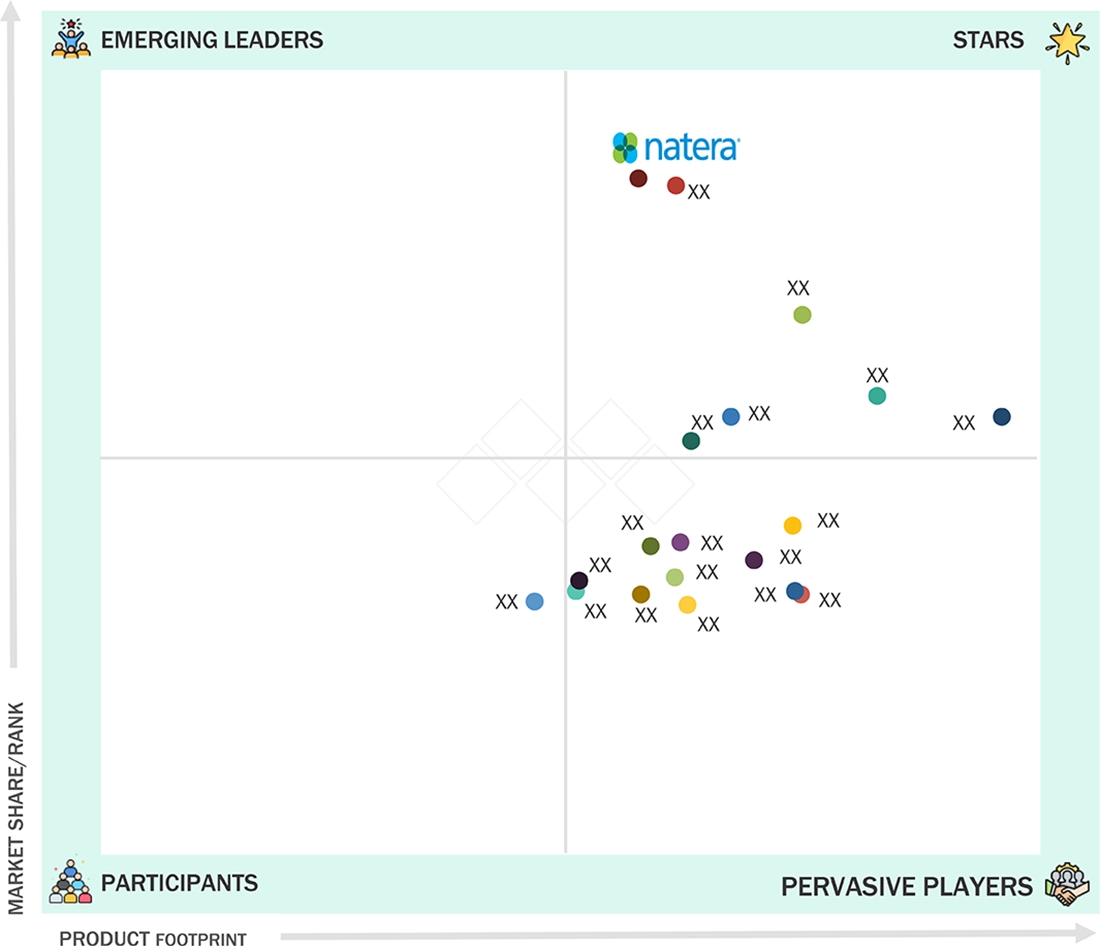
Liquid Biopsy Market: COMPANY EVALUATION MATRIX
Natera is a leading provider in the liquid biopsy market, specializing in non-invasive tests for cancer detection, therapy selection, and disease monitoring. The company serves hospitals, reference laboratories, physician labs, and research institutes, addressing a broad range of clinical and research needs. By partnering with healthcare providers and pharmaceutical companies, Natera enhances access to highly sensitive and accurate liquid biopsy solutions, supporting the integration of precision oncology into routine care in both developed and emerging markets.
Source: Secondary Research, Interviews with Experts, MarketsandMarkets Analysis
KEY MARKET PLAYERS
MARKET SCOPE
| REPORT METRIC | DETAILS |
|---|---|
| Market Size Value in 2024 | USD 3.65 Billion |
| Market Forecast in 2030 | USD 7.05 Billion |
| Growth Rate | CAGR of 11.8% from 2025-2030 |
| Years Considered | 2023-2030 |
| Base year | 2024 |
| Forecast period | 2025-2030 |
| Units considered | Value (USD Billion), Volume (Million) |
| Report Coverage | Revenue Forecast, Company Ranking, Competitive Landscape, Growth Factors, and Trends |
| Segments Covered | By product & service (assay kits, instruments, and services), by circulating biomarker type (circulating tumor cells, circulating tumor DNA, cell-free DNA, extracellular vesicles and other circulating biomarkers), by technology (multi-gene parallel analysis using NGS and single-gene analysis using PCR & microarrays), by application (cancer applications [lung cancer, breast cancer, colorectal cancer, prostate cancer, melanoma, and other cancers] and non-cancer applications [non-invasive prenatal testing, organ transplantation, and infectious disease testing]), by clinical application (early cancer screening, therapy selection, treatment monitoring, and recurrence monitoring), by sample type (blood and other sample types, by end user (reference laboratories, hospitals and physician laboratories, academic & research centers, and other end users) |
| Regional Scope | North America, Europe, Asia Pacific, Latin America and the Middle East & Africa |
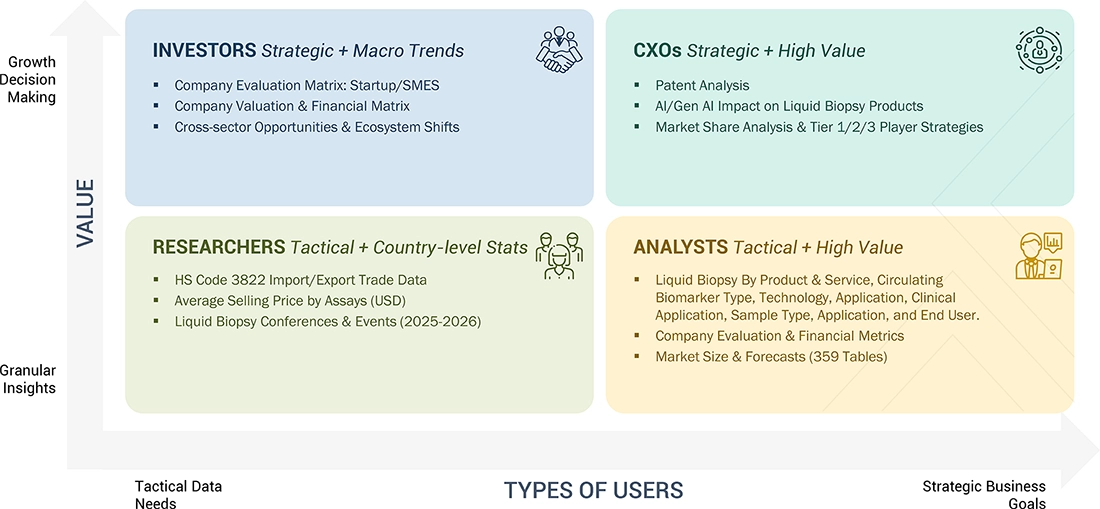
WHAT IS IN IT FOR YOU: Liquid Biopsy Market REPORT CONTENT GUIDE
RECENT DEVELOPMENTS
- May 2026: Guardant Health received U.S. FDA approval for its Guardant360® Liquid CDx, expanding the liquid biopsy test to a 100-fold larger genomic footprint than the previously approved version. The updated test integrates genomic and epigenomic insights from a blood sample to provide comprehensive tumor profiling and help guide treatment selection for patients with advanced cancer.
- April 2025 : Natera, Inc. (US), launched its ultra-sensitive Signatera Genome-MRD test in the US.
- February 2025 : Myriad Genetics, Inc. (US) collaborated with Gabbi (US), a telehealth solution for breast cancer risk assessment and specialist care services. The companies will work together to provide an integrated offering that combines Gabbi’s risk assessment program and access to breast specialists with Myriad’s MyRisk with RiskScore Hereditary Cancer Test.
- February 2024 : Myriad Genetics, Inc. (US) entered into a definitive agreement to acquire select assets from Intermountain Health. These included assets from its Intermountain Precision Genomics (IPG) laboratory business, including the Precise Tumor Test, the Precise Liquid Test, and IPG’s CLIA-certified laboratory.
- January 2024 : Natera, Inc. (US) acquired certain assets relating to non-invasive prenatal and carrier screening business from Invitae (US).
Table of Contents
 Exclusive indicates content/data unique to MarketsandMarkets and not available with any competitors.
TITLE
PAGE NO
1
INTRODUCTION
35
2
RESEARCH METHODOLOGY
40
3
EXECUTIVE SUMMARY
53
4
PREMIUM INSIGHTS
59
5
MARKET OVERVIEW
Explore liquid biopsy market dynamics, revealing growth drivers, pricing trends, and strategic opportunities.
64
5.1
INTRODUCTION
5.2
MARKET DYNAMICS
5.2.1
DRIVERS
5.2.1.1
INCREASING BURDEN OF CANCER
5.2.1.2
CANCER AWARENESS INITIATIVES UNDERTAKEN BY GLOBAL HEALTH ORGANIZATIONS
5.2.1.3
EXPANDING BENEFITS OF LIQUID BIOPSY OVER TRADITIONAL BIOPSY PROCEDURES
5.2.2
RESTRAINTS
5.2.2.1
LOWER SENSITIVITY OF SPECIFIC LIQUID BIOPSY PROCEDURES
5.2.3
OPPORTUNITIES
5.2.3.1
GROWING SIGNIFICANCE OF COMPANION DIAGNOSTICS
5.2.3.2
GROWTH POTENTIAL OF EMERGING ECONOMIES
5.2.4
CHALLENGES
5.2.4.1
UNFAVORABLE REIMBURSEMENT SCENARIO
5.3
PRICING ANALYSIS
5.3.1
INDICATIVE SELLING PRICE TREND OF LIQUID BIOPSY PRODUCTS, 2023−2025
5.3.2
INDICATIVE SELLING PRICE TREND OF ASSAY KITS, BY KEY PLAYER, 2023−2025
5.3.3
INDICATIVE SELLING PRICE TREND OF LIQUID BIOPSY PRODUCTS, BY REGION, 2023−2025
5.4
PATENT ANALYSIS
5.4.1
LIST OF MAJOR PATENTS
5.5
VALUE CHAIN ANALYSIS
5.6
SUPPLY CHAIN ANALYSIS
5.7
TRADE ANALYSIS
5.7.1
TRADE ANALYSIS FOR DIAGNOSTIC & LABORATORY REAGENTS
5.7.2
IMPORT DATA (HS CODE 3822)
5.7.3
EXPORT DATA (HS CODE 3822)
5.8
ECOSYSTEM ANALYSIS
5.9
PORTER’S FIVE FORCES ANALYSIS
5.9.1
THREAT OF NEW ENTRANTS
5.9.2
THREAT OF SUBSTITUTES
5.9.3
BARGAINING POWER OF BUYERS
5.9.4
BARGAINING POWER OF SUPPLIERS
5.9.5
INTENSITY OF COMPETITIVE RIVALRY
5.10
REGULATORY LANDSCAPE
5.10.1
REGULATORY BODIES, GOVERNMENT AGENCIES, AND OTHER ORGANIZATIONS
5.10.2
NORTH AMERICA
5.10.2.1
US
5.10.2.2
CANADA
5.10.3
EUROPE
5.10.4
ASIA PACIFIC
5.10.4.1
CHINA
5.10.4.2
JAPAN
5.10.4.3
INDIA
5.10.5
LATIN AMERICA
5.10.5.1
BRAZIL
5.10.5.2
MEXICO
5.10.6
MIDDLE EAST
5.10.6.1
AFRICA
5.11
TECHNOLOGY ANALYSIS
5.11.1
KEY TECHNOLOGIES
5.11.1.1
DIGITAL DROPLET PCR (DDPCR)
5.11.1.2
TAGGED-AMPLICON DEEP SEQUENCING (TAM-SEQ)
5.11.2
COMPLEMENTARY TECHNOLOGIES
5.11.2.1
ELECTROCHEMICAL BIOSENSING TECHNOLOGY
5.11.3
ADJACENT TECHNOLOGIES
5.11.3.1
MICROFLUIDIC-BASED DEVICES
5.12
KEY CONFERENCES & EVENTS, 2025–2026
5.13
TRENDS/DISRUPTIONS IMPACTING CUSTOMERS’ BUSINESSES
5.14
KEY STAKEHOLDERS & BUYING CRITERIA
5.14.1
KEY STAKEHOLDERS IN BUYING PROCESS
5.14.2
BUYING CRITERIA
5.15
INVESTMENT & FUNDING SCENARIO
5.16
CASE STUDY ANALYSIS
5.16.1
CASE STUDY 1: DETECTION OF LOW-FREQUENCY MUTATIONS USING TARGET SELECTOR CTDNA TECHNOLOGY
5.16.2
CASE STUDY 2: ANALYTICAL ASSESSMENT OF PLASMA & SERUM FOR CTDNA MUTATION DETECTION
5.17
IMPACT OF AI/GENERATIVE AI ON LIQUID BIOPSY MARKET
5.17.1
INTRODUCTION
5.17.2
MARKET POTENTIAL OF AI
5.17.3
AI USE CASES
5.17.4
FUTURE OF AI IN LIQUID BIOPSY MARKET
5.18
TRUMP TARIFF IMPACT ON LIQUID BIOPSY MARKET
5.18.1
INTRODUCTION
5.18.2
KEY TARIFF RATES
5.18.3
PRICE IMPACT ANALYSIS
5.18.4
KEY IMPACT ON COUNTRY/REGION
5.18.4.1
NORTH AMERICA
5.18.4.2
EUROPE
5.18.4.3
ASIA PACIFIC
5.18.5
IMPACT ON END-USE INDUSTRIES
5.18.5.1
REFERENCE LABORATORIES
5.18.5.2
HOSPITALS & PHYSICIANS’ LABORATORIES
5.18.5.3
ACADEMIC & RESEARCH CENTERS
6
LIQUID BIOPSY MARKET, BY PRODUCT & SERVICE
Market Size & Growth Rate Forecast Analysis to 2030 in USD Million | 18 Data Tables
100
6.1
INTRODUCTION
6.2
ASSAY KITS
6.2.1
RECURRING PURCHASE TO PROPEL MARKET
6.3
INSTRUMENTS
6.3.1
RISING TECHNOLOGICAL ADVANCES IN DDPCR TO FUEL MARKET
6.4
SERVICES
6.4.1
ADOPTION OF CFDNA & CTC TESTING SERVICES TO SUPPORT MARKET GROWTH
7
LIQUID BIOPSY MARKET, BY CIRCULATING BIOMARKER TYPE
Market Size & Growth Rate Forecast Analysis to 2030 in USD Million | 31 Data Tables
111
7.1
INTRODUCTION
7.2
CIRCULATING TUMOR DNA
7.2.1
HIGH SENSITIVITY & SPECIFICITY TO PROPEL MARKET
7.3
CELL-FREE DNA
7.3.1
BROADENING APPLICATIONS IN PRENATAL SCREENING TO DRIVE MARKET
7.4
CIRCULATING TUMOR CELLS
7.4.1
EASY COLLECTION AND PERSISTENT ASSESSMENT & ANALYSIS OF TUMORS TO FUEL MARKET
7.5
EXTRACELLULAR VESICLES
7.5.1
HIGH STABILITY IN BLOOD CIRCULATION TO ENSURE CONSISTENT GROWTH
7.6
OTHER CIRCULATING BIOMARKERS
8
LIQUID BIOPSY MARKET, BY TECHNOLOGY
Market Size & Growth Rate Forecast Analysis to 2030 in USD Million | 13 Data Tables
128
8.1
INTRODUCTION
8.2
MULTI-GENE PARALLEL ANALYSIS USING NGS
8.2.1
HIGHER THROUGHPUT EFFICIENCY TO PROPEL MARKET
8.3
SINGLE-GENE ANALYSIS USING PCR MICROARRAYS
8.3.1
COST-EFFICIENCY AND EASE OF USE TO FUEL UPTAKE
9
LIQUID BIOPSY MARKET, BY APPLICATION
Market Size & Growth Rate Forecast Analysis to 2030 in USD Million | 70 Data Tables
136
9.1
INTRODUCTION
9.2
CANCER APPLICATIONS
9.2.1
LUNG CANCER
9.2.1.1
GROWING PREVALENCE OF LUNG CANCER TO PROPEL MARKET
9.2.2
BREAST CANCER
9.2.2.1
INCREASING FUNDING INVESTMENTS FOR BREAST CANCER RESEARCH TO DRIVE MARKET
9.2.3
COLORECTAL CANCER
9.2.3.1
RISING GERIATRIC POPULATION TO FUEL UPTAKE
9.2.4
PROSTATE CANCER
9.2.4.1
ADOPTION OF TUMOR CELL KITS TO BOOST DEMAND
9.2.5
MELANOMA
9.2.5.1
GROWING NEED FOR EARLY DIAGNOSIS OF GENETICALLY MUTATED TUMORS TO DRIVE MARKET
9.2.6
OTHER CANCERS
9.3
NON-CANCER APPLICATIONS
9.3.1
NON-INVASIVE PRENATAL TESTING
9.3.1.1
GROWING DEMAND FOR NIPT IN HIGH-RISK PREGNANCIES TO DRIVE MARKET
9.3.2
ORGAN TRANSPLANTATION
9.3.2.1
EARLY DISEASE DIAGNOSIS & DETECTION TO SUPPORT MARKET GROWTH
9.3.3
INFECTIOUS DISEASE TESTING
9.3.3.1
POTENTIAL ACCURACY & EFFICACY FOR TESTING TO FUEL UPTAKE
10
LIQUID BIOPSY MARKET, BY CLINICAL APPLICATION
Market Size & Growth Rate Forecast Analysis to 2030 in USD Million | 21 Data Tables
171
10.1
INTRODUCTION
10.2
THERAPY SELECTION
10.2.1
GROWING PREFERENCE FOR PERSONALIZED TREATMENT TO DRIVE MARKET
10.3
TREATMENT MONITORING
10.3.1
EARLY DETECTION OF DISEASE PROGRESSION TO BOOST DEMAND
10.4
EARLY CANCER SCREENING
10.4.1
GROWING INCIDENCE OF CANCER AND RISING FUNDING INVESTMENTS TO PROPEL MARKET
10.5
RECURRENCE MONITORING
10.5.1
RISING NEED FOR POST-TREATMENT SURVEILLANCE TO FUEL UPTAKE
11
LIQUID BIOPSY MARKET, BY SAMPLE TYPE
Market Size & Growth Rate Forecast Analysis to 2030 in USD Million | 13 Data Tables
183
11.1
INTRODUCTION
11.2
BLOOD SAMPLES
11.2.1
STANDARD SIMPLICITY AND HIGH PATIENT ACCEPTANCE TO PROPEL MARKET
11.3
OTHER SAMPLE TYPES
12
LIQUID BIOPSY MARKET, BY END USER
Market Size & Growth Rate Forecast Analysis to 2030 in USD Million | 21 Data Tables
191
12.1
INTRODUCTION
12.2
REFERENCE LABORATORIES
12.2.1
RISING OUTSOURCING OF TESTS AND ABILITY TO UNDERTAKE LARGE SAMPLE VOLUMES TO PROPEL MARKET
12.3
HOSPITALS & PHYSICIANS LABORATORIES
12.3.1
INCREASING ESTABLISHMENT OF HOSPITALS TO BOOST DEMAND
12.4
ACADEMIC & RESEARCH CENTERS
12.4.1
INCREASING R&D ACTIVITIES FOR INNOVATIVE TESTS TO SUPPORT MARKET GROWTH
12.5
OTHER END USERS
13
LIQUID BIOPSY MARKET, BY REGION
Comprehensive coverage of 7 Regions with country-level deep-dive of 12 Countries | 192 Data Tables.
204
13.1
INTRODUCTION
13.2
NORTH AMERICA
13.2.1
NORTH AMERICA: MACROECONOMIC OUTLOOK
13.2.2
US
13.2.2.1
HIGH HEALTHCARE EXPENDITURE TO PROPEL MARKET
13.2.3
CANADA
13.2.3.1
AVAILABILITY OF VARIOUS CANCER SCREENING PROGRAMS TO DRIVE MARKET
13.3
EUROPE
13.3.1
EUROPE: MACROECONOMIC OUTLOOK
13.3.2
GERMANY
13.3.2.1
FAVORABLE RESEARCH FUNDING INVESTMENTS FOR CANCER RESEARCH TO FUEL MARKET
13.3.3
UK
13.3.3.1
NHS-FUNDED LAB-BASED DISEASE SCREENING FACILITIES TO BOOST DEMAND
13.3.4
FRANCE
13.3.4.1
GROWING FOCUS ON EXPANDING ACCESS TO ADVANCED GENOMIC TECHNOLOGIES TO DRIVE MARKET
13.3.5
ITALY
13.3.5.1
DEVELOPMENT OF NOVEL CIRCULATING CANCER BIOMARKERS TO SUPPORT MARKET GROWTH
13.3.6
SPAIN
13.3.6.1
FOCUS ON PERSONALIZED MEDICINE TO SUPPORT MARKET UPTAKE
13.3.7
REST OF EUROPE
13.4
ASIA PACIFIC
13.4.1
ASIA PACIFIC: MACROECONOMIC OUTLOOK
13.4.2
CHINA
13.4.2.1
INCREASING INCIDENCE OF INFECTIOUS DISEASES TO PROPEL MARKET
13.4.3
JAPAN
13.4.3.1
UNIVERSAL HEALTHCARE REIMBURSEMENT POLICY TO FUEL MARKET
13.4.4
INDIA
13.4.4.1
INCREASING INCIDENCE OF CHRONIC DISEASES AND GROWING FOCUS ON EARLY DISEASE DIAGNOSIS TO DRIVE MARKET
13.4.5
REST OF ASIA PACIFIC
13.5
LATIN AMERICA
13.5.1
LATIN AMERICA: MACROECONOMIC OUTLOOK
13.5.2
BRAZIL
13.5.2.1
IMPROVEMENTS IN LABORATORY INFRASTRUCTURE TO DRIVE MARKET
13.5.3
MEXICO
13.5.3.1
IMPROVING ACCESSIBILITY TO ADVANCED HEALTHCARE SERVICES TO SUPPORT MARKET GROWTH
13.5.4
REST OF LATIN AMERICA
13.6
MIDDLE EAST & AFRICA
13.6.1
INCREASING COLLABORATIONS & DEVELOPMENTS FOR ENHANCED DIAGNOSTIC ACCESS TO SUPPORT MARKET GROWTH
13.6.2
MIDDLE EAST & AFRICA: MACROECONOMIC OUTLOOK
14
COMPETITIVE LANDSCAPE
Discover strategic dominance and emerging leaders shaping the liquid biopsy market landscape.
292
14.1
INTRODUCTION
14.2
KEY PLAYER STRATEGIES/RIGHT TO WIN
14.2.1
OVERVIEW OF STRATEGIES DEPLOYED BY PLAYERS IN LIQUID BIOPSY MARKET
14.3
REVENUE ANALYSIS, 2022−2024
14.4
MARKET SHARE ANALYSIS
14.4.1
LIQUID BIOPSY MARKET
14.5
COMPANY EVALUATION MATRIX: KEY PLAYERS
14.5.1
STARS
14.5.2
EMERGING LEADERS
14.5.3
PERVASIVE PLAYERS
14.5.4
PARTICIPANTS
14.5.5
COMPANY FOOTPRINT: KEY PLAYERS, 2024
14.5.5.1
COMPANY FOOTPRINT
14.5.5.2
REGION FOOTPRINT
14.5.5.3
PRODUCT & SERVICE FOOTPRINT
14.6
COMPANY EVALUATION MATRIX: STARTUPS/SMES
14.6.1
PROGRESSIVE COMPANIES
14.6.2
RESPONSIVE COMPANIES
14.6.3
DYNAMIC COMPANIES
14.6.4
STARTING BLOCKS
14.6.5
COMPETITIVE BENCHMARKING: STARTUPS/SMES, 2024
14.6.5.1
DETAILED LIST OF KEY STARTUPS/SMES
14.6.5.2
COMPETITIVE BENCHMARKING OF KEY STARTUPS/SMES, BY PRODUCT & SERVICE
14.6.5.3
COMPETITIVE BENCHMARKING OF KEY STARTUPS/SMES, BY REGION
14.7
COMPANY VALUATION & FINANCIAL METRICS
14.7.1
FINANCIAL METRICS
14.7.2
COMPANY VALUATION
14.8
BRAND/PRODUCT COMPARATIVE ANALYSIS
14.8.1
BRAND COMPARISON OF PCR-BASED LIQUID BIOPSY ASSAYS
14.8.1.1
QIAGEN N.V.
14.8.1.2
THERMO FISHER SCIENTIFIC INC.
14.8.1.3
BIO-RAD LABORATORIES, INC.
14.9
COMPETITIVE SCENARIO
14.9.1
PRODUCT/SERVICE LAUNCHES & APPROVALS
14.9.2
DEALS
14.9.3
EXPANSIONS
15
COMPANY PROFILES
In-depth Company Profiles of Leading Market Players with detailed Business Overview, Product and Service Portfolio, Recent Developments, and Unique Analyst Perspective (MnM View)
311
15.1
KEY PLAYERS
15.1.1
NATERA, INC.
15.1.1.1
BUSINESS OVERVIEW
15.1.1.2
PRODUCTS/SERVICES OFFERED
15.1.1.3
RECENT DEVELOPMENTS
15.1.1.4
MNM VIEW
15.1.2
GUARDANT HEALTH
15.1.3
MYRIAD GENETICS, INC.
15.1.4
ILLUMINA, INC.
15.1.5
F. HOFFMANN-LA ROCHE LTD.
15.1.6
QIAGEN N.V.
15.1.7
EXACT SCIENCES CORPORATION
15.1.8
THERMO FISHER SCIENTIFIC INC.
15.1.9
GRAIL, INC.
15.1.10
BIO-RAD LABORATORIES, INC.
15.1.11
SYSMEX CORPORATION
15.1.12
MDXHEALTH
15.1.13
PERSONALIS, INC.
15.1.14
THE MENARINI GROUP
15.2
OTHER PLAYERS
15.2.1
NEOGENOMICS LABORATORIES
15.2.2
ANGLE PLC
15.2.3
LABCORP HOLDINGS INC.
15.2.4
BIO-TECHNE
15.2.5
MESA LABS, INC.
15.2.6
MEDGENOME
15.2.7
LUNGLIFE AI, INC.
15.2.8
STRAND
15.2.9
VORTEX BIOTECH HOLDINGS
15.2.10
FREENOME HOLDINGS, INC.
15.2.11
LUCENCE HEALTH INC.
15.2.12
NEW DAY DIAGNOSTICS, LLC
16
APPENDIX
384
16.1
DISCUSSION GUIDE
16.2
KNOWLEDGESTORE: MARKETSANDMARKETS’ SUBSCRIPTION PORTAL
16.3
CUSTOMIZATION OPTIONS
16.4
RELATED REPORTS
16.5
AUTHOR DETAILS
LIST OF TABLES
TABLE 1
LIQUID BIOPSY MARKET: KEY DATA FROM PRIMARY SOURCES
TABLE 2
LIQUID BIOPSY MARKET: RISK ASSESSMENT ANALYSIS
TABLE 3
INCIDENCE OF CANCER CASES WORLDWIDE, BY TYPE (2022)
TABLE 4
PROJECTED INCREASE IN CANCER PATIENTS, 2022 VS. 2035 VS. 2050, BY REGION
TABLE 5
INDICATIVE SELLING PRICING TREND OF LIQUID BIOPSY PRODUCTS, 2023–2025
TABLE 6
INDICATIVE SELLING PRICE TREND OF ASSAY KITS, BY KEY PLAYER, 2023–2025
TABLE 7
INDICATIVE SELLING PRICE TREND OF LIQUID BIOPSY PRODUCTS, BY REGION, 2023–2025
TABLE 8
LIQUID BIOPSY MARKET: LIST OF KEY PATENTS
TABLE 9
IMPORT DATA (HS CODE 3822), BY COUNTRY, 2020–2024 (USD MILLION)
TABLE 10
EXPORT DATA (HS CODE 3822), BY COUNTRY, 2020–2024 (USD MILLION)
TABLE 11
LIQUID BIOPSY MARKET: ROLE IN THE ECOSYSTEM
TABLE 12
LIQUID BIOPSY MARKET: PORTER’S FIVE FORCES ANALYSIS
TABLE 15
ASIA PACIFIC: REGULATORY BODIES, GOVERNMENT AGENCIES, AND OTHER ORGANIZATIONS
TABLE 18
EUROPE: CLASSIFICATION OF DEVICES
TABLE 19
JAPAN: TIME, COST, AND COMPLEXITY OF REGISTRATION PROCESS
TABLE 20
LIQUID BIOPSY MARKET: DETAILED LIST OF KEY CONFERENCES & EVENTS, JANUARY 2025–DECEMBER 2026
TABLE 21
INFLUENCE OF STAKEHOLDERS ON BUYING PROCESS OF LIQUID BIOPSY PRODUCTS (%)
TABLE 22
KEY BUYING CRITERIA FOR LIQUID BIOPSY PRODUCTS, BY RANK
TABLE 23
IMPLEMENTATION OF AI, BY KEY COMPANY & USE CASE
TABLE 24
US-ADJUSTED RECIPROCAL TARIFF RATES
TABLE 25
LIQUID BIOPSY MARKET, BY PRODUCT & SERVICE, 2023–2030 (USD MILLION)
TABLE 26
KEY ASSAY KITS CURRENTLY OFFERED
TABLE 27
LIQUID BIOPSY ASSAY KITS MARKET, BY REGION, 2023–2030 (USD MILLION)
TABLE 28
NORTH AMERICA: LIQUID BIOPSY ASSAY KITS MARKET, BY COUNTRY, 2023–2030 (USD MILLION)
TABLE 29
EUROPE: LIQUID BIOPSY ASSAY KITS MARKET, BY COUNTRY, 2023–2030 (USD MILLION)
TABLE 30
ASIA PACIFIC: LIQUID BIOPSY ASSAY KITS MARKET, BY COUNTRY, 2023–2030 (USD MILLION)
TABLE 31
LATIN AMERICA: LIQUID BIOPSY ASSAY KITS MARKET, BY COUNTRY, 2023–2030 (USD MILLION)
TABLE 32
KEY INSTRUMENTS CURRENTLY OFFERED
TABLE 33
LIQUID BIOPSY INSTRUMENTS MARKET, BY REGION, 2023–2030 (USD MILLION)
TABLE 34
NORTH AMERICA: LIQUID BIOPSY INSTRUMENTS MARKET, BY COUNTRY, 2023–2030 (USD MILLION)
TABLE 35
EUROPE: LIQUID BIOPSY INSTRUMENTS MARKET, BY COUNTRY, 2023–2030 (USD MILLION)
TABLE 36
ASIA PACIFIC: LIQUID BIOPSY INSTRUMENTS MARKET, BY COUNTRY, 2023–2030 (USD MILLION)
TABLE 37
LATIN AMERICA: LIQUID BIOPSY INSTRUMENTS MARKET, BY COUNTRY, 2023–2030 (USD MILLION)
TABLE 38
LIQUID BIOPSY SERVICES MARKET, BY REGION, 2023–2030 (USD MILLION)
TABLE 39
NORTH AMERICA: LIQUID BIOPSY SERVICES MARKET, BY COUNTRY, 2023–2030 (USD MILLION)
TABLE 40
EUROPE: LIQUID BIOPSY SERVICES MARKET, BY COUNTRY, 2023–2030 (USD MILLION)
TABLE 41
ASIA PACIFIC: LIQUID BIOPSY SERVICES MARKET, BY COUNTRY, 2023–2030 (USD MILLION)
TABLE 42
LATIN AMERICA: LIQUID BIOPSY SERVICES MARKET, BY COUNTRY, 2023–2030 (USD MILLION)
TABLE 43
LIQUID BIOPSY MARKET, BY CIRCULATING BIOMARKER TYPE, 2023–2030 (USD MILLION)
TABLE 44
KEY CTDNA PRODUCTS CURRENTLY AVAILABLE
TABLE 45
LIQUID BIOPSY MARKET FOR CIRCULATING TUMOR DNA, BY REGION, 2023–2030 (USD MILLION)
TABLE 46
NORTH AMERICA: LIQUID BIOPSY MARKET FOR CIRCULATING TUMOR DNA, BY COUNTRY, 2023–2030 (USD MILLION)
TABLE 47
EUROPE: LIQUID BIOPSY MARKET FOR CIRCULATING TUMOR DNA, BY COUNTRY, 2023–2030 (USD MILLION)
TABLE 48
ASIA PACIFIC: LIQUID BIOPSY MARKET FOR CIRCULATING TUMOR DNA, BY COUNTRY, 2023–2030 (USD MILLION)
TABLE 49
LATIN AMERICA: LIQUID BIOPSY MARKET FOR CIRCULATING TUMOR DNA, BY COUNTRY, 2023–2030 (USD MILLION)
TABLE 50
KEY CELL-FREE DNA PRODUCTS CURRENTLY AVAILABLE
TABLE 51
LIQUID BIOPSY MARKET FOR CELL-FREE DNA, BY REGION, 2023–2030 (USD MILLION)
TABLE 52
NORTH AMERICA: LIQUID BIOPSY MARKET FOR CELL-FREE DNA, BY COUNTRY, 2023–2030 (USD MILLION)
TABLE 53
EUROPE: LIQUID BIOPSY MARKET FOR CELL-FREE DNA, BY COUNTRY, 2023–2030 (USD MILLION)
TABLE 54
ASIA PACIFIC: LIQUID BIOPSY MARKET FOR CELL-FREE DNA, BY COUNTRY, 2023–2030 (USD MILLION)
TABLE 55
LATIN AMERICA: LIQUID BIOPSY MARKET FOR CELL-FREE DNA, BY COUNTRY, 2023–2030 (USD MILLION)
TABLE 56
KEY CTC PRODUCTS CURRENTLY AVAILABLE
TABLE 57
LIQUID BIOPSY MARKET FOR CIRCULATING TUMOR CELLS, BY REGION, 2023–2030 (USD MILLION)
TABLE 58
NORTH AMERICA: LIQUID BIOPSY MARKET FOR CIRCULATING TUMOR CELLS, BY COUNTRY, 2023–2030 (USD MILLION)
TABLE 59
EUROPE: LIQUID BIOPSY MARKET FOR CIRCULATING TUMOR CELLS, BY COUNTRY, 2023–2030 (USD MILLION)
TABLE 60
ASIA PACIFIC: LIQUID BIOPSY MARKET FOR CIRCULATING TUMOR CELLS, BY COUNTRY, 2023–2030 (USD MILLION)
TABLE 61
LATIN AMERICA: LIQUID BIOPSY MARKET FOR CIRCULATING TUMOR CELLS, BY COUNTRY, 2023–2030 (USD MILLION)
TABLE 62
KEY EXTRACELLULAR VESICLE PRODUCTS CURRENTLY AVAILABLE
TABLE 63
LIQUID BIOPSY MARKET FOR EXTRACELLULAR VESICLES, BY REGION, 2023–2030 (USD MILLION)
TABLE 64
NORTH AMERICA: LIQUID BIOPSY MARKET FOR EXTRACELLULAR VESICLES, BY COUNTRY, 2023–2030 (USD MILLION)
TABLE 65
EUROPE: LIQUID BIOPSY MARKET FOR EXTRACELLULAR VESICLES, BY COUNTRY, 2023–2030 (USD MILLION)
TABLE 66
ASIA PACIFIC: LIQUID BIOPSY MARKET FOR EXTRACELLULAR VESICLES, BY COUNTRY, 2023–2030 (USD MILLION)
TABLE 67
LATIN AMERICA: LIQUID BIOPSY MARKET FOR EXTRACELLULAR VESICLES, BY COUNTRY, 2023–2030 (USD MILLION)
TABLE 68
OTHER CIRCULATING BIOMARKER PRODUCTS CURRENTLY AVAILABLE
TABLE 69
LIQUID BIOPSY MARKET FOR OTHER CIRCULATING BIOMARKERS, BY REGION, 2023–2030 (USD MILLION)
TABLE 70
NORTH AMERICA: LIQUID BIOPSY MARKET FOR OTHER CIRCULATING BIOMARKERS, BY COUNTRY, 2023–2030 (USD MILLION)
TABLE 71
EUROPE: LIQUID BIOPSY MARKET FOR OTHER CIRCULATING BIOMARKERS, BY COUNTRY, 2023–2030 (USD MILLION)
TABLE 72
ASIA PACIFIC: LIQUID BIOPSY MARKET FOR OTHER CIRCULATING BIOMARKERS, BY COUNTRY, 2023–2030 (USD MILLION)
TABLE 73
LATIN AMERICA: LIQUID BIOPSY MARKET FOR OTHER CIRCULATING BIOMARKERS, BY COUNTRY, 2023–2030 (USD MILLION)
TABLE 74
LIQUID BIOPSY MARKET, BY TECHNOLOGY, 2023–2030 (USD MILLION)
TABLE 75
KEY NGS-BASED PRODUCTS CURRENTLY AVAILABLE
TABLE 76
LIQUID BIOPSY MARKET FOR MULTI-GENE PARALLEL ANALYSIS USING NGS, BY REGION, 2023–2030 (USD MILLION)
TABLE 77
NORTH AMERICA: LIQUID BIOPSY MARKET FOR MULTI-GENE PARALLEL ANALYSIS USING NGS, BY COUNTRY, 2023–2030 (USD MILLION)
TABLE 78
EUROPE: LIQUID BIOPSY MARKET FOR MULTI-GENE PARALLEL ANALYSIS USING NGS, BY COUNTRY, 2023–2030 (USD MILLION)
TABLE 79
ASIA PACIFIC: LIQUID BIOPSY MARKET FOR MULTI-GENE PARALLEL ANALYSIS USING NGS, BY COUNTRY, 2023–2030 (USD MILLION)
TABLE 80
LATIN AMERICA: LIQUID BIOPSY MARKET FOR MULTI-GENE PARALLEL ANALYSIS USING NGS, BY COUNTRY, 2023–2030 (USD MILLION)
TABLE 81
KEY PCR & MICROARRAY-BASED PRODUCTS CURRENTLY AVAILABLE
TABLE 82
LIQUID BIOPSY MARKET FOR SINGLE-GENE ANALYSIS USING PCR MICROARRAYS, BY REGION, 2023–2030 (USD MILLION)
TABLE 83
NORTH AMERICA: LIQUID BIOPSY MARKET FOR SINGLE-GENE ANALYSIS USING PCR MICROARRAYS, BY COUNTRY, 2023–2030 (USD MILLION)
TABLE 84
EUROPE: LIQUID BIOPSY MARKET FOR SINGLE-GENE ANALYSIS USING PCR MICROARRAYS, BY COUNTRY, 2023–2030 (USD MILLION)
TABLE 85
ASIA PACIFIC: LIQUID BIOPSY MARKET FOR SINGLE-GENE ANALYSIS USING PCR MICROARRAYS, BY COUNTRY, 2023–2030 (USD MILLION)
TABLE 86
LATIN AMERICA: LIQUID BIOPSY MARKET FOR SINGLE-GENE ANALYSIS USING PCR MICROARRAYS, BY COUNTRY, 2023–2030 (USD MILLION)
TABLE 87
LIQUID BIOPSY MARKET, BY APPLICATION, 2023–2030 (USD MILLION)
TABLE 88
GLOBAL CANCER INCIDENCE, 2022 VS. 2035 VS. 2045, BY REGION
TABLE 89
LIQUID BIOPSY MARKET FOR CANCER APPLICATIONS, BY REGION, 2023–2030 (USD MILLION)
TABLE 90
NORTH AMERICA: LIQUID BIOPSY MARKET FOR CANCER APPLICATIONS, BY COUNTRY, 2023–2030 (USD MILLION)
TABLE 91
EUROPE: LIQUID BIOPSY MARKET FOR CANCER APPLICATIONS, BY COUNTRY, 2023–2030 (USD MILLION)
TABLE 92
ASIA PACIFIC: LIQUID BIOPSY MARKET FOR CANCER APPLICATIONS, BY COUNTRY, 2023–2030 (USD MILLION)
TABLE 93
LATIN AMERICA: LIQUID BIOPSY MARKET FOR CANCER APPLICATIONS, BY COUNTRY, 2023–2030 (USD MILLION)
TABLE 94
LIQUID BIOPSY MARKET FOR CANCER APPLICATIONS, BY TYPE, 2023–2030 (USD MILLION)
TABLE 95
GLOBAL LUNG CANCER INCIDENCE, 2022 VS. 2035 VS. 2050
TABLE 96
KEY LIQUID BIOPSY PRODUCTS FOR LUNG CANCER
TABLE 97
LIQUID BIOPSY MARKET FOR LUNG CANCER, BY REGION, 2023–2030 (USD MILLION)
TABLE 98
NORTH AMERICA: LIQUID BIOPSY MARKET FOR LUNG CANCER, BY COUNTRY, 2023–2030 (USD MILLION)
TABLE 99
EUROPE: LIQUID BIOPSY MARKET FOR LUNG CANCER, BY COUNTRY, 2023–2030 (USD MILLION)
TABLE 100
ASIA PACIFIC: LIQUID BIOPSY MARKET FOR LUNG CANCER, BY COUNTRY, 2023–2030 (USD MILLION)
TABLE 101
LATIN AMERICA: LIQUID BIOPSY MARKET FOR LUNG CANCER, BY COUNTRY, 2023–2030 (USD MILLION)
TABLE 102
GLOBAL BREAST CANCER INCIDENCE, 2022 VS. 2035 VS. 2050
TABLE 103
KEY LIQUID BIOPSY PRODUCTS FOR BREAST CANCER
TABLE 104
LIQUID BIOPSY MARKET FOR BREAST CANCER, BY REGION, 2023–2030 (USD MILLION)
TABLE 105
NORTH AMERICA: LIQUID BIOPSY MARKET FOR BREAST CANCER, BY COUNTRY, 2023–2030 (USD MILLION)
TABLE 106
EUROPE: LIQUID BIOPSY MARKET FOR BREAST CANCER, BY COUNTRY, 2023–2030 (USD MILLION)
TABLE 107
ASIA PACIFIC: LIQUID BIOPSY MARKET FOR BREAST CANCER, BY COUNTRY, 2023–2030 (USD MILLION)
TABLE 108
LATIN AMERICA: LIQUID BIOPSY MARKET FOR BREAST CANCER, BY COUNTRY, 2023–2030 (USD MILLION)
TABLE 109
GLOBAL COLORECTAL CANCER INCIDENCE, 2022 VS. 2035 VS. 2050
TABLE 110
KEY LIQUID BIOPSY PRODUCTS FOR COLORECTAL CANCER
TABLE 111
LIQUID BIOPSY MARKET FOR COLORECTAL CANCER, BY REGION, 2023–2030 (USD MILLION)
TABLE 112
NORTH AMERICA: LIQUID BIOPSY MARKET FOR COLORECTAL CANCER, BY COUNTRY, 2023–2030 (USD MILLION)
TABLE 113
EUROPE: LIQUID BIOPSY MARKET FOR COLORECTAL CANCER, BY COUNTRY, 2023–2030 (USD MILLION)
TABLE 114
ASIA PACIFIC: LIQUID BIOPSY MARKET FOR COLORECTAL CANCER, BY COUNTRY, 2023–2030 (USD MILLION)
TABLE 115
LATIN AMERICA: LIQUID BIOPSY MARKET FOR COLORECTAL CANCER, BY COUNTRY, 2023–2030 (USD MILLION)
TABLE 116
GLOBAL PROSTATE CANCER INCIDENCE, 2022 VS. 2035 VS. 2050
TABLE 117
KEY LIQUID BIOPSY PRODUCTS FOR PROSTATE CANCER
TABLE 118
LIQUID BIOPSY MARKET FOR PROSTATE CANCER, BY REGION, 2023–2030 (USD MILLION)
TABLE 119
NORTH AMERICA: LIQUID BIOPSY MARKET FOR PROSTATE CANCER, BY COUNTRY, 2023–2030 (USD MILLION)
TABLE 120
EUROPE: LIQUID BIOPSY MARKET FOR PROSTATE CANCER, BY COUNTRY, 2023–2030 (USD MILLION)
TABLE 121
ASIA PACIFIC: LIQUID BIOPSY MARKET FOR PROSTATE CANCER, BY COUNTRY, 2023–2030 (USD MILLION)
TABLE 122
LATIN AMERICA: LIQUID BIOPSY MARKET FOR PROSTATE CANCER, BY COUNTRY, 2023–2030 (USD MILLION)
TABLE 123
GLOBAL MELANOMA INCIDENCE, 2022 VS. 2035 VS. 2050
TABLE 124
LIQUID BIOPSY MARKET FOR MELANOMA, BY REGION, 2023–2030 (USD MILLION)
TABLE 125
NORTH AMERICA: LIQUID BIOPSY MARKET FOR MELANOMA, BY COUNTRY, 2023–2030 (USD MILLION)
TABLE 126
EUROPE: LIQUID BIOPSY MARKET FOR MELANOMA, BY COUNTRY, 2023–2030 (USD MILLION)
TABLE 127
ASIA PACIFIC: LIQUID BIOPSY MARKET FOR MELANOMA, BY COUNTRY, 2023–2030 (USD MILLION)
TABLE 128
LATIN AMERICA: LIQUID BIOPSY MARKET FOR MELANOMA, BY COUNTRY, 2023–2030 (USD MILLION)
TABLE 129
GLOBAL INCIDENCE OF OTHER CANCERS, 2022 VS. 2050
TABLE 130
LIQUID BIOPSY MARKET FOR OTHER CANCERS, BY REGION, 2023–2030 (USD MILLION)
TABLE 131
NORTH AMERICA: LIQUID BIOPSY MARKET FOR OTHER CANCERS, BY COUNTRY, 2023–2030 (USD MILLION)
TABLE 132
EUROPE: LIQUID BIOPSY MARKET FOR OTHER CANCERS, BY COUNTRY, 2023–2030 (USD MILLION)
TABLE 133
ASIA PACIFIC: LIQUID BIOPSY MARKET FOR OTHER CANCERS, BY COUNTRY, 2023–2030 (USD MILLION)
TABLE 134
LATIN AMERICA: LIQUID BIOPSY MARKET FOR OTHER CANCERS, BY COUNTRY, 2023–2030 (USD MILLION)
TABLE 135
LIQUID BIOPSY MARKET FOR NON-CANCER APPLICATIONS, BY REGION, 2023–2030 (USD MILLION)
TABLE 136
LIQUID BIOPSY MARKET FOR NON-CANCER APPLICATIONS, BY TYPE, 2023–2030 (USD MILLION)
TABLE 137
NORTH AMERICA: LIQUID BIOPSY MARKET FOR NON-CANCER APPLICATIONS, BY COUNTRY, 2023–2030 (USD MILLION)
TABLE 138
EUROPE: LIQUID BIOPSY MARKET FOR NON-CANCER APPLICATIONS, BY COUNTRY, 2023–2030 (USD MILLION)
TABLE 139
ASIA PACIFIC: LIQUID BIOPSY MARKET FOR NON-CANCER APPLICATIONS, BY COUNTRY, 2023–2030 (USD MILLION)
TABLE 140
LATIN AMERICA: LIQUID BIOPSY MARKET FOR NON-CANCER APPLICATIONS, BY COUNTRY, 2023–2030 (USD MILLION)
TABLE 141
KEY NIPT LIQUID BIOPSY PRODUCTS
TABLE 142
LIQUID BIOPSY MARKET FOR NIPT, BY REGION, 2023–2030 (USD MILLION)
TABLE 143
NORTH AMERICA: LIQUID BIOPSY MARKET FOR NIPT, BY COUNTRY, 2023–2030 (USD MILLION)
TABLE 144
EUROPE: LIQUID BIOPSY MARKET FOR NIPT, BY COUNTRY, 2023–2030 (USD MILLION)
TABLE 145
ASIA PACIFIC: LIQUID BIOPSY MARKET FOR NIPT, BY COUNTRY, 2023–2030 (USD MILLION)
TABLE 146
LATIN AMERICA: LIQUID BIOPSY MARKET FOR NIPT, BY COUNTRY, 2023–2030 (USD MILLION)
TABLE 147
LIQUID BIOPSY MARKET FOR ORGAN TRANSPLANTATION, BY REGION, 2023–2030 (USD MILLION)
TABLE 148
NORTH AMERICA: LIQUID BIOPSY MARKET FOR ORGAN TRANSPLANTATION, BY COUNTRY, 2023–2030 (USD MILLION)
TABLE 149
EUROPE: LIQUID BIOPSY MARKET FOR ORGAN TRANSPLANTATION, BY COUNTRY, 2023–2030 (USD MILLION)
TABLE 150
ASIA PACIFIC: LIQUID BIOPSY MARKET FOR ORGAN TRANSPLANTATION, BY COUNTRY, 2023–2030 (USD MILLION)
TABLE 151
LATIN AMERICA: LIQUID BIOPSY MARKET FOR ORGAN TRANSPLANTATION, BY COUNTRY, 2023–2030 (USD MILLION)
TABLE 152
LIQUID BIOPSY MARKET FOR INFECTIOUS DISEASE TESTING, BY REGION, 2023–2030 (USD MILLION)
TABLE 153
NORTH AMERICA: LIQUID BIOPSY MARKET FOR INFECTIOUS DISEASE TESTING, BY COUNTRY, 2023–2030 (USD MILLION)
TABLE 154
EUROPE: LIQUID BIOPSY MARKET FOR INFECTIOUS DISEASE TESTING, BY COUNTRY, 2023–2030 (USD MILLION)
TABLE 155
ASIA PACIFIC: LIQUID BIOPSY MARKET FOR INFECTIOUS DISEASE TESTING, BY COUNTRY, 2023–2030 (USD MILLION)
TABLE 156
LATIN AMERICA: LIQUID BIOPSY MARKET FOR INFECTIOUS DISEASE TESTING, BY COUNTRY, 2023–2030 (USD MILLION)
TABLE 157
LIQUID BIOPSY MARKET, BY CLINICAL APPLICATION, 2023–2030 (USD MILLION)
TABLE 158
LIQUID BIOPSY MARKET FOR THERAPY SELECTION, BY REGION, 2023–2030 (USD MILLION)
TABLE 159
NORTH AMERICA: LIQUID BIOPSY MARKET FOR THERAPY SELECTION, BY COUNTRY, 2023–2030 (USD MILLION)
TABLE 160
EUROPE: LIQUID BIOPSY MARKET FOR THERAPY SELECTION, BY COUNTRY, 2023–2030 (USD MILLION)
TABLE 161
ASIA PACIFIC: LIQUID BIOPSY MARKET FOR THERAPY SELECTION, BY COUNTRY, 2023–2030 (USD MILLION)
TABLE 162
LATIN AMERICA: LIQUID BIOPSY MARKET FOR THERAPY SELECTION, BY COUNTRY, 2023–2030 (USD MILLION)
TABLE 163
LIQUID BIOPSY MARKET FOR TREATMENT MONITORING, BY REGION, 2023–2030 (USD MILLION)
TABLE 164
NORTH AMERICA: LIQUID BIOPSY MARKET FOR TREATMENT MONITORING, BY COUNTRY, 2023–2030 (USD MILLION)
TABLE 165
EUROPE: LIQUID BIOPSY MARKET FOR TREATMENT MONITORING, BY COUNTRY, 2023–2030 (USD MILLION)
TABLE 166
ASIA PACIFIC: LIQUID BIOPSY MARKET FOR TREATMENT MONITORING, BY COUNTRY, 2023–2030 (USD MILLION)
TABLE 167
LATIN AMERICA: LIQUID BIOPSY MARKET FOR TREATMENT MONITORING, BY COUNTRY, 2023–2030 (USD MILLION)
TABLE 168
LIQUID BIOPSY MARKET FOR EARLY CANCER SCREENING, BY REGION, 2023–2030 (USD MILLION)
TABLE 169
NORTH AMERICA: LIQUID BIOPSY MARKET FOR EARLY CANCER SCREENING, BY COUNTRY, 2023–2030 (USD MILLION)
TABLE 170
EUROPE: LIQUID BIOPSY MARKET FOR EARLY CANCER SCREENING, BY COUNTRY, 2023–2030 (USD MILLION)
TABLE 171
ASIA PACIFIC: LIQUID BIOPSY MARKET FOR EARLY CANCER SCREENING, BY COUNTRY, 2023–2030 (USD MILLION)
TABLE 172
LATIN AMERICA: LIQUID BIOPSY MARKET FOR EARLY CANCER SCREENING, BY COUNTRY, 2023–2030 (USD MILLION)
TABLE 173
LIQUID BIOPSY MARKET FOR RECURRENCE MONITORING, BY REGION, 2023–2030 (USD MILLION)
TABLE 174
NORTH AMERICA: LIQUID BIOPSY MARKET FOR RECURRENCE MONITORING, BY COUNTRY, 2023–2030 (USD MILLION)
TABLE 175
EUROPE: LIQUID BIOPSY MARKET FOR RECURRENCE MONITORING, BY COUNTRY, 2023–2030 (USD MILLION)
TABLE 176
ASIA PACIFIC: LIQUID BIOPSY MARKET FOR RECURRENCE MONITORING, BY COUNTRY, 2023–2030 (USD MILLION)
TABLE 177
LATIN AMERICA: LIQUID BIOPSY MARKET FOR RECURRENCE MONITORING, BY COUNTRY, 2023–2030 (USD MILLION)
TABLE 178
LIQUID BIOPSY MARKET, BY SAMPLE TYPE, 2023–2030 (USD MILLION)
TABLE 179
LIQUID BIOPSY SAMPLES & APPLICATIONS
TABLE 180
KEY BLOOD SAMPLE-BASED PRODUCTS CURRENTLY AVAILABLE
TABLE 181
LIQUID BIOPSY MARKET FOR BLOOD SAMPLES, BY REGION, 2023–2030 (USD MILLION)
TABLE 182
NORTH AMERICA: LIQUID BIOPSY MARKET FOR BLOOD SAMPLES, BY COUNTRY, 2023–2030 (USD MILLION)
TABLE 183
EUROPE: LIQUID BIOPSY MARKET FOR BLOOD SAMPLES, BY COUNTRY, 2023–2030 (USD MILLION)
TABLE 184
ASIA PACIFIC: LIQUID BIOPSY MARKET FOR BLOOD SAMPLES, BY COUNTRY, 2023–2030 (USD MILLION)
TABLE 185
LATIN AMERICA: LIQUID BIOPSY MARKET FOR BLOOD SAMPLES, BY COUNTRY, 2023–2030 (USD MILLION)
TABLE 186
LIQUID BIOPSY MARKET FOR OTHER SAMPLE TYPES, BY REGION, 2023–2030 (USD MILLION)
TABLE 187
NORTH AMERICA: LIQUID BIOPSY MARKET FOR OTHER SAMPLE TYPES, BY COUNTRY, 2023–2030 (USD MILLION)
TABLE 188
EUROPE: LIQUID BIOPSY MARKET FOR OTHER SAMPLE TYPES, BY COUNTRY, 2023–2030 (USD MILLION)
TABLE 189
ASIA PACIFIC: LIQUID BIOPSY MARKET FOR OTHER SAMPLE TYPES, BY COUNTRY, 2023–2030 (USD MILLION)
TABLE 190
LATIN AMERICA: LIQUID BIOPSY MARKET FOR OTHER SAMPLE TYPES, BY COUNTRY, 2023–2030 (USD MILLION)
TABLE 191
LIQUID BIOPSY MARKET, BY END USER, 2023–2030 (USD MILLION)
TABLE 192
LIQUID BIOPSY MARKET FOR REFERENCE LABORATORIES, BY REGION, 2023–2030 (USD MILLION)
TABLE 193
NORTH AMERICA: LIQUID BIOPSY MARKET FOR REFERENCE LABORATORIES, BY COUNTRY, 2023–2030 (USD MILLION)
TABLE 194
EUROPE: LIQUID BIOPSY MARKET FOR REFERENCE LABORATORIES, BY COUNTRY, 2023–2030 (USD MILLION)
TABLE 195
ASIA PACIFIC: LIQUID BIOPSY MARKET FOR REFERENCE LABORATORIES, BY COUNTRY, 2023–2030 (USD MILLION)
TABLE 196
LATIN AMERICA: LIQUID BIOPSY MARKET FOR REFERENCE LABORATORIES, BY COUNTRY, 2023–2030 (USD MILLION)
TABLE 197
LIQUID BIOPSY MARKET FOR HOSPITALS & PHYSICIANS LABORATORIES, BY REGION, 2023–2030 (USD MILLION)
TABLE 198
NORTH AMERICA: LIQUID BIOPSY MARKET FOR HOSPITALS & PHYSICIANS LABORATORIES, BY COUNTRY, 2023–2030 (USD MILLION)
TABLE 199
EUROPE: LIQUID BIOPSY MARKET FOR HOSPITALS & PHYSICIANS LABORATORIES, BY COUNTRY, 2023–2030 (USD MILLION)
TABLE 200
ASIA PACIFIC: LIQUID BIOPSY MARKET FOR HOSPITALS & PHYSICIANS LABORATORIES, BY COUNTRY, 2023–2030 (USD MILLION)
TABLE 201
LATIN AMERICA: LIQUID BIOPSY MARKET FOR HOSPITALS & PHYSICIANS LABORATORIES, BY COUNTRY, 2023–2030 (USD MILLION)
TABLE 202
LIQUID BIOPSY MARKET FOR ACADEMIC & RESEARCH CENTERS, BY REGION, 2023–2030 (USD MILLION)
TABLE 203
NORTH AMERICA: LIQUID BIOPSY MARKET FOR ACADEMIC & RESEARCH CENTERS, BY COUNTRY, 2023–2030 (USD MILLION)
TABLE 204
EUROPE: LIQUID BIOPSY MARKET FOR ACADEMIC & RESEARCH CENTERS, BY COUNTRY, 2023–2030 (USD MILLION)
TABLE 205
ASIA PACIFIC: LIQUID BIOPSY MARKET FOR ACADEMIC & RESEARCH CENTERS, BY COUNTRY, 2023–2030 (USD MILLION)
TABLE 206
LATIN AMERICA: LIQUID BIOPSY MARKET FOR ACADEMIC & RESEARCH CENTERS, BY COUNTRY, 2023–2030 (USD MILLION)
TABLE 207
LIQUID BIOPSY MARKET FOR OTHER END USERS, BY REGION, 2023–2030 (USD MILLION)
TABLE 208
NORTH AMERICA: LIQUID BIOPSY MARKET FOR OTHER END USERS, BY COUNTRY, 2023–2030 (USD MILLION)
TABLE 209
EUROPE: LIQUID BIOPSY MARKET FOR OTHER END USERS, BY COUNTRY, 2023–2030 (USD MILLION)
TABLE 210
ASIA PACIFIC: LIQUID BIOPSY MARKET FOR OTHER END USERS, BY COUNTRY, 2023–2030 (USD MILLION)
TABLE 211
LATIN AMERICA: LIQUID BIOPSY MARKET FOR OTHER END USERS, BY COUNTRY, 2023–2030 (USD MILLION)
TABLE 212
LIQUID BIOPSY MARKET, BY REGION, 2023–2030 (USD MILLION)
TABLE 213
NORTH AMERICA: NUMBER OF NEW CANCER CASES, BY CANCER TYPE, 2022 VS. 2050
TABLE 214
NORTH AMERICA: MACROECONOMIC INDICATORS
TABLE 215
NORTH AMERICA: LIQUID BIOPSY MARKET, BY COUNTRY, 2023–2030 (USD MILLION)
TABLE 216
NORTH AMERICA: LIQUID BIOPSY MARKET, BY PRODUCT & SERVICE, 2023–2030 (USD MILLION)
TABLE 217
NORTH AMERICA: LIQUID BIOPSY MARKET, BY CIRCULATING BIOMARKER TYPE, 2023–2030 (USD MILLION)
TABLE 218
NORTH AMERICA: LIQUID BIOPSY MARKET, BY TECHNOLOGY, 2023–2030 (USD MILLION)
TABLE 219
NORTH AMERICA: LIQUID BIOPSY MARKET, BY APPLICATION, 2023–2030 (USD MILLION)
TABLE 220
NORTH AMERICA: LIQUID BIOPSY MARKET FOR CANCER APPLICATIONS, BY TYPE, 2023–2030 (USD MILLION)
TABLE 221
NORTH AMERICA: LIQUID BIOPSY MARKET FOR NON-CANCER APPLICATIONS, BY TYPE, 2023–2030 (USD MILLION)
TABLE 222
NORTH AMERICA: LIQUID BIOPSY MARKET, BY CLINICAL APPLICATION, 2023–2030 (USD MILLION)
TABLE 223
NORTH AMERICA: LIQUID BIOPSY MARKET, BY SAMPLE TYPE, 2023–2030 (USD MILLION)
TABLE 224
NORTH AMERICA: LIQUID BIOPSY MARKET, BY END USER, 2023–2030 (USD MILLION)
TABLE 225
US: LIQUID BIOPSY MARKET, BY PRODUCT & SERVICE, 2023–2030 (USD MILLION)
TABLE 226
US: LIQUID BIOPSY MARKET, BY CIRCULATING BIOMARKER TYPE, 2023–2030 (USD MILLION)
TABLE 227
US: LIQUID BIOPSY MARKET, BY TECHNOLOGY, 2023–2030 (USD MILLION)
TABLE 228
US: LIQUID BIOPSY MARKET, BY APPLICATION, 2023–2030 (USD MILLION)
TABLE 229
US: LIQUID BIOPSY MARKET FOR CANCER APPLICATIONS, BY TYPE, 2023–2030 (USD MILLION)
TABLE 230
US: LIQUID BIOPSY MARKET FOR NON-CANCER APPLICATIONS, BY TYPE, 2023–2030 (USD MILLION)
TABLE 231
US: LIQUID BIOPSY MARKET, BY CLINICAL APPLICATION, 2023–2030 (USD MILLION)
TABLE 232
US: LIQUID BIOPSY MARKET, BY SAMPLE TYPE, 2023–2030 (USD MILLION)
TABLE 233
US: LIQUID BIOPSY MARKET, BY END USER, 2023–2030 (USD MILLION)
TABLE 234
US: TOTAL NUMBER OF WOMEN WHO UNDERGO NIPT TESTING, 2023–2030 (MILLION UNITS)
TABLE 235
CANADA: LIQUID BIOPSY MARKET, BY PRODUCT & SERVICE, 2023–2030 (USD MILLION)
TABLE 236
CANADA: LIQUID BIOPSY MARKET, BY CIRCULATING BIOMARKER TYPE, 2023–2030 (USD MILLION)
TABLE 237
CANADA: LIQUID BIOPSY MARKET, BY TECHNOLOGY, 2023–2030 (USD MILLION)
TABLE 238
CANADA: LIQUID BIOPSY MARKET, BY APPLICATION, 2023–2030 (USD MILLION)
TABLE 239
CANADA: LIQUID BIOPSY MARKET FOR CANCER APPLICATIONS, BY TYPE, 2023–2030 (USD MILLION)
TABLE 240
CANADA: LIQUID BIOPSY MARKET FOR NON-CANCER APPLICATIONS, BY TYPE, 2023–2030 (USD MILLION)
TABLE 241
CANADA: LIQUID BIOPSY MARKET, BY CLINICAL APPLICATION, 2023–2030 (USD MILLION)
TABLE 242
CANADA: LIQUID BIOPSY MARKET, BY SAMPLE TYPE, 2023–2030 (USD MILLION)
TABLE 243
CANADA: LIQUID BIOPSY MARKET, BY END USER, 2023–2030 (USD MILLION)
TABLE 244
EUROPE: MACROECONOMIC INDICATORS
TABLE 245
EUROPE: LIQUID BIOPSY MARKET, BY COUNTRY, 2023–2030 (USD MILLION)
TABLE 246
EUROPE: LIQUID BIOPSY MARKET, BY PRODUCT & SERVICE, 2023–2030 (USD MILLION)
TABLE 247
EUROPE: LIQUID BIOPSY MARKET, BY CIRCULATING BIOMARKER TYPE, 2023–2030 (USD MILLION)
TABLE 248
EUROPE: LIQUID BIOPSY MARKET, BY TECHNOLOGY, 2023–2030 (USD MILLION)
TABLE 249
EUROPE: LIQUID BIOPSY MARKET, BY APPLICATION, 2023–2030 (USD MILLION)
TABLE 250
EUROPE: LIQUID BIOPSY MARKET FOR CANCER APPLICATIONS, BY TYPE, 2023–2030 (USD MILLION)
TABLE 251
EUROPE: LIQUID BIOPSY MARKET FOR NON-CANCER APPLICATIONS, BY TYPE, 2023–2030 (USD MILLION)
TABLE 252
EUROPE: LIQUID BIOPSY MARKET, BY CLINICAL APPLICATION, 2023–2030 (USD MILLION)
TABLE 253
EUROPE: LIQUID BIOPSY MARKET, BY SAMPLE TYPE, 2023–2030 (USD MILLION)
TABLE 254
EUROPE: LIQUID BIOPSY MARKET, BY END USER, 2023–2030 (USD MILLION)
TABLE 255
GERMANY: LIQUID BIOPSY MARKET, BY PRODUCT & SERVICE, 2023–2030 (USD MILLION)
TABLE 256
GERMANY: LIQUID BIOPSY MARKET, BY CIRCULATING BIOMARKER TYPE, 2023–2030 (USD MILLION)
TABLE 257
GERMANY: LIQUID BIOPSY MARKET, BY TECHNOLOGY, 2023–2030 (USD MILLION)
TABLE 258
GERMANY: LIQUID BIOPSY MARKET, BY APPLICATION, 2023–2030 (USD MILLION)
TABLE 259
GERMANY: LIQUID BIOPSY MARKET FOR CANCER APPLICATIONS, BY TYPE, 2023–2030 (USD MILLION)
TABLE 260
GERMANY: LIQUID BIOPSY MARKET FOR NON-CANCER APPLICATIONS, BY TYPE, 2023–2030 (USD MILLION)
TABLE 261
GERMANY: LIQUID BIOPSY MARKET, BY CLINICAL APPLICATION, 2023–2030 (USD MILLION)
TABLE 262
GERMANY: LIQUID BIOPSY MARKET, BY SAMPLE TYPE, 2023–2030 (USD MILLION)
TABLE 263
GERMANY: LIQUID BIOPSY MARKET, BY END USER, 2023–2030 (USD MILLION)
TABLE 264
UK: LIQUID BIOPSY MARKET, BY PRODUCT & SERVICE, 2023–2030 (USD MILLION)
TABLE 265
UK: LIQUID BIOPSY MARKET, BY CIRCULATING BIOMARKER TYPE, 2023–2030 (USD MILLION)
TABLE 266
UK: LIQUID BIOPSY MARKET, BY TECHNOLOGY, 2023–2030 (USD MILLION)
TABLE 267
UK: LIQUID BIOPSY MARKET, BY APPLICATION, 2023–2030 (USD MILLION)
TABLE 268
UK: LIQUID BIOPSY MARKET FOR CANCER APPLICATIONS, BY TYPE, 2023–2030 (USD MILLION)
TABLE 269
UK: LIQUID BIOPSY MARKET FOR NON-CANCER APPLICATIONS, BY TYPE, 2023–2030 (USD MILLION)
TABLE 270
UK: LIQUID BIOPSY MARKET, BY CLINICAL APPLICATION, 2023–2030 (USD MILLION)
TABLE 271
UK: LIQUID BIOPSY MARKET, BY SAMPLE TYPE, 2023–2030 (USD MILLION)
TABLE 272
UK: LIQUID BIOPSY MARKET, BY END USER, 2023–2030 (USD MILLION)
TABLE 273
FRANCE: LIQUID BIOPSY MARKET, BY PRODUCT & SERVICE, 2023–2030 (USD MILLION)
TABLE 274
FRANCE: LIQUID BIOPSY MARKET, BY CIRCULATING BIOMARKER TYPE, 2023–2030 (USD MILLION)
TABLE 275
FRANCE: LIQUID BIOPSY MARKET, BY TECHNOLOGY, 2023–2030 (USD MILLION)
TABLE 276
FRANCE: LIQUID BIOPSY MARKET, BY APPLICATION, 2023–2030 (USD MILLION)
TABLE 277
FRANCE: LIQUID BIOPSY MARKET FOR CANCER APPLICATIONS, BY TYPE, 2023–2030 (USD MILLION)
TABLE 278
FRANCE: LIQUID BIOPSY MARKET FOR NON-CANCER APPLICATIONS, BY TYPE, 2023–2030 (USD MILLION)
TABLE 279
FRANCE: LIQUID BIOPSY MARKET, BY CLINICAL APPLICATION, 2023–2030 (USD MILLION)
TABLE 280
FRANCE: LIQUID BIOPSY MARKET, BY SAMPLE TYPE, 2023–2030 (USD MILLION)
TABLE 281
FRANCE: LIQUID BIOPSY MARKET, BY END USER, 2023–2030 (USD MILLION)
TABLE 282
ITALY: LIQUID BIOPSY MARKET, BY PRODUCT & SERVICE, 2023–2030 (USD MILLION)
TABLE 283
ITALY: LIQUID BIOPSY MARKET, BY CIRCULATING BIOMARKER TYPE, 2023–2030 (USD MILLION)
TABLE 284
ITALY: LIQUID BIOPSY MARKET, BY TECHNOLOGY, 2023–2030 (USD MILLION)
TABLE 285
ITALY: LIQUID BIOPSY MARKET, BY APPLICATION, 2023–2030 (USD MILLION)
TABLE 286
ITALY: LIQUID BIOPSY MARKET FOR CANCER APPLICATIONS, BY TYPE, 2023–2030 (USD MILLION)
TABLE 287
ITALY: LIQUID BIOPSY MARKET FOR NON-CANCER APPLICATIONS, BY TYPE, 2023–2030 (USD MILLION)
TABLE 288
ITALY: LIQUID BIOPSY MARKET, BY CLINICAL APPLICATION, 2023–2030 (USD MILLION)
TABLE 289
ITALY: LIQUID BIOPSY MARKET, BY SAMPLE TYPE, 2023–2030 (USD MILLION)
TABLE 290
ITALY: LIQUID BIOPSY MARKET, BY END USER, 2023–2030 (USD MILLION)
TABLE 291
SPAIN: LIQUID BIOPSY MARKET, BY PRODUCT & SERVICE, 2023–2030 (USD MILLION)
TABLE 292
SPAIN: LIQUID BIOPSY MARKET, BY CIRCULATING BIOMARKER TYPE, 2023–2030 (USD MILLION)
TABLE 293
SPAIN: LIQUID BIOPSY MARKET, BY TECHNOLOGY, 2023–2030 (USD MILLION)
TABLE 294
SPAIN: LIQUID BIOPSY MARKET, BY APPLICATION, 2023–2030 (USD MILLION)
TABLE 295
SPAIN: LIQUID BIOPSY MARKET FOR CANCER APPLICATIONS, BY TYPE, 2023–2030 (USD MILLION)
TABLE 296
SPAIN: LIQUID BIOPSY MARKET FOR NON-CANCER APPLICATIONS, BY TYPE, 2023–2030 (USD MILLION)
TABLE 297
SPAIN: LIQUID BIOPSY MARKET, BY CLINICAL APPLICATION, 2023–2030 (USD MILLION)
TABLE 298
SPAIN: LIQUID BIOPSY MARKET, BY SAMPLE TYPE, 2023–2030 (USD MILLION)
TABLE 299
SPAIN: LIQUID BIOPSY MARKET, BY END USER, 2023–2030 (USD MILLION)
TABLE 300
REST OF EUROPE: LIQUID BIOPSY MARKET, BY PRODUCT & SERVICE, 2023–2030 (USD MILLION)
TABLE 301
REST OF EUROPE: LIQUID BIOPSY MARKET, BY CIRCULATING BIOMARKER TYPE, 2023–2030 (USD MILLION)
TABLE 302
REST OF EUROPE: LIQUID BIOPSY MARKET, BY TECHNOLOGY, 2023–2030 (USD MILLION)
TABLE 303
REST OF EUROPE: LIQUID BIOPSY MARKET, BY APPLICATION, 2023–2030 (USD MILLION)
TABLE 304
REST OF EUROPE: LIQUID BIOPSY MARKET FOR CANCER APPLICATIONS, BY TYPE, 2023–2030 (USD MILLION)
TABLE 305
REST OF EUROPE: LIQUID BIOPSY MARKET FOR NON-CANCER APPLICATIONS, BY TYPE, 2023–2030 (USD MILLION)
TABLE 306
REST OF EUROPE: LIQUID BIOPSY MARKET, BY CLINICAL APPLICATION, 2023–2030 (USD MILLION)
TABLE 307
REST OF EUROPE: LIQUID BIOPSY MARKET, BY SAMPLE TYPE, 2023–2030 (USD MILLION)
TABLE 308
REST OF EUROPE: LIQUID BIOPSY MARKET, BY END USER, 2023–2030 (USD MILLION)
TABLE 309
ASIA PACIFIC: MACROECONOMIC INDICATORS
TABLE 310
ASIA PACIFIC: LIQUID BIOPSY MARKET, BY COUNTRY, 2023–2030 (USD MILLION)
TABLE 311
ASIA PACIFIC: LIQUID BIOPSY MARKET, BY PRODUCT & SERVICE, 2023–2030 (USD MILLION)
TABLE 312
ASIA PACIFIC: LIQUID BIOPSY MARKET, BY CIRCULATING BIOMARKER TYPE, 2023–2030 (USD MILLION)
TABLE 313
ASIA PACIFIC: LIQUID BIOPSY MARKET, BY TECHNOLOGY, 2023–2030 (USD MILLION)
TABLE 314
ASIA PACIFIC: LIQUID BIOPSY MARKET, BY APPLICATION, 2023–2030 (USD MILLION)
TABLE 315
ASIA PACIFIC: LIQUID BIOPSY MARKET FOR CANCER APPLICATIONS, BY TYPE, 2023–2030 (USD MILLION)
TABLE 316
ASIA PACIFIC: LIQUID BIOPSY MARKET FOR NON-CANCER APPLICATIONS, BY TYPE, 2023–2030 (USD MILLION)
TABLE 317
ASIA PACIFIC: LIQUID BIOPSY MARKET, BY CLINICAL APPLICATION, 2023–2030 (USD MILLION)
TABLE 318
ASIA PACIFIC: LIQUID BIOPSY MARKET, BY SAMPLE TYPE, 2023–2030 (USD MILLION)
TABLE 319
ASIA PACIFIC: LIQUID BIOPSY MARKET, BY END USER, 2023–2030 (USD MILLION)
TABLE 320
CHINA: LIQUID BIOPSY MARKET, BY PRODUCT & SERVICE, 2023–2030 (USD MILLION)
TABLE 321
CHINA: LIQUID BIOPSY MARKET, BY CIRCULATING BIOMARKER TYPE, 2023–2030 (USD MILLION)
TABLE 322
CHINA: LIQUID BIOPSY MARKET, BY TECHNOLOGY, 2023–2030 (USD MILLION)
TABLE 323
CHINA: LIQUID BIOPSY MARKET, BY APPLICATION, 2023–2030 (USD MILLION)
TABLE 324
CHINA: LIQUID BIOPSY MARKET FOR CANCER APPLICATIONS, BY TYPE, 2023–2030 (USD MILLION)
TABLE 325
CHINA: LIQUID BIOPSY MARKET FOR NON-CANCER APPLICATIONS, BY TYPE, 2023–2030 (USD MILLION)
TABLE 326
CHINA: LIQUID BIOPSY MARKET, BY CLINICAL APPLICATION, 2023–2030 (USD MILLION)
TABLE 327
CHINA: LIQUID BIOPSY MARKET, BY SAMPLE TYPE, 2023–2030 (USD MILLION)
TABLE 328
CHINA: LIQUID BIOPSY MARKET, BY END USER, 2023–2030 (USD MILLION)
TABLE 329
JAPAN: LIQUID BIOPSY MARKET, BY PRODUCT & SERVICE, 2023–2030 (USD MILLION)
TABLE 330
JAPAN: LIQUID BIOPSY MARKET, BY CIRCULATING BIOMARKER TYPE, 2023–2030 (USD MILLION)
TABLE 331
JAPAN: LIQUID BIOPSY MARKET, BY TECHNOLOGY, 2023–2030 (USD MILLION)
TABLE 332
JAPAN: LIQUID BIOPSY MARKET, BY APPLICATION, 2023–2030 (USD MILLION)
TABLE 333
JAPAN: LIQUID BIOPSY MARKET FOR CANCER APPLICATIONS, BY TYPE, 2023–2030 (USD MILLION)
TABLE 334
JAPAN: LIQUID BIOPSY MARKET FOR NON-CANCER APPLICATIONS, BY TYPE, 2023–2030 (USD MILLION)
TABLE 335
JAPAN: LIQUID BIOPSY MARKET, BY CLINICAL APPLICATION, 2023–2030 (USD MILLION)
TABLE 336
JAPAN: LIQUID BIOPSY MARKET, BY SAMPLE TYPE, 2023–2030 (USD MILLION)
TABLE 337
JAPAN: LIQUID BIOPSY MARKET, BY END USER, 2023–2030 (USD MILLION)
TABLE 338
INDIA: LIQUID BIOPSY MARKET, BY PRODUCT & SERVICE, 2023–2030 (USD MILLION)
TABLE 339
INDIA: LIQUID BIOPSY MARKET, BY CIRCULATING BIOMARKER TYPE, 2023–2030 (USD MILLION)
TABLE 340
INDIA: LIQUID BIOPSY MARKET, BY TECHNOLOGY, 2023–2030 (USD MILLION)
TABLE 341
INDIA: LIQUID BIOPSY MARKET, BY APPLICATION, 2023–2030 (USD MILLION)
TABLE 342
INDIA: LIQUID BIOPSY MARKET FOR CANCER APPLICATIONS, BY TYPE, 2023–2030 (USD MILLION)
TABLE 343
INDIA: LIQUID BIOPSY MARKET FOR NON-CANCER APPLICATIONS, BY TYPE, 2023–2030 (USD MILLION)
TABLE 344
INDIA: LIQUID BIOPSY MARKET, BY CLINICAL APPLICATION, 2023–2030 (USD MILLION)
TABLE 345
INDIA: LIQUID BIOPSY MARKET, BY SAMPLE TYPE, 2023–2030 (USD MILLION)
TABLE 346
INDIA: LIQUID BIOPSY MARKET, BY END USER, 2023–2030 (USD MILLION)
TABLE 347
REST OF ASIA PACIFIC: LIQUID BIOPSY MARKET, BY PRODUCT & SERVICE, 2023–2030 (USD MILLION)
TABLE 348
REST OF ASIA PACIFIC: LIQUID BIOPSY MARKET, BY CIRCULATING BIOMARKER TYPE, 2023–2030 (USD MILLION)
TABLE 349
REST OF ASIA PACIFIC: LIQUID BIOPSY MARKET, BY TECHNOLOGY, 2023–2030 (USD MILLION)
TABLE 350
REST OF ASIA PACIFIC: LIQUID BIOPSY MARKET, BY APPLICATION, 2023–2030 (USD MILLION)
TABLE 351
REST OF ASIA PACIFIC: LIQUID BIOPSY MARKET FOR CANCER APPLICATIONS, BY TYPE, 2023–2030 (USD MILLION)
TABLE 352
REST OF ASIA PACIFIC: LIQUID BIOPSY MARKET FOR NON-CANCER APPLICATIONS, BY TYPE, 2023–2030 (USD MILLION)
TABLE 353
REST OF ASIA PACIFIC: LIQUID BIOPSY MARKET, BY CLINICAL APPLICATION, 2023–2030 (USD MILLION)
TABLE 354
REST OF ASIA PACIFIC: LIQUID BIOPSY MARKET, BY SAMPLE TYPE, 2023–2030 (USD MILLION)
TABLE 355
REST OF ASIA PACIFIC: LIQUID BIOPSY MARKET, BY END USER, 2023–2030 (USD MILLION)
TABLE 356
LATIN AMERICA: MACROECONOMIC INDICATORS
TABLE 357
LATIN AMERICA: LIQUID BIOPSY MARKET, BY COUNTRY, 2023–2030 (USD MILLION)
TABLE 358
LATIN AMERICA: LIQUID BIOPSY MARKET, BY PRODUCT & SERVICE, 2023–2030 (USD MILLION)
TABLE 359
LATIN AMERICA: LIQUID BIOPSY MARKET, BY CIRCULATING BIOMARKER TYPE, 2023–2030 (USD MILLION)
TABLE 360
LATIN AMERICA: LIQUID BIOPSY MARKET, BY TECHNOLOGY, 2023–2030 (USD MILLION)
TABLE 361
LATIN AMERICA: LIQUID BIOPSY MARKET, BY APPLICATION, 2023–2030 (USD MILLION)
TABLE 362
LATIN AMERICA: LIQUID BIOPSY MARKET FOR CANCER APPLICATIONS, BY TYPE, 2023–2030 (USD MILLION)
TABLE 363
LATIN AMERICA: LIQUID BIOPSY MARKET FOR NON-CANCER APPLICATIONS, BY TYPE, 2023–2030 (USD MILLION)
TABLE 364
LATIN AMERICA: LIQUID BIOPSY MARKET, BY CLINICAL APPLICATION, 2023–2030 (USD MILLION)
TABLE 365
LATIN AMERICA: LIQUID BIOPSY MARKET, BY SAMPLE TYPE, 2023–2030 (USD MILLION)
TABLE 366
LATIN AMERICA: LIQUID BIOPSY MARKET, BY END USER, 2023–2030 (USD MILLION)
TABLE 367
BRAZIL: LIQUID BIOPSY MARKET, BY PRODUCT & SERVICE, 2023–2030 (USD MILLION)
TABLE 368
BRAZIL: LIQUID BIOPSY MARKET, BY CIRCULATING BIOMARKER TYPE, 2023–2030 (USD MILLION)
TABLE 369
BRAZIL: LIQUID BIOPSY MARKET, BY TECHNOLOGY, 2023–2030 (USD MILLION)
TABLE 370
BRAZIL: LIQUID BIOPSY MARKET, BY APPLICATION, 2023–2030 (USD MILLION)
TABLE 371
BRAZIL: LIQUID BIOPSY MARKET FOR CANCER APPLICATIONS, BY TYPE, 2023–2030 (USD MILLION)
TABLE 372
BRAZIL: LIQUID BIOPSY MARKET FOR NON-CANCER APPLICATIONS, BY TYPE, 2023–2030 (USD MILLION)
TABLE 373
BRAZIL: LIQUID BIOPSY MARKET, BY CLINICAL APPLICATION, 2023–2030 (USD MILLION)
TABLE 374
BRAZIL: LIQUID BIOPSY MARKET, BY SAMPLE TYPE, 2023–2030 (USD MILLION)
TABLE 375
BRAZIL: LIQUID BIOPSY MARKET, BY END USER, 2023–2030 (USD MILLION)
TABLE 376
MEXICO: LIQUID BIOPSY MARKET, BY PRODUCT & SERVICE, 2023–2030 (USD MILLION)
TABLE 377
MEXICO: LIQUID BIOPSY MARKET, BY CIRCULATING BIOMARKER TYPE, 2023–2030 (USD MILLION)
TABLE 378
MEXICO: LIQUID BIOPSY MARKET, BY TECHNOLOGY, 2023–2030 (USD MILLION)
TABLE 379
MEXICO: LIQUID BIOPSY MARKET, BY APPLICATION, 2023–2030 (USD MILLION)
TABLE 380
MEXICO: LIQUID BIOPSY MARKET FOR CANCER APPLICATIONS, BY TYPE, 2023–2030 (USD MILLION)
TABLE 381
MEXICO: LIQUID BIOPSY MARKET FOR NON-CANCER APPLICATIONS, BY TYPE, 2023–2030 (USD MILLION)
TABLE 382
MEXICO: LIQUID BIOPSY MARKET, BY CLINICAL APPLICATION, 2023–2030 (USD MILLION)
TABLE 383
MEXICO: LIQUID BIOPSY MARKET, BY SAMPLE TYPE, 2023–2030 (USD MILLION)
TABLE 384
MEXICO: LIQUID BIOPSY MARKET, BY END USER, 2023–2030 (USD MILLION)
TABLE 385
REST OF LATIN AMERICA: LIQUID BIOPSY MARKET, BY PRODUCT & SERVICE, 2023–2030 (USD MILLION)
TABLE 386
REST OF LATIN AMERICA: LIQUID BIOPSY MARKET, BY CIRCULATING BIOMARKER TYPE, 2023–2030 (USD MILLION)
TABLE 387
REST OF LATIN AMERICA: LIQUID BIOPSY MARKET, BY TECHNOLOGY, 2023–2030 (USD MILLION)
TABLE 388
REST OF LATIN AMERICA: LIQUID BIOPSY MARKET, BY APPLICATION, 2023–2030 (USD MILLION)
TABLE 389
REST OF LATIN AMERICA: LIQUID BIOPSY MARKET FOR CANCER APPLICATIONS, BY TYPE, 2023–2030 (USD MILLION)
TABLE 390
REST OF LATIN AMERICA: LIQUID BIOPSY MARKET FOR NON-CANCER APPLICATIONS, BY TYPE, 2023–2030 (USD MILLION)
TABLE 391
REST OF LATIN AMERICA: LIQUID BIOPSY MARKET, BY CLINICAL APPLICATION, 2023–2030 (USD MILLION)
TABLE 392
REST OF LATIN AMERICA: LIQUID BIOPSY MARKET, BY SAMPLE TYPE, 2023–2030 (USD MILLION)
TABLE 393
REST OF LATIN AMERICA: LIQUID BIOPSY MARKET, BY END USER, 2023–2030 (USD MILLION)
TABLE 394
MIDDLE EAST & AFRICA: MACROECONOMIC INDICATORS
TABLE 395
MIDDLE EAST & AFRICA: LIQUID BIOPSY MARKET, BY PRODUCT & SERVICE, 2023–2030 (USD MILLION)
TABLE 396
MIDDLE EAST & AFRICA: LIQUID BIOPSY MARKET, BY CIRCULATING BIOMARKER TYPE, 2023–2030 (USD MILLION)
TABLE 397
MIDDLE EAST & AFRICA: LIQUID BIOPSY MARKET, BY TECHNOLOGY, 2023–2030 (USD MILLION)
TABLE 398
MIDDLE EAST & AFRICA: LIQUID BIOPSY MARKET, BY APPLICATION, 2023–2030 (USD MILLION)
TABLE 399
MIDDLE EAST & AFRICA: LIQUID BIOPSY MARKET FOR CANCER APPLICATIONS, BY TYPE, 2023–2030 (USD MILLION)
TABLE 400
MIDDLE EAST & AFRICA: LIQUID BIOPSY MARKET FOR NON-CANCER APPLICATIONS, BY TYPE, 2023–2030 (USD MILLION)
TABLE 401
MIDDLE EAST & AFRICA: LIQUID BIOPSY MARKET, BY CLINICAL APPLICATION, 2023–2030 (USD MILLION)
TABLE 402
MIDDLE EAST & AFRICA: LIQUID BIOPSY MARKET, BY SAMPLE TYPE, 2023–2030 (USD MILLION)
TABLE 403
MIDDLE EAST & AFRICA: LIQUID BIOPSY MARKET, BY END USER, 2023–2030 (USD MILLION)
TABLE 404
OVERVIEW OF STRATEGIES DEPLOYED BY KEY COMPANIES IN LIQUID BIOPSY MARKET, JANUARY 2021−JUNE 2025
TABLE 405
LIQUID BIOPSY MARKET: DEGREE OF COMPETITION
TABLE 406
LIQUID BIOPSY MARKET: REGION FOOTPRINT
TABLE 407
LIQUID BIOPSY MARKET: PRODUCT & SERVICE FOOTPRINT
TABLE 408
LIQUID BIOPSY MARKET: APPLICATION FOOTPRINT
TABLE 409
LIQUID BIOPSY MARKET: DETAILED LIST OF KEY STARTUPS/SMES
TABLE 410
LIQUID BIOPSY MARKET: COMPETITIVE BENCHMARKING OF KEY STARTUPS/SMES, BY PRODUCT & SERVICE
TABLE 411
LIQUID BIOPSY MARKET: COMPETITIVE BENCHMARKING OF KEY STARTUPS/SMES, BY REGION
TABLE 412
LIQUID BIOPSY MARKET: PRODUCT/SERVICE LAUNCHES & APPROVALS, JANUARY 2021–JUNE 2025
TABLE 413
LIQUID BIOPSY MARKET: DEALS, JANUARY 2021–JUNE 2025
TABLE 414
LIQUID BIOPSY MARKET: EXPANSIONS, JANUARY 2021–JUNE 2025
TABLE 415
NATERA, INC.: COMPANY OVERVIEW
TABLE 416
NATERA, INC.: PRODUCTS/SERVICES OFFERED
TABLE 417
NATERA, INC.: PRODUCT/SERVICE LAUNCHES, JANUARY 2021–JUNE 2025
TABLE 418
NATERA, INC.: DEALS, JANUARY 2021−JUNE 2025
TABLE 419
NATERA, INC.: OTHER DEVELOPMENTS, JANUARY 2021– JUNE 2025
TABLE 420
GUARDANT HEALTH: COMPANY OVERVIEW
TABLE 421
GUARDANT HEALTH: PRODUCTS/SERVICES OFFERED
TABLE 422
GUARDANT HEALTH: PRODUCT/SERVICE LAUNCHES & APPROVALS, JANUARY 2021−JUNE 2025
TABLE 423
GUARDANT HEALTH: DEALS, JANUARY 2021−JUNE 2025
TABLE 424
MYRIAD GENETICS, INC.: COMPANY OVERVIEW
TABLE 425
MYRIAD GENETICS, INC.: PRODUCTS/SERVICES OFFERED
TABLE 426
MYRIAD GENETICS, INC.: PRODUCT/SERVICE LAUNCHES, JANUARY 2021−JUNE 2025
TABLE 427
MYRIAD GENETICS, INC.: DEALS, JANUARY 2021−JUNE 2025
TABLE 428
ILLUMINA, INC.: COMPANY OVERVIEW
TABLE 429
ILLUMINA, INC.: PRODUCTS/SERVICES OFFERED
TABLE 430
ILLUMINA, INC.:PRODUCT/SERVICE LAUNCHES & APPROVALS, JANUARY 2021−JUNE 2025
TABLE 431
ILLUMINA, INC.: DEALS, JANUARY 2021−JUNE 2025
TABLE 432
ILLUMINA, INC.: EXPANSIONS, JANUARY 2021−JUNE 2025
TABLE 433
ILLUMINA, INC.: OTHER DEVELOPMENTS, JANUARY 2021−JUNE 2025
TABLE 434
F. HOFFMANN-LA ROCHE LTD.: COMPANY OVERVIEW
TABLE 435
F. HOFFMANN-LA ROCHE LTD.: PRODUCTS/SERVICES OFFERED
TABLE 436
F. HOFFMANN-LA ROCHE LTD.: PRODUCT/SERVICE LAUNCHES, JANUARY 2021−JUNE 2025
TABLE 437
F. HOFFMANN-LA ROCHE LTD.: EXPANSIONS, JANUARY 2021−JUNE 2025
TABLE 438
QIAGEN N.V.: COMPANY OVERVIEW
TABLE 439
QIAGEN N.V.: PRODUCTS/SERVICES OFFERED
TABLE 440
QIAGEN N.V.: PRODUCT/SERVICE LAUNCHES, JANUARY 2021−JUNE 2025
TABLE 441
QIAGEN N.V.: DEALS, JANUARY 2021−JUNE 2025
TABLE 442
QIAGEN: EXPANSIONS, JANUARY 2021−JUNE 2025
TABLE 443
EXACT SCIENCES CORPORATION: COMPANY OVERVIEW
TABLE 444
EXACT SCIENCES CORPORATION: PRODUCTS/SERVICES OFFERED
TABLE 445
EXACT SCIENCES CORPORATION: PRODUCT/SERVICE LAUNCHES, JANUARY 2021−JUNE 2025
TABLE 446
EXACT SCIENCES CORPORATION: DEALS, JANUARY 2021−JUNE 2025
TABLE 447
THERMO FISHER SCIENTIFIC INC.: COMPANY OVERVIEW
TABLE 448
THERMO FISHER SCIENTIFIC INC.: PRODUCTS/SERVICES OFFERED
TABLE 449
THERMO FISHER SCIENTIFIC INC.: PRODUCT/SERVICE LAUNCHES, JANUARY 2021−JUNE 2025
TABLE 450
THERMO FISHER SCIENTIFIC INC.: DEALS, JANUARY 2021−JUNE 2025
TABLE 451
THERMO FISHER SCIENTIFIC INC.: EXPANSIONS, JANUARY 2021−JUNE 2025
TABLE 452
GRAIL, INC.: COMPANY OVERVIEW
TABLE 453
GRAIL, INC.: PRODUCTS/SERVICES OFFERED
TABLE 454
GRAIL, INC.: PRODUCT/SERVICE APPROVALS, JANUARY 2021−JUNE 2025
TABLE 455
GRAIL, INC.: DEALS, JANUARY 2021−JUNE 2025
TABLE 456
BIO-RAD LABORATORIES, INC.: COMPANY OVERVIEW
TABLE 457
BIO-RAD LABORATORIES, INC.: PRODUCTS/SERVICES OFFERED
TABLE 458
BIO-RAD LABORATORIES, INC.: PRODUCT/SERVICE LAUNCHES, JANUARY 2021−JUNE 2025
TABLE 459
BIO-RAD LABORATORIES, INC.: DEALS, JANUARY 2021−JUNE 2025
TABLE 460
SYSMEX CORPORATION: COMPANY OVERVIEW
TABLE 461
SYSMEX CORPORATION: PRODUCTS/SERVICES OFFERED
TABLE 462
SYSMEX CORPORATION: DEALS, JANUARY 2021−JUNE 2025
TABLE 463
SYSMEX CORPORATION: EXPANSIONS, JANUARY 2021−JUNE 2025
TABLE 464
MDXHEALTH: COMPANY OVERVIEW
TABLE 465
MDXHEALTH: PRODUCTS/SERVICES OFFERED
TABLE 466
MDXHEALTH: DEALS, JANUARY 2021−JUNE 2025
TABLE 467
PERSONALIS, INC.: COMPANY OVERVIEW
TABLE 468
PERSONALIS, INC.: PRODUCTS/SERVICES OFFERED
TABLE 469
PERSONALIS, INC.: PRODUCT/SERVICE LAUNCHES, JANUARY 2021−JUNE 2025
TABLE 470
PERSONALIS, INC.: DEALS, JANUARY 2021−JUNE 2025
TABLE 471
THE MENARINI GROUP: COMPANY OVERVIEW
TABLE 472
THE MENARINI GROUP: PRODUCTS/SERVICES OFFERED
TABLE 473
THE MENARINI GROUP: PRODUCT/SERVICE LAUNCHES, JANUARY 2021−JUNE 2025
TABLE 474
THE MENARINI GROUP: DEALS, JANUARY 2021−JUNE 2025
TABLE 475
NEOGENOMICS LABORATORIES: COMPANY OVERVIEW
TABLE 476
ANGLE PLC: COMPANY OVERVIEW
TABLE 477
LABCORP HOLDINGS INC.: COMPANY OVERVIEW
TABLE 478
BIO-TECHNE: COMPANY OVERVIEW
TABLE 479
MESA LABS, INC.: COMPANY OVERVIEW
TABLE 480
MEDGENOME: COMPANY OVERVIEW
TABLE 481
LUNGLIFE AI, INC.: COMPANY OVERVIEW
TABLE 482
STRAND: COMPANY OVERVIEW
TABLE 483
VORTEX BIOTECH HOLDINGS: COMPANY OVERVIEW
TABLE 484
FREENOME HOLDINGS, INC.: COMPANY OVERVIEW
TABLE 485
LUCENCE HEALTH INC.: COMPANY OVERVIEW
TABLE 486
NEW DAY DIAGNOSTICS, LLC: COMPANY OVERVIEW
LIST OF FIGURES
FIGURE 1
LIQUID BIOPSY MARKET SEGMENTATION & REGIONAL SCOPE
FIGURE 2
LIQUID BIOPSY MARKET: RESEARCH DESIGN METHODOLOGY
FIGURE 3
BREAKDOWN OF PRIMARY INTERVIEWS: SUPPLY-SIDE AND DEMAND-SIDE PARTICIPANTS
FIGURE 4
BREAKDOWN OF PRIMARY INTERVIEWS: BY COMPANY TYPE, DESIGNATION, AND REGION
FIGURE 5
BOTTOM-UP APPROACH: COMPANY REVENUE ESTIMATION APPROACH
FIGURE 6
CAGR PROJECTIONS: SUPPLY SIDE ANALYSIS
FIGURE 7
LIQUID BIOPSY MARKET: TOP-DOWN APPROACH
FIGURE 8
DATA TRIANGULATION METHODOLOGY
FIGURE 9
LIQUID BIOPSY MARKET: PARAMETRIC ASSUMPTIONS ANALYSIS
FIGURE 10
LIQUID BIOPSY MARKET, BY PRODUCT & SERVICE, 2025 VS. 2030 (USD MILLION)
FIGURE 11
LIQUID BIOPSY MARKET, BY CIRCULATING BIOMARKER TYPE, 2025 VS. 2030 (USD MILLION)
FIGURE 12
LIQUID BIOPSY MARKET, BY TECHNOLOGY, 2025 VS. 2030 (USD MILLION)
FIGURE 13
LIQUID BIOPSY MARKET, BY APPLICATION, 2025 VS. 2030 (USD MILLION)
FIGURE 14
LIQUID BIOPSY MARKET, BY CLINICAL APPLICATION, 2025 VS. 2030 (USD MILLION)
FIGURE 15
LIQUID BIOPSY MARKET, BY SAMPLE TYPE, 2025 VS. 2030 (USD MILLION)
FIGURE 16
LIQUID BIOPSY MARKET, BY END USER, 2025 VS. 2030 (USD MILLION)
FIGURE 17
LIQUID BIOPSY MARKET, BY REGION, 2025 VS. 2030 (USD MILLION)
FIGURE 18
INCREASING INCIDENCE OF CANCER AND ADVANCES IN LIQUID BIOPSY TECHNOLOGIES TO PROPEL MARKET
FIGURE 19
ASSAY KITS SEGMENT IS EXPECTED TO DOMINATE MARKET DURING FORECAST PERIOD
FIGURE 20
CIRCULATING TUMOR DNA SEGMENT TO DOMINATE MARKET DURING FORECAST PERIOD
FIGURE 21
MULTI-GENE PARALLEL ANALYSIS USING NGS SEGMENT TO DOMINATE MARKET DURING FORECAST PERIOD
FIGURE 22
CANCER APPLICATIONS SEGMENT TO DOMINATE MARKET DURING FORECAST PERIOD
FIGURE 23
THERAPY SELECTION SEGMENT TO DOMINATE MARKET DURING FORECAST PERIOD
FIGURE 24
BLOOD SAMPLES SEGMENT TO DOMINATE MARKET DURING FORECAST PERIOD
FIGURE 25
REFERENCE LABORATORIES SEGMENT TO DOMINATE MARKET DURING FORECAST PERIOD
FIGURE 26
ASIA PACIFIC TO REGISTER HIGHEST GROWTH RATE DURING FORECAST PERIOD
FIGURE 27
LIQUID BIOPSY MARKET: DRIVERS, RESTRAINTS, OPPORTUNITIES, AND CHALLENGES
FIGURE 28
PATENT ANALYSIS FOR LIQUID BIOPSY (JANUARY 2015–DECEMBER 2024)
FIGURE 29
VALUE CHAIN ANALYSIS OF LIQUID BIOPSY MARKET: MAJOR VALUE-ADDED DURING MANUFACTURING & ASSEMBLY PHASES
FIGURE 30
LIQUID BIOPSY MARKET: SUPPLY CHAIN ANALYSIS
FIGURE 31
LIQUID BIOPSY MARKET: ECOSYSTEM ANALYSIS
FIGURE 32
LIQUID BIOPSY MARKET: PORTER’S FIVE FORCES ANALYSIS
FIGURE 33
LIQUID BIOPSY MARKET: TRENDS/DISRUPTIONS IMPACTING CUSTOMERS’ BUSINESSES
FIGURE 34
INFLUENCE OF STAKEHOLDERS ON BUYING PROCESS FOR LIQUID BIOPSY PRODUCTS
FIGURE 35
KEY BUYING CRITERIA FOR LIQUID BIOPSY PRODUCTS
FIGURE 36
NUMBER OF DEALS & FUNDING ACTIVITIES IN LIQUID BIOPSY MARKET
FIGURE 37
MARKET POTENTIAL OF AI IN LIQUID BIOPSY MARKET
FIGURE 38
NORTH AMERICA: LIQUID BIOPSY MARKET SNAPSHOT
FIGURE 39
ASIA PACIFIC: LIQUID BIOPSY MARKET SNAPSHOT
FIGURE 40
REVENUE ANALYSIS OF LEADING FIVE PLAYERS, 2022−2024
FIGURE 41
MARKET SHARE ANALYSIS OF KEY PLAYERS (2024)
FIGURE 42
LIQUID BIOPSY MARKET: COMPANY EVALUATION MATRIX (KEY PLAYERS), 2024
FIGURE 43
LIQUID BIOPSY MARKET: COMPANY FOOTPRINT
FIGURE 44
LIQUID BIOPSY MARKET: COMPANY EVALUATION MATRIX (STARTUPS/SMES), 2024
FIGURE 45
EV/EBITDA OF KEY VENDORS
FIGURE 46
YEAR-TO-DATE (YTD) PRICE TOTAL RETURN AND 5-YEAR STOCK BETA OF KEY VENDORS
FIGURE 47
BRAND COMPARISON: PCR-BASED LIQUID BIOPSY ASSAYS
FIGURE 48
NATERA, INC.: COMPANY SNAPSHOT (2024)
FIGURE 49
GUARDANT HEALTH: COMPANY SNAPSHOT (2024)
FIGURE 50
MYRIAD GENETICS, INC.: COMPANY SNAPSHOT (2024)
FIGURE 51
ILLUMINA, INC.: COMPANY SNAPSHOT (2024)
FIGURE 52
F. HOFFMANN-LA ROCHE LTD.: COMPANY SNAPSHOT (2024)
FIGURE 53
QIAGEN N.V.: COMPANY SNAPSHOT (2024)
FIGURE 54
EXACT SCIENCES CORPORATION: COMPANY SNAPSHOT (2024)
FIGURE 55
THERMO FISHER SCIENTIFIC INC.: COMPANY SNAPSHOT (2024)
FIGURE 56
GRAIL, INC.: COMPANY SNAPSHOT (2024)
FIGURE 57
BIO-RAD LABORATORIES, INC.: COMPANY SNAPSHOT (2024)
FIGURE 58
SYSMEX CORPORATION: COMPANY SNAPSHOT (2024)
FIGURE 59
MDXHEALTH: COMPANY SNAPSHOT (2024)
FIGURE 60
PERSONALIS, INC.: COMPANY SNAPSHOT (2024)
Methodology
The study involved estimating activities to determine the current size of the liquid biopsy market. Exhaustive secondary research was done to collect information on the liquid biopsy industry. The next step was to validate these findings, assumptions, and sizing with industry experts across the value chain using primary research. Different approaches, such as top-down and bottom-up, were employed to estimate the total market size. After that, the market breakup and data triangulation procedures were used to estimate the market size of the segments and subsegments of the liquid biopsy market.
Secondary Research
In the secondary research process, various secondary sources such as annual reports, press releases & investor presentations of companies, white papers, certified publications, articles by recognized authors, gold-standard & silver-standard websites, regulatory bodies, and databases (such as D&B Hoovers, Bloomberg Business, and Factiva) were referred to identify and collect information for this study.
Primary Research
In the primary research process, various supply and demand sources were interviewed to obtain qualitative and quantitative information for this report. Primary sources were mainly industry experts from the core and related industries and preferred suppliers, manufacturers, distributors, service providers, technology developers, researchers, and organizations related to all segments of this industry’s value chain. In-depth interviews were conducted with primary respondents, including key industry participants, subject-matter experts, C-level executives of key market players, and industry consultants, to obtain and verify critical qualitative and quantitative information and assess prospects.
The following is a breakdown of the primary respondents:
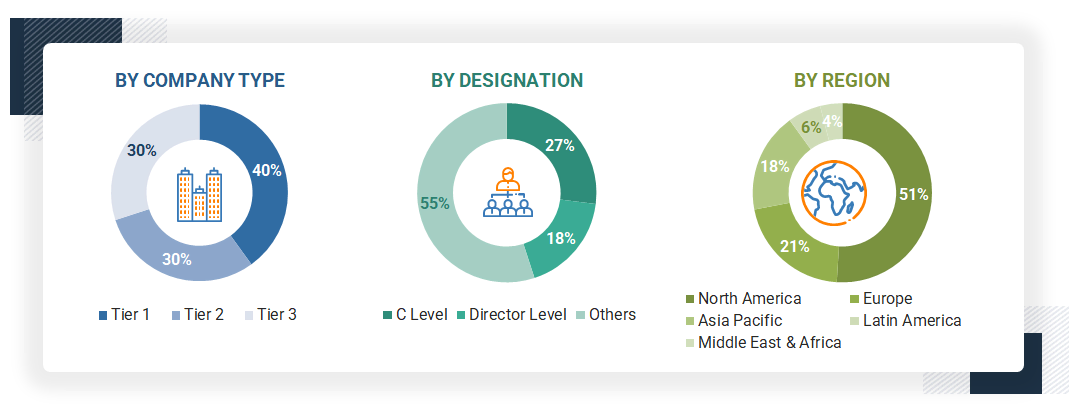
Note 1: Others include sales, marketing, and product managers.
Note 2: Companies are classified into tiers based on their total revenues. As of 2024, Tier 1 = >USD 100 million, Tier 2 = USD 10 million to USD 100 million, and Tier 3 = < USD 10 million.
To know about the assumptions considered for the study, download the pdf brochure
| COMPANY NAME | DESIGNATION |
|---|---|
| QIAGEN | Sales Manager |
| F. Hoffmann-La Roche Ltd. | Sales Executive |
Market Size Estimation
Liquid biopsy is a non-invasive method for diagnosing and monitoring diseases. Blood or other body fluids are collected to analyze cell-free DNA (cfDNA), circulating tumor DNA (ctDNA), or circulating tumor cells (CTCs).
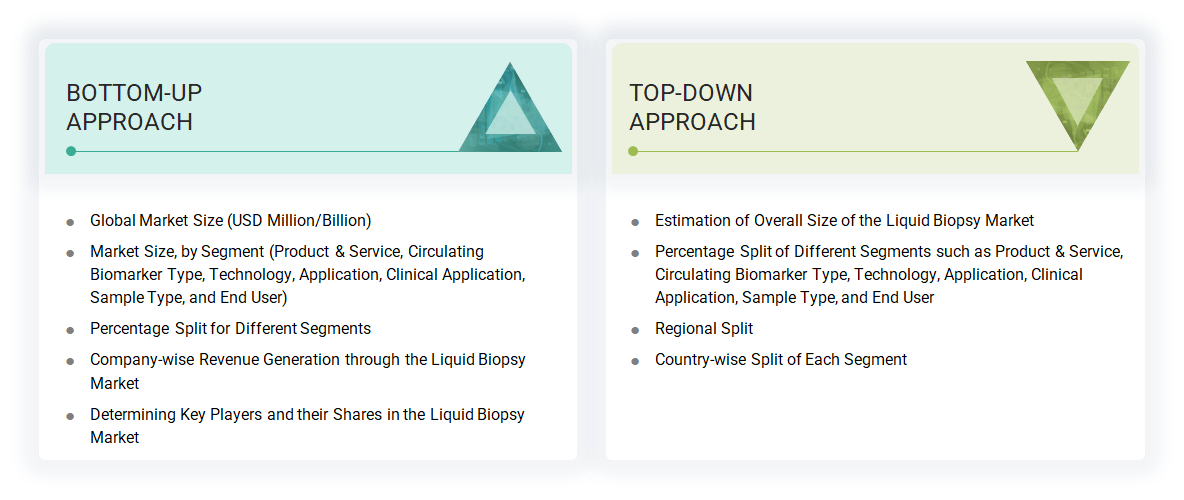
Data Triangulation
After arriving at the overall market size by applying the abovementioned process, the total market was split into several segments and subsegments. To complete the overall market engineering process and arrive at the exact statistics for all segments and subsegments, data triangulation and market breakdown procedures were employed, wherever applicable. The data was triangulated by studying various factors and trends from both the demand & supply sides.
Market Definition
Both top-down and bottom-up approaches were used to estimate and validate the liquid biopsy market's total size. These methods were also used extensively to estimate the size of various subsegments in the market. The research methodology used to estimate the market size includes the following:
- The key players in the industry have been identified through extensive secondary research
- Primary and secondary research have determined the revenues of leading players operating in the liquid biopsy market.
- All percentage shares, splits, and breakdowns have been determined using secondary sources and verified through primary sources.
The research methodology used to estimate the market size includes the following:
Stakeholders
- Manufacturers & Distributors of Liquid Biopsy Products
- Hospitals & Diagnostic Centers
- Reference Laboratories
- R&D Companies
- Research Laboratories and Academic Institutes
- Liquid Biopsy Service Providers
- Government Associations
- Venture Capitalists & Investors
Report Objectives
- To define, describe, segment, and forecast the liquid biopsy market, by product & service, circulating biomarker type, technology, application, clinical application, sample type, end user, and region
- To provide detailed information regarding the major factors influencing market growth (drivers, restraints, opportunities, and challenges)
- To analyze micro markets with respect to individual growth trends, prospects, and contributions to the overall market
- To analyze market opportunities for stakeholders and provide details of the competitive landscape for key players
- To forecast the size of the market segments with respect to five regions, namely, North America, Europe, the Asia Pacific, Latin America, and the Middle East & Africa
- To profile the key players and comprehensively analyze their product portfolios, market positions, and core competencies
- To track and analyze company developments such as acquisitions, collaborations, partnerships, agreements, and product launches & approvals in the liquid biopsy market
- To benchmark players within the liquid biopsy market using the Company Evaluation Matrix framework, which analyzes market players on various parameters within the broad categories of business strategy, market share, and product offerings
Frequently Asked Questions (FAQ)
What are the recent trends affecting the liquid biopsy market?
The recent trends shaping the liquid biopsy market include the rising global cancer burden, the expansion of liquid biopsy applications beyond oncology, and the growing recognition of its advantages over traditional tissue biopsy methods.
What are the primary products categorized in the liquid biopsy market?
The liquid biopsy market is broadly segmented into assay kits, instruments, and services. The assay kits segment accounted for the largest share of the market in 2024. Assay kits, known for their cost-effectiveness and minimally invasive application, are vital in patient monitoring and cancer screening.
Who are the key players in the liquid biopsy market?
The key players in this market are Natera, Inc. (US), QIAGEN (Netherlands), Guardant Health (US), Illumina, Inc. (US), F. Hoffmann-La Roche Ltd (Switzerland), Thermo Fisher Scientific Inc. (US), Myriad Genetics, Inc. (US), Bio-Rad Laboratories, Inc. (US), Exact Sciences Corporation (US), and Sysmex Corporation (Japan).
What are the key applications of liquid biopsy?
The liquid biopsy market is segmented into cancer and non-cancer applications. In 2024, the cancer applications segment accounted for the largest share of the market. This dominance is attributed to the unique advantages liquid biopsies offer in oncology, including the ability to monitor tumor dynamics in real time, detect minimal residual disease, and support the use of companion diagnostics.
Which region is lucrative for the liquid biopsy market?
The Asia Pacific region is expected to grow at the highest CAGR during the forecast period.
Fact checked
Personalize This Research
- Triangulate with your Own Data
- Get Data as per your Format and Definition
- Gain a Deeper Dive on a Specific Application, Geography, Customer or Competitor
- Any level of Personalization
Let Us Help You
- What are the Known and Unknown Adjacencies Impacting the Liquid Biopsy Market
- What will your New Revenue Sources be?
- Who will be your Top Customer; what will make them switch?
- Defend your Market Share or Win Competitors
- Get a Scorecard for Target Partners

Custom Market Research Services
We Will Customise The Research For You, In Case The Report Listed Above Does Not Meet With Your Requirements
Get 10% Free CustomisationTESTIMONIALS

JAYANT RAJPUROHIT
Director of Market Insights, Data and Analytics
SFI Health,
Leading Pharmaceutical Companywww.sfihealth.com/

We at SFI Health approached MarketsandMarkets for an Opportunity Assessment on "Incidence and Prevalence of Focus Indications" as we wanted to know the most attractive HCPs like Physician, Functional MD, Naturopath and Pharmacist. The project was critical for us to ensure our focus on the right target which would enable sustainable growth and profitability for SFI Health. The business insights provided exceeded our expectations and we were extremely impressed. The team at MarketsandMarkets is highly professional and detail oriented and very well understood our business needs. MarketsandMarkets offers a unique combination of expertise and dedicated engagement model. We identified 2 new products to be launched in coming months, based on the research findings provided by MarketsandMarkets. We are happy with the services and would strongly recommend MarketsandMarkets to my peers in the industry.

BEATRIZ DE LA CALLE
Head of Commercial Analytics
Qualicaps,
Leading Pharmaceutical Companywww.qualicaps.com/

We partnered with MarketsandMarkets for an assessment study on hard empty capsules. The team was extremely professional in understanding our business requirements and we received timely responses to all our queries. The market intelligence and the recommendations has met our business requirements. We were extremely impressed to see the final study results; it really exceeded our expectations. The market intelligence offered by MarketsandMarkets, and clarity on next steps will help us achieve our business objective for the Year 2021. We are happy with the services and would strongly recommend MarketsandMarkets to my peers in the industry.

Bob Williams,
Senior Director Business Development & Innovation
Bracco Diagnostics Inc.,
Italian Multinational in life sciences sector and a World Leader in imaging diagnosticsimaging.bracco.com/us-en
We were pleased with targeted insights that MarketsandMarkets identified from a custom study on the 'Radiation Dose Management Solutions Market'. Your team identified and characterized the market participants as well as underlying trends accurately. This study was useful to Bracco in formulating business strategies for our dose monitoring product lines and we thank MarketsandMarkets for the job well done.
Cody Coonradt,
Market Development and Strategy Manager
3M Health Information Systems,
Leader in Health care Coding, Payment & Analytics Solutions.www.3m.com/3M/en_US/health-information-systems-us
The value for our organization comes from three things: depth of research, specificity of segments and being easy to work with. As important as the first two are, the third can't be underestimated. MarketsandMarkets, maybe more than any other research vendor, wants to know what is top of mind for our team and what big questions we are grappling to answer.
Their customer first approach and high value engagement model, have given us great analysis and excellent value for money
- US Liquid Biopsy Market
- Canada Liquid Biopsy Market
- Germany Liquid Biopsy Market
- UK Liquid Biopsy Market
- France Liquid Biopsy Market
- Italy Liquid Biopsy Market
- Spain Liquid Biopsy Market
- China Liquid Biopsy Market
- Japan Liquid Biopsy Market
- India Liquid Biopsy Market
- Brazil Liquid Biopsy Market
- Mexico Liquid Biopsy Market
- Rest Of Europe Liquid Biopsy Market
Growth opportunities and latent adjacency in Liquid Biopsy Market






Elijah
Oct, 2022
Which of the end user segment is expected to hold the major share of the global Liquid Biopsy Market?.
Adam
Oct, 2022
What will be the global market value for Liquid Biopsy Market in 2029?.
Isabella
Jul, 2026
After reviewing the Liquid Biopsy Market report, I got a clearer sense of how payer coverage and clinical validation are still critical factors shaping adoption across oncology practices..
Mia
Jul, 2026
The Liquid Biopsy Market insights helped me better understand the evolving role of circulating tumor DNA technologies and how they are influencing early cancer detection strategies.
Alexander
Jul, 2026
Looking at the Liquid Biopsy Market from a growth perspective, I found the regional expansion trends and increasing partnerships between diagnostics firms and pharma quite indicative of where long-term investment opportunities may emerge.