



Preparative and Process Chromatography Market
Report Code
AST 3797
Published in
Feb, 2026, By MarketsandMarkets™
Preparative and Process Chromatography Market by Product [Preparative (Columns, System), Process (Resins, Services)], Application (Vaccines, Peptides & Oligonucleotides), End User (Food & Nutraceutical Companies, Others), Region - Global Forecast to 2031

$14.32B
MARKET SIZE, 2026
$21.50B
MARKET SIZE, 2031

8.2%
CAGR (2026-2031)

2026-2031
FORECAST PERIOD
OVERVIEW
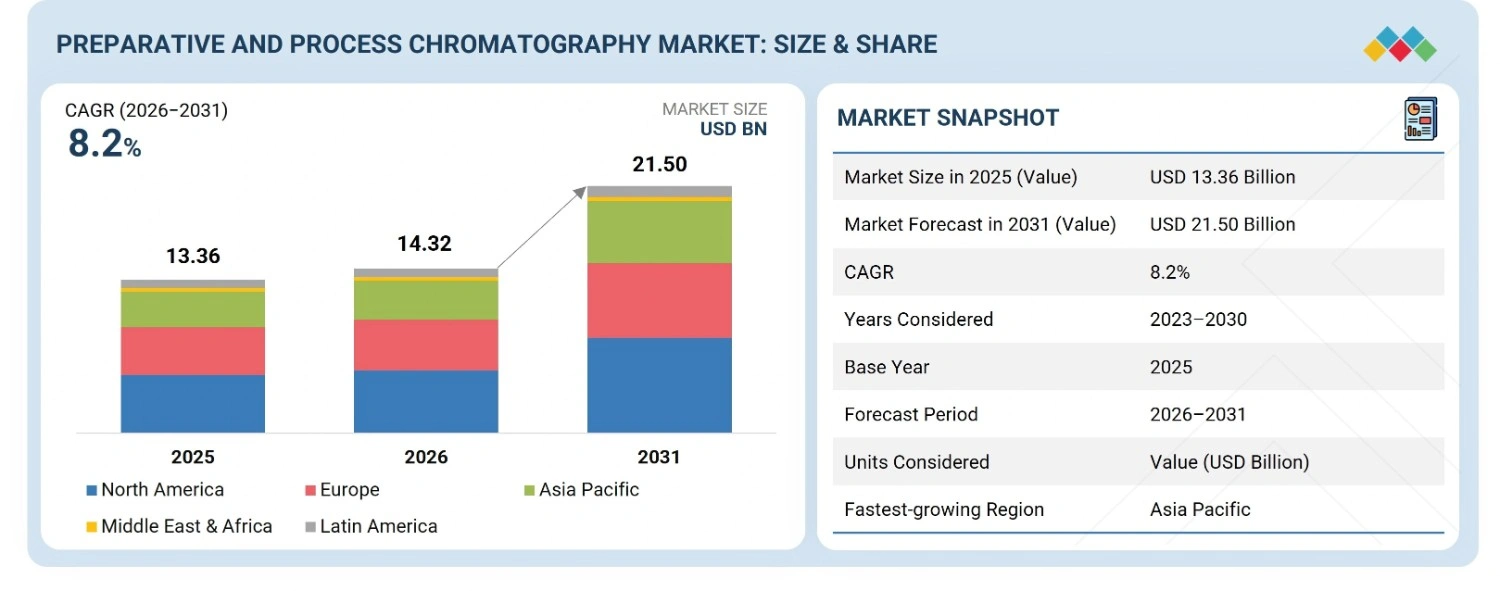
Source: Secondary Research, Interviews with Experts, MarketsandMarkets Analysis
The Preparative and Process Chromatography market, valued at US$13.36 billion in 2025, stood at US$14.32 billion in 2026 and is projected to advance at a resilient CAGR of 8.2% from 2026 to 2031, culminating in a forecasted valuation of US$21.50 billion by the end of the period. Vaccines and recombinant proteins, including new modalities such as CGT, oligos, and mRNA, are expected to increase in volume as demand for more personalized treatments rises in some developed economies. With increased volume, this diversity of biologics requires purification. These shifts make chromatography a critical unit operation, especially for capture and purification. With quality control reforms, agencies are expecting tighter control of host-cell proteins, DNA, aggregates, and residual ligands. These macro trends are projected to increase production volume in the bioprocessing niche. This will help drive demand for relevant products used in preparative and process-scale chromatography. These factors will help drive the market for preparative and process chromatography.
KEY TAKEAWAYS
-
MARKET SNAPSHOT:
Base Year Market Size (2025): USD 13.36 Billion
Current Market Size (2026): USD 14.32 Billion
Forecast Market Size (2031): USD 21.50 Billion
CAGR (2026–2031): 8.2% -
SEGMENT LEADERSHIP:
Regional Growth: Asia Pacific is projected to register the highest CAGR of 9.5%.
Product Type Leader: Process chromatography acquired the largest share of 69.4% in 2025.
End User Leader: Pharma & biopharma companies held the largest share of 51.0% in the preparative and process chromatography market.
Application Leader: Monoclonal antibodies & recombinant proteins accounted for 39.3% of the market in 2025. -
MARKET OUTLOOK & COMPETITIVE LANDSCAPE:
Danaher (US), Merck KGaA (US), Thermo Fisher Scientific (US), Waters Corporation (US), and Agilent Technologies (US) are key players in the global preparative and process chromatography market, supported by broad product portfolios and strong technical-service networks across major biopharma hubs.
Companies such as Bio-Works Technologies, Sunresin Life Sciences, Sykam, Inkarp Instruments, and various regional OEMs are active in niche segments of the preparative and process chromatography ecosystem, supplying specialized resins, pre-packed or empty columns, and cost-competitive systems.
Process alterations, such as multi-column continuous chromatography, increase chromatography throughput without expanding the operational footprint. Manufacturers now focus more on such approaches, as they help limit capex while serving more products from the same line, which matters as portfolios diversify and pipeline or process turnaround times decrease. These shifts help achieve higher resin density (kilograms per liter) and address bottlenecks in downstream processing workflows. Manufacturers offering such solutions in their consumable workflows will capitalize on these opportunities, helping grow the market for preparative and process chromatography. On the consumables side, demand is shifting toward higher-capacity, alkali-tolerant Protein A media and mixed-mode or advanced ion-exchange resins that can handle tougher impurity profiles or reduce the number of steps in a train. These shifts from conventional to advanced methods are expected to drive growth in the market for preparative and process chromatography.
TRENDS & DISRUPTIONS IMPACTING CUSTOMERS' CUSTOMERS
Preparative and process chromatography is evolving from a basic purification step into a strategic platform. It helps users meet four main goals: reproducible quality, high yield, cost-effective purification, and high-resolution separations. These improvements enable better outcomes for stakeholders. For end users on the supply side of biologics and drug manufacturing (pharmaceutical, biopharmaceutical, and CDMO companies), pre-packed columns and continuous systems help produce reliable GMP-grade biologics at lower costs and with faster scale-up. This leads to high-quality therapies, shorter development timelines, and reduced risk for sponsors. Food and nutraceutical companies use the same tools to consistently eliminate contaminants and standardize active ingredients. This builds strong brand trust and improves regulatory acceptance. Academic and research organizations need high-resolution preparative platforms to quickly purify various biomolecules. This accelerates discovery and lowers risk in downstream development.
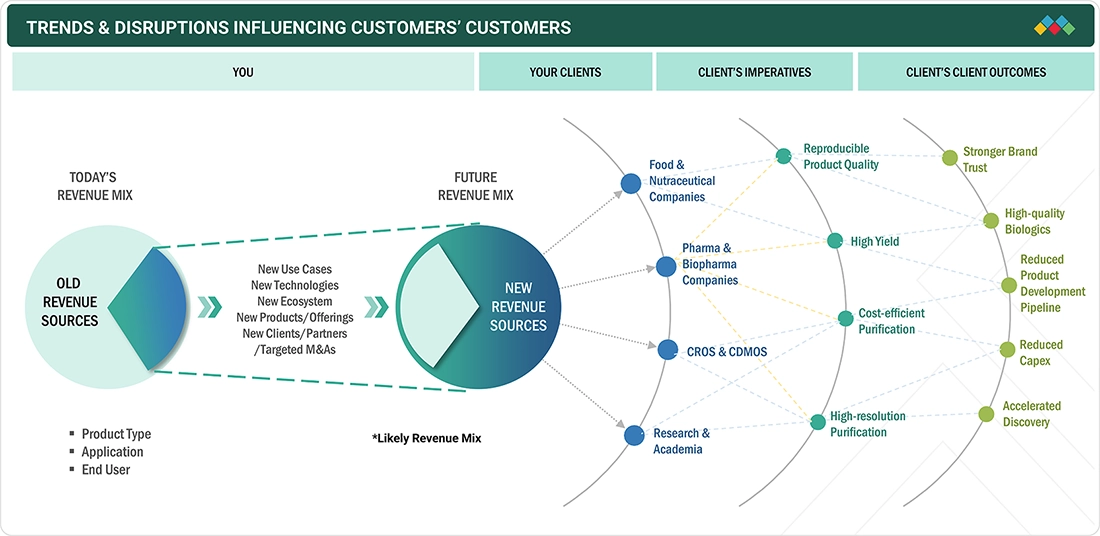
Source: Secondary Research, Interviews with Experts, MarketsandMarkets Analysis
MARKET DYNAMICS

Drivers
Impact
Level
Level
-
Increased demand for complex biologics and advanced therapeutics modalities

-
Increased outsourcing to CDMOs driving additional chromatography capacity and utilization


RESTRAINTS
Impact
Level
Level
-
Low replacement rate due to incomplete single-use adoption

-
Operational complexity of advanced and continuous chromatography


OPPORTUNITIES
Impact
Level
Level
-
Innovation in media and column solutions to capture new biologic modalities

-
Expansion of integrated intensified and continuous chromatography platforms


CHALLENGES
Impact
Level
Level
-
Shortage of skilled chromatography professionals

-
High capital and operating costs

Source: Secondary Research, Interviews with Experts, MarketsandMarkets Analysis
Driver: Increased demand for complex biologics and advanced therapeutics modalities
As demand for established biologics such as monoclonal antibodies (mAbs) grows, manufacturing facilities face increasing pressure to achieve high-volume yields with minimal resource use. Demand for new treatments from cell and gene therapies is also driving demand for high-value biologics. Scaling up manufacturing parameters from the preparative phase to large scale, along with the associated complexity, requires automation, which is driving sales of large-scale process systems, columns, and high-capacity resins for high-titer products. The purification challenges posed by new, complex, and fragile modalities increase the need for specialized, high-resolution, single-use or flexible systems with multimodal resins to achieve extremely high purity. Finally, to stay competitive and reduce costs, the industry is accelerating the adoption of continuous chromatography, or multi-column chromatography. This trend boosts sales of advanced systems and the software needed for process control and optimization.
Restraint: Low replacement rate due to incomplete single-use adoption
The main barrier to market growth is the incomplete technical readiness and adoption of single-use and pre-packed solutions, especially at a large scale. Significant economic gains from single-use technologies, such as reduced cleaning cycles, faster validation, and quicker changeovers, can only be realized when the entire manufacturing line primarily uses single-use systems. However, many important downstream steps still lack mature single-use options. This dependence on stainless-steel or traditionally packed columns in crucial process steps limits operational efficiency, keeps labor and cleaning costs high, and weakens the economic argument for expanding capacity with newer technology. Additionally, quality assurance and engineering teams are cautious due to ongoing concerns about the performance, lifespan, pressure limits, and scalability of newer solutions with very large column sizes. Such factors cause facilities to extend the operational life of existing packed columns rather than invest in upgrades, leading to lower demand for newer chromatography systems.
Opportunity: Innovation in media and column solutions to capture new biologic modalities
The increasing complexity and volume of biologics, coupled with strong demand for new treatment modalities such as viral vectors, mRNA, and oligonucleotides, create a significant growth opportunity for the preparative and process chromatography market. These shifts drive demand for column and chromatography media solutions tailored to these modalities. Traditional purification methods such as Protein A, standard ion exchange (IEX), and hydrophobic interaction chromatography (HIC) often perform poorly with these new, complex molecules. This gap presents a valuable opportunity for suppliers who can innovate and provide better chromatography resins, membranes, and pre-packed columns that offer higher selectivity, yield, or fewer steps in the purification process. By delivering tailored solutions for these high-value modalities, chromatography suppliers can command higher prices and establish long-term supply agreements. This shift allows them to move from being basic suppliers to becoming key technology partners, capturing significant, unique revenue streams that support the overall growth of the market.
Challenge: Shortage of skilled chromatography professionals
Running complex, high-performance systems and executing demanding method development require specialized expertise. The limited availability of trained staff in many regions impedes the efficient use of high-value instruments, leading to suboptimal process performance and increased operational risk. Critically, this skill gap discourages manufacturers, particularly smaller companies and labs already facing high capital costs, from upgrading to newer, more automated, and efficient systems. Instead, companies delay upgrades or rely on simpler, sometimes less efficient, processes, which slows the adoption of advanced systems and limits the replacement demand essential for sustained market growth.
PREPARATIVE AND PROCESS CHROMATOGRAPHY MARKET: COMMERCIAL USE CASES ACROSS INDUSTRIES
| COMPANY | USE CASE DESCRIPTION | BENEFITS |
|---|---|---|
 |
ÄKTA process chromatography systems with Capto purification resins (Protein A) serve as an integrated, automated platform in manufacturing. | Integrated automation reduces manual handling and process variability, cutting scale-up and process-development timelines. |
 |
Capture Select Protein A resins with Go Pure prepacked columns are tuned for high selectivity toward the Fc region of antibodies. | This eliminates 2–3 weeks of packing, column validation, and troubleshooting, allowing CDMOs to achieve faster time-to-clinic for sponsors. |
 |
Co Prime continuous chromatography systems are the platforms for continuous (as opposed to batch) operation, which reduces the turnaround time with a significant margin. | Continuous multi-column operation improves resin utilization by 2–3 times compared to batch processing, helping end users to optimize the operating cost. |
 |
OPUS pre-packed process columns are the single-use column platform where resin is pre-packed in disposable housings. | This platform reduces the need for specialized in-house column-packing expertise and labor, reducing the need for specialized workflow. |
Logos and trademarks shown above are the property of their respective owners. Their use here is for informational and illustrative purposes only.
MARKET ECOSYSTEM
The preparative and process chromatography ecosystem is a multi-layered value chain that connects chromatography platform manufacturers (resins, columns, systems), specialty material suppliers, distributor partners, and end-use organizations across the biopharmaceutical, food/nutraceutical, and research sectors. Manufacturers such as Danaher (Cytiva), Thermo Fisher Scientific, Repligen, Merck KGaA, Sartorius, Waters, and Agilent Technologies deliver integrated chromatography platforms—resins, pre-packed columns, and automated systems—that enable large-scale and preparative purification of biologics and specialty chemicals. Raw material and component suppliers, such as Welch Materials (silica and polymeric supports) and Chondrex (specialty resins for research), provide feedstock, base matrices, and supporting materials that manufacturers integrate into their final chromatography offerings. Distributors and channel partners, including Chemglass Life Sciences, Thomas Scientific, Rayden, SpectraLab, and regional scientific-supply networks, extend manufacturers’ reach into mid-market and emerging-region biotech facilities. Major pharmaceutical manufacturers, biotech firms, research and academic institutions, and food/nutraceutical companies deploy preparative and process chromatography to purify their own product candidates and manufactured goods.
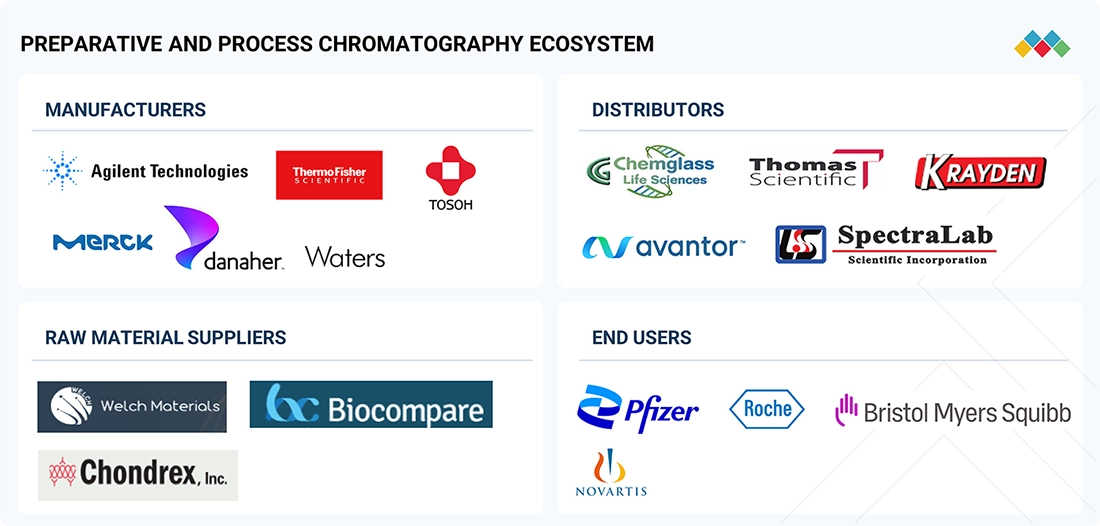
Logos and trademarks shown above are the property of their respective owners. Their use here is for informational and illustrative purposes only.
MARKET SEGMENTS
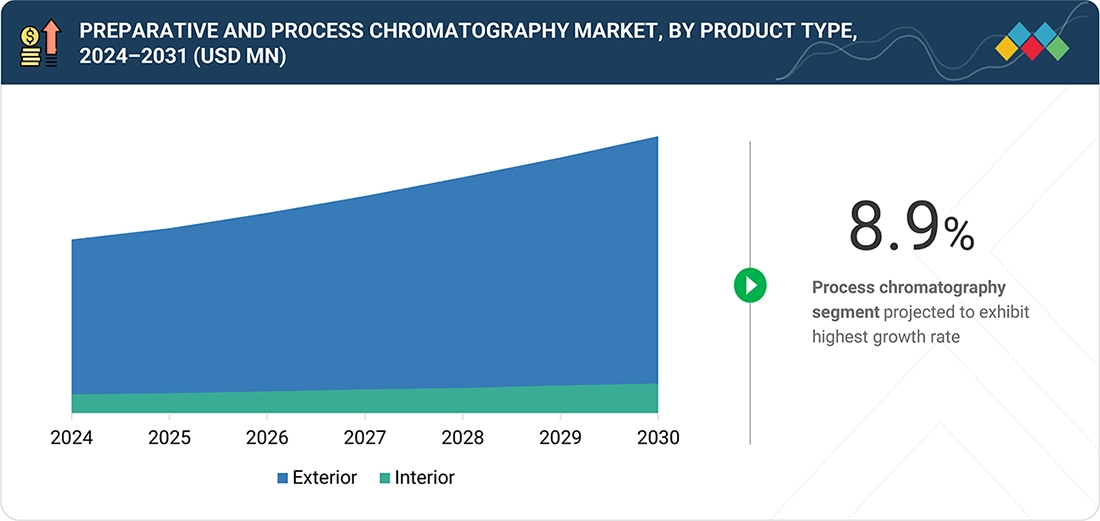
Source: Secondary Research, Interviews with Experts, MarketsandMarkets Analysis
Preparative and Process Chromatography Market, By Product Type
By product type, the market is divided into process chromatography products and preparative chromatography products. Process chromatography products hold the largest share of the market. Global pharmaceutical and biopharmaceutical end users—which include major pharma facilities and CDMOs—are focused on commercial downstream workflows designed for process chromatography rather than preparative stages. A new plant or large-scale manufacturing facility drives recurring, multi-year demand for process resins, columns, and services. The shift of manufacturing to contract organizations means more plants are being built and optimized around process chromatography platforms. CDMOs running multi-product lines consume large volumes of process resins and systems to serve many clients simultaneously, further concentrating market value in the process segment. Manufacturers invest in optimizing and designing process workflows to improve process economics. This helps estimate the cost of the manufacturing cycle (process level) rather than the preparative level. Such efforts address concerns related to buffer consumption, shrinking footprint, and extending resin lifetime—directly targeting process chromatography. This makes it clear that capital investments are more in process chromatography, which increases the consumption of target products. All these factors have helped process chromatography acquire a larger share.
Preparative and Process Chromatography Market, By Application
By application, the market for preparative and process chromatography is categorized into monoclonal antibodies & recombinant proteins, vaccines, peptides and oligonucleotides, cell and gene therapies, and other applications. The monoclonal antibodies & recombinant proteins production application held the largest market share in 2024. Monoclonal antibodies (mAbs) have become a widely adopted biotherapeutic modality across oncology, immunology, infectious disease, and rare disease indications. Regulatory pathways are well-established, manufacturing processes are standardized, and biosimilar competition has driven market growth.
Preparative and Process Chromatography Market, By End User
By end user, the preparative and process chromatography market is categorized into pharma & biopharma companies, food & nutraceutical companies, research & academia, and other end users. Pharma & biopharma companies held the largest share in 2024. Integrated pharmaceutical and biopharmaceutical manufacturers represent the anchor customer base for preparative and process chromatography, driven by their need to produce large-scale commercial biologics with consistent quality, high yield, and regulatory compliance. These organizations operate dedicated downstream facilities optimized for mAb, recombinant protein, and vaccine purification, requiring a continuous supply of resins, columns, systems, and technical support. Large pharma companies maintain in-house process development and manufacturing expertise and invest heavily in advanced chromatography platforms. The stability and scale of these operations, combined with their strict quality and regulatory requirements, make them a key end user segment with significant demand. These factors have helped them acquire the largest share.
PREPARATIVE AND PROCESS CHROMATOGRAPHY MARKET: COMPANY EVALUATION MATRIX
In the preparative and process chromatography market, Danaher (Cytiva) and Thermo Fisher Scientific are a part of the "stars" quadrant, anchored by comprehensive, integrated chromatography portfolios spanning resins, process and preparative systems, columns, and after-market services. Both vendors command dominant global market positions, maintain deep customer relationships across pharma, biopharma, and CDMOs, and lead in process-intensification technologies such as continuous multi-column systems and advanced pre-packed column platforms. Simultaneously, emerging players are targeting high-growth niches—such as continuous chromatography solutions, pre-packed single-use column systems optimized for CGT and oligonucleotide purification, and regional cost-competitiveness—to challenge established players and capture share from customers seeking specialized capabilities or cost reduction.
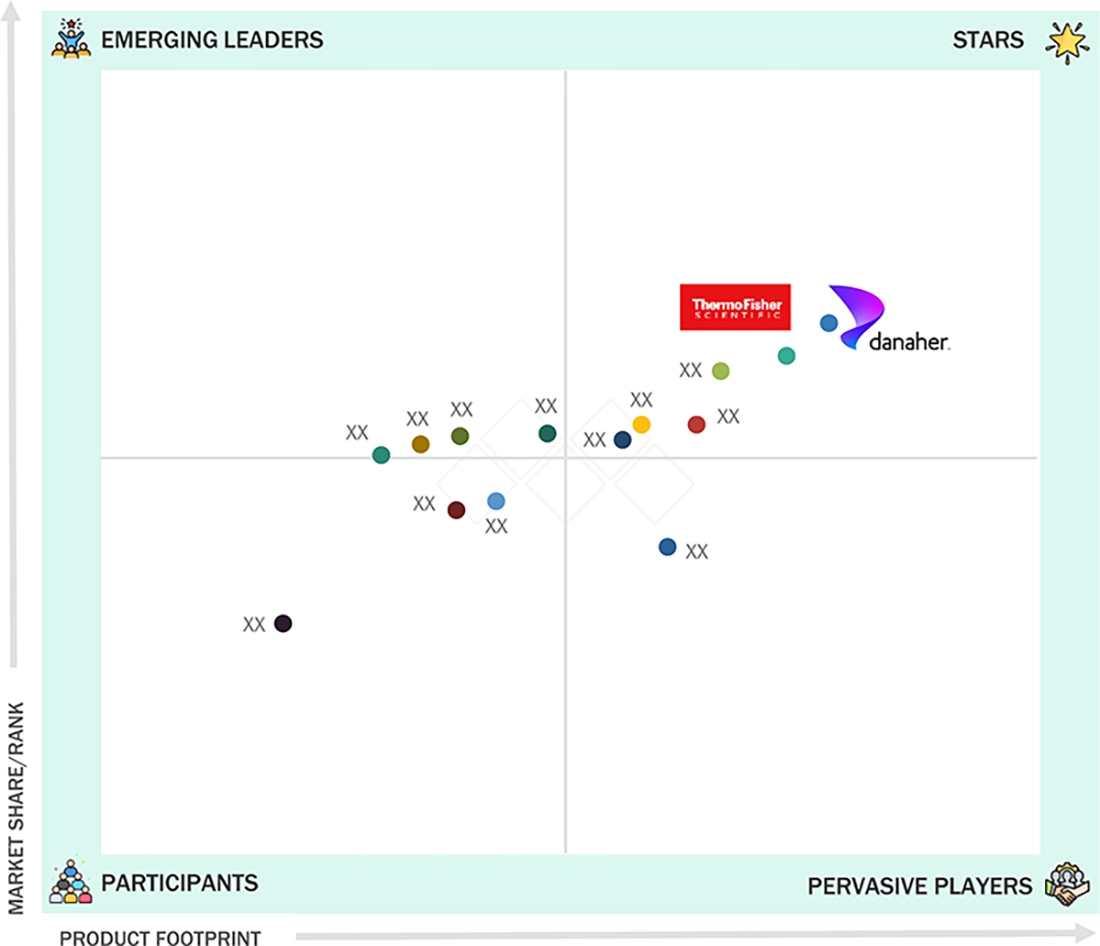
Source: Secondary Research, Interviews with Experts, MarketsandMarkets Analysis
KEY MARKET PLAYERS
- Agilent Technologies, Inc (US)
- Thermo Fisher Scientific, Inc (US)
- Danaher Corporation (US)
- Waters Corporation (US)
- Bio-Rad Laboratories, Inc. (US)
- Repligen (US)
- Revvity (US)
- Sartorius (Germany)
- Merck KGaA (Germany)
MARKET SCOPE
| REPORT METRIC | DETAILS |
|---|---|
| Market Size in 2025 (Value) | USD 13.36 Billion |
| Market Forecast in 2031 (Value) | USD 21.50 Billion |
| Growth Rate | 8.2% |
| Years Considered | 2023–2030 |
| Base Year | 2025 |
| Forecast Period | 2026–2031 |
| Units Considered | Value (USD Million/Billion) |
| Report Coverage | Revenue forecast, company ranking, competitive landscape, growth factors, and trends |
| Segments Covered |
|
WHAT IS IN IT FOR YOU: PREPARATIVE AND PROCESS CHROMATOGRAPHY MARKET REPORT CONTENT GUIDE
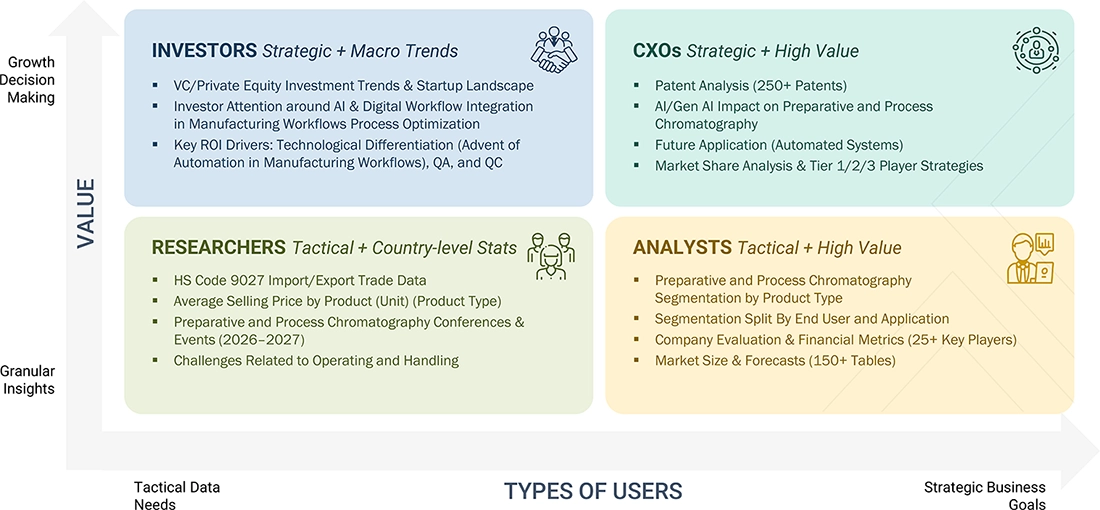
DELIVERED CUSTOMIZATIONS
We have successfully delivered the following deep-dive customizations:
| CLIENT REQUEST | CUSTOMIZATION DELIVERED | VALUE ADDS |
|---|---|---|
| Biopharmaceutical Companies |
|
|
RECENT DEVELOPMENTS
- April 2025 : Danaher Corporation (US), through its subsidiary Cytiva, introduced MabSelect SuRe?70 and MabSelect PrismA?X Protein?A resins designed for clinical- and commercial-scale mAb purification.
- February 2025 : Thermo Fisher Scientific Inc. (US) acquired Solventum's (US) bioprocess filtration business to strengthen its end-to-end downstream purification offerings, complementing its chromatography lines, including protein A resins.
- June 2024 : Repligen Corporation (US) and Ecolab (US) jointly introduced DurA?Cycle Protein?A Resin, designed for large-scale mAb manufacturing with improved cleaning resistance and cost savings.
Table of Contents
 Exclusive indicates content/data unique to MarketsandMarkets and not available with any competitors.
TITLE
PAGE NO
1
INTRODUCTION
25
2
EXECUTIVE SUMMARY
30
3
PREMIUM INSIGHTS
35
4
MARKET OVERVIEW
Explore growth via outsourcing, tech advances, and strategic investments in chromatography markets.
38
4.1
INTRODUCTION
4.2
MARKET DYNAMICS
4.2.1
DRIVERS
4.2.1.1
INCREASED DEMAND FOR COMPLEX BIOLOGICS AND ADVANCED THERAPEUTIC MODALITIES
4.2.1.2
INCREASED OUTSOURCING TO CDMOS
4.2.1.3
TECHNOLOGICAL ADVANCEMENTS IN CHROMATOGRAPHY MEDIA AND SYSTEMS
4.2.1.4
NEED FOR COST OPTIMIZATION IN DOWNSTREAM PROCESSING
4.2.2
RESTRAINTS
4.2.2.1
LOWERED REPLACEMENT RATE DUE TO INCOMPLETE SINGLE-USE ADOPTION
4.2.2.2
LIMITED RESIN LIFETIME AND PERFORMANCE DEGRADATION
4.2.3
OPPORTUNITIES
4.2.3.1
ONGOING INVESTMENTS IN BIOPROCESSING CAPACITY AND ANALYTICAL CAPABILITIES
4.2.3.2
EXPANSION OF INTEGRATED, INTENSIFIED, AND CONTINUOUS CHROMATOGRAPHY COLUMNS
4.2.4
CHALLENGES
4.2.4.1
SHORTAGE OF SKILLED CHROMATOGRAPHY PROFESSIONALS
4.2.4.2
HIGH CAPITAL AND OPERATING COSTS
4.3
UNMET NEEDS
4.4
INTERCONNECTED MARKETS & CROSS-SECTOR OPPORTUNITIES
4.5
STRATEGIC MOVES BY TIER1/2/3 PLAYERS
4.5.1
OVERVIEW OF STRATEGIES ADOPTED BY PLAYERS IN PREPARATIVE AND PROCESS CHROMATOGRAPHY MARKET
5
INDUSTRY TRENDS
Navigate industry evolution with strategic insights into competitive forces and bioprocess market dynamics.
48
5.1
PORTER’S FIVE FORCES ANALYSIS
5.1.1
BARGAINING POWER OF BUYERS
5.1.2
BARGAINING POWER OF SUPPLIERS
5.1.3
THREAT OF NEW ENTRANTS
5.1.4
THREAT OF SUBSTITUTES
5.1.5
INTENSITY OF COMPETITIVE RIVALRY
5.2
MACROECONOMIC INDICATORS
5.2.1
INTRODUCTION
5.2.2
GDP TRENDS & FORECAST
5.2.3
TRENDS IN GLOBAL BIOPROCESS INDUSTRY
5.3
SUPPLY CHAIN ANALYSIS
5.3.1
PROMINENT COMPANIES
5.3.2
SMALL & MEDIUM-SIZED ENTERPRISES
5.3.3
END USERS
5.4
VALUE CHAIN ANALYSIS
5.4.1
RESEARCH & PRODUCT DEVELOPMENT
5.4.2
RAW MATERIAL PROCUREMENT
5.4.3
MANUFACTURING
5.4.4
DISTRIBUTION, MARKETING & SALES, AND POST-SALES SERVICES
5.5
ECOSYSTEM ANALYSIS
5.6
PRICING ANALYSIS
5.6.1
AVERAGE SELLING PRICE OF PREPARATIVE AND PROCESS CHROMATOGRAPHY PRODUCTS, BY KEY PLAYER, 2025
5.6.2
AVERAGE SELLING PRICE OF PREPARATIVE AND PROCESS CHROMATOGRAPHY PRODUCTS, BY REGION, 2025
5.7
TRADE ANALYSIS
5.7.1
IMPORT DATA (HS CODE 902720)
5.7.2
EXPORT DATA (HS CODE 902720)
5.8
KEY CONFERENCES & EVENTS, 2026–2027
5.9
TRENDS/DISRUPTIONS IMPACTING CUSTOMERS’ BUSINESSES
5.10
INVESTMENT & FUNDING SCENARIO
5.11
CASE STUDY ANALYSIS
5.12
IMPACT OF 2025 US TARIFFS ON PREPARATIVE AND PROCESS CHROMATOGRAPHY MARKET
5.12.1
INTRODUCTION
5.12.2
KEY TARIFF RATES
5.12.3
PRICE IMPACT ANALYSIS
5.12.4
IMPACT ON COUNTRY/REGION
5.12.4.1
US
5.12.4.2
EUROPE
5.12.4.3
ASIA PACIFIC
5.12.5
IMPACT ON END-USE INDUSTRIES
6
STRATEGIC DISRUPTIONS THROUGH TECHNOLOGY, PATENTS, AND DIGITAL & AI ADOPTION
Harness AI and emerging tech to revolutionize chromatography with strategic patent insights.
69
6.1
KEY EMERGING TECHNOLOGIES
6.1.1
RECOMBINANT PROTEIN A LIGAND ENGINEERING
6.1.2
ALKALINE-STABLE LIGAND DEVELOPMENT
6.2
COMPLEMENTARY TECHNOLOGIES
6.2.1
AUTOMATED COLUMN PACKING SYSTEMS
6.2.2
IN-LINE MONITORING AND PAT (PROCESS ANALYTICAL TECHNOLOGY)
6.3
ADJACENT TECHNOLOGIES
6.3.1
CONTINUOUS CHROMATOGRAPHY SYSTEMS
6.3.2
AFFINITY MEMBRANE TECHNOLOGY
6.4
PATENT ANALYSIS
6.5
IMPACT OF AI ON PREPARATIVE AND PROCESS CHROMATOGRAPHY MARKET
6.5.1
TOP USE CASES & MARKET POTENTIAL
6.5.2
BEST PRACTICES IN PREPARATIVE AND PROCESS CHROMATOGRAPHY MARKET
6.5.3
CLIENTS' READINESS TO ADOPT GENERATIVE AI IN PREPARATIVE AND PROCESS CHROMATOGRAPHY
6.6
SUCCESS STORIES & REAL-WORLD APPLICATIONS
7
SUSTAINABILITY & REGULATORY LANDSCAPE
Navigate complex global regulations to align sustainability initiatives with emerging industry standards.
75
7.1
REGULATORY LANDSCAPE & SUSTAINABILITY INITIATIVES
7.1.1
REGULATORY BODIES, GOVERNMENT AGENCIES, AND OTHER ORGANIZATIONS
7.1.2
REGULATORY TRENDS
7.1.2.1
NORTH AMERICA
7.1.2.1.1
US
7.1.2.2
EUROPE
7.1.2.3
ASIA PACIFIC
7.1.2.4
REST OF THE WORLD
7.2
INDUSTRY STANDARDS
7.2.1
SUSTAINABILITY INITIATIVES
7.2.2
IMPACT OF REGULATORY POLICIES ON SUSTAINABILITY INITIATIVES
8
CUSTOMER LANDSCAPE & BUYER BEHAVIOR
Unlock buyer insights: Navigate stakeholder influence and unmet needs to boost market profitability.
80
8.1
DECISION-MAKING PROCESS
8.2
BUYER STAKEHOLDERS & BUYING EVALUATION CRITERIA
8.2.1
KEY STAKEHOLDERS IN BUYING PROCESS
8.2.2
BUYING EVALUATION CRITERIA
8.3
ADOPTION BARRIERS & INTERNAL CHALLENGES
8.4
UNMET NEEDS FROM VARIOUS END-USE INDUSTRIES
8.5
MARKET PROFITABILITY
9
PREPARATIVE AND PROCESS CHROMATOGRAPHY MARKET, BY PRODUCT TYPE
Market Size & Growth Rate Forecast Analysis to 2031 in USD Million | 15 Data Tables
84
9.1
INTRODUCTION
9.2
PROCESS CHROMATOGRAPHY PRODUCTS
9.2.1
CHEMICALS & REAGENTS
9.2.1.1
RECURRING CONSUMPTION TO DRIVE DEMAND FOR CHEMICALS & REAGENTS
9.2.2
RESINS
9.2.2.1
INCREASED PURIFICATION VOLUME TO DRIVE DEMAND FOR RESINS
9.2.3
COLUMNS
9.2.3.1
REPRODUCIBLE RESULTS AND LOW CROSS-CONTAMINATION RISK TO DRIVE DEMAND FOR COLUMNS IN PROCESS CHROMATOGRAPHY OPERATIONS
9.2.4
SYSTEMS
9.2.4.1
LESS CHANGEOVER TIME AND MAINTENANCE NEEDS TO BOOST DEMAND FOR SINGLE-USE CHROMATOGRAPHY SYSTEMS
9.2.5
AFTER-MARKET SERVICES
9.2.5.1
CAPACITY EXPANSIONS AND ROUTINE CALIBRATION NEEDS TO DRIVE MARKET GROWTH
9.3
PREPARATIVE CHROMATOGRAPHY PRODUCTS
9.3.1
CHEMICALS & REAGENTS
9.3.1.1
METHOD DEVELOPMENT FOCUS AND HIGH-PURITY RESULTS TO DRIVE MARKET FOR REAGENTS IN PREPARATIVE OPERATIONS
9.3.2
RESINS
9.3.2.1
COST-EFFECTIVE SUPPLY CHAIN METRICS TO DRIVE DEMAND FOR BULK RESINS
9.3.3
COLUMNS
9.3.3.1
FLEXIBILITY, LOW SAMPLE CONSUMPTION, AND HIGH THROUGHPUT TO DRIVE ADOPTION
9.3.4
SYSTEMS
9.3.4.1
BIOLOGICS INNOVATION AND STRONG MAB PIPELINE TO SUPPORT DEMAND FOR SYSTEMS
9.3.5
AFTER-MARKET SERVICES
9.3.5.1
CONSULTATIVE AND TECHNICAL SERVICES TO DRIVE DEMAND FOR AFTER-MARKET SERVICES
10
PREPARATIVE AND PROCESS CHROMATOGRAPHY MARKET, BY APPLICATION
Market Size & Growth Rate Forecast Analysis to 2031 in USD Million | 6 Data Tables
98
10.1
INTRODUCTION
10.2
MONOCLONAL ANTIBODIES & RECOMBINANT PROTEINS
10.2.1
SHIFT TOWARDS MORE COST-EFFECTIVE OPTIONS TO OPEN NEW REVENUE CHANNELS
10.3
VACCINES
10.3.1
WIDE APPLICATION BASE OF STANDARDIZED CHROMATOGRAPHY TECHNIQUES IN VACCINE MANUFACTURING TO DRIVE MARKET GROWTH
10.4
PEPTIDES & OLIGONUCLEOTIDES
10.4.1
SHIFT TOWARDS HYBRID SYNTHESIS TO DRIVE MARKET GROWTH
10.5
CELL & GENE THERAPIES
10.5.1
LOWER TARGET PRODUCT YIELD TO HAMPER GROWTH OF CHROMATOGRAPHY AS PRIMARY TECHNIQUE
10.6
OTHER APPLICATIONS
11
PREPARATIVE AND PROCESS CHROMATOGRAPHY MARKET, BY END USER
Market Size & Growth Rate Forecast Analysis to 2031 in USD Million | 5 Data Tables
104
11.1
INTRODUCTION
11.2
PHARMACEUTICAL & BIOPHARMACEUTICAL COMPANIES
11.2.1
EXTENSIVE USE IN BIOLOGICAL DRUG PRODUCTION TO ENSURE STRONG DEMAND
11.3
FOOD & NUTRACEUTICAL COMPANIES
11.3.1
EXPANDING USE CASES IN NUTRACEUTICAL INDUSTRY TO BOOST MARKET GROWTH
11.4
RESEARCH & ACADEMIC INSTITUTES
11.4.1
INCREASING R&D IN DRUG DISCOVERY TO DRIVE USE OF CHROMATOGRAPHY
11.5
OTHER END USERS
12
PREPARATIVE AND PROCESS CHROMATOGRAPHY MARKET, BY REGION
Comprehensive coverage of 8 Regions with country-level deep-dive of 14 Countries | 74 Data Tables.
110
12.1
INTRODUCTION
12.2
NORTH AMERICA
12.2.1
MACROECONOMIC OUTLOOK FOR NORTH AMERICA
12.2.2
US
12.2.2.1
EXPANSION IN BIOMANUFACTURING AND DOMESTIC CAPACITY TO DRIVE MARKET
12.2.3
CANADA
12.2.3.1
POLICY-LED CAPACITY BUILD AND CDMO GROWTH TO DRIVE MARKET
12.3
EUROPE
12.3.1
MACROECONOMIC OUTLOOK FOR EUROPE
12.3.2
GERMANY
12.3.2.1
CAPACITY EXPANSION IN END-USE FACILITIES TO GENERATE NEW DEMAND CHANNELS FOR TARGET PRODUCTS
12.3.3
UK
12.3.3.1
GOVERNMENT POLICIES AND PUBLIC-PRIVATE PARTNERSHIPS TO DRIVE MARKET
12.3.4
FRANCE
12.3.4.1
DEMAND-SIDE DEVELOPMENTS TO ADD NEW REVENUE CHANNELS FOR CHROMATOGRAPHY OEMS AND SUPPLIERS
12.3.5
ITALY
12.3.5.1
INCREASED CAPEX FROM MAJOR END-USER CATEGORIES TO FUEL DEMAND FOR TARGET PRODUCTS
12.3.6
SPAIN
12.3.6.1
INCREASED NUMBER OF CDMOS AND CROS TO PROPEL DEMAND FOR CHROMATOGRAPHY AND RELATED PRODUCTS
12.3.7
REST OF EUROPE
12.4
ASIA PACIFIC
12.4.1
MACROECONOMIC OUTLOOK FOR ASIA PACIFIC
12.4.2
JAPAN
12.4.2.1
CDMO CAPACITY EXPANSIONS, POLICY BACKING, AND CDMO INVESTMENTS TO PROPEL MARKET
12.4.3
CHINA
12.4.3.1
ROBUST BIOPHARMACEUTICAL EXPANSION TO SUPPORT DEMAND
12.4.4
INDIA
12.4.4.1
GROWTH OF PHARMA AND BIOTECH INDUSTRIES TO DRIVE DEMAND FOR PREPARATIVE AND PROCESS CHROMATOGRAPHY
12.4.5
AUSTRALIA
12.4.5.1
INCREASING DEMAND FOR PROTEIN-BASED THERAPEUTICS TO DRIVE GROWTH
12.4.6
SOUTH KOREA
12.4.6.1
DEVELOPMENTS IN BIOPHARMACEUTICAL SECTOR TO DRIVE MARKET GROWTH
12.4.7
REST OF ASIA PACIFIC
12.5
LATIN AMERICA
12.5.1
MACROECONOMIC OUTLOOK FOR LATIN AMERICA
12.5.2
BRAZIL
12.5.2.1
BIOMANUFACTURING EMPHASIS AND PUBLIC–PRIVATE PARTNERSHIPS TO CATALYZE DEMAND
12.5.3
MEXICO
12.5.3.1
SUPPORTIVE GOVERNMENT INITIATIVES TO BOOST DEMAND FOR PREPARATIVE AND PROCESS CHROMATOGRAPHY PRODUCTS
12.5.4
REST OF LATIN AMERICA
12.6
MIDDLE EAST & AFRICA
12.6.1
MACROECONOMIC OUTLOOK FOR MIDDLE EAST & AFRICA
12.6.2
GCC COUNTRIES
12.6.2.1
FAVORABLE GOVERNMENT POLICIES TO PROPEL MARKET GROWTH
12.6.3
REST OF MIDDLE EAST & AFRICA
13
COMPETITIVE LANDSCAPE
Discover strategic advantages and market dominance of key players and startups in chromatography.
155
13.1
INTRODUCTION
13.2
KEY PLAYER STRATEGIES/RIGHT TO WIN
13.2.1
OVERVIEW OF STRATEGIES ADOPTED BY KEY PLAYERS IN PREPARATIVE AND PROCESS CHROMATOGRAPHY MARKET
13.3
REVENUE ANALYSIS, 2020–2024
13.4
MARKET SHARE ANALYSIS, 2025
13.4.1
MARKET RANKING OF KEY PLAYERS, 2025
13.5
COMPANY VALUATION & FINANCIAL METRICS
13.5.1
FINANCIAL METRICS
13.5.2
COMPANY VALUATION
13.6
BRAND/PRODUCT COMPARISON
13.7
COMPANY EVALUATION MATRIX: KEY PLAYERS, 2025
13.7.1
STARS
13.7.2
EMERGING LEADERS
13.7.3
PERVASIVE PLAYERS
13.7.4
PARTICIPANTS
13.7.5
COMPANY FOOTPRINT: KEY PLAYERS, 2025
13.7.5.1
COMPANY FOOTPRINT
13.7.5.2
REGION FOOTPRINT
13.7.5.3
PRODUCT TYPE FOOTPRINT
13.7.5.4
APPLICATION FOOTPRINT
13.7.5.5
END-USER FOOTPRINT
13.8
COMPANY EVALUATION MATRIX: STARTUPS/SMES, 2025
13.8.1
PROGRESSIVE COMPANIES
13.8.2
RESPONSIVE COMPANIES
13.8.3
DYNAMIC COMPANIES
13.8.4
STARTING BLOCKS
13.8.5
COMPETITIVE BENCHMARKING OF STARTUPS/SMES, 2025
13.8.5.1
DETAILED LIST OF KEY STARTUPS/SMES
13.8.5.2
COMPETITIVE BENCHMARKING OF KEY STARTUPS/SMES
13.9
COMPETITIVE SCENARIO
13.9.1
PRODUCT LAUNCHES
13.9.2
DEALS
13.9.3
EXPANSIONS
14
COMPANY PROFILES
In-depth Company Profiles of Leading Market Players with detailed Business Overview, Product and Service Portfolio, Recent Developments, and Unique Analyst Perspective (MnM View)
179
14.1
KEY PLAYERS
14.1.1
DANAHER
14.1.1.1
BUSINESS OVERVIEW
14.1.1.2
PRODUCTS OFFERED
14.1.1.3
RECENT DEVELOPMENTS
14.1.1.3.1
PRODUCT LAUNCHES
14.1.1.3.2
DEALS
14.1.1.3.3
EXPANSIONS
14.1.1.4
MNM VIEW
14.1.1.4.1
RIGHT TO WIN
14.1.1.4.2
STRATEGIC CHOICES
14.1.1.4.3
WEAKNESSES & COMPETITIVE THREATS
14.1.2
THERMO FISHER SCIENTIFIC INC.
14.1.3
MERCK KGAA
14.1.4
SARTORIUS AG
14.1.5
WATERS CORPORATION
14.1.6
AGILENT TECHNOLOGIES, INC.
14.1.7
AVANTOR, INC.
14.1.8
BIO-RAD LABORATORIES, INC.
14.1.9
REPLIGEN CORPORATION
14.1.10
SHIMADZU CORPORATION
14.1.11
ECOLAB INC.
14.1.12
TOSOH BIOSCIENCE
14.2
OTHER PLAYERS
14.2.1
MITSUBISHI CHEMICAL CORPORATION
14.2.2
REVVITY
14.2.3
PERKINELMER
14.2.4
CECIL INSTRUMENTS LIMITED
14.2.5
W. R. GRACE & CO.-CONN
14.2.6
ECOM SPOL. S R.O
14.2.7
BÜCHI LABORTECHNIK AG
14.2.8
GOOD SCIENCE (TIANJIN) INSTRUMENT TECHNOLOGIES CO., LTD.
14.2.9
BIO WORKS TECHNOLOGIES
14.2.10
SYKAM GMBH
14.2.11
SUNRESIN NEW MATERIALS CO. LTD.
14.2.12
YMC CO., LTD.
14.2.13
GENO TECHNOLOGY INC.
15
RESEARCH METHODOLOGY
231
15.1
RESEARCH DATA
15.1.1
SECONDARY RESEARCH
15.1.1.1
KEY SECONDARY SOURCES
15.1.1.2
KEY DATA FROM SECONDARY SOURCES
15.1.1.3
OBJECTIVES OF SECONDARY RESEARCH
15.1.2
PRIMARY RESEARCH
15.1.2.1
KEY PRIMARY SOURCES
15.1.2.2
KEY SUPPLY- AND DEMAND-SIDE PARTICIPANTS
15.1.2.3
BREAKDOWN OF PRIMARY INTERVIEWS
15.1.2.4
OBJECTIVES OF PRIMARY RESEARCH
15.1.2.5
KEY PRIMARY INSIGHTS
15.2
MARKET SIZE ESTIMATION
15.2.1
BOTTOM-UP APPROACH
15.2.1.1
COMPANY REVENUE ESTIMATION
15.2.1.2
CUSTOMER-BASED MARKET ESTIMATION
15.2.1.3
PRIMARY INTERVIEWS
15.2.2
TOP-DOWN APPROACH
15.3
GROWTH RATE ASSUMPTIONS
15.4
DATA TRIANGULATION
15.5
STUDY ASSUMPTIONS
15.6
RESEARCH LIMITATIONS
15.7
RISK ANALYSIS
16
APPENDIX
247
16.1
DISCUSSION GUIDE
16.2
KNOWLEDGESTORE: MARKETSANDMARKETS’ SUBSCRIPTION PORTAL
16.3
CUSTOMIZATION OPTIONS
16.4
RELATED REPORTS
16.5
AUTHOR DETAILS
LIST OF TABLES
TABLE 1
PREPARATIVE AND PROCESS CHROMATOGRAPHY MARKET: INCLUSIONS & EXCLUSIONS
TABLE 2
PREPARATIVE AND PROCESS CHROMATOGRAPHY MARKET: UNMET NEEDS
TABLE 3
OVERVIEW OF STRATEGIES ADOPTED BY KEY COMPANIES IN PREPARATIVE AND PROCESS CHROMATOGRAPHY MARKET
TABLE 4
PREPARATIVE AND PROCESS CHROMATOGRAPHY MARKET: PORTER’S FIVE FORCES ANALYSIS
TABLE 5
AVERAGE SELLING PRICE OF GC COLUMNS, BY KEY PLAYER, 2025 (USD)
TABLE 6
AVERAGE SELLING PRICE TREND OF PREPARATIVE AND PROCESS CHROMATOGRAPHY PRODUCTS, BY REGION, 2023–2025 (USD)
TABLE 7
IMPORT DATA FOR CHROMATOGRAPHS AND ELECTROPHORESIS INSTRUMENTS, BY COUNTRY, 2021–2024 (USD THOUSAND)
TABLE 8
EXPORT DATA FOR CHROMATOGRAPHS AND ELECTROPHORESIS INSTRUMENTS, BY COUNTRY, 2021–2024 (USD THOUSAND)
TABLE 9
PREPARATIVE AND PROCESS CHROMATOGRAPHY MARKET: LIST OF MAJOR CONFERENCES AND EVENTS
TABLE 10
CASE STUDY 1: BIO-WORKS TECHNOLOGIES – WORKBEADS AFFIMAB FOR MONOCLONAL ANTIBODY PURIFICATION
TABLE 11
CASE STUDY 2: STATISTICAL APPROACHES TO DEVELOPMENT OF PROTEIN A AFFINITY CHROMATOGRAPHY FOR IMPROVING RECOVERY AND CONTROLLING QUALITY ATTRIBUTES OF MONOCLONAL ANTIBODIES
TABLE 12
CASE STUDY 3: CAPTURE CHROMATOGRAPHY WITH MIXED-MODE RESINS: A CASE STUDY WITH RECOMBINANT HUMAN THIOREDOXIN FROM ESCHERICHIA COLI
TABLE 13
US-ADJUSTED RECIPROCAL TARIFF RATES
TABLE 14
CASE STUDY 1: AI-GENERATED VS. IN-LAB HPLC METHOD OPTIMIZATION
TABLE 15
INTERCONNECTED ADJACENT ECOSYSTEMS & IMPACT ON MARKET PLAYERS
TABLE 16
NORTH AMERICA: REGULATORY BODIES, GOVERNMENT AGENCIES, AND OTHER ORGANIZATIONS
TABLE 17
EUROPE: REGULATORY BODIES, GOVERNMENT AGENCIES, AND OTHER ORGANIZATIONS
TABLE 18
ASIA PACIFIC: REGULATORY BODIES, GOVERNMENT AGENCIES, AND OTHER ORGANIZATIONS
TABLE 19
LATIN AMERICA: REGULATORY BODIES, GOVERNMENT AGENCIES, AND OTHER ORGANIZATIONS
TABLE 20
MIDDLE EAST & AFRICA: REGULATORY BODIES, GOVERNMENT AGENCIES, AND OTHER ORGANIZATIONS
TABLE 21
INDUSTRY STANDARDS FOR PREPARATIVE AND PROCESS CHROMATOGRAPHY MARKET
TABLE 22
INFLUENCE OF STAKEHOLDERS ON BUYING PROCESS (%)
TABLE 23
KEY BUYING CRITERIA, BY END USER
TABLE 24
PREPARATIVE AND PROCESS CHROMATOGRAPHY MARKET, BY PRODUCT TYPE, 2024–2031 (USD MILLION)
TABLE 25
PROCESS CHROMATOGRAPHY PRODUCTS MARKET, BY TYPE, 2024–2031 (USD MILLION)
TABLE 26
PROCESS CHROMATOGRAPHY PRODUCTS MARKET, BY REGION, 2024–2031 (USD MILLION)
TABLE 27
PROCESS CHROMATOGRAPHY PRODUCTS MARKET FOR CHEMICALS & REAGENTS, BY REGION, 2024–2031 (USD MILLION)
TABLE 28
PROCESS CHROMATOGRAPHY PRODUCTS MARKET FOR RESINS, BY REGION, 2024–2031 (USD MILLION)
TABLE 29
PROCESS CHROMATOGRAPHY PRODUCTS MARKET FOR COLUMNS, BY REGION, 2024–2031 (USD MILLION)
TABLE 30
PROCESS CHROMATOGRAPHY PRODUCTS MARKET FOR SYSTEMS, BY REGION, 2024–2031 (USD MILLION)
TABLE 31
PROCESS CHROMATOGRAPHY PRODUCTS MARKET FOR AFTER-MARKET SERVICES, BY REGION, 2024–2031 (USD MILLION)
TABLE 32
PREPARATIVE CHROMATOGRAPHY PRODUCTS MARKET, BY TYPE, 2024–2031 (USD MILLION)
TABLE 33
PREPARATIVE CHROMATOGRAPHY PRODUCTS MARKET, BY REGION, 2024–2031 (USD MILLION)
TABLE 34
PREPARATIVE CHROMATOGRAPHY PRODUCTS MARKET FOR CHEMICALS & REAGENTS, BY REGION, 2024–2031 (USD MILLION)
TABLE 35
PREPARATIVE CHROMATOGRAPHY PRODUCTS MARKET FOR RESINS, BY REGION, 2024–2031 (USD MILLION)
TABLE 36
PREPARATIVE CHROMATOGRAPHY PRODUCTS MARKET FOR COLUMNS, BY REGION, 2024–2031 (USD MILLION)
TABLE 37
PREPARATIVE CHROMATOGRAPHY PRODUCTS MARKET FOR SYSTEMS, BY REGION, 2024–2031 (USD MILLION)
TABLE 38
PREPARATIVE CHROMATOGRAPHY PRODUCTS MARKET FOR AFTER-MARKET SERVICES, BY REGION, 2024–2031 (USD MILLION)
TABLE 39
PREPARATIVE AND PROCESS CHROMATOGRAPHY MARKET, BY APPLICATION, 2024–2031 (USD MILLION)
TABLE 40
PREPARATIVE AND PROCESS CHROMATOGRAPHY MARKET FOR MONOCLONAL ANTIBODIES & RECOMBINANT PROTEINS, BY REGION, 2024–2031 (USD MILLION)
TABLE 41
PREPARATIVE AND PROCESS CHROMATOGRAPHY MARKET FOR VACCINES, BY REGION, 2024–2031 (USD MILLION)
TABLE 42
PREPARATIVE AND PROCESS CHROMATOGRAPHY MARKET FOR PEPTIDES & OLIGONUCLEOTIDES, BY REGION, 2024–2031 (USD MILLION)
TABLE 43
PREPARATIVE AND PROCESS CHROMATOGRAPHY MARKET FOR CELL & GENE THERAPIES, BY REGION, 2024–2031 (USD MILLION)
TABLE 44
PREPARATIVE AND PROCESS CHROMATOGRAPHY MARKET FOR OTHER APPLICATIONS, BY REGION, 2024–2031 (USD MILLION)
TABLE 45
PREPARATIVE AND PROCESS CHROMATOGRAPHY MARKET, BY END USER, 2024–2031 (USD MILLION)
TABLE 46
PREPARATIVE AND PROCESS CHROMATOGRAPHY MARKET FOR PHARMACEUTICAL & BIOPHARMACEUTICAL COMPANIES, BY REGION, 2024–2031 (USD MILLION)
TABLE 47
PREPARATIVE AND PROCESS CHROMATOGRAPHY MARKET FOR FOOD & NUTRACEUTICAL COMPANIES, BY REGION, 2024–2031 (USD MILLION)
TABLE 48
PREPARATIVE AND PROCESS CHROMATOGRAPHY MARKET FOR RESEARCH & ACADEMIC INSTITUTES, BY REGION, 2024–2031 (USD MILLION)
TABLE 49
PREPARATIVE AND PROCESS CHROMATOGRAPHY MARKET FOR OTHER END USERS, BY REGION, 2024–2031 (USD MILLION)
TABLE 50
PREPARATIVE AND PROCESS CHROMATOGRAPHY MARKET, BY REGION, 2024–2031 (USD MILLION)
TABLE 51
NORTH AMERICA: KEY MACROINDICATORS
TABLE 52
NORTH AMERICA: PREPARATIVE AND PROCESS CHROMATOGRAPHY MARKET, BY COUNTRY, 2024–2031 (USD MILLION)
TABLE 53
NORTH AMERICA: PREPARATIVE AND PROCESS CHROMATOGRAPHY MARKET, BY PRODUCT TYPE, 2024–2031 (USD MILLION)
TABLE 54
NORTH AMERICA: PROCESS CHROMATOGRAPHY PRODUCTS MARKET, BY TYPE, 2024–2031 (USD MILLION)
TABLE 55
NORTH AMERICA: PREPARATIVE CHROMATOGRAPHY PRODUCTS MARKET, BY TYPE, 2024–2031 (USD MILLION)
TABLE 56
NORTH AMERICA: PREPARATIVE AND PROCESS CHROMATOGRAPHY MARKET, BY APPLICATION, 2024–2031 (USD MILLION)
TABLE 57
NORTH AMERICA: PREPARATIVE AND PROCESS CHROMATOGRAPHY MARKET, BY END USER, 2024–2031 (USD MILLION)
TABLE 58
US: PROCESS CHROMATOGRAPHY PRODUCTS MARKET, BY TYPE, 2024–2031 (USD MILLION)
TABLE 59
US: PREPARATIVE CHROMATOGRAPHY PRODUCTS MARKET, BY TYPE, 2024–2031 (USD MILLION)
TABLE 60
CANADA: PROCESS CHROMATOGRAPHY PRODUCTS MARKET, BY TYPE, 2024–2031 (USD MILLION)
TABLE 61
CANADA: PREPARATIVE CHROMATOGRAPHY PRODUCTS MARKET, BY TYPE, 2024–2031 (USD MILLION)
TABLE 62
EUROPE: KEY MACROINDICATORS
TABLE 63
EUROPE: PREPARATIVE AND PROCESS CHROMATOGRAPHY MARKET, BY COUNTRY, 2024–2031 (USD MILLION)
TABLE 64
EUROPE: PREPARATIVE AND PROCESS CHROMATOGRAPHY MARKET, BY PRODUCT TYPE, 2024–2031 (USD MILLION)
TABLE 65
EUROPE: PROCESS CHROMATOGRAPHY PRODUCTS MARKET, BY TYPE, 2024–2031 (USD MILLION)
TABLE 66
EUROPE: PREPARATIVE CHROMATOGRAPHY PRODUCTS MARKET, BY TYPE, 2024–2031 (USD MILLION)
TABLE 67
EUROPE: PREPARATIVE AND PROCESS CHROMATOGRAPHY MARKET, BY APPLICATION, 2024–2031 (USD MILLION)
TABLE 68
EUROPE: PREPARATIVE AND PROCESS CHROMATOGRAPHY MARKET, BY END USER, 2024–2031 (USD MILLION)
TABLE 69
GERMANY: PROCESS CHROMATOGRAPHY PRODUCTS MARKET, BY TYPE, 2024–2031 (USD MILLION)
TABLE 70
GERMANY: PREPARATIVE CHROMATOGRAPHY PRODUCTS MARKET, BY TYPE, 2024–2031 (USD MILLION)
TABLE 71
UK: PROCESS CHROMATOGRAPHY PRODUCTS MARKET, BY TYPE, 2024–2031 (USD MILLION)
TABLE 72
UK: PREPARATIVE CHROMATOGRAPHY PRODUCTS MARKET, BY TYPE, 2024–2031 (USD MILLION)
TABLE 73
FRANCE: PROCESS CHROMATOGRAPHY PRODUCTS MARKET, BY TYPE, 2024–2031 (USD MILLION)
TABLE 74
FRANCE: PREPARATIVE CHROMATOGRAPHY PRODUCTS MARKET, BY TYPE, 2024–2031 (USD MILLION)
TABLE 75
ITALY: PROCESS CHROMATOGRAPHY PRODUCTS MARKET, BY TYPE, 2024–2031 (USD MILLION)
TABLE 76
ITALY: PREPARATIVE CHROMATOGRAPHY PRODUCTS MARKET, BY TYPE, 2024–2031 (USD MILLION)
TABLE 77
SPAIN: PROCESS CHROMATOGRAPHY PRODUCTS MARKET, BY TYPE, 2024–2031 (USD MILLION)
TABLE 78
SPAIN: PREPARATIVE CHROMATOGRAPHY PRODUCTS MARKET, BY TYPE, 2024–2031 (USD MILLION)
TABLE 79
REST OF EUROPE: PROCESS CHROMATOGRAPHY PRODUCTS MARKET, BY TYPE, 2024–2031 (USD MILLION)
TABLE 80
REST OF EUROPE: PREPARATIVE CHROMATOGRAPHY PRODUCTS MARKET, BY TYPE, 2024–2031 (USD MILLION)
TABLE 81
ASIA PACIFIC: KEY MACROINDICATORS
TABLE 82
ASIA PACIFIC: PREPARATIVE AND PROCESS CHROMATOGRAPHY MARKET, BY COUNTRY, 2024–2031 (USD MILLION)
TABLE 83
ASIA PACIFIC: PREPARATIVE AND PROCESS CHROMATOGRAPHY MARKET, BY PRODUCT TYPE, 2024–2031 (USD MILLION)
TABLE 84
ASIA PACIFIC: PROCESS CHROMATOGRAPHY PRODUCTS MARKET, BY TYPE, 2024–2031 (USD MILLION)
TABLE 85
ASIA PACIFIC: PREPARATIVE CHROMATOGRAPHY PRODUCTS MARKET, BY TYPE, 2024–2031 (USD MILLION)
TABLE 86
ASIA PACIFIC: PREPARATIVE AND PROCESS CHROMATOGRAPHY MARKET, BY APPLICATION, 2024–2031 (USD MILLION)
TABLE 87
ASIA PACIFIC: PREPARATIVE AND PROCESS CHROMATOGRAPHY MARKET, BY END USER, 2024–2031 (USD MILLION)
TABLE 88
JAPAN: PROCESS CHROMATOGRAPHY PRODUCTS MARKET, BY TYPE, 2024–2031 (USD MILLION)
TABLE 89
JAPAN: PREPARATIVE CHROMATOGRAPHY PRODUCTS MARKET, BY TYPE, 2024–2031 (USD MILLION)
TABLE 90
CHINA: PROCESS CHROMATOGRAPHY PRODUCTS MARKET, BY TYPE, 2024–2031 (USD MILLION)
TABLE 91
CHINA: PREPARATIVE CHROMATOGRAPHY PRODUCTS MARKET, BY TYPE, 2024–2031 (USD MILLION)
TABLE 92
INDIA: PROCESS CHROMATOGRAPHY PRODUCTS MARKET, BY TYPE, 2024–2031 (USD MILLION)
TABLE 93
INDIA: PREPARATIVE CHROMATOGRAPHY PRODUCTS MARKET, BY TYPE, 2024–2031 (USD MILLION)
TABLE 94
AUSTRALIA: PROCESS CHROMATOGRAPHY PRODUCTS MARKET, BY TYPE, 2024–2031 (USD MILLION)
TABLE 95
AUSTRALIA: PREPARATIVE CHROMATOGRAPHY PRODUCTS MARKET, BY TYPE, 2024–2031 (USD MILLION)
TABLE 96
SOUTH KOREA: PROCESS CHROMATOGRAPHY PRODUCTS MARKET, BY TYPE, 2024–2031 (USD MILLION)
TABLE 97
SOUTH KOREA: PREPARATIVE CHROMATOGRAPHY PRODUCTS MARKET, BY TYPE, 2024–2031 (USD MILLION)
TABLE 98
REST OF ASIA PACIFIC: PROCESS CHROMATOGRAPHY PRODUCTS MARKET, BY TYPE, 2024–2031 (USD MILLION)
TABLE 99
REST OF ASIA PACIFIC: PREPARATIVE CHROMATOGRAPHY PRODUCTS MARKET, BY TYPE, 2024–2031 (USD MILLION)
TABLE 100
LATIN AMERICA: KEY MACROINDICATORS
TABLE 101
LATIN AMERICA: PREPARATIVE AND PROCESS CHROMATOGRAPHY MARKET, BY COUNTRY, 2024–2031 (USD MILLION)
TABLE 102
LATIN AMERICA: PREPARATIVE AND PROCESS CHROMATOGRAPHY MARKET, BY PRODUCT TYPE, 2024–2031 (USD MILLION)
TABLE 103
LATIN AMERICA: PROCESS CHROMATOGRAPHY PRODUCTS MARKET, BY TYPE, 2024–2031 (USD MILLION)
TABLE 104
LATIN AMERICA: PREPARATIVE CHROMATOGRAPHY PRODUCTS MARKET, BY TYPE, 2024–2031 (USD MILLION)
TABLE 105
LATIN AMERICA: PREPARATIVE AND PROCESS CHROMATOGRAPHY MARKET, BY APPLICATION, 2024–2031 (USD MILLION)
TABLE 106
LATIN AMERICA: PREPARATIVE AND PROCESS CHROMATOGRAPHY MARKET, BY END USER, 2024–2031 (USD MILLION)
TABLE 107
BRAZIL: PROCESS CHROMATOGRAPHY PRODUCTS MARKET, BY TYPE, 2024–2031 (USD MILLION)
TABLE 108
BRAZIL: PREPARATIVE CHROMATOGRAPHY PRODUCTS MARKET, BY TYPE, 2024–2031 (USD MILLION)
TABLE 109
MEXICO: PROCESS CHROMATOGRAPHY PRODUCTS MARKET, BY TYPE, 2024–2031 (USD MILLION)
TABLE 110
MEXICO: PREPARATIVE CHROMATOGRAPHY PRODUCTS MARKET, BY TYPE, 2024–2031 (USD MILLION)
TABLE 111
REST OF LATIN AMERICA: PROCESS CHROMATOGRAPHY PRODUCTS MARKET, BY TYPE, 2024–2031 (USD MILLION)
TABLE 112
REST OF LATIN AMERICA: PREPARATIVE CHROMATOGRAPHY PRODUCTS MARKET, BY TYPE, 2024–2031 (USD MILLION)
TABLE 113
MIDDLE EAST & AFRICA: KEY MACROINDICATORS
TABLE 114
MIDDLE EAST & AFRICA: PREPARATIVE AND PROCESS CHROMATOGRAPHY MARKET, BY REGION, 2024–2031 (USD MILLION)
TABLE 115
MIDDLE EAST & AFRICA: PREPARATIVE AND PROCESS CHROMATOGRAPHY MARKET, BY PRODUCT TYPE, 2024–2031 (USD MILLION)
TABLE 116
MIDDLE EAST & AFRICA: PROCESS CHROMATOGRAPHY PRODUCTS MARKET, BY TYPE, 2024–2031 (USD MILLION)
TABLE 117
MIDDLE EAST & AFRICA: PREPARATIVE CHROMATOGRAPHY PRODUCTS MARKET, BY TYPE, 2024–2031 (USD MILLION)
TABLE 118
MIDDLE EAST & AFRICA: PREPARATIVE AND PROCESS CHROMATOGRAPHY MARKET, BY APPLICATION, 2024–2031 (USD MILLION)
TABLE 119
MIDDLE EAST & AFRICA: PREPARATIVE AND PROCESS CHROMATOGRAPHY MARKET, BY END USER, 2024–2031 (USD MILLION)
TABLE 120
GCC COUNTRIES: PROCESS CHROMATOGRAPHY PRODUCTS MARKET, BY TYPE, 2024–2031 (USD MILLION)
TABLE 121
GCC COUNTRIES: PREPARATIVE CHROMATOGRAPHY PRODUCTS MARKET, BY TYPE, 2024–2031 (USD MILLION)
TABLE 122
REST OF MIDDLE EAST & AFRICA: PROCESS CHROMATOGRAPHY PRODUCTS MARKET, BY TYPE, 2024–2031 (USD MILLION)
TABLE 123
REST OF MIDDLE EAST & AFRICA: PREPARATIVE CHROMATOGRAPHY PRODUCTS MARKET, BY TYPE, 2024–2031 (USD MILLION)
TABLE 124
OVERVIEW OF STRATEGIES DEPLOYED BY KEY PLAYERS IN PREPARATIVE AND PROCESS CHROMATOGRAPHY MARKET, 2022–2025
TABLE 125
PREPARATIVE AND PROCESS CHROMATOGRAPHY MARKET: DEGREE OF COMPETITION
TABLE 126
PREPARATIVE AND PROCESS CHROMATOGRAPHY MARKET: REGION FOOTPRINT
TABLE 127
PREPARATIVE AND PROCESS CHROMATOGRAPHY MARKET: PRODUCT TYPE FOOTPRINT
TABLE 128
PREPARATIVE AND PROCESS CHROMATOGRAPHY MARKET: APPLICATION FOOTPRINT
TABLE 129
PREPARATIVE AND PROCESS CHROMATOGRAPHY MARKET: END-USER FOOTPRINT
TABLE 130
PREPARATIVE AND PROCESS CHROMATOGRAPHY MARKET: DETAILED LIST OF KEY STARTUPS/SME PLAYERS, 2025
TABLE 131
PREPARATIVE AND PROCESS CHROMATOGRAPHY MARKET: COMPETITIVE BENCHMARKING OF KEY STARTUPS/SME PLAYERS, BY PRODUCT TYPE AND REGION
TABLE 132
PREPARATIVE AND PROCESS CHROMATOGRAPHY MARKET: PRODUCT LAUNCHES, JANUARY 2022–JANUARY 2026
TABLE 133
PREPARATIVE AND PROCESS CHROMATOGRAPHY MARKET: DEALS, JANUARY 2022–JANUARY 2026
TABLE 134
PREPARATIVE AND PROCESS CHROMATOGRAPHY MARKET: EXPANSIONS, JANUARY 2022–JANUARY 2026
TABLE 135
DANAHER: COMPANY OVERVIEW
TABLE 136
DANAHER: PRODUCTS OFFERED
TABLE 137
DANAHER: PRODUCT LAUNCHES, JANUARY 2022–DECEMBER 2025
TABLE 138
DANAHER: DEALS, JANUARY 2022–DECEMBER 2025
TABLE 139
DANAHER: EXPANSIONS, JANUARY 2022–JULY 2025
TABLE 140
THERMO FISHER SCIENTIFIC INC.: COMPANY OVERVIEW
TABLE 141
THERMO FISHER SCIENTIFIC INC.: PRODUCTS OFFERED
TABLE 142
THERMO FISHER SCIENTIFIC INC.: DEALS, JANUARY 2022–SEPTEMBER 2025
TABLE 143
THERMO FISHER SCIENTIFIC INC.: EXPANSIONS, JANUARY 2022–JULY 2025
TABLE 144
MERCK KGAA: COMPANY OVERVIEW
TABLE 145
MERCK KGAA: PRODUCTS OFFERED
TABLE 146
MERCK KGAA: DEALS, JANUARY 2022–DECEMBER 2025
TABLE 147
MERCK KGAA: EXPANSIONS, JANUARY 2022–DECEMBER 2025
TABLE 148
MERCK KGAA: OTHER DEVELOPMENTS, JANUARY 2022–DECEMBER 2025
TABLE 149
SARTORIUS AG COMPANY OVERVIEW
TABLE 150
SARTORIUS AG: PRODUCTS OFFERED
TABLE 151
WATERS CORPORATION: COMPANY OVERVIEW
TABLE 152
WATERS CORPORATION: PRODUCTS OFFERED
TABLE 153
WATERS CORPORATION: PRODUCT LAUNCHES, JANUARY 2022–DECEMBER 2025
TABLE 154
WATERS CORPORATION: DEALS, JANUARY 2022–SEPTEMBER 2025
TABLE 155
AGILENT TECHNOLOGIES, INC.: COMPANY OVERVIEW
TABLE 156
AGILENT TECHNOLOGIES, INC.: PRODUCTS OFFERED
TABLE 157
AGILENT TECHNOLOGIES, INC.: PRODUCT LAUNCHES, JANUARY 2022–DECEMBER 2025
TABLE 158
AGILENT TECHNOLOGIES, INC.: DEALS, JANUARY 2022–DECEMBER 2025
TABLE 159
AGILENT TECHNOLOGIES, INC.: EXPANSIONS, JANUARY 2022–SEPTEMBER 2025
TABLE 160
AVANTOR, INC.: COMPANY OVERVIEW
TABLE 161
AVATOR, INC.: PRODUCTS OFFERED
TABLE 162
BIO-RAD LABORATORIES, INC.: COMPANY OVERVIEW
TABLE 163
BIO-RAD LABORATORIES, INC.: PRODUCTS OFFERED
TABLE 164
REPLIGEN CORPORATION: COMPANY OVERVIEW
TABLE 165
REPLIGEN CORPORATION: PRODUCTS OFFERED
TABLE 166
REPLIGEN CORPORATION: PRODUCT LAUNCHES, JANUARY 2022–DECEMBER 2025
TABLE 167
REPLIGEN CORPORATION: DEALS, JANUARY 2022–DECEMBER 2025
TABLE 168
SHIMADZU CORPORATION: COMPANY OVERVIEW
TABLE 169
SHIMADZU CORPORATION: PRODUCTS OFFERED
TABLE 170
SHIMADZU CORPORATION: DEALS, JANUARY 2022–DECEMBER 2025
TABLE 171
ECOLAB INC.: COMPANY OVERVIEW
TABLE 172
ECOLAB INC: PRODUCTS OFFERED
TABLE 173
ECOLAB INC.: PRODUCT LAUNCHES, JANUARY 2022–DECEMBER 2025
TABLE 174
ECOLAB INC.: DEALS, JANUARY 2022–DECEMBER 2025
TABLE 175
ECOLAB INC.: EXPANSIONS, JANUARY 2022–DECEMBER 2025
TABLE 176
TOSOH BIOSCIENCE: COMPANY OVERVIEW
TABLE 177
TOSOH BIOSCIENCE: PRODUCTS OFFERED
TABLE 178
TOSOH BIOSCIENCE: EXPANSIONS, JANUARY 2022–DECEMBER 2025
TABLE 179
MITSUBISHI CHEMICAL CORPORATION: COMPANY OVERVIEW
TABLE 180
REVVITY: COMPANY OVERVIEW
TABLE 181
PERKINELMER: COMPANY OVERVIEW
TABLE 182
CECIL INSTRUMENTS LIMITED: COMPANY OVERVIEW
TABLE 183
W. R. GRACE & CO.-CONN: COMPANY OVERVIEW
TABLE 184
ECOM SPOL. S R.O.: COMPANY OVERVIEW
TABLE 185
BÜCHI LABORTECHNIK AG: COMPANY OVERVIEW
TABLE 186
GOOD SCIENCE (TIANJIN) INSTRUMENT TECHNOLOGIES CO., LTD.: COMPANY OVERVIEW
TABLE 187
BIO WORKS TECHNOLOGIES: COMPANY OVERVIEW
TABLE 188
SYKAM GMBH: COMPANY OVERVIEW
TABLE 189
SUNRESIN NEW MATERIALS CO. LTD.: COMPANY OVERVIEW
TABLE 190
YMC CO., LTD.: COMPANY OVERVIEW
TABLE 191
GENO TECHNOLOGY INC.: COMPANY OVERVIEW
TABLE 192
PREPARATIVE AND PROCESS CHROMATOGRAPHY MARKET: STUDY ASSUMPTIONS
TABLE 193
PREPARATIVE AND PROCESS CHROMATOGRAPHY MARKET: RISK ANALYSIS
LIST OF FIGURES
FIGURE 1
PREPARATIVE AND PROCESS CHROMATOGRAPHY MARKET SEGMENTATION & REGIONAL SCOPE
FIGURE 2
PREPARATIVE AND PROCESS CHROMATOGRAPHY MARKET: YEARS CONSIDERED
FIGURE 3
MARKET SCENARIO
FIGURE 4
GLOBAL PREPARATIVE AND PROCESS CHROMATOGRAPHY MARKET, 2023–2031
FIGURE 5
MAJOR STRATEGIES ADOPTED BY KEY PLAYERS IN PREPARATIVE AND PROCESS CHROMATOGRAPHY MARKET, 2024–2025
FIGURE 6
DISRUPTIONS INFLUENCING GROWTH OF PREPARATIVE AND PROCESS CHROMATOGRAPHY MARKET
FIGURE 7
HIGH-GROWTH SEGMENTS IN PREPARATIVE AND PROCESS CHROMATOGRAPHY MARKET, 2025–2031
FIGURE 8
ASIA PACIFIC TO REGISTER HIGHEST CAGR IN PREPARATIVE AND PROCESS CHROMATOGRAPHY MARKET, IN TERMS OF VALUE, DURING FORECAST PERIOD
FIGURE 9
INCREASED PRODUCTION OF MONOCLONAL ANTIBODIES TO DRIVE DEMAND FOR BIOPROCESSING AND SEPARATION PRODUCTS
FIGURE 10
CHINA AND JAPAN TO ACQUIRE A MAJOR SHARE OF MARKET IN ASIA PACIFIC IN 2025
FIGURE 11
INDIA TO REGISTER HIGHEST CAGR FROM 2026 TO 2030
FIGURE 12
PREPARATIVE AND PROCESS CHROMATOGRAPHY MARKET: DRIVERS, RESTRAINTS, OPPORTUNITIES, AND CHALLENGES
FIGURE 13
PREPARATIVE AND PROCESS CHROMATOGRAPHY MARKET: PORTER’S FIVE FORCES ANALYSIS
FIGURE 14
PREPARATIVE AND PROCESS CHROMATOGRAPHY MARKET: SUPPLY CHAIN ANALYSIS
FIGURE 15
PREPARATIVE AND PROCESS CHROMATOGRAPHY MARKET: VALUE CHAIN ANALYSIS
FIGURE 16
PREPARATIVE AND PROCESS CHROMATOGRAPHY MARKET: ECOSYSTEM ANALYSIS
FIGURE 17
AVERAGE SELLING PRICE OF GC COLUMNS, BY KEY PLAYER, 2025 (USD)
FIGURE 18
AVERAGE SELLING PRICE OF PREPARATIVE AND PROCESS CHROMATOGRAPHY PRODUCTS, BY REGION, 2025 (USD)
FIGURE 19
PREPARATIVE AND PROCESS CHROMATOGRAPHY MARKET: IMPORT SCENARIO FOR CHROMATOGRAPHS AND ELECTROPHORESIS INSTRUMENTS (HS CODE 902720)
FIGURE 20
PREPARATIVE AND PROCESS CHROMATOGRAPHY MARKET: EXPORT SCENARIO FOR CHROMATOGRAPHS AND ELECTROPHORESIS INSTRUMENTS (HS CODE 902720)
FIGURE 21
PREPARATIVE AND PROCESS CHROMATOGRAPHY MARKET: TRENDS/DISRUPTIONS IMPACTING CUSTOMERS’ BUSINESSES
FIGURE 22
PREPARATIVE AND PROCESS CHROMATOGRAPHY MARKET: INVESTMENT & FUNDING SCENARIO, 2019–2023
FIGURE 23
PREPARATIVE AND PROCESS CHROMATOGRAPHY MARKET: NUMBER OF INVESTOR DEALS, BY KEY PLAYER, 2019–2023
FIGURE 24
PREPARATIVE AND PROCESS CHROMATOGRAPHY MARKET: VALUE OF INVESTOR DEALS, BY KEY PLAYER, 2019–2023 (USD MILLION)
FIGURE 25
PATENT ANALYSIS FOR PREPARATIVE AND PROCESS CHROMATOGRAPHY MARKET (JANUARY 2015–JANUARY 2026)
FIGURE 26
INFLUENCE OF STAKEHOLDERS ON BUYING PROCESS FOR TOP FOUR END USERS
FIGURE 27
KEY BUYING CRITERIA, BY END USER
FIGURE 28
NORTH AMERICA: PREPARATIVE AND PROCESS CHROMATOGRAPHY MARKET SNAPSHOT (2024)
FIGURE 29
ASIA PACIFIC: PREPARATIVE AND PROCESS CHROMATOGRAPHY MARKET SNAPSHOT (2025)
FIGURE 30
REVENUE ANALYSIS OF KEY PLAYERS IN PREPARATIVE AND PROCESS CHROMATOGRAPHY MARKET, 2020–2024 (USD MILLION)
FIGURE 31
MARKET SHARE ANALYSIS OF KEY PLAYERS IN PREPARATIVE AND PROCESS CHROMATOGRAPHY MARKET (2025)
FIGURE 32
MARKET RANKING OF KEY PLAYERS IN PREPARATIVE AND PROCESS CHROMATOGRAPHY MARKET (2025)
FIGURE 33
EV/EBITDA OF TOP THREE PLAYERS (2026)
FIGURE 34
YEAR-TO-DATE (YTD) PRICE TOTAL RETURN AND 5-YEAR STOCK BETA OF TOP THREE PLAYERS (2026)
FIGURE 35
PREPARATIVE AND PROCESS CHROMATOGRAPHY: BRAND/PRODUCT COMPARATIVE ANALYSIS
FIGURE 36
PREPARATIVE AND PROCESS CHROMATOGRAPHY MARKET: COMPANY EVALUATION MATRIX (KEY PLAYERS), 2025
FIGURE 37
PREPARATIVE AND PROCESS CHROMATOGRAPHY MARKET: COMPANY FOOTPRINT
FIGURE 38
PREPARATIVE AND PROCESS CHROMATOGRAPHY MARKET: COMPANY EVALUATION MATRIX (STARTUPS/SMES), 2025
FIGURE 39
DANAHER: COMPANY SNAPSHOT (2024)
FIGURE 40
THERMO FISHER SCIENTIFIC INC.: COMPANY SNAPSHOT (2024)
FIGURE 41
MERCK KGAA: COMPANY SNAPSHOT (2024)
FIGURE 42
SARTORIUS AG: COMPANY SNAPSHOT (2024)
FIGURE 43
WATERS CORPORATION: COMPANY SNAPSHOT (2024)
FIGURE 44
AGILENT TECHNOLOGIES, INC.: COMPANY SNAPSHOT (2025)
FIGURE 45
AVANTOR, INC.: COMPANY SNAPSHOT (2024)
FIGURE 46
BIO-RAD LABORATORIES, INC.: COMPANY SNAPSHOT (2024)
FIGURE 47
REPLIGEN CORPORATION: COMPANY SNAPSHOT (2024)
FIGURE 48
SHIMADZU CORPORATION: COMPANY SNAPSHOT (2025)
FIGURE 49
ECOLAB INC.: COMPANY SNAPSHOT (2024)
FIGURE 50
TOSOH BIOSCIENCE: COMPANY SNAPSHOT (2024)
FIGURE 51
PREPARATIVE AND PROCESS CHROMATOGRAPHY MARKET: RESEARCH DATA
FIGURE 52
PREPARATIVE AND PROCESS CHROMATOGRAPHY MARKET: RESEARCH DESIGN
FIGURE 53
PREPARATIVE AND PROCESS CHROMATOGRAPHY MARKET: KEY SECONDARY SOURCES
FIGURE 54
PREPARATIVE AND PROCESS CHROMATOGRAPHY MARKET: KEY DATA FROM SECONDARY SOURCES
FIGURE 55
PREPARATIVE AND PROCESS CHROMATOGRAPHY MARKET: KEY PRIMARY SOURCES (DEMAND AND SUPPLY SIDES)
FIGURE 56
PREPARATIVE AND PROCESS CHROMATOGRAPHY MARKET: KEY SUPPLY- AND DEMAND-SIDE PARTICIPANTS
FIGURE 57
PREPARATIVE AND PROCESS CHROMATOGRAPHY MARKET: BREAKDOWN OF PRIMARY INTERVIEWS (BY COMPANY TYPE, DESIGNATION, AND REGION)
FIGURE 58
PREPARATIVE AND PROCESS CHROMATOGRAPHY MARKET: KEY INSIGHTS FROM PRIMARY EXPERTS
FIGURE 59
RESEARCH METHODOLOGY: HYPOTHESIS BUILDING
FIGURE 60
PREPARATIVE AND PROCESS CHROMATOGRAPHY MARKET: COMPANY REVENUE ESTIMATION
FIGURE 61
PREPARATIVE AND PROCESS CHROMATOGRAPHY MARKET: END-USER AND REVENUE MAPPING-BASED MARKET SIZE ESTIMATION METHODOLOGY
FIGURE 62
PREPARATIVE AND PROCESS CHROMATOGRAPHY MARKET: TOP-DOWN APPROACH
FIGURE 63
GROWTH PROJECTIONS ON REVENUE IMPACT OF KEY MACROINDICATORS
FIGURE 64
PREPARATIVE AND PROCESS CHROMATOGRAPHY MARKET: DATA TRIANGULATION METHODOLOGY
Methodology
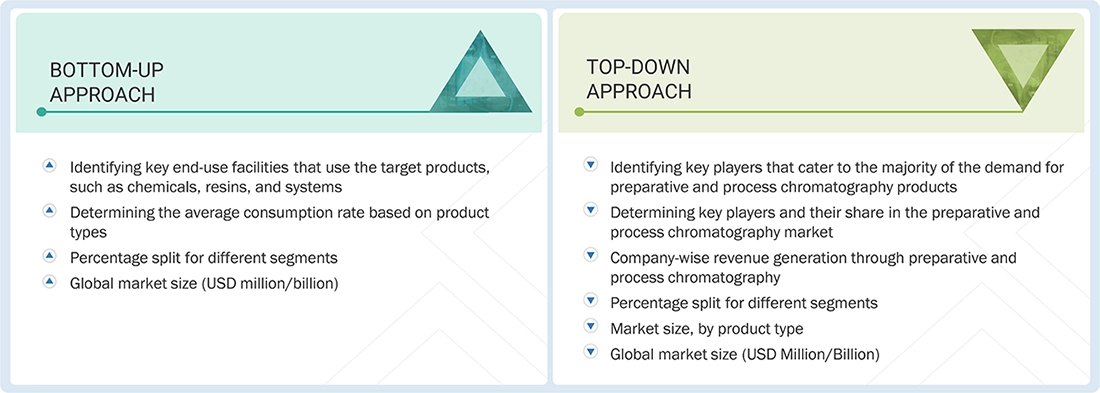
This study balanced primary and secondary research for the preparative and process chromatography market by analyzing market variables that affect small, medium, and large businesses. The next step was to conduct primary research with industry experts along the value chain to validate the findings, assumptions, and market sizing. Multiple methodologies, including both top-down and bottom-up approaches, were used to estimate the overall market size.
The study covers market segments, evolving trends, regulatory frameworks, and competitive dynamics. It also examines leading market players and the strategies they employ in this sector. In conclusion, the total market size was estimated using a combination of top-down and bottom-up approaches, with data triangulation to finalize the estimate. Primary research was conducted throughout the study to validate and test each hypothesis.
Secondary Research
During the study, secondary research drew on a range of sources, including directories and databases such as Bloomberg Businessweek, D&B Hoovers, and Factiva. Additional materials included white papers, annual reports, SEC filings, and investor presentations. This approach was used to collect and analyze data that provides comprehensive, technical, and market-focused insights into the preparative and process chromatography market. The findings offer insights into key players and market segmentation based on recent industry trends, as well as significant developments within the market. A database of leading industry figures was also created as part of this secondary research.
Primary Research
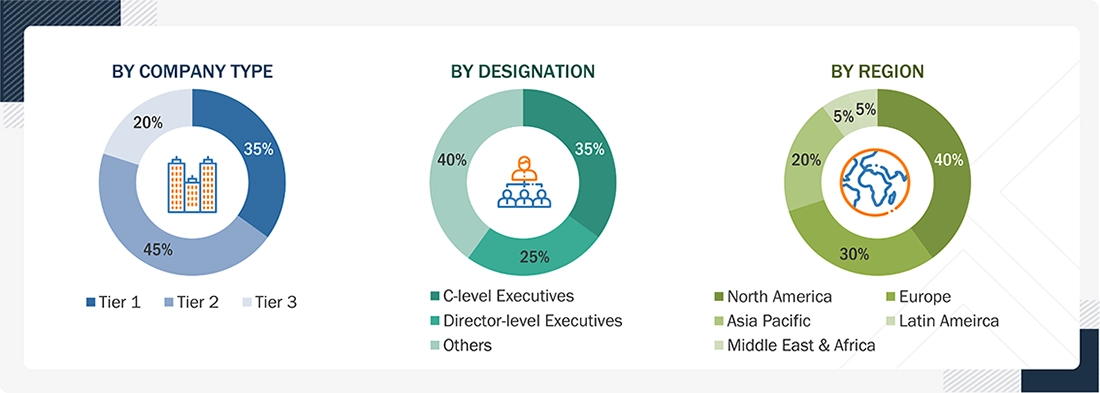
Primary research involved activities to gather both qualitative and quantitative data. A variety of individuals from both the supply and demand sides were questioned during this phase. On the supply side, key figures such as CEOs, vice presidents, directors of marketing and sales, directors of technology and innovation, and other important leaders were interviewed by industry experts. On the demand side, primary sources included academic institutions and research organizations. This research aimed to validate market segmentation, identify prominent market participants, and gain insights into significant industry trends and market dynamics through a real-world primary study.
A breakdown of the primary respondents is provided below:
Note 1: Others include distributors, suppliers, product managers, business development managers, marketing managers, and sales managers.
Note 2: Companies are categorized into tiers based on their total revenue. As of 2024, Tier 1 = >USD 1,000 million, Tier 2 = USD 500–1,000 million, and Tier 3 = <USD 500 million.
Market Size Estimation
This report analyzes the global preparative and process chromatography market size by reviewing the revenue shares of prominent companies. Key players with significant market shares were identified through secondary research, and their revenue from preparative and process chromatography sales was calculated and then validated through primary research. The secondary research included an analysis of annual and financial reports from leading market participants. The primary research involved in-depth interviews with key thought leaders, such as directors, CEOs, and marketing executives.
To calculate the global market value, segmental revenue was determined using revenue mapping for service and product providers. The process involved the following steps:
- Generating a list of key players that operate in the preparative and process chromatography market at the regional or global level
- Mapping the products of manufacturers of preparative and process chromatography and related product lines at the regional level
- Mapping the revenue of listed players from preparative and process chromatography and related products
- Mapping the revenue of major players to cover at least ~90% of the global market share as of 2024
- Extrapolating the mapped revenue of players to arrive at the global market value for the respective segment
- Summing up the market value for all segments and subsegments to achieve the actual value of the global preparative and process chromatography market
Data Triangulation
After estimating the overall market size, the preparative and process chromatography market was segmented into segments and subsegments. The overall market engineering process was finalized using data triangulation and market segmentation techniques to obtain accurate statistics for all segments and subsegments. This triangulation involved analyzing trends and factors from both the demand and supply sides. Furthermore, the preparative and process chromatography market data were verified and validated using both top-down and bottom-up approaches.
Market Definition
The market encompasses preparative chromatography, which targets lab-to-pilot-scale purification of high-value compounds such as APIs, peptides, and biomolecules, and process chromatography, which enables large-scale industrial purification in biopharmaceutical manufacturing. It includes essential products such as resins and chemicals (stationary phases and buffers for selective separation), columns (pre-packed or custom for holding media), systems (HPLC and LC systems), and aftermarket services (maintenance, validation, training, and optimization).
Key Stakeholders
- Pharmaceutical companies
- Biopharmaceutical companies
- CROs
- CDMOs
- Chromatography products manufacturers
- Chromatography products suppliers and distributors
- Market research and consulting firms
- Academic & research institutes
- Regulatory authorities and industry associations
- Venture capitalists and investment firms
- Research labs
Report Objectives
- To define, describe, and forecast the size of the preparative and process chromatography market based on product type, application, end user, and region
- To provide detailed information regarding the major factors influencing the growth potential of the global preparative and process chromatography market (drivers, restraints, opportunities, challenges, and trends)
- To analyze the micromarkets with respect to individual growth trends, prospects, and contributions to the global preparative and process chromatography market
- To analyze key growth opportunities in the global preparative and process chromatography market for key stakeholders and provide details of the competitive landscape for market leaders
- To forecast the size of market segments and/or subsegments with respect to five major regions: North America (US and Canada), Europe (Germany, France, UK, Spain, Italy, and Rest of Europe), Asia Pacific (Japan, China, India, Australia, South Korea, and Rest of Asia Pacific), Latin America (Brazil, Mexico, Rest of Latin America ), and Middle East & Africa (GCC countries and Rest of Middle East & Africa)
- To profile key players in the preparative and process chromatography market and comprehensively analyze their market share and core competencies
- To analyze competitive developments, such as product launches, agreements, expansions, and mergers & acquisitions, undertaken in the global preparative and process chromatography market
Available customizations:
Based on the provided market data, MarketsandMarkets offers customizations tailored to your company’s specific needs. The following customization options are available for the current global preparative and process chromatography market report.
Product Analysis
- Product matrix, which gives a detailed comparison of the product portfolios of the top fifteen companies
Company Information
- Detailed analysis and profiling of additional market players (up to 13)
Geographic Analysis
- Further breakdown of the Rest of Europe preparative and process chromatography market into Russia, Belgium, the Netherlands, Switzerland, Austria, Finland, Sweden, Poland, and Portugal
- Further breakdown of the Rest of Asia Pacific preparative and process chromatography market into Singapore, Taiwan, New Zealand, the Philippines, Malaysia, and other Asia Pacific countries
- Further breakdown of the Rest of Latin America preparative and process chromatography market into Argentina, Chile, Peru, and Colombia
Fact checked
Personalize This Research
- Triangulate with your Own Data
- Get Data as per your Format and Definition
- Gain a Deeper Dive on a Specific Application, Geography, Customer or Competitor
- Any level of Personalization
Let Us Help You
- What are the Known and Unknown Adjacencies Impacting the Preparative and Process Chromatography Market
- What will your New Revenue Sources be?
- Who will be your Top Customer; what will make them switch?
- Defend your Market Share or Win Competitors
- Get a Scorecard for Target Partners

Custom Market Research Services
We Will Customise The Research For You, In Case The Report Listed Above Does Not Meet With Your Requirements
Get 10% Free CustomisationTESTIMONIALS

JAYANT RAJPUROHIT
Director of Market Insights, Data and Analytics
SFI Health,
Leading Pharmaceutical Companywww.sfihealth.com/

We at SFI Health approached MarketsandMarkets for an Opportunity Assessment on "Incidence and Prevalence of Focus Indications" as we wanted to know the most attractive HCPs like Physician, Functional MD, Naturopath and Pharmacist. The project was critical for us to ensure our focus on the right target which would enable sustainable growth and profitability for SFI Health. The business insights provided exceeded our expectations and we were extremely impressed. The team at MarketsandMarkets is highly professional and detail oriented and very well understood our business needs. MarketsandMarkets offers a unique combination of expertise and dedicated engagement model. We identified 2 new products to be launched in coming months, based on the research findings provided by MarketsandMarkets. We are happy with the services and would strongly recommend MarketsandMarkets to my peers in the industry.

BEATRIZ DE LA CALLE
Head of Commercial Analytics
Qualicaps,
Leading Pharmaceutical Companywww.qualicaps.com/

We partnered with MarketsandMarkets for an assessment study on hard empty capsules. The team was extremely professional in understanding our business requirements and we received timely responses to all our queries. The market intelligence and the recommendations has met our business requirements. We were extremely impressed to see the final study results; it really exceeded our expectations. The market intelligence offered by MarketsandMarkets, and clarity on next steps will help us achieve our business objective for the Year 2021. We are happy with the services and would strongly recommend MarketsandMarkets to my peers in the industry.

Bob Williams,
Senior Director Business Development & Innovation
Bracco Diagnostics Inc.,
Italian Multinational in life sciences sector and a World Leader in imaging diagnosticsimaging.bracco.com/us-en
We were pleased with targeted insights that MarketsandMarkets identified from a custom study on the 'Radiation Dose Management Solutions Market'. Your team identified and characterized the market participants as well as underlying trends accurately. This study was useful to Bracco in formulating business strategies for our dose monitoring product lines and we thank MarketsandMarkets for the job well done.
Cody Coonradt,
Market Development and Strategy Manager
3M Health Information Systems,
Leader in Health care Coding, Payment & Analytics Solutions.www.3m.com/3M/en_US/health-information-systems-us
The value for our organization comes from three things: depth of research, specificity of segments and being easy to work with. As important as the first two are, the third can't be underestimated. MarketsandMarkets, maybe more than any other research vendor, wants to know what is top of mind for our team and what big questions we are grappling to answer.
Their customer first approach and high value engagement model, have given us great analysis and excellent value for money
- US Preparative and Process Chromatography Market
- Canada Preparative and Process Chromatography Market
- Germany Preparative and Process Chromatography Market
- UK Preparative and Process Chromatography Market
- France Preparative and Process Chromatography Market
- Italy Preparative and Process Chromatography Market
- Spain Preparative and Process Chromatography Market
- Japan Preparative and Process Chromatography Market
- China Preparative and Process Chromatography Market
- India Preparative and Process Chromatography Market
- Australia Preparative and Process Chromatography Market
- South Korea Preparative and Process Chromatography Market
- Brazil Preparative and Process Chromatography Market
- Mexico Preparative and Process Chromatography Market
- Rest Of Europe Preparative and Process Chromatography Market
- Rest Of Asia Pacific Preparative and Process Chromatography Market
- Rest Of Latin America Preparative and Process Chromatography Market
Growth opportunities and latent adjacency in Preparative and Process Chromatography Market






Ethan
Apr, 2026
From a biopharma manufacturing standpoint, how do you see the high capital cost of preparative process chromatography systems impacting adoption among mid-sized CDMOs?.
Sophie
Apr, 2026
With increasing biologics complexity, how scalable are current preparative chromatography techniques for large-scale commercial production?.
Liam
Apr, 2026
What are the key integration challenges when implementing advanced chromatography systems into existing bioprocess workflows?.
Isabella
Apr, 2026
How do you assess the trust factor when it comes to newer technologies like continuous chromatography versus traditional batch methods?.
Noah
Apr, 2026
Looking ahead, where do you see the biggest growth opportunities in the preparative process chromatography market?.