North America UAV (Drone) Market

North America UAV (Drone) Market by Application (Military, Commercial, Government & Law Enforcement, Consumer), Platform (Defense & Government, Civil & Commercial), Type, Mode of Operation, MTOW, Range, Function, Technology, and Country – Forecast to 2030




OVERVIEW
Source: Secondary Research, Interviews with Experts, MarketsandMarkets Analysis
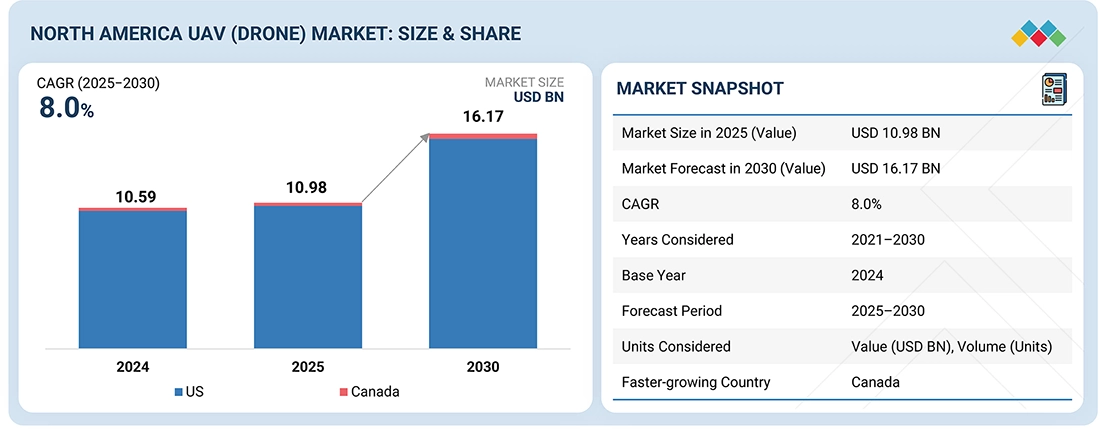
The North American UAV (Drone) Industry is projected to grow from USD 10.98 billion in 2025 to USD 16.17 billion by 2030 at a CAGR of 8.0%. Rising adoption across defense, public safety, infrastructure, and energy sectors, driven by the demand for long-range missions, high-precision data capture, and autonomous operations, continues to accelerate market expansion, supported by advancements in analytics, automation, and beyond-visual-line-of-sight (BVLOS) capabilities.
Market Size & Forecast
• 2024 Market Size (Value): USD 10.59 BN
• 2030 Market Forecast (Value): USD 16.17 BN
• CAGR: 8.0%
• North America: US Accounted for 98% Market Share
• Defense & Government Segment: Grow at the Fastest Rate
KEY TAKEAWAYS
-
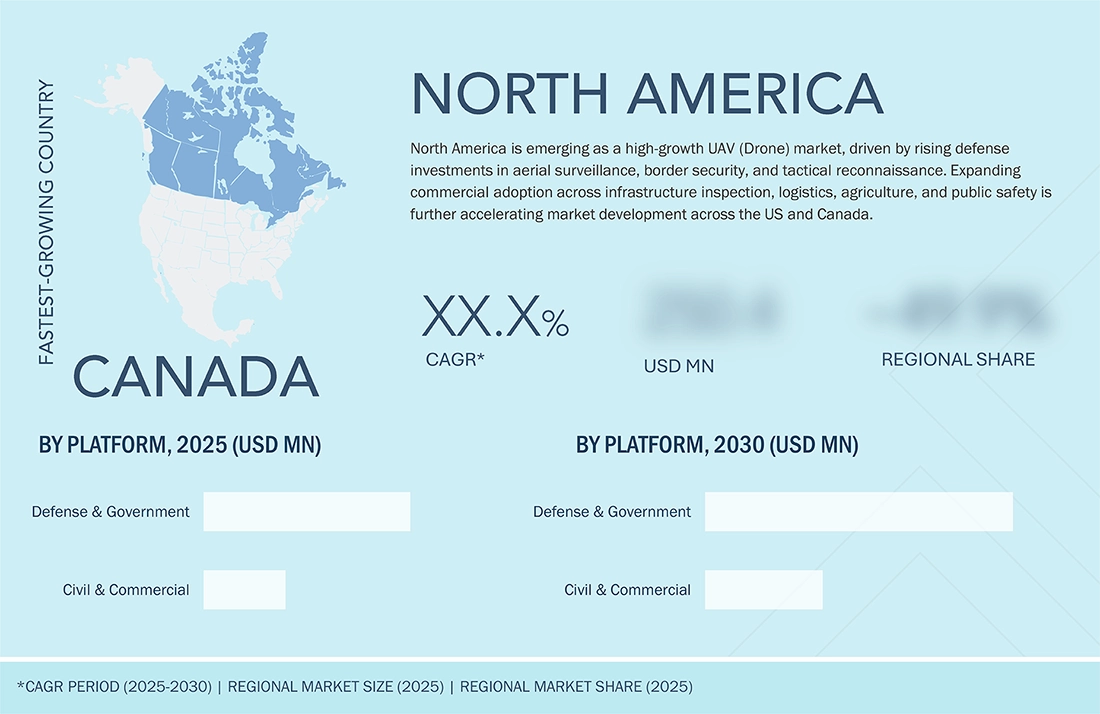
By CountryIn North America, the US accounted for 98% market share in 2025.
-
By TypeThe hybrid segment is projected to grow at the fastest rate from 2025 to 2030.
-
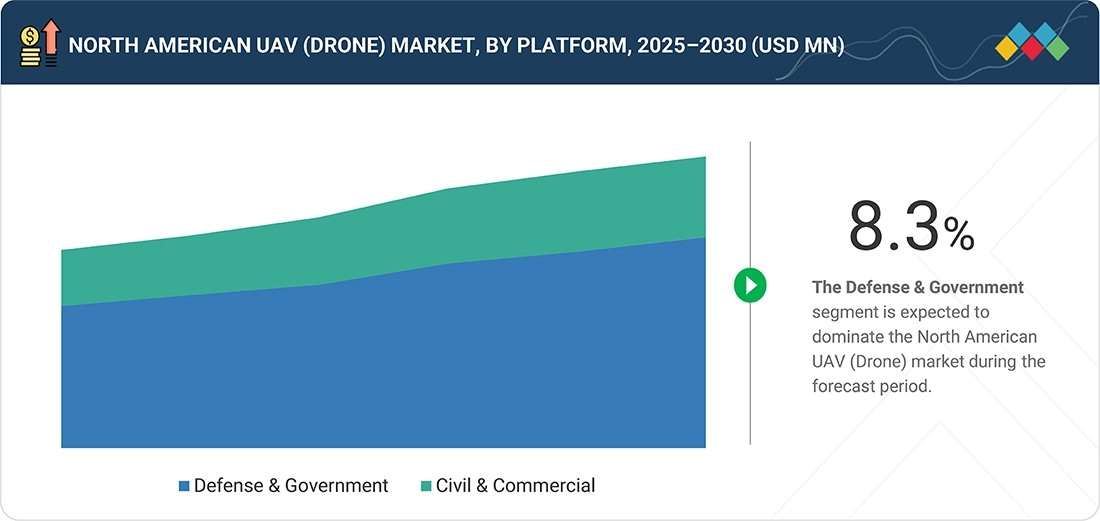
By PlatformThe defense & government segment is projected to grow at the fastest rate from 2025 to 2030.
-
By ApplicationThe military segment is projected to grow at the fastest rate from 2025 to 2030 at an 8.4% CAGR.
-
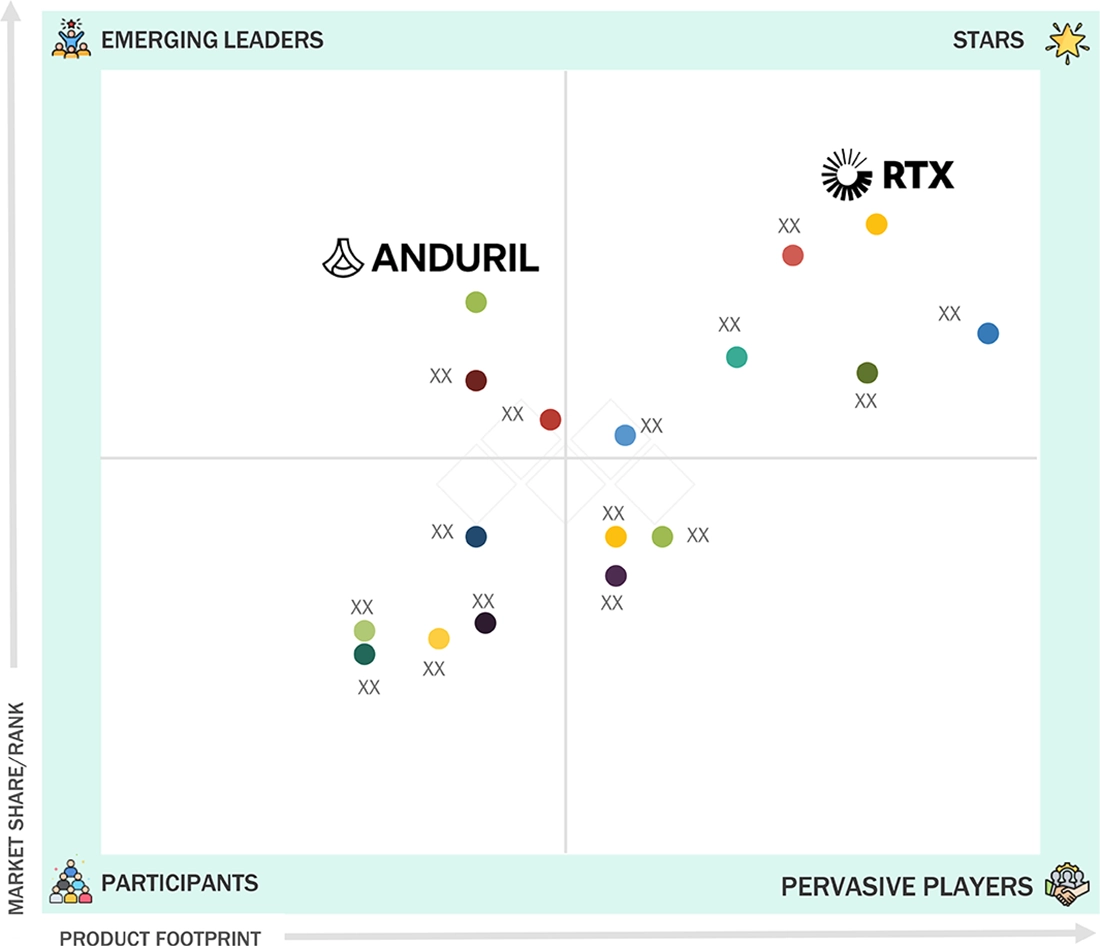
Competitive Landscape-Key PlayersRTX, Boeing, and General Dynamics Corporation were identified as some of the star players in the North American UAV (Drone) market due to their strong market shares and product footprints.
-
Competitive Landscape-StartupsZipline, Airspace Link, and SkyX have emerged as leading startups and SMEs by securing strong footholds in autonomous delivery networks, airspace infrastructure, and long-range industrial inspection. Their rapid advancements in scalable drone operations and specialized mission capabilities highlight their influence in high-growth niches, underscoring their potential as emerging market leaders in the North American UAV ecosystem.
The North America UAV (Drone) Market is predominantly driven by the expanding use of unmanned systems across defense, commercial, and public safety sectors. Advancements in UAV technologies, including extended flight endurance, high-precision sensor payloads, and enhanced autonomous navigation, are significantly broadening their mission capabilities. The increasing adoption of border surveillance, infrastructure inspection, emergency response, and data-driven operations continues to strengthen their functional relevance across the region.
TRENDS & DISRUPTIONS IMPACTING CUSTOMERS' CUSTOMERS
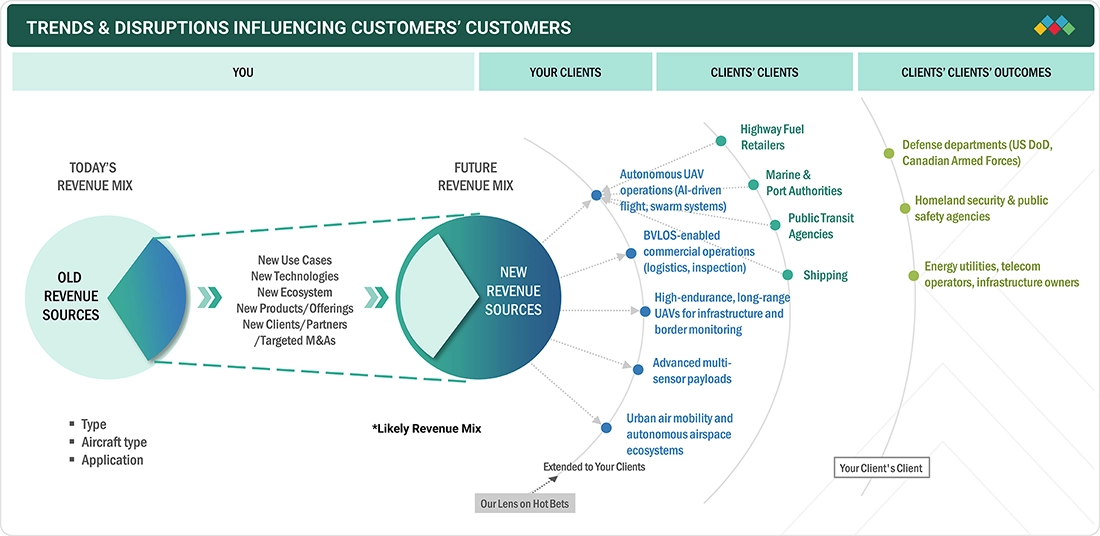
Several UAV startups and established manufacturers in North America are pursuing increased venture capital funding, strategic partnerships, and joint development programs to accelerate advancements in drone technologies. This momentum is expected to drive critical improvements in autonomy, sensor performance, and operational infrastructure, ultimately expanding the adoption of UAVs and broadening the regional customer base.
Source: Secondary Research, Interviews with Experts, MarketsandMarkets Analysis
MARKET DYNAMICS

Level
-
Rising defense and security adoption

-
Growing commercial use across industries


Level
-
Strict airspace and BVLOS rules

-
Cybersecurity and data privacy risks


Level
-
Growth in AI-enabled autonomous drones

-
Expansion of drone delivery and inspection markets


Level
-
Threats of hacking and signal interference

-
Weather-related operational limitations

Source: Secondary Research, Interviews with Experts, MarketsandMarkets Analysis
Driver: Rising defense and security adoption
The growing demand from defense and homeland security agencies is accelerating UAV procurement for ISR, border monitoring, and tactical operations. Investments in autonomous surveillance and long-range mission capability are strengthening UAV integration across US and Canadian defense programs.
Restraint: Strict airspace and BVLOS rules
Regulatory limitations on airspace access and slow approval processes for BVLOS operations continue to restrict broader commercial deployment. These constraints increase compliance burdens and delay operational scaling for enterprises.
Opportunity: Growth in AI-enabled autonomous drones
Advancements in AI, edge analytics, and autonomous navigation are unlocking high-value applications in inspection, logistics, and emergency response. These innovations enhance mission accuracy and operational efficiency, creating strong growth avenues across the region.
Challenge: Threats of hacking and signal interference
Increasing exposure to cyberattacks, GPS spoofing, and communications jamming poses a significant risk to UAV mission integrity. Ensuring secure data links and resilient navigation systems remains critical to expanding safe and reliable UAV operations.
NORTH AMERICA UAV (DRONE) MARKET: COMMERCIAL USE CASES ACROSS INDUSTRIES
| COMPANY | USE CASE DESCRIPTION | BENEFITS |
|---|---|---|
 |
Deploys long-endurance UAVs like MQ-9 Reaper for ISR, border security, strike coordination, and multi-domain defense missions | Persistent surveillance coverage, precision targeting support, and enhanced situational awareness for defense agencies |
 |
Uses high-altitude UAVs such as Global Hawk for strategic reconnaissance, maritime domain awareness, and wide-area intelligence missions | High-resolution, long-range monitoring, reduced human risk, and reliable intelligence delivery for national security |
 |
Develops unmanned systems like MQ-25 Stingray for naval aerial refueling, maritime surveillance, and logistics missions | Extends operational reach of combat aircraft, strengthens naval ISR capability, and optimizes fleet mission readiness |
 |
Provides tactical and rotary-wing UAVs for shipborne surveillance, targeting assistance, and battlefield reconnaissance | Enhanced resilience in contested environments, real-time target tracking, and improved operational flexibility |
Logos and trademarks shown above are the property of their respective owners. Their use here is for informational and illustrative purposes only.
MARKET ECOSYSTEM
The North American UAV (Drone) market ecosystem is shaped by strong collaboration among platform manufacturers, service providers, and end users. Leading aerospace and defense OEMs develop advanced UAV platforms, while service providers deliver data analytics, flight operations, and mission support solutions. End users across logistics, defense, and commercial sectors are accelerating adoption, creating a dynamic ecosystem driven by innovation, operational efficiency, and expanding mission requirements.
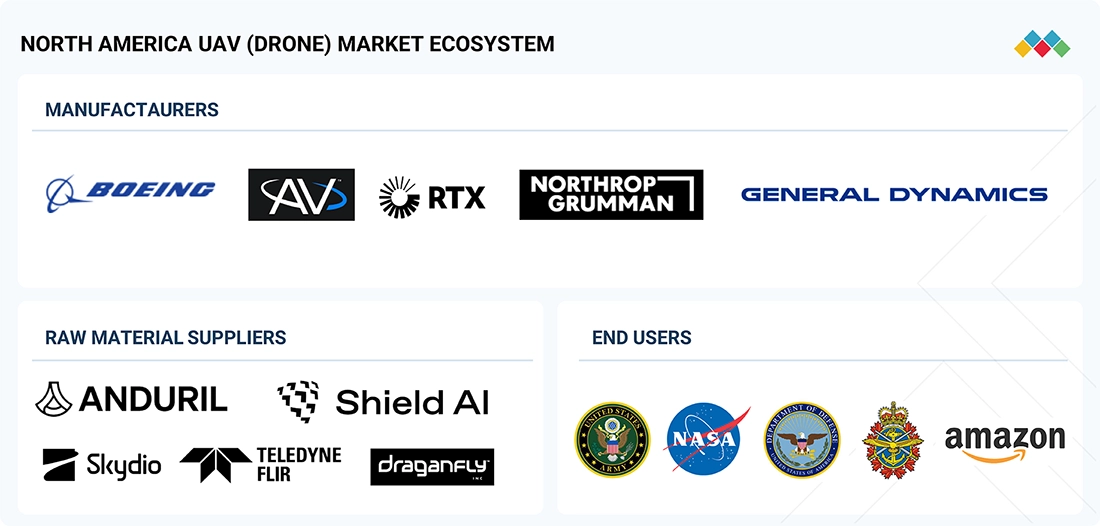
Logos and trademarks shown above are the property of their respective owners. Their use here is for informational and illustrative purposes only.
MARKET SEGMENTS
Source: Secondary Research, Interviews with Experts, MarketsandMarkets Analysis
North America UAV (Drone) Market, By Application
The military segment dominates owing to the expanding demand for advanced ISR, targeting, and battlefield awareness capabilities across U.S. and Canadian defense forces. The growing use of UAVs for long-endurance surveillance, precision operations, and tactical mission support is driving payload integration. Rising modernization programs continue to strengthen the adoption of high-performance military payloads.
North America UAV (Drone) Market, By Platform
The defense & government platform segment dominates due to increasing reliance on UAVs for border security, public safety, and national defense missions. Agencies are prioritizing payloads that enhance reconnaissance accuracy, real-time communication, and mission reliability. Investments in autonomous capabilities and secure data systems are driving wider deployment across government operations.
North America UAV (Drone) Market, By Type
The fixed-wing segment dominates as operators require long-endurance, high-altitude capabilities for wide-area surveillance and extended mission durations. These UAVs support heavier and more advanced payloads, enabling superior coverage for defense and commercial operations. Their efficiency and range advantages drive the segment in North America.
North America UAV (Drone) Market, By Mode of Operation
The optionally piloted segment dominates due to its ability to switch between autonomous and manned operations, enhancing flexibility for diverse mission profiles. This mode supports higher payload capacity and extended operational safety, especially in complex or high-risk environments. Increasing adoption by defense and government agencies is strengthening segment growth.
North America UAV (Drone) Market, By MTOW
The 2–25 kg segment dominates as it balances payload capacity with operational ease, enabling deployment across defense, commercial, and public safety missions. These UAVs support versatile sensor payloads for mapping, surveillance, and inspection tasks. Their regulatory advantages and broad mission adaptability are accelerating regional adoption.
North America UAV (Drone) Market, By Range
The BVLOS segment dominates owing to the rising demand for long-range intelligence, infrastructure monitoring, and border surveillance missions. Operators benefit from expanded coverage, higher mission efficiency, and improved payload utilization. Regulatory advancements across the US and Canada are further enabling BVLOS growth.
North America UAV (Drone) Market, By Function
Special-purpose drones dominate as specialized payloads are required for missions such as disaster response, environmental monitoring, and precision reconnaissance. Their ability to support custom sensors and mission-specific equipment enhances operational effectiveness. Increasing adoption across high-value defense and industrial missions fuels market leadership.
North America UAV (Drone) Market, By End Use
The defense & security segment dominates due to the growing requirements for persistent surveillance, threat detection, and tactical mission support. Payload advancements in imaging, targeting, and communication systems are improving mission accuracy and operational decision-making. Rising investment in UAV modernization across North America reinforces segmental growth.
North America UAV (Drone) Market, By Technology
The conventional drone segment dominates due to proven reliability, mature supply chains, and wide applicability across defense and commercial missions. These platforms support a broad range of payloads, enabling efficient integration for ISR, mapping, and inspection tasks. Their operational stability and cost-effectiveness continue to drive strong market preference.
REGION
North America is expected to be the largest region in the UAV (Drone) market
The growth of the North America UAV (Drone) market can be attributed to expanding adoption of drones across defense, public safety, and commercial sectors. In recent years, manufacturers have focused on developing UAVs that are more efficient, autonomous, and mission-flexible, capable of carrying advanced payloads for long-endurance and high-precision operations.
NORTH AMERICA UAV (DRONE) MARKET: COMPANY EVALUATION MATRIX
In the North America UAV (Drone) market matrix, RTX (Star) leads with strong dominance and advanced UAV technologies, solidifying its leadership in the industry. Anduril Industries (Emerging Leader) is maintaining a competitive global presence with robust UAV offerings, demonstrating potential to strengthen its market position as global demand for drones continues to expand.
Source: Secondary Research, Interviews with Experts, MarketsandMarkets Analysis
KEY MARKET PLAYERS
List of Top North America UAV (Drone) Market Companies
- RTX
- Boeing
- General Dynamics Corporation
- Northrop Grumman
- Textron Inc.
- L3Harris Technologies Inc.
- Kratos
- AeroVironment, Inc.
- General Atomics
- Anduril Industries
MARKET SCOPE
| REPORT METRIC | DETAILS |
|---|---|
| Market Size in 2024 (Value) | USD 10.59 BN |
| Market Forecast in 2030 (value) | USD 16.17 BN |
| Growth Rate | 8.0% |
| Years Considered | 2021–2030 |
| Base Year | 2024 |
| Forecast Period | 2025–2030 |
| Units Considered | Value (USD BN) |
| Report Coverage | Revenue forecast, company ranking, competitive landscape, growth factors, and trends |
| Segments Covered |
|
| Contries Covered | US,Canada |
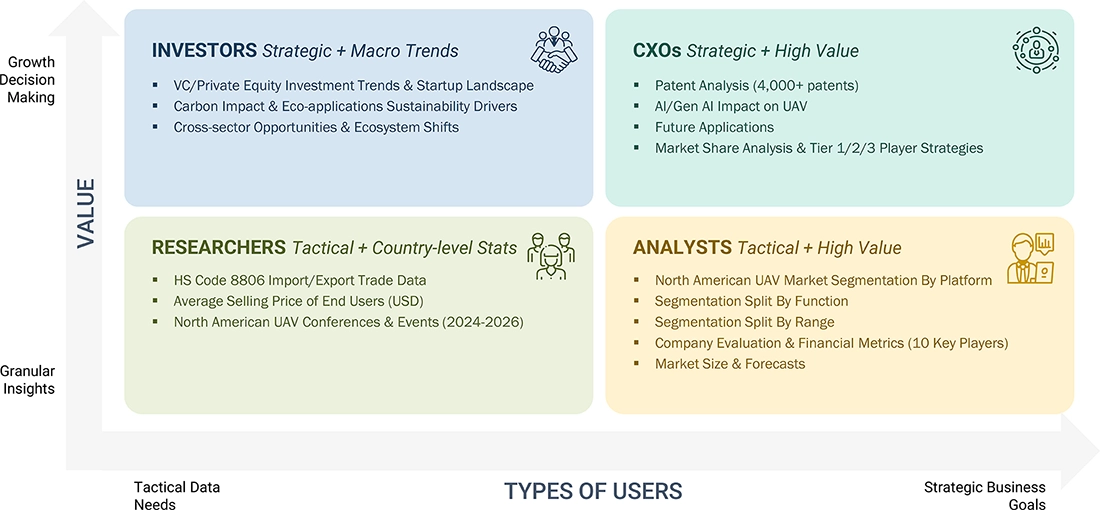
WHAT IS IN IT FOR YOU: NORTH AMERICA UAV (DRONE) MARKET REPORT CONTENT GUIDE
DELIVERED CUSTOMIZATIONS
We have successfully delivered the following deep-dive customizations:
| CLIENT REQUEST | CUSTOMIZATION DELIVERED | VALUE ADDS |
|---|---|---|
| Leading Manufacturer | Additional segment breakdown for countries | Additional country-level market sizing tables for segments/sub-segments covered at the regional/global level to gain an understanding of market potential by each country |
| Emerging Leader | Additional company profiles | Competitive information on targeted players to gain granular insights on direct competition |
| Regional Market Leader | Additional country market estimates | Additional country-level deep dive for a more targeted understanding of the total addressable market |
RECENT DEVELOPMENTS
- July 2025 : AeroVironment, Inc. (US) announced enhancements to its Puma 3 AE unmanned aircraft, integrating a new multi-sensor payload with improved optical zoom and extended-range communications. The update increases mission endurance for border surveillance, maritime operations, and environmental monitoring.
- May 2025 : General Atomics Aeronautical Systems (GA-ASI) (US) unveiled a new modular payload architecture for the MQ-9 series, enabling operators to integrate advanced radar, EO/IR sensors, and electronic warfare modules. This improves flexibility for ISR missions and supports evolving defense modernization priorities in North America.
- January 2025 : L3Harris Technologies, Inc. (US) introduced new enhancements to its FVR-90 unmanned aerial system to support advanced defense, border security, and public safety missions. The updated system features improved long-endurance flight performance, expanded multi-payload integration, and strengthened autonomous operation in GPS-denied and contested airspace environments. The upgrade increases mission flexibility and system resilience. The enhancement reinforces the FVR-90’s role in tactical reconnaissance, critical infrastructure inspection, and rapid emergency response operations across the U.S. and key international partner regions.
Table of Contents
 Exclusive indicates content/data unique to MarketsandMarkets and not available with any competitors.
Methodology
This research study on the North America UAV (Drone) Market extensively used secondary sources, directories, and databases such as Hoovers, Bloomberg BusinessWeek, and Factiva to identify and collect information relevant to the market. Primary sources included industry experts, service providers, manufacturers, solution providers, technology developers, alliances, and organizations related to all segments of this industry’s value chain. In-depth interviews with primary respondents, including key industry participants, subject matter experts, industry consultants, and C-level executives, were conducted to obtain and verify critical qualitative and quantitative information about the North America UAV (Drone) Market and assess the market’s growth prospects.
Secondary Research
The market share of companies in the North America UAV (Drone) Market was determined using the secondary data acquired through paid and unpaid sources, and by analyzing the product portfolios of major companies operating in the market. These companies were rated based on the performance and quality of their products. Primary sources further validated these data points.
Secondary sources for this research study included financial statements of companies offering UAV services, infrastructure and software providers, and various trade, business, and professional associations. Secondary data was collected and analyzed, and was validated by primary respondents.
Primary Research
Extensive primary research was conducted after acquiring information on the North America UAV (Drone) Market through secondary research. Several primary interviews were conducted with market experts from the demand and supply sides across North America. Primary data was collected through questionnaires, emails, and telephonic interviews.
Market Size Estimation
All percentage shares, splits, and breakdowns were determined using secondary sources and verified through primary sources. All possible parameters that affect the markets covered in this research study were accounted for, viewed in extensive detail, verified through primary research, and analyzed to obtain the final quantitative and qualitative data. This data was consolidated, enhanced with detailed inputs, analyzed by MarketsandMarkets, and presented in this report.
- Top-down and bottom-up approaches were used to estimate and validate the size of the North America UAV (Drone) Market.
- Key players were identified through secondary research, and their market ranking was determined through primary and secondary research. This included a study of annual and financial reports of the top market players and extensive interviews of leaders, including CEOs, directors, and marketing executives.
Data Triangulation
After arriving at the overall size of the North America UAV (Drone) Market from the market size estimation process explained above, the total market was split into several segments and subsegments. Wherever applicable, data triangulation and market breakdown procedures described below were implemented to complete the overall market engineering process and arrive at the exact statistics for various market segments and subsegments. The data was triangulated by studying different factors and trends from both the demand and supply sides. Additionally, the market size was validated using both top-down and bottom-up approaches.
Market Definition
Unmanned aerial vehicles (UAVs) are remotely piloted, optionally piloted, or fully autonomous aerial vehicles that play a significant role in the defense and commercial sectors. They are commonly termed drones and are mostly known for their wide usage in various military missions, such as border surveillance and combat operations. These vehicles are also used for mapping, surveying, and determining the weather conditions of a specific area.
Key Stakeholders
- UAV (Drone) Suppliers
- UAV (Drone) Component Manufacturers
- UAV (Drone) Manufacturers
- UAV (Drone) Pilot Training Institutes
- Technology Support Providers
- UAV (Drone) Software/Hardware/Service and Solution Providers
- Regulatory Bodies
- UAV (Drone) Consultants
- Defense Forces
Report Objectives
- To define, describe, segment, and forecast the size of the North America UAV market based on platform, system, industry, application, mode of operation, maximum take-off weight (MTOW), type, range, sales channel, function, technology, and region
- To identify and analyze key drivers, restraints, opportunities, and challenges influencing the growth of the market across the globe
- To identify industry trends, market trends, and technology trends that are currently prevailing in the market
- To provide an overview of the tariff and regulatory landscape with respect to drone regulations across regions
- To analyze micromarkets with respect to individual growth trends, prospects, and their contribution to the overall market
- To analyze opportunities in the market for stakeholders by identifying key market trends
- To profile key market players and comprehensively analyze their market shares and core competencies
- To analyze the degree of competition in the market by identifying key growth strategies, such as acquisitions, product launches, contracts, and partnerships, adopted by leading market players
- To identify detailed financial positions, key products, and unique selling points of leading companies in the market
- To provide a detailed competitive landscape of the market, along with market ranking analysis, market share analysis, and revenue analysis of key players
Customization Options
Along with the market data, MarketsandMarkets offers customizations to meet the specific needs of companies. The following customization options are available for the report:
Product Analysis
- Product matrix, which gives a detailed comparison of the product portfolio of each company
Regional Analysis
- Further breakdown of the market segments at the country level
Company Information
- Detailed analysis and profiling of additional market players (up to 5)
Key Questions Addressed by the Report
What is the current and projected market value of the North America UAV drone market?
The North America UAV drone market is projected to grow from USD 10.98 billion in 2025 to USD 16.17 billion by 2030, at a CAGR of 8.0% during the forecast period.
Which country dominates the North America UAV drone market?
The United States dominates the North America UAV drone market, accounting for approximately 98% of the regional market share in 2025.
Which segment is expected to grow the fastest in the North America UAV drone market?
The military application segment is expected to grow at the fastest rate in the North America UAV drone market, driven by increasing defense investments and demand for advanced surveillance and combat capabilities.
How is the North America UAV drone market segmented?
The North America UAV drone market is segmented by application into military, commercial, government and law enforcement, and consumer, and by platform into defense and government and civil and commercial, along with segmentation by type, mode of operation, MTOW, range, function, technology, and country.
Who are the key players in the North America UAV drone market?
Key players in the North America UAV drone market include RTX, Boeing, General Dynamics Corporation, Northrop Grumman, and Textron Inc., which are actively driving innovation and market growth.


Personalize This Research
- Triangulate with your Own Data
- Get Data as per your Format and Definition
- Gain a Deeper Dive on a Specific Application, Geography, Customer or Competitor
- Any level of Personalization
Let Us Help You
- What are the Known and Unknown Adjacencies Impacting the North America UAV (Drone) Market
- What will your New Revenue Sources be?
- Who will be your Top Customer; what will make them switch?
- Defend your Market Share or Win Competitors
- Get a Scorecard for Target Partners

Custom Market Research Services
We Will Customise The Research For You, In Case The Report Listed Above Does Not Meet With Your Requirements
Get 10% Free CustomisationTESTIMONIALS






Growth opportunities and latent adjacency in North America UAV (Drone) Market