



Nucleic Acid Isolation and Purification Market
Report Code
BT 2398
Published in
Jan, 2026, By MarketsandMarkets™
Nucleic Acid Isolation and Purification Market by Product (Kits, Reagents, Instruments), Method (Column, Magnetic Beads), Type (Plasmid DNA, microRNA), Sample Type (Cellular, FFPE, CfDNA/CtDNA), Application, End User, Competition - Global Forecast to 2031

$6.37B
MARKET SIZE, 2026
$9.66B
MARKET SIZE, 2031

8.7%
CAGR (2026-2031)

2026-2031
FORECAST PERIOD
NUCLEIC ACID ISOLATION AND PURIFICATION MARKET SIZE, SHARE & GROWTH SNAPSHOT
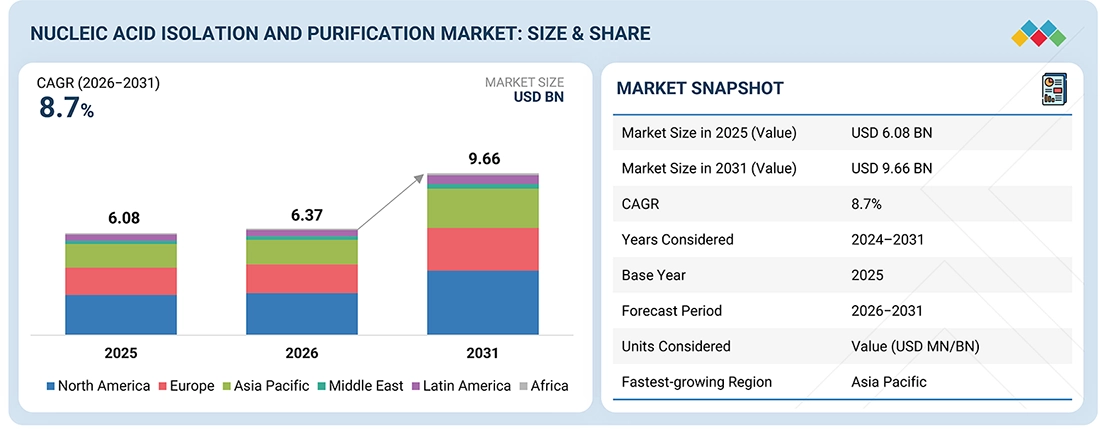
Source: Secondary Research, Interviews with Experts, MarketsandMarkets Analysis
The global nucleic acid isolation and purification market is projected to grow from USD 6.37 billion in 2026 to USD 9.66 billion by 2031, at a CAGR of 8.7% during the forecast period. The market was valued at USD 6.08 billion in 2025. Nucleic acid isolation and purification is a foundational step in modern molecular biology and clinical testing, enabling the extraction of high-quality DNA and RNA from blood, tissues, cells, and other biological samples for downstream analysis. It is predominantly used in fields such as molecular diagnostics, infectious disease testing, oncology, genetic disorder screening, reproductive health, biopharmaceutical research, and academic genomics. Market growth is primarily driven by the rising adoption of automated nucleic acid extraction systems, the increasing need for high-purity, inhibitor-free nucleic acid recovery, and growth in the processing of complex and difficult sample types.
KEY TAKEAWAYS
-
MARKET SNAPSHOT:
Base Year Market Size (2025): USD 6.08 Billion
Current Market Size (2026): USD 6.37 Billion
Forecast Market Size (2031): USD 9.66 Billion
CAGR (2026–2031): 8.7% -
SEGMENT LEADERSHIP:
Fastest-Growing Region: Asia Pacific is projected to register the highest CAGR of 9.6% during the forecast period.
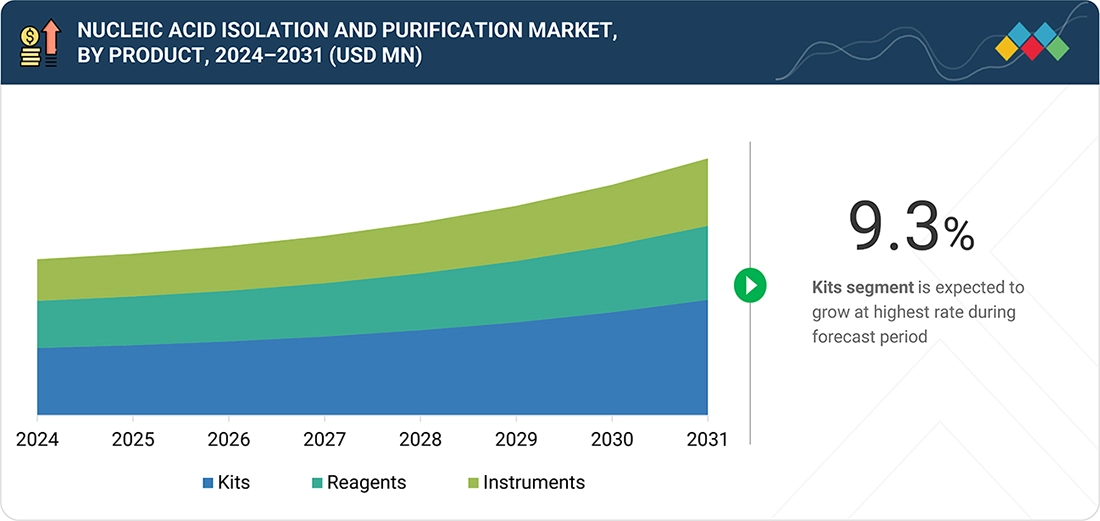
Product Leader: Kits are projected to register the highest CAGR of 9.3% between 2026 and 2031.
Method Leader: Magnetic bead-based isolation and purification accounted for 39.1% of the market in 2025.
Type Leader: Plasmid DNA isolation and purification is expected to dominate the market in 2025.
Fastest-Growing Sample Type: Cell-free samples are expected to register the highest CAGR during the forecast period.
Fastest-Growing Application: Personalized medicine is expected to register the highest CAGR during the forecast period.
End User Leader: Hospitals & diagnostic centers dominated the market in 2025. -
MARKET OUTLOOK & COMPETITIVE LANDSCAPE:
Leading companies include Thermo Fisher Scientific, Inc., QIAGEN N.V., and Merck KGaA.
Emerging companies such as Favorgen Biotech Corporation and Omega Bio-Tek, Inc. have established strong positions in specialized niche areas.
The global nucleic acid isolation and purification market is expanding for several reasons. These include the growing adoption of molecular diagnostics, increased use of PCR and NGS in clinical and research workflows, rising demand for liquid biopsy and precision medicine applications, and the shift toward automated extraction platforms. The market is also supported by the need for high-purity DNA/RNA recovery from complex sample types, such as FFPE, cfDNA, microbiome, and pathogen samples, as well as stricter quality and validation requirements across clinical diagnostics, biopharma, and research laboratories.
TRENDS & DISRUPTIONS IMPACTING CUSTOMERS' CUSTOMERS
The nucleic acid isolation and purification market is shifting, with revenue generation evolving in response to changing customer expectations and downstream impact. At the core, the market is transitioning from traditional, low-value consumables (basic extraction kits and reagents) to high-value, integrated, and automation-driven solutions. This shift is primarily driven by the evolving needs of key customers, including diagnostic labs, research institutes, and biopharma companies, which are increasingly focused on improving the efficiency, scalability, and reliability of molecular workflows. As a result, their priorities have moved toward automation, standardization, faster turnaround times, compatibility with advanced technologies such as PCR and NGS, and regulatory compliance. These changing imperatives are directly shaping the future revenue mix of nucleic acid isolation and purification providers, pushing them to offer automated extraction systems, premium application-specific kits, and integrated workflow solutions rather than standalone products. The focus is now on building ecosystems that combine instruments, consumables, and software, enabling recurring revenue and stronger customer retention. Ultimately, these changes are driven by the need to deliver better outcomes at the end-user level. Improved nucleic acid isolation and purification workflows enable faster and more accurate diagnostics, better clinical decisions, scalable genomic testing, and higher success rates in biopharma research and CGT manufacturing.
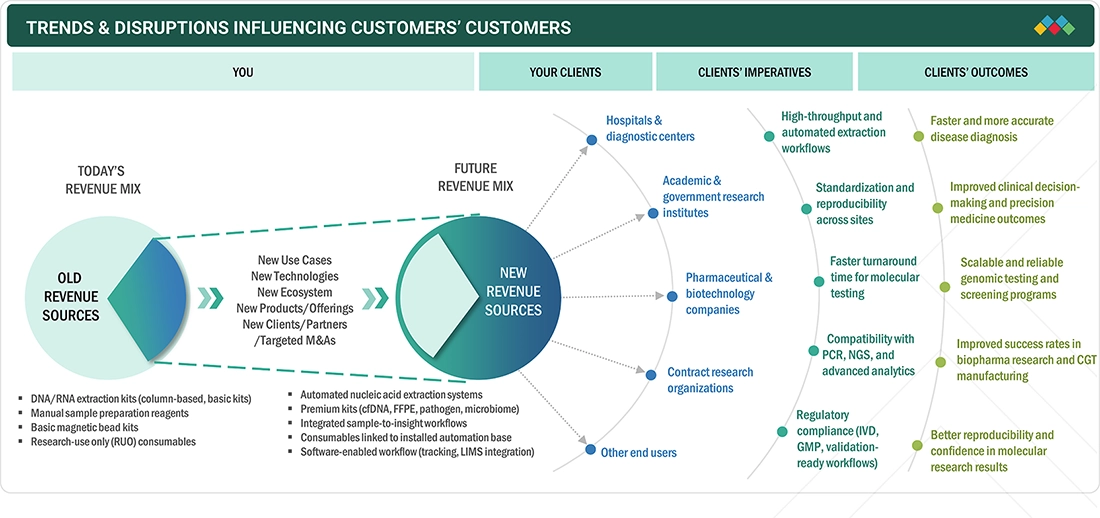
Source: Secondary Research, Interviews with Experts, MarketsandMarkets Analysis
MARKET DYNAMICS

Drivers
Impact
Level
Level
-
Rising adoption of automated nucleic acid extraction systems

-
Increasing need for high-purity and inhibitor-free nucleic acid recovery


RESTRAINTS
Impact
Level
Level
-
Price pressure and partial commoditization of routine extraction kits

-
Continued use of manual and low-cost in-house methods in small & mid-sized labs


OPPORTUNITIES
Impact
Level
Level
-
Premium extraction solutions for low-input and cell-free nucleic acids

-
Expansion of automated benchtop and mid-throughput extraction platforms


CHALLENGES
Impact
Level
Level
-
Pre-analytical variability that affects extraction output

-
Removal of inhibitors and contaminants from difficult matrices

Source: Secondary Research, Interviews with Experts, MarketsandMarkets Analysis
Driver: Rising adoption of automated nucleic acid extraction systems
Automation is becoming a core purchasing criterion in the nucleic acid isolation and purification market as laboratories are expected to process higher sample volumes with faster turnaround times and less reliance on skilled manual handling. In molecular diagnostics, hospital labs, public health labs, biopharma R&D, and genomic testing centers, manual extraction is increasingly seen as a bottleneck because it can increase variability, contamination risk, and labor burden. Automated systems help standardize workflows, improve reproducibility, and support scale-up from routine testing to high-throughput processing. This is especially relevant for applications such as PCR, qPCR, NGS, liquid biopsy, and infectious disease testing, where consistency in pre-analytical processing directly affects downstream accuracy. Thermo Fisher reports that its KingFisher systems can process up to 96 samples per run and isolate RNA or DNA from a 96-well plate in about 25 minutes, underscoring why automation is gaining strong traction in routine and high-volume settings.
Restraint: Price pressure and partial commoditization of routine extraction kits
Price pressure is intensifying in the nucleic acid isolation and purification market, particularly for routine extraction kits used in standard applications such as PCR, qPCR, and basic molecular biology workflows. As these kits become widely available from multiple vendors, differentiation in core chemistry has diminished, leading to partial commoditization. Buyers, especially academic and diagnostic labs in cost-sensitive regions, as well as large testing facilities, are increasingly comparing products by price per sample rather than by brand loyalty. This has led to competitive pricing strategies, bulk discounts, and more frequent tender-based procurement.
Opportunity: Premium extraction solutions for low-input and cell-free nucleic acids
A major opportunity in this market is the growing demand for premium extraction solutions for low-input and cell-free nucleic acids, especially in liquid biopsy, prenatal screening, transplant monitoring, and residual disease testing. These applications involve very small amounts of fragmented DNA or RNA, so routine extraction kits are often insufficient. Laboratories need kits that deliver both high recovery efficiency and high purity, enabling suppliers to position these products at premium prices. This makes the segment commercially attractive compared with standard extraction kits, where pricing pressure is much higher.
Challenge: Pre-analytical variability that affects extraction output
One of the biggest challenges in the nucleic acid isolation and purification market is pre-analytical variability, which can significantly affect extraction yield, purity, and reproducibility. Pre-analytical factors include how a sample is collected, transported, stored, and processed before extraction. Variations in sample handling, such as processing delays, temperature fluctuations, repeated freeze-thaw cycles, differences in anticoagulants or preservatives, and inconsistent input volume, can all affect the quality and integrity of DNA or RNA. This is especially critical for RNA, cell-free nucleic acids, and other low-abundance targets that are highly sensitive to degradation.
NUCLEIC ACID ISOLATION AND PURIFICATION MARKET: COMMERCIAL USE CASES ACROSS INDUSTRIES
| COMPANY | USE CASE DESCRIPTION | BENEFITS |
|---|---|---|
 |
Provides KingFisher automated extraction systems, MagMAX kits, and PureLink purification solutions used across molecular diagnostics, genomics, infectious disease testing, and biopharma research | Enables high-throughput, reproducible DNA/RNA extraction with reduced manual handling and better compatibility with PCR, qPCR, and NGS workflows |
 |
Offers QIAamp, DNeasy, RNeasy, QIAcube, EZ2 Connect, and QIAsymphony platforms for clinical diagnostics, oncology, liquid biopsy, microbiome, and research workflows | Improves sample standardization, supports complex sample processing such as FFPE and cfDNA, and strengthens automation-driven workflow efficiency |
 |
Provides MagNA Pure systems and High Pure kits for automated nucleic acid extraction in clinical molecular diagnostics and infectious disease testing laboratories | Supports reliable, regulated, and standardized extraction workflows with strong integration into downstream molecular testing platforms |
 |
Offers Maxwell automated extraction systems and ReliaPrep/Wizard kits for research, clinical, forensic, and biopharma applications | Reduces hands-on time, improves consistency, and supports flexible extraction from diverse sample types including FFPE, blood, cells, and viral samples |
 |
Through Beckman Coulter and Cytiva, provides Biomek automation platforms, AMPure XP/SPRI bead chemistries, and sample-prep solutions for NGS, genomics, and high-throughput research | Enables scalable sample preparation, efficient cleanup, and workflow automation for sequencing and advanced molecular research applications |
Logos and trademarks shown above are the property of their respective owners. Their use here is for informational and illustrative purposes only.
MARKET ECOSYSTEM
The nucleic acid isolation and purification market encompasses a diverse ecosystem of stakeholders, including product manufacturers, reagent and consumable suppliers, instrument providers, distributors, and end users such as pharmaceutical and biotechnology companies, diagnostic laboratories, academic and research institutions, hospitals, CROs, CDMOs, and government laboratories. Manufacturers develop, produce, and supply nucleic acid isolation and purification solutions, ranging from manual extraction kits, magnetic beads, spin columns, reagents, and buffers to automated sample preparation systems and high-throughput purification instruments. These products are widely used across applications such as molecular diagnostics, PCR/qPCR, next-generation sequencing, genomics research, infectious disease testing, oncology research, drug discovery, biobanking, and forensic analysis. Companies operating in this ecosystem must comply with applicable regulatory requirements and quality standards to ensure product accuracy, reproducibility, safety, and reliability. Regulatory and quality oversight is critical to maintaining the integrity of the nucleic acid isolation and purification supply chain, from raw material sourcing and product development to manufacturing, distribution, and end use in clinical, research, and industrial workflows.
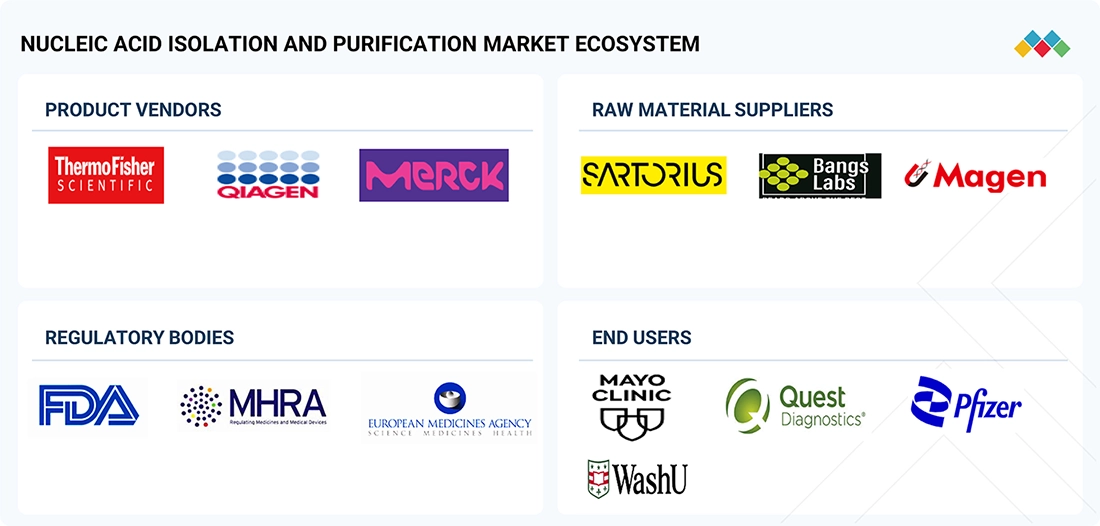
Logos and trademarks shown above are the property of their respective owners. Their use here is for informational and illustrative purposes only.
MARKET SEGMENTS
Source: Secondary Research, Interviews with Experts, MarketsandMarkets Analysis
Global Nucleic Acid Isolation and Purification Market, by Product
In 2025, the kits segment dominated the nucleic acid isolation and purification market due to their ease of use in applications such as molecular diagnostics, gene sequencing, and gene cloning, as well as the ongoing focus of key market players on developing and launching advanced kits.
Nucleic Acid Isolation and Purification Market, by Method
In 2025, the magnetic bead-based isolation and purification segment held the largest share of the nucleic acid isolation and purification market. This dominance can be attributed to its high compatibility with automated and high-throughput workflows, enabling faster processing, reduced manual intervention, and improved reproducibility.
Nucleic Acid Isolation and Purification Market, by Type
In 2025, the plasmid DNA isolation and purification segment held the largest share and will be the fastest-growing segment in the global nucleic acid isolation and purification market. This dominance is driven by the availability of a broad range of kits for plasmid DNA extraction and processing, and by the increasing application of plasmid DNA in gene expression profiling and its wide use in a variety of downstream applications.
Nucleic Acid Isolation and Purification Market, by Sample Type
In 2025, cellular samples dominated the market due to their widespread use in infectious disease testing, genomic research, cell biology, drug discovery, and molecular diagnostics, where nucleic acid extraction is a foundational upstream step.
Nucleic Acid Isolation and Purification Market, by Application
In 2025, the diagnostics segment accounted for the largest share of the global nucleic acid isolation and purification market. This dominance can be attributed to the rising application of DNA and RNA isolation for pathogen identification in routine sample processing, increasing awareness of genomic diagnostics among patients, and the growing efficiency of genomic sequencing in disease diagnosis.
Nucleic Acid Isolation and Purification Market, by End User
In 2025, hospitals and diagnostic centers accounted for the largest share of the global nucleic acid isolation and purification market. The growing importance of nucleic acid testing in molecular diagnostics is expected to drive this segment's growth over the forecast period.
REGION
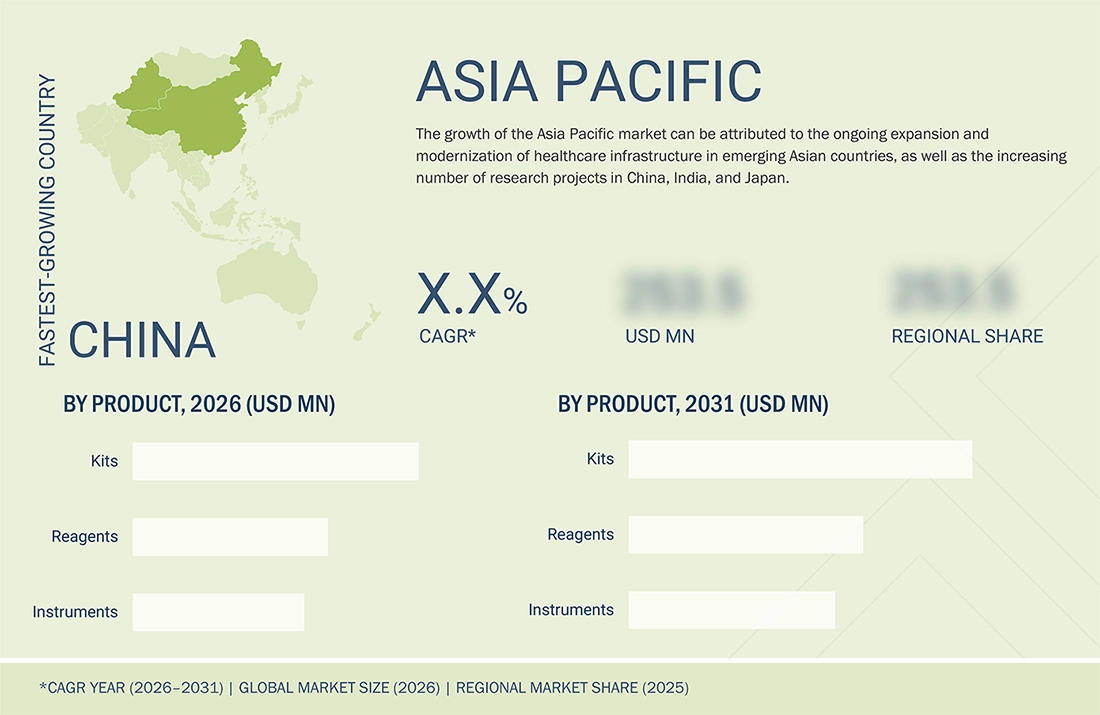
Asia Pacific to be fastest-growing region in market during forecast period
Asia Pacific is likely to be the fastest-growing region in the global nucleic acid isolation and purification market, fueled by the rapid expansion of healthcare infrastructure in China, India, and Japan. Additionally, an increasing patient population suffering from chronic diseases, a rising number of testing facilities, and the implementation of awareness campaigns and conferences on nucleic acid isolation and purification contributed to this trend.
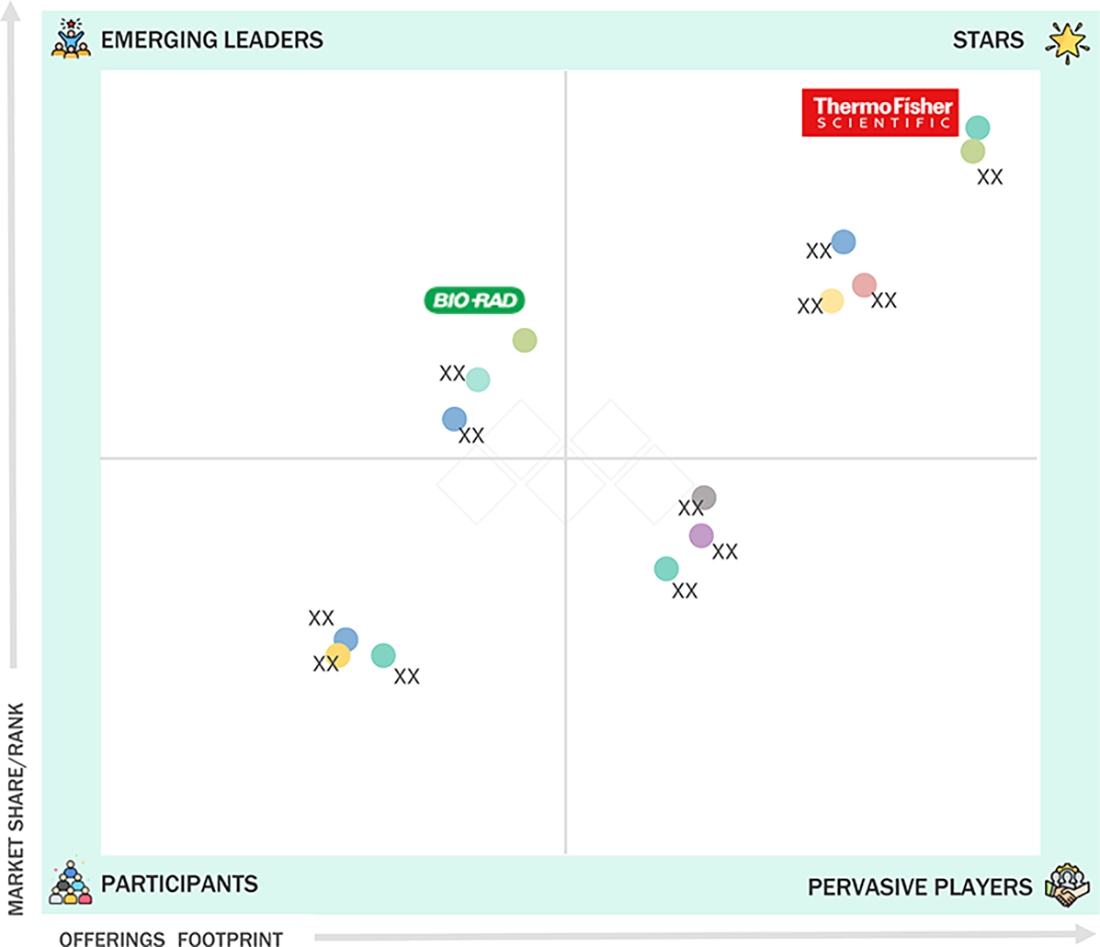
NUCLEIC ACID ISOLATION AND PURIFICATION MARKET: COMPANY EVALUATION MATRIX
Thermo Fisher Scientific is a prominent leader in the global nucleic acid isolation and purification market, backed by a comprehensive range of extraction kits, purification reagents, magnetic bead-based chemistries, automated sample preparation devices, and integrated molecular biology workflows. Its validated solutions are trusted by pharmaceutical and biotech firms, diagnostic labs, academic research centers, CROs, and government labs for DNA and RNA extraction in applications like PCR/qPCR, NGS, molecular diagnostics, infectious disease testing, oncology research, and biobanking. Meanwhile, Bio-Rad Laboratories is gaining ground as a strong competitor, expanding its sample preparation and molecular biology product lineup. Their nucleic acid extraction and purification solutions enable reliable sample processing in research, clinical, and applied testing workflows. As they grow in PCR, ddPCR, genomics, and life science research, Bio-Rad’s market relevance increases, especially among research labs, diagnostic entities, and academic institutions seeking dependable, workflow-compatible solutions.
Source: Secondary Research, Interviews with Experts, MarketsandMarkets Analysis
KEY MARKET PLAYERS
- Thermo Fisher Scientific Inc. (US)
- Qiagen N.V. (Netherlands)
- F. Hoffmann-La Roche Ltd. (Switzerland)
- Merck KGaA (Germany)
- Danaher Corporation (US)
- Promega Corporation (US)
- Agilent Technologies, Inc. (US)
- Bio-rad Laboratories, Inc. (US)
- illumina, inc. (US)
- Takara Bio Inc. (Japan)
- New England Biolabs (US)
- A&A biotechnology (Poland)
- Revvity, Inc. (US)
- Bioneer Corporation (South Korea)
- HiMedia Laboratories Pvt. Ltd. (India)
MARKET SCOPE
| REPORT METRIC | DETAILS |
|---|---|
| Market Size in 2025 (Value) | USD 6.08 Billion |
| Market Forecast in 2031 (Value) | USD 9.66 Billion |
| Growth Rate | CAGR of 8.7% from 2026–2031 |
| Years Considered | 2024–2031 |
| Base Year | 2025 |
| Forecast Period | 2026–2031 |
| Units Considered | Value (USD Million/Billion) |
| Report Coverage | Revenue Forecast, Company Ranking, Competitive Landscape, Growth Factors, and Trends |
| Segments Covered |
|
| Regions Covered | North America, Europe, Asia Pacific, Latin America, Middle East, Africa |
WHAT IS IN IT FOR YOU: NUCLEIC ACID ISOLATION AND PURIFICATION MARKET REPORT CONTENT GUIDE
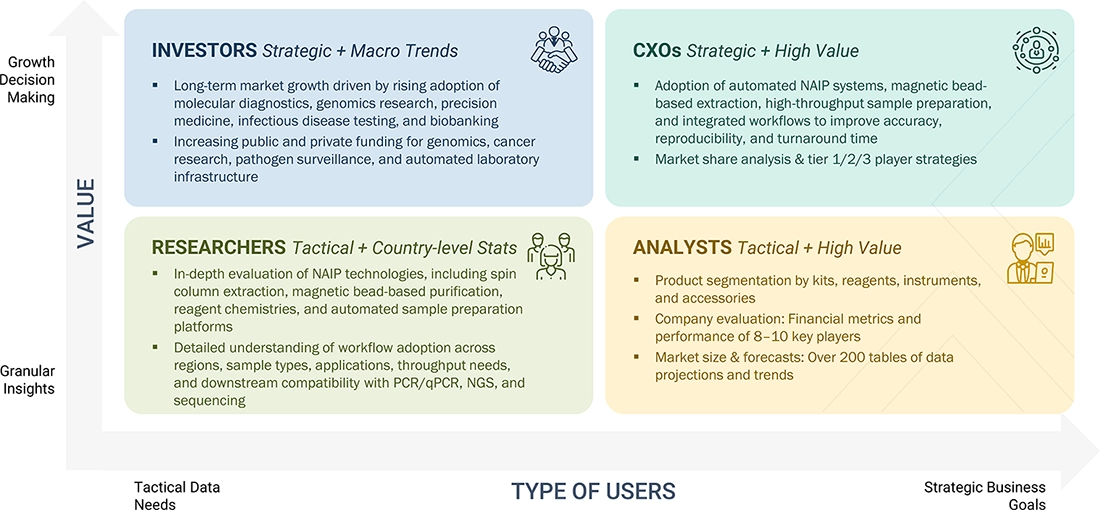
DELIVERED CUSTOMIZATIONS
We have successfully delivered the following deep-dive customizations:
| CLIENT REQUEST | CUSTOMIZATION DELIVERED | VALUE ADDS |
|---|---|---|
| Benchmarking end-user preferences for nucleic acid isolation and purification technologies and applications |
|
Assessed adoption across workflows such as PCR/qPCR, NGS, molecular diagnostics, infectious disease testing, oncology research, biobanking |
| Identifying outsourcing, collaboration, and partnership opportunities in nucleic acid isolation and purification workflow development |
|
Identified partners for workflow integration, automation, assay development, validation support |
| Country-specific regulatory, accreditation, and procurement insights for nucleic acid isolation and purification systems |
|
Assessed funding trends, public health initiatives, technology adoption for molecular diagnostics and genomics |
| Additional company profiling requirements for competitive intelligence |
|
Benchmarked players across automation, throughput, application coverage |
RECENT DEVELOPMENTS
- October 2025 : QIAGEN announced the placement of its 4,000th QIAcube Connect and reported that the total number of QIAcube family installations had approached 13,000. The company also reiterated its plans for the upcoming launches of QIAsymphony Connect, QIAsprint, and QIAmini.
- October 2025 : Merck introduced two new kits: the MagPrep Viral RNA Isolation Kit and the MagPrep cfDNA Isolation Kit. The cfDNA kit extracts cell-free DNA from blood samples for liquid biopsy, whereas the viral RNA kit isolates viral RNA from biological samples like nasal swabs.
- September 2025 : Thermo Fisher launched the MagMAX HMW DNA Kit for high-molecular-weight DNA extraction, designed for long-read sequencing applications and automated KingFisher workflows.
- October 2024 : Illumina launched the MiSeq i100 Series, positioning it as a simpler, faster benchtop sequencing platform for more labs.
Table of Contents
 Exclusive indicates content/data unique to MarketsandMarkets and not available with any competitors.
TITLE
PAGE NO
1
INTRODUCTION
45
2
EXECUTIVE SUMMARY
51
3
PREMIUM INSIGHTS
58
2026
VS 2031 (%)
61
4
MARKET OVERVIEW
Automated systems and premium solutions drive innovation in nucleic acid extraction markets.
62
4.1
INTRODUCTION
4.2
MARKET DYNAMICS
4.2.1
DRIVERS
4.2.1.1
RISING ADOPTION OF AUTOMATED NUCLEIC ACID EXTRACTION SYSTEMS
4.2.1.2
INCREASING NEED FOR HIGH-PURITY AND INHIBITOR-FREE NUCLEIC ACID RECOVERY
4.2.1.3
BROADENING USE OF MAGNETIC BEAD-BASED PURIFICATION CHEMISTRIES
4.2.1.4
GROWTH IN COMPLEX AND DIFFICULT SAMPLE-TYPE PROCESSING
4.2.2
RESTRAINTS
4.2.2.1
PRICE PRESSURE AND PARTIAL COMMODITIZATION OF ROUTINE EXTRACTION KITS
4.2.2.2
CONTINUED USE OF MANUAL AND LOW-COST IN-HOUSE METHODS IN SMALL & MID-SIZED LABS
4.2.2.3
WORKFLOW SUBSTITUTION IN SELECTED USE CASES
4.2.3
OPPORTUNITIES
4.2.3.1
PREMIUM EXTRACTION SOLUTIONS FOR LOW-INPUT AND CELL-FREE NUCLEIC ACIDS
4.2.3.2
EXPANSION OF AUTOMATED BENCHTOP AND MID-THROUGHPUT EXTRACTION PLATFORMS
4.2.3.3
WORKFLOW INTEGRATION WITH QUANTITATION, TRACKING, AND DIGITAL REPORTING
4.2.3.4
APPLICATION-SPECIFIC EXTRACTION WORKFLOWS IN BIOPHARMA AND CGT
4.2.4
CHALLENGES
4.2.4.1
PRE-ANALYTICAL VARIABILITY THAT AFFECTS EXTRACTION OUTPUT
4.2.4.2
REMOVAL OF INHIBITORS AND CONTAMINANTS FROM DIFFICULT MATRICES
4.2.4.3
STANDARDIZATION AND VALIDATION FOR REGULATED OR SENSITIVE WORKFLOWS
4.3
UNMET NEEDS & WHITE SPACES
4.4
INTERCONNECTED MARKETS & CROSS-SECTOR OPPORTUNITIES
4.5
STRATEGIC MOVES BY TIER-1/2/3 PLAYERS
5
INDUSTRY TRENDS
Navigate competitive dynamics and pricing shifts shaping the nucleic acid isolation market.
73
5.1
PORTER’S FIVE FORCES ANALYSIS
5.1.1
THREAT OF NEW ENTRANTS
5.1.2
THREAT OF SUBSTITUTES
5.1.3
BARGAINING POWER OF BUYERS
5.1.4
BARGAINING POWER OF SUPPLIERS
5.1.5
INTENSITY OF COMPETITIVE RIVALRY
5.2
MACROECONOMIC OUTLOOK
5.2.1
INTRODUCTION
5.2.2
GDP TRENDS & FORECAST
5.2.3
TRENDS IN GLOBAL NUCLEIC ACID ISOLATION AND PURIFICATION MARKET
5.2.4
TRENDS IN HEALTHCARE EXPENDITURE
5.3
VALUE CHAIN ANALYSIS
5.4
SUPPLY CHAIN ANALYSIS
5.5
ECOSYSTEM ANALYSIS
5.5.1
EMERGING BUSINESS MODELS & ECOSYSTEM SHIFTS
5.6
PRICING ANALYSIS
5.6.1
INDICATIVE SELLING PRICE OF KEY PLAYERS, BY PRODUCT, 2025
5.6.2
INDICATIVE SELLING PRICE OF NAIP PRODUCTS, BY REGION, 2025
5.7
KEY CONFERENCES & EVENTS
5.8
TRENDS/DISRUPTIONS IMPACTING CUSTOMERS’ BUSINESSES
5.9
INVESTMENT/FUNDING ACTIVITY
5.10
CASE STUDY ANALYSIS
5.11
IMPACT OF 2025 US TARIFFS ON NUCLEIC ACID ISOLATION AND PURIFICATION MARKET
5.11.1
INTRODUCTION
5.11.2
KEY TARIFF RATES
5.11.3
PRICE IMPACT ANALYSIS
5.11.4
IMPACT ON COUNTRY/REGION
5.11.4.1
US
5.11.4.2
EUROPE
5.11.4.3
ASIA PACIFIC
5.11.5
IMPACT ON END-USE INDUSTRIES
5.11.5.1
HOSPITALS & DIAGNOSTIC CENTERS
5.11.5.2
ACADEMIC & GOVERNMENT RESEARCH INSTITUTES
5.11.5.3
PHARMACEUTICAL & BIOTECHNOLOGY COMPANIES
5.11.5.4
CONTRACT RESEARCH ORGANIZATIONS (CROS)
5.11.5.5
OTHER END USERS
6
TECHNOLOGICAL ADVANCEMENTS, AI-DRIVEN IMPACT, PATENTS, INNOVATIONS, AND FUTURE APPLICATIONS
AI revolutionizes nucleic acid isolation with innovative technologies and strategic patent insights.
98
6.1
TECHNOLOGY ANALYSIS
6.1.1
KEY TECHNOLOGIES
6.1.1.1
SILICA MEMBRANE/SPIN COLUMN PURIFICATION
6.1.1.2
MAGNETIC BEAD-BASED PURIFICATION
6.1.1.3
REAGENT-BASED EXTRACTION/ORGANIC EXTRACTION
6.1.2
COMPLEMENTARY TECHNOLOGIES
6.1.2.1
SAMPLE LYSIS & HOMOGENIZATION TECHNOLOGIES
6.1.2.2
CENTRIFUGATION & VACUUM MANIFOLD SYSTEMS
6.1.3
ADJACENT TECHNOLOGIES
6.1.3.1
PCR & QPCR TECHNOLOGIES
6.2
TECHNOLOGY/PRODUCT ROADMAP
6.3
PATENT ANALYSIS
6.3.1
TOP APPLICANTS/OWNERS (COMPANIES) FOR NUCLEIC ACID ISOLATION AND PURIFICATION PRODUCT/TECHNOLOGY PATENTS, 2015–2025
6.4
FUTURE APPLICATIONS
6.5
IMPACT OF AI/GEN AI ON NUCLEIC ACID ISOLATION AND PURIFICATION MARKET
6.5.1
TOP USE CASES & MARKET POTENTIAL
6.5.2
CASE STUDIES OF AI IMPLEMENTATION IN NUCLEIC ACID ISOLATION AND PURIFICATION MARKET
6.5.3
INTERCONNECTED ADJACENT ECOSYSTEMS & IMPACT ON MARKET PLAYERS
6.5.4
CLIENTS’ READINESS TO ADOPT GENERATIVE AI IN NUCLEIC ACID ISOLATION AND PURIFICATION MARKET
6.6
SUCCESS STORIES & REAL-WORLD APPLICATIONS
7
SUSTAINABILITY & REGULATORY LANDSCAPE
Navigate complex global regulations to drive sustainable innovation and compliance across key markets.
110
7.1
REGULATORY LANDSCAPE
7.1.1
REGULATORY BODIES, GOVERNMENT AGENCIES, AND OTHER ORGANIZATIONS
7.1.2
REGULATORY FRAMEWORK/KEY REGULATIONS
7.1.2.1
NORTH AMERICA
7.1.2.1.1
US
7.1.2.1.2
CANADA
7.1.2.2
EUROPE
7.1.2.2.1
GERMANY
7.1.2.2.2
FRANCE
7.1.2.2.3
UK
7.1.2.3
ASIA PACIFIC
7.1.2.3.1
JAPAN
7.1.2.3.2
CHINA
7.1.2.3.3
INDIA
7.1.2.3.4
SOUTH KOREA
7.1.2.4
LATIN AMERICA
7.1.2.4.1
BRAZIL
7.1.2.5
MIDDLE EAST
7.1.2.5.1
SAUDI ARABIA
7.1.3
INDUSTRY STANDARDS
7.2
SUSTAINABILITY IMPACT & REGULATORY POLICY INITIATIVES
7.3
CERTIFICATIONS, LABELING, AND ECO-STANDARDS
8
CUSTOMER LANDSCAPE & BUYER BEHAVIOR
Unlock buyer dynamics by identifying key decision-makers and unmet needs across industries.
123
8.1
DECISION-MAKING PROCESS
8.2
BUYER STAKEHOLDERS & BUYING EVALUATION CRITERIA
8.2.1
KEY STAKEHOLDERS IN BUYING PROCESS
8.2.2
KEY BUYING CRITERIA, BY END USER
8.3
ADOPTION BARRIERS & INTERNAL CHALLENGES
8.4
UNMET NEEDS FROM VARIOUS END-USE INDUSTRIES
8.5
MARKET PROFITABILITY
9
NUCLEIC ACID ISOLATION AND PURIFICATION MARKET, BY PRODUCT
Market Size & Growth Rate Forecast Analysis to 2031 in USD Million | 37 Data Tables
128
9.1
INTRODUCTION
9.2
KITS
KITS TO ACCOUNT FOR LARGEST SHARE OF MARKET DURING
9.3
REAGENTS
9.3.1
AVAILABILITY OF READY-TO-USE REAGENTS TO DRIVE GROWTH
9.4
INSTRUMENTS
9.4.1
AUTOMATIC INSTRUMENTS
9.4.1.1
BENEFITS OF AUTOMATIC INSTRUMENTS TO DRIVE GROWTH
9.4.2
MANUAL INSTRUMENTS
9.4.2.1
GROWING DEMAND FOR NUCLEIC ACID ISOLATION AND PURIFICATION IN RESEARCH AND CLINICAL APPLICATIONS TO DRIVE GROWTH
10
NUCLEIC ACID ISOLATION AND PURIFICATION MARKET, BY METHOD
Market Size & Growth Rate Forecast Analysis to 2031 in USD Million | 29 Data Tables
150
10.1
INTRODUCTION
10.2
MAGNETIC BEAD-BASED ISOLATION AND PURIFICATION
10.2.1
MAGNETIC BEAD-BASED ISOLATION AND PURIFICATION SEGMENT TO REGISTER HIGHEST CAGR DURING FORECAST PERIOD
10.3
REAGENT-BASED ISOLATION AND PURIFICATION
10.3.1
REAGENT-BASED ISOLATION AND PURIFICATION SEGMENT TO REGISTER STEADY GROWTH DURING FORECAST PERIOD
10.4
COLUMN-BASED ISOLATION AND PURIFICATION
10.4.1
GROWING POPULARITY OF COLUMN-BASED ISOLATION AND PURIFICATION IN CURRENT KITS TO BOOST MARKET
10.5
OTHER ISOLATION AND PURIFICATION METHODS
11
NUCLEIC ACID ISOLATION AND PURIFICATION MARKET, BY TYPE
Market Size & Growth Rate Forecast Analysis to 2031 in USD Million | 50 Data Tables
167
11.1
INTRODUCTION
11.2
PLASMID DNA ISOLATION AND PURIFICATION
11.2.1
PLASMID DNA ISOLATION AND PURIFICATION TO ACCOUNT FOR LARGEST SHARE OF MARKET
11.3
TOTAL RNA ISOLATION AND PURIFICATION
11.3.1
WIDE USE OF TOTAL RNA ISOLATION AND PURIFICATION FOR RESEARCH AND DIAGNOSTIC APPLICATIONS TO BOOST MARKET
11.4
GENOMIC DNA ISOLATION AND PURIFICATION
11.4.1
IMPORTANCE OF GENOMIC DNA ISOLATION IN GENETIC-BASED TESTS TO SUPPORT GROWTH
11.5
MESSENGER RNA ISOLATION AND PURIFICATION
11.5.1
ROLE PLAYED BY MESSENGER RNA ISOLATION AND PURIFICATION IN GENE EXPRESSION AND TRANSCRIPTOMICS TO DRIVE GROWTH
11.6
CIRCULATING NUCLEIC ACID ISOLATION AND PURIFICATION
11.6.1
ABILITY OF CIRCULATING NAIP TO ENABLE COLLECTION OF GENETIC INFORMATION FROM BODY FLUIDS TO BOOST ADOPTION
11.7
MICRORNA ISOLATION AND PURIFICATION
11.7.1
GROWING APPLICATIONS OF MICRORNA ISOLATION AND PURIFICATION IN DRUG DEVELOPMENT RESEARCH TO FUEL GROWTH
11.8
OTHER NUCLEIC ACID ISOLATION AND PURIFICATION TYPES
12
NUCLEIC ACID ISOLATION AND PURIFICATION MARKET, BY SAMPLE TYPE
Market Size & Growth Rate Forecast Analysis to 2031 in USD Million | 95 Data Tables
195
12.1
INTRODUCTION
12.2
CELLULAR SAMPLES
12.2.1
WBCS
12.2.1.1
STRONG DEMAND FROM ROUTINE BLOOD-BASED GENOMICS AND DIAGNOSTIC TESTING WORKFLOWS TO BOOST MARKET
12.2.2
CULTURED CELLS
12.2.2.1
CORE SEGMENT SUPPORTING DRUG DISCOVERY, CELL BIOLOGY, AND BIOPHARMA R&D APPLICATIONS
12.2.3
BACTERIAL
12.2.3.1
RISING ADOPTION IN INFECTIOUS DISEASE, MICROBIOME, AND ENVIRONMENTAL TESTING WORKFLOWS TO FUEL MARKET GROWTH
12.2.4
OTHER CELLULAR SAMPLES
12.3
PRESERVED TISSUE SAMPLES
12.3.1
FRESH/FROZEN TISSUES
12.3.1.1
PREFERRED FOR HIGH-QUALITY NUCLEIC ACID RECOVERY IN RESEARCH AND TRANSLATIONAL STUDIES
12.3.2
FFPE (FORMALIN-FIXED PARAFFIN-EMBEDDED)
12.3.2.1
FASTEST-GROWING SEGMENT FUELED BY INCREASING USE OF ARCHIVED CLINICAL SAMPLES IN ONCOLOGY
12.3.3
OTHER PRESERVED TISSUE SAMPLES
12.4
CELL-FREE SAMPLES
12.4.1
CFDNA/CTDNA
12.4.1.1
KEY GROWTH DRIVER ENABLING LIQUID BIOPSY AND REAL-TIME DISEASE MONITORING
12.4.2
OTHER CELL-FREE SAMPLES
12.5
OTHER SAMPLES
13
NUCLEIC ACID ISOLATION AND PURIFICATION MARKET, BY APPLICATION
Market Size & Growth Rate Forecast Analysis to 2031 in USD Million | 36 Data Tables
244
13.1
INTRODUCTION
13.2
DIAGNOSTICS
13.2.1
DIAGNOSTIC APPLICATIONS TO DOMINATE MARKET DURING FORECAST PERIOD
13.3
DRUG DISCOVERY & DEVELOPMENT
13.3.1
POTENTIAL OF NAIP TO HELP IN DEVELOPMENT OF DRUGS FOR RARE DISEASES TO BOOST MARKET
13.4
PERSONALIZED MEDICINE
13.4.1
RISING INCIDENCE OF CANCER AND INCREASING RESEARCH AND FUNDING TO DRIVE GROWTH
13.5
AGRICULTURE & ANIMAL RESEARCH
13.5.1
FAVORABLE FUNDING SCENARIO TO SUPPORT MARKET GROWTH
13.6
OTHER APPLICATIONS
14
NUCLEIC ACID ISOLATION AND PURIFICATION MARKET, BY END USER
Market Size & Growth Rate Forecast Analysis to 2031 in USD Million | 36 Data Tables
265
14.1
INTRODUCTION
14.2
HOSPITALS & DIAGNOSTIC CENTERS
14.2.1
RISING FOCUS ON PERSONALIZED MEDICINE IN HOSPITALS TO DRIVE MARKET GROWTH
14.3
ACADEMIC & GOVERNMENT RESEARCH INSTITUTES
14.3.1
INCREASE IN RESEARCH INTENSITY TO DRIVE USAGE OF NUCLEIC ACID ISOLATION AND PURIFICATION SYSTEMS
14.4
PHARMACEUTICAL & BIOTECHNOLOGY COMPANIES
14.4.1
INCREASING NUMBER OF RESEARCH PROJECTS IN GENOMICS AND RELATED AREAS TO DRIVE SEGMENT GROWTH
14.5
CONTRACT RESEARCH ORGANIZATIONS
14.5.1
CONTRACT RESEARCH ORGANIZATIONS TO REGISTER STEADY GROWTH DURING FORECAST PERIOD
14.6
OTHER END USERS
15
NUCLEIC ACID ISOLATION AND PURIFICATION MARKET, BY REGION
Comprehensive coverage of 7 Regions with country-level deep-dive of 16 Countries | 287 Data Tables.
287
15.1
INTRODUCTION
15.2
NORTH AMERICA
15.2.1
US
15.2.1.1
GOVERNMENT AND PRIVATE FUNDING TO SUPPORT MARKET GROWTH
15.2.2
CANADA
15.2.2.1
GROWING INVESTMENTS IN GENOMICS TO BOOST MARKET DEMAND
15.3
EUROPE
15.3.1
GERMANY
15.3.1.1
GERMANY TO DOMINATE MARKET IN EUROPE
15.3.2
UK
GOVERNMENT SUPPORT FOR RESEARCH THROUGH INVESTMENTS, FUNDS,
15.3.3
FRANCE
INCREASING NUMBER OF ESTABLISHED BIOTECH FACILITIES TO DRIVE
15.3.4
ITALY
15.3.4.1
GOVERNMENT SUPPORT TO DRIVE MARKET GROWTH IN ITALY
15.3.5
SPAIN
15.3.5.1
HIGH ADOPTION OF ADVANCED DIAGNOSTIC TECHNOLOGIES TO DRIVE MARKET GROWTH IN SPAIN
15.3.6
REST OF EUROPE
15.4
ASIA PACIFIC
15.4.1
CHINA
15.4.1.1
STRONG DOMESTIC GENOMICS SCALE AND TIGHTENING IVD FRAMEWORK TO DRIVE NAIP ADOPTION
15.4.2
JAPAN
15.4.2.1
WHOLE-GENOME MEDICINE AND STRUCTURED CLINICAL IMPLEMENTATION TO SUPPORT PREMIUM NAIP DEMAND
15.4.3
INDIA
15.4.3.1
NATIONAL GENOMICS INITIATIVES AND RISING DOMESTIC MANUFACTURING TO EXPAND NAIP OPPORTUNITIES
15.4.4
AUSTRALIA
15.4.4.1
PRECISION HEALTH FUNDING AND RARE-DISEASE GENOMICS TO SUPPORT ADVANCED NAIP WORKFLOWS
15.4.5
SOUTH KOREA
15.4.5.1
SUPPORT FROM GOVERNMENTS TO DRIVE MARKET IN REGION
15.4.6
REST OF ASIA PACIFIC (ROAPAC)
15.5
LATIN AMERICA
15.5.1
BRAZIL
15.5.1.1
BRAZIL TO DOMINATE LATAM MARKET
15.5.2
MEXICO
15.5.2.1
FAVORABLE TRADE AGREEMENTS TO SUPPORT IMPORTS AND IMPROVE ACCESS TO NAIP INSTRUMENTS IN MEXICO
15.5.3
REST OF LATIN AMERICA
15.6
MIDDLE EAST
15.6.1
GCC COUNTRIES
15.6.1.1
SAUDI ARABIA
15.6.1.1.1
NATIONAL GENOMICS STRATEGY AND PRECISION MEDICINE EXPANSION TO ACCELERATE NAIP DEMAND
15.6.1.2
UAE
15.6.1.2.1
MOLECULAR LAB STANDARDIZATION AND GENOMICS-LED HEALTHCARE INVESTMENT TO STRENGTHEN NAIP ADOPTION
15.6.1.3
REST OF GCC COUNTRIES
15.6.2
REST OF MIDDLE EAST
15.7
AFRICA
15.7.1
GOVERNMENT SUPPORT FOR RESEARCH STUDIES TO FUEL GROWTH
16
COMPETITIVE LANDSCAPE
Discover market dominance strategies and key player insights shaping future competitive dynamics.
426
16.1
INTRODUCTION
16.2
STRATEGIES ADOPTED BY KEY PLAYERS/RIGHT TO WIN
16.3
REVENUE ANALYSIS, 2021–2025
16.4
MARKET SHARE ANALYSIS, 2025
16.5
COMPANY EVALUATION MATRIX: KEY PLAYERS, 2025
16.5.1
STARS
16.5.2
EMERGING LEADERS
16.5.3
PERVASIVE PLAYERS
16.5.4
PARTICIPANTS
16.5.5
COMPANY FOOTPRINT: KEY PLAYERS, 2025
16.5.5.1
COMPANY FOOTPRINT
16.5.5.2
REGION FOOTPRINT
16.5.5.3
PRODUCT FOOTPRINT
16.5.5.4
METHOD FOOTPRINT
16.5.5.5
APPLICATION FOOTPRINT
16.6
COMPANY EVALUATION MATRIX: STARTUPS/SMES, 2025
16.6.1
PROGRESSIVE COMPANIES
16.6.2
RESPONSIVE COMPANIES
16.6.3
DYNAMIC COMPANIES
16.6.4
STARTING BLOCKS
16.6.5
COMPETITIVE BENCHMARKING: STARTUPS/SMES, 2025
16.6.5.1
LIST OF KEY STARTUPS/SMES
16.6.5.2
COMPETITIVE BENCHMARKING OF KEY STARTUPS/SMES
16.7
COMPANY VALUATION & FINANCIAL METRICS
16.7.1
FINANCIAL METRICS
16.7.2
COMPANY VALUATION
16.8
BRAND/PRODUCT COMPARISON
16.8.1
BRAND/PRODUCT COMPARATIVE ANALYSIS, BY PRODUCT
16.9
COMPETITIVE SCENARIO
16.9.1
PRODUCT LAUNCHES
16.9.2
DEALS
17
COMPANY PROFILES
In-depth Company Profiles of Leading Market Players with detailed Business Overview, Product and Service Portfolio, Recent Developments, and Unique Analyst Perspective (MnM View)
447
17.1
KEY PLAYERS
17.1.1
THERMO FISHER SCIENTIFIC INC.
17.1.1.1
BUSINESS OVERVIEW
17.1.1.2
PRODUCTS OFFERED
17.1.1.3
RECENT DEVELOPMENTS
17.1.1.3.1
PRODUCT LAUNCHES
17.1.1.3.2
EXPANSIONS
17.1.1.3.3
OTHER DEVELOPMENTS
17.1.1.4
MNM VIEW
17.1.1.4.1
KEY STRENGTHS
17.1.1.4.2
STRATEGIC CHOICES
17.1.1.4.3
WEAKNESSES & COMPETITIVE THREATS
17.1.2
QIAGEN N.V.
17.1.3
MERCK KGAA
17.1.4
F. HOFFMANN-LA ROCHE LTD.
17.1.5
DANAHER CORPORATION
17.1.6
PROMEGA CORPORATION
17.1.7
AGILENT TECHNOLOGIES, INC.
17.1.8
BIO-RAD LABORATORIES, INC.
17.1.9
ILLUMINA, INC.
17.1.10
TAKARA BIO INC.
17.1.11
NEW ENGLAND BIOLABS
17.1.12
A&A BIOTECHNOLOGY
17.1.13
REVVITY INC.
17.1.14
BIONEER CORPORATION
17.1.15
HIMEDIA LABORATORIES PRIVATE LIMITED
17.2
OTHER PLAYERS
17.2.1
KILPEST INDIA LIMITED
17.2.2
APICAL SCIENTIFIC SDN. BHD.
17.2.3
ENDRESS+HAUSER GROUP SERVICES AG
17.2.4
GENAXXON BIOSCIENCE GMBH
17.2.5
LGC BIOSEARCH TECHNOLOGIES
17.2.6
ZYMO RESEARCH CORPORATION
17.2.7
NORGEN BIOTEK CORP.
17.2.8
OMEGA BIO-TEK, INC.
17.2.9
FAVORGEN BIOTECH CORPORATION
17.2.10
TIANGEN BIOTECH(BEIJING)CO., LTD.
17.2.11
AUTOGEN INC.
17.2.12
PCR BIOSYSTEMS
17.2.13
BIOGENUIX
17.2.14
MP BIOMEDICALS
17.2.15
NANJING VAZYME BIOTECH CO., LTD.
18
RESEARCH METHODOLOGY
522
18.1
RESEARCH DATA
18.1.1
SECONDARY DATA
18.1.1.1
KEY DATA FROM SECONDARY SOURCES
18.1.2
PRIMARY DATA
18.1.2.1
KEY DATA FROM PRIMARY SOURCES
18.1.2.2
KEY PRIMARY PARTICIPANTS
18.1.2.3
BREAKDOWN OF PRIMARY INTERVIEWS
18.1.2.4
KEY INDUSTRY INSIGHTS
18.2
MARKET SIZE ESTIMATION
18.2.1
SEGMENTAL MARKET SIZE ESTIMATION
18.3
MARKET GROWTH RATE PROJECTIONS
18.4
FACTOR ANALYSIS
18.5
DATA TRIANGULATION
18.6
RESEARCH ASSUMPTIONS
18.7
RESEARCH LIMITATIONS & RISK ASSESSMENT
18.8
SRISK ASSESSMENT
19
APPENDIX
536
19.1
DISCUSSION GUIDE
19.2
KNOWLEDGESTORE: MARKETSANDMARKETS’ SUBSCRIPTION PORTAL
19.3
CUSTOMIZATION OPTIONS
19.4
RELATED REPORTS
19.5
AUTHOR DETAILS
LIST OF TABLES
TABLE 1
NUCLEIC ACID ISOLATION AND PURIFICATION MARKET: IMPACT ANALYSIS
TABLE 2
NEXT-GENERATION SEQUENCING MARKET, BY REGION, 2024–2031 (USD MILLION)
TABLE 3
NUCLEIC ACID ISOLATION AND PURIFICATION MARKET: PORTER’S FIVE FORCES ANALYSIS
TABLE 4
HEALTH EXPENDITURE AND FINANCING, 2015–2024 (IN PERCENTAGE OF GDP)
TABLE 5
NUCLEIC ACID ISOLATION AND PURIFICATION MARKET: ROLE IN ECOSYSTEM
TABLE 6
INDICATIVE SELLING PRICE OF KEY PLAYERS, BY PRODUCT, 2025
TABLE 7
INDICATIVE SELLING PRICE OF NAIP PRODUCTS, BY REGION, 2025
TABLE 8
NUCLEIC ACID ISOLATION AND PURIFICATION MARKET: KEY CONFERENCES & EVENTS, 2026–2027
TABLE 9
CASE STUDY 1: DNA EXTRACTION FROM ARCHEOLOGICAL AND RECENT SKELETAL REMAINS
TABLE 10
CASE STUDY 2: CLINICAL LAB AUTOMATION FOR ROUTINE MOLECULAR SAMPLE PREPARATION
TABLE 11
CASE STUDY 3: AUTOMATED EXTRACTION OF FFPE SAMPLES FOR ONCOLOGY/NGS WORKFLOWS
TABLE 12
US-ADJUSTED RECIPROCAL TARIFF RATES
TABLE 13
NUCLEIC ACID ISOLATION AND PURIFICATION MARKET: KEY COMPANIES’ TECHNOLOGY/PRODUCT ROADMAP
TABLE 14
DETAILED ANALYSIS OF KEY PATENTS IN NUCLEIC ACID ISOLATION AND PURIFICATION MARKET
TABLE 15
CASE STUDIES OF AI IMPLEMENTATION IN NUCLEIC ACID ISOLATION AND PURIFICATION
TABLE 16
CLIENTS’ READINESS TO ADOPT GENERATIVE AI IN NUCLEIC ACID ISOLATION AND PURIFICATION MARKET
TABLE 17
KEY SUCCESS STORIES WITH RESPECT TO REAL-WORLD APPLICATION IN NUCLEIC ACID ISOLATION AND PURIFICATION MARKET
TABLE 18
REGULATORY BODIES, GOVERNMENT AGENCIES, AND OTHER ORGANIZATIONS
TABLE 19
US FDA: MEDICAL DEVICE CLASSIFICATION
TABLE 20
US: MEDICAL DEVICE REGULATORY APPROVAL PROCESS
TABLE 21
EUROPE: CLASSIFICATION OF DEVICES
TABLE 22
JAPAN: TIME, COST, AND COMPLEXITY OF REGISTRATION PROCESS
TABLE 23
CHINA: TIME, COST, AND COMPLEXITY OF REGISTRATION PROCESS
TABLE 24
SOUTH KOREA: TIME, COST, AND COMPLEXITY OF REGISTRATION PROCESS
TABLE 25
INFLUENCE OF STAKEHOLDERS ON BUYING PROCESS, BY PRODUCT (%)
TABLE 26
KEY BUYING CRITERIA, BY END USER
TABLE 27
UNMET NEED ACROSS DIFFERENT END USERS IN NUCLEIC ACID ISOLATION AND PURIFICATION MARKET
TABLE 28
NUCLEIC ACID ISOLATION AND PURIFICATION MARKET, BY PRODUCT, 2024–2031 (USD MILLION)
TABLE 29
NUCLEIC ACID ISOLATION AND PURIFICATION KITS MARKET, BY REGION, 2024–2031 (USD MILLION)
TABLE 30
NORTH AMERICA: NUCLEIC ACID ISOLATION AND PURIFICATION KITS MARKET, BY COUNTRY, 2024–2031 (USD MILLION)
TABLE 31
EUROPE: NUCLEIC ACID ISOLATION AND PURIFICATION KITS MARKET, BY COUNTRY, 2024–2031 (USD MILLION)
TABLE 32
ASIA PACIFIC: NUCLEIC ACID ISOLATION AND PURIFICATION KITS MARKET, BY COUNTRY, 2024–2031 (USD MILLION)
TABLE 33
LATIN AMERICA: NUCLEIC ACID ISOLATION AND PURIFICATION KITS MARKET, BY COUNTRY, 2024–2031 (USD MILLION)
TABLE 34
MIDDLE EAST: NUCLEIC ACID ISOLATION AND PURIFICATION KITS MARKET, BY REGION, 2024–2031 (USD MILLION)
TABLE 35
GCC COUNTRIES: NUCLEIC ACID ISOLATION AND PURIFICATION KITS MARKET, BY COUNTRY, 2024–2031 (USD MILLION)
TABLE 36
NUCLEIC ACID ISOLATION AND PURIFICATION REAGENTS MARKET, BY REGION, 2024–2031 (USD MILLION)
TABLE 37
NORTH AMERICA: NUCLEIC ACID ISOLATION AND PURIFICATION REAGENTS MARKET, BY COUNTRY, 2024–2031 (USD MILLION)
TABLE 38
EUROPE: NUCLEIC ACID ISOLATION AND PURIFICATION REAGENTS MARKET, BY COUNTRY, 2024–2031 (USD MILLION)
TABLE 39
ASIA PACIFIC: NUCLEIC ACID ISOLATION AND PURIFICATION REAGENTS MARKET, BY COUNTRY, 2024–2031 (USD MILLION)
TABLE 40
LATIN AMERICA: NUCLEIC ACID ISOLATION AND PURIFICATION REAGENTS MARKET, BY COUNTRY, 2024–2031 (USD MILLION)
TABLE 41
MIDDLE EAST: NUCLEIC ACID ISOLATION AND PURIFICATION REAGENTS MARKET, BY REGION, 2024–2031 (USD MILLION)
TABLE 42
GCC COUNTRIES: NUCLEIC ACID ISOLATION AND PURIFICATION REAGENTS MARKET, BY COUNTRY, 2024–2031 (USD MILLION)
TABLE 43
NUCLEIC ACID ISOLATION AND PURIFICATION INSTRUMENTS MARKET, BY TYPE, 2024–2031 (USD MILLION)
TABLE 44
NUCLEIC ACID ISOLATION AND PURIFICATION INSTRUMENTS MARKET, BY REGION, 2024–2031 (USD MILLION)
TABLE 45
NORTH AMERICA: NUCLEIC ACID ISOLATION AND PURIFICATION INSTRUMENTS MARKET, BY COUNTRY, 2024–2031 (USD MILLION)
TABLE 46
EUROPE: NUCLEIC ACID ISOLATION AND PURIFICATION INSTRUMENTS MARKET, BY COUNTRY, 2024–2031 (USD MILLION)
TABLE 47
ASIA PACIFIC: NUCLEIC ACID ISOLATION AND PURIFICATION INSTRUMENTS MARKET, BY COUNTRY, 2024–2031 (USD MILLION)
TABLE 48
LATIN AMERICA: NUCLEIC ACID ISOLATION AND PURIFICATION INSTRUMENTS MARKET, BY COUNTRY, 2024–2031 (USD MILLION)
TABLE 49
MIDDLE EAST: NUCLEIC ACID ISOLATION AND PURIFICATION INSTRUMENTS MARKET, BY REGION, 2024–2031 (USD MILLION)
TABLE 50
GCC COUNTRIES: NUCLEIC ACID ISOLATION AND PURIFICATION INSTRUMENTS MARKET, BY COUNTRY, 2024–2031 (USD MILLION)
TABLE 51
NUCLEIC ACID ISOLATION AND PURIFICATION MARKET FOR AUTOMATIC INSTRUMENTS, BY REGION, 2024–2031 (USD MILLION)
TABLE 52
NORTH AMERICA: NUCLEIC ACID ISOLATION AND PURIFICATION MARKET FOR AUTOMATIC INSTRUMENTS, BY COUNTRY, 2024–2031 (USD MILLION)
TABLE 53
EUROPE: NUCLEIC ACID ISOLATION AND PURIFICATION MARKET FOR AUTOMATIC INSTRUMENTS, BY COUNTRY, 2024–2031 (USD MILLION)
TABLE 54
ASIA PACIFIC: NUCLEIC ACID ISOLATION AND PURIFICATION MARKET FOR AUTOMATIC INSTRUMENTS, BY COUNTRY, 2024–2031 (USD MILLION)
TABLE 55
LATIN AMERICA: NUCLEIC ACID ISOLATION AND PURIFICATION MARKET FOR AUTOMATIC INSTRUMENTS, BY COUNTRY, 2024–2031 (USD MILLION)
TABLE 56
MIDDLE EAST: NUCLEIC ACID ISOLATION AND PURIFICATION MARKET FOR AUTOMATIC INSTRUMENTS, BY REGION, 2024–2031 (USD MILLION)
TABLE 57
GCC COUNTRIES: NUCLEIC ACID ISOLATION AND PURIFICATION MARKET FOR AUTOMATIC INSTRUMENTS, BY COUNTRY, 2024–2031 (USD MILLION)
TABLE 58
NUCLEIC ACID ISOLATION AND PURIFICATION MARKET FOR MANUAL INSTRUMENTS, BY REGION, 2024–2031 (USD MILLION)
TABLE 59
NORTH AMERICA: NUCLEIC ACID ISOLATION AND PURIFICATION MARKET FOR MANUAL INSTRUMENTS, BY COUNTRY, 2024–2031 (USD MILLION)
TABLE 60
EUROPE: NUCLEIC ACID ISOLATION AND PURIFICATION MARKET FOR MANUAL INSTRUMENTS, BY COUNTRY, 2024–2031 (USD MILLION)
TABLE 61
ASIA PACIFIC: NUCLEIC ACID ISOLATION AND PURIFICATION MARKET FOR MANUAL INSTRUMENTS, BY COUNTRY, 2024–2031 (USD MILLION)
TABLE 62
LATIN AMERICA: NUCLEIC ACID ISOLATION AND PURIFICATION MARKET FOR MANUAL INSTRUMENTS, BY COUNTRY, 2024–2031 (USD MILLION)
TABLE 63
MIDDLE EAST: NUCLEIC ACID ISOLATION AND PURIFICATION MARKET FOR MANUAL INSTRUMENTS, BY REGION, 2024–2031 (USD MILLION)
TABLE 64
GCC COUNTRIES: NUCLEIC ACID ISOLATION AND PURIFICATION MARKET FOR MANUAL INSTRUMENTS, BY COUNTRY, 2024–2031 (USD MILLION)
TABLE 65
NUCLEIC ACID ISOLATION AND PURIFICATION MARKET, BY METHOD, 2024–2031 (USD MILLION)
TABLE 66
MAGNETIC BEAD-BASED ISOLATION AND PURIFICATION MARKET, BY REGION, 2024–2031 (USD MILLION)
TABLE 67
NORTH AMERICA: MAGNETIC BEAD-BASED ISOLATION AND PURIFICATION MARKET, BY COUNTRY, 2024–2031 (USD MILLION)
TABLE 68
EUROPE: MAGNETIC BEAD-BASED ISOLATION AND PURIFICATION MARKET, BY COUNTRY, 2024–2031 (USD MILLION)
TABLE 69
ASIA PACIFIC: MAGNETIC BEAD-BASED ISOLATION AND PURIFICATION MARKET, BY COUNTRY, 2024–2031 (USD MILLION)
TABLE 70
LATIN AMERICA: MAGNETIC BEAD-BASED ISOLATION AND PURIFICATION MARKET, BY COUNTRY, 2024–2031 (USD MILLION)
TABLE 71
MIDDLE EAST: MAGNETIC BEAD-BASED ISOLATION AND PURIFICATION MARKET, BY REGION, 2024–2031 (USD MILLION)
TABLE 72
GCC COUNTRIES: MAGNETIC BEAD-BASED ISOLATION AND PURIFICATION MARKET, BY COUNTRY, 2024–2031 (USD MILLION)
TABLE 73
REAGENT-BASED ISOLATION AND PURIFICATION MARKET, BY REGION, 2024–2031 (USD MILLION)
TABLE 74
NORTH AMERICA: REAGENT-BASED ISOLATION AND PURIFICATION MARKET, BY COUNTRY, 2024–2031 (USD MILLION)
TABLE 75
EUROPE: REAGENT-BASED ISOLATION AND PURIFICATION MARKET, BY COUNTRY, 2024–2031 (USD MILLION)
TABLE 76
ASIA PACIFIC: REAGENT-BASED ISOLATION AND PURIFICATION MARKET, BY COUNTRY, 2024–2031 (USD MILLION)
TABLE 77
LATIN AMERICA: REAGENT-BASED ISOLATION AND PURIFICATION MARKET, BY COUNTRY, 2024–2031 (USD MILLION)
TABLE 78
MIDDLE EAST: REAGENT-BASED ISOLATION AND PURIFICATION MARKET, BY REGION, 2024–2031 (USD MILLION)
TABLE 79
GCC COUNTRIES: REAGENT-BASED ISOLATION AND PURIFICATION MARKET, BY COUNTRY, 2024–2031 (USD MILLION)
TABLE 80
COLUMN-BASED ISOLATION AND PURIFICATION MARKET, BY REGION, 2024–2031 (USD MILLION)
TABLE 81
NORTH AMERICA: COLUMN-BASED ISOLATION AND PURIFICATION MARKET, BY COUNTRY, 2024–2031 (USD MILLION)
TABLE 82
EUROPE: COLUMN-BASED ISOLATION AND PURIFICATION MARKET, BY COUNTRY, 2024–2031 (USD MILLION)
TABLE 83
ASIA PACIFIC: COLUMN-BASED ISOLATION AND PURIFICATION MARKET, BY COUNTRY, 2024–2031 (USD MILLION)
TABLE 84
LATIN AMERICA: COLUMN-BASED ISOLATION AND PURIFICATION MARKET, BY COUNTRY, 2024–2031 (USD MILLION)
TABLE 85
MIDDLE EAST: COLUMN-BASED ISOLATION AND PURIFICATION MARKET, BY REGION, 2024–2031 (USD MILLION)
TABLE 86
GCC COUNTRIES: COLUMN-BASED ISOLATION AND PURIFICATION MARKET, BY COUNTRY, 2024–2031 (USD MILLION)
TABLE 87
OTHER ISOLATION AND PURIFICATION METHODS MARKET, BY REGION, 2024–2031 (USD MILLION)
TABLE 88
NORTH AMERICA: OTHER ISOLATION AND PURIFICATION METHODS MARKET, BY COUNTRY, 2024–2031 (USD MILLION)
TABLE 89
EUROPE: OTHER ISOLATION AND PURIFICATION METHODS MARKET, BY COUNTRY, 2024–2031 (USD MILLION)
TABLE 90
ASIA PACIFIC: OTHER ISOLATION AND PURIFICATION METHODS MARKET, BY COUNTRY, 2024–2031 (USD MILLION)
TABLE 91
LATIN AMERICA: OTHER ISOLATION AND PURIFICATION METHODS MARKET, BY COUNTRY, 2024–2031 (USD MILLION)
TABLE 92
MIDDLE EAST: OTHER ISOLATION AND PURIFICATION METHODS MARKET, BY REGION, 2024–2031 (USD MILLION)
TABLE 93
GCC COUNTRIES: OTHER ISOLATION AND PURIFICATION METHODS MARKET, BY COUNTRY, 2024–2031 (USD MILLION)
TABLE 94
NUCLEIC ACID ISOLATION AND PURIFICATION MARKET, BY TYPE, 2024–2031 (USD MILLION)
TABLE 95
PLASMID DNA ISOLATION AND PURIFICATION MARKET, BY REGION, 2024–2031 (USD MILLION)
TABLE 96
NORTH AMERICA: PLASMID DNA ISOLATION AND PURIFICATION MARKET, BY COUNTRY, 2024–2031 (USD MILLION)
TABLE 97
EUROPE: PLASMID DNA ISOLATION AND PURIFICATION MARKET, BY COUNTRY, 2024–2031 (USD MILLION)
TABLE 98
ASIA PACIFIC: PLASMID DNA ISOLATION AND PURIFICATION MARKET, BY COUNTRY, 2024–2031 (USD MILLION)
TABLE 99
LATIN AMERICA: PLASMID DNA ISOLATION AND PURIFICATION MARKET, BY COUNTRY, 2024–2031 (USD MILLION)
TABLE 100
MIDDLE EAST: PLASMID DNA ISOLATION AND PURIFICATION MARKET, BY REGION, 2024–2031 (USD MILLION)
TABLE 101
GCC COUNTRIES: PLASMID DNA ISOLATION AND PURIFICATION MARKET, BY COUNTRY, 2024–2031 (USD MILLION)
TABLE 102
TOTAL RNA ISOLATION AND PURIFICATION MARKET, BY REGION, 2024–2031 (USD MILLION)
TABLE 103
NORTH AMERICA: TOTAL RNA ISOLATION AND PURIFICATION MARKET, BY COUNTRY, 2024–2031 (USD MILLION)
TABLE 104
EUROPE: TOTAL RNA ISOLATION AND PURIFICATION MARKET, BY COUNTRY, 2024–2031 (USD MILLION)
TABLE 105
ASIA PACIFIC: TOTAL RNA ISOLATION AND PURIFICATION MARKET, BY COUNTRY, 2024–2031 (USD MILLION)
TABLE 106
LATIN AMERICA: TOTAL RNA ISOLATION AND PURIFICATION MARKET, BY COUNTRY, 2024–2031 (USD MILLION)
TABLE 107
MIDDLE EAST: TOTAL RNA ISOLATION AND PURIFICATION MARKET, BY REGION, 2024–2031 (USD MILLION)
TABLE 108
GCC COUNTRIES: TOTAL RNA ISOLATION AND PURIFICATION MARKET, BY COUNTRY, 2024–2031 (USD MILLION)
TABLE 109
GENOMIC DNA ISOLATION AND PURIFICATION MARKET, BY REGION, 2024–2031 (USD MILLION)
TABLE 110
NORTH AMERICA: GENOMIC DNA ISOLATION AND PURIFICATION MARKET, BY COUNTRY, 2024–2031 (USD MILLION)
TABLE 111
EUROPE: GENOMIC DNA ISOLATION AND PURIFICATION MARKET, BY COUNTRY, 2024–2031 (USD MILLION)
TABLE 112
ASIA PACIFIC: GENOMIC DNA ISOLATION AND PURIFICATION MARKET, BY COUNTRY, 2024–2031 (USD MILLION)
TABLE 113
LATIN AMERICA: GENOMIC DNA ISOLATION AND PURIFICATION MARKET, BY COUNTRY, 2024–2031 (USD MILLION)
TABLE 114
MIDDLE EAST: GENOMIC DNA ISOLATION AND PURIFICATION MARKET, BY REGION, 2024–2031 (USD MILLION)
TABLE 115
GCC COUNTRIES: GENOMIC DNA ISOLATION AND PURIFICATION MARKET, BY COUNTRY, 2024–2031 (USD MILLION)
TABLE 116
MESSENGER RNA ISOLATION AND PURIFICATION MARKET, BY REGION, 2024–2031 (USD MILLION)
TABLE 117
NORTH AMERICA: MESSENGER RNA ISOLATION AND PURIFICATION MARKET, BY COUNTRY, 2024–2031 (USD MILLION)
TABLE 118
EUROPE: MESSENGER RNA ISOLATION AND PURIFICATION MARKET, BY COUNTRY, 2024–2031 (USD MILLION)
TABLE 119
ASIA PACIFIC: MESSENGER RNA ISOLATION AND PURIFICATION MARKET, BY COUNTRY, 2024–2031 (USD MILLION)
TABLE 120
LATIN AMERICA: MESSENGER RNA ISOLATION AND PURIFICATION MARKET, BY COUNTRY, 2024–2031 (USD MILLION)
TABLE 121
MIDDLE EAST: MESSENGER RNA ISOLATION AND PURIFICATION MARKET, BY REGION, 2024–2031 (USD MILLION)
TABLE 122
GCC COUNTRIES: MESSENGER RNA ISOLATION AND PURIFICATION MARKET, BY COUNTRY, 2024–2031 (USD MILLION)
TABLE 123
CIRCULATING NUCLEIC ACID ISOLATION AND PURIFICATION MARKET, BY REGION, 2024–2031 (USD MILLION)
TABLE 124
NORTH AMERICA: CIRCULATING NUCLEIC ACID ISOLATION AND PURIFICATION MARKET, BY COUNTRY, 2024–2031 (USD MILLION)
TABLE 125
EUROPE: CIRCULATING NUCLEIC ACID ISOLATION AND PURIFICATION MARKET, BY COUNTRY, 2024–2031 (USD MILLION)
TABLE 126
ASIA PACIFIC: CIRCULATING NUCLEIC ACID ISOLATION AND PURIFICATION MARKET, BY COUNTRY, 2024–2031 (USD MILLION)
TABLE 127
LATIN AMERICA: CIRCULATING NUCLEIC ACID ISOLATION AND PURIFICATION MARKET, BY COUNTRY, 2024–2031 (USD MILLION)
TABLE 128
MIDDLE EAST: CIRCULATING NUCLEIC ACID ISOLATION AND PURIFICATION MARKET, BY REGION, 2024–2031 (USD MILLION)
TABLE 129
GCC COUNTRIES: CIRCULATING NUCLEIC ACID ISOLATION AND PURIFICATION MARKET, BY COUNTRY, 2024–2031 (USD MILLION)
TABLE 130
MICRORNA ISOLATION AND PURIFICATION MARKET, BY REGION, 2024–2031 (USD MILLION)
TABLE 131
NORTH AMERICA: MICRORNA ISOLATION AND PURIFICATION MARKET, BY COUNTRY, 2024–2031 (USD MILLION)
TABLE 132
EUROPE: MICRORNA ISOLATION AND PURIFICATION MARKET, BY COUNTRY, 2024–2031 (USD MILLION)
TABLE 133
ASIA PACIFIC: MICRORNA ISOLATION AND PURIFICATION MARKET, BY COUNTRY, 2024–2031 (USD MILLION)
TABLE 134
LATIN AMERICA: MICRORNA ISOLATION AND PURIFICATION MARKET, BY COUNTRY, 2024–2031 (USD MILLION)
TABLE 135
MIDDLE EAST: MICRORNA ISOLATION AND PURIFICATION MARKET, BY REGION, 2024–2031 (USD MILLION)
TABLE 136
GCC COUNTRIES: MICRORNA ISOLATION AND PURIFICATION MARKET, BY COUNTRY, 2024–2031 (USD MILLION)
TABLE 137
OTHER NUCLEIC ACID ISOLATION AND PURIFICATION TYPES MARKET, BY REGION, 2024–2031 (USD MILLION)
TABLE 138
NORTH AMERICA: OTHER NUCLEIC ACID ISOLATION AND PURIFICATION TYPES MARKET, BY COUNTRY, 2024–2031 (USD MILLION)
TABLE 139
EUROPE: OTHER NUCLEIC ACID ISOLATION AND PURIFICATION TYPES MARKET, BY COUNTRY, 2024–2031 (USD MILLION)
TABLE 140
ASIA PACIFIC: OTHER NUCLEIC ACID ISOLATION AND PURIFICATION TYPES MARKET, BY COUNTRY, 2024–2031 (USD MILLION)
TABLE 141
LATIN AMERICA: OTHER NUCLEIC ACID ISOLATION AND PURIFICATION TYPES MARKET, BY COUNTRY, 2024–2031 (USD MILLION)
TABLE 142
MIDDLE EAST: OTHER NUCLEIC ACID ISOLATION AND PURIFICATION TYPES MARKET, BY REGION, 2024–2031 (USD MILLION)
TABLE 143
GCC COUNTRIES: OTHER NUCLEIC ACID ISOLATION AND PURIFICATION TYPES MARKET, BY COUNTRY, 2024–2031 (USD MILLION)
TABLE 144
NUCLEIC ACID ISOLATION AND PURIFICATION MARKET, BY SAMPLE TYPE, 2024–2031 (USD MILLION)
TABLE 145
NUCLEIC ACID ISOLATION AND PURIFICATION MARKET FOR CELLULAR SAMPLES, BY TYPE, 2024–2031 (USD MILLION)
TABLE 146
NUCLEIC ACID ISOLATION AND PURIFICATION MARKET FOR CELLULAR SAMPLES, BY REGION, 2024–2031 (USD MILLION)
TABLE 147
NORTH AMERICA: NUCLEIC ACID ISOLATION AND PURIFICATION MARKET FOR CELLULAR SAMPLES, BY COUNTRY, 2024–2031 (USD MILLION)
TABLE 148
EUROPE: NUCLEIC ACID ISOLATION AND PURIFICATION MARKET FOR CELLULAR SAMPLES, BY COUNTRY, 2024–2031 (USD MILLION)
TABLE 149
ASIA PACIFIC: NUCLEIC ACID ISOLATION AND PURIFICATION MARKET FOR CELLULAR SAMPLES, BY COUNTRY, 2024–2031 (USD MILLION)
TABLE 150
LATIN AMERICA: NUCLEIC ACID ISOLATION AND PURIFICATION MARKET FOR CELLULAR SAMPLES, BY COUNTRY, 2024–2031 (USD MILLION)
TABLE 151
MIDDLE EAST: NUCLEIC ACID ISOLATION AND PURIFICATION MARKET FOR CELLULAR SAMPLES, BY REGION, 2024–2031 (USD MILLION)
TABLE 152
GCC COUNTRIES: NUCLEIC ACID ISOLATION AND PURIFICATION MARKET FOR CELLULAR SAMPLES, BY COUNTRY, 2024–2031 (USD MILLION)
TABLE 153
NUCLEIC ACID ISOLATION AND PURIFICATION MARKET FOR WBCS, BY REGION, 2024–2031 (USD MILLION)
TABLE 154
NORTH AMERICA: NUCLEIC ACID ISOLATION AND PURIFICATION MARKET FOR WBCS, BY COUNTRY, 2024–2031 (USD MILLION)
TABLE 155
EUROPE: NUCLEIC ACID ISOLATION AND PURIFICATION MARKET FOR WBCS, BY COUNTRY, 2024–2031 (USD MILLION)
TABLE 156
ASIA PACIFIC: NUCLEIC ACID ISOLATION AND PURIFICATION MARKET FOR WBCS, BY COUNTRY, 2024–2031 (USD MILLION)
TABLE 157
LATIN AMERICA: NUCLEIC ACID ISOLATION AND PURIFICATION MARKET FOR WBCS, BY COUNTRY, 2024–2031 (USD MILLION)
TABLE 158
MIDDLE EAST: NUCLEIC ACID ISOLATION AND PURIFICATION MARKET FOR WBCS, BY REGION, 2024–2031 (USD MILLION)
TABLE 159
GCC COUNTRIES: NUCLEIC ACID ISOLATION AND PURIFICATION MARKET FOR WBCS, BY COUNTRY, 2024–2031 (USD MILLION)
TABLE 160
NUCLEIC ACID ISOLATION AND PURIFICATION MARKET FOR CULTURED CELLS, BY REGION, 2024–2031 (USD MILLION)
TABLE 161
NORTH AMERICA: NUCLEIC ACID ISOLATION AND PURIFICATION MARKET FOR CULTURED CELLS, BY COUNTRY, 2024–2031 (USD MILLION)
TABLE 162
EUROPE: NUCLEIC ACID ISOLATION AND PURIFICATION MARKET FOR CULTURED CELLS, BY COUNTRY, 2024–2031 (USD MILLION)
TABLE 163
ASIA PACIFIC: NUCLEIC ACID ISOLATION AND PURIFICATION MARKET FOR CULTURED CELLS, BY COUNTRY, 2024–2031 (USD MILLION)
TABLE 164
LATIN AMERICA: NUCLEIC ACID ISOLATION AND PURIFICATION MARKET FOR CULTURED CELLS, BY COUNTRY, 2024–2031 (USD MILLION)
TABLE 165
MIDDLE EAST: NUCLEIC ACID ISOLATION AND PURIFICATION MARKET FOR CULTURED CELLS, BY REGION, 2024–2031 (USD MILLION)
TABLE 166
GCC COUNTRIES: NUCLEIC ACID ISOLATION AND PURIFICATION MARKET FOR CULTURED CELLS, BY COUNTRY, 2024–2031 (USD MILLION)
TABLE 167
NUCLEIC ACID ISOLATION AND PURIFICATION MARKET FOR BACTERIAL CELLS, BY REGION, 2024–2031 (USD MILLION)
TABLE 168
NORTH AMERICA: NUCLEIC ACID ISOLATION AND PURIFICATION MARKET FOR BACTERIAL CELLS, BY COUNTRY, 2024–2031 (USD MILLION)
TABLE 169
EUROPE: NUCLEIC ACID ISOLATION AND PURIFICATION MARKET FOR BACTERIAL CELLS, BY COUNTRY, 2024–2031 (USD MILLION)
TABLE 170
ASIA PACIFIC: NUCLEIC ACID ISOLATION AND PURIFICATION MARKET FOR BACTERIAL CELLS, BY COUNTRY, 2024–2031 (USD MILLION)
TABLE 171
LATIN AMERICA: NUCLEIC ACID ISOLATION AND PURIFICATION MARKET FOR BACTERIAL CELLS, BY COUNTRY, 2024–2031 (USD MILLION)
TABLE 172
MIDDLE EAST: NUCLEIC ACID ISOLATION AND PURIFICATION MARKET FOR BACTERIAL CELLS, BY REGION, 2024–2031 (USD MILLION)
TABLE 173
GCC COUNTRIES: NUCLEIC ACID ISOLATION AND PURIFICATION MARKET FOR BACTERIAL CELLS, BY COUNTRY, 2024–2031 (USD MILLION)
TABLE 174
NUCLEIC ACID ISOLATION AND PURIFICATION MARKET FOR OTHER CELLULAR SAMPLES, BY REGION, 2024–2031 (USD MILLION)
TABLE 175
NORTH AMERICA: NUCLEIC ACID ISOLATION AND PURIFICATION MARKET FOR OTHER CELLULAR SAMPLES, BY COUNTRY, 2024–2031 (USD MILLION)
TABLE 176
EUROPE: NUCLEIC ACID ISOLATION AND PURIFICATION MARKET FOR OTHER CELLULAR SAMPLES, BY COUNTRY, 2024–2031 (USD MILLION)
TABLE 177
ASIA PACIFIC: NUCLEIC ACID ISOLATION AND PURIFICATION MARKET FOR OTHER CELLULAR SAMPLES, BY COUNTRY, 2024–2031 (USD MILLION)
TABLE 178
LATIN AMERICA: NUCLEIC ACID ISOLATION AND PURIFICATION MARKET FOR OTHER CELLULAR SAMPLES, BY COUNTRY, 2024–2031 (USD MILLION)
TABLE 179
MIDDLE EAST: NUCLEIC ACID ISOLATION AND PURIFICATION MARKET FOR OTHER CELLULAR SAMPLES, BY REGION, 2024–2031 (USD MILLION)
TABLE 180
GCC COUNTRIES: NUCLEIC ACID ISOLATION AND PURIFICATION MARKET FOR OTHER CELLULAR SAMPLES, BY COUNTRY, 2024–2031 (USD MILLION)
TABLE 181
NUCLEIC ACID ISOLATION AND PURIFICATION MARKET FOR PRESERVED TISSUE SAMPLES, BY TYPE, 2024–2031 (USD MILLION)
TABLE 182
NUCLEIC ACID ISOLATION AND PURIFICATION MARKET FOR PRESERVED TISSUE SAMPLES, BY REGION, 2024–2031 (USD MILLION)
TABLE 183
NORTH AMERICA: NUCLEIC ACID ISOLATION AND PURIFICATION MARKET FOR PRESERVED TISSUE SAMPLES, BY COUNTRY, 2024–2031 (USD MILLION)
TABLE 184
EUROPE: NUCLEIC ACID ISOLATION AND PURIFICATION MARKET FOR PRESERVED TISSUE SAMPLES, BY COUNTRY, 2024–2031 (USD MILLION)
TABLE 185
ASIA PACIFIC: NUCLEIC ACID ISOLATION AND PURIFICATION MARKET FOR PRESERVED TISSUE SAMPLES, BY COUNTRY, 2024–2031 (USD MILLION)
TABLE 186
LATIN AMERICA: NUCLEIC ACID ISOLATION AND PURIFICATION MARKET FOR PRESERVED TISSUE SAMPLES, BY COUNTRY, 2024–2031 (USD MILLION)
TABLE 187
MIDDLE EAST: NUCLEIC ACID ISOLATION AND PURIFICATION MARKET FOR PRESERVED TISSUE SAMPLES, BY REGION, 2024–2031 (USD MILLION)
TABLE 188
GCC COUNTRIES: NUCLEIC ACID ISOLATION AND PURIFICATION MARKET FOR PRESERVED TISSUE SAMPLES, BY COUNTRY, 2024–2031 (USD MILLION)
TABLE 189
NUCLEIC ACID ISOLATION AND PURIFICATION MARKET FOR FRESH/FROZEN TISSUES, BY REGION, 2024–2031 (USD MILLION)
TABLE 190
NORTH AMERICA: NUCLEIC ACID ISOLATION AND PURIFICATION MARKET FOR FRESH/FROZEN TISSUES, BY COUNTRY, 2024–2031 (USD MILLION)
TABLE 191
EUROPE: NUCLEIC ACID ISOLATION AND PURIFICATION MARKET FOR FRESH/FROZEN TISSUES, BY COUNTRY, 2024–2031 (USD MILLION)
TABLE 192
ASIA PACIFIC: NUCLEIC ACID ISOLATION AND PURIFICATION MARKET FOR FRESH/FROZEN TISSUES, BY COUNTRY, 2024–2031 (USD MILLION)
TABLE 193
LATIN AMERICA: NUCLEIC ACID ISOLATION AND PURIFICATION MARKET FOR FRESH/FROZEN TISSUES, BY COUNTRY, 2024–2031 (USD MILLION)
TABLE 194
MIDDLE EAST: NUCLEIC ACID ISOLATION AND PURIFICATION MARKET FOR FRESH/FROZEN TISSUES, BY REGION, 2024–2031 (USD MILLION)
TABLE 195
GCC COUNTRIES: NUCLEIC ACID ISOLATION AND PURIFICATION MARKET FOR FRESH/FROZEN TISSUES, BY COUNTRY, 2024–2031 (USD MILLION)
TABLE 196
NUCLEIC ACID ISOLATION AND PURIFICATION MARKET FOR FFPE, BY REGION, 2024–2031 (USD MILLION)
TABLE 197
NORTH AMERICA: NUCLEIC ACID ISOLATION AND PURIFICATION MARKET FOR FFPE, BY COUNTRY, 2024–2031 (USD MILLION)
TABLE 198
EUROPE: NUCLEIC ACID ISOLATION AND PURIFICATION MARKET FOR FFPE, BY COUNTRY, 2024–2031 (USD MILLION)
TABLE 199
ASIA PACIFIC: NUCLEIC ACID ISOLATION AND PURIFICATION MARKET FOR FFPE, BY COUNTRY, 2024–2031 (USD MILLION)
TABLE 200
LATIN AMERICA: NUCLEIC ACID ISOLATION AND PURIFICATION MARKET FOR FFPE, BY COUNTRY, 2024–2031 (USD MILLION)
TABLE 201
MIDDLE EAST: NUCLEIC ACID ISOLATION AND PURIFICATION MARKET FOR FFPE, BY REGION, 2024–2031 (USD MILLION)
TABLE 202
GCC COUNTRIES: NUCLEIC ACID ISOLATION AND PURIFICATION MARKET FOR FFPE, BY COUNTRY, 2024–2031 (USD MILLION)
TABLE 203
NUCLEIC ACID ISOLATION AND PURIFICATION MARKET FOR OTHER PRESERVED TISSUE SAMPLES, BY REGION, 2024–2031 (USD MILLION)
TABLE 204
NORTH AMERICA: NUCLEIC ACID ISOLATION AND PURIFICATION MARKET FOR OTHER PRESERVED TISSUE SAMPLES, BY COUNTRY, 2024–2031 (USD MILLION)
TABLE 205
EUROPE: NUCLEIC ACID ISOLATION AND PURIFICATION MARKET FOR OTHER PRESERVED TISSUE SAMPLES, BY COUNTRY, 2024–2031 (USD MILLION)
TABLE 206
ASIA PACIFIC: NUCLEIC ACID ISOLATION AND PURIFICATION MARKET FOR OTHER PRESERVED TISSUE SAMPLES, BY COUNTRY, 2024–2031 (USD MILLION)
TABLE 207
LATIN AMERICA: NUCLEIC ACID ISOLATION AND PURIFICATION MARKET FOR OTHER PRESERVED TISSUE SAMPLES, BY COUNTRY, 2024–2031 (USD MILLION)
TABLE 208
MIDDLE EAST: NUCLEIC ACID ISOLATION AND PURIFICATION MARKET FOR OTHER PRESERVED TISSUE SAMPLES, BY REGION, 2024–2031 (USD MILLION)
TABLE 209
GCC COUNTRIES: NUCLEIC ACID ISOLATION AND PURIFICATION MARKET FOR OTHER PRESERVED TISSUE SAMPLES, BY COUNTRY, 2024–2031 (USD MILLION)
TABLE 210
NUCLEIC ACID ISOLATION AND PURIFICATION MARKET FOR CELL-FREE SAMPLES, BY TYPE, 2024–2031 (USD MILLION)
TABLE 211
NUCLEIC ACID ISOLATION AND PURIFICATION MARKET FOR CELL-FREE SAMPLES, BY REGION, 2024–2031 (USD MILLION)
TABLE 212
NORTH AMERICA: NUCLEIC ACID ISOLATION AND PURIFICATION MARKET FOR CELL-FREE SAMPLES, BY COUNTRY, 2024–2031 (USD MILLION)
TABLE 213
EUROPE: NUCLEIC ACID ISOLATION AND PURIFICATION MARKET FOR CELL-FREE SAMPLES, BY COUNTRY, 2024–2031 (USD MILLION)
TABLE 214
ASIA PACIFIC: NUCLEIC ACID ISOLATION AND PURIFICATION MARKET FOR CELL-FREE SAMPLES, BY COUNTRY, 2024–2031 (USD MILLION)
TABLE 215
LATIN AMERICA: NUCLEIC ACID ISOLATION AND PURIFICATION MARKET FOR CELL-FREE SAMPLES, BY COUNTRY, 2024–2031 (USD MILLION)
TABLE 216
MIDDLE EAST: NUCLEIC ACID ISOLATION AND PURIFICATION MARKET FOR CELL-FREE SAMPLES, BY REGION, 2024–2031 (USD MILLION)
TABLE 217
GCC COUNTRIES: NUCLEIC ACID ISOLATION AND PURIFICATION MARKET FOR CELL-FREE SAMPLES, BY COUNTRY, 2024–2031 (USD MILLION)
TABLE 218
NUCLEIC ACID ISOLATION AND PURIFICATION MARKET FOR CFDNA/CTDNA, BY REGION, 2024–2031 (USD MILLION)
TABLE 219
NORTH AMERICA: NUCLEIC ACID ISOLATION AND PURIFICATION MARKET FOR CFDNA/CTDNA, BY COUNTRY, 2024–2031 (USD MILLION)
TABLE 220
EUROPE: NUCLEIC ACID ISOLATION AND PURIFICATION MARKET FOR CFDNA/CTDNA, BY COUNTRY, 2024–2031 (USD MILLION)
TABLE 221
ASIA PACIFIC: NUCLEIC ACID ISOLATION AND PURIFICATION MARKET FOR CFDNA/CTDNA, BY COUNTRY, 2024–2031 (USD MILLION)
TABLE 222
LATIN AMERICA: NUCLEIC ACID ISOLATION AND PURIFICATION MARKET FOR CFDNA/CTDNA, BY COUNTRY, 2024–2031 (USD MILLION)
TABLE 223
MIDDLE EAST: NUCLEIC ACID ISOLATION AND PURIFICATION MARKET FOR CFDNA/CTDNA, BY REGION, 2024–2031 (USD MILLION)
TABLE 224
GCC COUNTRIES: NUCLEIC ACID ISOLATION AND PURIFICATION MARKET FOR CFDNA/CTDNA, BY COUNTRY, 2024–2031 (USD MILLION)
TABLE 225
NUCLEIC ACID ISOLATION AND PURIFICATION MARKET FOR OTHER CELL-FREE SAMPLES, BY REGION, 2024–2031 (USD MILLION)
TABLE 226
NORTH AMERICA: NUCLEIC ACID ISOLATION AND PURIFICATION MARKET FOR OTHER CELL-FREE SAMPLES, BY COUNTRY, 2024–2031 (USD MILLION)
TABLE 227
EUROPE: NUCLEIC ACID ISOLATION AND PURIFICATION MARKET FOR OTHER CELL-FREE SAMPLES, BY COUNTRY, 2024–2031 (USD MILLION)
TABLE 228
ASIA PACIFIC: NUCLEIC ACID ISOLATION AND PURIFICATION MARKET FOR OTHER CELL-FREE SAMPLES, BY COUNTRY, 2024–2031 (USD MILLION)
TABLE 229
LATIN AMERICA: NUCLEIC ACID ISOLATION AND PURIFICATION MARKET FOR OTHER CELL-FREE SAMPLES, BY COUNTRY, 2024–2031 (USD MILLION)
TABLE 230
MIDDLE EAST: NUCLEIC ACID ISOLATION AND PURIFICATION MARKET FOR OTHER CELL-FREE SAMPLES, BY REGION, 2024–2031 (USD MILLION)
TABLE 231
GCC COUNTRIES: NUCLEIC ACID ISOLATION AND PURIFICATION MARKET FOR OTHER CELL-FREE SAMPLES, BY COUNTRY, 2024–2031 (USD MILLION)
TABLE 232
NUCLEIC ACID ISOLATION AND PURIFICATION MARKET FOR OTHER SAMPLES, BY REGION, 2024–2031 (USD MILLION)
TABLE 233
NORTH AMERICA: NUCLEIC ACID ISOLATION AND PURIFICATION MARKET FOR OTHER SAMPLES, BY COUNTRY, 2024–2031 (USD MILLION)
TABLE 234
EUROPE: NUCLEIC ACID ISOLATION AND PURIFICATION MARKET FOR OTHER SAMPLES, BY COUNTRY, 2024–2031 (USD MILLION)
TABLE 235
ASIA PACIFIC: NUCLEIC ACID ISOLATION AND PURIFICATION MARKET FOR OTHER SAMPLES, BY COUNTRY, 2024–2031 (USD MILLION)
TABLE 236
LATIN AMERICA: NUCLEIC ACID ISOLATION AND PURIFICATION MARKET FOR OTHER SAMPLES, BY COUNTRY, 2024–2031 (USD MILLION)
TABLE 237
MIDDLE EAST: NUCLEIC ACID ISOLATION AND PURIFICATION MARKET FOR OTHER SAMPLES, BY REGION, 2024–2031 (USD MILLION)
TABLE 238
GCC COUNTRIES: NUCLEIC ACID ISOLATION AND PURIFICATION MARKET FOR OTHER SAMPLES, BY COUNTRY, 2024–2031 (USD MILLION)
TABLE 239
NUCLEIC ACID ISOLATION AND PURIFICATION MARKET, BY APPLICATION, 2024–2031 (USD MILLION)
TABLE 240
NUCLEIC ACID ISOLATION AND PURIFICATION MARKET FOR DIAGNOSTIC APPLICATIONS, BY REGION, 2024–2031 (USD MILLION)
TABLE 241
NORTH AMERICA: NUCLEIC ACID ISOLATION AND PURIFICATION MARKET FOR DIAGNOSTIC APPLICATIONS, BY COUNTRY, 2024–2031 (USD MILLION)
TABLE 242
EUROPE: NUCLEIC ACID ISOLATION AND PURIFICATION MARKET FOR DIAGNOSTIC APPLICATIONS, BY COUNTRY, 2024–2031 (USD MILLION)
TABLE 243
ASIA PACIFIC: NUCLEIC ACID ISOLATION AND PURIFICATION MARKET FOR DIAGNOSTIC APPLICATIONS, BY COUNTRY, 2024–2031 (USD MILLION)
TABLE 244
LATIN AMERICA: NUCLEIC ACID ISOLATION AND PURIFICATION MARKET FOR DIAGNOSTIC APPLICATIONS, BY COUNTRY, 2024–2031 (USD MILLION)
TABLE 245
MIDDLE EAST: NUCLEIC ACID ISOLATION AND PURIFICATION MARKET FOR DIAGNOSTIC APPLICATIONS, BY REGION, 2024–2031 (USD MILLION)
TABLE 246
GCC COUNTRIES: NUCLEIC ACID ISOLATION AND PURIFICATION MARKET FOR DIAGNOSTIC APPLICATIONS, BY COUNTRY, 2024–2031 (USD MILLION)
TABLE 247
NUCLEIC ACID ISOLATION AND PURIFICATION MARKET FOR DRUG DISCOVERY & DEVELOPMENT APPLICATIONS, BY REGION, 2024–2031 (USD MILLION)
TABLE 248
NORTH AMERICA: NUCLEIC ACID ISOLATION AND PURIFICATION MARKET FOR DRUG DISCOVERY & DEVELOPMENT APPLICATIONS, BY COUNTRY, 2024–2031 (USD MILLION)
TABLE 249
EUROPE: NUCLEIC ACID ISOLATION AND PURIFICATION MARKET FOR DRUG DISCOVERY & DEVELOPMENT APPLICATIONS, BY COUNTRY, 2024–2031 (USD MILLION)
TABLE 250
ASIA PACIFIC: NUCLEIC ACID ISOLATION AND PURIFICATION MARKET FOR DRUG DISCOVERY & DEVELOPMENT APPLICATIONS, BY COUNTRY, 2024–2031 (USD MILLION)
TABLE 251
LATIN AMERICA: NUCLEIC ACID ISOLATION AND PURIFICATION MARKET FOR DRUG DISCOVERY & DEVELOPMENT APPLICATIONS, BY COUNTRY, 2024–2031 (USD MILLION)
TABLE 252
MIDDLE EAST: NUCLEIC ACID ISOLATION AND PURIFICATION MARKET FOR DRUG DISCOVERY & DEVELOPMENT APPLICATIONS, BY REGION, 2024–2031 (USD MILLION)
TABLE 253
GCC COUNTRIES: NUCLEIC ACID ISOLATION AND PURIFICATION MARKET FOR DRUG DISCOVERY & DEVELOPMENT APPLICATIONS, BY COUNTRY, 2024–2031 (USD MILLION)
TABLE 254
NUCLEIC ACID ISOLATION AND PURIFICATION MARKET FOR PERSONALIZED MEDICINE APPLICATIONS, BY REGION, 2024–2031 (USD MILLION)
TABLE 255
NORTH AMERICA: NUCLEIC ACID ISOLATION AND PURIFICATION MARKET FOR PERSONALIZED MEDICINE APPLICATIONS, BY COUNTRY, 2024–2031 (USD MILLION)
TABLE 256
EUROPE: NUCLEIC ACID ISOLATION AND PURIFICATION MARKET FOR PERSONALIZED MEDICINE APPLICATIONS, BY COUNTRY, 2024–2031 (USD MILLION)
TABLE 257
ASIA PACIFIC: NUCLEIC ACID ISOLATION AND PURIFICATION MARKET FOR PERSONALIZED MEDICINE APPLICATIONS, BY COUNTRY, 2024–2031 (USD MILLION)
TABLE 258
LATIN AMERICA: NUCLEIC ACID ISOLATION AND PURIFICATION MARKET FOR PERSONALIZED MEDICINE APPLICATIONS, BY COUNTRY, 2024–2031 (USD MILLION)
TABLE 259
MIDDLE EAST: NUCLEIC ACID ISOLATION AND PURIFICATION MARKET FOR PERSONALIZED MEDICINE APPLICATIONS, BY REGION, 2024–2031 (USD MILLION)
TABLE 260
GCC COUNTRIES: NUCLEIC ACID ISOLATION AND PURIFICATION MARKET FOR PERSONALIZED MEDICINE APPLICATIONS, BY COUNTRY, 2024–2031 (USD MILLION)
TABLE 261
NUCLEIC ACID ISOLATION AND PURIFICATION MARKET FOR AGRICULTURE & ANIMAL RESEARCH APPLICATIONS, BY REGION, 2024–2031 (USD MILLION)
TABLE 262
NORTH AMERICA: NUCLEIC ACID ISOLATION AND PURIFICATION MARKET FOR AGRICULTURE & ANIMAL RESEARCH APPLICATIONS, BY COUNTRY, 2024–2031 (USD MILLION)
TABLE 263
EUROPE: NUCLEIC ACID ISOLATION AND PURIFICATION MARKET FOR AGRICULTURE & ANIMAL RESEARCH APPLICATIONS, BY COUNTRY, 2024–2031 (USD MILLION)
TABLE 264
ASIA PACIFIC: NUCLEIC ACID ISOLATION AND PURIFICATION MARKET FOR AGRICULTURE & ANIMAL RESEARCH APPLICATIONS, BY COUNTRY, 2024–2031 (USD MILLION)
TABLE 265
LATIN AMERICA: NUCLEIC ACID ISOLATION AND PURIFICATION MARKET FOR AGRICULTURE & ANIMAL RESEARCH APPLICATIONS, BY COUNTRY, 2024–2031 (USD MILLION)
TABLE 266
MIDDLE EAST: NUCLEIC ACID ISOLATION AND PURIFICATION MARKET FOR AGRICULTURE & ANIMAL RESEARCH APPLICATIONS, BY REGION, 2024–2031 (USD MILLION)
TABLE 267
GCC COUNTRIES: NUCLEIC ACID ISOLATION AND PURIFICATION MARKET FOR AGRICULTURE & ANIMAL RESEARCH APPLICATIONS, BY COUNTRY, 2024–2031 (USD MILLION)
TABLE 268
NUCLEIC ACID ISOLATION AND PURIFICATION MARKET FOR OTHER APPLICATIONS, BY REGION, 2024–2031 (USD MILLION)
TABLE 269
NORTH AMERICA: NUCLEIC ACID ISOLATION AND PURIFICATION MARKET FOR OTHER APPLICATIONS, BY COUNTRY, 2024–2031 (USD MILLION)
TABLE 270
EUROPE: NUCLEIC ACID ISOLATION AND PURIFICATION MARKET FOR OTHER APPLICATIONS, BY COUNTRY, 2024–2031 (USD MILLION)
TABLE 271
ASIA PACIFIC: NUCLEIC ACID ISOLATION AND PURIFICATION MARKET FOR OTHER APPLICATIONS, BY COUNTRY, 2024–2031 (USD MILLION)
TABLE 272
LATIN AMERICA: NUCLEIC ACID ISOLATION AND PURIFICATION MARKET FOR OTHER APPLICATIONS, BY COUNTRY, 2024–2031 (USD MILLION)
TABLE 273
MIDDLE EAST: NUCLEIC ACID ISOLATION AND PURIFICATION MARKET FOR OTHER APPLICATIONS, BY REGION, 2024–2031 (USD MILLION)
TABLE 274
GCC COUNTRIES: NUCLEIC ACID ISOLATION AND PURIFICATION MARKET FOR OTHER APPLICATIONS, BY COUNTRY, 2024–2031 (USD MILLION)
TABLE 275
NUCLEIC ACID ISOLATION AND PURIFICATION MARKET, BY END USER, 2024–2031 (USD MILLION)
TABLE 276
NUCLEIC ACID ISOLATION AND PURIFICATION MARKET FOR HOSPITALS & DIAGNOSTIC CENTERS, BY REGION, 2024–2031 (USD MILLION)
TABLE 277
NORTH AMERICA: NUCLEIC ACID ISOLATION AND PURIFICATION MARKET FOR HOSPITALS & DIAGNOSTIC CENTERS, BY COUNTRY, 2024–2031 (USD MILLION)
TABLE 278
EUROPE: NUCLEIC ACID ISOLATION AND PURIFICATION MARKET FOR HOSPITALS & DIAGNOSTIC CENTERS, BY COUNTRY, 2024–2031 (USD MILLION)
TABLE 279
ASIA PACIFIC: NUCLEIC ACID ISOLATION AND PURIFICATION MARKET FOR HOSPITALS & DIAGNOSTIC CENTERS, BY COUNTRY, 2024–2031 (USD MILLION)
TABLE 280
LATIN AMERICA: NUCLEIC ACID ISOLATION AND PURIFICATION MARKET FOR HOSPITALS & DIAGNOSTIC CENTERS, BY COUNTRY, 2024–2031 (USD MILLION)
TABLE 281
MIDDLE EAST: NUCLEIC ACID ISOLATION AND PURIFICATION MARKET FOR HOSPITALS & DIAGNOSTIC CENTERS, BY REGION, 2024–2031 (USD MILLION)
TABLE 282
GCC COUNTRIES: NUCLEIC ACID ISOLATION AND PURIFICATION MARKET FOR HOSPITALS & DIAGNOSTIC CENTERS, BY COUNTRY, 2024–2031 (USD MILLION)
TABLE 283
NUCLEIC ACID ISOLATION AND PURIFICATION MARKET FOR ACADEMIC & GOVERNMENT RESEARCH INSTITUTES, BY REGION, 2024–2031 (USD MILLION)
TABLE 284
NORTH AMERICA: NUCLEIC ACID ISOLATION AND PURIFICATION MARKET FOR ACADEMIC & GOVERNMENT RESEARCH INSTITUTES, BY COUNTRY, 2024–2031 (USD MILLION)
TABLE 285
EUROPE: NUCLEIC ACID ISOLATION AND PURIFICATION MARKET FOR ACADEMIC & GOVERNMENT RESEARCH INSTITUTES, BY COUNTRY, 2024–2031 (USD MILLION)
TABLE 286
ASIA PACIFIC: NUCLEIC ACID ISOLATION AND PURIFICATION MARKET FOR ACADEMIC & GOVERNMENT RESEARCH INSTITUTES, BY COUNTRY, 2024–2031 (USD MILLION)
TABLE 287
LATIN AMERICA: NUCLEIC ACID ISOLATION AND PURIFICATION MARKET FOR ACADEMIC & GOVERNMENT RESEARCH INSTITUTES, BY COUNTRY, 2024–2031 (USD MILLION)
TABLE 288
MIDDLE EAST: NUCLEIC ACID ISOLATION AND PURIFICATION MARKET FOR ACADEMIC & GOVERNMENT RESEARCH INSTITUTES, BY REGION, 2024–2031 (USD MILLION)
TABLE 289
GCC COUNTRIES: NUCLEIC ACID ISOLATION AND PURIFICATION MARKET FOR ACADEMIC & GOVERNMENT RESEARCH INSTITUTES, BY COUNTRY, 2024–2031 (USD MILLION)
TABLE 290
NUCLEIC ACID ISOLATION AND PURIFICATION MARKET FOR PHARMACEUTICAL & BIOTECHNOLOGY COMPANIES, BY REGION, 2024–2031 (USD MILLION)
TABLE 291
NORTH AMERICA: NUCLEIC ACID ISOLATION AND PURIFICATION MARKET FOR PHARMACEUTICAL & BIOTECHNOLOGY COMPANIES, BY COUNTRY, 2024–2031 (USD MILLION)
TABLE 292
EUROPE: NUCLEIC ACID ISOLATION AND PURIFICATION MARKET FOR PHARMACEUTICAL & BIOTECHNOLOGY COMPANIES, BY COUNTRY, 2024–2031 (USD MILLION)
TABLE 293
ASIA PACIFIC: NUCLEIC ACID ISOLATION AND PURIFICATION MARKET FOR PHARMACEUTICAL & BIOTECHNOLOGY COMPANIES, BY COUNTRY, 2024–2031 (USD MILLION)
TABLE 294
LATIN AMERICA: NUCLEIC ACID ISOLATION AND PURIFICATION MARKET FOR PHARMACEUTICAL & BIOTECHNOLOGY COMPANIES, BY COUNTRY, 2024–2031 (USD MILLION)
TABLE 295
MIDDLE EAST: NUCLEIC ACID ISOLATION AND PURIFICATION MARKET FOR PHARMACEUTICAL & BIOTECHNOLOGY COMPANIES, BY REGION, 2024–2031 (USD MILLION)
TABLE 296
GCC COUNTRIES: NUCLEIC ACID ISOLATION AND PURIFICATION MARKET FOR PHARMACEUTICAL & BIOTECHNOLOGY COMPANIES, BY COUNTRY, 2024–2031 (USD MILLION)
TABLE 297
NUCLEIC ACID ISOLATION AND PURIFICATION MARKET FOR CONTRACT RESEARCH ORGANIZATIONS, BY REGION, 2024–2031 (USD MILLION)
TABLE 298
NORTH AMERICA: NUCLEIC ACID ISOLATION AND PURIFICATION MARKET FOR CONTRACT RESEARCH ORGANIZATIONS, BY COUNTRY, 2024–2031 (USD MILLION)
TABLE 299
EUROPE: NUCLEIC ACID ISOLATION AND PURIFICATION MARKET FOR CONTRACT RESEARCH ORGANIZATIONS, BY COUNTRY, 2024–2031 (USD MILLION)
TABLE 300
ASIA PACIFIC: NUCLEIC ACID ISOLATION AND PURIFICATION MARKET FOR CONTRACT RESEARCH ORGANIZATIONS, BY COUNTRY, 2024–2031 (USD MILLION)
TABLE 301
LATIN AMERICA: NUCLEIC ACID ISOLATION AND PURIFICATION MARKET FOR CONTRACT RESEARCH ORGANIZATIONS, BY COUNTRY, 2024–2031 (USD MILLION)
TABLE 302
MIDDLE EAST: NUCLEIC ACID ISOLATION AND PURIFICATION MARKET FOR CONTRACT RESEARCH ORGANIZATIONS, BY REGION, 2024–2031 (USD MILLION)
TABLE 303
GCC COUNTRIES: NUCLEIC ACID ISOLATION AND PURIFICATION MARKET FOR CONTRACT RESEARCH ORGANIZATIONS, BY COUNTRY, 2024–2031 (USD MILLION)
TABLE 304
NUCLEIC ACID ISOLATION AND PURIFICATION MARKET FOR OTHER END USERS, BY REGION, 2024–2031 (USD MILLION)
TABLE 305
NORTH AMERICA: NUCLEIC ACID ISOLATION AND PURIFICATION MARKET FOR OTHER END USERS, BY COUNTRY, 2024–2031 (USD MILLION)
TABLE 306
EUROPE: NUCLEIC ACID ISOLATION AND PURIFICATION MARKET FOR OTHER END USERS, BY COUNTRY, 2024–2031 (USD MILLION)
TABLE 307
ASIA PACIFIC: NUCLEIC ACID ISOLATION AND PURIFICATION MARKET FOR OTHER END USERS, BY COUNTRY, 2024–2031 (USD MILLION)
TABLE 308
LATIN AMERICA: NUCLEIC ACID ISOLATION AND PURIFICATION MARKET FOR OTHER END USERS, BY COUNTRY, 2024–2031 (USD MILLION)
TABLE 309
MIDDLE EAST: NUCLEIC ACID ISOLATION AND PURIFICATION MARKET FOR OTHER END USERS, BY REGION, 2024–2031 (USD MILLION)
TABLE 310
GCC COUNTRIES: NUCLEIC ACID ISOLATION AND PURIFICATION MARKET FOR OTHER END USERS, BY COUNTRY, 2024–2031 (USD MILLION)
TABLE 311
NUCLEIC ACID ISOLATION AND PURIFICATION MARKET, BY REGION, 2024–2031 (USD MILLION)
TABLE 312
NORTH AMERICA: NUCLEIC ACID ISOLATION AND PURIFICATION MARKET, BY COUNTRY, 2024–2031 (USD MILLION)
TABLE 313
NORTH AMERICA: NUCLEIC ACID ISOLATION AND PURIFICATION MARKET, BY PRODUCT, 2024–2031 (USD MILLION)
TABLE 314
NORTH AMERICA: NUCLEIC ACID ISOLATION AND PURIFICATION INSTRUMENTS MARKET, BY TYPE, 2024–2031 (USD MILLION)
TABLE 315
NORTH AMERICA: NUCLEIC ACID ISOLATION AND PURIFICATION MARKET, BY METHOD, 2024–2031 (USD MILLION)
TABLE 316
NORTH AMERICA: NUCLEIC ACID ISOLATION AND PURIFICATION MARKET, BY TYPE, 2024–2031 (USD MILLION)
TABLE 317
NORTH AMERICA: NUCLEIC ACID ISOLATION AND PURIFICATION MARKET, BY SAMPLE TYPE, 2024–2031 (USD MILLION)
TABLE 318
NORTH AMERICA: NUCLEIC ACID ISOLATION AND PURIFICATION MARKET FOR CELLULAR SAMPLES, BY TYPE, 2024–2031 (USD MILLION)
TABLE 319
NORTH AMERICA: NUCLEIC ACID ISOLATION AND PURIFICATION MARKET FOR PRESERVED TISSUE SAMPLES, BY TYPE, 2024–2031 (USD MILLION)
TABLE 320
NORTH AMERICA: NUCLEIC ACID ISOLATION AND PURIFICATION MARKET FOR CELL-FREE SAMPLES, BY TYPE, 2024–2031 (USD MILLION)
TABLE 321
NORTH AMERICA: NUCLEIC ACID ISOLATION AND PURIFICATION MARKET, BY APPLICATION, 2024–2031 (USD MILLION)
TABLE 322
NORTH AMERICA: NUCLEIC ACID ISOLATION AND PURIFICATION MARKET, BY END USER, 2024–2031 (USD MILLION)
TABLE 323
US: NUCLEIC ACID ISOLATION AND PURIFICATION MARKET, BY PRODUCT, 2024–2031 (USD MILLION)
TABLE 324
US: NUCLEIC ACID ISOLATION AND PURIFICATION INSTRUMENTS MARKET, BY TYPE, 2024–2031 (USD MILLION)
TABLE 325
US: NUCLEIC ACID ISOLATION AND PURIFICATION MARKET, BY METHOD, 2024–2031 (USD MILLION)
TABLE 326
US: NUCLEIC ACID ISOLATION AND PURIFICATION MARKET, BY TYPE, 2024–2031 (USD MILLION)
TABLE 327
US: NUCLEIC ACID ISOLATION AND PURIFICATION MARKET, BY SAMPLE TYPE, 2024–2031 (USD MILLION)
TABLE 328
US: NUCLEIC ACID ISOLATION AND PURIFICATION MARKET FOR CELLULAR SAMPLES, BY TYPE, 2024–2031 (USD MILLION)
TABLE 329
US: NUCLEIC ACID ISOLATION AND PURIFICATION MARKET FOR PRESERVED TISSUE SAMPLES, BY TYPE, 2024–2031 (USD MILLION)
TABLE 330
US: NUCLEIC ACID ISOLATION AND PURIFICATION MARKET FOR CELL-FREE SAMPLES, BY TYPE, 2024–2031 (USD MILLION)
TABLE 331
US: NUCLEIC ACID ISOLATION AND PURIFICATION MARKET, BY APPLICATION, 2024–2031 (USD MILLION)
TABLE 332
US: NUCLEIC ACID ISOLATION AND PURIFICATION MARKET, BY END USER, 2024–2031 (USD MILLION)
TABLE 333
CANADA: NUCLEIC ACID ISOLATION AND PURIFICATION MARKET, BY PRODUCT, 2024–2031 (USD MILLION)
TABLE 334
CANADA: NUCLEIC ACID ISOLATION AND PURIFICATION INSTRUMENTS MARKET, BY TYPE, 2024–2031 (USD MILLION)
TABLE 335
CANADA: NUCLEIC ACID ISOLATION AND PURIFICATION MARKET, BY METHOD, 2024–2031 (USD MILLION)
TABLE 336
CANADA: NUCLEIC ACID ISOLATION AND PURIFICATION MARKET, BY TYPE, 2024–2031 (USD MILLION)
TABLE 337
CANADA: NUCLEIC ACID ISOLATION AND PURIFICATION MARKET, BY SAMPLE TYPE, 2024–2031 (USD MILLION)
TABLE 338
CANADA: NUCLEIC ACID ISOLATION AND PURIFICATION MARKET FOR CELLULAR SAMPLES, BY TYPE, 2024–2031 (USD MILLION)
TABLE 339
CANADA: NUCLEIC ACID ISOLATION AND PURIFICATION MARKET FOR PRESERVED TISSUE SAMPLES, BY TYPE, 2024–2031 (USD MILLION)
TABLE 340
CANADA: NUCLEIC ACID ISOLATION AND PURIFICATION MARKET FOR CELL-FREE SAMPLES, BY TYPE, 2024–2031 (USD MILLION)
TABLE 341
CANADA: NUCLEIC ACID ISOLATION AND PURIFICATION MARKET, BY APPLICATION, 2024–2031 (USD MILLION)
TABLE 342
CANADA: NUCLEIC ACID ISOLATION AND PURIFICATION MARKET, BY END USER, 2024–2031 (USD MILLION)
TABLE 343
EUROPE: NUCLEIC ACID ISOLATION AND PURIFICATION MARKET, BY COUNTRY, 2024–2031 (USD MILLION)
TABLE 344
EUROPE: NUCLEIC ACID ISOLATION AND PURIFICATION MARKET, BY PRODUCT, 2024–2031 (USD MILLION)
TABLE 345
EUROPE: NUCLEIC ACID ISOLATION AND PURIFICATION INSTRUMENTS MARKET, BY TYPE, 2024–2031 (USD MILLION)
TABLE 346
EUROPE: NUCLEIC ACID ISOLATION AND PURIFICATION MARKET, BY METHOD, 2024–2031 (USD MILLION)
TABLE 347
EUROPE: NUCLEIC ACID ISOLATION AND PURIFICATION MARKET, BY TYPE, 2024–2031 (USD MILLION)
TABLE 348
EUROPE: NUCLEIC ACID ISOLATION AND PURIFICATION MARKET, BY SAMPLE TYPE, 2024–2031 (USD MILLION)
TABLE 349
EUROPE: NUCLEIC ACID ISOLATION AND PURIFICATION MARKET FOR CELLULAR SAMPLES, BY TYPE, 2024–2031 (USD MILLION)
TABLE 350
EUROPE: NUCLEIC ACID ISOLATION AND PURIFICATION MARKET FOR PRESERVED TISSUE SAMPLES, BY TYPE, 2024–2031 (USD MILLION)
TABLE 351
EUROPE: NUCLEIC ACID ISOLATION AND PURIFICATION MARKET FOR CELL-FREE SAMPLES, BY TYPE, 2024–2031 (USD MILLION)
TABLE 352
EUROPE: NUCLEIC ACID ISOLATION AND PURIFICATION MARKET, BY APPLICATION, 2024–2031 (USD MILLION)
TABLE 353
EUROPE: NUCLEIC ACID ISOLATION AND PURIFICATION MARKET, BY END USER, 2024–2031 (USD MILLION)
TABLE 354
GERMANY: NUCLEIC ACID ISOLATION AND PURIFICATION MARKET, BY PRODUCT, 2024–2031 (USD MILLION)
TABLE 355
GERMANY: NUCLEIC ACID ISOLATION AND PURIFICATION INSTRUMENTS MARKET, BY TYPE, 2024–2031 (USD MILLION)
TABLE 356
GERMANY: NUCLEIC ACID ISOLATION AND PURIFICATION MARKET, BY METHOD, 2024–2031 (USD MILLION)
TABLE 357
GERMANY: NUCLEIC ACID ISOLATION AND PURIFICATION MARKET, BY TYPE, 2024–2031 (USD MILLION)
TABLE 358
GERMANY: NUCLEIC ACID ISOLATION AND PURIFICATION MARKET, BY SAMPLE TYPE, 2024–2031 (USD MILLION)
TABLE 359
GERMANY: NUCLEIC ACID ISOLATION AND PURIFICATION MARKET FOR CELLULAR SAMPLES, BY TYPE, 2024–2031 (USD MILLION)
TABLE 360
GERMANY: NUCLEIC ACID ISOLATION AND PURIFICATION MARKET FOR PRESERVED TISSUE SAMPLES, BY TYPE, 2024–2031 (USD MILLION)
TABLE 361
GERMANY: NUCLEIC ACID ISOLATION AND PURIFICATION MARKET FOR CELL-FREE SAMPLES, BY TYPE, 2024–2031 (USD MILLION)
TABLE 362
GERMANY: NUCLEIC ACID ISOLATION AND PURIFICATION MARKET, BY APPLICATION, 2024–2031 (USD MILLION)
TABLE 363
GERMANY: NUCLEIC ACID ISOLATION AND PURIFICATION MARKET, BY END USER, 2024–2031 (USD MILLION)
TABLE 364
UK: NUCLEIC ACID ISOLATION AND PURIFICATION MARKET, BY PRODUCT, 2024–2031 (USD MILLION)
TABLE 365
UK: NUCLEIC ACID ISOLATION AND PURIFICATION INSTRUMENTS MARKET, BY TYPE, 2024–2031 (USD MILLION)
TABLE 366
UK: NUCLEIC ACID ISOLATION AND PURIFICATION MARKET, BY METHOD, 2024–2031 (USD MILLION)
TABLE 367
UK: NUCLEIC ACID ISOLATION AND PURIFICATION MARKET, BY TYPE, 2024–2031 (USD MILLION)
TABLE 368
UK: NUCLEIC ACID ISOLATION AND PURIFICATION MARKET, BY SAMPLE TYPE, 2024–2031 (USD MILLION)
TABLE 369
UK: NUCLEIC ACID ISOLATION AND PURIFICATION MARKET FOR CELLULAR SAMPLES, BY TYPE, 2024–2031 (USD MILLION)
TABLE 370
UK: NUCLEIC ACID ISOLATION AND PURIFICATION MARKET FOR PRESERVED TISSUE SAMPLES, BY TYPE, 2024–2031 (USD MILLION)
TABLE 371
UK: NUCLEIC ACID ISOLATION AND PURIFICATION MARKET FOR CELL-FREE SAMPLES, BY TYPE, 2024–2031 (USD MILLION)
TABLE 372
UK: NUCLEIC ACID ISOLATION AND PURIFICATION MARKET, BY APPLICATION, 2024–2031 (USD MILLION)
TABLE 373
UK: NUCLEIC ACID ISOLATION AND PURIFICATION MARKET, BY END USER, 2024–2031 (USD MILLION)
TABLE 374
FRANCE: NUCLEIC ACID ISOLATION AND PURIFICATION MARKET, BY PRODUCT, 2024–2031 (USD MILLION)
TABLE 375
FRANCE: NUCLEIC ACID ISOLATION AND PURIFICATION INSTRUMENTS MARKET, BY TYPE, 2024–2031 (USD MILLION)
TABLE 376
FRANCE: NUCLEIC ACID ISOLATION AND PURIFICATION MARKET, BY METHOD, 2024–2031 (USD MILLION)
TABLE 377
FRANCE: NUCLEIC ACID ISOLATION AND PURIFICATION MARKET, BY TYPE, 2024–2031 (USD MILLION)
TABLE 378
FRANCE: NUCLEIC ACID ISOLATION AND PURIFICATION MARKET, BY SAMPLE TYPE, 2024–2031 (USD MILLION)
TABLE 379
FRANCE: NUCLEIC ACID ISOLATION AND PURIFICATION MARKET FOR CELLULAR SAMPLES, BY TYPE, 2024–2031 (USD MILLION)
TABLE 380
FRANCE: NUCLEIC ACID ISOLATION AND PURIFICATION MARKET FOR PRESERVED TISSUE SAMPLES, BY TYPE, 2024–2031 (USD MILLION)
TABLE 381
FRANCE: NUCLEIC ACID ISOLATION AND PURIFICATION MARKET FOR CELL-FREE SAMPLES, BY TYPE, 2024–2031 (USD MILLION)
TABLE 382
FRANCE: NUCLEIC ACID ISOLATION AND PURIFICATION MARKET, BY APPLICATION, 2024–2031 (USD MILLION)
TABLE 383
FRANCE: NUCLEIC ACID ISOLATION AND PURIFICATION MARKET, BY END USER, 2024–2031 (USD MILLION)
TABLE 384
ITALY: NUCLEIC ACID ISOLATION AND PURIFICATION MARKET, BY PRODUCT, 2024–2031 (USD MILLION)
TABLE 385
ITALY: NUCLEIC ACID ISOLATION AND PURIFICATION INSTRUMENTS MARKET, BY TYPE, 2024–2031 (USD MILLION)
TABLE 386
ITALY: NUCLEIC ACID ISOLATION AND PURIFICATION MARKET, BY METHOD, 2024–2031 (USD MILLION)
TABLE 387
ITALY: NUCLEIC ACID ISOLATION AND PURIFICATION MARKET, BY TYPE, 2024–2031 (USD MILLION)
TABLE 388
ITALY: NUCLEIC ACID ISOLATION AND PURIFICATION MARKET, BY SAMPLE TYPE, 2024–2031 (USD MILLION)
TABLE 389
ITALY: NUCLEIC ACID ISOLATION AND PURIFICATION MARKET FOR CELLULAR SAMPLES, BY TYPE, 2024–2031 (USD MILLION)
TABLE 390
ITALY: NUCLEIC ACID ISOLATION AND PURIFICATION MARKET FOR PRESERVED TISSUE SAMPLES, BY TYPE, 2024–2031 (USD MILLION)
TABLE 391
ITALY: NUCLEIC ACID ISOLATION AND PURIFICATION MARKET FOR CELL-FREE SAMPLES, BY TYPE, 2024–2031 (USD MILLION)
TABLE 392
ITALY: NUCLEIC ACID ISOLATION AND PURIFICATION MARKET, BY APPLICATION, 2024–2031 (USD MILLION)
TABLE 393
ITALY: NUCLEIC ACID ISOLATION AND PURIFICATION MARKET, BY END USER, 2024–2031 (USD MILLION)
TABLE 394
SPAIN: NUCLEIC ACID ISOLATION AND PURIFICATION MARKET, BY PRODUCT, 2024–2031 (USD MILLION)
TABLE 395
SPAIN: NUCLEIC ACID ISOLATION AND PURIFICATION INSTRUMENTS MARKET, BY TYPE, 2024–2031 (USD MILLION)
TABLE 396
SPAIN: NUCLEIC ACID ISOLATION AND PURIFICATION MARKET, BY METHOD, 2024–2031 (USD MILLION)
TABLE 397
SPAIN: NUCLEIC ACID ISOLATION AND PURIFICATION MARKET, BY TYPE, 2024–2031 (USD MILLION)
TABLE 398
SPAIN: NUCLEIC ACID ISOLATION AND PURIFICATION MARKET, BY SAMPLE TYPE, 2024–2031 (USD MILLION)
TABLE 399
SPAIN: NUCLEIC ACID ISOLATION AND PURIFICATION MARKET FOR CELLULAR SAMPLES, BY TYPE, 2024–2031 (USD MILLION)
TABLE 400
SPAIN: NUCLEIC ACID ISOLATION AND PURIFICATION MARKET FOR PRESERVED TISSUE SAMPLES, BY TYPE, 2024–2031 (USD MILLION)
TABLE 401
SPAIN: NUCLEIC ACID ISOLATION AND PURIFICATION MARKET FOR CELL-FREE SAMPLES, BY TYPE, 2024–2031 (USD MILLION)
TABLE 402
SPAIN: NUCLEIC ACID ISOLATION AND PURIFICATION MARKET, BY APPLICATION, 2024–2031 (USD MILLION)
TABLE 403
SPAIN: NUCLEIC ACID ISOLATION AND PURIFICATION MARKET, BY END USER, 2024–2031 (USD MILLION)
TABLE 404
REST OF EUROPE: NUCLEIC ACID ISOLATION AND PURIFICATION MARKET, BY PRODUCT, 2024–2031 (USD MILLION)
TABLE 405
REST OF EUROPE: NUCLEIC ACID ISOLATION AND PURIFICATION INSTRUMENTS MARKET, BY TYPE, 2024–2031 (USD MILLION)
TABLE 406
REST OF EUROPE: NUCLEIC ACID ISOLATION AND PURIFICATION MARKET, BY METHOD, 2024–2031 (USD MILLION)
TABLE 407
REST OF EUROPE: NUCLEIC ACID ISOLATION AND PURIFICATION MARKET, BY TYPE, 2024–2031 (USD MILLION)
TABLE 408
REST OF EUROPE: NUCLEIC ACID ISOLATION AND PURIFICATION MARKET, BY SAMPLE TYPE, 2024–2031 (USD MILLION)
TABLE 409
REST OF EUROPE: NUCLEIC ACID ISOLATION AND PURIFICATION MARKET FOR CELLULAR SAMPLES, BY TYPE, 2024–2031 (USD MILLION)
TABLE 410
REST OF EUROPE: NUCLEIC ACID ISOLATION AND PURIFICATION MARKET FOR PRESERVED TISSUE SAMPLES, BY TYPE, 2024–2031 (USD MILLION)
TABLE 411
REST OF EUROPE: NUCLEIC ACID ISOLATION AND PURIFICATION MARKET FOR CELL-FREE SAMPLES, BY TYPE, 2024–2031 (USD MILLION)
TABLE 412
REST OF EUROPE: NUCLEIC ACID ISOLATION AND PURIFICATION MARKET, BY APPLICATION, 2024–2031 (USD MILLION)
TABLE 413
REST OF EUROPE: NUCLEIC ACID ISOLATION AND PURIFICATION MARKET, BY END USER, 2024–2031 (USD MILLION)
TABLE 414
ASIA PACIFIC: NUCLEIC ACID ISOLATION AND PURIFICATION MARKET, BY COUNTRY, 2024–2031 (USD MILLION)
TABLE 415
ASIA PACIFIC: NUCLEIC ACID ISOLATION AND PURIFICATION MARKET, BY PRODUCT, 2024–2031 (USD MILLION)
TABLE 416
ASIA PACIFIC: NUCLEIC ACID ISOLATION AND PURIFICATION INSTRUMENTS MARKET, BY TYPE, 2024–2031 (USD MILLION)
TABLE 417
ASIA PACIFIC: NUCLEIC ACID ISOLATION AND PURIFICATION MARKET, BY METHOD, 2024–2031 (USD MILLION)
TABLE 418
ASIA PACIFIC: NUCLEIC ACID ISOLATION AND PURIFICATION MARKET, BY TYPE, 2024–2031 (USD MILLION)
TABLE 419
ASIA PACIFIC: NUCLEIC ACID ISOLATION AND PURIFICATION MARKET, BY SAMPLE TYPE, 2024–2031 (USD MILLION)
TABLE 420
ASIA PACIFIC: NUCLEIC ACID ISOLATION AND PURIFICATION MARKET FOR CELLULAR SAMPLES, BY TYPE, 2024–2031 (USD MILLION)
TABLE 421
ASIA PACIFIC: NUCLEIC ACID ISOLATION AND PURIFICATION MARKET FOR PRESERVED TISSUE SAMPLES, BY TYPE, 2024–2031 (USD MILLION)
TABLE 422
ASIA PACIFIC: NUCLEIC ACID ISOLATION AND PURIFICATION MARKET FOR CELL-FREE SAMPLES, BY TYPE, 2024–2031 (USD MILLION)
TABLE 423
ASIA PACIFIC: NUCLEIC ACID ISOLATION AND PURIFICATION MARKET, BY APPLICATION, 2024–2031 (USD MILLION)
TABLE 424
ASIA PACIFIC: NUCLEIC ACID ISOLATION AND PURIFICATION MARKET, BY END USER, 2024–2031 (USD MILLION)
TABLE 425
CHINA: NUCLEIC ACID ISOLATION AND PURIFICATION MARKET, BY PRODUCT, 2024–2031 (USD MILLION)
TABLE 426
CHINA: NUCLEIC ACID ISOLATION AND PURIFICATION INSTRUMENTS MARKET, BY TYPE, 2024–2031 (USD MILLION)
TABLE 427
CHINA: NUCLEIC ACID ISOLATION AND PURIFICATION MARKET, BY METHOD, 2024–2031 (USD MILLION)
TABLE 428
CHINA: NUCLEIC ACID ISOLATION AND PURIFICATION MARKET, BY TYPE, 2024–2031 (USD MILLION)
TABLE 429
CHINA: NUCLEIC ACID ISOLATION AND PURIFICATION MARKET, BY SAMPLE TYPE, 2024–2031 (USD MILLION)
TABLE 430
CHINA: NUCLEIC ACID ISOLATION AND PURIFICATION MARKET FOR CELLULAR SAMPLES, BY TYPE, 2024–2031 (USD MILLION)
TABLE 431
CHINA: NUCLEIC ACID ISOLATION AND PURIFICATION MARKET FOR PRESERVED TISSUE SAMPLES, BY TYPE, 2024–2031 (USD MILLION)
TABLE 432
CHINA: NUCLEIC ACID ISOLATION AND PURIFICATION MARKET FOR CELL-FREE SAMPLES, BY TYPE, 2024–2031 (USD MILLION)
TABLE 433
CHINA: NUCLEIC ACID ISOLATION AND PURIFICATION MARKET, BY APPLICATION, 2024–2031 (USD MILLION)
TABLE 434
CHINA: NUCLEIC ACID ISOLATION AND PURIFICATION MARKET, BY END USER, 2024–2031 (USD MILLION)
TABLE 435
JAPAN: NUCLEIC ACID ISOLATION AND PURIFICATION MARKET, BY PRODUCT, 2024–2031 (USD MILLION)
TABLE 436
JAPAN: NUCLEIC ACID ISOLATION AND PURIFICATION INSTRUMENTS MARKET, BY TYPE, 2024–2031 (USD MILLION)
TABLE 437
JAPAN: NUCLEIC ACID ISOLATION AND PURIFICATION MARKET, BY METHOD, 2024–2031 (USD MILLION)
TABLE 438
JAPAN: NUCLEIC ACID ISOLATION AND PURIFICATION MARKET, BY TYPE, 2024–2031 (USD MILLION)
TABLE 439
JAPAN: NUCLEIC ACID ISOLATION AND PURIFICATION MARKET, BY SAMPLE TYPE, 2024–2031 (USD MILLION)
TABLE 440
JAPAN: NUCLEIC ACID ISOLATION AND PURIFICATION MARKET FOR CELLULAR SAMPLES, BY TYPE, 2024–2031 (USD MILLION)
TABLE 441
JAPAN: NUCLEIC ACID ISOLATION AND PURIFICATION MARKET FOR PRESERVED TISSUE SAMPLES, BY TYPE, 2024–2031 (USD MILLION)
TABLE 442
JAPAN: NUCLEIC ACID ISOLATION AND PURIFICATION MARKET FOR CELL-FREE SAMPLES, BY TYPE, 2024–2031 (USD MILLION)
TABLE 443
JAPAN: NUCLEIC ACID ISOLATION AND PURIFICATION MARKET, BY APPLICATION, 2024–2031 (USD MILLION)
TABLE 444
JAPAN: NUCLEIC ACID ISOLATION AND PURIFICATION MARKET, BY END USER, 2024–2031 (USD MILLION)
TABLE 445
INDIA: NUCLEIC ACID ISOLATION AND PURIFICATION MARKET, BY PRODUCT, 2024–2031 (USD MILLION)
TABLE 446
INDIA: NUCLEIC ACID ISOLATION AND PURIFICATION INSTRUMENTS MARKET, BY TYPE, 2024–2031 (USD MILLION)
TABLE 447
INDIA: NUCLEIC ACID ISOLATION AND PURIFICATION MARKET, BY METHOD, 2024–2031 (USD MILLION)
TABLE 448
INDIA: NUCLEIC ACID ISOLATION AND PURIFICATION MARKET, BY TYPE, 2024–2031 (USD MILLION)
TABLE 449
INDIA: NUCLEIC ACID ISOLATION AND PURIFICATION MARKET, BY SAMPLE TYPE, 2024–2031 (USD MILLION)
TABLE 450
INDIA: NUCLEIC ACID ISOLATION AND PURIFICATION MARKET FOR CELLULAR SAMPLES, BY TYPE, 2024–2031 (USD MILLION)
TABLE 451
INDIA: NUCLEIC ACID ISOLATION AND PURIFICATION MARKET FOR PRESERVED TISSUE SAMPLES, BY TYPE, 2024–2031 (USD MILLION)
TABLE 452
INDIA: NUCLEIC ACID ISOLATION AND PURIFICATION MARKET FOR CELL-FREE SAMPLES, BY TYPE, 2024–2031 (USD MILLION)
TABLE 453
INDIA: NUCLEIC ACID ISOLATION AND PURIFICATION MARKET, BY APPLICATION, 2024–2031 (USD MILLION)
TABLE 454
INDIA: NUCLEIC ACID ISOLATION AND PURIFICATION MARKET, BY END USER, 2024–2031 (USD MILLION)
TABLE 455
AUSTRALIA: NUCLEIC ACID ISOLATION AND PURIFICATION MARKET, BY PRODUCT, 2024–2031 (USD MILLION)
TABLE 456
AUSTRALIA: NUCLEIC ACID ISOLATION AND PURIFICATION INSTRUMENTS MARKET, BY TYPE, 2024–2031 (USD MILLION)
TABLE 457
AUSTRALIA: NUCLEIC ACID ISOLATION AND PURIFICATION MARKET, BY METHOD, 2024–2031 (USD MILLION)
TABLE 458
AUSTRALIA: NUCLEIC ACID ISOLATION AND PURIFICATION MARKET, BY TYPE, 2024–2031 (USD MILLION)
TABLE 459
AUSTRALIA: NUCLEIC ACID ISOLATION AND PURIFICATION MARKET, BY SAMPLE TYPE, 2024–2031 (USD MILLION)
TABLE 460
AUSTRALIA: NUCLEIC ACID ISOLATION AND PURIFICATION MARKET FOR CELLULAR SAMPLES, BY TYPE, 2024–2031 (USD MILLION)
TABLE 461
AUSTRALIA: NUCLEIC ACID ISOLATION AND PURIFICATION MARKET FOR PRESERVED TISSUE SAMPLES, BY TYPE, 2024–2031 (USD MILLION)
TABLE 462
AUSTRALIA: NUCLEIC ACID ISOLATION AND PURIFICATION MARKET FOR CELL-FREE SAMPLES, BY TYPE, 2024–2031 (USD MILLION)
TABLE 463
AUSTRALIA: NUCLEIC ACID ISOLATION AND PURIFICATION MARKET, BY APPLICATION, 2024–2031 (USD MILLION)
TABLE 464
AUSTRALIA: NUCLEIC ACID ISOLATION AND PURIFICATION MARKET, BY END USER, 2024–2031 (USD MILLION)
TABLE 465
SOUTH KOREA: NUCLEIC ACID ISOLATION AND PURIFICATION MARKET, BY PRODUCT, 2024–2031 (USD MILLION)
TABLE 466
SOUTH KOREA: NUCLEIC ACID ISOLATION AND PURIFICATION INSTRUMENTS MARKET, BY TYPE, 2024–2031 (USD MILLION)
TABLE 467
SOUTH KOREA: NUCLEIC ACID ISOLATION AND PURIFICATION MARKET, BY METHOD, 2024–2031 (USD MILLION)
TABLE 468
SOUTH KOREA: NUCLEIC ACID ISOLATION AND PURIFICATION MARKET, BY TYPE, 2024–2031 (USD MILLION)
TABLE 469
SOUTH KOREA: NUCLEIC ACID ISOLATION AND PURIFICATION MARKET, BY SAMPLE TYPE, 2024–2031 (USD MILLION)
TABLE 470
SOUTH KOREA: NUCLEIC ACID ISOLATION AND PURIFICATION MARKET FOR CELLULAR SAMPLES, BY TYPE, 2024–2031 (USD MILLION)
TABLE 471
SOUTH KOREA: NUCLEIC ACID ISOLATION AND PURIFICATION MARKET FOR PRESERVED TISSUE SAMPLES, BY TYPE, 2024–2031 (USD MILLION)
TABLE 472
SOUTH KOREA: NUCLEIC ACID ISOLATION AND PURIFICATION MARKET FOR CELL-FREE SAMPLES, BY TYPE, 2024–2031 (USD MILLION)
TABLE 473
SOUTH KOREA: NUCLEIC ACID ISOLATION AND PURIFICATION MARKET, BY APPLICATION, 2024–2031 (USD MILLION)
TABLE 474
SOUTH KOREA: NUCLEIC ACID ISOLATION AND PURIFICATION MARKET, BY END USER, 2024–2031 (USD MILLION)
TABLE 475
REST OF ASIA PACIFIC: NUCLEIC ACID ISOLATION AND PURIFICATION MARKET, BY PRODUCT, 2024–2031 (USD MILLION)
TABLE 476
REST OF ASIA PACIFIC: NUCLEIC ACID ISOLATION AND PURIFICATION INSTRUMENTS MARKET, BY TYPE, 2024–2031 (USD MILLION)
TABLE 477
REST OF ASIA PACIFIC: NUCLEIC ACID ISOLATION AND PURIFICATION MARKET, BY METHOD, 2024–2031 (USD MILLION)
TABLE 478
REST OF ASIA PACIFIC: NUCLEIC ACID ISOLATION AND PURIFICATION MARKET, BY TYPE, 2024–2031 (USD MILLION)
TABLE 479
REST OF ASIA PACIFIC: NUCLEIC ACID ISOLATION AND PURIFICATION MARKET, BY SAMPLE TYPE, 2024–2031 (USD MILLION)
TABLE 480
REST OF ASIA PACIFIC: NUCLEIC ACID ISOLATION AND PURIFICATION MARKET FOR CELLULAR SAMPLES, BY TYPE, 2024–2031 (USD MILLION)
TABLE 481
REST OF ASIA PACIFIC: NUCLEIC ACID ISOLATION AND PURIFICATION MARKET FOR PRESERVED TISSUE SAMPLES, BY TYPE, 2024–2031 (USD MILLION)
TABLE 482
REST OF ASIA PACIFIC: NUCLEIC ACID ISOLATION AND PURIFICATION MARKET FOR CELL-FREE SAMPLES, BY TYPE, 2024–2031 (USD MILLION)
TABLE 483
REST OF ASIA PACIFIC: NUCLEIC ACID ISOLATION AND PURIFICATION MARKET, BY APPLICATION, 2024–2031 (USD MILLION)
TABLE 484
REST OF ASIA PACIFIC: NUCLEIC ACID ISOLATION AND PURIFICATION MARKET, BY END USER, 2024–2031 (USD MILLION)
TABLE 485
LATIN AMERICA: NUCLEIC ACID ISOLATION AND PURIFICATION MARKET, BY COUNTRY, 2024–2031 (USD MILLION)
TABLE 486
LATIN AMERICA: NUCLEIC ACID ISOLATION AND PURIFICATION MARKET, BY PRODUCT, 2024–2031 (USD MILLION)
TABLE 487
LATIN AMERICA: NUCLEIC ACID ISOLATION AND PURIFICATION INSTRUMENTS MARKET, BY TYPE, 2024–2031 (USD MILLION)
TABLE 488
LATIN AMERICA: NUCLEIC ACID ISOLATION AND PURIFICATION MARKET, BY METHOD, 2024–2031 (USD MILLION)
TABLE 489
LATIN AMERICA: NUCLEIC ACID ISOLATION AND PURIFICATION MARKET, BY TYPE, 2024–2031 (USD MILLION)
TABLE 490
LATIN AMERICA: NUCLEIC ACID ISOLATION AND PURIFICATION MARKET, BY SAMPLE TYPE, 2024–2031 (USD MILLION)
TABLE 491
LATIN AMERICA: NUCLEIC ACID ISOLATION AND PURIFICATION MARKET FOR CELLULAR SAMPLES, BY TYPE, 2024–2031 (USD MILLION)
TABLE 492
LATIN AMERICA: NUCLEIC ACID ISOLATION AND PURIFICATION MARKET FOR PRESERVED TISSUE SAMPLES, BY TYPE, 2024–2031 (USD MILLION)
TABLE 493
LATIN AMERICA: NUCLEIC ACID ISOLATION AND PURIFICATION MARKET FOR CELL-FREE SAMPLES, BY TYPE, 2024–2031 (USD MILLION)
TABLE 494
LATIN AMERICA: NUCLEIC ACID ISOLATION AND PURIFICATION MARKET, BY APPLICATION, 2024–2031 (USD MILLION)
TABLE 495
LATIN AMERICA: NUCLEIC ACID ISOLATION AND PURIFICATION MARKET, BY END USER, 2024–2031 (USD MILLION)
TABLE 496
BRAZIL: NUCLEIC ACID ISOLATION AND PURIFICATION MARKET, BY PRODUCT, 2024–2031 (USD MILLION)
TABLE 497
BRAZIL: NUCLEIC ACID ISOLATION AND PURIFICATION INSTRUMENTS MARKET, BY TYPE, 2024–2031 (USD MILLION)
TABLE 498
BRAZIL: NUCLEIC ACID ISOLATION AND PURIFICATION MARKET, BY METHOD, 2024–2031 (USD MILLION)
TABLE 499
BRAZIL: NUCLEIC ACID ISOLATION AND PURIFICATION MARKET, BY TYPE, 2024–2031 (USD MILLION)
TABLE 500
BRAZIL: NUCLEIC ACID ISOLATION AND PURIFICATION MARKET, BY SAMPLE TYPE, 2024–2031 (USD MILLION)
TABLE 501
BRAZIL: NUCLEIC ACID ISOLATION AND PURIFICATION MARKET FOR CELLULAR SAMPLES, BY TYPE, 2024–2031 (USD MILLION)
TABLE 502
BRAZIL: NUCLEIC ACID ISOLATION AND PURIFICATION MARKET FOR PRESERVED TISSUE SAMPLES, BY TYPE, 2024–2031 (USD MILLION)
TABLE 503
BRAZIL: NUCLEIC ACID ISOLATION AND PURIFICATION MARKET FOR CELL-FREE SAMPLES, BY TYPE, 2024–2031 (USD MILLION)
TABLE 504
BRAZIL: NUCLEIC ACID ISOLATION AND PURIFICATION MARKET, BY APPLICATION, 2024–2031 (USD MILLION)
TABLE 505
BRAZIL: NUCLEIC ACID ISOLATION AND PURIFICATION MARKET, BY END USER, 2024–2031 (USD MILLION)
TABLE 506
MEXICO: NUCLEIC ACID ISOLATION AND PURIFICATION MARKET, BY PRODUCT, 2024–2031 (USD MILLION)
TABLE 507
MEXICO: NUCLEIC ACID ISOLATION AND PURIFICATION INSTRUMENTS MARKET, BY TYPE, 2024–2031 (USD MILLION)
TABLE 508
MEXICO: NUCLEIC ACID ISOLATION AND PURIFICATION MARKET, BY METHOD, 2024–2031 (USD MILLION)
TABLE 509
MEXICO: NUCLEIC ACID ISOLATION AND PURIFICATION MARKET, BY TYPE, 2024–2031 (USD MILLION)
TABLE 510
MEXICO: NUCLEIC ACID ISOLATION AND PURIFICATION MARKET, BY SAMPLE TYPE, 2024–2031 (USD MILLION)
TABLE 511
MEXICO: NUCLEIC ACID ISOLATION AND PURIFICATION MARKET FOR CELLULAR SAMPLES, BY TYPE, 2024–2031 (USD MILLION)
TABLE 512
MEXICO: NUCLEIC ACID ISOLATION AND PURIFICATION MARKET FOR PRESERVED TISSUE SAMPLES, BY TYPE, 2024–2031 (USD MILLION)
TABLE 513
MEXICO: NUCLEIC ACID ISOLATION AND PURIFICATION MARKET FOR CELL-FREE SAMPLES, BY TYPE, 2024–2031 (USD MILLION)
TABLE 514
MEXICO: NUCLEIC ACID ISOLATION AND PURIFICATION MARKET, BY APPLICATION, 2024–2031 (USD MILLION)
TABLE 515
MEXICO: NUCLEIC ACID ISOLATION AND PURIFICATION MARKET, BY END USER, 2024–2031 (USD MILLION)
TABLE 516
REST OF LATIN AMERICA: NUCLEIC ACID ISOLATION AND PURIFICATION MARKET, BY PRODUCT, 2024–2031 (USD MILLION)
TABLE 517
REST OF LATIN AMERICA: NUCLEIC ACID ISOLATION AND PURIFICATION INSTRUMENTS MARKET, BY TYPE, 2024–2031 (USD MILLION)
TABLE 518
REST OF LATIN AMERICA: NUCLEIC ACID ISOLATION AND PURIFICATION MARKET, BY METHOD, 2024–2031 (USD MILLION)
TABLE 519
REST OF LATIN AMERICA: NUCLEIC ACID ISOLATION AND PURIFICATION MARKET, BY TYPE, 2024–2031 (USD MILLION)
TABLE 520
REST OF LATIN AMERICA: NUCLEIC ACID ISOLATION AND PURIFICATION MARKET, BY SAMPLE TYPE, 2024–2031 (USD MILLION)
TABLE 521
REST OF LATIN AMERICA: NUCLEIC ACID ISOLATION AND PURIFICATION MARKET FOR CELLULAR SAMPLES, BY TYPE, 2024–2031 (USD MILLION)
TABLE 522
REST OF LATIN AMERICA: NUCLEIC ACID ISOLATION AND PURIFICATION MARKET FOR PRESERVED TISSUE SAMPLES, BY TYPE, 2024–2031 (USD MILLION)
TABLE 523
REST OF LATIN AMERICA: NUCLEIC ACID ISOLATION AND PURIFICATION MARKET FOR CELL-FREE SAMPLES, BY TYPE, 2024–2031 (USD MILLION)
TABLE 524
REST OF LATIN AMERICA: NUCLEIC ACID ISOLATION AND PURIFICATION MARKET, BY APPLICATION, 2024–2031 (USD MILLION)
TABLE 525
REST OF LATIN AMERICA: NUCLEIC ACID ISOLATION AND PURIFICATION MARKET, BY END USER, 2024–2031 (USD MILLION)
TABLE 526
MIDDLE EAST: NUCLEIC ACID ISOLATION AND PURIFICATION MARKET, BY REGION, 2024–2031 (USD MILLION)
TABLE 527
MIDDLE EAST: NUCLEIC ACID ISOLATION AND PURIFICATION MARKET, BY PRODUCT, 2024–2031 (USD MILLION)
TABLE 528
MIDDLE EAST: NUCLEIC ACID ISOLATION AND PURIFICATION INSTRUMENTS MARKET, BY TYPE, 2024–2031 (USD MILLION)
TABLE 529
MIDDLE EAST: NUCLEIC ACID ISOLATION AND PURIFICATION MARKET, BY METHOD, 2024–2031 (USD MILLION)
TABLE 530
MIDDLE EAST: NUCLEIC ACID ISOLATION AND PURIFICATION MARKET, BY TYPE, 2024–2031 (USD MILLION)
TABLE 531
MIDDLE EAST: NUCLEIC ACID ISOLATION AND PURIFICATION MARKET, BY SAMPLE TYPE, 2024–2031 (USD MILLION)
TABLE 532
MIDDLE EAST: NUCLEIC ACID ISOLATION AND PURIFICATION MARKET FOR CELLULAR SAMPLES, BY TYPE, 2024–2031 (USD MILLION)
TABLE 533
MIDDLE EAST: NUCLEIC ACID ISOLATION AND PURIFICATION MARKET FOR PRESERVED TISSUE SAMPLES, BY TYPE, 2024–2031 (USD MILLION)
TABLE 534
MIDDLE EAST: NUCLEIC ACID ISOLATION AND PURIFICATION MARKET FOR CELL-FREE SAMPLES, BY TYPE, 2024–2031 (USD MILLION)
TABLE 535
MIDDLE EAST: NUCLEIC ACID ISOLATION AND PURIFICATION MARKET, BY APPLICATION, 2024–2031 (USD MILLION)
TABLE 536
MIDDLE EAST: NUCLEIC ACID ISOLATION AND PURIFICATION MARKET, BY END USER, 2024–2031 (USD MILLION)
TABLE 537
GCC COUNTRIES: NUCLEIC ACID ISOLATION AND PURIFICATION MARKET, BY COUNTRY, 2024–2031 (USD MILLION)
TABLE 538
GCC COUNTRIES: NUCLEIC ACID ISOLATION AND PURIFICATION MARKET, BY PRODUCT, 2024–2031 (USD MILLION)
TABLE 539
GCC COUNTRIES: NUCLEIC ACID ISOLATION AND PURIFICATION INSTRUMENTS MARKET, BY TYPE, 2024–2031 (USD MILLION)
TABLE 540
GCC COUNTRIES: NUCLEIC ACID ISOLATION AND PURIFICATION MARKET, BY METHOD, 2024–2031 (USD MILLION)
TABLE 541
GCC COUNTRIES: NUCLEIC ACID ISOLATION AND PURIFICATION MARKET, BY TYPE, 2024–2031 (USD MILLION)
TABLE 542
GCC COUNTRIES: NUCLEIC ACID ISOLATION AND PURIFICATION MARKET, BY SAMPLE TYPE, 2024–2031 (USD MILLION)
TABLE 543
GCC COUNTRIES: NUCLEIC ACID ISOLATION AND PURIFICATION MARKET FOR CELLULAR SAMPLES, BY TYPE, 2024–2031 (USD MILLION)
TABLE 544
GCC COUNTRIES: NUCLEIC ACID ISOLATION AND PURIFICATION MARKET FOR PRESERVED TISSUE SAMPLES, BY TYPE, 2024–2031 (USD MILLION)
TABLE 545
GCC COUNTRIES: NUCLEIC ACID ISOLATION AND PURIFICATION MARKET FOR CELL-FREE SAMPLES, BY TYPE, 2024–2031 (USD MILLION)
TABLE 546
GCC COUNTRIES: NUCLEIC ACID ISOLATION AND PURIFICATION MARKET, BY APPLICATION, 2024–2031 (USD MILLION)
TABLE 547
GCC COUNTRIES: NUCLEIC ACID ISOLATION AND PURIFICATION MARKET, BY END USER, 2024–2031 (USD MILLION)
TABLE 548
SAUDI ARABIA: NUCLEIC ACID ISOLATION AND PURIFICATION MARKET, BY PRODUCT, 2024–2031 (USD MILLION)
TABLE 549
SAUDI ARABIA: NUCLEIC ACID ISOLATION AND PURIFICATION INSTRUMENTS MARKET, BY TYPE, 2024–2031 (USD MILLION)
TABLE 550
SAUDI ARABIA: NUCLEIC ACID ISOLATION AND PURIFICATION MARKET, BY METHOD, 2024–2031 (USD MILLION)
TABLE 551
SAUDI ARABIA: NUCLEIC ACID ISOLATION AND PURIFICATION MARKET, BY TYPE, 2024–2031 (USD MILLION)
TABLE 552
SAUDI ARABIA: NUCLEIC ACID ISOLATION AND PURIFICATION MARKET, BY SAMPLE TYPE, 2024–2031 (USD MILLION)
TABLE 553
SAUDI ARABIA: NUCLEIC ACID ISOLATION AND PURIFICATION MARKET FOR CELLULAR SAMPLES, BY TYPE, 2024–2031 (USD MILLION)
TABLE 554
SAUDI ARABIA: NUCLEIC ACID ISOLATION AND PURIFICATION MARKET FOR PRESERVED TISSUE SAMPLES, BY TYPE, 2024–2031 (USD MILLION)
TABLE 555
SAUDI ARABIA: NUCLEIC ACID ISOLATION AND PURIFICATION MARKET FOR CELL-FREE SAMPLES, BY TYPE, 2024–2031 (USD MILLION)
TABLE 556
SAUDI ARABIA: NUCLEIC ACID ISOLATION AND PURIFICATION MARKET, BY APPLICATION, 2024–2031 (USD MILLION)
TABLE 557
SAUDI ARABIA: NUCLEIC ACID ISOLATION AND PURIFICATION MARKET, BY END USER, 2024–2031 (USD MILLION)
TABLE 558
UAE: NUCLEIC ACID ISOLATION AND PURIFICATION MARKET, BY PRODUCT, 2024–2031 (USD MILLION)
TABLE 559
UAE: NUCLEIC ACID ISOLATION AND PURIFICATION INSTRUMENTS MARKET, BY TYPE, 2024–2031 (USD MILLION)
TABLE 560
UAE: NUCLEIC ACID ISOLATION AND PURIFICATION MARKET, BY METHOD, 2024–2031 (USD MILLION)
TABLE 561
UAE: NUCLEIC ACID ISOLATION AND PURIFICATION MARKET, BY TYPE, 2024–2031 (USD MILLION)
TABLE 562
UAE: NUCLEIC ACID ISOLATION AND PURIFICATION MARKET, BY SAMPLE TYPE, 2024–2031 (USD MILLION)
TABLE 563
UAE: NUCLEIC ACID ISOLATION AND PURIFICATION MARKET FOR CELLULAR SAMPLES, BY TYPE, 2024–2031 (USD MILLION)
TABLE 564
UAE: NUCLEIC ACID ISOLATION AND PURIFICATION MARKET FOR PRESERVED TISSUE SAMPLES, BY TYPE, 2024–2031 (USD MILLION)
TABLE 565
UAE: NUCLEIC ACID ISOLATION AND PURIFICATION MARKET FOR CELL-FREE SAMPLES, BY TYPE, 2024–2031 (USD MILLION)
TABLE 566
UAE: NUCLEIC ACID ISOLATION AND PURIFICATION MARKET, BY APPLICATION, 2024–2031 (USD MILLION)
TABLE 567
UAE: NUCLEIC ACID ISOLATION AND PURIFICATION MARKET, BY END USER, 2024–2031 (USD MILLION)
TABLE 568
REST OF GCC COUNTRIES: NUCLEIC ACID ISOLATION AND PURIFICATION MARKET, BY PRODUCT, 2024–2031 (USD MILLION)
TABLE 569
REST OF GCC COUNTRIES: NUCLEIC ACID ISOLATION AND PURIFICATION INSTRUMENTS MARKET, BY TYPE, 2024–2031 (USD MILLION)
TABLE 570
REST OF GCC COUNTRIES: NUCLEIC ACID ISOLATION AND PURIFICATION MARKET, BY METHOD, 2024–2031 (USD MILLION)
TABLE 571
REST OF GCC COUNTRIES: NUCLEIC ACID ISOLATION AND PURIFICATION MARKET, BY TYPE, 2024–2031 (USD MILLION)
TABLE 572
REST OF GCC COUNTRIES: NUCLEIC ACID ISOLATION AND PURIFICATION MARKET, BY SAMPLE TYPE, 2024–2031 (USD MILLION)
TABLE 573
REST OF GCC COUNTRIES: NUCLEIC ACID ISOLATION AND PURIFICATION MARKET FOR CELLULAR SAMPLES, BY TYPE, 2024–2031 (USD MILLION)
TABLE 574
REST OF GCC COUNTRIES: NUCLEIC ACID ISOLATION AND PURIFICATION MARKET FOR PRESERVED TISSUE SAMPLES, BY TYPE, 2024–2031 (USD MILLION)
TABLE 575
REST OF GCC COUNTRIES: NUCLEIC ACID ISOLATION AND PURIFICATION MARKET FOR CELL-FREE SAMPLES, BY TYPE, 2024–2031 (USD MILLION)
TABLE 576
REST OF GCC COUNTRIES: NUCLEIC ACID ISOLATION AND PURIFICATION MARKET, BY APPLICATION, 2024–2031 (USD MILLION)
TABLE 577
REST OF GCC COUNTRIES: NUCLEIC ACID ISOLATION AND PURIFICATION MARKET, BY END USER, 2024–2031 (USD MILLION)
TABLE 578
REST OF MIDDLE EAST: NUCLEIC ACID ISOLATION AND PURIFICATION MARKET, BY PRODUCT, 2024–2031 (USD MILLION)
TABLE 579
REST OF MIDDLE EAST: NUCLEIC ACID ISOLATION AND PURIFICATION INSTRUMENTS MARKET, BY TYPE, 2024–2031 (USD MILLION)
TABLE 580
REST OF MIDDLE EAST: NUCLEIC ACID ISOLATION AND PURIFICATION MARKET, BY METHOD, 2024–2031 (USD MILLION)
TABLE 581
REST OF MIDDLE EAST: NUCLEIC ACID ISOLATION AND PURIFICATION MARKET, BY TYPE, 2024–2031 (USD MILLION)
TABLE 582
REST OF MIDDLE EAST: NUCLEIC ACID ISOLATION AND PURIFICATION MARKET, BY SAMPLE TYPE, 2024–2031 (USD MILLION)
TABLE 583
REST OF MIDDLE EAST: NUCLEIC ACID ISOLATION AND PURIFICATION MARKET FOR CELLULAR SAMPLES, BY TYPE, 2024–2031 (USD MILLION)
TABLE 584
REST OF MIDDLE EAST: NUCLEIC ACID ISOLATION AND PURIFICATION MARKET FOR PRESERVED TISSUE SAMPLES, BY TYPE, 2024–2031 (USD MILLION)
TABLE 585
REST OF MIDDLE EAST: NUCLEIC ACID ISOLATION AND PURIFICATION MARKET FOR CELL-FREE SAMPLES, BY TYPE, 2024–2031 (USD MILLION)
TABLE 586
REST OF MIDDLE EAST: NUCLEIC ACID ISOLATION AND PURIFICATION MARKET, BY APPLICATION, 2024–2031 (USD MILLION)
TABLE 587
REST OF MIDDLE EAST: NUCLEIC ACID ISOLATION AND PURIFICATION MARKET, BY END USER, 2024–2031 (USD MILLION)
TABLE 588
AFRICA: NUCLEIC ACID ISOLATION AND PURIFICATION MARKET, BY PRODUCT, 2024–2031 (USD MILLION)
TABLE 589
AFRICA: NUCLEIC ACID ISOLATION AND PURIFICATION INSTRUMENTS MARKET, BY TYPE, 2024–2031 (USD MILLION)
TABLE 590
AFRICA: NUCLEIC ACID ISOLATION AND PURIFICATION MARKET, BY METHOD, 2024–2031 (USD MILLION)
TABLE 591
AFRICA: NUCLEIC ACID ISOLATION AND PURIFICATION MARKET, BY TYPE, 2024–2031 (USD MILLION)
TABLE 592
AFRICA: NUCLEIC ACID ISOLATION AND PURIFICATION MARKET, BY SAMPLE TYPE, 2024–2031 (USD MILLION)
TABLE 593
AFRICA: NUCLEIC ACID ISOLATION AND PURIFICATION MARKET FOR CELLULAR SAMPLES, BY TYPE, 2024–2031 (USD MILLION)
TABLE 594
AFRICA: NUCLEIC ACID ISOLATION AND PURIFICATION MARKET FOR PRESERVED TISSUE SAMPLES, BY TYPE, 2024–2031 (USD MILLION)
TABLE 595
AFRICA: NUCLEIC ACID ISOLATION AND PURIFICATION MARKET FOR CELL-FREE SAMPLES, BY TYPE, 2024–2031 (USD MILLION)
TABLE 596
AFRICA: NUCLEIC ACID ISOLATION AND PURIFICATION MARKET, BY APPLICATION, 2024–2031 (USD MILLION)
TABLE 597
AFRICA: NUCLEIC ACID ISOLATION AND PURIFICATION MARKET, BY END USER, 2024–2031 (USD MILLION)
TABLE 598
STRATEGIES ADOPTED BY KEY PLAYERS IN NUCLEIC ACID ISOLATION AND PURIFICATION MARKET, 2023−2026
TABLE 599
NUCLEIC ACID ISOLATION AND PURIFICATION MARKET: DEGREE OF COMPETITION
TABLE 600
NUCLEIC ACID ISOLATION AND PURIFICATION MARKET: REGION FOOTPRINT
TABLE 601
NUCLEIC ACID ISOLATION AND PURIFICATION MARKET: PRODUCT FOOTPRINT
TABLE 602
NUCLEIC ACID ISOLATION AND PURIFICATION MARKET: METHOD FOOTPRINT
TABLE 603
NUCLEIC ACID ISOLATION AND PURIFICATION MARKET: APPLICATION FOOTPRINT
TABLE 604
NUCLEIC ACID ISOLATION AND PURIFICATION MARKET: KEY STARTUPS/SMES
TABLE 605
NUCLEIC ACID ISOLATION AND PURIFICATION MARKET: COMPETITIVE BENCHMARKING OF KEY STARTUPS/SMES
TABLE 606
NUCLEIC ACID ISOLATION AND PURIFICATION MARKET: PRODUCT LAUNCHES, JANUARY 2023–APRIL 2026
TABLE 607
NUCLEIC ACID ISOLATION AND PURIFICATION MARKET: DEALS, JANUARY 2023– APRIL 2026
TABLE 608
THERMO FISHER SCIENTIFIC INC.: COMPANY OVERVIEW
TABLE 609
THERMO FISHER SCIENTIFIC INC.: PRODUCTS OFFERED
TABLE 610
THERMO FISHER SCIENTIFIC INC.: PRODUCT LAUNCHES, JANUARY 2023–APRIL 2026
TABLE 611
THERMO FISHER SCIENTIFIC INC.: EXPANSIONS, JANUARY 2023–APRIL 2026
TABLE 612
THERMO FISHER SCIENTIFIC INC.: OTHER DEVELOPMENTS, JANUARY 2023–APRIL 2026
TABLE 613
QIAGEN N.V.: COMPANY OVERVIEW
TABLE 614
QIAGEN N.V.: PRODUCTS OFFERED
TABLE 615
QIAGEN N.V.: PRODUCT LAUNCHES, JANUARY 2023–APRIL 2026
TABLE 616
QIAGEN N.V.: DEALS, JANUARY 2023–APRIL 2026
TABLE 617
MERCK KGAA: COMPANY OVERVIEW
TABLE 618
MERCK KGAA: PRODUCTS OFFERED
TABLE 619
MERCK KGAA: PRODUCT LAUNCHES, JANUARY 2023–APRIL 2026
TABLE 620
F. HOFFMANN-LA ROCHE LTD.: COMPANY OVERVIEW
TABLE 621
F. HOFFMANN-LA ROCHE LTD.: PRODUCTS OFFERED
TABLE 622
F. HOFFMANN-LA ROCHE LTD.: OTHER DEVELOPMENTS, JANUARY 2023–APRIL 2026
TABLE 623
DANAHER CORPORATION: COMPANY OVERVIEW
TABLE 624
DANAHER CORPORATION: PRODUCTS OFFERED
TABLE 625
DANAHER CORPORATION: DEALS, JANUARY 2023–APRIL 2026
TABLE 626
PROMEGA CORPORATION: COMPANY OVERVIEW
TABLE 627
PROMEGA CORPORATION: PRODUCTS OFFERED
TABLE 628
PROMEGA CORPORATION: DEALS, JANUARY 2023–APRIL 2026
TABLE 629
AGILENT TECHNOLOGIES, INC.: COMPANY OVERVIEW
TABLE 630
AGILENT TECHNOLOGIES, INC.: PRODUCTS OFFERED
TABLE 631
AGILENT TECHNOLOGIES, INC.: OTHER DEVELOPMENTS, JANUARY 2023–APRIL 2026
TABLE 632
BIO-RAD LABORATORIES, INC.: COMPANY OVERVIEW
TABLE 633
BIO-RAD LABORATORIES, INC.: PRODUCTS OFFERED
TABLE 634
ILLUMINA, INC.: COMPANY OVERVIEW
TABLE 635
ILLUMINA, INC.: PRODUCTS OFFERED
TABLE 636
ILLUMINA, INC.: PRODUCT LAUNCHES, JANUARY 2023–APRIL 2026
TABLE 637
TAKARA BIO INC.: COMPANY OVERVIEW
TABLE 638
TAKARA BIO INC.: PRODUCTS OFFERED
TABLE 639
NEW ENGLAND BIOLABS: COMPANY OVERVIEW
TABLE 640
NEW ENGLAND BIOLABS: PRODUCTS OFFERED
TABLE 641
NEW ENGLAND BIOLABS: PRODUCT LAUNCHES, JANUARY 2023–MARCH 2026
TABLE 642
A&A BIOTECHNOLOGY: COMPANY OVERVIEW
TABLE 643
A&A BIOTECHNOLOGY: PRODUCTS OFFERED
TABLE 644
REVVITY INC.: COMPANY OVERVIEW
TABLE 645
REVVITY INC.: PRODUCTS OFFERED
TABLE 646
BIONEER CORPORATION: COMPANY OVERVIEW
TABLE 647
BIONEER CORPORATION: PRODUCTS OFFERED
TABLE 648
HIMEDIA LABORATORIES PRIVATE LIMITED: COMPANY OVERVIEW
TABLE 649
HIMEDIA LABORATORIES PRIVATE LIMITED: PRODUCTS OFFERED
TABLE 650
KILPEST INDIA LIMITED: COMPANY OVERVIEW
TABLE 651
APICAL SCIENTIFIC SDN. BHD.: COMPANY OVERVIEW
TABLE 652
ENDRESS+HAUSER GROUP SERVICES AG: COMPANY OVERVIEW
TABLE 653
GENAXXON BIOSCIENCE GMBH: COMPANY OVERVIEW
TABLE 654
LGC BIOSEARCH TECHNOLOGIES: COMPANY OVERVIEW
TABLE 655
ZYMO RESEARCH CORPORATION: COMPANY OVERVIEW
TABLE 656
NORGEN BIOTEK CORP.: COMPANY OVERVIEW
TABLE 657
OMEGA BIO-TEK, INC.: COMPANY OVERVIEW
TABLE 658
FAVORGEN BIOTECH CORPORATION: COMPANY OVERVIEW
TABLE 659
TIANGEN BIOTECH(BEIJING)CO., LTD.: COMPANY OVERVIEW
TABLE 660
AUTOGEN INC.: COMPANY OVERVIEW
TABLE 661
PCR BIOSYSTEMS: COMPANY OVERVIEW
TABLE 662
BIOGENUIX: COMPANY OVERVIEW
TABLE 663
MP BIOMEDICALS: COMPANY OVERVIEW
TABLE 664
NANJING VAZYME BIOTECH CO., LTD.: COMPANY OVERVIEW
TABLE 665
IMPACT ANALYSIS OF SUPPLY-SIDE AND DEMAND-SIDE FACTORS
TABLE 666
NUCLEIC ACID ISOLATION AND PURIFICATION MARKET: RISK ANALYSIS
LIST OF FIGURES
FIGURE 1
NUCLEIC ACID ISOLATION AND PURIFICATION MARKET SEGMENTATION & REGIONAL SCOPE
FIGURE 2
NUCLEIC ACID ISOLATION AND PURIFICATION MARKET: YEARS CONSIDERED
FIGURE 3
MARKET SCENARIO
FIGURE 4
GLOBAL NUCLEIC ACID ISOLATION AND PURIFICATION MARKET, 2024–2031
FIGURE 5
MAJOR STRATEGIES ADOPTED BY KEY PLAYERS IN NUCLEIC ACID ISOLATION AND PURIFICATION MARKET, 2023–2026
FIGURE 6
DISRUPTIONS INFLUENCING GROWTH OF NUCLEIC ACID ISOLATION AND PURIFICATION MARKET
FIGURE 7
HIGH-GROWTH SEGMENTS IN NUCLEIC ACID ISOLATION AND PURIFICATION MARKET, 2026–2031
FIGURE 8
ASIA PACIFIC TO REGISTER HIGHEST CAGR IN NUCLEIC ACID ISOLATION AND PURIFICATION MARKET, IN TERMS OF VALUE, DURING FORECAST PERIOD
FIGURE 9
ADVANCEMENTS IN NUCLEIC ACID ISOLATION AND PURIFICATION PLATFORMS TO DRIVE MARKET GROWTH
FIGURE 10
KITS ACCOUNTED FOR LARGEST SHARE OF NUCLEIC ACID ISOLATION AND PURIFICATION MARKET IN NORTH AMERICA IN 2025
FIGURE 11
ASIA PACIFIC IS LIKELY TO BE FASTEST-GROWING MARKET IN GLOBAL NUCLEIC ACID ISOLATION AND PURIFICATION MARKET DURING FORECAST PERIOD
FIGURE 12
HOSPITALS & DIAGNOSTIC CENTERS TO DOMINATE MARKET DURING FORECAST PERIOD
FIGURE 13
NUCLEIC ACID ISOLATION AND PURIFICATION MARKET: DRIVERS, RESTRAINTS, OPPORTUNITIES, AND CHALLENGES
FIGURE 14
NUCLEIC ACID ISOLATION AND PURIFICATION MARKET: PORTER'S FIVE FORCES ANALYSIS
FIGURE 15
NUCLEIC ACID ISOLATION AND PURIFICATION MARKET: VALUE CHAIN ANALYSIS
FIGURE 16
NUCLEIC ACID ISOLATION AND PURIFICATION MARKET: SUPPLY CHAIN ANALYSIS
FIGURE 17
NUCLEIC ACID ISOLATION AND PURIFICATION MARKET: ECOSYSTEM ANALYSIS
FIGURE 18
INDICATIVE SELLING PRICE OF NAIP PRODUCTS, BY TYPE, 2025
FIGURE 19
NUCLEIC ACID ISOLATION AND PURIFICATION MARKET: TRENDS/DISRUPTIONS IMPACTING CUSTOMERS’ BUSINESSES
FIGURE 20
VC/PRIVATE EQUITY INVESTMENT TRENDS & STARTUP LANDSCAPE
FIGURE 21
TOP APPLICANTS/OWNERS (COMPANIES) FOR NUCLEIC ACID ISOLATION AND PURIFICATION PRODUCTS/TECHNOLOGY PATENTS, 2015–2025
FIGURE 22
IMPACT OF AI/GEN AI ON NUCLEIC ACID ISOLATION AND PURIFICATION MARKET
FIGURE 23
CANADA: REGULATORY PROCESS FOR MEDICAL DEVICES
FIGURE 24
INFLUENCE OF STAKEHOLDERS ON BUYING PROCESS, BY PRODUCT
FIGURE 25
KEY BUYING CRITERIA, BY END USER
FIGURE 26
NORTH AMERICA: NUCLEIC ACID ISOLATION AND PURIFICATION MARKET SNAPSHOT
FIGURE 27
ASIA PACIFIC: NUCLEIC ACID ISOLATION AND PURIFICATION MARKET SNAPSHOT
FIGURE 28
REVENUE ANALYSIS OF KEY PLAYERS IN NUCLEIC ACID ISOLATION AND PURIFICATION MARKET, 2021–2025 (USD MILLION)
FIGURE 29
MARKET SHARE ANALYSIS OF KEY PLAYERS IN NUCLEIC ACID ISOLATION AND PURIFICATION MARKET (2025)
FIGURE 30
NUCLEIC ACID ISOLATION AND PURIFICATION MARKET: COMPANY EVALUATION MATRIX (KEY PLAYERS), 2025
FIGURE 31
NUCLEIC ACID ISOLATION AND PURIFICATION MARKET: COMPANY FOOTPRINT
FIGURE 32
NUCLEIC ACID ISOLATION AND PURIFICATION MARKET: COMPANY EVALUATION MATRIX (STARTUPS/SMES), 2025
FIGURE 33
EV/EBITDA OF KEY VENDORS
FIGURE 34
YEAR-TO-DATE (YTD) PRICE TOTAL RETURN AND 5-YEAR STOCK BETA OF KEY VENDORS
FIGURE 35
BRAND/PRODUCT COMPARATIVE ANALYSIS, BY PRODUCT
FIGURE 36
THERMO FISHER SCIENTIFIC INC.: COMPANY SNAPSHOT (2025)
FIGURE 37
QIAGEN N.V.: COMPANY SNAPSHOT (2025)
FIGURE 38
MERCK KGAA: COMPANY SNAPSHOT (2025)
FIGURE 39
F. HOFFMANN-LA ROCHE LTD.: COMPANY SNAPSHOT (2025)
FIGURE 40
DANAHER CORPORATION: COMPANY SNAPSHOT (2025)
FIGURE 41
AGILENT TECHNOLOGIES, INC.: COMPANY SNAPSHOT (2025)
FIGURE 42
BIO-RAD LABORATORIES, INC.: COMPANY SNAPSHOT (2025)
FIGURE 43
ILLUMINA, INC.: COMPANY SNAPSHOT (2025)
FIGURE 44
TAKARA BIO INC.: COMPANY SNAPSHOT (2025)
FIGURE 45
REVVITY INC.: COMPANY SNAPSHOT (2025)
FIGURE 46
BIONEER CORPORATION: COMPANY SNAPSHOT (2025)
FIGURE 47
NUCLEIC ACID ISOLATION AND PURIFICATION MARKET: RESEARCH DESIGN
FIGURE 48
NUCLEIC ACID ISOLATION AND PURIFICATION MARKET: BREAKDOWN OF PRIMARIES
FIGURE 49
NUCLEIC ACID ISOLATION AND PURIFICATION MARKET: INSIGHTS FROM PRIMARIES
FIGURE 50
GLOBAL NUCLEIC ACID ISOLATION AND PURIFICATION MARKET ESTIMATION (SUPPLY-SIDE ANALYSIS), 2025
FIGURE 51
NUCLEIC ACID ISOLATION AND PURIFICATION MARKET: COMPANY REVENUE ANALYSIS-BASED ESTIMATION (BOTTOM-UP APPROACH) (2025)
FIGURE 52
ILLUSTRATIVE EXAMPLE OF THERMO FISHER SCIENTIFIC INC.: REVENUE ANALYSIS (2025)
FIGURE 53
SEGMENTAL MARKET SIZE ESTIMATION: TOP-DOWN APPROACH
FIGURE 54
NUCLEIC ACID ISOLATION AND PURIFICATION MARKET: CAGR PROJECTIONS
FIGURE 55
NUCLEIC ACID ISOLATION AND PURIFICATION MARKET: DATA TRIANGULATION
Methodology
This research study extensively used secondary sources, directories, and databases to identify and collect valuable information to analyze the global nucleic acid isolation and purification market. In-depth interviews were conducted with primary respondents, including key industry participants, subject-matter experts (SMEs), C-level executives of leading market players, and industry consultants, to obtain and verify critical qualitative and quantitative information and to assess the market's growth prospects. The global market size estimated through secondary research was then triangulated with primary research inputs to arrive at the final market size.
Secondary Research
Secondary research was used mainly to identify and collect information for the extensive, technical, market-oriented, and commercial study of the global nucleic acid isolation and purification market. The secondary sources used for this study include WHO Disease Statistics (Oncology, Genetic Disorders), CMS Clinical Laboratory Improvement Amendments (CLIA) Laboratory Lists, Association of Public Health Laboratories (APHL) List, Regional Forensic Laboratories list, State Office of Chief Medical Examiner (OCME) List, Biocluster List of Members (Massbio, NC Bio, CLSA), Organization for Economic Co-operation and Development (OECD) R&D Expenditure, National Animal Health Laboratory Network (NAHLN) laboratories List, Genome Canada Membership List, Genome Canada Laboratories Network, Canada Statistics Business Enterprise R&D Statistics, EudraGMP Sites, Biodeutschland Member List, European Federation of Pharmaceutical Industries and Associations (EFPIA) R&D Spending, European Union Drugs Agency (EUDA) Network of forensic and toxicological laboratories list, EudraGMP Sites, BioIndustry Association Member List, NHS Genomics Laboratories Hub, UK Health Security Agency's Laboratories List, FranceBiotech List, China Pharmaceutical Industry Association (CPIA) Member List, China Chinese Center for Disease Control and Prevention (CDC) National Institute for Viral Disease Control and Prevention (IVDC) Laboratories, Japan Pharmaceutical Manufacturers Association (JPMA) & Japanese Bankers Association (JBA) Statistics, NIID (National Institute of Infectious Diseases) reference labs, Indian Pharmaceutical Association (IPA) and Organisation of Pharmaceutical Producers of India (OPPI) Membership List, Brazilian Association of Research-Based Pharmaceutical Industries (Interfarma), Fiocruz Genomic Network Institutes, KAUST Research and Technology Park Companies, Saudi Public Health Authority (Weqaya) National Reference Laboratory System, African Biomedical Engineering Consortium List, Africa CDC Pathogen Genomics Initiative (Africa PGI) Sequencing Laboratories; corporate filings such as annual reports, SEC filings, investor presentations, and financial statements; press releases; and trade, business, professional associations. These sources were also used to obtain key information on major players, market classification, and segmentation aligned with industry trends, regional/country-level markets, market developments, and technology perspectives.
Primary Research
Following an initial assessment of the global nucleic acid isolation and purification market landscape through secondary research, comprehensive primary research was undertaken. This involved conducting in-depth interviews with market experts from the demand side, including stakeholders from pharmaceutical and biotechnology firms, CROs, CMOs, and academic and research institutions. Additionally, interviews were conducted with key supply-side participants, including C-suite and senior executives, product managers, and marketing and sales leaders from prominent manufacturers, distributors, and channel partners. The research covered six major geographical regions: North America, Europe, Asia Pacific, Latin America, the Middle East, and Africa. Approximately 70% of the primary interviews were conducted with supply-side participants, while 30% were conducted with demand-side experts. Data collection methods included structured questionnaires, email correspondence, online surveys, personal interviews, and telephonic discussions to comprehensively understand market dynamics.
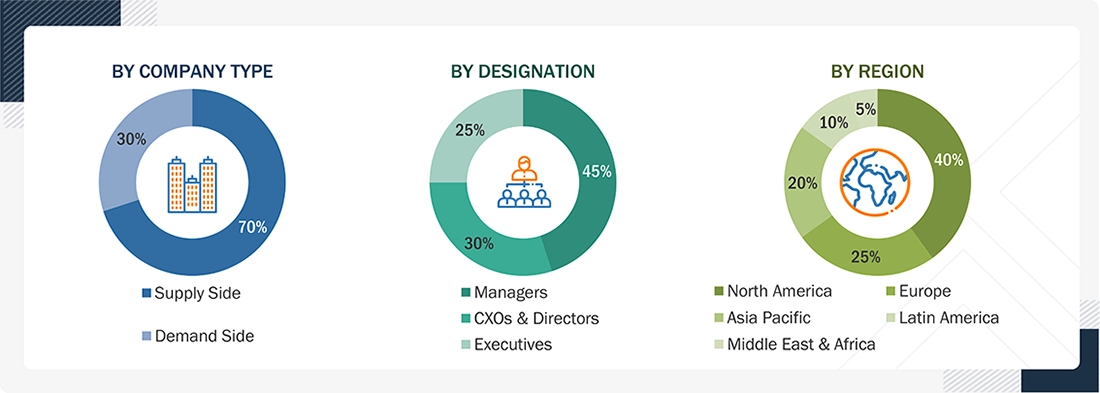
To know about the assumptions considered for the study, download the pdf brochure
Market Size Estimation
Both bottom-up and top-down approaches were used to estimate and validate the total size of the global nucleic acid isolation and purification market. These methods were also widely used to estimate the sizes of various subsegments in the market. The research methodology used to estimate the market size includes the following:
- A list of the major global players operating in the nucleic acid isolation and purification market was generated.
- The revenues generated from their nucleic acid isolation and purification product portfolios have been determined through annual reports and secondary sources (including paid databases).
- The products were mapped according to the segments of the market. Percentage shares and splits were determined based on each segment's revenue contribution. This was verified using secondary sources and by industry experts.
- All assumptions, approaches, and individual shares/revenue estimates were validated through expert interviews.
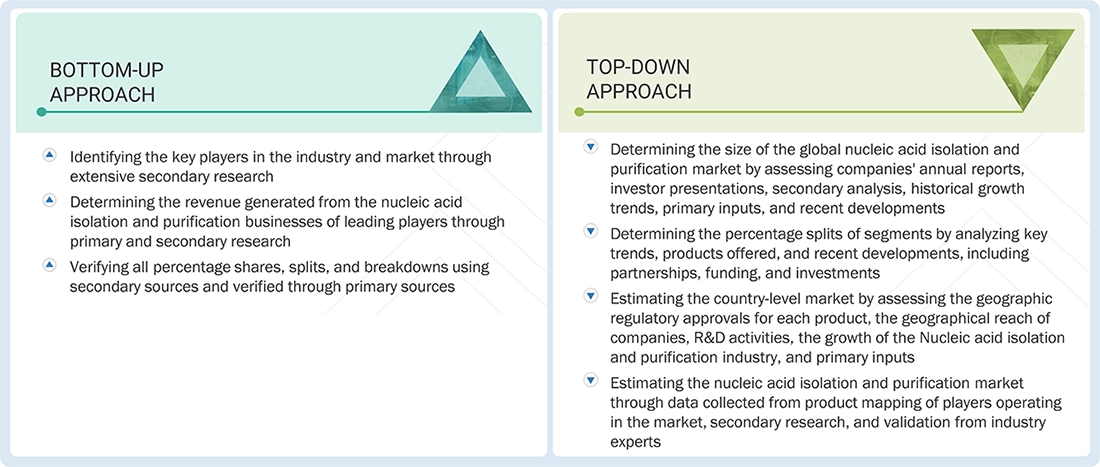
Data Triangulation
After arriving at the market size from the estimation process explained above, the total market was divided into several segments and subsegments. To complete the overall market engineering process and obtain exact statistics for all segments and subsegments, data triangulation and market breakdown procedures were employed, as applicable. The data was triangulated by studying various factors and trends from both the demand and supply sides.
Market Definition
Nucleic acid isolation and purification is a set of molecular biology techniques used for the extraction of DNA and RNA for use in downstream applications, such as sequencing, cloning, and polymerase chain reaction. These downstream applications are important parts of life science research, molecular diagnostics, forensics, and genetic engineering. The report defines the Nucleic acid isolation and purification market as the supplier revenue market for kits, reagents, and instruments used for method, application, type of nucleic acid, and type of samples as described below in the inclusions and exclusions.
Key Stakeholders
- OEMs, contract manufacturers, and distributors of nucleic acid isolation and purification kits, reagents, and instruments
- Start-ups, platform technology & service providers
- Diagnostic centers, government hospitals, and private clinics
- Pharmaceutical & biotechnology companies
- Contract research organizations and other service providers
- Government institutions & associations funding pharmaceutical & biotechnology R&D
- Venture capitalists and investors
- Research associations related to genomics
- Forensic laboratories
- Veterinary hospitals/clinics
- Food testing laboratories
Report Objectives
- To define, describe, and forecast the global nucleic acid isolation and purification market based on product, method, type, sample type, application, and end user
- To provide detailed information regarding the major factors influencing market growth (such as drivers, restraints, opportunities, and challenges)
- To strategically analyze micromarkets concerning individual growth trends, prospects, and contributions to the nucleic acid isolation and purification market
- To analyze the opportunities in the market for stakeholders and provide details of the competitive landscape for market leaders
- To forecast the size of the market segments concerning six main regions: North America, Europe, Asia Pacific, Latin America, Middle East, and Africa
- To profile the key players in the global nucleic acid isolation and purification market and comprehensively analyze their product portfolios, market positions, and core competencies
- To analyze competitive developments such as product approvals and launches, expansions, agreements, and collaborations in the nucleic acid isolation and purification market
- To benchmark players within the nucleic acid isolation and purification market using the company evaluation matrix framework, which analyzes market players based on various parameters within the broad categories of business and service strategy
Available customizations:
With the given market data, MarketsandMarkets offers customizations to meet your company's needs. The following customization options are available for this report:
Portfolio Assessment
- Product Matrix, which gives a detailed comparison of the product portfolios of the top three companies.
Company Information
- Detailed analysis and profiling of additional market players (up to three).
Geographical Analysis
- A further breakdown of the Rest of Asia Pacific nucleic acid isolation and purification market into countries
- A further breakdown of the Rest of Europe nucleic acid isolation and purification market into countries
- A further breakdown of the Rest of Latin America nucleic acid isolation and purification market into countries
Fact checked
Personalize This Research
- Triangulate with your Own Data
- Get Data as per your Format and Definition
- Gain a Deeper Dive on a Specific Application, Geography, Customer or Competitor
- Any level of Personalization
Let Us Help You
- What are the Known and Unknown Adjacencies Impacting the Nucleic Acid Isolation and Purification Market
- What will your New Revenue Sources be?
- Who will be your Top Customer; what will make them switch?
- Defend your Market Share or Win Competitors
- Get a Scorecard for Target Partners

Custom Market Research Services
We Will Customise The Research For You, In Case The Report Listed Above Does Not Meet With Your Requirements
Get 10% Free CustomisationTESTIMONIALS

JAYANT RAJPUROHIT
Director of Market Insights, Data and Analytics
SFI Health,
Leading Pharmaceutical Companywww.sfihealth.com/

We at SFI Health approached MarketsandMarkets for an Opportunity Assessment on "Incidence and Prevalence of Focus Indications" as we wanted to know the most attractive HCPs like Physician, Functional MD, Naturopath and Pharmacist. The project was critical for us to ensure our focus on the right target which would enable sustainable growth and profitability for SFI Health. The business insights provided exceeded our expectations and we were extremely impressed. The team at MarketsandMarkets is highly professional and detail oriented and very well understood our business needs. MarketsandMarkets offers a unique combination of expertise and dedicated engagement model. We identified 2 new products to be launched in coming months, based on the research findings provided by MarketsandMarkets. We are happy with the services and would strongly recommend MarketsandMarkets to my peers in the industry.

BEATRIZ DE LA CALLE
Head of Commercial Analytics
Qualicaps,
Leading Pharmaceutical Companywww.qualicaps.com/

We partnered with MarketsandMarkets for an assessment study on hard empty capsules. The team was extremely professional in understanding our business requirements and we received timely responses to all our queries. The market intelligence and the recommendations has met our business requirements. We were extremely impressed to see the final study results; it really exceeded our expectations. The market intelligence offered by MarketsandMarkets, and clarity on next steps will help us achieve our business objective for the Year 2021. We are happy with the services and would strongly recommend MarketsandMarkets to my peers in the industry.

Bob Williams,
Senior Director Business Development & Innovation
Bracco Diagnostics Inc.,
Italian Multinational in life sciences sector and a World Leader in imaging diagnosticsimaging.bracco.com/us-en
We were pleased with targeted insights that MarketsandMarkets identified from a custom study on the 'Radiation Dose Management Solutions Market'. Your team identified and characterized the market participants as well as underlying trends accurately. This study was useful to Bracco in formulating business strategies for our dose monitoring product lines and we thank MarketsandMarkets for the job well done.
Cody Coonradt,
Market Development and Strategy Manager
3M Health Information Systems,
Leader in Health care Coding, Payment & Analytics Solutions.www.3m.com/3M/en_US/health-information-systems-us
The value for our organization comes from three things: depth of research, specificity of segments and being easy to work with. As important as the first two are, the third can't be underestimated. MarketsandMarkets, maybe more than any other research vendor, wants to know what is top of mind for our team and what big questions we are grappling to answer.
Their customer first approach and high value engagement model, have given us great analysis and excellent value for money
- Canada Nucleic Acid Isolation and Purification Market
- US Nucleic Acid Isolation and Purification Market
- Germany Nucleic Acid Isolation and Purification Market
- UK Nucleic Acid Isolation and Purification Market
- France Nucleic Acid Isolation and Purification Market
- Italy Nucleic Acid Isolation and Purification Market
- Spain Nucleic Acid Isolation and Purification Market
- China Nucleic Acid Isolation and Purification Market
- Japan Nucleic Acid Isolation and Purification Market
- India Nucleic Acid Isolation and Purification Market
- Australia Nucleic Acid Isolation and Purification Market
- South Korea Nucleic Acid Isolation and Purification Market
- Brazil Nucleic Acid Isolation and Purification Market
- Mexico Nucleic Acid Isolation and Purification Market
- Saudi Arabia Nucleic Acid Isolation and Purification Market
- UAE Nucleic Acid Isolation and Purification Market
Growth opportunities and latent adjacency in Nucleic Acid Isolation and Purification Market






Alessia
Jun, 2026
After reviewing the Nucleic Acid Isolation and Purification Market report, I see the demand is being strongly shaped by expanding molecular diagnostics and I now better understand how clinical labs are prioritizing workflow efficiency over cost alone..
Julian
Jun, 2026
Going through the Nucleic Acid Isolation and Purification Market analysis helped me clarify the technical shift toward automated extraction platforms and silica membrane-based kits that are improving reproducibility in high-throughput testing..
Seraphina
Jun, 2026
From an investment perspective, the Nucleic Acid Isolation and Purification Market insights suggest I should closely watch reagent manufacturers and regional expansion in Asia-Pacific, where genomics adoption is accelerating faster than expected..