



Yeast Market
Report Code
FB 2233
Published in
Mar, 2026, By MarketsandMarkets™
Yeast Market By Type (Baker’s Yeast, Brewer’s Yeast, Wine Yeast, Probiotic Yeast, Other Types), Application (Food, Feed, Other Applications), Form (Fresh, Instant, Active), Genus (Saccharomyces, Kluyveromyces, Other Genera), Yeast Extract (Qualitative), and Region - Global Forecast to 2031

USD 10.14 Billion
MARKET SIZE, 2031

CAGR 9.0%
(2026-2031)

350
REPORT PAGES

300
MARKET TABLES
OVERVIEW
Source: Secondary Research, Interviews with Experts, MarketsandMarkets Analysis
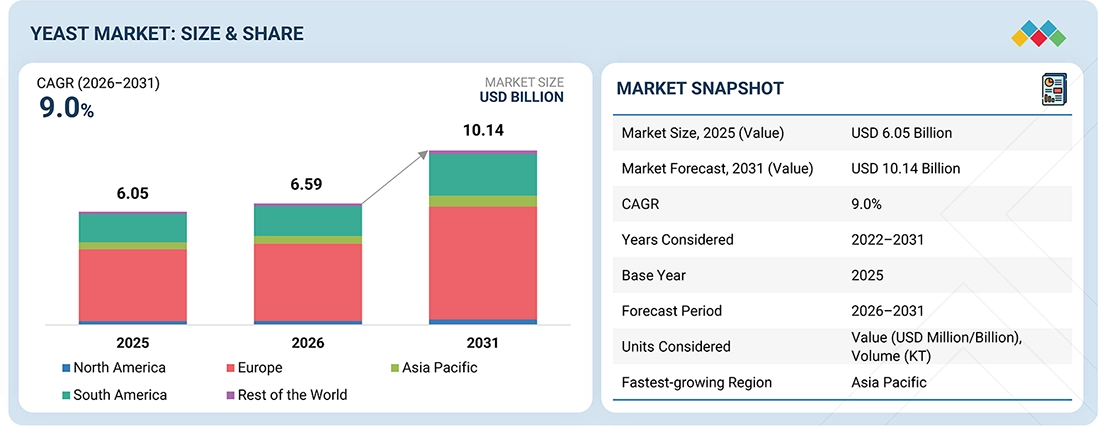
The yeast market is projected to reach USD 10.14 billion by 2031 from USD 6.59 billion in 2026, at a CAGR of 9.0%. The market's upward trajectory is fueled by several factors, foremost among them being the rising recognition of the health benefits associated with yeast ingredients. Consumers are becoming increasingly aware of yeast's positive impacts on their well-being, driving demand for yeast-based products in food and feed.
Market Size and Forecast:
- Market Size Value in 2025: USD 6.05 Billion
- Market Size Value in 2026: USD 6.59 Billion
- Revenue Forecast in 2031: USD 10.14 Billion
- Growth Rate: CAGR of 9.0% from 2026 to 2031
- Base year: 2025
- Forecast period: 2026–2031
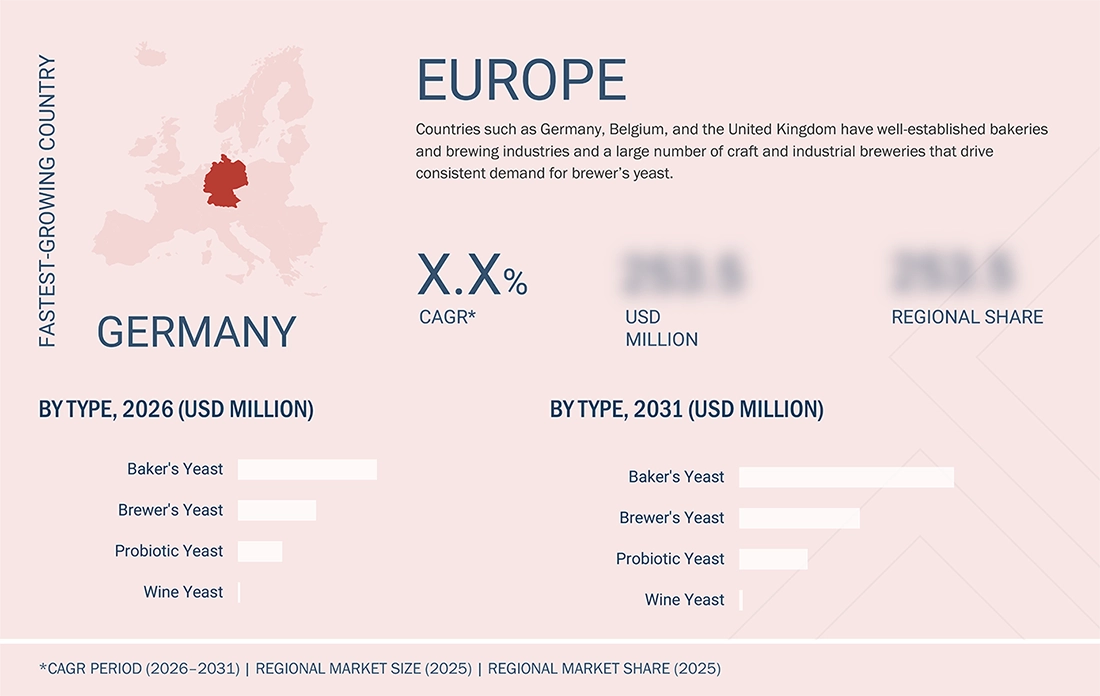
- The European region is estimated to account for 36.6% of the yeast market in 2026.
- The baker's yeast segment is estimated to dominate the market with a share of 37.3% in 2026.
Key Market Trends and Insights
- By Type: Rising demand for baker’s yeast, specialty yeast, and yeast extracts across food, beverage, and animal feed industries is creating strong growth opportunities in the yeast market.
- Strategic Benefits: Yeast enhances fermentation efficiency, improves nutritional value, supports clean-label product development, and boosts taste, texture, and shelf-life across multiple applications.
- Emerging Industry Trends: Food manufacturers are increasingly shifting toward natural ingredients, plant-based nutrition, probiotic-rich products, and sustainable fermentation technologies to meet evolving consumer preferences.
- Future Growth Potential: Expanding demand for functional foods, alcoholic beverages, bioethanol production, and animal nutrition products is generating significant market expansion opportunities for yeast manufacturers.
KEY TAKEAWAYS
-
BY REGIONThe European region is estimated to account for 36.6% of the yeast market in 2026.
-
BY PRODUCT TYPEBy product type, the baker's yeast segment is estimated to dominate the market with a share of 37.3% in 2026.
-
BY GENUSBy form, the Kluyveromyces segment is projected to witness a higher CAGR of 9.2% from 2026 to 2031.
-
BY APPLICATIONBy application, the food & beverage segment is expected to hold a dominant market share.
-
BY FORMOn the basis of form, the fresh segment accounted for the majority of the market share among the forms of yeast.
-
COMPETITIVE LANDSCAPE - KEY PLAYERSAngelYeast Co., Ltd., Associated British Foods plc, ADM, Nisshin Seifun Group Inc., and Kothari Fermentation and Biochem Ltd are among the leading companies in the yeast market, given their global presence and strong product portfolios.
-
COMPETITIVE LANDSCAPE - STARTUPSAGRANO GMBH & CO. KG, Biorigin, and ABN Aplicaciones Biológicas a la Nutrición, among others, have distinguished themselves among startups and SMEs by securing strong footholds in specialized niche areas, underscoring their potential as emerging market leaders.
The yeast market is mainly driven by growth in the food industry, which constantly upgrades its technologies and adapts to changing economic factors. This market is dominated by medium- to high-scale enterprises with specialized technological expertise. They have a better regional presence due to their knowledge of nutritional requirements for various food & beverage applications and other consumers. Companies are seeking patents and registrations for their products to stay competitive.
TRENDS & DISRUPTIONS IMPACTING CUSTOMERS' CUSTOMERS
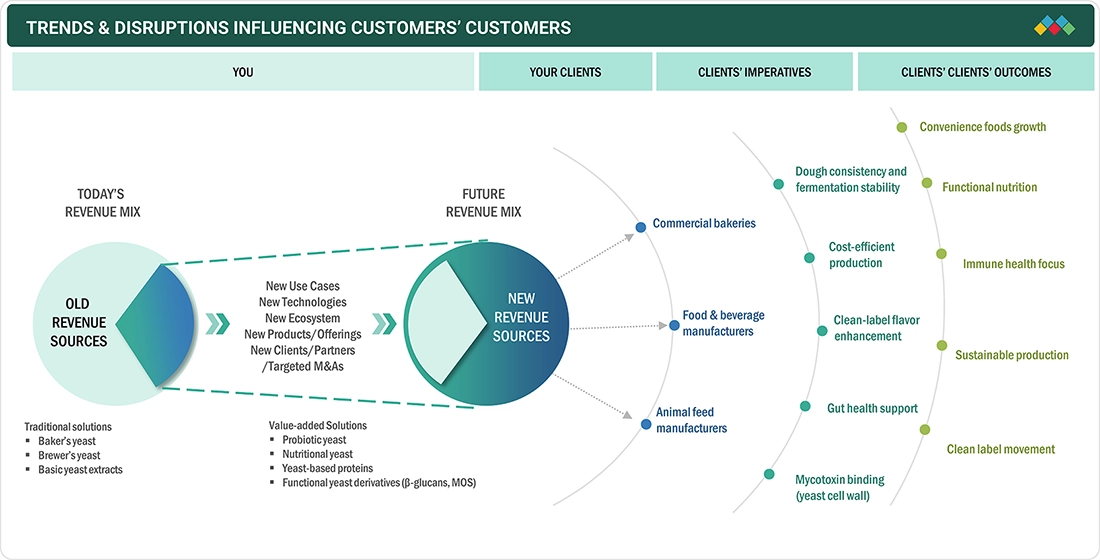
The transition from traditional commodity fermentation inputs to high-value, functional yeast solutions is increasingly influencing the brewer's yeast market. Commercial breweries are concentrating on developing diverse flavors, ensuring uniformity across batches, and optimizing fermentation outcomes. Moreover, food and beverage companies are incorporating yeast derivatives such as beta-glucans to enhance immune system functions. Concurrently, manufacturers of animal feed are integrating yeast cell wall components to promote gut health and facilitate the binding of mycotoxins within the feed. These evolving client requirements stem from end-consumer preferences for premium and craft products, functional nutrition, immune health, sustainable production practices, and clean-label formulations. Consequently, brewer's yeast is emerging as a multifunctional bio-ingredient platform, extending beyond its traditional role as a basic brewing component.
Source: Secondary Research, Interviews with Experts, MarketsandMarkets Analysis
MARKET DYNAMICS

Drivers
Impact
Level
Level
-
Global expansion of bakery industry

-
Increasing demand for yeast in brewing sector


RESTRAINTS
Impact
Level
Level
-
Concerns regarding allergenic potential of yeast

-
Competition for basic raw materials


OPPORTUNITIES
Impact
Level
Level
-
Strategic collaborations and partnerships between yeast manufacturers and other players

-
New variants of yeast ingredients for improved functionality


CHALLENGES
Impact
Level
Level
-
Difficulty in achieving consistent product quality and performance due to variations in raw materials, fermentation conditions, and strain characteristics

-
High research and development costs

Source: Secondary Research, Interviews with Experts, MarketsandMarkets Analysis
Driver: Global expansion of bakery industry
The bakery industry has witnessed substantial growth worldwide, especially in emerging economies, driven by urbanization and changing consumer preferences. This expansion has led to a surge in demand for yeast, a crucial ingredient in bread-making. Yeast serves as the leavening agent responsible for the fermentation process that gives bread its desired texture. In emerging economies, the rising preference for convenient and affordable food options, including packaged bread and pastries, has further fueled the demand for yeast.
Restraint: Concerns regarding allergenic potential of yeast
The allergenic potential of yeast poses a significant restraint for the yeast market, particularly in food and beverage applications. With increasing awareness of food allergies among consumers, concerns about allergic reactions to yeast can lead individuals to avoid products containing this ingredient, impacting market demand. For manufacturers, yeast allergies limit their ability to include yeast in their products, restricting product offerings and potentially reducing revenue streams.
Opportunity: Strategic collaborations and partnerships between yeast manufacturers and other players
Brewer's yeast makers can make a lot of money by getting into the nutraceuticals market. Beta-glucans from yeast are known to help the immune system, and postbiotics are stable, non-viable functional ingredients that are good for gut health and overall health. As consumers become more interested in immunity, preventive health care, and clean-label products, the demand for dietary supplements, functional foods, and drinks is growing. This change lets manufacturers move away from supplying yeast as a commodity and toward bioactive ingredients that are backed by science and add value. This increases margins and diversifies revenue.
Challenge: Difficulty in achieving consistent product quality and performance due to variations in raw materials, fermentation conditions, and strain characteristics
Ensuring consistent product quality and performance in the yeast market poses a significant challenge due to variations in raw materials, fermentation conditions, and strain characteristics. Raw materials such as molasses or sugar can differ in composition and quality based on geographic origin and seasonal variations, impacting nutrient availability and ultimately affecting yeast growth and productivity during fermentation. Fluctuations in fermentation conditions, such as temperature, pH, and oxygen levels, can influence yeast metabolism and product attributes, leading to inconsistencies in flavor and aroma. Variations in strain characteristics, whether due to genetic mutations or microbial contamination, can result in unpredictable fermentation outcomes and product quality.
YEAST MARKET: COMMERCIAL USE CASES ACROSS INDUSTRIES
| COMPANY | USE CASE DESCRIPTION | BENEFITS |
|---|---|---|
 |
Angel Yeast has expanded its line of yeast by developing specialty yeast strains and yeast-based products for brewing, food, and health applications. To meet the demand for functional ingredients and improve brewing efficiency, the company focuses on high-performance fermentation strains, yeast extracts, and derivatives that are high in beta-glucan. | These programs help breweries make better beer by improving fermentation stability, flavor consistency. They also let food and nutraceutical companies use yeast-derived functional ingredients that support immune health and clean-label formulations. |
 |
The Associated British Foods AB Mauri division formulates advanced user-specific fermentation yeast solutions for both the food and beverage industries. The strong focus on fermentation performance, yeast strain optimization, and dialed-in specific strains for varying brewing styles and industrial fermentation processes makes AB Mauri a leader in their field. | These solutions help manufacturers improve fermentation efficiency, maintain consistent product quality, and develop differentiated flavor profiles. Customized yeast strains also support product innovation in craft brewing and specialty beverages. |
 |
ADM leverages its fermentation and bio-ingredient expertise to develop yeast-based ingredients such as yeast extracts, beta-glucans, and functional fermentation products for food, beverage, and nutrition markets. The company integrates fermentation technology with its broader ingredient portfolio to expand yeast applications. | ADM’s yeast-derived ingredients enhance flavor, nutritional value, and functionality in food and beverage formulations while supporting immune health and gut health applications. This diversification helps expand brewer’s yeast usage into high-value functional and nutraceutical markets. |
Logos and trademarks shown above are the property of their respective owners. Their use here is for informational and illustrative purposes only.
MARKET ECOSYSTEM
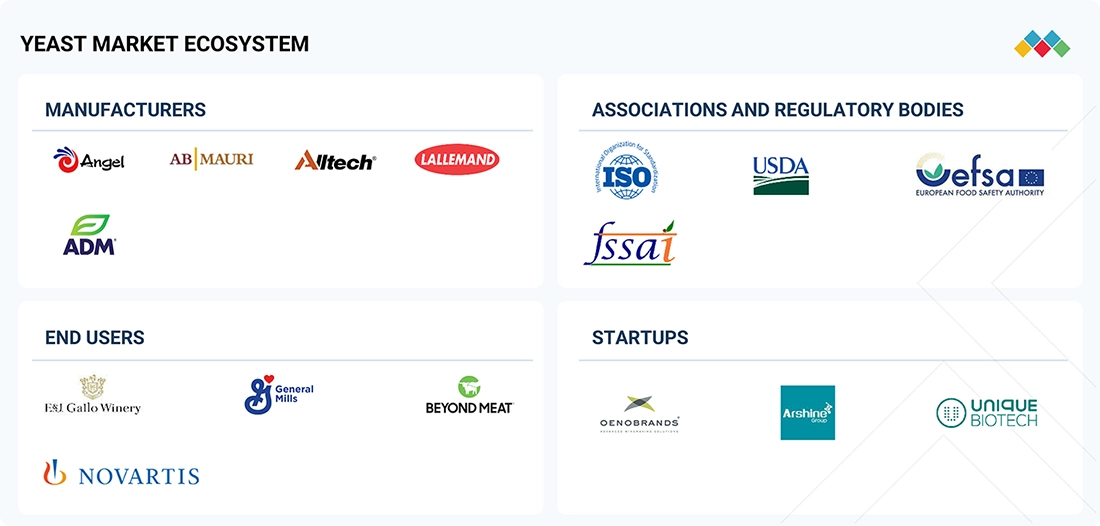
The yeast market ecosystem comprises manufacturers, government bodies, end users, and startups. Major manufacturers like AngelYeast, ADM, Alltech, AB Mauri, and Lallemand are at the forefront of developing fermentation technologies and yeast-based ingredients. Government bodies like ISO, USDA, EFSA, and FSSAI are at the core of ensuring the safety and quality of yeast. End users like breweries, wineries, and food producers are the ultimate consumers of yeast, while startups are also contributing to the development of yeast through innovative yeast strains.
Logos and trademarks shown above are the property of their respective owners. Their use here is for informational and illustrative purposes only.
MARKET SEGMENTS
Source: Secondary Research, Interviews with Experts, MarketsandMarkets Analysis
Yeast Market, by Type
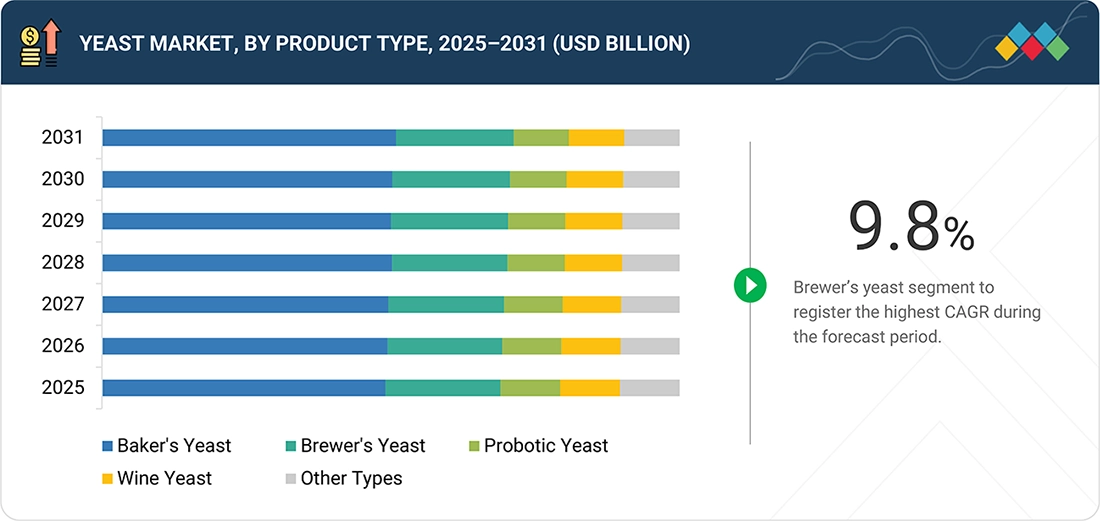
The growth of the baker’s yeast market is directly linked to the increasing consumption of bakery items. Different forms of baker’s yeast are used to produce various bakery products. Fresh baker’s yeast provided for commercial uses includes products in liquid, creamy, or compressed forms and active dry yeast. Compressed baker’s yeast is the most used product and consists of only one yeast species, namely, S. cerevisiae.
Yeast Market, by Form
On the basis of form, the fresh segment accounted for most of the market share among the forms of yeast, primarily because it is considered a more sustainable form of yeast processing and has wide applicability across a wide range of food applications.
Yeast Market, by Genus
On the basis of the genus, the Saccharomyces segment accounted for the highest share in the global yeast market due to the increase in acceptability of this strain for adoption in the food industry. The increase in demand for baked products at the global level is projected to drive the market growth for Saccharomyces sp.-based yeast.
Yeast Market, by Application
Based on application, the food & beverage segment dominated the market during the study period. There is a significant rise in the demand for yeast in the market as it finds applications in the functioning of the bakery, wine, and beer industries. Since the demand for processed & baked food and non-carbonated beverages is increasing due to the change in the lifestyle of consumers, the growth of the yeast market is projected to remain high. Along with imparting flavors in food products, the infusion of yeast as an ingredient also increases the nutritive value of feed. This has significantly encouraged the inclusion of yeast in feed products.
REGION
Europe to dominate global yeast market
Europe is estimated to have the largest share of the global yeast market as of 2024. The European yeast market is witnessing significant growth due to the increasing consumption of processed food products, increased alcohol consumption, and awareness about the nutritional value of yeast. The EU market revolves around bread production. The increase in the consumption of cakes, bread, pastries, and alcoholic beverages has driven a surge in yeast demand across Europe.
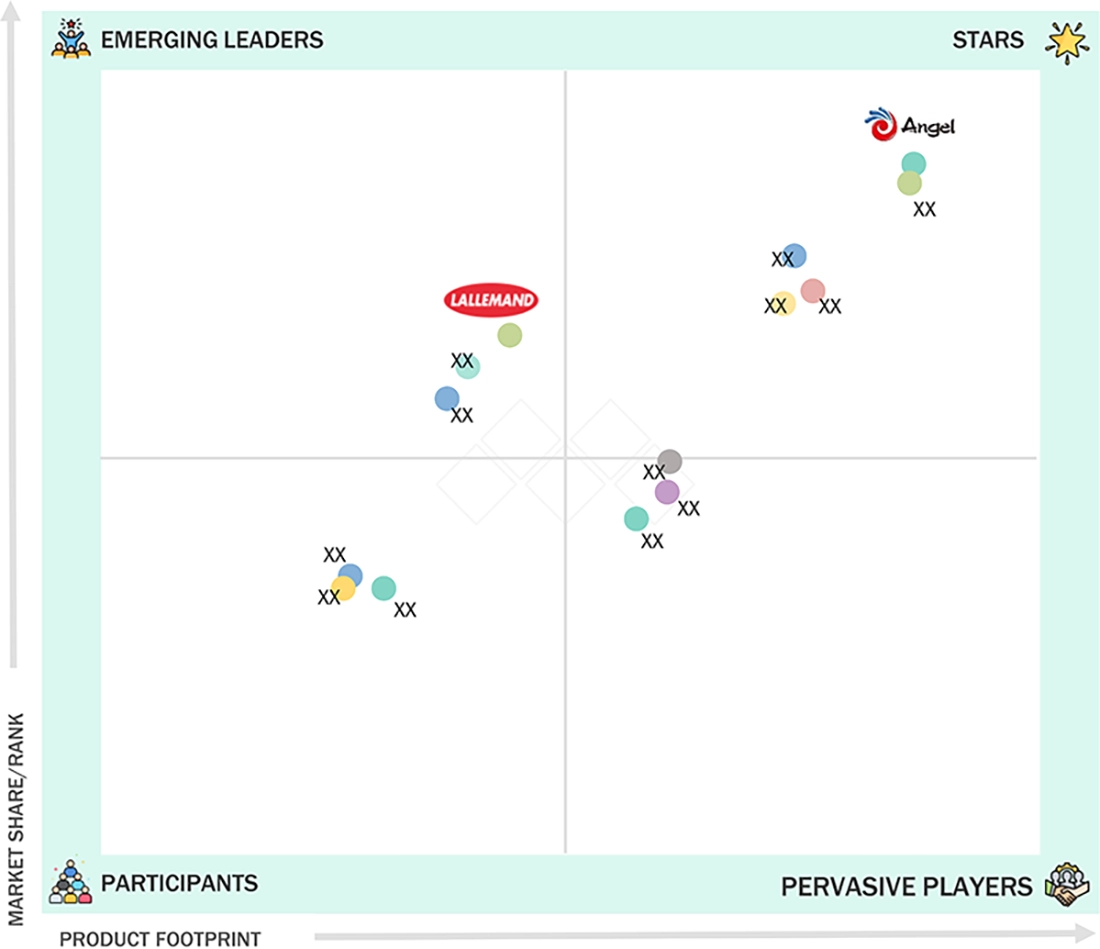
YEAST MARKET: COMPANY EVALUATION MATRIX
In the yeast market matrix, AngelYeast Co., Ltd., Associated British Foods plc (Star) lead with a moderate market share and extensive product footprint for yeast products, driven by their strong geographical presence, significant formulation and distribution capabilities, and strong ties with food manufacturers and breweries. Lallemand (Emerging Leader) is gaining visibility with its specialized yeast offerings, strengthening its position through strong product offerings.
Source: Secondary Research, Interviews with Experts, MarketsandMarkets Analysis
KEY MARKET PLAYERS
- Associated British Foods Plc (UK)
- AngelYeast Co., Ltd. (China)
- Chr. Hansen Holding A/S (Denmark)
- Koninklijke Dsm N.V (Netherlands)
- Lallemand Inc. (Canada)
- Leiber Gmbh (Germany)
- Lesaffre Group (France)
- Oriental Yeast Co., Ltd. (Japan)
- Synergy Flavors (Us)
- Halcyon Proteins Pvy. Ltd. (Australia)
- Food Chem International Corporation (China)
- Sensient Technologies Corporation (Us)
- Pacific Fermentation Industries (Canada)
- Kerry Group Plc (Ireland)
MARKET SCOPE
| REPORT METRIC | DETAILS |
|---|---|
| Market Size, 2025 (Value) | USD 6.05 Billion |
| Market Forecast, 2031 (Value) | USD 10.14 Billion |
| Growth Rate | CAGR of 9.0% from 2026 to 2031 |
| Years Considered | 2022–2031 |
| Base Year | 2025 |
| Forecast Period | 2026–2031 |
| Units Considered | Value (USD Million/Billion), Volume (KT) |
| Report Coverage | Revenue Forecast, Company Ranking, Competitive Landscape, Growth Factors, and Trends |
| Segments Covered |
|
| Regions Covered | North America, Europe, Asia Pacific, South America, Rest of the World |
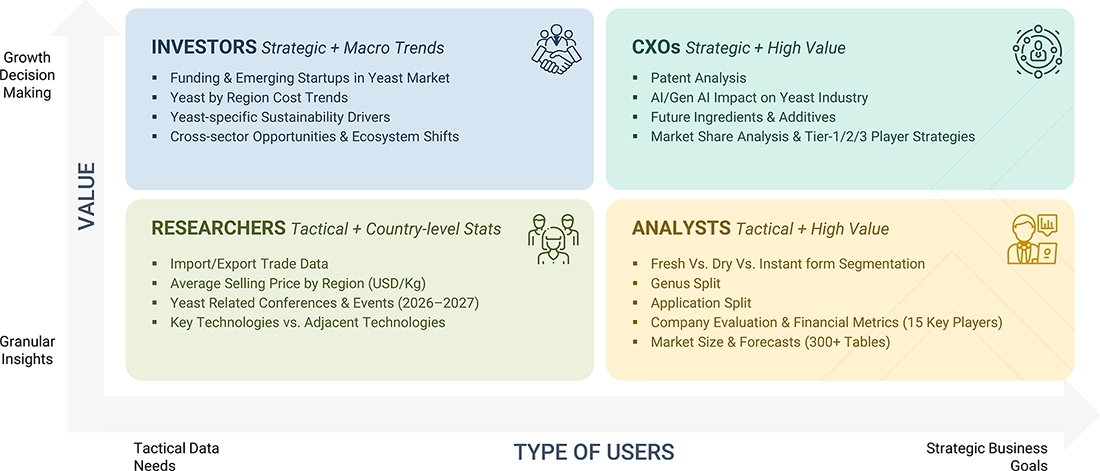
WHAT IS IN IT FOR YOU: YEAST MARKET REPORT CONTENT GUIDE
DELIVERED CUSTOMIZATIONS
We have successfully delivered the following deep-dive customizations:
| CLIENT REQUEST | CUSTOMIZATION DELIVERED | VALUE ADDS |
|---|---|---|
| Europe-based yeast manufacturers | Detailed yeast market analysis, competitive landscape, and competitor benchmarking (financials, product portfolios) | Identified and profiled 20+ brewer’s yeast producers |
| Yeast derivative segment assessment | Segmentation of yeast demand by type (baker's yeast, brewer's yeast, probiotic yeast, wine yeast) and application (brewing, food & beverage, feed, nutraceuticals) | Benchmarking yeast strain adoption and fermentation performance across regions |
RECENT DEVELOPMENTS
- December 2025 : AngelYeast began trial production at its new specialty yeast production plant located in Yichang, China. The facility was designed with highly sterile production processes and will have the capacity for producing around 8,500 metric tons annually when it becomes operational. The facility would also have a Brewing Functional Microorganism Pilot Test Platform to mimic real-world brewery conditions for faster product development. The facility would be the final link in the integrated value chain from R&D to mass production for AngelYeast Company.
- February 2025 : Asahi Group Foods signed a supply agreement with ADM Wild Valencia to distribute its proprietary lactic acid bacteria Lactobacillus gasseri CP2305 internationally. Starting in March, ADM Wild Valencia will supply the ingredient to food manufacturers across North America, Europe, and Asia for use in supplements and health foods. This would be the first time Asahi Group Foods would sell this probiotic outside its group, aiming to capitalize on rising global demand for health-focused food and beverage ingredients.
- August 2024 : AB Biotek, a division of AB Mauri under Associated British Foods, develops yeast technologies and fermentation solutions for alcoholic beverages, bioethanol, animal nutrition, and human health markets. The company gained attention for its Pinnacle Crisp Sour Lachancea yeast strain, originally sourced from a wasp, designed to support innovative sour beer production.
Table of Contents
 Exclusive indicates content/data unique to MarketsandMarkets and not available with any competitors.
TITLE
PAGE NO
1
INTRODUCTION
15
2
EXECUTIVE SUMMARY
3
PREMIUM INSIGHTS
4
MARKET OVERVIEW
Explains the evolving landscape through demand-side drivers, supply-side constraints, and opportunity hotspots.
4.1
INTRODUCTION
4.2
MARKET DYNAMICS
4.2.1
DRIVERS
4.2.2
RESTRAINTS
4.2.3
OPPORTUNITIES
4.2.4
CHALLENGES
4.3
UNMET NEEDS AND WHITE SPACES
4.4
INTERCONNECTED MARKETS AND CROSS-SECTOR OPPORTUNITIES
4.5
STRATEGIC MOVES BY TIER-1/2/3 PLAYERS
5
INDUSTRY TRENDS
Outlines emerging trends, technology impact, and regulatory signals affecting growth trajectory and stakeholder decisions.
5.1
PORTER’S FIVE FORCES ANALYSIS
5.1.1
INTENSITY OF COMPETITIVE RIVALRY
5.1.2
THREAT OF NEW ENTRANTS
5.1.3
THREAT OF SUBSTITUTES
5.1.4
BARGAINING POWER OF SUPPLIERS
5.1.5
BARGAINING POWER OF BUYERS
5.2
MACROECONOMICS INDICATORS
5.3
VALUE CHAIN ANALYSIS
5.3.1
RESEARCH & PRODUCT DEVELOPMENT
5.3.2
RAW MATERIAL SOURCING
5.3.3
PROCESSING AND MANUFACTURING OPERATIONS
5.3.4
QUALITY CONTROL & SAFETY
5.3.5
DISTRIBUTION & LOGISTICS
5.3.6
MARKETING & SALES
4.3.7
END USERS
5.4
ECOSYSTEM ANALYSIS
5.4.1
DEMAND SIDE
5.4.2
SUPPLY SIDE
5.5
PRICING ANALYSIS
5.5.1
AVERAGE SELLING PRICE TREND OF PRODUCT, BY KEY PLAYER,
5.5.2
AVERAGE SELLING PRICE TREND, BY REGION, 2022–2025
5.6
TRADE ANALYSIS
5.6.1
EXPORT SCENARIO (HS CODE 230990): MAJOR EXPORTING COUNTRIES & REGIONS
5.6.2
IMPORT SCENARIO (HS CODE 230990): MAJOR IMPORTING COUNTRIES & REGIONS
5.7
KEY CONFERENCES & EVENTS IN 2026–2027
5.8
TRENDS/DISRUPTIONS IMPACTING THE CUSTOMER’S BUSINESS
5.9
INVESTMENT AND FUNDING SCENARIO
5.10
CASE STUDY ANALYSIS
5.11
IMPACT OF 2025 US TARIFF - BREWING YEAST INDUSTRY
5.11.1
INTRODUCTION
5.11.2
KEY TARIFF RATES
5.11.3
PRICE IMPACT ANALYSIS
5.11.4
IMPACT ON COUNTRY/REGION*
5.11.4.1
US
5.11.4.2
EUROPE
5.11.4.3
ASIA PACIFIC
5.11.5
IMPACT ON END-USE INDUSTRIES
6
STRATEGIC DISRUPTION THROUGH TECHNOLOGY, PATENTS, DIGITAL, AND AI ADOPTIONS
6.1
KEY TECHNOLOGIES
6.1.1
PRECISION NUTRITION
6.1.2
NUTRIENT ENCAPSULATION TECHNOLOGY
6.2
COMPLEMENTARY TECHNOLOGIES
6.2.1
WATER QUALITY MONITORING SYSTEM
6.3
ADJACENT TECHNOLOGIES
6.4
TECHNOLOGY/PRODUCT ROADMAP
6.5
PATENT ANALYSIS
6.5.1
LIST OF MAJOR PATENTS PERTAINING TO THE MARKET
6.6
IMPACT OF GEN AI ON BREWER’S YEAST INDUSTRY
6.6.1
TOP USE CASES AND MARKET POTENTIAL
6.6.2
BEST PRACTICE FOLLOWED BY MANUFACTURERS
6.6.3
CASE STUDY RELATED TO AI IMPLEMENTATION IN BREWER’S YEAST MARKET
6.6.4
INTERCONNECTED ECOSYSTEM AND IMPACT ON MARKET PLAYERS
6.6.5
CLIENT READINESS TO ADOPT AI INTEGRATED BREWER’S YEAST
6.7
SUCCESS STORIES AND REAL-WORLD APPLICATIONS
7
REGULATORY AND SUSTAINABILITY LANDSCAPE
7.1
REGIONAL REGULATIONS AND COMPLIANCE
7.1.1
REGULATORY BODIES, GOVERNMENT AGENCIES, AND OTHER ORGANIZATIONS
7.1.2
INDUSTRY STANDARDS
7.2
SUSTAINABILITY INITIATIVES
7.3
IMPACT OF REGULATORY POLICIES ON SUSTAINABILITY INITIATIVES
8
CUSTOMER LANDSCAPE & BUYER BEHAVIOR
8.1
DECISION-MAKING PROCESS
8.2
BUYER STAKEHOLDERS AND BUYING EVALUATION CRITERIA
8.3
ADOPTION BARRIERS & INTERNAL CHALLENGES
8.4
UNMET NEEDS FROM VARIOUS END-USE INDUSTRIES
8.5
MARKET PROFITABILITY
9
YEAST MARKET, BY FORM
Market Size, Volume & Forecast – USD Million
9.1
INTRODUCTION
9.2
FRESH
9.3
INSTANT
9.4
ACTIVE
10
YEAST MARKET, BY GENUS
Market Size, Volume & Forecast – USD Million
10.1
INTRODUCTION
10.2
SACCHAROMYCES
10.3
KLUYVEROMYCES
10.4
OTHER GENERA
11
YEAST MARKET, BY TYPE
Market Size, Volume & Forecast – USD Million
11.1
INTRODUCTION
11.2
BREWER’S YEAST
11.3
BAKER’S YEAST
11.4
WINE YEAST
11.5
PROBIOTIC YEAST
11.6
OTHER TYPES
12
YEAST MARKET, BY APPLICATION
Market Size, Volume & Forecast – USD Million
12.1
INTRODUCTION
12.2
FOOD & BEVERAGES
12.2.1
BAKERY PRODUCTS
12.2.2
PREPARED MEALS
11.2.3
BEVERAGES
12.2.4
OTHER FOOD APPLICATIONS
12.3
FEED
12.3.1
SWINE
12.3.2
POULTRY
12.3.3
CATTLE
12.3.4
OTHER FEED APPLICATIONS
12.4
PHARMACEUTICAL
12.5
OTHER APPLICATIONS
13
YEAST MARKET, BY YEAST EXTRACTS (QUALITATIVE)
Market Size, Volume & Forecast – USD Million
13.1
INTRODUCTION
13.2
YEAST AUTOLYSATES
13.3
YEAST HYDROLYSATES
13.4
YEAST CELL WALL
14
BREWER’S YEAST MARKET, BY REGION
Market Size, Volume & Forecast – USD Million
14.1
NORTH AMERICA
14.1.1
US
14.1.2
CANADA
14.1.3
MEXICO
14.2
EUROPE
14.2.1
GERMANY
14.2.3
UK
14.2.4
ITALY
14.2.5
SPAIN
14.2.6
FRANCE
14.2.7
REST OF EUROPE
14.3
ASIA PACIFIC
14.3.1
CHINA
14.3.2
JAPAN
14.3.4
INDIA
14.3.5
AUSTRALIA & NEW ZEALAND
14.3.6
SOUTH KOREA
14.3.7
REST OF ASIA PACIFIC
14.4
SOUTH AMERICA
14.4.1
BRAZIL
14.4.2
CHILE
14.4.3
REST OF SOUTH AMERICA
14.5
REST OF THE WORLD
14.5.1
MIDDLE EAST
14.5.2
AFRICA
15
COMPETITIVE LANDSCAPE
15.1
OVERVIEW
15.2
KEY PLAYERS STRATEGIES/RIGHT TO WIN, 2022–2026
15.3
REVENUE ANALYSIS, 2022–2024
15.4
MARKET SHARE ANALYSIS,
15.5
PRODUCT COMPARISON
15.6
COMPANY VALUATION AND FINANCIAL METRICS
15.7
COMPANY EVALUATION MATRIX: KEY PLAYERS,
15.7.1
STARS
15.7.2
EMERGING LEADERS
15.7.3
PERVASIVE PLAYERS
15.7.4
PARTICIPANTS
15.7.5
COMPANY FOOTPRINT: KEY PLAYERS,
15.7.5.1
COMPANY FOOTPRINT
15.7.5.2
REGION FOOTPRINT
15.7.5.3
SPECIES FOOTPRINT
15.7.5.4
INGREDIENT FOOTPRINT
15.8
COMPANY EVALUATION MATRIX: STARTUPS/SMES,
15.8.1
PROGRESSIVE COMPANIES
15.8.2
RESPONSIVE COMPANIES
15.8.3
DYNAMIC COMPANIES
15.8.4
STARTING BLOCKS
15.8.5
COMPETITIVE BENCHMARKING: STARTUPS/SMES,
15.8.5.1
DETAILED LIST OF KEY STARTUPS/SMES
15.8.5.2
COMPETITIVE BENCHMARKING OF KEY STARTUPS/SMES
15.9
COMPETITIVE SCENARIO
15.9.1
NEW PRODUCT LAUNCHES
15.9.2
DEALS
15.9.3
EXPANSIONS
15.9.4
OTHER DEVELOPMENTS
15
COMPANY PROFILES
15.1
KEY PLAYERS
15.1.1
ASSOCIATED BRITISH FOODS PLC
15.1.2
ALLTECH
15.1.3
ANGELYEAST CO., LTD.
15.1.4
CHR. HANSEN HOLDING A/S
15.1.5
KONINKLIJKE DSM NV
15.1.6
LALLEMAND INC
15.1.7
LEIBER GMBH
15.1.8
LESAFFRE GROUP
15.1.9
ORIENTAL YEAST CO., LTD.
15.1.10
SYNERGY FLAVORS
15.1.11
HALCYON PROTEINS PVY. LTD.
15.1.12
FOOD CHEM INTERNATIONAL CORPORATION
15.1.13
SENSIENT TECHNOLOGIES CORPORATION
15.1.14
PACIFIC FERMENTATION INDUSTRIES
15.1.15
KERRY GROUP PLC
15.2
OTHER PLAYERS/STARTUPS/SMES
15.2.1
BIORIGIN
15.2.2
ICC BRAZIL
15.2.3
NOVOZYMES
15.2.4
AGENCIAS LEVAPAN
15.2.5
PAKMAYA
15.2.6
HEXON LABORATORIES PVT. LTD
15.2.7
HIYEAST
15.2.8
SHENYANG FADA CO. LTD.
15.2.9
SHANGHAI GENON BIOTECH CO. LTD
15.2.10
SIVER AGRO LLC
16
RESEARCH METHODOLOGY
16.1
RESEARCH DATA
16.1.1
SECONDARY DATA
16.1.1.1
KEY DATA FROM SECONDARY SOURCES
16.1.2
PRIMARY DATA
16.1.2.1
KEY DATA FROM PRIMARY SOURCES
16.1.2.2
KEY INDUSTRY INSIGHTS
16.1.2.3
BREAKDOWN OF PRIMARIES
16.2
MARKET SIZE ESTIMATION
16.2.1
BOTTOM-UP APPROACH
16.2.1.1
APPROACH FOR CAPTURING MARKET SHARE BY BOTTOM-UP ANALYSIS
16.2.2
TOP-DOWN APPROACH
16.2.2.2
APPROACH FOR CAPTURING MARKET SHARE BY TOP-UP ANALYSIS
16.3
DATA TRIANGULATION
16.4
RESEARCH ASSUMPTIONS
16.5
RISK ASSESSMENT
16.6
LIMITATIONS
17
ADJACENT & RELATED MARKETS
18
APPENDIX
18.1
DISCUSSION GUIDE
18.2
KNOWLEDGE STORE: MARKETSANDMARKETS’ SUBSCRIPTION PORTAL
18.3
AVAILABLE CUSTOMIZATIONS
18.4
RELATED REPORTS
18.5
AUTHOR DETAILS
Methodology
The study involved two major segments in estimating the current size of the yeast market. Exhaustive secondary research was done to collect information on the market, peer, and parent markets. The next step was to validate these findings, assumptions, and sizing with industry experts across the value chain through primary research. Both top-down and bottom-up approaches were employed to estimate the complete market size. After that, market breakdown and data triangulation were used to estimate the market size of segments and subsegments.
Secondary Research
This research study involved the extensive use of secondary sources—directories and databases such as Bloomberg Businessweek and Factiva—to identify and collect information useful for a technical, market-oriented, and commercial study of the market.
In the secondary research process, various sources such as annual reports, press releases & investor presentations of companies, white papers, food journals, certified publications, articles from recognized authors, directories, and databases, were referred to identify and collect information.
Secondary research was mainly used to obtain key information about the industry’s supply chain, the total pool of key players, and market classification and segmentation as per the industry trends to the bottom-most level, regional markets, and key developments from both market- and technology-oriented perspectives.
Primary Research
Extensive primary research was conducted after obtaining information regarding the Yeast market scenario through secondary research. Several primary interviews were conducted with market experts from both the demand and supply sides across major countries of North America, Europe, Asia Pacific, South America, and the Rest of the World. Primary data was collected through questionnaires, emails, and telephonic interviews. The primary sources from the supply side included various industry experts, such as Chief X Officers (CXOs), Vice Presidents (VPs), Directors, from business development, marketing, research, and development teams, and related key executives from distributors, and key opinion leaders. Primary interviews were conducted to gather insights such as market statistics, data on revenue collected from the products and services, market breakdowns, market size estimations, market forecasting, and data triangulation. Primary research also helped in understanding the various trends related to yeast, type, form, application, and region. Stakeholders from the demand side, such as processed food and functional food products manufacturers who manufacture the products, were interviewed to understand the buyer’s perspective on the suppliers, products, and their current usage of yeast and the outlook of their business, which will affect the overall market.
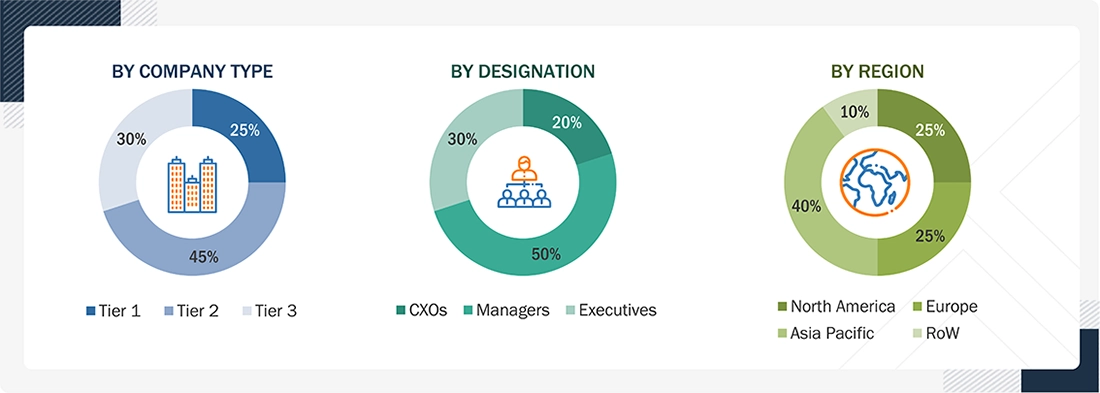
Note: The three tiers of the companies are defined based on their total revenues in 2021 or 2022, as per the availability of financial data: Tier 1: Revenue > USD 1 billion; Tier 2: USD 100 million ≤ Revenue ≤ USD 1 billion; Tier 3: Revenue < USD 100 million.
|
COMPANY NAME |
designation |
|
ADM (US) |
General Manager |
|
Associated British Foods plc (UK) |
Sales Manager |
|
Alltech (Kentucky) |
Manager |
|
AngelYeast Co., Ltd (China) |
Head, Processing Department |
|
Lallemand Inc. (Canada) |
Marketing Manager |
|
Leiber (Germany) |
Sales Executive |
To know about the assumptions considered for the study, download the pdf brochure
Market Size Estimation
Both the top-down and bottom-up approaches were used to estimate and validate the total size of the yeast market. These approaches were also used extensively to determine the size of various subsegments in the market. The research methodology used to estimate the market size includes the following details:
- The key players in the industry and the overall markets were identified through extensive secondary research.
- All shares, splits, and breakdowns were determined using secondary sources and verified through primary sources.
- All possible parameters that affect the market covered in this research study were accounted for, viewed in extensive detail, verified through primary research, and analyzed to obtain final quantitative and qualitative data.
- The research included the study of reports, reviews, and newsletters of top market players, along with extensive interviews for opinions from leaders, such as CEOs, directors, and marketing executives.
Data Triangulation
After arriving at the overall market size from the estimation process explained above, the total market was split into several segments and subsegments. Data triangulation and market breakdown procedures were employed to estimate the yeast market and arrive at the exact statistics for all segments and subsegments. The data was triangulated by studying numerous factors and trends from the demand and supply sides. The market size was also validated using both the top-down and bottom-up approaches.
Market Definition
According to the FAO, yeast is a unicellular fungus that reproduces asexually by budding or division, particularly the genus Saccharomyces, which is important in food fermentations. It is used in the preparation of food products, animal nutrition, and pet nutrition products, which help in improving the health and performance of animals. According to Lallemand Inc., “the ban of antibiotic growth promoters in feed for production of animal foods in the European Union has led to increased interest in evaluating the effect of yeast products on the gastrointestinal ecosystem, rumen microbial populations, and overall animal performance.”
Furthermore, the large-scale industrial production and commercial use of yeasts were initiated around the end of the 19th century. Yeasts approved for use in food products are rich in nutrition, proteins, enzymes, and vitamins. Hence, yeast can be used in the food industry as a nutritional supplement. Yeast is used in basic cultures for manufacturing specific fermented food products, such as dairy, bakery, fermented meat and vegetable products, and vinegar.
Key Stakeholders
- Yeast manufacturers
- Yeast importers and exporters
- Yeast traders, distributors, and suppliers
-
Food additive manufacturers, importers, and exporters
Feed manufacturers - Food associations of several countries
- Intermediary suppliers, including traders and distributors of food & beverage, feed, and bio-ethanol products
- Research organizations and associations such as the Food and Agriculture Organization (FAO), Food and Drug Administration (FDA), European Animal Protein Association (EAPA), Food Standards Australia New Zealand (FSANZ), European Food Safety Authority (EFSA), and United States Department of Agriculture (USDA)
- Regulatory bodies such as
- US Food and Drug Administration (FDA)
- European Commission (EC)
- United States Department of Agriculture (USDA)
- Commercial research & development (R&D) institutions and financial institutions
- Food and Agriculture Organization (FAO)
Report Objectives
- To determine and project the size of the yeast market with respect to the type, applications, form, genus, yeast extract (qualitative), and region in terms of value and volume over five years, ranging from 2026 to 2031
- To identify the attractive opportunities in the market by determining the largest and fastest-growing segments across regions
- To provide detailed information about the key factors influencing market growth (drivers, restraints, opportunities, and challenges)
- To analyze the opportunities in the market for stakeholders and provide details of the competitive landscape for market leaders
- To analyze the micro-markets with respect to individual growth trends, prospects, and their contribution to the total market
- To identify and profile the key players in the yeast market
- To understand the competitive landscape and identify the major growth strategies adopted by players across the key regions
- To provide insights into key product innovations and investments in the yeast market
Available customizations:
With the given market data, MarketsandMarkets offers customizations according to company-specific scientific needs.
The following customization options are available for the report:
Product Analysis
- Product Matrix, which gives a detailed comparison of the product portfolio of each company.
Geographic Analysis
With the given market data, MarketsandMarkets offers customizations according to company-specific scientific needs.
- Further breakdown of the European Yeast market into its key countries, the Netherlands, Russia, Switzerland, Greece, and Poland.
- Further breakdown of the Rest of Asia Pacific Yeast market into its key countries, the Philippines, Indonesia, Malaysia, Vietnam, Singapore, and Thailand.
Company Information
- Detailed analyses and profiling of additional market players (up to five)
Key Questions Addressed by the Report
What is the projected size of the global yeast market?
The global yeast market is projected to grow from USD 6.59 billion in 2026 to USD 10.14 billion by 2031, at a CAGR of 9.0% during the forecast period. Growth is driven by increasing demand for bakery products, alcoholic beverages, functional foods, and animal feed applications.
Which segment holds the largest share of the yeast market?
The baker's yeast segment is expected to hold the largest share of the yeast market, accounting for 37.3% in 2026. By application, the food segment dominates the market, while the fresh yeast segment holds the largest share by form.
What are the key trends driving the yeast market?
Key trends include growing demand for clean-label and natural ingredients, increasing adoption of plant-based and functional foods, expanding use of yeast extracts, advancements in fermentation technologies, and rising applications of yeast in food, feed, and biotechnology industries.
Which region holds the largest share of the yeast market?
Europe is expected to hold the largest share of the global yeast market, accounting for 36.6% in 2026. The region's leadership is supported by strong demand for bakery products, alcoholic beverages, and processed foods.
Who are the key players in the yeast market?
Key companies operating in the yeast market include AngelYeast Co., Ltd. (China), Associated British Foods plc (UK), ADM (US), Nisshin Seifun Group Inc. (Japan), Kothari Fermentation and Biochem Ltd. (India), Lallemand Inc. (Canada), Lesaffre Group (France), Chr. Hansen Holding A/S (Denmark), Kerry Group plc (Ireland), and Koninklijke DSM N.V. (Netherlands).
Fact checked
Personalize This Research
- Triangulate with your Own Data
- Get Data as per your Format and Definition
- Gain a Deeper Dive on a Specific Application, Geography, Customer or Competitor
- Any level of Personalization
Let Us Help You
- What are the Known and Unknown Adjacencies Impacting the Yeast Market
- What will your New Revenue Sources be?
- Who will be your Top Customer; what will make them switch?
- Defend your Market Share or Win Competitors
- Get a Scorecard for Target Partners

Custom Market Research Services
We Will Customise The Research For You, In Case The Report Listed Above Does Not Meet With Your Requirements
Get 10% Free CustomisationTESTIMONIALS

Business Innovation Director
US Based Leading Agribusiness,
Food and Ingredients ManufacturerI highly appreciate the team's efficiency for a well conducted study that helped us clarify some blind spots in food and agricultural niche markets. Although compiling information for B2B markets is very difficult, the MnM team pulled out the task successfully. The quality of research, level of insights, and responsiveness of team were commendable.
Growth opportunities and latent adjacency in Yeast Market






Charlotte
Apr, 2026
Which bakery ingredients (e.g., yeast, emulsifiers, enzymes) are currently in highest demand?.
Sophia
Apr, 2026
Could you please share the sample report for the Yeast Market segmented by type (bakers yeast, brewers yeast, wine yeast, probiotic yeast), application (food, feed), form (fresh, instant, active), genus (Saccharomyces, Kluveromyces), yeast extract (qualitative), and region, along with insights on global market analysis and key trends through 2029?.
Michael
Apr, 2026
What are the key factors driving the strong growth in the yeast industry?.
Daniel
Apr, 2026
What are the biggest opportunities for industry players?.