Solid-state Transformer Market

Solid-state Transformer Market by Semiconductor Device Type (SiC-based, GaN-based), Deployment Type (New Installation, Retrofit/Replacement), and End User (Electric Utilities, Renewable Energy Developers), and Application - Global Forecast to 2035




SOLID-STATE TRANSFORMER MARKET OVERVIEW
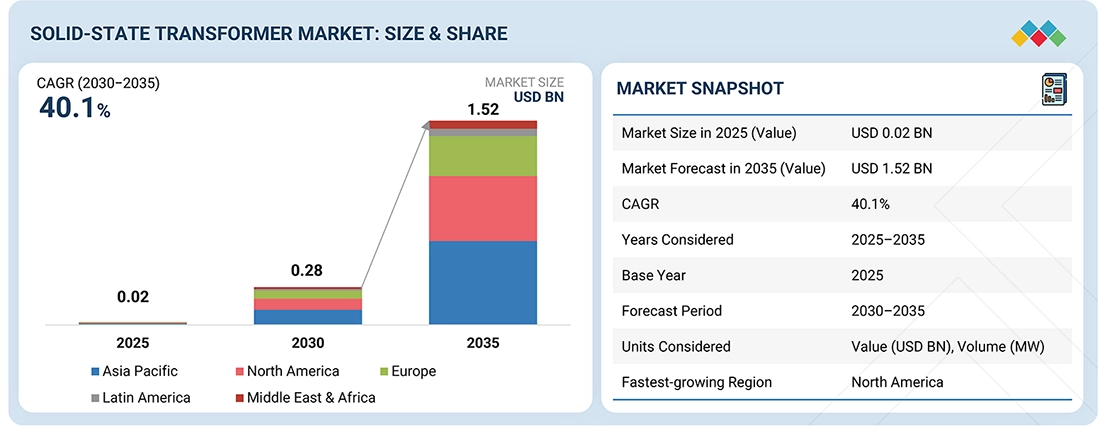
According to Marketsandmarkets, the Solid-State Transformer Market Size was valued at USD 0.02 billion in 2025 and is projected to reach USD 1.52 billion by 2035, growing at a CAGR of 40.1% from 2025 to 2035. The solid-state transformer industry is witnessing steady growth driven by increasing investments in grid modernization, renewable energy integration, and electrification of transportation. Growing deployment of smart grids, digital substations, and distributed energy resources is accelerating the adoption of advanced power conversion technologies. Additionally, rising demand for high-efficiency power distribution systems and compact transformer architectures supported by wide bandgap semiconductor technologies such as silicon carbide (SiC) and gallium nitride (GaN) is further strengthening market expansion globally.
REPORT SCOPE
| REPORT METRIC | DETAILS |
|---|---|
| Market Size in 2025 (Value) | USD 0.02 Billion |
| Market Forecast in 2035 (Value) | USD 1.52 Billion |
| Growth Rate | CAGR of 40.1% from 2025-2030 |
| Years Considered | 2025-2035 |
| Base Year | 2025 |
| Forecast Period | 2030-2035 |
| Units Considered | Value (USD Billion), Volume (MW) |
| Report Coverage | Revenue Forecast, Company Ranking, Competitive Landscape, Growth Factors, and Trends |
| Top Companies |
|
| Growth Driver |
|
| Segments Covered |
|
| Regions Covered | North America, Europe, Asia Pacific, Latin America, Middle East & Africa |
SOLID-STATE TRANSFORMER MARKET KEY TAKEAWAYS
-
By RegionAsia Pacific accounted for the largest share of approximately 45% in 2025, supported by large-scale renewable energy deployments, strong power electronics manufacturing, rapid grid expansion, and increasing electrification across China, India, Japan, and South Korea.
-
By Power RatingThe 1–5 MVA segment is projected to account for the largest market share with 42%, due to its extensive use in distribution networks, renewable integration systems, and microgrid applications requiring medium-capacity power conversion.
-
By Voltage LevelThe medium voltage (1–35 kV) segment is expected to dominate the market, driven by its widespread use in smart grids, digital substations, and distributed energy resource integration across modern power distribution networks.
-
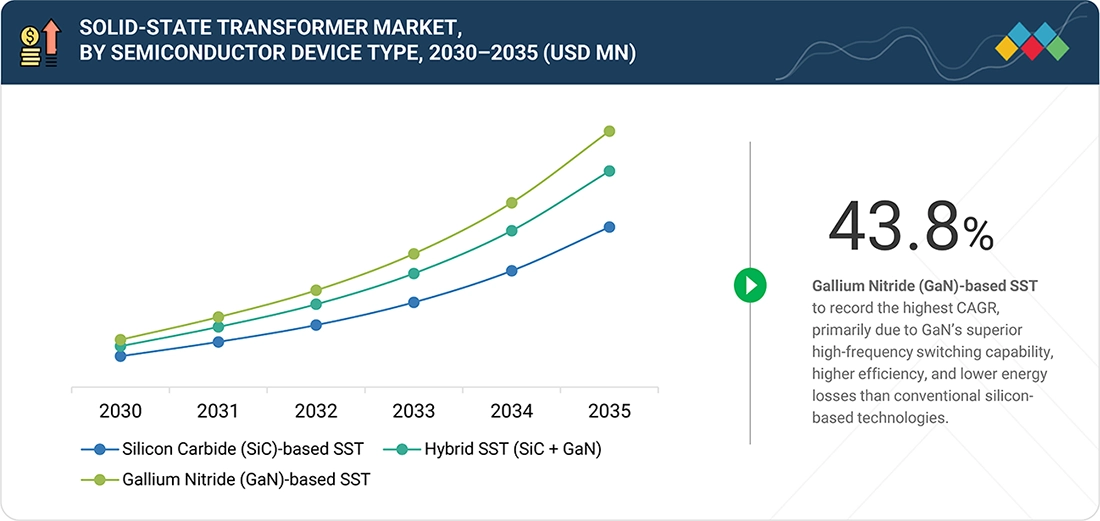
By Semiconductor Device TypeThe gallium nitride (GaN)-based SST segment is projected to register the highest CAGR of 43.8% during the forecast period, driven by its high switching frequency, compact design, and suitability for next-generation, high-efficiency power conversion applications such as data centers and EV infrastructure.
-
By Deploymeny TypeThe new installation segment is expected to register the highest CAGR of 40.9% during the forecast period, supported by increasing investments in new grid infrastructure, renewable energy projects, and EV charging networks, where SSTs are integrated from the design stage for optimized performance and efficiency.
-
By ApplicationThe electric vehicle infrastructure segment is expected to dominate the market due to the rapid expansion of EV charging networks and increasing electrification of transportation. SSTs enable efficient power conversion, fast charging, and bidirectional power flow, supporting grid interaction and energy management in modern EV ecosystems.
-
By End UserThe commercial & institutional operators segment is projected to register the highest CAGR during the forecast period, driven by increasing deployment of advanced power distribution systems across data centers, commercial buildings, and institutional campuses requiring high-efficiency and intelligent energy management solutions.
-
Competitive LandscapeKey players in the solid-state transformer market include Hitachi, Ltd., ABB, Eaton, Delta Electronics, Inc., DG Matrix, SolarEdge Technologies, Inc., WattEV, and GridBridge, supported by strong investments in power electronics innovation and smart grid technologies.
-
Competitive LandscapeCompanies such as RCT Systems, Transformare Energy, and Heron Power Electronics are emerging players in the solid-state transformer market, advancing innovative SST architectures and modular power conversion technologies for applications across smart grids, renewable energy integration, EV charging infrastructure, and advanced power distribution systems.
Source: Secondary Research, Interviews with Experts, MarketsandMarkets Analysis
TRENDS & DISRUPTIONS IMPACTING CUSTOMERS' CUSTOMERS
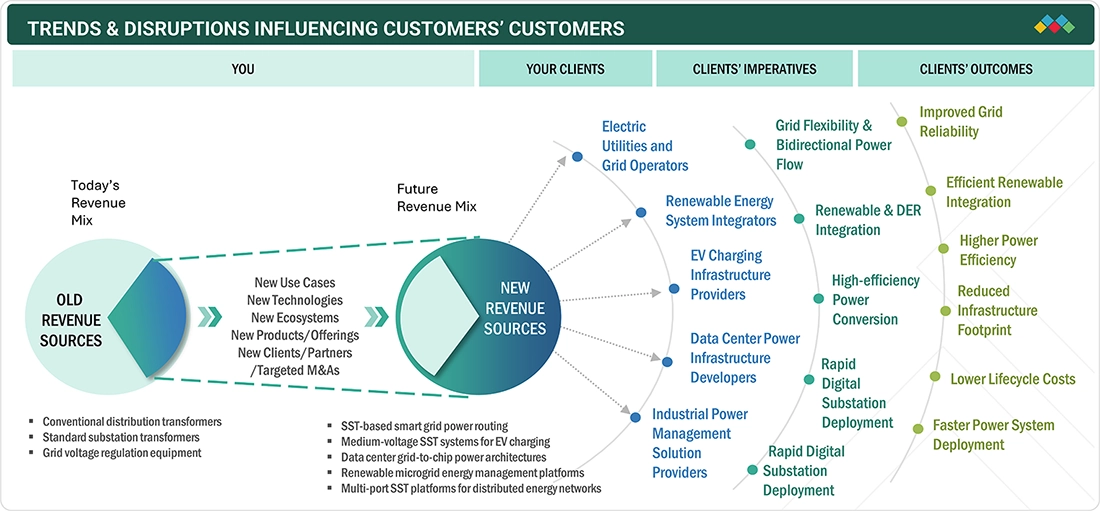
Trends in grid modernization, renewable energy integration, EV charging expansion, and digital substation deployment are reshaping the adoption of solid-state transformers across modern power infrastructure. Utilities, renewable energy developers, and data center operators are increasingly exploring SST-based power routing and conversion technologies to enable flexible grid operations and efficient energy management. These trends are accelerating demand for high-efficiency SST architectures across smart grids, EV charging networks, renewable microgrids, and advanced power distribution systems, enabling improved grid reliability, higher power conversion efficiency, reduced infrastructure footprint, and faster deployment of next-generation power systems.
Source: Secondary Research, Interviews with Experts, MarketsandMarkets Analysis
SOLID-STATE TRANSFORMER MARKET DYNAMICS

Level
-
Increasing investments in grid modernization and smart grid infrastructure

-
Rising integration of renewable energy sources such as solar and wind


Level
-
High initial development and deployment costs of solid-state transformers

-
Technical complexity associated with high-frequency power electronics


Level
-
Growing deployment of digital substations

-
Increasing electrification of transportation systems


Level
-
Thermal management issues

-
Reliability concerns under high-power applications

Source: Secondary Research, Interviews with Experts, MarketsandMarkets Analysis
Driver: Increasing investments in grid modernization and smart grid infrastructure
Increasing investments in grid modernization initiatives and smart grid infrastructure are accelerating the adoption of solid-state transformer technologies. Utilities and grid operators are deploying advanced power conversion systems to enable real-time monitoring, bidirectional power flow, and improved voltage regulation across modern distribution networks. Solid-state transformers support integration of distributed energy resources, renewable power generation, and microgrids, helping utilities enhance grid flexibility, efficiency, and resilience as electricity networks transition toward digital and decentralized energy systems.
Restraint: High initial development and deployment costs of solid-state transformers
The high initial development and deployment costs of solid-state transformers remain a key restraint to large-scale adoption. SST systems require advanced power electronics, wide bandgap semiconductor devices such as silicon carbide, sophisticated control systems, and specialized cooling mechanisms. These components increase capital expenditure compared with conventional transformers. Additionally, integration with existing grid infrastructure and the need for advanced system engineering further elevate project costs, limiting widespread deployment beyond pilot and demonstration projects.
Opportunity: Growing deployment of digital substations
The growing deployment of digital substations presents significant opportunities for solid-state transformer adoption. As utilities modernize power networks with intelligent monitoring, automation, and advanced control systems, demand for flexible and digitally controllable power conversion technologies is increasing. Solid-state transformers enable efficient voltage regulation, improved power quality management, and seamless integration of renewable energy sources and distributed energy resources, making them well suited for next-generation digital substation architectures.
Challenge: Thermal management issues in high-power applications
Thermal management remains a major challenge for solid-state transformer systems operating in high-power applications. The high switching frequencies and dense power electronics components generate significant heat, requiring advanced cooling mechanisms such as liquid cooling systems. Maintaining reliable thermal performance while ensuring compact system design and long operational life is technically complex. Inefficient thermal management can impact system reliability, performance stability, and overall operational efficiency in demanding grid and industrial environments.
SOLID-STATE TRANSFORMER MARKET: COMMERCIAL USE CASES ACROSS INDUSTRIES
| COMPANY | USE CASE DESCRIPTION | BENEFITS |
|---|---|---|
 |
Development and deployment of solid-state transformer solutions for smart grid infrastructure and digital substations to enable advanced voltage regulation and distributed energy resource integration | Improved grid stability | Efficient renewable integration | Enhanced power quality management |
 |
Integration of solid-state transformer concepts into medium-voltage power conversion platforms for advanced grid-edge applications and digital power distribution systems | Bidirectional power flow | Higher system efficiency | Flexible grid operations |
 |
Development of compact medium-voltage solid-state transformer systems for microgrids, EV charging infrastructure, and industrial power management applications | Improved energy efficiency | Reduced system footprint | Enhanced grid resilience |
 |
Design of high-efficiency power conversion systems incorporating SST architectures for renewable energy integration and data center power infrastructure | Higher power density | Efficient AC/DC power conversion | Optimized energy management |
 |
Deployment of multi-port solid-state transformer platforms to manage AC/DC power conversion and routing in renewable energy, storage systems, and data center power architectures | Intelligent power routing | Reduced infrastructure footprint | Faster deployment of modular power systems |
Logos and trademarks shown above are the property of their respective owners. Their use here is for informational and illustrative purposes only.
SOLID-STATE TRANSFORMER MARKET ECOSYSTEM
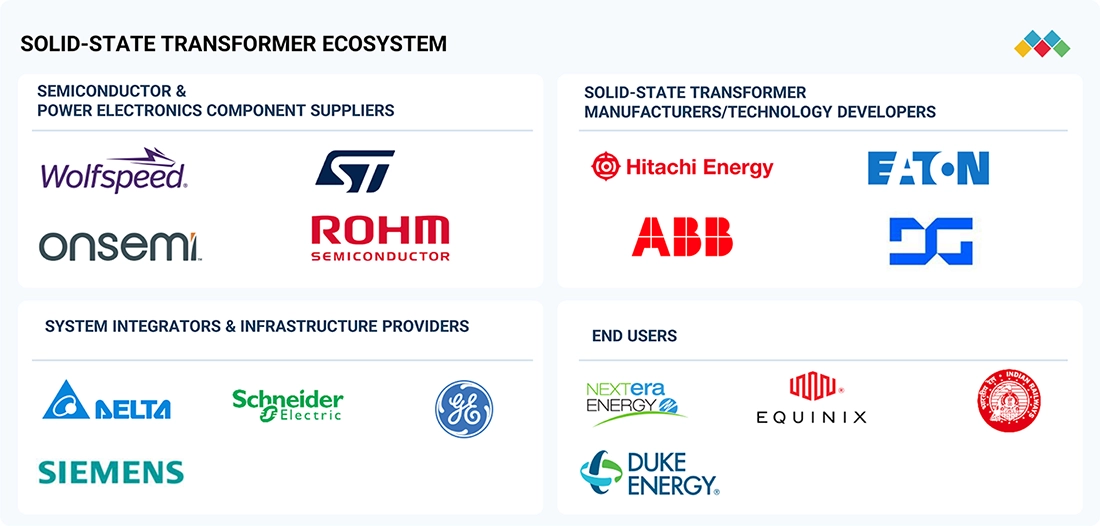
The solid-state transformer market ecosystem comprises semiconductor and power electronics component suppliers, SST manufacturers and technology developers, system integrators and infrastructure providers, and end users. Semiconductor suppliers enable high-frequency power conversion through advanced wide bandgap devices such as silicon carbide (SiC) and gallium nitride (GaN). SST manufacturers develop advanced transformer architectures and power conversion platforms for grid-edge applications. System integrators support deployment across smart grids, renewable energy systems, EV charging infrastructure, and digital substations. End users, including electric utilities, data center operators, transportation authorities, and industrial enterprises, drive adoption through grid modernization, renewable integration, and advanced power distribution applications.
Logos and trademarks shown above are the property of their respective owners. Their use here is for informational and illustrative purposes only.
SOLID-STATE TRANSFORMER MARKET SEGMENTS
Source: Secondary Research, Interviews with Experts, MarketsandMarkets Analysis
Solid-state Transformer Market, by Power Rating
The 1–5 MVA segment is expected to hold the largest share of the solid-state transformer market due to its widespread suitability for distribution networks, renewable integration, and microgrid applications. Meanwhile, the >5–20 MVA segment is projected to register the fastest growth, driven by increasing deployment in high-power applications such as data centers, EV charging infrastructure, and advanced industrial power systems.
Solid-state Transformer Market, by Voltage Level
The medium voltage (1–35 kV) segment is expected to dominate the solid-state transformer market and also grow at the fastest rate during the forecast period. Growth is driven by its extensive use in smart grids, digital substations, renewable energy integration, and electric vehicle charging networks, where efficient medium-voltage power conversion and grid flexibility are essential.
Solid-state Transformer Market, by Semiconductor Device Type
Silicon carbide (SiC)-based SSTs are expected to dominate the market due to their superior switching efficiency, higher thermal tolerance, and ability to support high-frequency power conversion in compact transformer architectures. While Gallium nitride (GaN)-based SSTs are expected to grow at the fastest pace during the forecast period due to their high switching frequency, compact size, and superior efficiency in high-frequency power conversion applications.
Solid-state Transformer Market, by Deployment Type
New installations are expected to account for the largest share and register the highest CAGR during the forecast period, driven by increasing deployment in new smart grid infrastructure, renewable energy projects, and EV charging networks.
Solid-state Transformer Market, by Application
The electric vehicle infrastructure segment is expected to hold the largest market share due to rapid expansion of EV charging networks. Meanwhile, the data centers segment is projected to grow at the fastest rate, driven by demand for efficient, compact, and high-performance power conversion systems.
Solid-state Transformer Market, by End User
The transportation authorities segment is expected to account for the largest share due to rising investments in rail electrification and electric mobility. Meanwhile, the commercial & institutional operators segment is projected to register the fastest growth during the forecast period, driven by rising adoption of advanced power distribution systems in data centers, commercial buildings, campuses, and industrial facilities requiring high-efficiency and intelligent power management solutions.
SOLID-STATE TRANSFORMER MARKET BY REGION
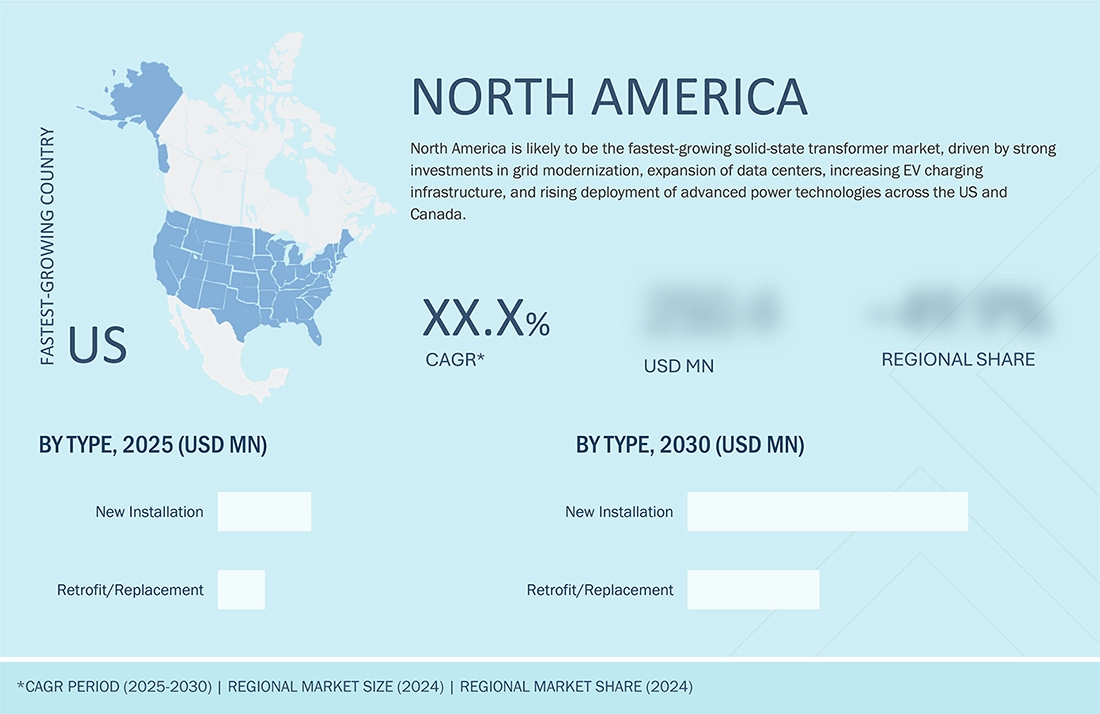
North America to Record fastest CAGR in Global Solid-state Transformer Market During Forecast Period
North America is expected to register the highest CAGR in the solid-state transformer market during 2030–2035, supported by increasing investments in grid modernization, renewable energy integration, and advanced power infrastructure. Expanding deployment of data centers, EV charging networks, and digital substations across the region is accelerating demand for efficient and flexible power conversion technologies. Additionally, strong government funding programs and initiatives focused on grid resilience, electrification, and decarbonization are further driving the adoption of solid-state transformer solutions across the region.
SOLID-STATE TRANSFORMER MARKET: COMPANY EVALUATION MATRIX
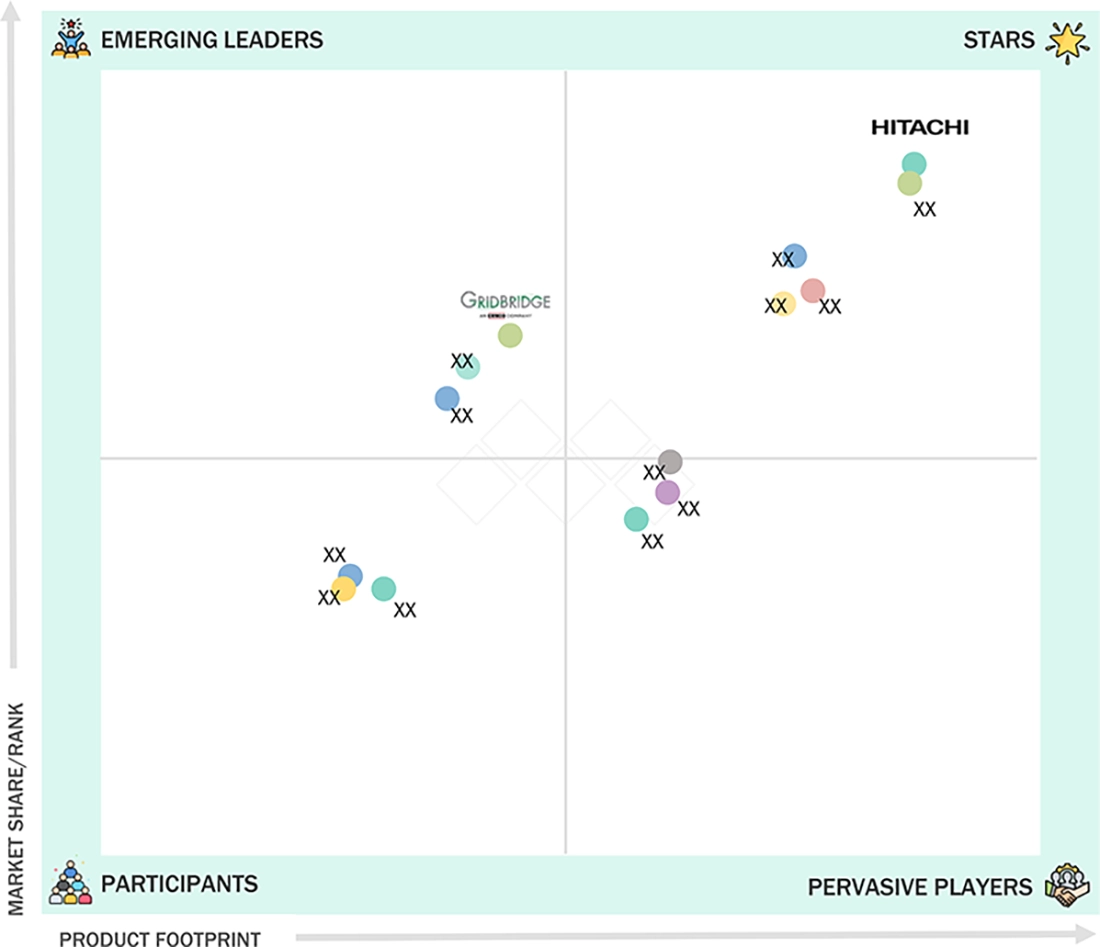
In the solid-state transformer market matrix, Hitachi, Ltd. is positioned as a Star, supported by its strong global presence, advanced power electronics expertise, and active development of grid modernization and digital substation solutions. GridBridge (an ERMCO company) is identified as an Emerging Leader, driven by its focus on medium-voltage SST technologies, growing deployments in utility distribution networks, and increasing involvement in next-generation smart grid infrastructure projects.
Source: Secondary Research, Interviews with Experts, MarketsandMarkets Analysis
KEY MARKET PLAYERS
- Hitachi, Ltd (Japan)
- ABB (Switzerland)
- Eaton (Ireland)
- GridBridge (An ERMCO Company) (US)
- Amperesand PTE LTD (Singapore)
- Delta Electronics, Inc. (Taiwan)
- RCT Systems (US)
- DG Matrix (US)
- SolarEdge Technologies, Inc. (Israel)
- WattEV (US)
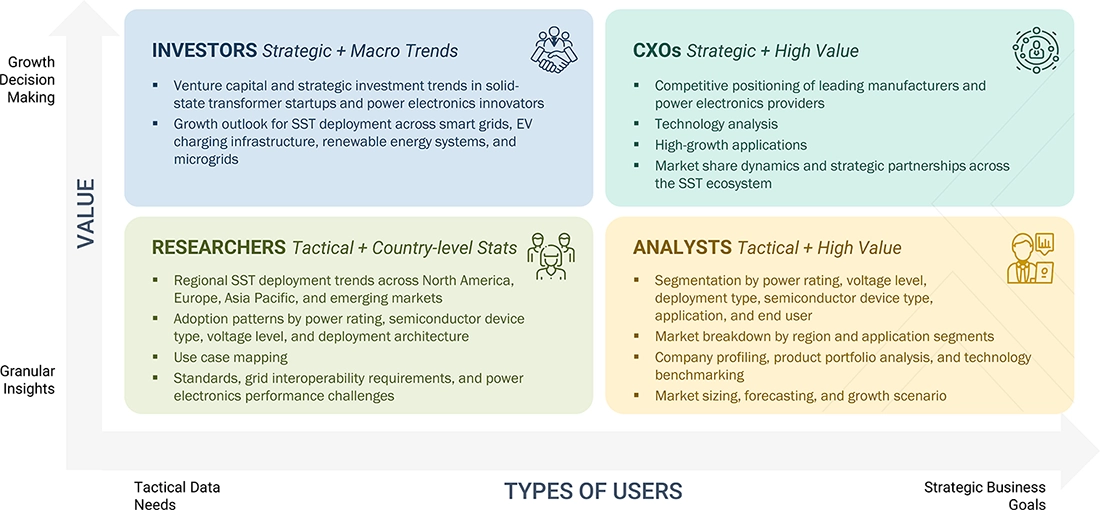
WHAT IS IN IT FOR YOU: SOLID-STATE TRANSFORMER MARKET REPORT CONTENT GUIDE
DELIVERED CUSTOMIZATIONS
We have successfully delivered the following deep-dive customizations:
| CLIENT REQUEST | CUSTOMIZATION DELIVERED | VALUE ADDS |
|---|---|---|
| Electric Utility/Grid Operator |
|
|
| Renewable Energy Developer/IPP |
|
|
| Data Center Operator/Hyperscale Cloud Provider |
|
|
| EV Charging Infrastructure Provider |
|
|
| Railway & Transportation Authority |
|
|
| Industrial Power Systems/Manufacturing Enterprise |
|
|
| SST Manufacturer/Power Electronics Vendor |
|
|
RECENT DEVELOPMENTS
- June 2026: Eaton expanded the real-world deployment of its medium-voltage solid-state transformer (MVSST) technology through its participation in Singapore’s Sustainable Tropical Data Centre Testbed 2.0. Eaton is set to showcase a 2.5 MW MVSST container at Data Centre World 2026 before installing it at Jurong Island for live trials and detailed performance data collection. The project will evaluate the technology in an AI-ready data-center environment and provide operational insights for future hyperscale and colocation facilities. This represents a direct expansion and field-validation of Eaton’s solid-state transformer technology for high-density power infrastructure.
- June 2026 : Heron Power, DG Matrix, and Amperesand are advancing solid-state transformers (SSTs) to address the rising power demands of AI data centers. The technology replaces conventional transformers with power semiconductors and software-defined controls, enabling more efficient and flexible power conversion. SSTs can support the shift to 800 VDC infrastructure, reduce electrical equipment footprints, and manage rapid AI load fluctuations. The market is gaining momentum, with the three companies raising a combined $280 million and major players including Eaton, Enphase Energy, and SolarEdge also entering the space. The technology is emerging as a key enabler for faster, denser, and more scalable AI data center infrastructure.
- March 2026: Hitachi Energy advanced its solid-state transformer technology through the publication of a patent for a solid-state transformer and converter system. The patented architecture uses multiple converter modules and sub-modules connected through high-frequency transformers, with the configuration designed to support medium-voltage power conversion. The development is relevant to Hitachi Energy’s emerging SST portfolio, which targets compact, high-efficiency power delivery for applications including next-generation data centers. The patent demonstrates continued technical development of Hitachi Energy’s solid-state transformer architecture.
- February 2026 : Delta Electronics collaborated with Chindata Group and Meituan to deploy its solid-state transformer system at a hyperscale data center campus in North China. The project focuses on enabling high-efficiency, flexible, and scalable power delivery for AI-driven computing infrastructure. Delta's SST system leverages SiC technology for high-frequency power conversion, enabling the direct transformation of medium-voltage inputs into multi-level DC outputs of 240 V, 400 V, and 800 V. This innovative approach capitalizes on the superior thermal and electrical properties of SiC, enhancing efficiency and performance in power conversion applications.), achieving up to 98.5% efficiency and reducing energy losses by over 30%. The solution features a modular, high-power-density design (up to 1 MW per cabinet) and supports dynamic load management, energy storage integration, and distributed DC architecture, enhancing power reliability, space utilization, and scalability for data center operations.
- February 2026 : DG Matrix closed Series A funding led by Engine Ventures, with participation from multiple strategic and financial investors. The funding will support scaling of its solid-state transformer platform, Interport, including manufacturing expansion, supply chain development, and commercial deployments. The investment aims to accelerate the adoption of multi-port SST technology for AI data centers and electrification applications, enabling faster deployment of power infrastructure, improved energy efficiency, and the integration of multiple energy sources, such as the grid, solar, batteries, and generators.
Table of Contents
 Exclusive indicates content/data unique to MarketsandMarkets and not available with any competitors.
Methodology
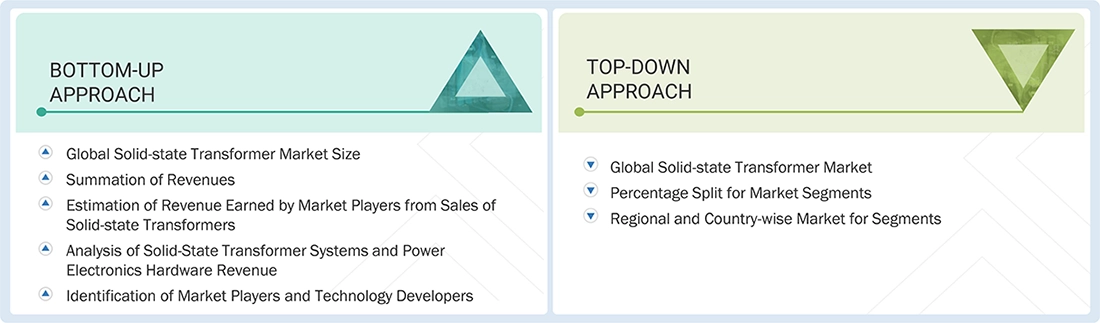
The research study involved four major activities in estimating the size of the solid-state transformer market. Exhaustive secondary research has been conducted to gather key information on the market and peer markets. The validation of these findings, assumptions, and sizing was conducted through primary research with industry experts across the power electronics, power distribution, and energy infrastructure value chain. Both top-down and bottom-up approaches have been used to estimate the market size. Post which, the market breakdown and data triangulation have been adopted to estimate the market sizes of segments and subsegments.
Secondary Research
In the secondary research process, various sources have been consulted to identify and collect the information required for this study. The secondary sources include annual reports, press releases, company investor presentations, white papers, and articles by recognized authors. Secondary research has primarily focused on obtaining key information about the market’s supply chain, the pool of key solid-state transformer manufacturers and power electronics providers, market segmentation based on industry trends, regional outlook, and developments from both market and technology perspectives.
In the solid-state transformer market report, the global market size has been estimated using both the top-down and bottom-up approaches, along with several other dependent submarkets. The major players in the market were identified through extensive secondary research, and their presence was determined through both secondary and primary research. All the percentage shares, splits, and breakdowns have been determined using secondary sources and verified through primary sources.
Primary Research
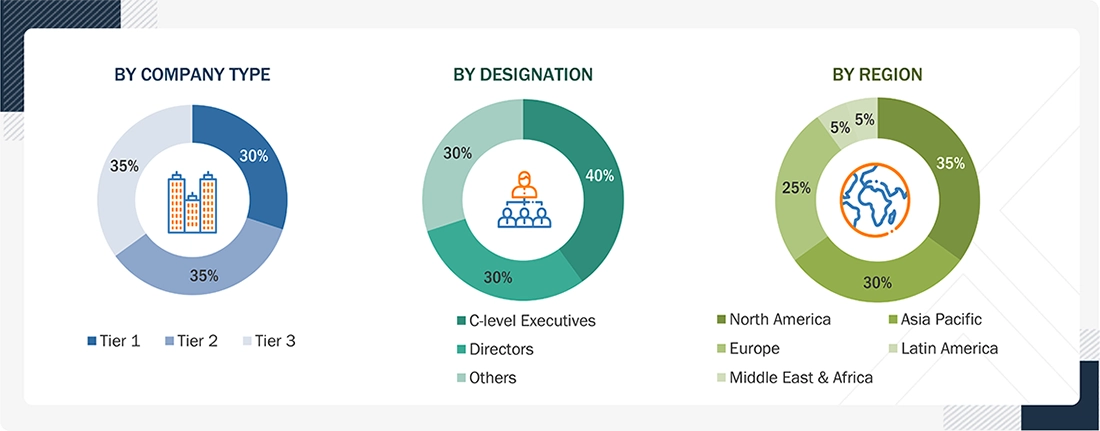
Extensive primary research has been conducted, building on the understanding of the solid-state transformer market scenario from secondary research. Several primary interviews have been conducted with key opinion leaders from both demand- and supply-side vendors across five major regions—Asia Pacific, North America, Europe, Latin America, and Middle East & Africa. Approximately 25% of the primary interviews have been conducted with demand-side vendors, and 75% with supply-side vendors. Primary data has been collected mainly through telephone interviews, which accounted for 80% of the total primary interviews; questionnaires and emails have also been used to collect the data.
Following successful interactions with industry experts, brief sessions were held with highly experienced independent consultants to reinforce the findings of our primary research. This, along with the opinions of our in-house subject-matter experts, has led us to the findings described in the report. The breakdown of primary respondents is as follows:
To know about the assumptions considered for the study, download the pdf brochure
Market Size Estimation
In the market engineering process, both top-down and bottom-up approaches, along with data triangulation methods, have been used to estimate and validate the size of the solid-state transformer market and its dependent submarkets. The research methodology used to estimate the market sizes includes the following:
- Identifying top-line investments and spending across grid modernization, smart grid infrastructure, EV charging systems, renewable energy integration, and advanced power electronics ecosystems while considering segment-level splits and major market developments
- Identifying different stakeholders in the solid-state transformer market that influence the overall market, along with participants across the power electronics and energy infrastructure value chain
- Analyzing major companies in the solid-state transformer ecosystem and studying their product portfolios, technology capabilities, and R&D activities
- Analyzing adoption trends of solid-state transformers across key sectors, including electric utilities, renewable energy developers, transportation electrification, EV charging infrastructure, data centers, industrial enterprises, and commercial & institutional facilities
- Tracking recent and upcoming market developments, including investments, R&D initiatives, product launches, collaborations, agreements, expansions, and partnerships, and forecasting the market size based on these developments and other critical parameters such as regulatory policies, technology adoption rates, pricing trends, supply chain dynamics, demand across key end users, and macroeconomic factors.
- Conducting multiple discussions with key opinion leaders to understand adoption trends and technological developments related to solid-state transformers
- Segmenting the overall market into various segments, such as power rating, voltage level, conversion stage, semiconductor device type, cooling method, deployment type, application, end user, and region
- Validating the estimates at every level through discussions with key opinion leaders, such as chief executives (CXOs), directors, technology specialists, and operations managers, and finally with the domain experts at MarketsandMarket
Solid-State Transformer Market : Top-Down and Bottom-Up Approach
Data Triangulation
After arriving at the overall market size using the market size estimation processes as explained above, the market has been split into several segments and subsegments. To complete the entire market engineering process and obtain the exact statistics for each market segment and subsegment, data triangulation and market breakdown procedures have been employed, as applicable. The data has been triangulated by examining various factors and trends on both the demand and supply sides of the solid-state transformer market.
Market Definition
A solid-state transformer is an advanced power conversion device that uses power electronic components, high-frequency transformers, and digital control systems to convert and regulate electrical power. Unlike conventional transformers, SSTs enable bidirectional power flow, voltage regulation, power quality management, and integration with digital grid systems. These transformers operate using high-frequency switching and wide-bandgap semiconductor devices such as silicon carbide (SiC) and gallium nitride (GaN), enabling higher efficiency, reduced size, and improved power density. Solid-state transformers are increasingly used in smart grids, renewable energy integration, electric vehicle charging infrastructure, railway traction systems, microgrids, and advanced industrial power distribution networks.
Key Stakeholders
- Power semiconductor manufacturers
- Power electronics module and converter manufacturers
- Solid-state transformer manufacturers and technology developers
- Electrical equipment and transformer manufacturers
- Smart grid and digital substation solution providers
- Renewable energy system developers and integrators
- Electric vehicle charging infrastructure providers
- Microgrid and distributed energy resource (DER) solution providers
- Industrial power management and automation solution providers
- Utilities and power distribution companies
- Engineering, procurement, and construction (EPC) companies
- Research institutions and technology laboratories
- Government agencies and regulatory authorities
- Industry associations and standards organizations
- End users
Report Objectives
- To describe, segment, and forecast the size of the solid-state transformer market, by power rating, voltage level, semiconductor device type, deployment type, application, and end user, in terms of value
- To forecast the solid-state transformer market, by region, in terms of volume
- To forecast the size of various segments for five regions: North America, the Asia Pacific, Europe, Latin America, and the Middle East & Africa, in terms of value
- To offer detailed information on drivers, restraints, opportunities, and challenges influencing the growth of the solid-state transformer market
- To provide a detailed overview of the solid-state transformer market value chain
- To strategically analyze the micromarkets concerning individual growth trends, prospects, and contributions to the overall market
- To study industry trends, technological advancements, regulatory landscape, sustainability initiatives, customer landscape & buyer behavior, the impact of AI/Gen AI, along with the macroeconomic outlook
- To analyze opportunities for various stakeholders by identifying the high-growth segments of the market
- To benchmark the key players and analyze their market position in terms of revenue, market share, and core competencies, as well as to provide a detailed competitive landscape for the market leaders
- To analyze competitive developments such as product launches, deals, and expansions carried out by players in the solid-state transformer market
Available customizations:
Based on the given market data, MarketsandMarkets offers customizations tailored to companies' specific requirements. The following customization options are available for the report:
- Detailed analysis and profiling of additional market players (up to 5)
Key Questions Addressed by the Report
What is the projected market size of the solid-state transformer market?
The solid-state transformer market is projected to reach USD 1.52 billion by 2035, growing from USD 0.28 billion in 2030.
What is the CAGR of the solid-state transformer market?
The market is expected to grow at a CAGR of 40.1% during 2030–2035, indicating rapid adoption of advanced power technologies.
What are the key growth drivers of the market?
Key drivers include grid modernization investments, renewable energy integration, EV infrastructure expansion, and demand for high-efficiency power systems.
Which region dominates the solid-state transformer market?
Asia Pacific holds the largest share (~45% in 2025) due to strong renewable energy deployment and electrification in countries like China, India, and Japan.
What are the major industry applications of solid-state transformers?
Applications include smart grids, EV charging infrastructure, renewable energy systems, rail traction, microgrids, and industrial power distribution.
What are the key market trends in this industry?
Major trends include adoption of wide bandgap semiconductors (SiC & GaN), digital substations, compact transformer designs, and bidirectional power flow technologies.
Which power rating segment holds the largest share?
The 1–5 MVA segment holds around 42% share, driven by its use in distribution networks and renewable integration systems.
What are the key companies operating in the solid-state transformer market?
Major players include companies such as ABB, Schneider Electric, Siemens, GE Vernova, Mitsubishi Electric, and emerging startups focusing on power electronics innovation.
How is the market analyzed in the report?
The report uses top-down and bottom-up approaches, data triangulation, and analysis of investments, stakeholders, and adoption trends across industries.
What are the major regions covered in the report?
The market is analyzed across North America, Europe, Asia Pacific, Latin America, and Middle East & Africa, with Asia Pacific expected to grow fastest.


Personalize This Research
- Triangulate with your Own Data
- Get Data as per your Format and Definition
- Gain a Deeper Dive on a Specific Application, Geography, Customer or Competitor
- Any level of Personalization
Let Us Help You
- What are the Known and Unknown Adjacencies Impacting the Solid-state Transformer Market
- What will your New Revenue Sources be?
- Who will be your Top Customer; what will make them switch?
- Defend your Market Share or Win Competitors
- Get a Scorecard for Target Partners

Custom Market Research Services
We Will Customise The Research For You, In Case The Report Listed Above Does Not Meet With Your Requirements
Get 10% Free CustomisationTESTIMONIALS

Tetsuya Ohhira
Business Development Manager-Technology Business
Nikon Corporation,
Leading Japanese MNC specializing in optics and imaging productswww.nikon.com
MarketsandMarkets™ response
is quick. Their attitude is flexible and positive. Analyst Insights are globally considered and
significant. Client Services quickly respond to our inquiry and demand. Their wide range of global
surveys help us make our strategic plan.
We hope Knowledge Store will be easier to search
for a report.
VP - Marketing & Business Development
Leading Provider of Process Control Solutions
We engaged with MarketsandMarkets on a study to perform an analysis and recommend a Go-To-Market strategy for metrology and process control in the semiconductor market. The study was tailored to our targets and needs with well-defined milestones. Our overall experience with the MarketsandMarkets team was very good throughout the project in all aspects including the analysis methodologies used, the quality and depth of primary and secondary data sets, the professionalism and flexibility of the team and the ability to meet the target schedule and milestones. We want to thank MarketsandMarkets team for a job well done.
- South Africa Solid-state Transformer Market
- Rest Of Europe Solid-state Transformer Market
- Rest Of Asia Pacific Solid-state Transformer Market
- GCC Solid-state Transformer Market
- US Solid-state Transformer Market
- Canada Solid-state Transformer Market
- Germany Solid-state Transformer Market
- France Solid-state Transformer Market
- UK Solid-state Transformer Market
- Italy Solid-state Transformer Market
- Spain Solid-state Transformer Market
- China Solid-state Transformer Market
- Japan Solid-state Transformer Market
- South Korea Solid-state Transformer Market
- India Solid-state Transformer Market
- Brazil Solid-state Transformer Market
- Argentina Solid-state Transformer Market
- Mexico Solid-state Transformer Market






Growth opportunities and latent adjacency in Solid-state Transformer Market