
Home Automation System Market

Home Automation System Market by Lighting Controls, Smart Speakers, Entertainment Controls, HVAC Controls, Security & Access Controls, Wired, Wireless, Behavioral, Proactive, Multi-family Residence, Single - family Residence - Global Forecast To 2032




HOME AUTOMATION SYSTEM MARKET OVERVIEW
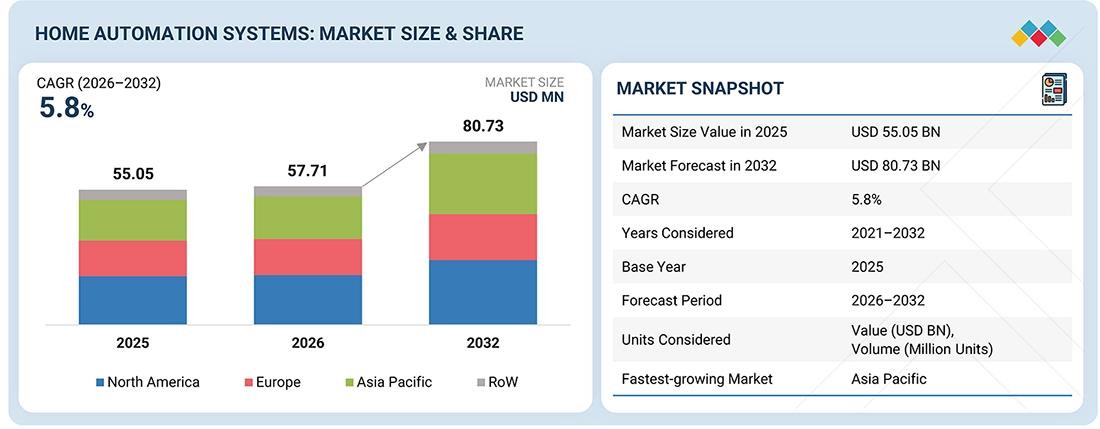
The global home automation system market is projected to reach USD 80.73 billion by 2032, growing from USD 57.71 billion in 2026, reflecting a compound annual growth rate (CAGR) of 5.8% from 2026 to 2032. This growth is driven by an increasing demand for convenience, safety, and energy efficiency among homeowners. Additionally, the rising use of smartphones, high-speed internet, and Internet of Things (IoT) devices has made automated home systems more user-friendly and manageable. Moreover, the growing awareness of people regarding energy savings and sustainability is further boosting the adoption of smart lighting, HVAC systems, and energy management solutions. Advancements in artificial intelligence, voice assistants, and cloud platforms are further enhancing system intelligence and user experience. Supportive government incentives and the expansion of smart residential projects are also accelerating market growth.
Market Size & Forecast
HOME AUTOMATION SYSTEM MARKET KEY TAKEAWAYS
-
By RegionAsia Pacific is projected to register the highest growth (7.4%) during the forecast period.
-
By Residence TypeThe multi-family segment accounted for a larger market share (54.8%) than the single-family segment in 2025.
-
By System TypeThe behavioral segment is projected to grow at a higher CAGR (5.7%) than the proactive segment during the forecast period.
-
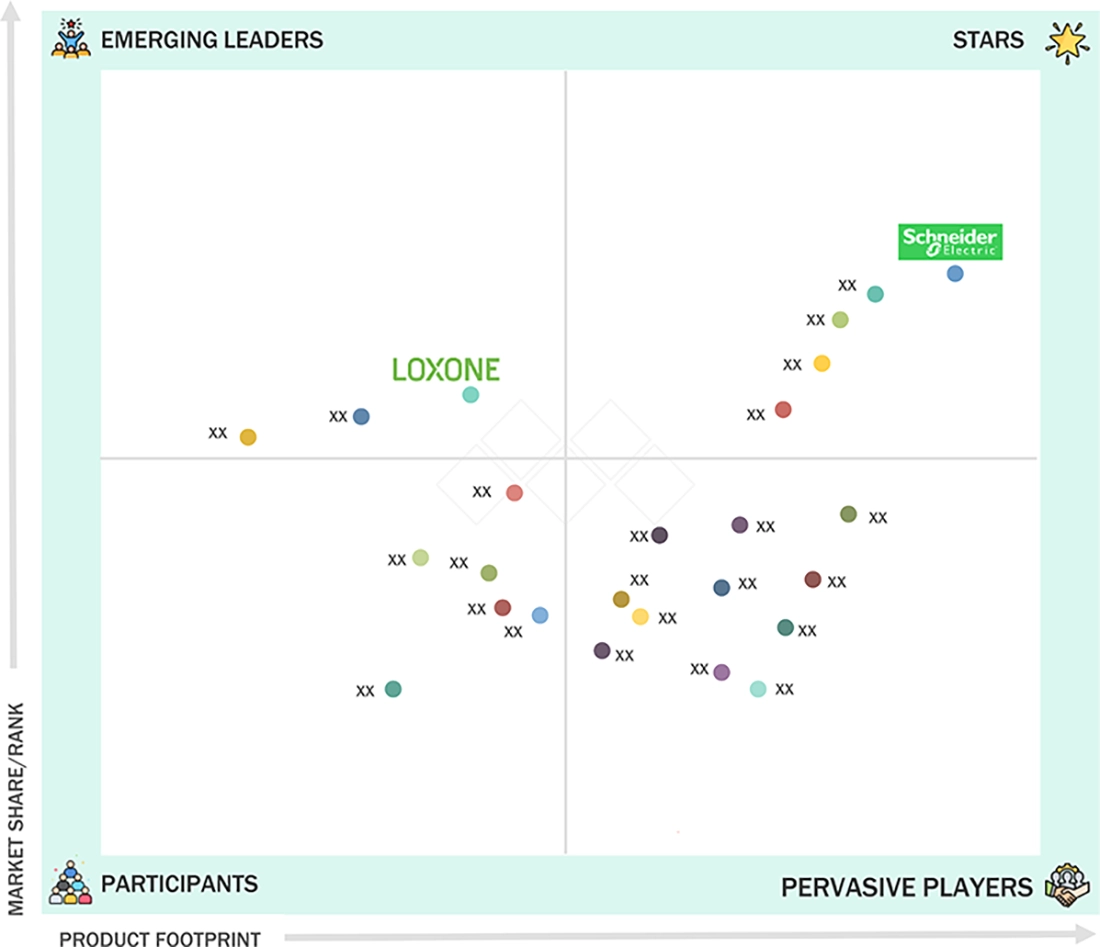
Competitive Landscape - Key PlayersCompany Johnson Controls Inc., Schneider Electric, and Siemens were identified as star players in the home automation market (global) given their strong market share and product footprint.
-
Competitive Landscape - Startups/SMEsAjax Systems, Govee, and Wyze Labs, Inc. have distinguished themselves among startups and SMEs due to their strong product portfolio and business strategy.
The home automation system market is expanding due to changing lifestyles and a growing emphasis on remote home management. Consumers increasingly prefer automated solutions that allow for real-time monitoring and control of security systems, lighting, and appliances through mobile devices. Rising labor costs and busy schedules are driving demand for homes that are automated and self-managing. The integration of voice control and AI-driven automation enhances ease of use. Additionally, decreasing device prices and DIY installation options are making home automation accessible to a broader range of customers.
Source: Secondary Research, Interviews with Experts, MarketsandMarkets Analysis
TRENDS & DISRUPTIONS IMPACTING CUSTOMERS' CUSTOMERS
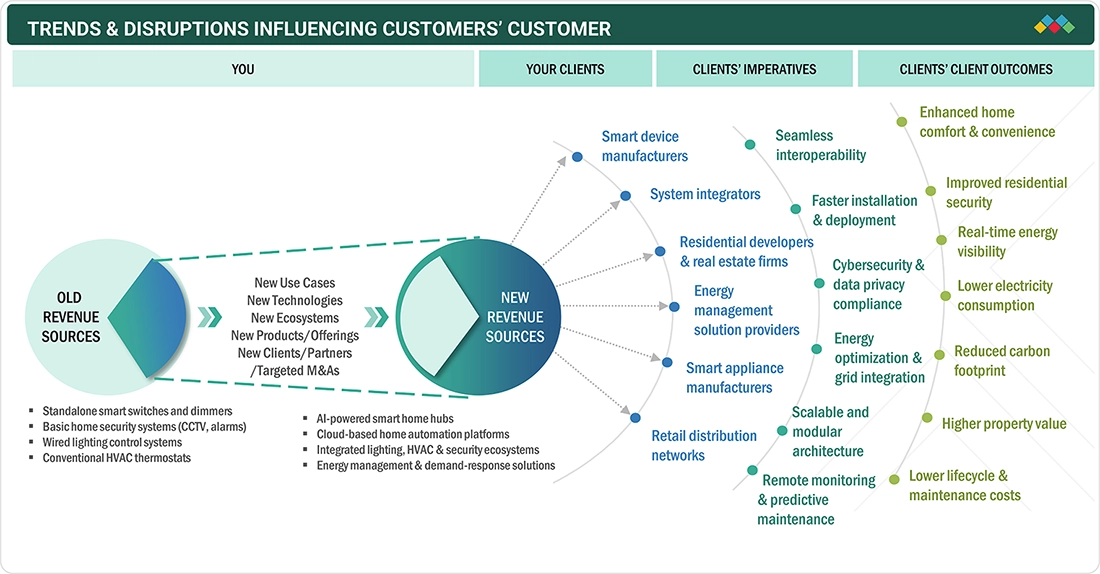
This section describes the trends/disruptions impacting customer businesses in the home automation systems market. The analysis of the home automation ecosystem provides insights related to the market, showcases interconnections between various companies, and depicts the flow of value among different segments. Currently, smart appliances such as smart lighting and entertainment systems are witnessing high demand. However, with the new shift mainly caused by the increasing penetration of the Internet, technological advancements in the home automation systems market, and efforts by smart appliance manufacturers to launch low-priced products, there has been a rise in demand for other types of smart appliances such as smart speakers, access controls, and smart lighting devices as well. Future hot bets such as AI in home appliances, IoT, and robotics are expected to impact the businesses of customers of home automation product manufacturers and indirectly impact the revenue of home automation product manufacturers during the forecast period.
Source: Secondary Research, Interviews with Experts, MarketsandMarkets Analysis
HOME AUTOMATION SYSTEM MARKET DYNAMICS

Level
-
Rising demand for convenience and comfort

-
Increasing demand for energy-efficient devices


Level
-
High up-front costs

-
Complexity and glitches


Level
-
Favorable government regulations

-
Adaptive to remote working


Level
-
Cybersecurity concerns

Source: Secondary Research, Interviews with Experts, MarketsandMarkets Analysis
Driver: Rising demand for convenience and comfort
Consumers are increasingly seeking automated solutions that simplify daily activities and improve living comfort. Home automation enables centralized control of lighting, HVAC, security, and appliances through smartphones or voice assistants. Busy lifestyles and remote home management needs are accelerating adoption. Personalized automation and real-time control further enhance user experience. These benefits continue to drive strong demand for home automation systems.
Restraint: High up-front costs
The high initial cost of smart devices, sensors, and system integration remains a major restraint. Advanced home automation solutions often require compatible infrastructure and professional installation. This can limit adoption, especially among price-sensitive consumers. Ongoing maintenance and upgrade costs add to the total expense. As a result, cost remains a key barrier to mass-market adoption.
Opportunity: Favorable government regulations
Government policies promoting energy efficiency and smart buildings are creating growth opportunities. Incentives, tax benefits, and utility rebate programs support the adoption of smart lighting, HVAC, and energy management systems. Smart city initiatives further encourage connected home deployments. Regulations focused on sustainability and carbon reduction also boost demand. These measures strengthen long-term market growth prospects.
Challenge: Cybersecurity concerns
Home automation systems rely heavily on internet connectivity and cloud platforms, increasing cybersecurity risks. Threats such as data breaches, hacking, and unauthorized access raise consumer concerns. Lack of strong security standards across devices can worsen these risks. Ensuring data protection and secure communication remains critical. Cybersecurity challenges can impact user trust and slow adoption.
HOME AUTOMATION SYSTEM MARKET SIZE, SHARE & GROWTH: COMMERCIAL USE CASES ACROSS INDUSTRIES
| COMPANY | USE CASE DESCRIPTION | BENEFITS |
|---|---|---|
 |
Integration of AI-driven home automation system devices across residential and hospitality facilities for automated lighting, climate, and security control through mobile and voice-enabled interfaces | Improvement in energy efficiency | Lower maintenance costs | Elevated guest experience through intelligent and customizable automation features |
 |
Deployment of community-wide home automation system ecosystems in residential neighborhoods and educational facilities, connecting IoT sensors for lighting, ventilation, and energy analytics | Improvement in energy efficiency | Optimized living and learning conditions | Reduced energy waste through predictive automation and analytics |
 |
Implementation of IoT-enabled home automation systems and building systems, automating lighting, HVAC, and appliance control through smart devices, across student dormitories and classrooms | Reduction in overall utility costs | Improved occupant safety | Enhanced environmental comfort supporting digital campus sustainability goals |
 |
Deployment of home automation system energy management systems, integrating lighting, heating, and water management via IoT-enabled meters and sensors, across residential projects in Sweden | Improved household energy efficiency and water conservation | 20% reduction in energy usage | Enhanced sustainability compliance in line with Sweden’s green energy initiatives |
 |
Implementation of connected workplace automation, integrating smart lighting, HVAC scheduling, and occupancy-based energy control, across European office campuses | Achieved reduction in facility energy costs | Improved indoor comfort for employees | Enhanced operational transparency through real-time data insights |
Logos and trademarks shown above are the property of their respective owners. Their use here is for informational and illustrative purposes only.
HOME AUTOMATION SYSTEM MARKET ECOSYSTEM
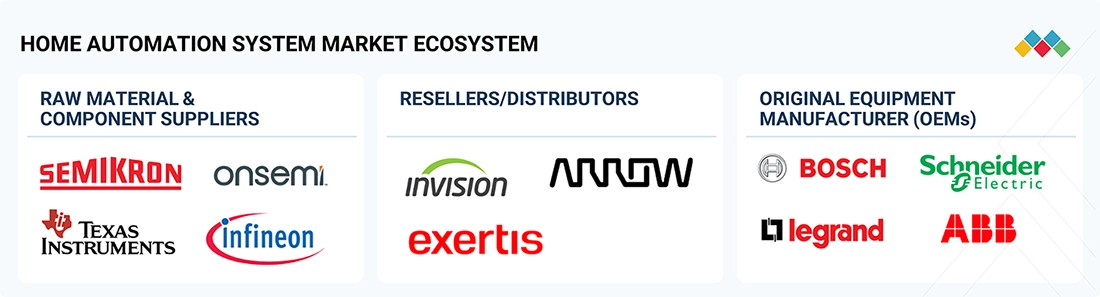
The home automation system market ecosystem comprises raw material and component suppliers, original equipment manufacturers (OEMs), and resellers/distributors, collectively enabling smart and connected home solutions. Raw material & component suppliers, including Infineon, Texas Instruments, onsemi, and SEMIKRON, provide essential semiconductor components such as microcontrollers, power devices, sensors, connectivity chips, and RF modules. These components form the backbone of smart lighting, security systems, HVAC controls, energy management devices, and connected appliances. Original equipment manufacturers (OEMs) such as ABB, Bosch, Schneider Electric, and Legrand design and manufacture integrated home automation solutions, including smart switches, lighting control systems, smart meters, circuit protection devices, building management systems, and IoT-enabled home infrastructure. These companies focus on interoperability, energy efficiency, safety, and seamless user experience across residential environments. Resellers and distributors, including Exertis, Anew, and Invision, facilitate market reach by supplying products to installers, system integrators, retailers, and end customers. They support logistics, technical assistance, and after-sales services, ensuring efficient deployment across residential projects.
Logos and trademarks shown above are the property of their respective owners. Their use here is for informational and illustrative purposes only.
HOME AUTOMATION SYSTEM MARKET SEGMENTS
Source: Secondary Research, Interviews with Experts, MarketsandMarkets Analysis
Home Automation System Market, By Product
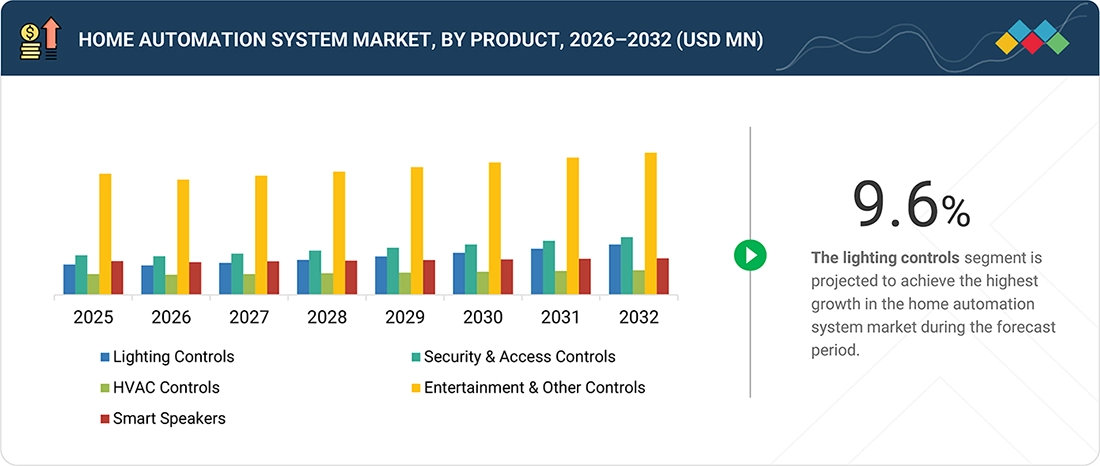
The entertainment & control systems segment accounted for a notable share of the home automation system market in 2025. This growth was driven by increasing demand for smart energy monitoring, HVAC control, and intelligent lighting solutions. Additionally, the adoption of AI- and IoT-based analytics is improving system integration and performance. These technologies also support predictive maintenance and energy-efficient operations across residential and commercial buildings.
Home Automation System Market, By Protocol
The wired segment is estimated to lead market share in 2026. This growth is due to high reliability, stable performance, and secure data transmission of wired systems. Additionally, these systems are less susceptible to signal interference and network congestion. And this makes them ideal for critical functions, such as lighting control, HVAC, and security systems. These solutions are commonly preferred in new residential and commercial buildings where wiring can be integrated during construction. Additionally, wired protocols offer long-term durability and require less maintenance, which supports their continued dominance in the market.
Home Automation System Market, By Installation Type
The new segment dominated the home automation system market in 2025. The growth of the segment is supported by the rapid development of energy-efficient housing projects and smart residential communities. Additionally, builders are increasingly integrating AI-enabled systems for energy management, lighting control, and home security at the construction stage. This reduces installation complexity and overall costs compared to retrofitting. As a result, new installations continue to drive strong market adoption.
Home Automation System Market, By System Type
The behavioral segment accounted for a notable share of the home automation system market in 2025. The growth of the market is supported by the increasing use of connected devices and mobile apps for real-time monitoring and comfort control. Consumers rely on these solutions to track energy usage and manage home systems manually. At the same time, the proactive segment is gaining traction with AI-driven automation platforms. These systems can predict usage patterns, reduce energy consumption, and improve overall sustainability performance.
Home Automation System Market, By Residence Type
The multi-family segment is projected to lead market share during the forecast period. This growth is due to the high concentration of housing units and faster technology adoption in urban areas. Apartments and condominiums benefit from shared infrastructure, which reduces per-unit installation and maintenance costs. Property developers increasingly integrate smart lighting, access control, energy management, and security systems during construction. Additionally, centralized monitoring and management make home automation more efficient in multi-family residential buildings, supporting their dominant market position.
HOME AUTOMATION SYSTEM MARKET REGION
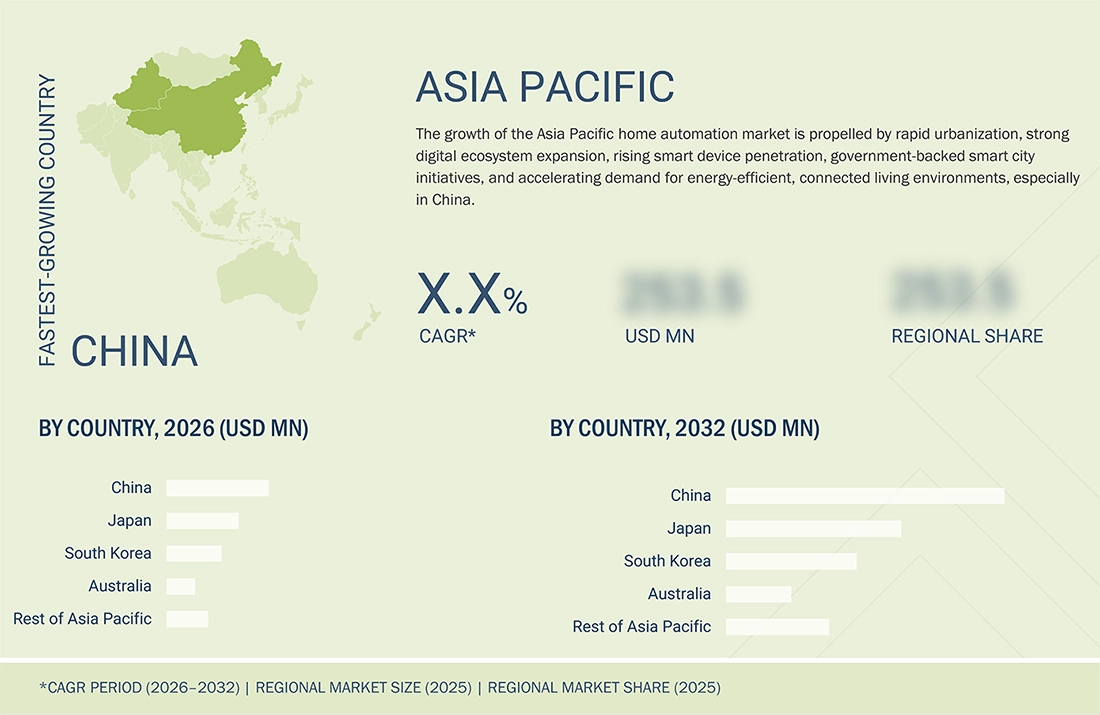
Asia Pacific is projected to be the fastest-growing region across the home automation system market during the forecast period
The Asia Pacific region is experiencing the fastest growth in the home automation system industry, driven by strong government initiatives for smart city development, rapid digital adoption, and expanding urban infrastructure. China is at the forefront of large-scale IoT deployments, high-speed connectivity upgrades, and nationwide smart home programs, which are accelerating adoption in residential and mixed-use buildings. Additionally, government incentives for energy-efficient housing, along with advancements in AI-driven automation, smart security, and climate control systems, are further fueling this growth. Moreover, the increasing use of renewable energy integration, smart metering, and cloud-based home management platforms is enhancing household efficiency and comfort throughout the region.
The North America Home Automation System Market is projected to reach USD 25.74 billion by 2030 from USD 19.79 billion in 2025, at a CAGR of 5.4% from 2025 to 2030. The regional market is driven by the rising demand for convenience, safety, and energy efficiency among homeowners. High penetration of smartphones, broadband internet, and connected devices supports easy adoption of automated home systems.
The Europe home automation system market is projected to reach USD 18.23 billion by 2030 from USD 14.41 billion in 2025, at a CAGR of 4.8%. Growth is being fueled by increasing demand for comfort, security, and energy savings. Widespread use of smartphones, reliable broadband, and connected devices makes it easier to adopt home automation solutions. Rising energy prices and sustainability goals are boosting demand for smart lighting, HVAC, and energy management systems. Additionally, strong participation from major technology players and the availability of DIY installation options are accelerating market expansion.
HOME AUTOMATION SYSTEM MARKET SIZE, SHARE & GROWTH: COMPANY EVALUATION MATRIX
In the home automation system companies, Schneider Electric (Star) is a leader with a strong global presence and a comprehensive product portfolio. The company has proven expertise in integrated building automation, energy management, and smart electrical systems designed for residential use. Loxone Electronics GmbH (Emerging Leader) is gaining momentum by introducing innovations in wired and wireless hybrid automation. It offers intuitive central control servers and highly customizable solutions for lighting, shading, heating, and security.
Source: Secondary Research, Interviews with Experts, MarketsandMarkets Analysis
HOME AUTOMATION SYSTEM MARKET KEY PLAYERS
- Johnson Controls (Ireland)
- Schneider Electric (France)
- Siemens (Germany)
- Resideo Technologies Inc. (US)
- Legrand (France)
- ASSA ABLOY (Sweden)
- Apple (US)
- ADT (US)
- Robert Bosch (Germany)
- ABB (Switzerland)
HOME AUTOMATION SYSTEM MARKET SCOPE
| REPORT METRIC | DETAILS |
|---|---|
| Market Size in 2025 (Value) | USD 55.05 BN |
| Market Forecast in 2032 (Value) | USD 80.73 BN |
| Growth Rate | 5.8% |
| Years Considered | 2021–2032 |
| Base Year | 2025 |
| Forecast Period | 2026–2032 |
| Units Considered | Value (USD BN), Volume (Million Units) |
| Report Coverage | Revenue forecast, company ranking, competitive landscape, growth factors, and trends |
| Segments Covered |
|
| Regional Scope | North America, Europe, Asia Pacific, Rest of the World |
WHAT IS IN IT FOR YOU: HOME AUTOMATION SYSTEM MARKET REPORT CONTENT GUIDE
DELIVERED CUSTOMIZATIONS
We have successfully delivered the following deep-dive customizations:
| CLIENT REQUEST | CUSTOMIZATION DELIVERED | VALUE ADDS |
|---|---|---|
| Smart Home Device Manufacturer |
|
|
| Energy Utility/Smart City Authority |
|
|
| Technology Provider/IoT Integrator |
|
|
RECENT DEVELOPMENTS
- January 2025 : Resideo launched the Home X2S Smart Thermostat. The Matter-enabled and ENERGY STAR-certified thermostat can be integrated with Amazon Alexa, Google Home, and Apple Home.
- November 2024 : Resideo launched the new Honeywell Home FocusPRO series of thermostats. The series includes non-programmable, programmable, and smart models with a focus on simple design, user-friendly interface, and energy efficiency.
- September 2024 : Schneider Electric launched an AI-powered energy management feature for its Wiser Home app, designed to optimize energy consumption for homeowners.
Table of Contents
 Exclusive indicates content/data unique to MarketsandMarkets and not available with any competitors.
Methodology
The research study involved four major activities in estimating the size of the global home automation system market. Exhaustive secondary research was done to collect important information about the market and peer markets. The validation of these findings, assumptions, and sizing with the help of primary research with industry experts across the supply chain was the next step. Both top-down and bottom-up approaches were used to estimate the market size. Thereafter, the market breakdown and data triangulation were adopted to estimate the market sizes of segments and sub-segments.
Secondary Research
In the secondary research process, various secondary sources were referred to for identifying and collecting information required for this study. The secondary sources include annual reports, press releases, investor presentations of companies, white papers, and articles from recognized authors. Secondary research was done to obtain key information about the market’s supply chain, the pool of key market players, market segmentation according to industry trends, regional outlook, and developments from both market and technology perspectives. In the global home automation system market report, the global market size was estimated using the top-down and bottom-up approaches, along with several other dependent submarkets. Major players in the market were identified using extensive secondary research, and their presence in the market was determined using secondary and primary research. All the percentage shares, splits, and breakdowns were determined using secondary sources and verified through primary sources.
Primary Research
Extensive primary research was conducted after understanding the global home automation system market scenario through secondary research. Several primary interviews were conducted with key opinion leaders from demand- and supply-side vendors across four major regions: North America, Europe, Asia Pacific, and the Rest of the World. Approximately 25% of the primary interviews were conducted with the demand-side vendors and 75% with the supply-side vendors. Primary data was collected mainly through telephonic interviews, which consist of 80% of the total primary interviews; questionnaires and emails have also been used to collect the data.
After successful interaction with industry experts, brief sessions were conducted with highly experienced independent consultants to reinforce the findings of our primary research. This, along with the in-house subject matter experts’ opinions, led us to the findings as described in the report.
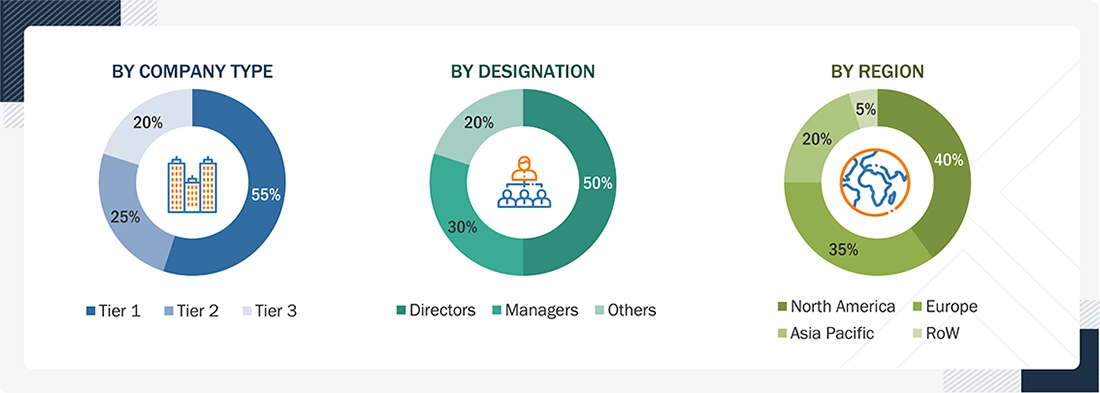
The following is a breakdown of the primary respondents:
Market Size Estimation
In the market engineering process, the top-down and bottom-up approaches, along with data triangulation methods, were used to estimate and validate the size of the home automation and other dependent submarkets.
The research methodology used to estimate the market sizes included the following:
- Identifying top-line investments and spending in the ecosystem, and considering segment-level splits and major market developments
- Identifying different stakeholders that influence the entire market, along with participants across the supply chain
- Analyzing major manufacturers and solution providers in the home automation system market and studying their solutions and service portfolios
- Analyzing trends related to the adoption of home automation solutions and services
- Tracking recent and upcoming market developments, including investments, R&D activities, solution launches, collaborations, acquisitions, and partnerships, as well as forecasting the market size based on these developments and other critical parameters
- Carrying out multiple discussions with key opinion leaders to identify the adoption trends of home automation systems
- Segmenting the overall market into various other market segments
- Validating the estimates at every level through discussions with key opinion leaders, such as chief executives (CXOs), directors, and operations managers, and finally with the domain experts at MarketsandMarkets
Top-Down and Bottom-Up Approach
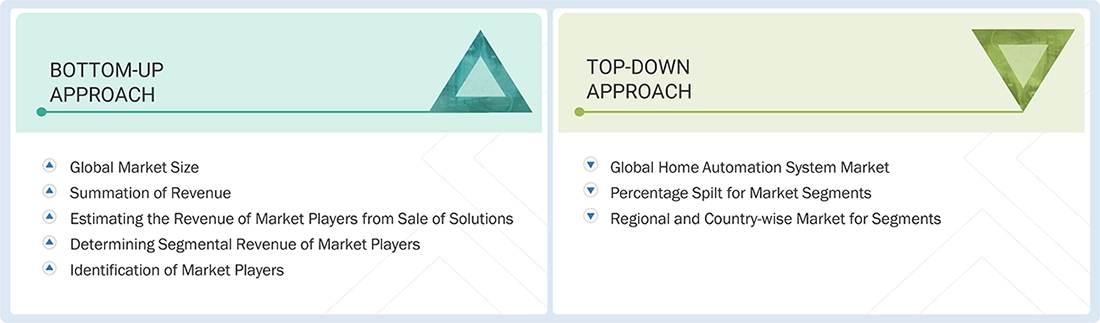
Data Triangulation
After arriving at the overall market size—using the market size estimation processes as explained above—the market was split into several segments and subsegments. To complete the entire market engineering process and arrive at the exact statistics of each market segment and subsegment, data triangulation and market breakdown procedures were employed, wherever applicable. The data was then triangulated by studying various factors and trends from the demand and supply sides in the home automation system market.
Market Definition
A home automation system is a network of hardware, communication, and electronic interfaces that controls home devices to connect them through the internet. Each device comes with built-in sensors. Additionally, Wi-Fi, Bluetooth, or other communication protocols are linked to a central hub or controller to enable users to manage or automatically control multiple systems, appliances, and services either via mobile app or through preset programming. Examples of standard systems are lighting, heating, security, and entertainment systems. Home automation provides increased comfort, improved energy utilization, safety, and control of a home environment. It enables a user to make repetitive tasks automatic, manage their home devices using their smartphone or verbally, and monitor home events live.
Key Stakeholders
- Raw Material and Manufacturing Equipment Suppliers
- Automation and Control Networking Technology Vendors
- Real Estate Builders
- System Integrators
- Homeowners
- Project Consultants
- Designers/Consultants (HVAC, Security, and Fire and Safety)
- Component Manufacturers (Sensors and Controls)
- Home Management Solution Providers
- Smart Home-related Associations, Organizations, Forums, and Alliance
- Government Bodies Associated with Green Buildings
Report Objectives
- To define, describe, segment, and forecast the global home automation system market, by product, system type, protocol, residence type, and installation type, in terms of value
- To forecast the market for products, in terms of volume, in the global home automation system market
- To describe the protocols and technologies used for home automation in the global home automation system market
- To describe and forecast the global home automation system market for various segments across North America, Europe, Asia Pacific, and RoW, in terms of value
- To provide detailed information regarding the drivers, restraints, opportunities, and challenges influencing the growth of the global home automation system market
- To provide a detailed overview of the home automation market’s supply chain, along with the ecosystem, technology trends, use cases, regulatory environment, and Porter’s five forces analysis
- To analyze industry trends, pricing data, patents, innovations, and trade data (export and import data) related to the global home automation system industry
- To strategically analyze the micromarkets with respect to individual growth trends, prospects, and contributions to the total global home automation system market
- To strategically profile the key players and comprehensively analyze their market shares and core competencies
- To analyze opportunities for stakeholders and provide a detailed competitive landscape of the global home automation system market
- To analyze competitive developments, such as product launches/developments, collaborations, partnerships, acquisitions, and research & development (R&D) activities carried out by players in the global home automation system market
Available customizations:
With the given market data, MarketsandMarkets offers customizations according to the specific requirements of companies. The following customization options are available for the report:
- Detailed analysis and profiling of additional market players based on various blocks of the supply chain
Key Questions Addressed by the Report
What is the projected market size of the home automation control systems market?
The market is projected to reach USD 80.73 billion by 2032, growing at a CAGR of 5.8% from 2026 to 2032.
What are the key drivers of the home automation control systems market?
Growth is driven by rising demand for convenience, energy efficiency, and smart home security, along with increasing adoption of IoT and smartphones.
Which segment dominates the home automation control systems market?
Multi-family residential systems hold a larger share due to cost efficiency, shared infrastructure, and higher adoption in urban housing projects.
What are the major challenges in the home automation market?
High initial installation costs and system complexity, along with cybersecurity concerns, remain key barriers to adoption.
Who are the key stakeholders in the home automation ecosystem?
Key stakeholders include device manufacturers, system integrators, real estate developers, technology providers, and end users.
Need a Tailored Report?
Customize this report to your needs
Get 10% FREE Customization
Customize This ReportPersonalize This Research
- Triangulate with your Own Data
- Get Data as per your Format and Definition
- Gain a Deeper Dive on a Specific Application, Geography, Customer or Competitor
- Any level of Personalization
Let Us Help You
- What are the Known and Unknown Adjacencies Impacting the Home Automation System Market
- What will your New Revenue Sources be?
- Who will be your Top Customer; what will make them switch?
- Defend your Market Share or Win Competitors
- Get a Scorecard for Target Partners

Custom Market Research Services
We Will Customise The Research For You, In Case The Report Listed Above Does Not Meet With Your Requirements
Get 10% Free CustomisationTESTIMONIALS

Tetsuya Ohhira
Business Development Manager-Technology Business
Nikon Corporation,
Leading Japanese MNC specializing in optics and imaging productswww.nikon.com
MarketsandMarkets™ response
is quick. Their attitude is flexible and positive. Analyst Insights are globally considered and
significant. Client Services quickly respond to our inquiry and demand. Their wide range of global
surveys help us make our strategic plan.
We hope Knowledge Store will be easier to search
for a report.
VP - Marketing & Business Development
Leading Provider of Process Control Solutions
We engaged with MarketsandMarkets on a study to perform an analysis and recommend a Go-To-Market strategy for metrology and process control in the semiconductor market. The study was tailored to our targets and needs with well-defined milestones. Our overall experience with the MarketsandMarkets team was very good throughout the project in all aspects including the analysis methodologies used, the quality and depth of primary and secondary data sets, the professionalism and flexibility of the team and the ability to meet the target schedule and milestones. We want to thank MarketsandMarkets team for a job well done.
Growth opportunities and latent adjacency in Home Automation System Market

Still Researching the
Home Automation System Ecosystem?
See the competitors, opportunity evaluation, and growth signals shaping it - Instantly!
Generate 15+ consulting-grade strategic intelligence outputs - from competitor analysis to board-ready strategy decks, tailored to your Home Automation System growth question.




Daniel
Jan, 2014
I am interested to know ongoing trends in home & building automation industry. Also, the difference between IP-based systems versus vintage proprietary closed systems like BACnet, LON, Crestron, AMX, etc..
Sureshchandra
Jun, 2014
We are in the field of security control and home automation solutions as system integrators .We are interested to have idea of market potential globally..
Benedikt
Nov, 2012
I am interested to know, what are the key players and new entry players strategies in home automation market..
Mark
Jul, 2015
Interested in data such as market forecast by solutions, competitive trends , key competitors, installation or purchase type in Canadian home automation market..
Brandon
Apr, 2026
How is Artificial Intelligence transforming home automation systems and smart homes?.
Kenneth
Apr, 2026
What are the biggest challenges or barriers to adopting home automation systems?.
Ronald
Apr, 2026
Which products (lighting, security, HVAC, smart speakers) dominate the home automation market?.
Michael
Sep, 2011
I would like to have a call to understand the data sources and methodology used, and overview of your research needs. When would you be available for a call? .
Girish
Feb, 2014
I am doing a project in the field of home automation, as part of that I needed some idea about the industry, trends and major challenges related to home automation. Any assistance will be greatly appreciated!.
Bruno
Oct, 2016
We are interested to publish an article related to home automation in our upcoming month issue, so can you share a detailed summary or article on same?.
smruti
Nov, 2017
After implementing artificial intelligence, What are the future impacts on the demand of home automation solutions?.
User
Sep, 2019
I am interest to understand the home automation system market. Also, want to understand the company profiles of leading players with focus on their annual turnover ?.
Barb
Jul, 2015
Table of Contents suggests the report gives a breakdown of regions, one of which is North America which includes Mexico. But does it lump Mexico in with North America? Or does the report give the market size in Mexico, US, and Canada broken down by country? .
Sameh
Jun, 2014
I am doing a research on the strategies of key players in home automation or smart home market, so will be interested in the analysis of the 20 key players in this market..
Roberto
Jan, 2015
We are manufacturing HAVC & Lighting Control and interested in a depth market analysis for entering in the US home automation market. .
Connor
Mar, 2014
Can you provide the data related to the upcoming products in retrofit window coverings and lighting devices market, which will easily integrated with home automation systems?.
Michael
Feb, 2013
HI, I am a university researcher and working on the home automation market for a research purpose. Would it be possible to get a copy of this report? .
Michael
Feb, 2013
I am an university student and doing research on the home automation market. Would it be possible to get understanding on same? Please let me know, if you can share some insights. .
Michael
Dec, 2013
We are performing a market assessment on the US smart homes We are interested in penetration growth and ARPU growth by product type (e.g. monitored home security, HVAC management, lighting control, access control, etc.). We're also interested in customer purchasing preferences (DIY vs. professional install) and who is best positioned to win in this space . We're comparing our products with some of competitors, so any information you can provide about the competitors strategies related to this market. Also, we're heavily budget constrained, so I'd be interested in whatever price breaks you can provide as well..
User
Sep, 2019
till what extend , the growth of IoT based solutions will drive the growth for home automation system market . Also, there is any role of AI in this market? If, yes then what is that. .
HEMANTH
Jul, 2018
Can I get access for the details of the value chain of the home automation system market present in the report. I will cite the source in my research document with the analyst views..
Eduardo
Nov, 2011
I am a Portuguese student. I am Studying Network Communications, and at the moment writing a thesis whose subject is home automation using wireless sensor networks. This report seems interesting for my research. .
Manuel
May, 2015
I'm developing home connected products using Internet of things technology. While we launch our products into the market, I would like to study a little the home automation market globally..
User
Sep, 2019
Would like to know market opportunities for home automation systems and government regulations for the Middle Eastern counties? Also, the cost of these home automation solutions in this region?.
Sureshchandra
Aug, 2014
US is the leader in the smart home market. How do you look towards the market in Middle East, and use of home automation solutions in this region? Have you provided the estimates for solutions in this region?.
Wolfgang
Jul, 2015
Interested in global home automation market overview with emphasis on control technologies and interfaces (remote access & control). .
nathan
Mar, 2016
I am a college student and require to do market research for home automation Solutions. Can you help me to understand the market? .
nathan
Mar, 2016
till what extend, the growth of IoT based solutions will drive the growth for home automation system market. Also, there is any role of AI in this market. If, yes then what is that?.
joydip
Feb, 2015
Are we getting a report with editable MS Excel calculation sheet to understand the market for home automation? .
nello
Dec, 2018
Please help me with research methodology of home automation systems market calculations? Also, the market share for the key players who deal in home automation market?.
User
Nov, 2019
Please help me with research methodology of home automation systems market calculations? Also, the market share for the key players who deal in home automation market ?.
Tom
Nov, 2016
Our client is dealing in window & door automation and energy saving solutions for home automation. We are currently focusing on partnerships with strategic entities in the "smart home "market , any specific marketing, media or consumer sales info related to market will help us to target the correct ones. .
Manuel
Nov, 2019
I am interest to understand the home automation system market. Also, want to understand the company profiles of leading players with focus on their annual turnover. .
Connor
Nov, 2014
We are focusing on home automation devices that aren't necessarily part of centralized hub controllers. Also, the market for devices designed by third parties that integrate with home automation systems. .
Adeleke
Oct, 2019
I need information regarding the current size and potential of the home automation market in Nigeria and West Africa..
Leandro
Sep, 2019
I am planning to enter in the home automation business, so I need more information to analyze the market. .
Sreepriya
Sep, 2022
We are manufacturers in this segment and would like to understand more about the industry. .
Victor
Sep, 2013
till what extend, the growth of IoT based solutions will drive the growth for home automation system market. Also, there is any role of AI in this market? If, yes then what is that. .
Victor
Sep, 2013
Is this study will help to compare the energy savings of traditional renovation methods and demand side management implementation in buildings? Also, there is any market share for the retrofit installations of home automation solutions?.
Leor
Aug, 2019
I am interested in the market share and role of Creston System in home automation market. Do you provide the details as customization?.
Greg
Jul, 2014
Is it possible to buy a section of the report or profiles on specific companies contained with in the report? Our project doesn't have much budget, but it might be helpful to get useful insights about the key players of home automation market. .
glenn
Jul, 2019
Intending to research on publicly-traded and private, middle-market firms who are focused in these aforementioned markets. Can MarketsandMarkets provide the information? .
Christopher
Jun, 2017
I am interested specifically in the growth in terms of the African market and more specifically the SADC member states aiming specifically at Domestic Garage and Gate Acres and security. .
Stephen
Jun, 2013
Would like to know market opportunities for home automation systems and government regulations for the Middle Eastern counties? Also, the cost of these home automation solutions in this region?.
Jevon
May, 2013
I am interested in lighting control, HVAC control, and Security solutions mentioned in this study. .
dario
May, 2015
Can I get a separate study related to Italian home automation market? .
User
Mar, 2019
Is this study will help to compare the energy savings of traditional renovation methods and demand side management implementation in buildings? Also, there is any market share for the retrofit installations of home automation solutions?.