Connected Motorcycle Market

Connected Motorcycle Market by Hardware (Embedded & Tethered/Integrated), Network Type (3G/4G, 5G), Two-wheeler Type, Propulsion Type, End User, Application (Safety & Security, Navigation, Infotainment), and Region – Global Forecast to 2033




OVERVIEW
Source: Secondary Research, Interviews with Experts, MarketsandMarkets Analysis
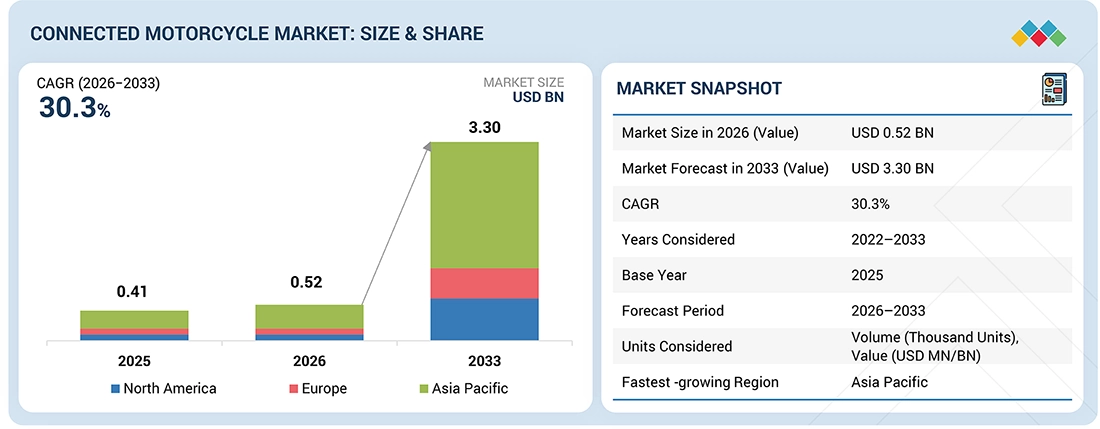
The connected motorcycle market is estimated to grow from USD 0.52 billion in 2026 to USD 3.30 billion in 2033, at a CAGR of 30.3%. The connected motorcycle market is evolving as motorcycle electronics become increasingly data-centric, with the telematics control unit, GNSS tracking, eSIM connectivity, vehicle sensors, BMS, and cloud platforms forming an integrated data chain between the vehicle and backend systems. The key market shift is the movement from smartphone-linked functions toward continuous vehicle connectivity, enabling remote diagnostics, vehicle health monitoring, predictive maintenance, anti-theft systems, rider analytics, vehicle tracking, and OTA updates throughout the vehicle lifecycle. In electric two-wheelers, direct BMS connectivity and battery connectivity are creating additional data streams for battery state-of-charge monitoring, range monitoring, EV remote diagnostics, and EV OTA updates, increasing the value of EV telematics. At the same time, 5G and advanced cellular connectivity are enabling faster data exchange for smart motorcycles, connected electric motorcycles, connected scooters, and cloud-connected motorcycles, positioning connectivity as an underlying digital architecture for connected mobility rather than an isolated vehicle feature.
KEY TAKEAWAYS
-
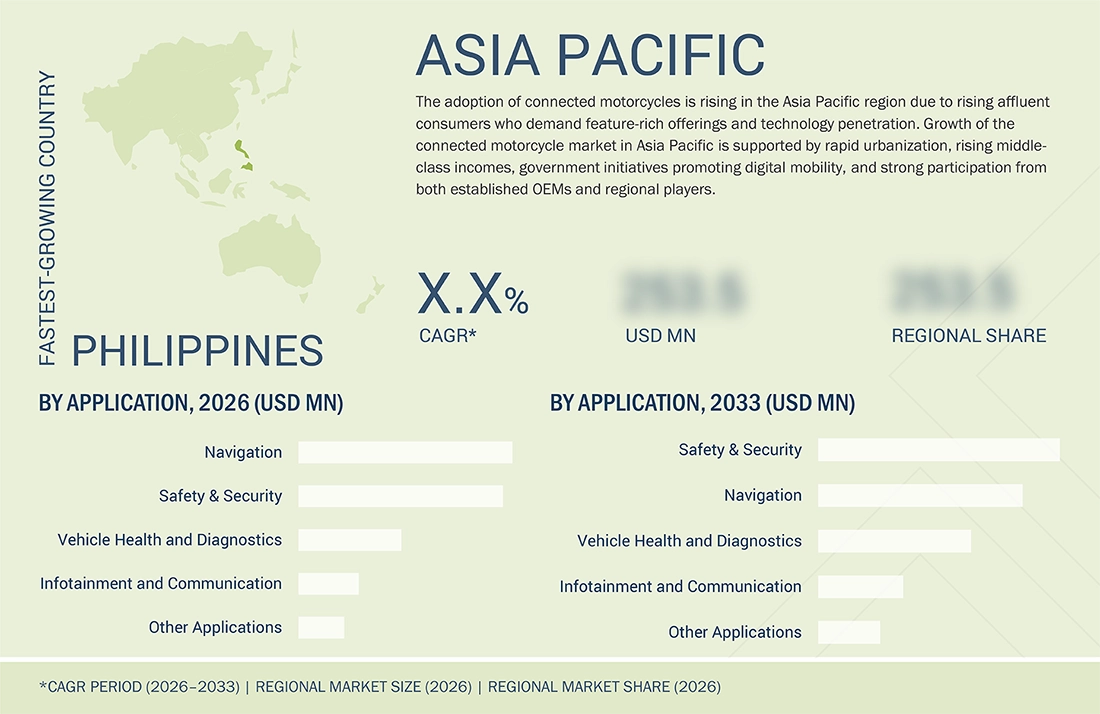
By RegionThe connected motorcycle market in Asia Pacific is projected to reach 29,287.5 thousand units by 2033, growing from 10,161.3 thousand units in 2026 at a CAGR of 16.3%.
-
Two-wheeler TypeThe motorcycle market expanded from 4,328 thousand units in 2026 to 13,822 thousand in 2033, registering a CAGR of 17.5%.
-
Hardware TypeThe embedded segment is projected to grow from 1,205.0 thousand units in 2026 to 16,484.9 thousand by 2033.
-
PropulsionICE-powered connected motorcycles will remain dominant in the coming years. As a result, the ICE segment is projected to grow from 7,478.2 thousand units in 2026 to 23,449.1 thousand units by 2033, at a CAGR of 17.7%.
-
Network TypeThe 3G/4G segment is projected to expand from 3,554 thousand units in 2026 to 12,049 thousand units by 2033, at a CAGR of 19.1%.
-
End UserThe private segment is projected to grow from 7,012 thousand units in 2026 to 18,369 thousand units by 2033 at a CAGR of 14.75% during the forecast period.
-
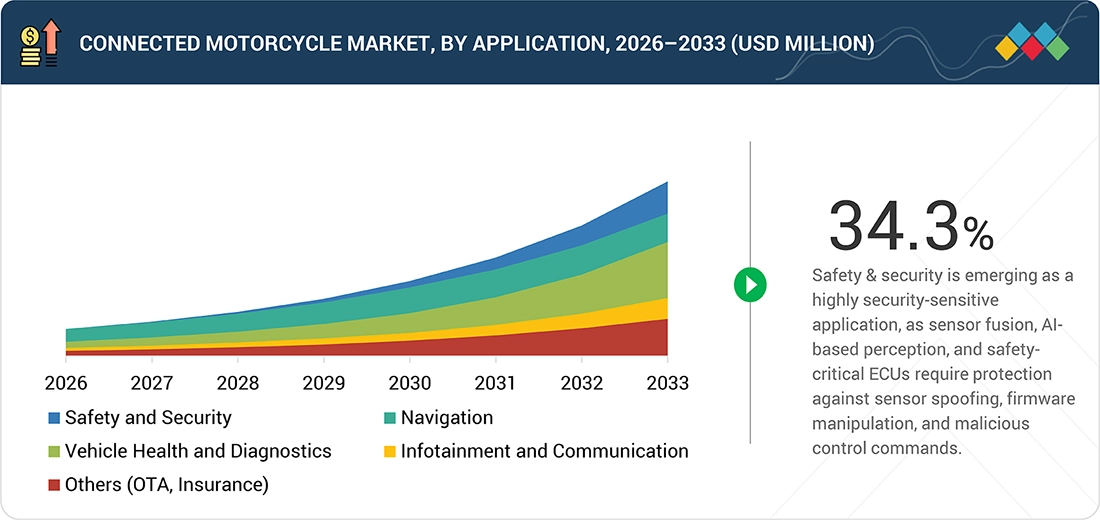
ApplicationSafety & Security is projected to grow from USD 169.9 million in 2026 to USD 1,095.4 million in 2033 at a 30.5% CAGR
-
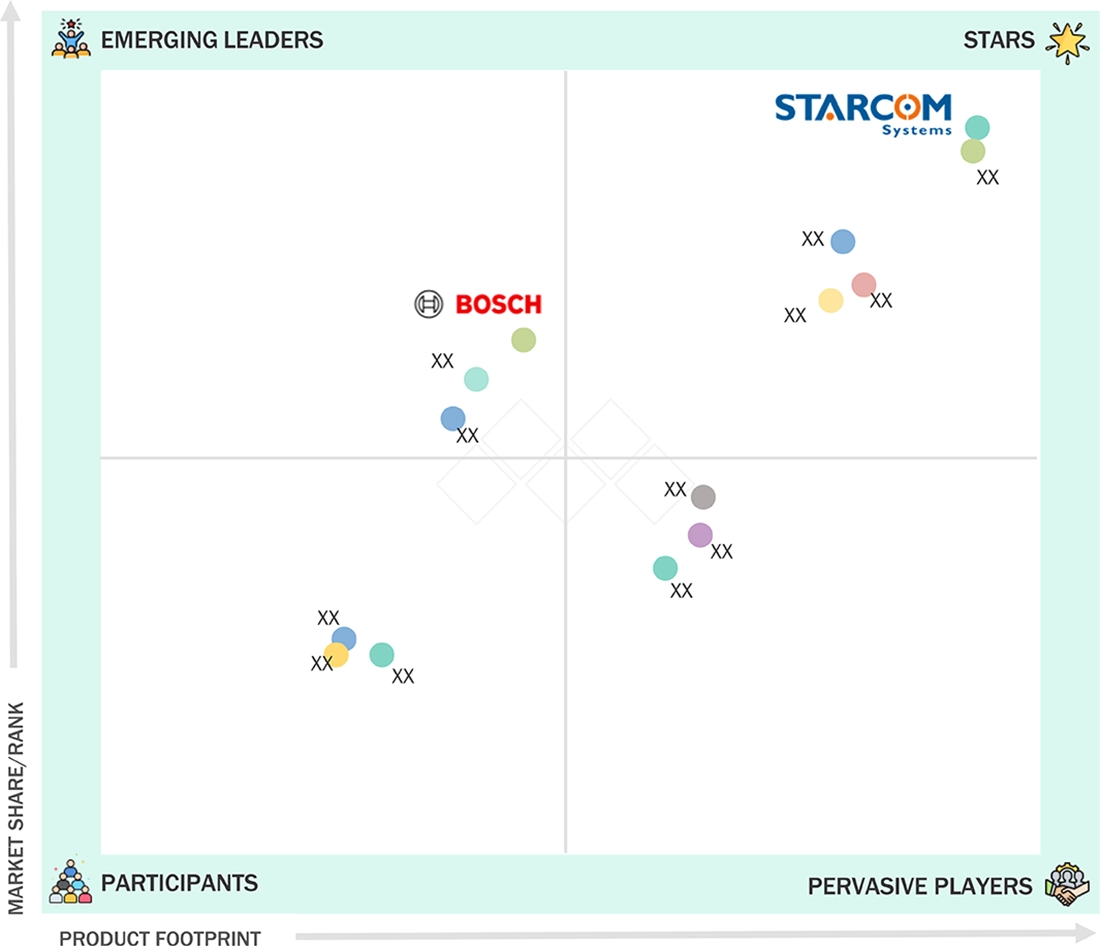
Competitive LandscapeStarcom System is categorized as Star Player and Robert Bosch is segmented as an Emerging Leader
The connected motorcycle market is being driven by rapid adoption of motorcycle telematics, integrated connectivity, 5G, and cloud connected motorcycles, with Asia Pacific leading on volume and growth. EV adoption is increasing demand for BMS connectivity, battery state of charge monitoring, range monitoring, EV remote diagnostics, and EV OTA updates, while integrated TCUs are expanding applications such as vehicle tracking, remote diagnostics, predictive maintenance, anti theft systems, and rider analytics. Revenue is gradually shifting from hardware sales toward recurring software, connectivity, data, and digital services, while cybersecurity and connectivity costs remain key constraints.
TRENDS & DISRUPTIONS IMPACTING CUSTOMERS' CUSTOMERS
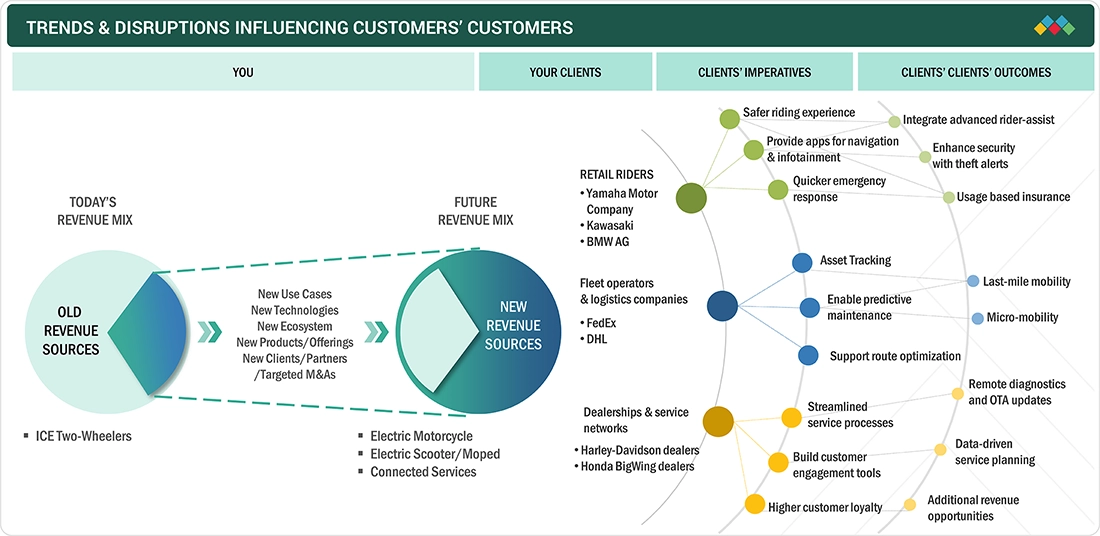
The connected motorcycle ecosystem is shifting from ICE vehicle sales toward electric two-wheelers, connected services, and software-enabled revenue, with the projected mix moving from 80% ICE-focused revenue today to 80% electric and digital revenue within 4 to 5 years. This shift is expanding monetization across the vehicle lifecycle through OTA updates, remote diagnostics, predictive maintenance, asset tracking, rider analytics, navigation, insurance, and data-driven service planning. For OEMs and ecosystem providers, the key strategic change is the transition from one-time vehicle revenue to recurring software, connectivity, data, maintenance, and subscription revenue, increasing lifetime customer value across retail, fleet, and service channels.
Source: Secondary Research, Interviews with Experts, MarketsandMarkets Analysis
MARKET DYNAMICS

Level
-
Growing OEM Integration of Telematics and Connected Services

-
Rising Adoption of Connected Electric Two-Wheelers


Level
-
High Cost and Limited Willingness to Pay

-
Fragmentation of Connectivity Ecosystems


Level
-
Growth of Connected-Service Monetization

-
Expansion of Connected Diagnostics and Aftermarket Telematics


Level
-
Rising Cybersecurity Risks

-
Increasing Software and OTA Complexity

Source: Secondary Research, Interviews with Experts, MarketsandMarkets Analysis
Driver: Growing OEM Integration of Telematics and Connected Services
Factory integration is expanding telematics from rider features to vehicle-level intelligence. OEMs are increasingly integrating telematics control units, GNSS, eSIM connectivity, vehicle sensors, and cloud platforms directly with motorcycle electronics, enabling continuous data exchange across remote diagnostics, vehicle health monitoring, vehicle tracking, anti-theft systems, rider analytics, and OTA updates. Integration with BMS also extends these capabilities to connected electric motorcycles and scooters, where battery state of charge, range, charging, and vehicle health data can be monitored remotely.
Restraint: High Cost and Limited Willingness to Pay
High connectivity hardware and service costs are limiting adoption beyond premium two-wheelers. The cost of TCUs, cellular modules, eSIM connectivity, GNSS hardware, cloud infrastructure, and software maintenance can materially increase vehicle cost, while many two-wheeler customers have limited willingness to pay for subscription-based connected services. This is particularly restrictive in price-sensitive markets, where OEMs must balance connectivity investment against demand for core vehicle performance, resulting in selective deployment of motorcycle telematics and connected vehicle platforms.
Opportunities: Growth of Connected-Service Monetization
Recurring connected services are creating new revenue streams beyond motorcycle sales. OEMs and technology providers are increasingly monetizing vehicle data through remote diagnostics, predictive maintenance, fleet management, premium navigation, vehicle tracking, anti-theft services, rider analytics, and OTA-enabled features. For EVs, EV telematics, BMS connectivity, battery monitoring, range monitoring, and EV remote diagnostics can support subscription-based services, allowing connected motorcycles to generate revenue throughout the vehicle lifecycle rather than only at the point of sale.
Challenge: Increasing Software and OTA Complexity
Greater vehicle connectivity is expanding the attack surface across motorcycle electronics and cloud systems. The integration of cellular connectivity, eSIMs, GNSS, smartphone applications, cloud platforms, TCUs, and OTA updates increases the number of interfaces attackers can target. Unauthorized access to vehicle data or communication pathways can compromise vehicle tracking, remote diagnostics, anti-theft systems, BMS connectivity, and OTA functions, requiring OEMs to strengthen secure communication, authentication, access control, software integrity, and continuous vulnerability monitoring across the connected motorcycle architecture.
CONNECTED MOTORCYCLE MARKET: COMMERCIAL USE CASES ACROSS INDUSTRIES
| COMPANY | USE CASE DESCRIPTION | BENEFITS |
|---|---|---|
 |
Starcom Systems provides motorcycle-specific GPS and cellular telematics through its Helios platform, enabling vehicle location, condition monitoring, battery and range monitoring, and remote software updates. (t42 Tracking Solutions) | The solution enables continuous vehicle tracking, vehicle health monitoring, theft protection, and remote powertrain management, while allowing OEMs to integrate connectivity during motorcycle production. |
 |
Comodule provides an end-to-end IoT connectivity platform for electric two-wheelers, combining connectivity hardware, cloud software, GPS tracking, ride data, remote diagnostics, and OTA updates, with its technology demonstrated on CAKE electric motorbikes. (Comodule: IoT for E-bikes) | The platform enables remote vehicle monitoring, theft protection, predictive service support, battery monitoring, and continuous software enhancement, while giving OEMs a scalable connectivity architecture. |
 |
KPIT provides a connected motorcycle platform combining embedded software, smartphone applications, cloud infrastructure, analytics, and machine learning to support navigation, ride planning, vehicle tracking, and service reminders. (KPIT) | The platform enables OEMs to integrate vehicle data with digital rider services, improving connected mobility, remote vehicle management, rider engagement, and software-based service delivery. |
 |
Ituran provides motorcycle and scooter telematics combining real time GPS tracking, theft detection, geofencing, motion sensing, remote monitoring, and mobile application control. (Ituran) | The solution strengthens anti theft systems and vehicle security, while enabling real time vehicle tracking, faster stolen vehicle recovery, rider notifications, and recurring digital services. |
 |
e-Novia has developed motorcycle focused digital solutions including Ducati Link and Brembo TrackTribe, using vehicle data, GPS, telemetry, and connected applications to deliver ride performance analysis and digital rider services. (Ducati) | These solutions enable ride analytics, performance monitoring, digital rider engagement, and data-driven riding services, helping motorcycle manufacturers create differentiated software-based experiences. |
Logos and trademarks shown above are the property of their respective owners. Their use here is for informational and illustrative purposes only.
MARKET ECOSYSTEM
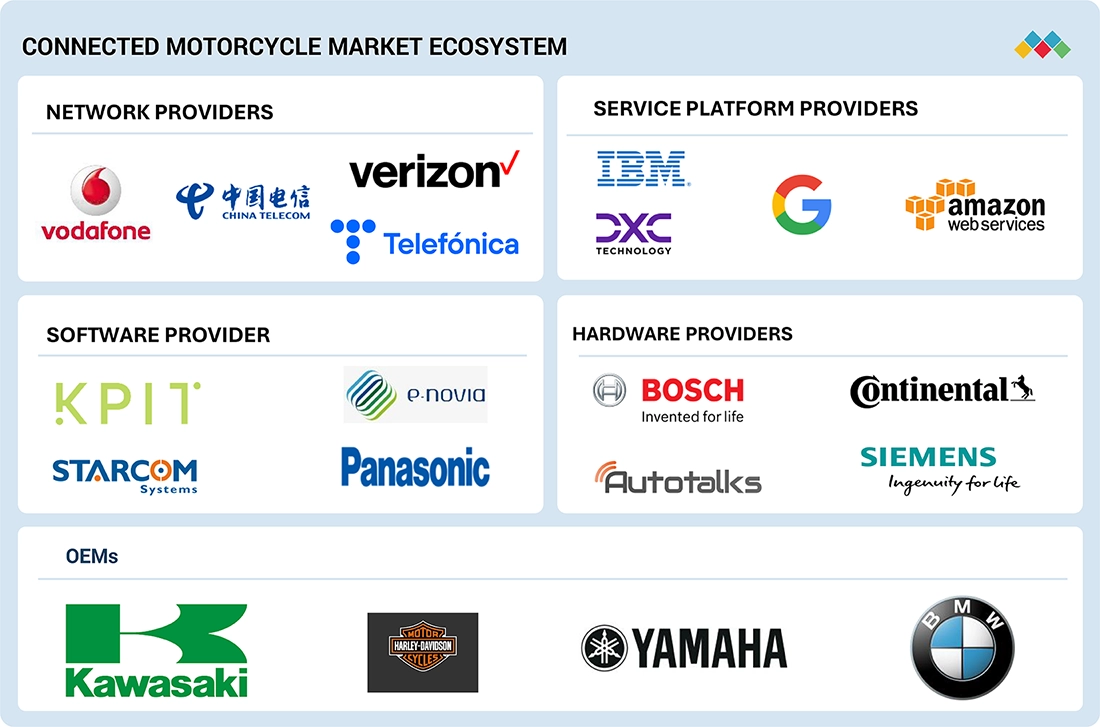
The market ecosystem is becoming a closely integrated value chain. OEMs such as BMW, Kawasaki, Honda, and Yamaha are leading by enhancing the riding experience through proprietary apps and cloud-connected control units. At the same time, Vodafone Automotive and China Telecom provide connectivity through eSIM, coverage, and service, which are essential for large deployments. Service-platform providers such as Amazon, Google Cloud, and IBM serve as the foundation for data security, data analytics, and over-the-air updates. These services offer fast deployment of diagnostics, safety, and subscription services. Special-purpose software providers like Starcom Systems cater to the aftermarket and fleet telematics. Hardware providers, such as Bosch, Panasonic, and Harman, produce connected control units, digital instrument clusters, and emergency-call modules for two-wheelers. Together, these players are a worldwide integrated value chain that helps to provide connectivity, cloud analytics, and hardware innovations to create new revenue models, boost end user safety, and cater to the burgeoning demand for connected and electric two-wheelers.
Logos and trademarks shown above are the property of their respective owners. Their use here is for informational and illustrative purposes only.
MARKET SEGMENTS
Source: Secondary Research, Interviews with Experts, MarketsandMarkets Analysis
Connected Motorcycle Market, by Two-wheeler Type
The two-wheeler type motorcycle is the fastest-growing segment. Rising adoption of digitally equipped mid- and premium motorcycles is increasing the integration of motorcycle telematics, GNSS tracking, ride analytics, navigation, and connected vehicle platforms, creating higher connectivity content per motorcycle than basic commuter two-wheelers. BMW Motorrad integrates connectivity with its TFT-based rider interface, supporting navigation, route recording, vehicle information, and service functions.
Connected Motorcycle Market, Hardware
By hardware, embedded is the fastest-growing segment. OEMs are increasingly integrating telematics control units, cellular connectivity, GNSS, and eSIM connectivity into the motorcycle electrical architecture, enabling continuous vehicle data exchange without dependence on an external device or smartphone. Continental's Connected Infotainment Box combines 4G LTE, GNSS, CAN connectivity, and cloud communication for motorcycle applications.
Connected Motorcycle Market, Propulsion
By propulsion, ICE is the fastest-growing segment. The large installed base of ICE motorcycles is becoming progressively connected through TCUs, GPS tracking, remote diagnostics, anti-theft systems, and OTA updates, creating a much larger near-term connectivity retrofit and factory-fit opportunity than the smaller EV parc. Ituran provides motorcycle telematics combining GPS tracking, theft detection, geofencing, and remote monitoring for ICE two-wheelers.
Connected Motorcycle Market, Network Type
By network type, 5G is the fastest-growing segment. Increasing data exchange between TCUs, cloud-connected motorcycles, rider applications, and connected vehicle platforms is driving demand for higher-bandwidth, lower-latency connectivity, particularly for real-time diagnostics, cloud services, and OTA updates. HARMAN Ready Ride uses cellular connectivity, GNSS, cloud services, and OTA capabilities as part of its connected two wheeler platform.
Connected Motorcycle Market, End User
By end user, private is the largest segment. Private riders represent the largest connected vehicle base, with connectivity increasingly bundled into motorcycles to support vehicle tracking, anti-theft systems, navigation and infotainment, emergency assistance, ride analytics, and vehicle health monitoring. Harley-Davidson H-D Connect provides private motorcycle owners with location, security alerts, vehicle status, and service-related information.
Connected Motorcycle Market, Application
By application, safety & security is the largest segment. High motorcycle theft exposure and the need for rapid incident response are making GPS tracking, geofencing, anti-theft systems, emergency assistance, and remote vehicle monitoring among the most commercially relevant connected functions. Honda and Telefónica have implemented IoT-based motorcycle tracking using GPS, SIM connectivity, and movement detection to support theft prevention and recovery.
REGION
Asia Pacific to be the largest region in connected motorcycle market
Asia Pacific is the largest and fastest-growing region in the connected motorcycle market, supported by its massive two-wheeler base and rapid electrification. China and India are accelerating adoption of connected electric scooters, connected electric motorcycles, motorcycle IoT, and two-wheeler IoT, with TCUs, GNSS tracking, eSIM connectivity, BMS connectivity, battery state-of-charge monitoring, EV remote diagnostics, and OTA updates increasingly integrated into vehicles. Southeast Asia is driving demand through delivery and fleet applications that require vehicle tracking, fleet management, anti-theft systems, and remote vehicle monitoring, while Japan and South Korea contribute advanced integrated connectivity, motorcycle telematics, navigation and infotainment, and connected vehicle platforms.
CONNECTED MOTORCYCLE MARKET: COMPANY EVALUATION MATRIX
Starcom Systems is categorized as a Star player because it has a strong product footprint in motorcycle-specific telematics, GPS tracking, cellular connectivity, and remote monitoring, along with established deployments across private and commercial two-wheeler applications, giving it a strong market presence and broad product coverage. Robert Bosch is segmented as an Emerging Leader because Bosch has strong automotive electronics and connectivity capabilities, but its connected motorcycle portfolio remains more selective, resulting in a strong technology position with comparatively narrower motorcycle-specific market penetration and product footprint.
Source: Secondary Research, Interviews with Experts, MarketsandMarkets Analysis
KEY MARKET PLAYERS
- Starcom Systems Ltd.
- Comodule OÜ
- KPIT Technologies
- Ituran Global
- E-Novia S.P.A
- Yamaha Motor Co., Ltd.
- Kawasaki Motors Corp.
- Suzuki Motor Corporation
- Harley-Davidson
- BMW Group
- Robert Bosch GmbH
- Continental AG
- Autotalks
- Panasonic Corporation
- Siemens
MARKET SCOPE
| REPORT METRIC | DETAILS |
|---|---|
| Market Size in 2025 (Value) | USD 0.41 Billion |
| Market Estimation in 2026 (Value) | USD 0.52 Billion |
| Market Forecast in 2033 (Value) | USD 3.30 Billion |
| Growth Rate | CAGR of 30.3% from 2026–2033 |
| Years Considered | 2022-2033 |
| Base Year | 2025 |
| Forecast Period | 2026-2033 |
| Units Considered | Volume (Thousand Units), Value (USD Million/Billion) |
| Report Coverage | Revenue Forecast, Competitive Landscape, Company Share, Growth Factors and Trends |
| Segments Covered | Two-wheeler Type (Motorcycle & Scooter/Moped), Hardware (Embedded & Tethered/Integrated), Propulsion Type (ICE & Electric), Network Type (3G/4G, 5G & Others), End User (Private & Commercial) and Application (Safety and Security, Navigation, Vehicle Health and Diagnostics, Infotainment and Communication & Others (OTA, Insurance)) |
| Regional Scope | Asia Pacific, North America, Europe |
WHAT IS IN IT FOR YOU: CONNECTED MOTORCYCLE MARKET REPORT CONTENT GUIDE
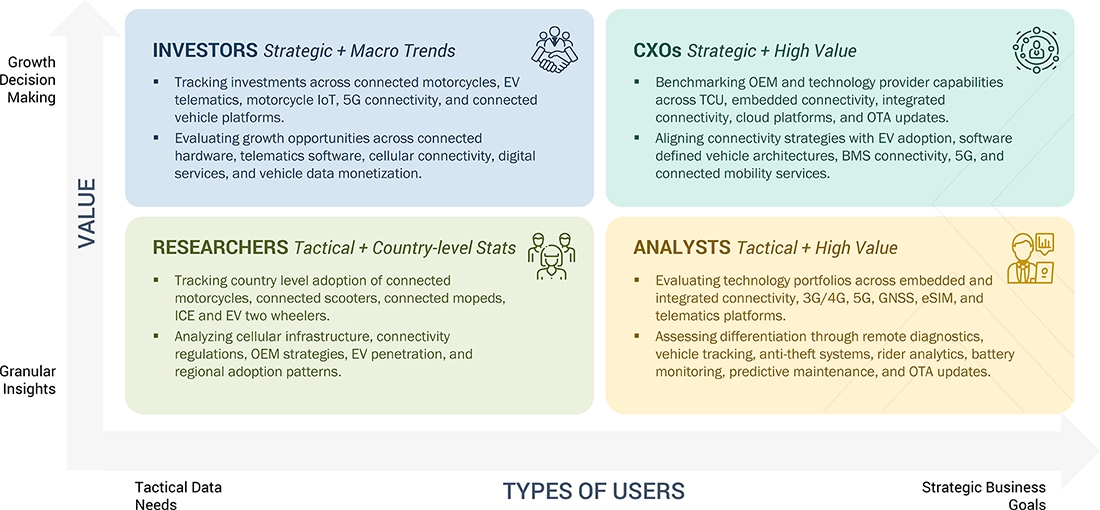
DELIVERED CUSTOMIZATIONS
We have successfully delivered the following deep-dive customizations:
| CLIENT REQUEST | CUSTOMIZATION DELIVERED | VALUE ADDS |
|---|---|---|
| Country-level market assessment | Customized market sizing and forecasts across North America, Europe, Asia Pacific, and Rest of World, covering key markets such as China, India, Japan, Germany, US, UK, and Italy | Enables identification of high growth countries and supports market entry, regional expansion, and investment decisions |
| OEM connected motorcycle benchmarking | Comparative assessment of OEM connectivity strategies covering motorcycle telematics, embedded connectivity, integrated connectivity, connected vehicle platforms, OTA updates, navigation, and anti theft systems | Helps benchmark connectivity maturity and identify technology, product, and capability gaps |
| Connected motorcycle technology analysis | Customized assessment of TCUs, GNSS, GPS tracking, eSIM connectivity, cellular connectivity, 3G/4G, 5G, IoT platforms, cloud connectivity, and vehicle data systems | Supports technology selection, partnership evaluation, and prioritization of connectivity investments |
| Propulsion and powertrain analysis | Mapping of connected motorcycle adoption across ICE and EV, including ICE engine capacity and EV power categories, with assessment of EV telematics, BMS connectivity, battery monitoring, and range monitoring | Identifies high growth powertrain segments and supports product portfolio planning |
| Competitive and ecosystem analysis | Customized profiling of OEMs, technology providers, telematics companies, connectivity providers, IoT companies, and software providers across the connected two wheeler ecosystem | Provides visibility into competitive positioning, technology capabilities, partnerships, and market opportunities |
| Connected motorcycle architecture assessment | Analysis of tethered, embedded, and integrated connectivity architectures, including their interaction with ECUs, instrument clusters, BMS, sensors, smartphones, and cloud platforms | Helps identify emerging architecture trends and supports decisions on connectivity integration and system design |
| Application-specific analysis | Mapping of connectivity applications across remote diagnostics, vehicle tracking, rider analytics, fleet management, predictive maintenance, anti theft systems, vehicle health monitoring, navigation and infotainment, and emergency assistance | Enables prioritization of applications based on customer value, OEM monetization potential, and adoption opportunity |
| Network and connectivity analysis | Assessment of 3G/4G, 5G, and other network technologies, including their suitability for motorcycle telematics, real time tracking, remote diagnostics, and cloud connected motorcycles | Supports network technology selection and identifies opportunities for higher bandwidth and lower latency connectivity |
| EV connected services assessment | Evaluation of connected electric motorcycles and connected electric scooters across battery connectivity, BMS data, state of charge, range monitoring, EV remote diagnostics, and EV OTA updates | Identifies high value EV connectivity applications and supports development of software enabled revenue streams |
RECENT DEVELOPMENTS
- August 2026 : Yamaha Motor Co., Ltd. teased the Yamaha R2 (Motorcycle), which is expected to feature connected motorcycle functionality as part of its digital rider experience.
- July 2026 : Kawasaki Motors, Ltd. launched the Ninja 650 (Motorcycle), retaining Kawasaki's smartphone connectivity functionality through the RIDEOLOGY THE APP, which connects the motorcycle and rider's smartphone to provide vehicle information and related digital functions.
- June 2026 : Harley-Davidson introduced a limited-edition Super Glide motorcycle to celebrate America’s 250th anniversary. This heritage model integrates modern electronics and connectivity-ready platforms for future connected motorcycle features.
- April 2026 : Suzuki Motor USA partnered with Octane Lending to broaden financing options for motorcycle, scooter, and ATV customers in the United States. This collaboration provides Suzuki dealers access to Octane’s comprehensive financing platform, aiming to increase powersports sales and promote the adoption of modern two-wheelers.
- February 2026 : Suzuki Motorcycle India launched a new variant of its popular Access scooter equipped with an anti-lock braking system (ABS). This upgrade enhances braking safety for urban riders and strengthens Suzuki’s technology offering in the mass-market scooter segment.
- January 2026 : KPIT Technologies partnered with Salesforce to expand its Vehicle Relationship Management (VRM) solution globally, leveraging Salesforce’s AI and cloud capabilities. This collaboration focuses on connected vehicle aftersales and lifecycle management for OEMs and fleets, including connected motorcycle platforms.
Table of Contents
 Exclusive indicates content/data unique to MarketsandMarkets and not available with any competitors.
Methodology
The study involved four major activities in estimating the current size of the Connected motorcycle market. Exhaustive secondary research was done to collect information on the market, the peer market, and the parent market. The next step was to validate these findings, assumptions, and sizing with industry experts across value chains through primary research. The top-down and bottom-up approaches were employed to estimate the complete market size. Thereafter, market breakdown and data triangulation processes were used to estimate the market size of segments and subsegments.
Secondary Research
Secondary sources referred to for this research study included Connected Motorcycle Industry organizations; corporate filings such as annual reports, investor presentations, and financial statements; trade and business whitepapers and databases; and articles from recognized associations and government publishing sources. The secondary data was collected and analyzed to arrive at the overall market size, which was further validated by primary research.
Primary Research
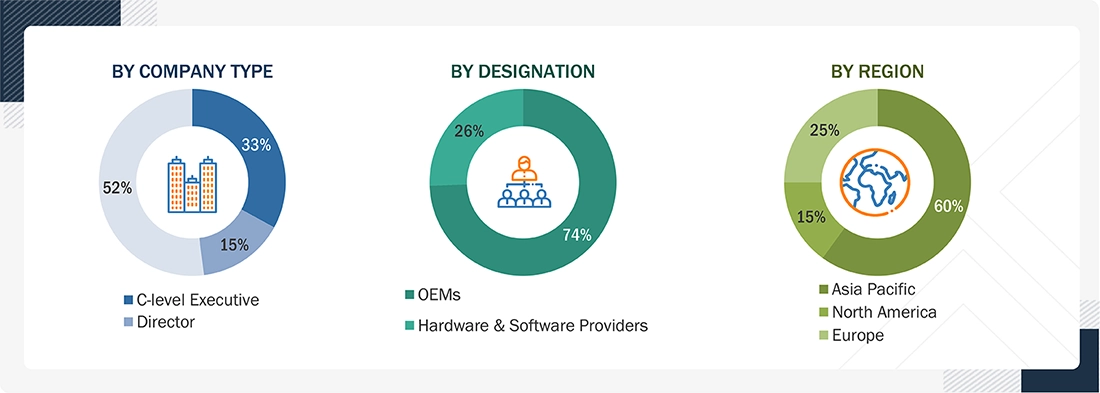
Extensive primary research has been conducted after acquiring an understanding of this market scenario through secondary research. Several primary interviews have been conducted with market experts from the demand- and supply-side OEMs (in terms of component supply, country-level government associations, and trade associations) and component manufacturers across three major regions, namely, Asia Pacific, Europe, and North America. Approximately 60% and 40% of primary interviews have been conducted from the demand and supply side, respectively. Primary data has been collected through questionnaires, emails, LinkedIn, and telephonic interviews. In the canvassing of primaries, we have striven to cover various departments within organizations, such as sales, operations, and administration, to provide a holistic viewpoint in our report.
Brief sessions with highly experienced independent consultants were conducted to reinforce findings from primaries after interacting with industry experts. This, along with the in-house subject matter experts’ opinions, led to the findings, as described in the remainder of this report.
In the primary research process, various primary sources from the supply and demand sides were interviewed to obtain qualitative and quantitative information for the report. The primary sources from the supply side included industry experts, such as Vice Presidents (VPs), marketing directors, technology and innovation directors, and related key executives from various key companies and organizations. The primary sources from the demand side included end users, such as Chief Information Officers (CIOs), consultants, service professionals, technicians and technologists, and managers.
To know about the assumptions considered for the study, download the pdf brochure
Market Size Estimation
Bottom-Up Approach
The bottom-up approach was used to estimate and validate the connected motorcycle market size by units. The two-wheeler market size by country was obtained by overlaying the annual two-wheeler sales (motorcycles and scooters/mopeds) categorized by propulsion type (ICE and electric). The base was historical sales data (2022–2025) at the country level. A forecast for every segment was then formulated by using different micro and macro indicators, including past growth trends, country-wise GDP, government regulations on safety, connectivity features adopted by users, and OEM offerings within the associated motorcycle market. This ensured that the market outlook was on par with industry-specific drivers and policy mandates.
he penetration of connected motorcycles in each country was then identified separately for ICE and electric motorcycles and scooters. The share of connected motorcycles was applied to the corresponding country-level two-wheeler volume, thereby deriving the connected motorcycle market size for each propulsion type and vehicle category. The market size at the regional level was obtained by aggregating the country-level connected motorcycle market figures. Subsequently, the global connected motorcycle market was estimated by summing the regional data. This provided the connected motorcycle market outlook by propulsion type (ICE and electric) and vehicle type (motorcycle and scooter).
Top-Down Approach
The top-down approach was utilized to estimate and confirm the market size for connected motorcycles from the revenue side. The connected motorcycle market was first estimated and then segmented by propulsion type (ICE and electric), based on the scope and range of available connected services. The services were identified using the model mapping function and confirmed using the primary interviews conducted among industry players. After the division by propulsion was finalized, the market for connected motorcycles was further divided by region, consisting of Asia Pacific, Europe, and North America, to take into account regional differences based on the level of adoption, regulatory support, and OEM plans.
Each regional market was subsequently broken down by type of connected services offered. The revenue contribution of each service type was then mapped for the OEMs that provide services in annual packages, which enabled a granular view of the connected motorcycle ecosystem. The summation of regional-level markets provided the total global connected motorcycle market size in terms of value.

Data Triangulation
After arriving at the overall market size using the market size estimation processes as explained above, the market was split into several segments and subsegments. To complete the overall market engineering process and arrive at the exact statistics of each market segment and subsegment, data triangulation and market breakdown procedures were employed, wherever applicable. The data was triangulated by studying various factors and trends from both the demand and supply sides.
Market Definition
Connected motorcycles are two-wheelers that feature telematics, IoT, V2X, and smartphone connectivity, enabling ongoing communication between the rider, vehicle, cloud, and infrastructure near the vehicle. These motorcycles offer vehicle diagnostics, navigation, infotainment, eCall, fleet management, and rider support, making connectivity a key enabling aspect toward safety, performance, and predictive maintenance.
Key Stakeholders
- Automotive Component Manufacturers
- Original Equipment Manufacturers (OEMs)
- Software Providers
- Telematics Hardware Providers
- Internet Service Providers (ISPs)
- Governments, Financial Institutions, and Investment Communities
- Research Institutes and Organizations
- Service Platform Providers
- Technology Standards Organizations, Forums, Alliances, and Associations
- Vehicle Safety Regulatory Bodies
To track and analyze competitive developments such as deals (mergers & acquisitions, partnerships, collaborations), product developments, and other activities carried out by key industry participants
Report Objectives
- To define, describe, and forecast the connected motorcycle market with respect to individual growth trends and prospects, and determine the contribution of each segment to the total market
-
To forecast the connected motorcycle market
- By two-wheeler type (Motorcycle and Scooter/Moped)
- By Hardware (Embedded & Tethered/Integrated)
- By Propulsion Type (ICE and Electric)
- By Network Type (3G/4G, 5G, and Others)
- By End User (Private and Commercial)
- By Application (Safety & Security, Navigation, Vehicle Health & Diagnostics, Infotainment & Communication, and Other Applications)
- By Region [Asia Pacific (India, China, Japan, South Korea, the Philippines, Indonesia, Vietnam, Thailand, and Rest of Asia Pacific), Europe (France, Germany, Italy, Spain, UK, and Rest of Europe), and North America (US, Mexico, and Canada)]
- To analyze the primary factors, including market drivers, limiting restraints, emerging opportunities, and potential challenges, that influence market expansion.
-
To strategically analyze the market through
- Trends/disruptions impacting customer business,
- Case studies,
- Patent analysis,
- Supply chain analysis,
- Market ecosystem,
- Regulatory analysis,
- Impact of AI/Gen AI
- Brand comparison
- Company valuation
- Investment & funding scenario
- To understand competition in the connected motorcycle market and position players as stars, emerging leaders, pervasive players, and participants according to their product portfolio and business strategies
- To analyze the market share of leading players in the connected motorcycle market and evaluate the competitive leadership mapping
- To strategically analyze key player strategies/right to win and company revenue
- To analyze the opportunities in the market for stakeholders and provide details of the competitive landscape for market leaders
- To provide an analysis of recent developments, alliances, joint ventures, mergers & acquisitions, product launches, and other activities carried out by key industry participants in the connected motorcycle market
Customization Options:
With the given market data, MarketsandMarkets offers customizations in line with company-specific needs.
- Additional country-level analysis of the cyber warfare market
- Profiling of other market players (up to five)
Company Information
- Profiling of Additional Market Players (Up to 5)
Key Questions Addressed by the Report
What is the current market size of the Connected Motorcycle Market, and how is it expected to grow?
The Connected Motorcycle Market is projected to grow from USD 0.46 billion in 2025 to USD 3.40 billion by 2032, at a CAGR of 33.1% during the forecast period.
What are the key factors driving the growth of the Connected Motorcycle Market?
The market is driven by mandatory eCall and cybersecurity regulations, rising demand for rider safety, increasing adoption of electric motorcycles, and advancements in telematics and OTA updates.
Which region is expected to dominate the Connected Motorcycle Market during the forecast period?
Asia Pacific is expected to dominate the Connected Motorcycle Market due to its large two-wheeler user base, growing smartphone penetration, and strong push toward connected and electric mobility.
What are the latest trends shaping the Connected Motorcycle Market?
Key trends include embedded connectivity, 5G-enabled communication, AI-powered diagnostics, predictive maintenance, smartphone integration, and connected electric two-wheelers.
Who are the leading companies in the Connected Motorcycle Market, and what strategies are they adopting?
Leading companies are focusing on embedded connectivity solutions, OTA software updates, rider assistance technologies, strategic partnerships, and connected mobility platforms to strengthen their market position.


Personalize This Research
- Triangulate with your Own Data
- Get Data as per your Format and Definition
- Gain a Deeper Dive on a Specific Application, Geography, Customer or Competitor
- Any level of Personalization
Let Us Help You
- What are the Known and Unknown Adjacencies Impacting the Connected Motorcycle Market
- What will your New Revenue Sources be?
- Who will be your Top Customer; what will make them switch?
- Defend your Market Share or Win Competitors
- Get a Scorecard for Target Partners

Custom Market Research Services
We Will Customise The Research For You, In Case The Report Listed Above Does Not Meet With Your Requirements
Get 10% Free CustomisationTESTIMONIALS

JIM NAAS
PRODUCT DIRECTOR, WEASLER
Weasler Engineering, a CentroMotion organization
Global Provider of Industrial Actuation & Control Solutionswww.weasler.com
Our organization was interested in learning more about the attractiveness of a particular market space. We contacted MarketsandMarkets to help us based on previous positive experiences we had with them. The results did not disappoint! We discussed our objectives with them, and the team at MarketsandMarkets developed and executed a proposal that met our needs precisely. We were very impressed by their level of expertise, the quality of the analysis and their insightful recommendations. We would not hesitate in working with them again in the future.

Matt Kardel,
Vice President
Aptiv,
A global technology company that develops safer, greener and more connected solutions.www.aptiv.com
We contracted with
MarketsandMarkets to evaluate the value chain and potential go-to-market partners related to our
interest in the Fleet Management space. The team successfully completed the work on time and at the
pricing agreed. MarketsandMarkets listened and understood our objectives and collaborated well with
us to help us get the visibility we needed to make an investment.
We have subsequently used
MarketsandMarkets again related to Smart Cities to good results.
Growth opportunities and latent adjacency in Connected Motorcycle Market






Bruce
Jul, 2022
Connected Motorcycle Market stating the market size for Hardware, Network Type, Communication Type, End-User, Service, Motorcycle Type, Propulsion, Application, and Calling Service at the regional and country levels. The market focuses on both types of propulsion, namely ICE and electric. Following are pointers to get hold of the market scenario: * Market Estimates, CAGRs, and Forecasts. * Rising demand in the Emerging Markets. * Opportunity analysis in the market for key stakeholders by identification of high growth segments. * Trend analysis and study of drivers and restraints that will affect the global landscape. * Key playing fields and burning issues in the sector. * Market share, contracts & developments, strategies, and product innovations of key companies/players. * Competition mapping.