
Japan 3D Printing Ceramics Market (2025-2030)

The Japan 3D Printing Ceramics Market was valued at $27.14 Million in 2025 and projected to reach to $93.23 Million by 2030, representing a compound annual growth rate of 28.0%. Japan's 3D printing ceramics market is poised for accelerated growth through 2030, driven by the country's commitment to Industry 4.0 initiatives and advanced manufacturing capabilities.


| Market Size in | USD 26.32 MN |
| Market Forecast in | |
| CAGR | |
| Forecast Period | |
| Units Considered | Value (USD MN) |
Japan 3D Printing Ceramics Market Trends and Insights
- Japan's advanced manufacturing ecosystem and strong investment in additive technologies position the country as a key regional player in ceramic 3D printing innovation.
- The 28% compound annual growth rate reflects Japan's leadership in precision engineering and materials science, driven by demand across aerospace, healthcare, and industrial applications. Japan's market growth is underpinned by the country's established ceramics heritage combined with cutting-edge digital manufacturing capabilities.
- Between 2025 and 2030, Japan is expected to see accelerated adoption of 3D-printed ceramics in high-value sectors including medical implants, dental applications, and specialized industrial components.
- Japan's commitment to Industry 4.0 and smart manufacturing further catalyzes market expansion, positioning the nation as a critical hub for ceramic additive manufacturing in the Asia Pacific region..
Key Market Statistics
- CAGR (2025-2030) 28.0% CAGR
- Market Size, 2025 ~USD 27.14 Million
- Forecast, 2030 ~USD 93.23 Million
- Country Japan
Japan 3D Printing Ceramics Market Overview
Market Valuation Growth :
Japan's 3D printing ceramics market is valued at $27.14 million in 2025, with projections reaching $93.23 million by 2030, representing a 28% CAGR—outpacing the global average of 25%.
Advanced Manufacturing Leadership :
Japan's established precision engineering ecosystem and robotics expertise provide a competitive advantage in developing high-quality ceramic 3D printing technologies and applications.
Innovation Investment :
Strong government and private sector investment in additive manufacturing R&D positions Japan as a regional innovation hub for ceramic 3D printing solutions and commercialization.
Industrial Application Expansion :
Growing adoption across automotive, electronics, medical devices, and aerospace sectors drives demand for customized ceramic components manufactured through 3D printing technologies.
Japan 3D Printing Ceramics Market Dynamics
- The 28% CAGR reflects increasing adoption of ceramic additive manufacturing in high-precision applications, particularly within automotive and medical device sectors where Japan maintains global leadership. Key growth catalysts include technological advancements in ceramic printing materials, expanding production capacity, and strategic partnerships between equipment manufacturers and end-users.
- Japan's aging population and labor constraints further incentivize automation and additive manufacturing adoption, positioning the nation as a critical market for ceramic 3D printing innovation and commercialization in Asia-Pacific..
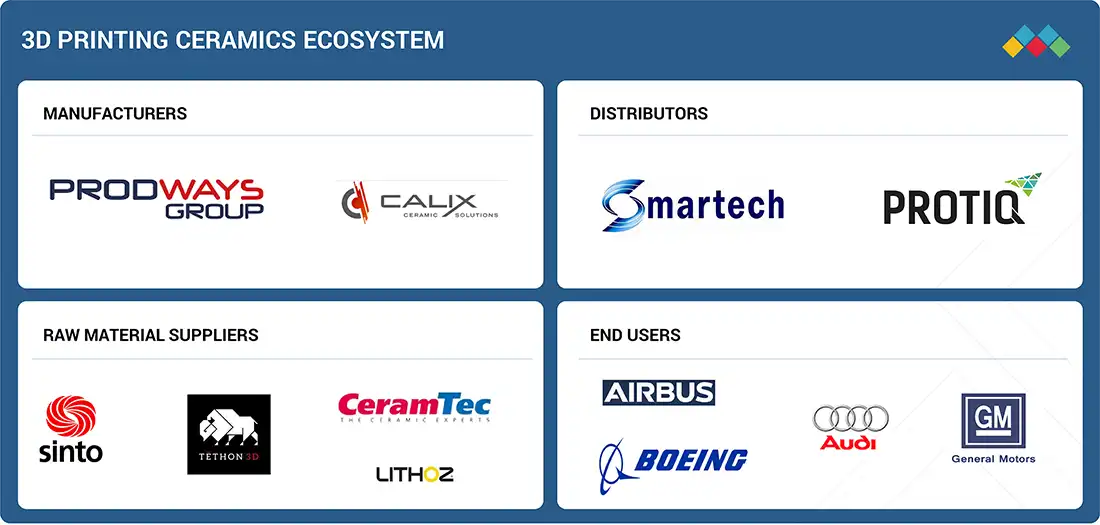
Market Ecosystem
3D Printing Ceramics Market: COMMERCIAL USE CASES ACROSS INDUSTRIES
| COMPANY | USE CASE DESCRIPTION | BENEFITS |
|---|---|---|
 |
Integrating 3D-printed ceramic matrix composite components in Advance3 and UltraFan jet engines, including turbine blades, combustion chambers, and structural elements | 25% improvement in fuel efficiency, reduced weight, higher operating temperatures up to 1,650°C, reduced cooling air requirements, and improved engine reliability |
 |
Utilizing 3D-printed sand casting molds for gigacasting automotive components, enabling rapid prototyping of large structural parts for Model Y and other vehicles | 97% cost reduction in design validation, 3-month development cycle vs 6-12 months with metal molds, enables gigacasting of 1.5m+ components |
 |
Developing TiONIC technology for 3D-printed spinal implants with enhanced surface textures and honeycomb structures for fusion surgery | Enhanced osteoconductivity, improved bone fusion rates, customizable angles, and reduced surgery time |
Logos and trademarks shown above are the property of their respective owners. Their use here is for informational and illustrative purposes only.
Related Ecosystem
Ceramics And Glass
- Zirconia
- Alumina Ceramics
- Silicon Carbide
- Silicon Nitride
- Titanate Ceramics
- Saint-gobain
- 3M COMPANY
- Kyocera Corporation
- COORSTEK INCORPORATED
- CERAMTEC GMBH
Key Takeaways
- Japan's 3D printing ceramics market will grow from $27.14M (2025) to $93.23M (2030), representing a 28% CAGR.
- Japan leads Asia Pacific in ceramic additive manufacturing innovation, driven by precision engineering and materials expertise.
- Medical, dental, and aerospace sectors are primary growth drivers for 3D-printed ceramics adoption in Japan.
- Japan's Industry 4.0 initiatives and smart manufacturing focus accelerate market penetration and technological advancement.
3D Printing Ceramics Market Report Scope
| Report Metric | Details |
|---|---|
| Base Year | 2025 |
| Fastest Growing Segment | FILAMENT (Form) |
| Forecast Period | 2025-2030 |
| Growth Rate | CAGR of 25% from 2025 to 2030 |
| Largest Segment | POWDER (Form) |
| Market Size Base Year (Billions) | ~USD 0.32 (2025) |
| Revenue Forecast (Billions) | ~USD 0.97 (2030) |
| Segments Covered | Ceramic Type, Type, Form, End-Use Industry |
Japan 3D Printing Ceramics Market Report Segmentation
4 segment dimensions are covered across the global market.
By Ceramic Type
- Non-Oxides
- Oxide
- Oxides
By Type
- Alumina
- Other Non-Oxide Types
- Other Types
- Silicon Carbide
- Silicon Nitride
- Zirconia
By Form
- Filament
- Liquid
- Powder
By End-Use Industry
- Aerospace & Defense
- Automotive
- Consumer Goods & Electronics
- Healthcare
- Other End-Use Industries
Target Audience
- Equipment Manufacturers & Technology Providers : Evaluate Japan's market opportunity, identify local partnerships, and develop region-specific product strategies for ceramic 3D printing systems and materials.
- Materials & Chemical Companies : Understand demand for specialized ceramic powders, resins, and binders in Japan's additive manufacturing sector to optimize product development and supply chain strategies.
- Industrial End-Users & OEMs : Assess ceramic 3D printing adoption trends in automotive, medical, and electronics sectors to evaluate technology integration, cost-benefit analysis, and supplier selection.
- Investment & Private Equity Firms : Identify high-growth investment opportunities in Japan's ceramic additive manufacturing ecosystem with market sizing, competitive positioning, and exit potential analysis.
- Government & Policy Organizations : Leverage market intelligence to inform manufacturing policy, R&D funding priorities, and industrial strategy initiatives supporting Japan's additive manufacturing competitiveness.
Reasons to Buy this Report
- Market-Specific Sizing & Forecasts : Access precise valuation data for Japan's ceramic 3D printing market with detailed 2025-2030 projections, enabling accurate budgeting and investment planning specific to the Japanese market.
- Competitive Landscape Intelligence : Understand Japan's unique competitive dynamics, local manufacturers, technology leaders, and market consolidation trends to identify partnership and acquisition opportunities.
- Sector-Specific Application Insights : Gain detailed analysis of ceramic 3D printing adoption across Japan's key industries—automotive, electronics, medical devices, and aerospace—with growth drivers and barriers by sector.
- Regulatory & Policy Framework : Navigate Japan-specific regulations, manufacturing standards, quality certifications, and government incentives shaping the ceramic 3D printing market landscape.
- Strategic Market Entry Guidance : Develop informed go-to-market strategies for Japan with insights on distribution channels, customer preferences, pricing dynamics, and localization requirements for ceramic 3D printing solutions.
Frequently asked questions
What is the current market size of 3D printing ceramics in Japan?
Japan's 3D printing ceramics market was valued at $27.14 million in 2025 and is projected to grow to $93.23 million by 2030.
What is the expected growth rate for Japan's 3D printing ceramics market?
Japan's market is expected to grow at a compound annual growth rate (CAGR) of 28% between 2025 and 2030.
Which industries are driving 3D printing ceramics demand in Japan?
Primary demand drivers in Japan include aerospace, healthcare, dental applications, and specialized industrial manufacturing sectors.
Why is Japan a key market for 3D printing ceramics?
Japan's advanced manufacturing infrastructure, ceramics heritage, precision engineering expertise, and Industry 4.0 investments position it as a regional leader in ceramic additive manufacturing.
What factors support market growth in Japan through 2030?
Key growth factors include increasing adoption in medical implants, dental applications, smart manufacturing initiatives, and Japan's commitment to advanced materials innovation.
RESEARCH METHODOLOGY
The study involves two major activities in estimating the current market size for the 3D printing ceramics market. Exhaustive secondary research was done to collect information on the market, peer market, and parent market. The next step was to validate these findings, assumptions, and sizing with industry experts across the value chain through primary research. Both top-down and bottom-up approaches were employed to estimate the complete market size. After that, market breakdown and data triangulation were used to estimate the market size of segments and subsegments.
Secondary Research
Secondary sources referred to for this research study include financial statements of companies offering 3D printing ceramics and information from various trade, business, and professional associations. Secondary research has been used to obtain critical information about the industry’s value chain, the total pool of key players, market classification, and segmentation according to industry trends, to the bottom-most level, and regional markets. The secondary data was collected and analyzed to arrive at the overall size of the 3D printing ceramics market, which was validated by primary respondents.
Primary Research
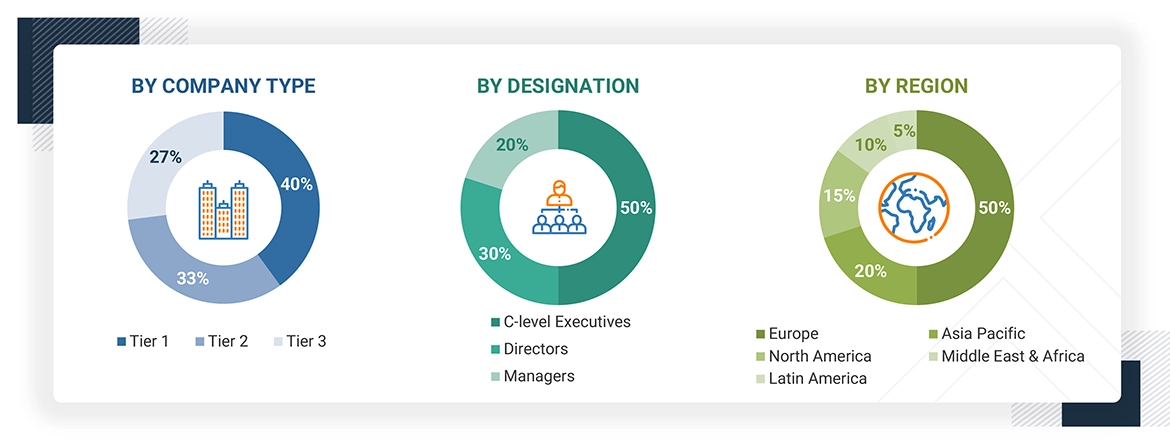
Extensive primary research was conducted after obtaining information regarding the 3D printing ceramics market scenario through secondary research. Several primary interviews were conducted with market experts from both the demand and supply sides across major countries of North America, Europe, Asia Pacific, the Middle East & Africa, and Latin America. Primary data was collected through questionnaires, emails, and telephonic interviews. The primary sources from the supply side included various industry experts, such as chief experience officers (CXOs), vice presidents (VPs), business development/marketing directors, product development/innovation teams, related key executives from the 3D printing ceramics industry, system integrators, component providers, distributors, and key opinion leaders. Primary interviews were conducted to gather insights such as market statistics, data on revenue collected from the products and services, market breakdowns, market size estimations, market forecasting, and data triangulation. Primary research also helped understand the various trends related to fiber type, resin type, diameter, surface treatment, tensile strength, application, and region. Stakeholders from the demand side, including CIOs, CTOs, CSOs, and installation teams of customers/end users for 3D printing ceramics services, were interviewed to understand the buyer’s perspective on the suppliers, products, component providers, and their current usage of 3D printing ceramics and future outlook of their business which will affect the overall market.
Breakup of Primary Research
To know about the assumptions considered for the study, download the pdf brochure
Market Size Estimation
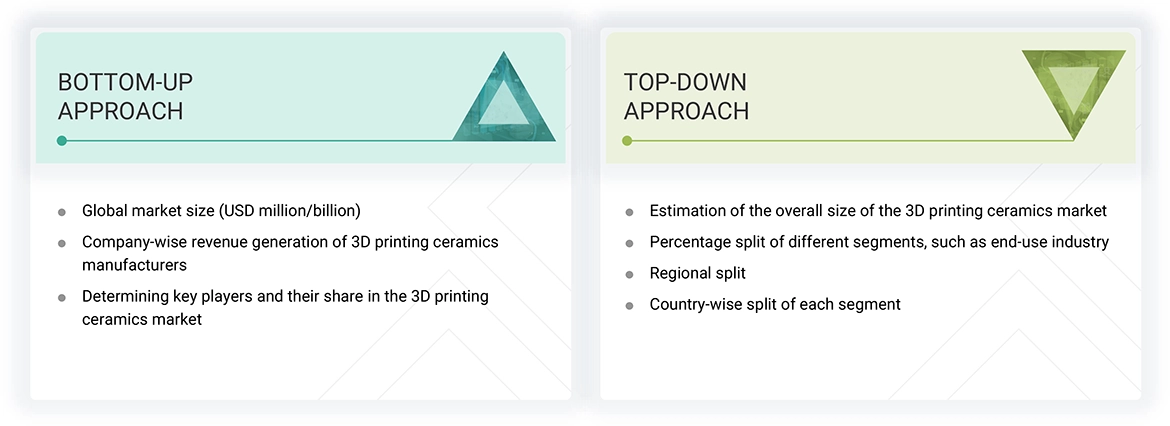
The research methodology used to estimate the size of the 3D printing ceramics market includes the following details. The market size was determined from the demand side. The market was upsized based on the demand for 3D printing ceramics in different applications at the regional level. Such procurements provide information on the demand aspects of the 3D printing ceramics industry for each application. For each application, all possible segments of the 3D printing ceramics market were integrated and mapped.
Data Triangulation
After arriving at the overall size from the market size estimation process explained above, the total market was split into several segments and subsegments. The data triangulation and market breakdown procedures explained below were implemented, wherever applicable, to complete the overall market engineering process and arrive at the exact statistics for various market segments and subsegments. The data was triangulated by studying various factors and trends from the demand and supply sides. Along with this, the market size was validated using both the top-down and bottom-up approaches.
Market Definition
Additive manufacturing technologies help print a three-dimensional (3D) object from a digital file using materials such as plastics, metals, and ceramics. Ceramics are a category of non-metallic inorganic compounds that exhibit high strength, brittleness, melting point, and thermal & electric insulation. These materials are broadly classified into two types: oxides and non-oxides. They come in the forms of powder, liquid (resin), and filament. Powdered and liquid ceramics are mainly used for industrial purposes, while filaments are used by hobbyists and artists. 3D printing ceramics has a wide range of applications, such as thermal insulation in the aerospace industry, body armor in the defense industry, bone and dental implants in the healthcare industry, fuel cells and shock absorbers in the automobile industry, and others, including jewelry, pumps, and refractories.
Stakeholders
- 3D printing ceramic manufacturers
- 3D printing ceramic distributors and suppliers
- Universities, governments, and research organizations
- Associations and industrial bodies
- R&D institutes
- Environmental support agencies
- Investment banks and private equity firms
- Research and consulting firms
Report Objectives
- To define, describe, and forecast the 3D printing ceramics market size in terms of volume and value
- To provide detailed information regarding the key factors, such as drivers, restraints, opportunities, and challenges influencing market growth
- To analyze and project the global 3D printing ceramics market by ceramic type, form, End-use industry, and region
- To forecast the market size concerning five main regions (along with country-level data), namely, North America, Europe, Asia Pacific, the Middle East & Africa, and Latin America, and analyze the significant region-specific trends
- To strategically analyze micromarkets with respect to individual growth trends, prospects, and contributions of the submarkets to the overall market
- To analyze the market opportunities and the competitive landscape for stakeholders and market leaders
- To assess recent market developments and competitive strategies, such as agreements, contracts, acquisitions, and product developments/product launches, to draw the competitive landscape
- To strategically profile the key market players and comprehensively analyze their core competencies
Get the Full 3D Printing Ceramics Market Report
Full forecast, segment splits, and company analysis for all 3D Printing Ceramics Market.
- GCC Countries 3D Printing Ceramics Market
- -Rest Of GCC Countries 3D Printing Ceramics Market
- US 3D Printing Ceramics Market
- Canada 3D Printing Ceramics Market
- Germany 3D Printing Ceramics Market
- France 3D Printing Ceramics Market
- UK 3D Printing Ceramics Market
- Italy 3D Printing Ceramics Market
- China 3D Printing Ceramics Market
- South Korea 3D Printing Ceramics Market
- India 3D Printing Ceramics Market
- Brazil 3D Printing Ceramics Market
- Mexico 3D Printing Ceramics Market
- South Africa 3D Printing Ceramics Market
- Rest Of Europe 3D Printing Ceramics Market
- Rest Of Asia Pacific 3D Printing Ceramics Market
- Rest Of Latin America 3D Printing Ceramics Market
Need a Tailored Report?
Customize this report to your needs
Get 10% FREE Customization
Customize This Report
