
Rest Of Europe 3D Printing High-Performance Plastic Market (2025-2030)

The Rest Of Europe 3D Printing High-Performance Plastic Market was valued at $7.59 Million in 2025 and projected to reach to $19.8 Million by 2030, representing a compound annual growth rate of 21.1%. Rest Of Europe's 3D printing high-performance plastic market is positioned for exceptional growth through 2030, driven by increasing industrial adoption and technological advancements.


| Market Size in | USD 26.32 MN |
| Market Forecast in | |
| CAGR | |
| Forecast Period | |
| Units Considered | Value (USD MN) |
Rest Of Europe 3D Printing High-Performance Plastic Market Trends and Insights
- Rest Of Europe demonstrates a compound annual growth rate of 21.1%, outpacing global trends and reflecting strong regional demand for advanced manufacturing solutions.
- Rest Of Europe's market growth is driven by increasing adoption of 3D printing technologies across aerospace, automotive, and medical device sectors, where high-performance plastics offer superior mechanical properties and design flexibility. Rest Of Europe's competitive landscape is characterized by rising investments in additive manufacturing infrastructure and material innovation.
- Rest Of Europe's manufacturers are leveraging high-performance polymers to address stringent regulatory requirements and sustainability goals across the region.
- Rest Of Europe's market trajectory through 2030 indicates accelerating commercialization of engineering-grade materials, positioning the region as a key hub for advanced 3D printing applications in Europe..
Key Market Statistics
- CAGR (2025-2030) 21.1% CAGR
- Market Size, 2025 ~USD 7.59 Million
- Forecast, 2030 ~USD 19.8 Million
- Country Rest Of Europe
Rest Of Europe 3D Printing High-Performance Plastic Market Overview
Strong Regional Growth Trajectory :
Rest Of Europe's 3D printing high-performance plastic market is expanding at 21.1% CAGR, significantly outpacing the global average of 20.4%, indicating accelerating regional adoption and market maturation.
Substantial Market Valuation Growth :
The market is projected to grow from USD 7.59 million in 2025 to USD 19.80 million by 2030, representing a 161% increase over five years and demonstrating robust investment potential in the region.
Advanced Manufacturing Demand :
Rest Of Europe is experiencing increasing demand for advanced manufacturing solutions, driven by industrial modernization, aerospace applications, and automotive sector adoption of 3D printing technologies.
Regional Innovation Hub Development :
The region is establishing itself as a competitive hub for high-performance plastic 3D printing, with growing investments in R&D and manufacturing capabilities across multiple European markets.
Rest Of Europe 3D Printing High-Performance Plastic Market Dynamics
- The region's 21.1% CAGR reflects strong demand from aerospace, automotive, and medical device manufacturers seeking cost-effective, high-precision manufacturing solutions.
- Investment in regional production facilities and material innovation is accelerating market penetration. The outlook for Rest Of Europe remains highly positive, supported by favorable regulatory environments, skilled workforce availability, and growing collaboration between material suppliers and end-users.
- Emerging applications in healthcare, consumer goods, and industrial components are expanding market opportunities.
- Strategic partnerships and localized supply chains will further strengthen the region's competitive position in the global 3D printing landscape..
Market Ecosystem
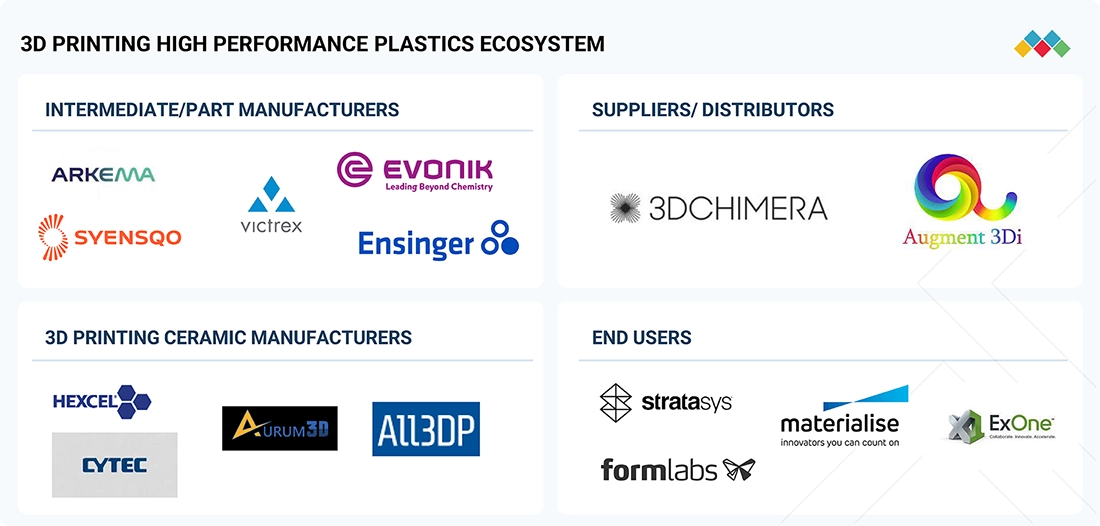
3D Printing High-Performance Plastic Market: COMMERCIAL USE CASES ACROSS INDUSTRIES
| COMPANY | USE CASE DESCRIPTION | BENEFITS |
|---|---|---|
 |
Integrating 3D-printed PEEK and titanium aluminide components in GE9X jet engines for Boeing 777X aircraft, including fuel nozzles, turbine blades, and heat exchangers. The GE9X engine incorporates over 300 3D-printed parts consolidating hundreds of traditional components into just seven additive manufactured parts. | 12% improvement in fuel efficiency, 10% reduction in operating costs, 25% lighter weight compared to traditionally manufactured parts, 5x longer lifetime for fuel nozzles, and USD 1.6 million annual fuel savings per engine. |
 |
Utilizing 3D-printed ULTEM 9085 resin components for A350 XWB aircraft interior and structural parts, including wall panels, cabinet doors, overhead compartments, and lightweight brackets. Over 1,000 3D-printed plastic parts are currently used in serial A350 production, with consolidation of 30+ fuel system components into single lightweight assemblies . | 55% weight reduction compared to traditionally manufactured parts, 75% weight savings in fuel system components, improved fuel efficiency through lightweighting, and 90% material waste reduction. |
 |
Developing patient-specific 3D-printed PEEK cranial implants using 3D Systems' EXT 220 MED printer and Evonik VESTAKEEP i4 3DF PEEK material for cranioplasty procedures. The VSP PEEK Cranial Implant system provides complete FDA-cleared workflow for neurosurgery applications with nearly 40 successful procedures completed across Europe . | Enhanced osteointegration with bone-like mechanics, 115 MPa yield strength exceeding cranial bone (100 MPa), precise "drop-in" fit reducing surgery time, 85% material waste reduction compared to traditional machining, radiolucency enabling clear post-operative imaging, and biocompatibility with no inflammatory response. |
Logos and trademarks shown above are the property of their respective owners. Their use here is for informational and illustrative purposes only.
Related Ecosystem
Automotive Electronics And Electrical Equipment
- Battery Electric Vehicle (BEV)
- Light Commercial Vehicles (LCVs)
- Fuel Cell Electric Vehicle (FCEV)
- Sensors
- Hybrid Electric Vehicle (HEV)
- BOSCH LIMITED
- DENSO Corporation
- Continental ag
- Panasonic Holdings Corporation
- Texas Instruments Incorporated
Fibers And Composites
- Polyetheretherketone (PEEK)
- Polyphenylene Sulfide (PPS)
- Epoxy Resin
- Polycarbonate
- Polyester Resin
- Toray Industries, Inc.
- Teijin Limited
- Sgl carbon se
- Hexcel Corporation
- Solvay sa
Resins And Polymers
- Polycarbonate
- Acrylonitrile Butadiene Styrene (ABS)
- Epoxy Resin
- Light Commercial Vehicles (LCVs)
- Polypropylene (PP)
- Basf se
- DOW CHEMICAL COMPANY
- Solvay sa
- Saudi arabia basic industries corporation (sabic)
- DuPont de Nemours, Inc.
Key Takeaways
- Rest Of Europe's 3D printing high-performance plastic market will grow from USD 7.59M (2025) to USD 19.80M (2030) at a 21.1% CAGR.
- Rest Of Europe's aerospace and automotive sectors are primary drivers of high-performance plastic adoption in additive manufacturing.
- Rest Of Europe's regulatory environment and sustainability mandates accelerate demand for advanced engineering-grade materials.
- Rest Of Europe's market expansion reflects increased R&D investment and commercialization of next-generation 3D printing polymers.
3D Printing High-Performance Plastic Market Report Scope
| Report Metric | Details |
|---|---|
| Base Year | 2025 |
| Fastest Growing Segment | FUNCTIONAL PART MANUFACTURING (Application) |
| Forecast Period | 2025–2030 |
| Growth Rate | CAGR of 20.4% from 2025 to 2030 |
| Largest Segment | FDM/FFF (Technology) |
| Market Size Base Year (Billions) | ~USD 0.18 (2025) |
| Revenue Forecast (Billions) | ~USD 0.45 (2030) |
| Segments Covered | Type, Resin Type, Fiber Type, Form, Technology, Plastic Type, Application, End-Use Industry, Material |
Rest Of Europe 3D Printing High-Performance Plastic Market Report Segmentation
9 segment dimensions are covered across the global market.
By Type
- Filament & Pellet
- Other Types
- Pa
- Peek & Pekk
- Pei
- Powder
- Reinforced Hpp
- Reinforced Hpps
By Resin Type
- Other Resin Types
- Pa
- Peek & Pekk
By Fiber Type
- Carbon Fiber
- Other Fiber Types
By Form
- Filament & Pellet
- Powder
By Technology
- Fdm/Fff
- Sls
By Plastic Type
- Other Types
- Peek & Pekk
- Pei
- Reinforced Hpp
By Application
- Functional Part Manufacturing
- Prototyping
- Tooling
By End-Use Industry
- Aerospace & Defense
- Medical & Healthcare
- Oil & Gas
- Other End-Use Industries
- Other Industries
- Transportation
By Material
- Aerospace & Defense
- Medical & Healthcare
- Oil & Gas
- Other End-Use Industries
- Transportation
Target Audience
- Materials & Chemical Manufacturers : Need Rest Of Europe market data to develop region-specific product portfolios, optimize production capacity, and identify high-demand polymer formulations for local industrial customers.
- 3D Printing Equipment Providers : Require regional market insights to assess Rest Of Europe's growth potential, identify key customer segments, and develop localized sales and support strategies for equipment distribution.
- Investment & Private Equity Firms : Seek detailed Rest Of Europe market analysis to evaluate investment opportunities, assess portfolio company growth potential, and identify acquisition targets in the high-performance plastics sector.
- Industrial & Manufacturing Companies : Need Rest Of Europe adoption trends and competitive benchmarking data to make informed decisions about integrating 3D printing technologies and sourcing high-performance materials regionally.
- Business Consultants & Strategy Advisors : Require comprehensive Rest Of Europe market intelligence to advise clients on market entry strategies, competitive positioning, and growth opportunities in the 3D printing high-performance plastics sector.
Key Companies in the Rest Of Europe 3D Printing High-Performance Plastic Market
| Company | HQ | Ownership | Strongest segments |
|---|---|---|---|
| DUPONT | United States | Public Company | Healthcare & Water Technologies,Construction Materials (Tyvek house wrap, Styrofoam, Corian),Industrial Engineered Components (Vespel, Molykote, adhesives), |
| DSM N. V. | Netherlands | Subsidiary | Human nutrition and health solutions,Animal nutrition and feed additives,Specialty and performance materials, |
| EVONIK INDUSTRIES | Germany | Public Company | Advanced Technologies,Custom Solutions,Infrastructure, |
| ARKEMA | France | Public Company | Adhesive Solutions,Advanced Materials,Coating Solutions, |
| EOS GMBH | Australia | Public Company | Remote weapon systems, fire control, and lethality solutions,Counter-drone, force protection, and UGV/marine lethality systems,High energy laser weapons, |
| SOLVAY | Belgium | Public Company | Soda ash and derivatives,Sodium bicarbonate and related applications,Hydrogen peroxide, |
| SABIC | Saudi Arabia | Public Company | Base petrochemicals & intermediates (olefins, aromatics, methanol, glycols, MTBE, CO2),Commodity polymers (PE, PP, PVC, PET, PS, ABS),Specialties & engineering plastics (NORYL, ULTEM, EXTEM, SILTEM, PC, compounds), |
| VICTREX PLC | United Kingdom | Public Company | Sustainable Solutions – Energy & Industrial,Sustainable Solutions – Aerospace,Sustainable Solutions – Automotive, |
| MITSUBISHI CHEMICAL CORPORATION | Japan | Public Company | Basic Materials & Polymers,Specialty Materials and Performance Products,MMA & Derivatives / PMMA, |
| TORAY INDUSTRIES, INC. | Japan | Public Company | Fibers and Textiles,Performance Chemicals (Resins, Films, Fine Chemicals, Electronic Materials),Carbon Fiber Composite Materials, |
DUPONT
DuPont is a United States-based public company founded in 2015 with 15,000 employees.
DSM N. V.
Insufficient data available for DSM N.V.
EVONIK INDUSTRIES
Evonik Industries is a German public company founded in 1847 with 30,643 employees.
ARKEMA
Arkema is a French public company founded in 2003 with 20,648 employees.
EOS GMBH
EOS GmbH is an Australian public company founded in 1983 with 436 employees.
SOLVAY
Solvay is a Belgian public company founded in 1863 with 8,400 employees.
SABIC
SABIC is a Saudi Arabian public company founded in 1976 with 35,000 employees.
VICTREX PLC
Victrex PLC is a United Kingdom-based public company founded in 1993 with 1,169 employees.
MITSUBISHI CHEMICAL CORPORATION
Mitsubishi Chemical Corporation is a Japanese public company founded in 1933 with 56,678 employees.
TORAY INDUSTRIES, INC.
Toray Industries, Inc. is a Japanese public company founded in 1926 with 46,294 employees.
Reasons to Buy this Report
- Regional Market Sizing & Forecasting : Obtain precise market valuation data specific to Rest Of Europe (USD 7.59M in 2025, USD 19.80M in 2030) with detailed CAGR analysis to support investment decisions and business planning in the region.
- Competitive Landscape Intelligence : Understand Rest Of Europe's unique competitive dynamics, regional players, and market positioning relative to global trends, enabling strategic differentiation and market entry strategies.
- Growth Driver Identification : Identify region-specific growth catalysts including industrial demand patterns, regulatory factors, and application sectors driving the 21.1% CAGR in Rest Of Europe's market.
- Investment & Expansion Planning : Leverage Rest Of Europe market insights to evaluate expansion opportunities, facility locations, and partnership strategies for maximizing ROI in this high-growth regional market.
- Customer & Segment Analysis : Access detailed Rest Of Europe customer profiles, end-user segments, and demand patterns to tailor product offerings and marketing strategies for regional market penetration.
Frequently asked questions
What is the market size of 3D printing high-performance plastics in Rest Of Europe?
Rest Of Europe's 3D printing high-performance plastic market was valued at USD 7.59 million in 2025 and is forecast to reach USD 19.80 million by 2030.
What is the CAGR for Rest Of Europe's 3D printing high-performance plastic market?
Rest Of Europe's market is projected to grow at a compound annual growth rate of 21.1% from 2025 to 2030.
Which industries drive demand in Rest Of Europe's high-performance plastic 3D printing market?
Rest Of Europe's aerospace, automotive, medical device, and industrial manufacturing sectors are the primary demand drivers for high-performance 3D printing plastics.
What factors support growth in Rest Of Europe's 3D printing plastic market?
Rest Of Europe's market growth is supported by regulatory compliance requirements, sustainability initiatives, technological advancements, and increased adoption of additive manufacturing across industries.
How does Rest Of Europe's market compare to global trends?
Rest Of Europe's 21.1% CAGR exceeds the global market CAGR of 20.4%, indicating stronger regional momentum and market maturity in additive manufacturing adoption.
RESEARCH METHODOLOGY
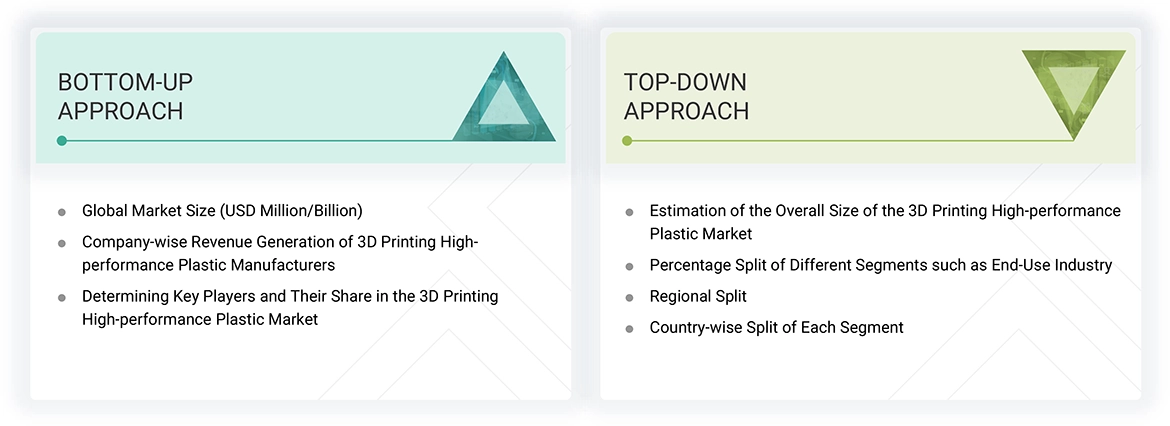
The study involves two major activities in estimating the current market size for the 3D printing high-performance plastic market. Exhaustive secondary research was done to collect information on the market, peer market, and parent market. The next step was to validate these findings, assumptions, and sizing with industry experts across the value chain through primary research. Both top-down and bottom-up approaches were employed to estimate the complete market size. After that, market breakdown and data triangulation were used to estimate the market size of segments and subsegments.
Secondary Research
Secondary sources referred to for this research study include financial statements of companies offering 3D printing high-performance plastic and information from various trade, business, and professional associations. Secondary research has been used to obtain critical information about the industry’s value chain, the total pool of key players, market classification, and segmentation according to industry trends to the bottom-most level and regional markets. The secondary data was collected and analyzed to arrive at the overall size of the 3D printing high-performance plastic market, which was validated by primary respondents.
Primary Research
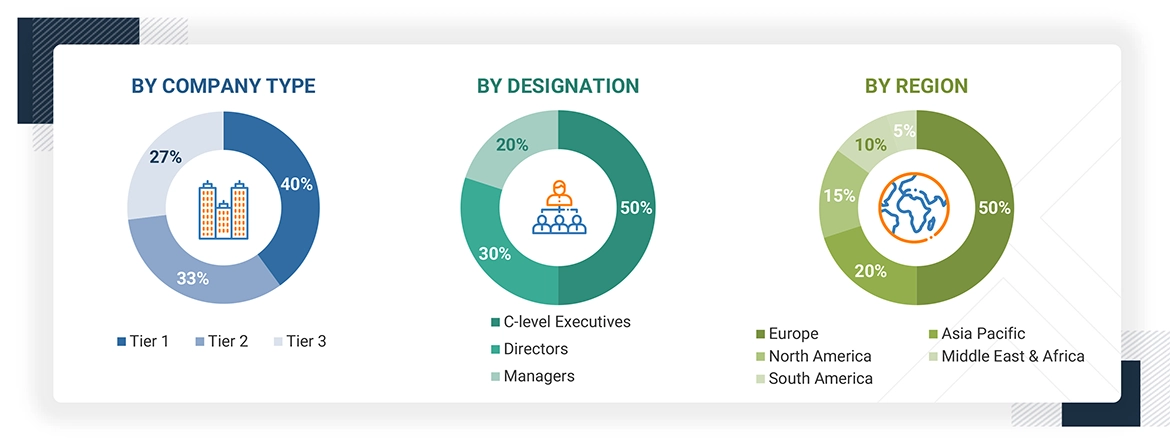
Extensive primary research was conducted after obtaining information regarding the 3D printing high-performance plastic market scenario through secondary research. Several primary interviews were conducted with market experts from both the demand and supply sides across major countries of North America, Europe, Asia Pacific, the Middle East & Africa, and South America. Primary data was collected through questionnaires, emails, and telephonic interviews. The primary sources from the supply side included various industry experts, such as chief experience officers (CXOs), vice presidents (VPs), business development/marketing directors, product development/innovation teams, related key executives from the 3D printing high-performance plastic industry, system integrators, component providers, distributors, and key opinion leaders. Primary interviews were conducted to gather insights such as market statistics, data on revenue collected from the products and services, market breakdowns, market size estimations, market forecasting, and data triangulation. Primary research also helped in understanding the various trends related to product type, end-use industry, and region. Stakeholders from the demand side, such as CIOs, CTOs, CSOs, and installation teams of the customers/end users who are 3D printing services, were interviewed to understand the buyer’s perspective on the suppliers, products, component providers, and their current usage of 3D printing high performance plastic and future outlook of their business which will affect the overall market.
Breakup of Primary Research:
To know about the assumptions considered for the study, download the pdf brochure
Market Size Estimation
The research methodology used to estimate the size of the 3D printing high-performance plastic market includes the following details. The market sizing was undertaken from the demand side. The market was upsized based on the demand for 3D printing high-performance plastic in different end-use industries at the regional level. Such procurements provide information on the demand aspects of the 3D printing high-performance plastic industry for each end-use industry. For each end-use industry, all possible segments of the 3D printing high-performance plastic market were integrated and mapped.
Data Triangulation
After arriving at the overall size from the market size estimation process explained above, the total market was split into several segments and subsegments. The data triangulation and market breakdown procedures explained below were implemented, wherever applicable, to complete the overall market engineering process and arrive at the exact statistics for various market segments and subsegments. The data was triangulated by studying various factors and trends from the demand and supply sides. Along with this, the market size was validated using both the top-down and bottom-up approaches.
Market Definition
3D printing is the process of producing three-dimensional (3D) objects from digital models using materials such as plastics and other engineered substances. This advanced manufacturing approach enables the creation of stronger, lighter, and more complex components, revolutionizing traditional industrial production.
Within this market, high-performance plastics refer to polymer materials that exhibit superior mechanical strength, purity, stiffness, and resistance to wear and chemicals compared to standard 3D printing materials like PLA and ABS. In addition to a broad spectrum of polymer types, the market includes an extensive array of polymer blends, glass—and carbon-fiber-reinforced polymers, and proprietary composite materials.
High-performance plastics are specifically designed to retain their mechanical, thermal, and chemical properties under extreme conditions—such as elevated temperatures, high pressure, or exposure to corrosive substances—without bending, warping, cracking, or splintering.
In recent years, additive manufacturing has seen significant growth in the use of high-performance polymers, defined as polymers with a heat deflection temperature exceeding 150°C. These materials offer enhanced thermal stability, chemical resistance, mechanical strength, and low density, making them superior to conventional 3D printing polymers such as ABS, PP, and PET.
Examples of 3D printing high-performance plastics include engineered nylons, Polyether ether ketone (PEEK), Polyether ketone ketone (PEKK), Polyetherimide (PEI), Reinforced plastics, Polyphenylsulfone (PPSU), Polyphenylene sulfide (PPS), Polyamide-imide (PAI), and Polyethersulfone (PES).
Advancements in fused deposition modeling (FDM/FFF) and selective laser sintering (SLS) have significantly expanded the feasibility of using these materials in 3D printing. These technologies allow for the production of intricate, high-performance parts, reshaping the manufacturing landscape across multiple sectors.
Key application areas include tooling, prototyping, and functional part production across industries such as medical & healthcare, aerospace & defense, transportation, oil & gas, and others. High-performance plastics for 3D printing are commercially available in filament, pellet, and powder forms, enabling flexibility across different additive manufacturing platforms.
Stakeholders
- 3d printing high-performance plastic manufacturers
- 3d printing high-performance plastic distributors and suppliers
- Universities, governments, and research organizations
- Associations and industrial bodies
- R&D institutes
- Environmental support agencies
- Investment banks and private equity firms
- Research and consulting firms
Report Objectives
- To define, describe, and forecast the 3D printing high-performance plastic market size in terms of volume and value
- To provide detailed information regarding the key factors, such as drivers, restraints, opportunities, and challenges influencing the market growth
- To analyze and project the global 3D printing high-performance plastic market by product type, end-use industry, and region
- To forecast the market size concerning five main regions (along with country-level data): North America, Europe, Asia Pacific, the Middle East & Africa, and South America, and analyze the significant region-specific trends
- To strategically analyze micromarkets with respect to individual growth trends, prospects, and contributions of the submarkets to the overall market
- To analyze the market opportunities and the competitive landscape for stakeholders and market leaders
- To assess recent market developments and competitive strategies, such as agreements, contracts, acquisitions, and product developments/product launches, to draw the competitive landscape
- To strategically profile the key market players and comprehensively analyze their core competencies
Get the Full 3D Printing High-Performance Plastic Market Report
Full forecast, segment splits, and company analysis for all 3D Printing High-Performance Plastic Market.
- Argentina 3D Printing High-Performance Plastic Market
- Brazil 3D Printing High-Performance Plastic Market
- Canada 3D Printing High-Performance Plastic Market
- China 3D Printing High-Performance Plastic Market
- France 3D Printing High-Performance Plastic Market
- Germany 3D Printing High-Performance Plastic Market
- India 3D Printing High-Performance Plastic Market
- ISRAEL 3D Printing High-Performance Plastic Market
- Italy 3D Printing High-Performance Plastic Market
- Japan 3D Printing High-Performance Plastic Market
- Mexico 3D Printing High-Performance Plastic Market
- South Africa 3D Printing High-Performance Plastic Market
- South Korea 3D Printing High-Performance Plastic Market
- Spain 3D Printing High-Performance Plastic Market
- UAE 3D Printing High-Performance Plastic Market
- UK 3D Printing High-Performance Plastic Market
- US 3D Printing High-Performance Plastic Market
Need a Tailored Report?
Customize this report to your needs
Get 10% FREE Customization
Customize This Report
