
India Agricultural Microbials Market (2025-2030)

The India Agricultural Microbials Market was valued at $303.9 Million in 2025 and projected to reach to $593.2 Million by 2030, representing a compound annual growth rate of 14.3%. India's agricultural microbials market is poised for significant expansion as farmers increasingly recognize the benefits of microbial-based solutions for sustainable crop production.


| Market Size in | USD 26.32 MN |
| Market Forecast in | |
| CAGR | |
| Forecast Period | |
| Units Considered | Value (USD MN) |
India Agricultural Microbials Market Trends and Insights
- This growth trajectory reflects India's increasing adoption of sustainable farming practices and bio-based solutions to enhance soil health and crop productivity.
- India's agricultural sector is leveraging microbial innovations to reduce chemical dependency while maintaining yield targets across diverse agro-climatic zones. The 14.3% compound annual growth rate underscores India's commitment to precision agriculture and organic farming initiatives.
- India's market expansion is driven by government support for biological inputs, rising farmer awareness, and the need for cost-effective crop protection solutions.
- By 2030, India is expected to solidify its position as a key regional hub for agricultural microbials, with increasing investments in research, development, and commercialization of microbial-based products tailored to India's unique farming conditions..
Key Market Statistics
- CAGR (2025-2030) 14.3% CAGR
- Market Size, 2025 ~USD 303.9 Million
- Forecast, 2030 ~USD 593.2 Million
- Country India
India Agricultural Microbials Market Overview
Market Valuation Growth :
India's agricultural microbials market is valued at USD 303.9 million in 2025, with a projected CAGR of 14.3%, reaching USD 593.2 million by 2030, nearly doubling in size over five years.
Sustainable Farming Adoption :
Indian farmers are increasingly transitioning to bio-based solutions and sustainable practices, driven by government initiatives promoting organic farming and reduced chemical dependency in agriculture.
Soil Health Enhancement :
Microbial innovations are being widely adopted across India to improve soil microbiota, enhance nutrient availability, and boost crop productivity while maintaining environmental sustainability.
Chemical Reduction Trend :
India's agricultural sector is leveraging microbial solutions to minimize synthetic fertilizer and pesticide usage, aligning with national policies on sustainable agriculture and farmer profitability.
India Agricultural Microbials Market Dynamics
- Government support through subsidy schemes, organic certification programs, and agricultural extension services is accelerating market penetration across rural and semi-urban regions.
- The growing awareness of soil degradation and the need for long-term agricultural sustainability are driving demand for bio-based alternatives. The forecast period through 2030 will witness increased investment in microbial research and development, coupled with rising adoption among progressive farmers and agricultural cooperatives.
- Market growth will be supported by improving distribution networks, competitive pricing, and demonstrated agronomic benefits.
- India's position as a major agricultural economy, combined with its commitment to sustainable farming practices, positions the microbials market for sustained double-digit growth..
Market Ecosystem
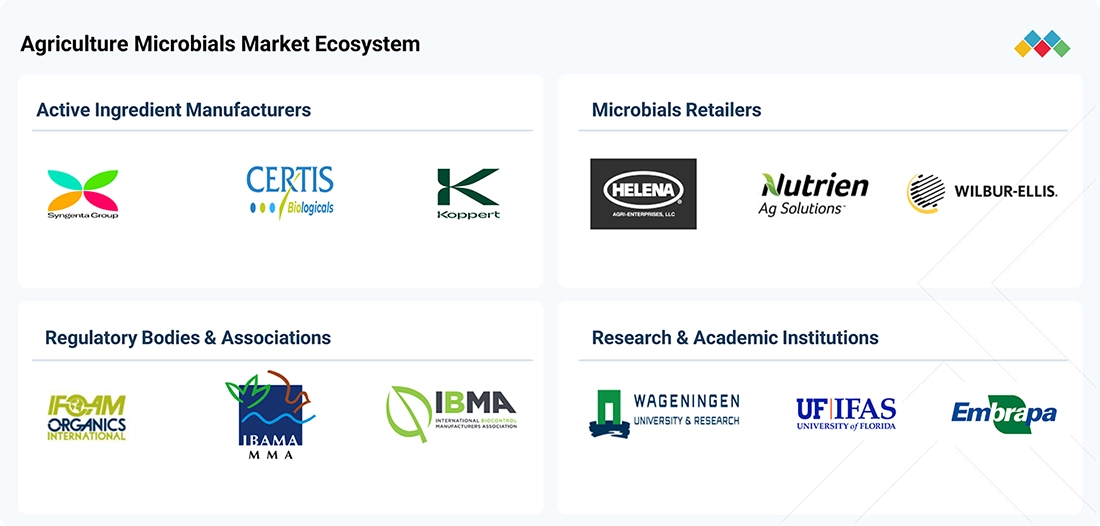
AGRICULTURAL MICROBIALS MARKET: COMMERCIAL USE CASES ACROSS INDUSTRIES
| COMPANY | USE CASE DESCRIPTION | BENEFITS |
|---|---|---|
 |
Microbial biofertilizers and biostimulants that enhance nutrient availability and improve crop productivity across cereals, oilseeds, fruits, and vegetables | Improved nutrient use efficiency, enhanced crop yield, and better soil health |
 |
Beneficial microbial solutions for biological disease control and rhizosphere management in horticulture and field crops | Reduced dependence on synthetic pesticides and improved crop resilience |
 |
Microbial seed treatments and inoculants for biological nitrogen fixation and improved nutrient uptake | Higher seed vigor, improved nitrogen efficiency, and increased productivity |
 |
Microbial biopesticides and biofungicides for integrated pest and disease management programs | Effective disease suppression, residue-free crop protection, and sustainable farming practices |
Logos and trademarks shown above are the property of their respective owners. Their use here is for informational and illustrative purposes only.
Related Ecosystem
Agricultural Biologicals
- Bionematicides
- Auxins
- Cytokinins
- Ethylene
- Humic Substances
- NICHINO INDIA PVT LTD.
- Corteva, Inc.
- Basf se
- AZELIS HOLDINGS SA
- BAYER AG
Key Takeaways
- India's agricultural microbials market is valued at USD 303.9 million in 2025 and is forecast to nearly double to USD 593.2 million by 2030.
- India is experiencing a 14.3% CAGR, driven by government initiatives promoting biological inputs and sustainable farming practices.
- India's diverse agro-climatic zones and large farming population create significant demand for cost-effective, region-specific microbial solutions.
- India's market growth is supported by rising farmer awareness, organic certification trends, and the need to reduce chemical input dependency.
Agricultural Microbials Market Report Scope
| Report Metric | Details |
|---|---|
| Base Year | 2025 |
| Fastest Growing Segment | SEED TREATMENT (Mode Of Application) |
| Forecast Period | 2025–2030 |
| Growth Rate | CAGR of 14.7% from 2025 to 2030 |
| Largest Segment | BACTERIA (Type) |
| Market Size Base Year (Billions) | ~USD 9.44 (2025) |
| Revenue Forecast (Billions) | ~USD 18.75 (2030) |
| Segments Covered | Type, Function, Nitrogen-Fixing Biofertilizer, Phosphate-Solubilizing Biofertilizer, Potassium-Solubilizing Biofertilizer, Mode Of Application, Formulation, Crop Type |
India Agricultural Microbials Market Report Segmentation
8 segment dimensions are covered across the global market.
By Type
- Bacillus
- Bacillus Firmus
- Bacillus Thuringenesis
- Bacteria
- Baculovirus
- Beauveria Bassiana
- Berries
- Biofertilizers
- Biofungicides
- Bioherbicides
- Bioinsecticides
- Bionematicides
- Biostimulants
- Citrus Fruits
- Colletotrichum Spp.
- Corn
- Dry Granules
- Emulsifiable Concentrate
- Fungi
- Leafy Vegetables
- Metarhizium Anisopliae
- Nitrogen-Fixing Biofertilizers
- Other Bionematicides
- Other Cereals & Grains
- Other Crop Protection Functions
- Other Fruits & Vegetables
- Other Microbial Species
- Other Oilseeds & Pulses
- Other Organism Types
- Other Species
- Other Types
- Paecilomyces Lilacinus
- Phosphate-Solubilizing & Mobilizing Biofertilizers
- Pome Fruits
- Potassium-Solubilizing & Mobilizing Biofertilizers
- Protozoa
- Pseudomonas
- Rice
- Root & Tuber Vegetables
- Soluble Liquid Concentrate
- Soybean
- Streptomyces
- Sunflower
- Suspension Concentrate
- Trichoderma
- Verticillium Lecanii
- Virus
- Viruses
- Water-Dispersible Granules
- Wettable Powder
- Wheat
- Xanthomonas Campestris
By Function
- Crop Protection
- Soil Amendments
By Nitrogen-Fixing Biofertilizer
- Azospirillum
- Azotobacter
- Other Nitrogen-Fixing Microorganisms
- Rhizobium
By Phosphate-Solubilizing Biofertilizer
- Bacillus Subtilis
- Other Phosphate-Solubilizing Microorganisms
- Pseudomonas
By Potassium-Solubilizing Biofertilizer
- Bacillus Mucilaginosus
- Other Potassium-Solubilizing Microorganisms
By Mode Of Application
- Foliar Spray
- Other Modes Of Application
- Seed Treatment
- Soil Treatment
By Formulation
- Dry
- Liquid
By Crop Type
- Cereals & Grains
- Fruits & Vegetables
- Oilseeds & Pulses
- Other Crop Types
Target Audience
- Agricultural Input Manufacturers : Companies producing fertilizers, pesticides, and soil amendments need India market data to develop microbial product lines, understand competitive positioning, and plan market entry or expansion strategies.
- Agribusiness & Distribution Companies : Distributors and agribusiness firms require India-specific insights to identify growth opportunities, assess market demand, establish supply chains, and develop sales strategies for microbial products.
- Investment & Private Equity Firms : Investors evaluating opportunities in India's agricultural biotech sector need validated market data, growth projections, and regional insights to make informed investment decisions and portfolio allocations.
- Government & Policy Organizations : Agricultural ministries, regulatory bodies, and policy makers use market intelligence to design subsidy programs, set agricultural standards, and develop sustainable farming initiatives aligned with market trends.
- Research & Development Organizations : Agricultural research institutions and biotech companies need India market data to prioritize R&D investments, identify unmet farmer needs, and develop commercially viable microbial solutions for Indian conditions.
Key Companies in the India Agricultural Microbials Market
| Company | HQ | Ownership | Strongest segments |
|---|---|---|---|
| SOJITZ CORPORATION | Japan | Public Company | Automotive, Aircraft, and Transportation Infrastructure,Power, Energy, and IPP/IWPP Infrastructure,Metals, Resources, and Chemicals, |
| DOW CHEMICAL COMPANY | United States | Private Company | Packaging & Specialty Plastics (ethylene, polyethylene, polyolefin elastomers, EVA),Industrial Intermediates & Infrastructure (ethylene derivatives, propylene derivatives, aromatics),Performance Materials & Coatings (cellulose ethers, acrylic emulsions, acrylics-based building blocks), |
| NUFARM LIMITED | Australia | Public Company | Herbicides,Fungicides,Insecticides, |
| TESSENDERLO GROUP | Belgium | Public Company | Agro (specialty fertilizers and crop protection),Bio-Valorization (gelatin, collagen, proteins, fats),Industrial Solutions (water treatment and industrial chemicals), |
| BOREALIS AG | Austria | Private Company | Polyolefin solutions (PE/PP for consumer, energy, infrastructure, mobility),Base chemicals (olefins, phenol, aromatics, intermediates),Recycling, circular solutions, technology licensing & catalysts, |
| ISRAEL CHEMICALS LTD. | Israel | Public Company | Potash,Phosphate Solutions,Growing Solutions (Specialty Fertilizers and Agritech), |
| ORIGIN ENTERPRISES PLC | Ireland | Public Company | Agronomy advice and on-farm services,Crop inputs (seed, nutrition, fertilizers, crop protection, biologicals),Animal feed ingredients and grain/feed trading, |
| MITSUI & CO., LTD. | Japan | Public Company | Energy (LNG, oil, fuels, carbon solutions),Mobility, Digital & Infrastructure,Chemicals (gas, basic chemicals, performance monomers), |
| BASF SE | Germany | Public Company | Chemicals (Petrochemicals and Intermediates),Materials (Isocyanates, Polyamides, Inorganics, Plastics Specialties),Industrial Solutions (Dispersions, Resins, Additives, Catalysts, Electronic Materials), |
| BAYER AG | Germany | Public Company | Crop Science (crop protection, seeds, digital agriculture),Pharmaceuticals (cardiology, women’s health, oncology, hematology, ophthalmology, imaging, cell and gene therapy),Consumer Health (OTC, self-care, supplements, allergy, cough/cold, dermatology, pain, digestive health), |
| CORTEVA | United States | Public Company | Seed (germplasm and traits, including digital decision tools),Crop Protection (herbicides, insecticides, fungicides, seed-applied technologies),Nitrogen stabilizers, pasture and range management, and ancillary solutions, |
| FMC CORPORATION | United States | Public Company | Insecticides,Herbicides,Fungicides, |
| UPL | India | Public Company | Crop Protection (herbicides, fungicides, insecticides, acaricides, seed treatment, adjuvants, bio-solutions, public health, fumigants, soil and water technologies),Seeds (Advanta, Alta Seeds, Pacific Seeds, Hannaford and related crop portfolios),Non-Agro & Specialty (industrial chemicals, post-harvest, environmental electronics, apiculture, other non-agricultural products, digital platform), |
| SUMITOMO CHEMICAL CO., LTD. | Japan | Public Company | Essential & Green Materials,Agro & Life Solutions,ICT & Mobility Solutions, |
| NUFARM | Australia | Public Company | Herbicides,Fungicides,Insecticides, |
| BIOCERES CROP SOLUTIONS | Argentina | Public Company | Crop Nutrition (inoculants, bio-inductors, biological and microgranulated fertilizers),Seed and Integrated Products (traits, germplasm, seed treatment packs, HB4),Crop Protection (Rizoderma, adjuvants, herbicides, insecticides, fungicides, baits), |
SOJITZ CORPORATION
Sojitz Corporation is a Japanese public company founded in 1862 with 26,789 employees. It operates as a diversified trading and investment company with global operations across multiple sectors.
DOW CHEMICAL COMPANY
The Dow Chemical Company is a United States-based private company established in 1897 with 34,600 employees. It is a major producer of chemicals, plastics, and agricultural products serving industrial and consumer markets worldwide.
NUFARM LIMITED
Nufarm Limited is an Australian public company founded in 1916 with 3,046 employees. The company specializes in crop protection products and agricultural chemicals for global markets.
TESSENDERLO GROUP
Tessenderlo Group is a Belgian public company established in 1919 with 6,945 employees. It operates in the chemical and agricultural sectors, producing specialty chemicals and crop nutrition products.
BOREALIS AG
Borealis AG is an Austrian private company founded in 1994 with 5,887 employees. The company is a leading provider of polyolefins, base chemicals, and fertilizers for industrial and agricultural applications.
ISRAEL CHEMICALS LTD.
Israel Chemicals Ltd. is an Israeli public company established in 1968 with 12,000 employees. It produces and markets fertilizers, chemicals, and specialty products for agriculture and industry.
ORIGIN ENTERPRISES PLC
Origin Enterprises PLC is an Irish public company founded in 2006 with 2,997 employees. The company provides crop inputs, seeds, and agronomy services to farmers across Europe and North America.
MITSUI & CO., LTD.
Mitsui & Co., Ltd. is a Japanese public company established in 1947 with 55,463 employees. It is a major global trading and investment corporation operating across energy, metals, chemicals, and agricultural sectors.
BASF SE
BASF SE is a German public company founded in 1865 with 106,428 employees. It is one of the world's largest chemical producers, offering products for agriculture, chemicals, plastics, and performance materials.
BAYER AG
Bayer AG is a German public company established in 1863 with 87,757 employees. The company operates in pharmaceuticals, crop science, and consumer health, serving global markets with innovative products.
CORTEVA
Corteva is a United States-based public company founded in 1802 with 21,500 employees. It is a leading provider of seeds, crop protection products, and digital agriculture solutions.
FMC CORPORATION
FMC Corporation is a United States-based public company founded in 1883 with 5,500 employees. It produces agricultural sciences, specialty chemicals, and lithium products for global markets.
UPL
UPL is an Indian public company established in 1969 with 12,000 employees. The company is a leading provider of crop protection products and agricultural solutions globally.
SUMITOMO CHEMICAL CO., LTD.
Nufarm is an Australian public company founded in 1916 with 3,046 employees. The company specializes in crop protection products and agricultural chemicals for global markets.
NUFARM
Insufficient data available for company description.
BIOCERES CROP SOLUTIONS
Koppert is a Netherlands-based private company established in 1967 with 47 employees. The company specializes in biological pest control and crop protection solutions.
Reasons to Buy this Report
- Market Size & Growth Validation : Obtain precise valuation data for India's agricultural microbials market with verified CAGR of 14.3%, enabling accurate financial forecasting and investment decision-making for the 2025-2030 period.
- Regional Opportunity Assessment : Understand India-specific growth drivers including government sustainability initiatives, farmer adoption rates, and regional agricultural practices to identify high-potential market segments and entry strategies.
- Competitive Positioning Intelligence : Benchmark your products and strategies against India's market dynamics, including local competitor landscape, distribution channels, and pricing models specific to Indian agricultural markets.
- Investment & Expansion Planning : Leverage detailed India market forecasts to justify capital allocation, plan manufacturing facilities, establish distribution networks, and develop localized product portfolios for maximum market penetration.
- Stakeholder Alignment : Present credible India-specific market data to investors, board members, and partners to secure funding, build partnerships, and align organizational strategy with high-growth agricultural biotech opportunities.
Frequently asked questions
What is the current size of India's agricultural microbials market?
India's agricultural microbials market is valued at USD 303.9 million in 2025, with expectations to reach USD 593.2 million by 2030.
What is the projected growth rate for India's agricultural microbials market?
India's agricultural microbials market is projected to grow at a compound annual growth rate (CAGR) of 14.3% from 2025 to 2030.
What factors are driving growth in India's agricultural microbials market?
India's market growth is driven by government support for biological inputs, increasing farmer awareness of sustainable practices, organic farming certification trends, and the need for cost-effective alternatives to chemical inputs.
How does India's agricultural microbials market compare to global trends?
India's 14.3% CAGR is slightly below the global average of 14.7%, but India's market is expanding rapidly due to unique regional factors including large farming populations and diverse agro-climatic conditions.
What types of microbial products are most relevant to India's agriculture?
India's agricultural sector benefits from bio-fertilizers, biopesticides, and soil health enhancers tailored to regional crops such as rice, wheat, cotton, and legumes, addressing India's specific farming challenges.
RESEARCH METHODOLOGY
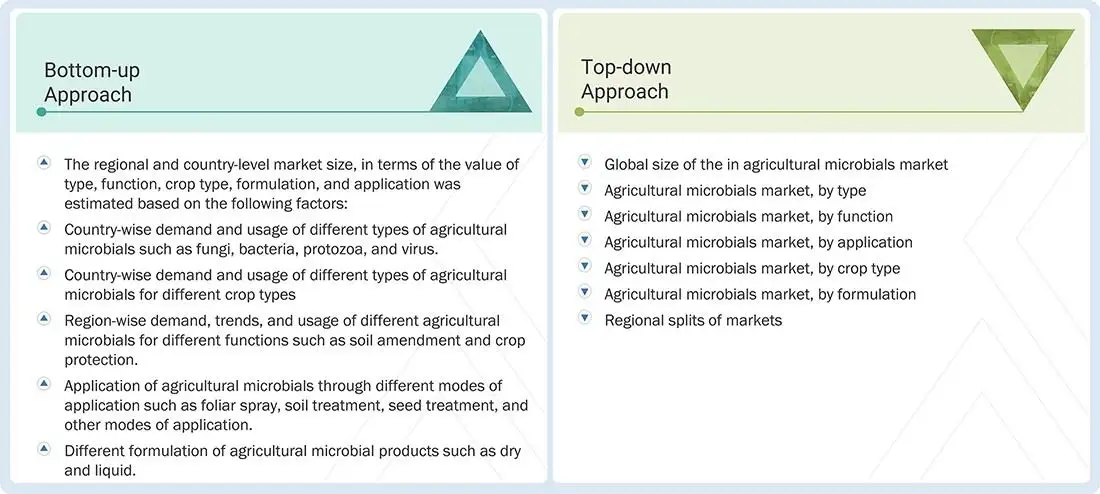
The study involved two major approaches in estimating the current size of the agricultural microbials market. Exhaustive secondary research was done to collect information on the market, peer, and parent markets. The next step was to validate these findings, assumptions, and sizing with industry experts across the value chain through primary research. Both top-down and bottom-up approaches were employed to estimate the complete market size. After that, data triangulation was used to estimate the market size of segments and subsegments.
Secondary Research
This research study involved the extensive use of secondary sources—directories and databases such as Bloomberg Businessweek and Factiva—to identify and collect information useful for a technical, market-oriented, and commercial study of the market.
In the secondary research process, various sources such as annual reports, press releases & investor presentations of companies, white papers, food journals, certified publications, articles from recognized authors, directories, and databases were referred to identify and collect information.
Secondary research was mainly used to obtain key information about the industry’s supply chain, the total pool of key players, and market classification and segmentation as per the industry trends to the bottom-most level, regional markets, and key developments from both market- and technology-oriented perspectives.
Primary Research
Extensive primary research was conducted after obtaining information regarding the agricultural microbials market scenario through secondary research. Several primary interviews were conducted with market experts from both the demand and supply sides across major countries of North America, Europe, Asia Pacific, South America, and the Rest of the World. Primary data was collected through questionnaires, emails, and telephonic interviews. The primary sources from the supply side included various industry experts, such as Chief X Officers (CXOs), Vice Presidents (VPs), Directors from business development, marketing, research, and development teams, and related key executives from distributors and key opinion leaders. Primary interviews were conducted to gather insights such as market statistics, data on revenue collected from the products and services, market breakdown, market size estimations, market forecasting, and data triangulation. Primary research also helped in understanding the various trends related to agricultural microbial type, function, formulation, crop type, application, and region. Stakeholders from the demand side, such as research institutions and universities, agrochemical distributors and retailers, and food processing companies, were interviewed to understand the buyer’s perspective on the suppliers, products, and their current usage of agricultural microbials and the outlook of their business, which will affect the overall market.
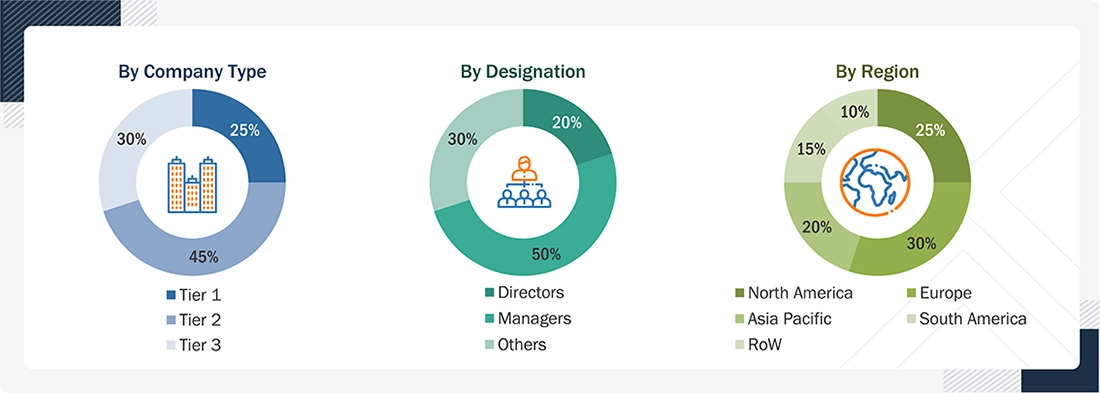
Note: The three tiers of the companies are defined based on their total revenues in 2022 or 2023, as per the availability of financial data: Tier 1: Revenue > USD 1 billion; Tier 2: USD 100 million ≤ Revenue ≤ USD 1 billion; Tier 3: Revenue < USD 100 million.
|
COMPANY NAME |
DESIGNATION |
|
Koppert (Netherlands) |
General Manager |
|
BASF SE (Germany) |
Sales Manager |
|
Bayer AG (Germany) |
Manager |
|
BioConsortia (US) |
Sales Manager |
|
IPL Biologicals (India) |
Marketing Manager |
To know about the assumptions considered for the study, download the pdf brochure
Market Size Estimation
Both the top-down and bottom-up approaches were used to estimate and validate the total size of the agricultural microbials market. These approaches were also used extensively to determine the size of various subsegments in the market. The research methodology used to estimate the market size includes the following details.
- The key players in the industry and the overall markets were identified through extensive secondary research.
- All shares, splits, and breakdowns were determined using secondary sources and verified through primary sources.
- All possible parameters that affect the market covered in this research study were accounted for, viewed in extensive detail, verified through primary research, and analyzed to obtain final quantitative and qualitative data.
- The research included the study of reports, reviews, and newsletters of top market players, along with extensive interviews for opinions from leaders, such as CEOs, directors, and marketing executives.
Global Agricultural Microbials Market: Bottom Up & Top Down Approach:
Data Triangulation
After arriving at the overall market size from the estimation process explained above, the total market was split into several segments and subsegments. The data triangulation and market breakdown procedures were employed, wherever applicable, to estimate the overall agricultural microbials market and arrive at the exact statistics for all segments and subsegments. The data was triangulated by studying various factors and trends from the demand and supply sides. The market size was also validated using both the top-down and bottom-up approaches.
Market Definition
According to the European Commission, “biological plant protection products contain micro-organisms which provide farmers with tools to substitute chemical plant protection products. Biological plant protection products can be used in organic agriculture, thereby presenting new sustainable alternatives available to EU organic farmers for controlling plant pests.”
Agricultural microbials are a group of agricultural products that include active ingredients of microbial origin, which may be bacteria, fungi, viruses, or protozoa. They cover a wide range of applications that include not only soil amendments for enhancing soil health and ecology but also crop protection to improve plant immunity and resistance to many pests and diseases, thus providing a holistic approach toward crop health. They significantly contribute to plant health by improving processes such as efficient nutrient uptake, disease resistance, pest protection, and improved immunity under stress and drought conditions.
Key Stakeholders
- Key manufacturers of microbial pesticides, microbial fertilizers, and microbial biostimulants
- Key companies in the agricultural microbials market
- Traders, distributors, and suppliers in the agricultural microbials market
- Technology providers to agricultural microbial companies
- Farmer organizations and crop protection product manufacturers
- Associations and industry bodies such as the Food and Agriculture Organization (FAO), Biopesticide Industry Alliance (BPIA), International Biocontrol Manufacturers Association (IBMA), and Association of American Plant Food Control Officials (AAPFCO)
- Concerned government authorities, commercial R&D institutions, and other regulatory bodies
Report Objectives
MARKET INTELLIGENCE
- To determine and project the size of the agricultural microbials market with respect to the type, function, formulation, application, crop type, and regions in terms of value over five years, ranging from 2026 to 2031
- To identify the attractive opportunities in the market by determining the largest and fastest-growing segments across regions
- To provide detailed information about the key factors influencing market growth (drivers, restraints, opportunities, and challenges)
- To analyze the opportunities in the market for stakeholders and provide details of the competitive landscape for market leaders
- To analyze the micro-markets with respect to individual growth trends, prospects, and their contribution to the total market
- To identify and profile the key players in the agricultural microbials market
- To understand the competitive landscape and identify the major growth strategies adopted by players across the key regions
Available customizations:
With the given market data, MarketsandMarkets offers customizations according to company-specific scientific needs.
The following customization options are available for the report:
PRODUCT ANALYSIS
- Product Matrix, which gives a detailed comparison of the product portfolio of each company
GEOGRAPHIC ANALYSIS
With the given market data, MarketsandMarkets offers customizations according to company-specific scientific needs
- Further breakdown of the Rest of Europe agricultural microbials market into key countries
- Further breakdown of the Rest of Asia Pacific agricultural microbials market into key countries
- Further breakdown of the Rest of South America agricultural microbials market into key countries
COMPANY INFORMATION
- Detailed analyses and profiling of additional market players (up to five)
Get the Full Agricultural Microbials Market Report
Full forecast, segment splits, and company analysis for all Agricultural Microbials Market.
- US Agricultural Microbials Market
- Canada Agricultural Microbials Market
- Mexico Agricultural Microbials Market
- France Agricultural Microbials Market
- Germany Agricultural Microbials Market
- Italy Agricultural Microbials Market
- Spain Agricultural Microbials Market
- UK Agricultural Microbials Market
- China Agricultural Microbials Market
- Japan Agricultural Microbials Market
- Australia Agricultural Microbials Market
- Argentina Agricultural Microbials Market
- Brazil Agricultural Microbials Market
Need a Tailored Report?
Customize this report to your needs
Get 10% FREE Customization
Customize This Report
