
UK Agricultural Surfactants Market (2023-2028)

The UK Agricultural Surfactants Market was valued at $25.5 Million in 2023 and projected to reach to $33.5 Million by 2028, representing a compound annual growth rate of 5.6%. The UK agricultural surfactants market is positioned for steady expansion through 2028, supported by farmers' increasing reliance on advanced crop protection formulations.


| Market Size in | USD 26.32 MN |
| Market Forecast in | |
| CAGR | |
| Forecast Period | |
| Units Considered | Value (USD MN) |
UK Agricultural Surfactants Market Trends and Insights
- The UK market reflects steady demand for adjuvants and wetting agents across the country's arable and horticultural sectors.
- Growth in the UK is driven by intensified crop protection practices, regulatory pressures for sustainable farming, and adoption of precision agriculture technologies that enhance pesticide and herbicide efficacy. The UK agricultural surfactants market benefits from established distribution networks and strong farmer engagement with modern agronomic solutions.
- Between 2023 and 2028, the UK market is expected to expand as producers seek cost-effective formulations and environmentally compliant products.
- The UK's commitment to sustainable intensification and integrated pest management creates sustained demand for high-performance surfactant solutions that improve spray coverage and reduce chemical inputs..
Key Market Statistics
- CAGR (2023-2028) 5.6% CAGR
- Market Size, 2023 ~USD 25.5 Million
- Forecast, 2028 ~USD 33.5 Million
- Country UK
UK Agricultural Surfactants Market Overview
Market Valuation :
The UK agricultural surfactants market was valued at £25.5 million in 2023 and is projected to reach £33.5 million by 2028, demonstrating consistent growth in the adjuvant sector.
Growth Trajectory :
The UK market is expanding at a CAGR of 5.6% through 2028, driven by increased adoption of crop protection solutions across arable and horticultural farming operations.
Key Drivers :
Intensified crop protection practices and stringent regulatory requirements for sustainable farming methods are propelling demand for effective wetting agents and adjuvants in UK agriculture.
Sector Focus :
The UK's arable and horticultural sectors are the primary consumers of agricultural surfactants, reflecting the country's diverse farming landscape and commitment to yield optimization.
UK Agricultural Surfactants Market Dynamics
- Regulatory pressures to adopt sustainable farming practices are encouraging the uptake of efficient adjuvants that enhance pesticide efficacy while reducing chemical volumes.
- The UK's established agricultural infrastructure and investment in precision farming technologies create a favorable environment for surfactant innovation. Looking ahead, the market will benefit from growing awareness of environmental compliance and the need for cost-effective crop management solutions.
- As UK farmers face pressure to maintain productivity amid climate variability, demand for high-performance wetting agents and spreader-sticker formulations will continue to rise, supporting market growth at a 5.6% CAGR through 2028..
Market Ecosystem
Related Ecosystem
Agrochemicals
- Phosphatic Fertilizers
- Potassic Fertilizers
- Fungicides
- Anticoagulant Rodenticides
- Ammonium Nitrate
- AZELIS HOLDINGS SA
- Basf se
- Origin Enterprises plc
- MITSUI AGRO BUSINESS SACO
- SNF HOLDING COMPANY INC.
Key Takeaways
- The UK agricultural surfactants market is valued at £25.5 million in 2023 and will reach £33.5 million by 2028.
- The UK market is growing at a 5.6% CAGR, driven by sustainable farming practices and precision agriculture adoption.
- UK farmers increasingly demand environmentally compliant surfactant solutions that reduce chemical inputs while maintaining efficacy.
- The UK's established distribution infrastructure and regulatory framework support steady market expansion through 2028.
Agricultural Surfactants Market Report Scope
| Report Metric | Details |
|---|---|
| Base Year | 2023 |
| Fastest Growing Segment | AMPHOTERIC (Type) |
| Forecast Period | 2023–2028 |
| Growth Rate | CAGR of 6.2% from 2023 to 2028 |
| Largest Segment | NON-IONIC (Type) |
| Market Size Base Year (Billions) | ~USD 1.7 (2023) |
| Revenue Forecast (Billions) | ~USD 2.3 (2028) |
| Segments Covered | Type, Application, Crop Type, Substrate Type |
UK Agricultural Surfactants Market Report Segmentation
4 segment dimensions are covered across the global market.
By Type
- Amphoteric
- Anionic
- Cationic
- Non-Ionic
By Application
- Fungicides
- Herbicides
- Insecticides
- Other Applications
By Crop Type
- Cereals & Grains
- Fruits & Vegetables
- Oilseeds & Pulses
- Other Crop Types
By Substrate Type
- Bio-Based
- Synthetic
UK: AGRICULTURAL SURFACTANTS MARKET, BY APPLICATION, 2023–2028
| Segment | 2023 | 2024 | 2025 | 2026 | 2027 | 2028 | CAGR (%) |
|---|---|---|---|---|---|---|---|
| FUNGICIDES | 0.67 | 0.7 | 0.74 | 0.79 | 0.83 | 0.9 | 6.1 |
| HERBICIDES | 13.69 | 14.42 | 15.21 | 16.11 | 17.03 | 18.12 | 5.8 |
| INSECTICIDES | 9.91 | 10.42 | 10.98 | 11.61 | 12.26 | 12.97 | 5.5 |
| OTHER APPLICATIONS | 1.18 | 1.23 | 1.29 | 1.36 | 1.42 | 1.5 | 4.8 |
| TOTAL | 25.45 | 26.78 | 28.23 | 29.87 | 31.55 | 33.49 | 5.6 |
Target Audience
- Agricultural Chemical Manufacturers : UK-based and international surfactant producers need market-specific data to optimize product portfolios, identify distribution channels, and plan capacity investments for the growing UK demand.
- Crop Protection Companies : Agrochemical firms require detailed UK market insights to formulate adjuvant strategies, understand regulatory drivers, and develop region-specific marketing campaigns for their crop protection solutions.
- Farm Input Distributors : UK agricultural distributors and retailers need market forecasts to stock appropriate surfactant products, anticipate customer demand, and negotiate supplier agreements based on growth projections.
- Agricultural Consultants & Advisors : Farm management professionals and agronomists require UK market data to provide evidence-based recommendations on adjuvant selection and help farmers optimize crop protection investments.
- Investment & Business Development Teams : Private equity, venture capital, and corporate development professionals need UK market intelligence to evaluate acquisition targets, assess growth potential, and identify strategic partnership opportunities in the sector.
Key Companies in the UK Agricultural Surfactants Market
| Company | HQ | Ownership | Strongest segments |
|---|---|---|---|
| DOW CHEMICAL COMPANY | United States | Private Company | Packaging and Specialty Plastics (ethylene, polyethylene, EVA, polyolefin elastomers),Industrial Intermediates and Infrastructure (propylene, aromatics, ethylene derivatives),Performance Materials and Coatings (cellulose ethers, acrylic emulsions, acrylics-based building blocks), |
| TESSENDERLO GROUP | Belgium | Public Company | Agro (specialty fertilizers and crop protection),Bio-Valorization (gelatins, collagen, proteins, fats),Industrial Solutions (water treatment and industrial chemicals), |
| ORIGIN ENTERPRISES PLC | Ireland | Public Company | Agronomy advice & on-farm services,Seed, nutrition, fertilizers & biologicals,Crop protection products, |
| KAO CORPORATION | Japan | Public Company | Hygiene & Living Care (fabric, kitchen, home, sanitary),Health & Beauty Care (facial, body, hair, oral, warming),Cosmetics & Salon, |
| OXITENO | Brazil | Private Company | Surfactants and ethylene oxide derivatives for detergents and home/personal care,Agrochemical and crop protection intermediates,Industrial applications (coatings, oilfield, textiles, leather, hydraulic fluids), |
| CORTEVA AGRISCIENCE | United States | Public Company | Seed,Crop Protection, |
| BASF SE | Germany | Public Company | Chemicals,Materials,Industrial Solutions, |
| EVONIK INDUSTRIES | Germany | Public Company | Advanced Technologies,Custom Solutions,Infrastructure, |
| SOLVAY | Belgium | Public Company | Soda ash and sodium bicarbonate,Hydrogen peroxide,Precipitated and highly dispersible silica, |
| CLARIANT | Switzerland | Public Company | Care Chemicals,Catalysts,Adsorbents & Additives, |
| CHS INC. | United States | Private Company | Grain marketing and origination,Energy products (refined fuels, propane, lubricants, renewable fuels),Agronomy (crop nutrients, seed, crop protection, seed treatments), |
| NUFARM | Australia | Public Company | Herbicides,Fungicides,Insecticides, |
| CRODA INTERNATIONAL PLC | United Kingdom | Public Company | Consumer Care (beauty, actives, home care, fragrances & flavours),Life Sciences (biologics delivery, crop protection, seed enhancement),Industrial Specialties (surfactants, phase change materials, textile finishes), |
| STEPAN COMPANY | United States | Public Company | Surfactants,Polymers (polyurethane polyols, polyester resins, specialty polyols, phthalic anhydride),Specialty Products (flavors, emulsifiers, solubilizers), |
DOW CHEMICAL COMPANY
The Dow Chemical Company is a private American chemical manufacturer founded in 1897 with 34,600 employees. The company operates as a major producer of chemicals and materials for various industrial applications.
TESSENDERLO GROUP
Tessenderlo Group is a Belgian public company established in 1919 with 6,945 employees. The company operates in the chemical and agricultural sectors.
ORIGIN ENTERPRISES PLC
Origin Enterprises PLC is an Irish public company founded in 2006 with 2,997 employees. The company operates in the agricultural and related business sectors.
KAO CORPORATION
Kao Corporation is a Japanese public company founded in 1887 with 31,514 employees. The company operates in the chemical, consumer products, and related industries.
OXITENO
Oxiteno is a private Brazilian company established in 1971 with 1,829 employees. The company manufactures specialty chemicals for industrial applications.
CORTEVA AGRISCIENCE
Corteva Agriscience is a public American company founded in 1802 with 21,500 employees. The company operates as a major provider of agricultural products and services.
BASF SE
BASF SE is a German public company founded in 1865 with 106,428 employees. The company is one of the world's largest chemical manufacturers serving diverse industrial sectors.
EVONIK INDUSTRIES
Evonik Industries is a German public company established in 1847 with 30,643 employees. The company manufactures specialty chemicals and materials for various industrial applications.
SOLVAY
Solvay is a Belgian public company founded in 1863 with 8,400 employees. The company operates as a major chemical and advanced materials manufacturer.
CLARIANT
Clariant is a Swiss public company established in 1886 with 9,998 employees. The company manufactures specialty chemicals and materials for industrial applications.
CHS INC.
CHS Inc. is a private American company founded in 1931 with 10,683 employees. The company operates in the agricultural and energy sectors.
NUFARM
Nufarm is an Australian public company established in 1916 with 3,046 employees. The company manufactures and distributes agricultural chemicals and related products.
CRODA INTERNATIONAL PLC
Croda International PLC is a British public company founded in 1925 with 5,954 employees. The company manufactures specialty chemicals for personal care, health, and industrial applications.
STEPAN COMPANY
Stepan Company is a private American company established in 1932 with 2,328 employees. The company manufactures specialty chemicals for various industrial applications.
Reasons to Buy this Report
- UK-Specific Market Sizing : Access precise valuation data for the UK agricultural surfactants market with historical figures (2023: £25.5M) and forecasts through 2028, enabling accurate budget allocation and investment planning.
- Regulatory Compliance Insights : Understand how UK-specific environmental regulations and sustainability mandates are shaping surfactant demand, helping you align product development with local compliance requirements.
- Sector-Specific Demand Analysis : Gain detailed intelligence on surfactant adoption patterns across UK arable and horticultural sectors, identifying high-growth subsegments and customer segments for targeted market entry.
- Competitive Positioning : Benchmark your offerings against UK market trends and growth rates (5.6% CAGR), enabling data-driven decisions on pricing, distribution, and product innovation strategies.
- Strategic Growth Planning : Leverage UK market forecasts to identify expansion opportunities, assess market maturity, and develop long-term strategies for capturing share in this steady-growth agricultural segment.
Frequently asked questions
What is the current size of the UK agricultural surfactants market?
The UK agricultural surfactants market was valued at £25.5 million in 2023 and is projected to reach £33.5 million by 2028.
What is the growth rate of the UK agricultural surfactants market?
The UK agricultural surfactants market is growing at a compound annual growth rate (CAGR) of 5.6% from 2023 to 2028.
What factors are driving growth in the UK agricultural surfactants market?
Growth in the UK is driven by sustainable farming practices, regulatory compliance requirements, precision agriculture adoption, and the need for improved pesticide efficacy.
Which segments dominate the UK agricultural surfactants market?
The UK market is dominated by adjuvants and wetting agents used in arable and horticultural crop protection applications.
How does the UK market compare to global trends?
The UK market grows at 5.6% CAGR, slightly below the global average of 6.2%, reflecting mature market dynamics and established regulatory frameworks.
RESEARCH METHODOLOGY
This research study involved the extensive use of secondary sources directories and databases such as Bloomberg Businessweek and Factiva—to identify and collect information useful for a technical, market-oriented, and commercial study of the agricultural surfactants market. In-depth interviews were conducted with various primary respondents—such as key industry participants, subject matter experts (SMEs), C-level executives of key market players, and industry consultants—to obtain and verify critical qualitative and quantitative information as well as to assess prospects.
Secondary Research
This research study of agricultural surfactants market involved the extensive use of secondary sources—directories and databases such as Bloomberg Businessweek and Factiva—to identify and collect valuable information for a technical, market-oriented, and commercial study of the agricultural adjuvants market.
In the secondary research process, sources such as annual reports, press releases & investor presentations of companies, white papers, food journals, certified publications, articles from recognized authors, gold & silver standard websites, directories, and databases, were referred to identify and collect information. This research study involved the extensive use of secondary sources—directories and databases such as Bloomberg Businessweek and Factiva—to identify and collect information useful for a technical, market-oriented, and commercial study of the agricultural adjuvants market.
Secondary research was mainly used to obtain key information about the industry’s supply chain, the total pool of key players, and market classification and segmentation as per the industry trends to the bottom-most level, regional markets, and key developments from both market- and technology-oriented perspectives.
Primary Research
Extensive primary research was conducted after obtaining information regarding the agricultural adjuvants market scenario through secondary research. Several primary interviews were conducted with market experts from both the demand and supply sides across major countries of North America, Europe, Asia Pacific, the Middle East & Africa, and South America. Primary data was collected through questionnaires, emails, and telephonic interviews. The primary sources from the supply side included various industry experts, such as Chief X Officers (CXOs), Vice Presidents (VPs), Directors from business development, marketing, research, and development teams, and related key executives from distributors and key opinion leaders. Primary interviews were conducted to gather insights such as market statistics, data on revenue collected from the products and services, market breakdowns, market size estimations, market forecasting, and data triangulation. Primary research also helped understand the formulation, adoption stage, functions, crop types, application, and regional trends. Stakeholders from the demand side, such as dealers, distributors, farmers, and government authorities who are using agricultural adjuvants, were interviewed to understand the buyer’s perspective on the suppliers, products, and their current usage of agricultural adjuvants and future outlook of their business which will affect the overall market.
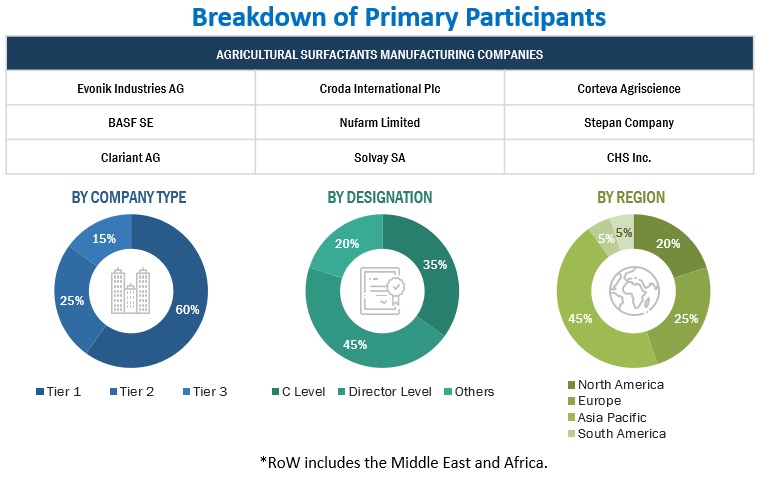
To know about the assumptions considered for the study, download the pdf brochure
Agricultural Surfactants Market Size Estimation
The following approaches represent the overall market size estimation process employed for the purpose of this study.
Both top-down and bottom-up approaches were used to estimate and validate the total size of the market. These approaches were also used extensively to estimate the size of various dependent submarkets. The research methodology used to estimate the market size includes the following:
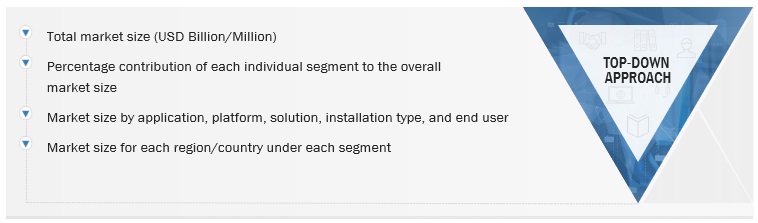
Top-down Approach:
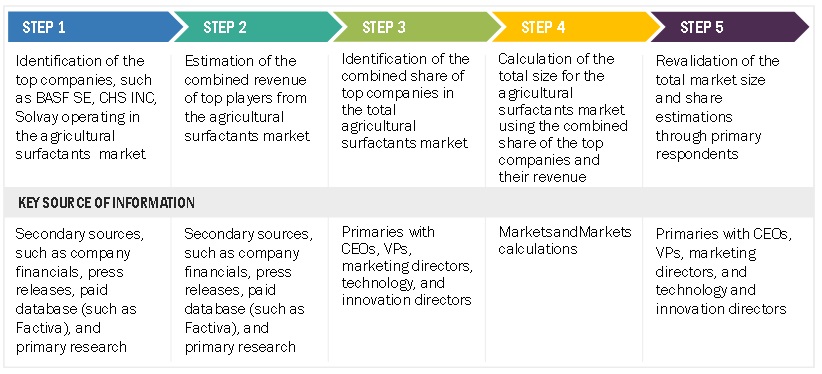
- The key players in the industry and the market were identified through extensive secondary research.
- The revenues of major agricultural surfactant manufacturers were determined through primary and secondary research, such as paid databases, which were used as the basis for market estimation.
- Based on the market share analysis of key industry players from all regions, the final market size of the agricultural surfactants market has been arrived at.
To know about the assumptions considered for the study, Request for Free Sample Report
Bottom-up Approach:
- Based on the share of agricultural surfactants for each application at regional and country levels, the market sizes were analyzed. Thus, with a bottom-up approach to the application at the country level, the global market for agricultural surfactants was estimated.
- Based on the demand for applications, offerings of key players, and the region-wise market share of major players, the global market for applications was estimated.
- Other factors considered include the penetration rate of agricultural surfactants, the demand for sustainable crop protection solutions, consumer awareness, functional trends, the adoption rate, patents registered, and organic & inorganic growth attempts.
- From this, market sizes for each region were derived.
- All percentage shares, splits, and breakdowns were determined using secondary sources and verified through primary sources.
- All macroeconomic and microeconomic factors affecting the growth of the agricultural surfactants market were considered while estimating the market size.
- All parameters that affect the market covered in this research study were accounted for, viewed in extensive detail, verified through primary research, and analyzed to obtain final quantitative and qualitative data.
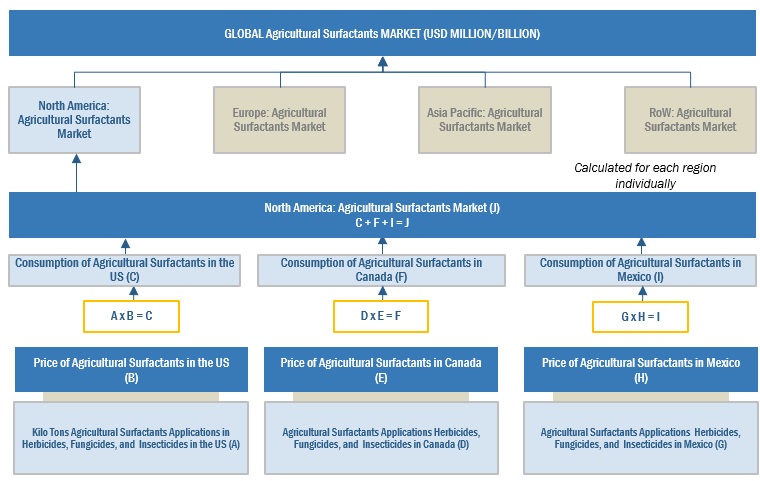
The following sections (bottom-up & top-down) (supply-demand) depict the overall market size estimation process employed for this study.
Agricultural Surfactants Market Data Triangulation
After arriving at the global market size from the estimation process explained above, the total market was split into various segments and subsegments. The data triangulation and market breakdown procedures were employed, wherever applicable, to estimate the market and arrive at the exact statistics for all segments and subsegments. The data was triangulated by studying a range of factors and trends from the demand and supply sides. Additionally, the market size was validated using both the top-down and bottom-up approaches.
Agricultural Surfactants Market Definition
According to UPL, agricultural surfactants are activators that improve performance by enhancing surface contact, decreasing runoff, and improving leaf penetration. Non-ionic surfactants, anionic surfactants, and cationic surfactants are the three types of surfactants, with the first two being utilized on crops. Non-ionic surfactants lower the surface tension of water molecules, allowing droplets to cover a larger surface area of the leaf. Anionic surfactants, on the other hand, interact with water to improve foaming and spreading.
The University of Georgia states that ‘Surfactants are adjuvants that facilitate and accentuate the emulsifying, dispersing, spreading, wetting, or other surface modifying properties of liquids.’ There are different chemistries of agricultural surfactants such as Ethoxylated fatty amines (Cationic), Alkylphenol ethoxylate-based surfactants (non-ionic), Alcohol ethoxylate-based surfactants (non-ionic), and Silicone-Based Surfactants as proposed by USDA.
Stakeholders
- Manufacturers of pesticides, fertilizers, and other crop inputs
- Key manufacturers of surfactants
- Pesticide traders, distributors, and suppliers
- Raw material and intermediate traders and suppliers in the agricultural adjuvants market
- Manufacturers and suppliers related to seed treatment and the seeds industry
- Concerned government authorities, commercial R&D institutions, and other regulatory bodies
- Regulatory bodies such as
- US Food and Drug Administration (FDA)
- European Commission (EC)
- European Food Safety Authority (EFSA)
- United States Department of Agriculture (USDA)
- Food Standards Australia New Zealand (FSANZ)
- United States Environmental Protection Agency (USEPA)
- Pest Management Regulatory Agency (PMRA)
- Government agencies and NGOs
- Commercial research & development (R&D) institutions and financial institutions
- Food and Agriculture Organization (FAO)
- World Health Organization (WHO)
- Intermediary suppliers such as wholesalers and dealers
Report Objectives
Market Intelligence
- Determining and projecting the size of the agricultural surfactants market, with respect to type, application, substrate type, crop type, and region, over a five-year period, ranging from 2023 to 2028
- Identifying the attractive opportunities in the market by determining the largest and fastest-growing segments across regions
- Providing detailed information about the key factors influencing the growth of the market (drivers, restraints, opportunities, and industry-specific challenges)
- Providing the regulatory framework for significant countries related to the market
- Analyzing the micro markets with respect to individual growth trends, prospects, and their contribution to the total market
- Impact of macro- and microeconomic factors on the market
- Shift in demand patterns across different subsegments and regions
Competitive Intelligence
- Identifying and profiling the key players in the global market
-
Providing a comparative analysis of market leaders on the basis of the following:
- Product offerings
- Business strategies
- Strengths and weaknesses
- Key financials
- Understanding the competitive landscape and identifying the major growth strategies adopted by players across the key regions
- Analyzing the value chain and products across the key regions and their impact on the prominent market players
- Providing insights on key product innovations and investments in the global agricultural surfactants market.
Available Customizations:
With the given market data, MarketsandMarkets offers customizations according to company-specific scientific needs.
The following customization options are available for the report:
Product Analysis
- Product Matrix, which gives a detailed comparison of the product portfolio of each company
Geographic Analysis
With the given market data, MarketsandMarkets offers customizations according to company-specific scientific needs.
- Further breakdown of the Rest of Asia Pacific agricultural surfactants market into Singapore, Malaysia, Philippines, Thailand, and South Korea
- Further breakdown of the Rest of Europe's market into Netherlands, Denmark, Belgium, and Switzerland
- Further breakdown of the Rest of South America's market into Chile, Peru, and Ecuador
Company Information
- Detailed analyses and profiling of additional market players (up to five)
Get the Full Agricultural Surfactants Market Report
Full forecast, segment splits, and company analysis for all Agricultural Surfactants Market.
- US Agricultural Surfactants Market
- Canada Agricultural Surfactants Market
- Mexico Agricultural Surfactants Market
- Germany Agricultural Surfactants Market
- France Agricultural Surfactants Market
- Italy Agricultural Surfactants Market
- Spain Agricultural Surfactants Market
- China Agricultural Surfactants Market
- India Agricultural Surfactants Market
- Japan Agricultural Surfactants Market
- Brazil Agricultural Surfactants Market
- Argentina Agricultural Surfactants Market
- Rest Of Europe Agricultural Surfactants Market
Need a Tailored Report?
Customize this report to your needs
Get 10% FREE Customization
Customize This Report
