
Japan Allergy Diagnostics Market (2026-2031)

The Japan Allergy Diagnostics Market was valued at $194.7 Million in 2026 and projected to reach to $308 Million by 2031, representing a compound annual growth rate of 9.6%. Japan's allergy diagnostics market is positioned for sustained expansion through 2031, driven by demographic shifts and heightened healthcare awareness among consumers.


| Market Size in | USD 26.32 MN |
| Market Forecast in | |
| CAGR | |
| Forecast Period | |
| Units Considered | Value (USD MN) |
Japan Allergy Diagnostics Market Trends and Insights
- This 9.6% compound annual growth rate reflects Japan's aging population, rising prevalence of allergic diseases, and increasing healthcare awareness.
- Japan's advanced healthcare infrastructure and strong diagnostic capabilities position the country as a key market within the Asia Pacific region. The expansion of Japan's allergy diagnostics sector is driven by technological innovation in testing methodologies, growing patient demand for accurate diagnosis, and enhanced reimbursement policies.
- Japan's emphasis on preventive healthcare and early disease detection supports market penetration across both urban and regional healthcare facilities.
- Between 2026 and 2031, Japan is expected to see increased adoption of molecular and immunological diagnostic platforms..
Key Market Statistics
- CAGR (2026-2031) 9.6% CAGR
- Market Size, 2026 ~USD 194.7 Million
- Forecast, 2031 ~USD 308 Million
- Country Japan
Japan Allergy Diagnostics Market Overview
Market Valuation Growth :
Japan's allergy diagnostics market is valued at USD 194.7 million in 2026 and is projected to reach USD 308.0 million by 2031, representing a robust 9.6% CAGR over the forecast period.
Aging Population Driver :
Japan's rapidly aging demographic is a key growth catalyst, as elderly populations exhibit higher prevalence of allergic conditions and require more frequent diagnostic testing and monitoring.
Advanced Healthcare Infrastructure :
Japan's world-class healthcare system, equipped with cutting-edge diagnostic technologies and high healthcare spending, supports widespread adoption of advanced allergy testing methodologies.
Rising Allergic Disease Prevalence :
Increasing incidence of allergic diseases including allergic rhinitis, asthma, and food allergies across Japanese populations is driving demand for accurate and timely diagnostic solutions.
Japan Allergy Diagnostics Market Dynamics
- The country's sophisticated medical infrastructure and emphasis on preventive care create favorable conditions for diagnostic innovation and market penetration.
- Healthcare providers are increasingly adopting advanced testing methodologies to address rising allergy prevalence. Government healthcare initiatives and insurance coverage expansion are expected to improve patient access to diagnostic services.
- Investment in research and development by both domestic and international players will accelerate the introduction of novel testing platforms.
- Japan's aging population will continue to represent a significant revenue opportunity, with chronic allergy management becoming increasingly important in geriatric care protocols..
Market Ecosystem
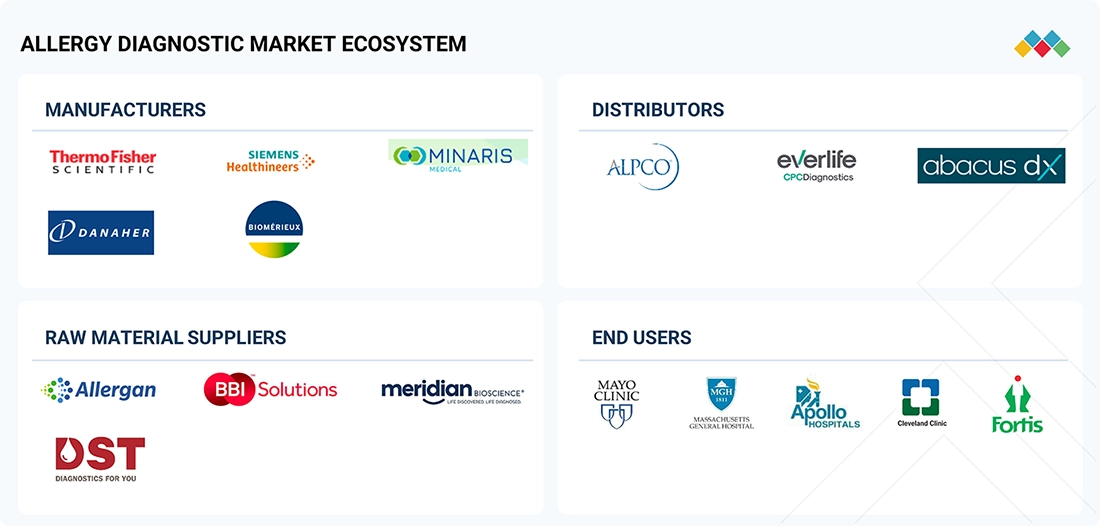
ALLERGY DIAGNOSTICS MARKET: COMMERCIAL USE CASES ACROSS INDUSTRIES
| COMPANY | USE CASE DESCRIPTION | BENEFITS |
|---|---|---|
 |
Comprehensive allergy testing portfolio (ImmunoCAP, component-resolved diagnostics) for accurate identification of specific allergens across respiratory, food, and drug allergies | High diagnostic accuracy | Personalized allergy profiling | Reduced misdiagnosis |
 |
Automated immunoassay-based allergy testing integrated into high-throughput laboratory workflows for hospitals and reference labs | Faster turnaround time | Workflow efficiency | Scalable testing |
 |
Multiplex and single-allergen testing solutions enabling simultaneous detection of multiple allergen sensitivities | Broad allergen coverage | Efficient sample utilization | Improved clinical insights |
 |
Allergy testing solutions integrated with laboratory automation and data management systems for routine and specialty diagnostics | Standardized results | Streamlined lab operations | Improved reproducibility |
 |
Cost-effective allergy testing systems designed for small to mid-sized laboratories and emerging markets | Affordable testing | Ease of use | Expanded access to allergy diagnostics |
Logos and trademarks shown above are the property of their respective owners. Their use here is for informational and illustrative purposes only.
Related Ecosystem
In Vitro Diagnostics
- Polymerase Chain Reaction (PCR)
- Enzyme-Linked Immunosorbent Assay (ELISA)
- Dna Microarrays
- Assay Kits
- Microarrays
- ROCHE HOLDINGS AG
- Thermo Fisher Scientific Inc.
- Danaher Corporation
- Abbott Laboratories
- Biomerieux s.a.
Key Takeaways
- Japan's allergy diagnostics market will grow from USD 194.7M (2026) to USD 308.0M (2031) at a 9.6% CAGR.
- Japan's aging demographic and rising allergic disease prevalence are primary growth catalysts for diagnostic demand.
- Japan's advanced healthcare infrastructure and reimbursement systems accelerate adoption of innovative diagnostic technologies.
- Japan is positioned as a leading Asia Pacific market, driven by preventive healthcare focus and early detection initiatives.
Allergy Diagnostics Market Report Scope
| Report Metric | Details |
|---|---|
| Base Year | 2026 |
| Fastest Growing Segment | IN VITRO TESTS (Test Type) |
| Forecast Period | 2026–2031 |
| Growth Rate | CAGR of 9.6% from 2026 to 2031 |
| Largest Segment | CONSUMABLES (Product & Service) |
| Market Size Base Year (Billions) | ~USD 6.81 (2026) |
| Revenue Forecast (Billions) | ~USD 10.77 (2031) |
| Segments Covered | Product & Service, Type, Test Type, Allergen, End User |
Japan Allergy Diagnostics Market Report Segmentation
5 segment dimensions are covered across the global market.
By Product & Service
- Consumables
- Instruments
- Services
By Type
- Immunoassay Analyzers
- Luminometers
- Other In Vivo Tests
- Other Instruments
- Patch Tests
- Skin Prick Tests
By Test Type
- In Vitro Tests
- In Vivo Tests
By Allergen
- Drug Allergens
- Food Allergens
- Inhaled Allergens
- Other Allergens
By End User
- Academic Research Institutes
- Diagnostic Laboratories
- Hospital-Based Laboratories
- Other End Users
JAPAN: ALLERGY DIAGNOSTIC MARKET, BY END USER, 2024–2031
| Segment | 2024 | 2025 | 2026 | 2027 | 2028 | 2029 | 2030 | 2031 | CAGR (%) |
|---|---|---|---|---|---|---|---|---|---|
| ACADEMIC RESEARCH INSTITUTES | 30.5 | 31.4 | 33.3 | 35.1 | 36.9 | 39.3 | 42 | 45.2 | 6.3 |
| DIAGNOSTIC LABORATORIES | 72.6 | 77.6 | 85.3 | 93.3 | 101.9 | 112.5 | 124.6 | 139.1 | 10.3 |
| HOSPITAL-BASED LABORATORIES | 165.8 | 174.2 | 188.1 | 202.1 | 216.9 | 235.4 | 256.2 | 281 | 8.4 |
| OTHER END USERS | 15.5 | 15.9 | 16.6 | 17.4 | 18.1 | 19.1 | 20.2 | 21.5 | 5.3 |
| TOTAL | 284.4 | 299.1 | 323.2 | 347.8 | 373.8 | 406.4 | 443 | 486.9 | 8.5 |
Target Audience
- In Vitro Diagnostics Manufacturers : IVD companies need Japan-specific market data to assess market entry feasibility, competitive dynamics, and growth potential for allergy diagnostic test kits and platforms.
- Healthcare Investment Firms : Private equity and venture capital investors require detailed Japan market analysis to evaluate investment opportunities in diagnostic companies and healthcare technology startups.
- Hospital & Diagnostic Lab Operators : Japanese healthcare facilities need market insights to optimize diagnostic service portfolios, justify capital investments in allergy testing equipment, and plan service expansion.
- Pharmaceutical & Biotech Companies : Pharma firms developing allergy treatments require market data on diagnostic adoption rates and patient populations to inform clinical trial design and commercialization strategies in Japan.
- Healthcare Consultants & Policy Makers : Consultants and government health agencies need comprehensive market intelligence to develop healthcare policies, reimbursement frameworks, and diagnostic service guidelines for Japan.
Key Companies in the Japan Allergy Diagnostics Market
| Company | HQ | Ownership | Strongest segments |
|---|---|---|---|
| TECAN GROUP LTD. | Switzerland |
TECAN GROUP LTD.
TECAN GROUP LTD. is a Swiss life sciences company providing laboratory automation and diagnostic instruments.
Reasons to Buy this Report
- Market Size & Growth Validation : Obtain precise market valuation data for Japan (USD 194.7M in 2026) with verified 9.6% CAGR projections through 2031, enabling accurate financial forecasting and investment decisions.
- Demographic Insights & Opportunity Mapping : Understand Japan's aging population dynamics and their correlation with allergic disease prevalence, identifying high-value patient segments and geographic expansion opportunities.
- Competitive Landscape Intelligence : Gain detailed analysis of Japan-specific market players, regulatory environment, and healthcare infrastructure advantages to benchmark competitive positioning and identify partnership opportunities.
- Strategic Market Entry Planning : Access Japan-focused market segmentation, reimbursement pathways, and healthcare provider adoption trends essential for developing localized go-to-market strategies and pricing models.
- Risk Assessment & Mitigation : Evaluate Japan-specific regulatory requirements, healthcare policy changes, and market barriers to inform risk management strategies and ensure compliant market operations.
Frequently asked questions
What is the current size of Japan's allergy diagnostics market?
Japan's allergy diagnostics market is valued at USD 194.7 million in 2026 and is expected to reach USD 308.0 million by 2031.
What is the projected growth rate for Japan's allergy diagnostics market?
Japan's allergy diagnostics market is projected to grow at a compound annual growth rate (CAGR) of 9.6% from 2026 to 2031.
What factors are driving growth in Japan's allergy diagnostics market?
Key drivers include Japan's aging population, rising prevalence of allergic diseases, technological innovation, enhanced reimbursement policies, and emphasis on preventive healthcare.
How does Japan's market compare within Asia Pacific?
Japan is positioned as a leading market in Asia Pacific due to its advanced healthcare infrastructure, strong diagnostic capabilities, and high healthcare spending.
What diagnostic technologies are gaining adoption in Japan?
Japan is seeing increased adoption of molecular and immunological diagnostic platforms, supported by technological innovation and healthcare modernization initiatives.
RESEARCH METHODOLOGY
The study involved major activities in estimating the current market size for the global Allergy Diagnostic market. Exhaustive secondary research was done to collect information on the allergy diagnostic market. The next step was to validate these findings, assumptions, and sizing with industry experts across the value chain using primary research. Different approaches, such as top-down and bottom-up, were employed to estimate the total market size. After that, the market breakup and data triangulation procedures were used to estimate the market sizes of the allergy diagnostic market's segments and subsegments.
Secondary Research
This research study involved the wide use of secondary sources, directories, databases such as Dun & Bradstreet, Bloomberg Businessweek, Factiva, whitepapers, and companies’ in-house documents. Secondary research was undertaken to identify and collect information for this extensive, technical, market-oriented, and commercial study of the allergy diagnostic market. It was also used to obtain important information about the top players, market classification, and segmentation according to industry trends to the bottom-most level, geographic markets, and key developments related to the market. A database of the key industry leaders was also prepared using secondary research.
Primary Research
In the primary research process, various supply- and demand-side sources were interviewed to obtain qualitative and quantitative information for this report. Primary sources from the supply side included industry experts such as CEOs, VPs/managing directors, marketing heads/directors and sales directors, marketing/sales managers, regional/area sales managers, export/import heads/managers, and other market-related personnel from various companies and organizations operating in the allergy diagnostic market. Primary sources from the demand side included vice presidents in hospitals & clinics, C-level executives, department heads, doctors/physicians, hospital supply management teams, clinic personnel, and laboratory technicians.
Breakdown of Primary Interviews
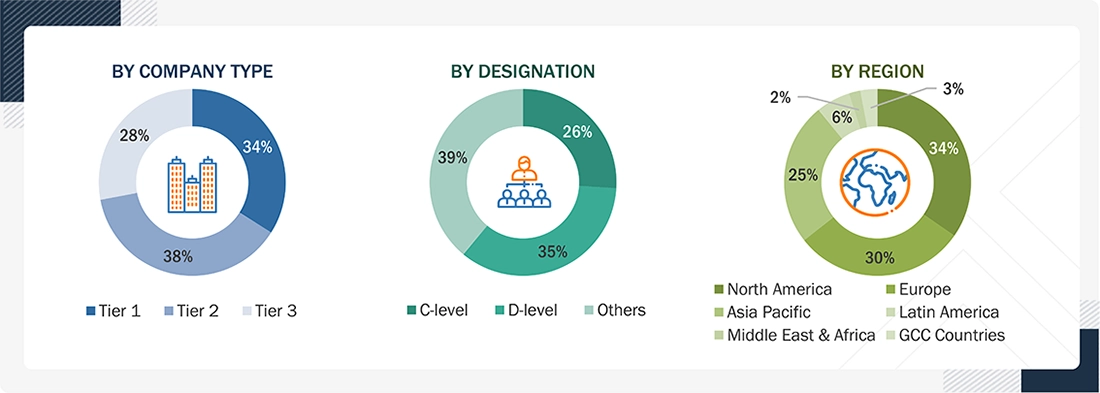
Note 1: C-level primaries include CEOs, COOs, and CTOs.
Note 2: Others include sales managers, marketing managers, and product managers.
Note 3: Companies are classified into tiers based on their total revenue. As of 2025: Tier 1 = >USD 1 billion, Tier 2 = USD 500 million to USD 1 billion, Tier 3 = <USD 500 million
To know about the assumptions considered for the study, download the pdf brochure
Market Size Estimation
Both top-down and bottom-up approaches were used to estimate and validate the total size of the allergy diagnostic market. These methods were also widely used to estimate the sizes of various subsegments in the market. The research methodology used to estimate the market size includes the following:
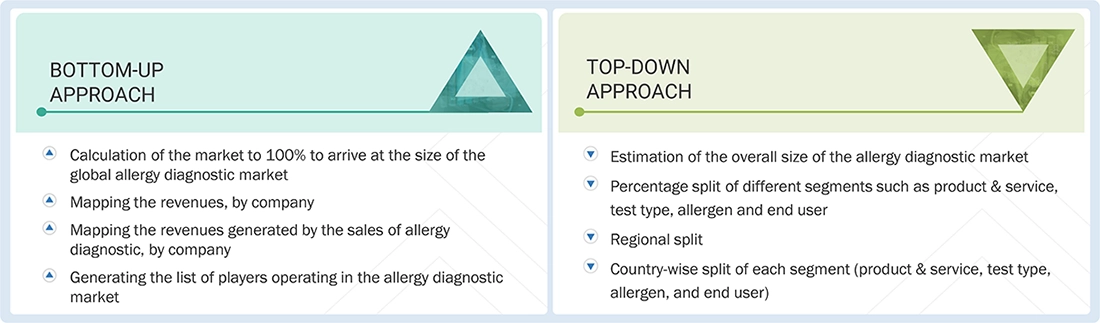
Data Triangulation
The market was divided into four segments when the market size was determined. Data triangulation and market breakdown processes were used where necessary to complete the market engineering process and arrive at precise statistics for all segments.
Approach to derive the market size and estimate market growth: Using secondary data from paid and unpaid sources, the market rankings for the major players were determined following a thorough analysis of their sales of allergy diagnostic products. Due to data restrictions, the revenue share in certain cases was determined after a thorough analysis of the product portfolio of big corporations and their individual sales performance. This information was verified at each stage by in-depth interviews with professionals in the field.
Market Definition
Allergy testing helps determine the substances causing a patient's allergy symptoms. Tests include skin tests, intradermal tests, challenge tests, blood tests, and patch tests. Allergists commonly conduct challenge tests, including food, inhalation, drug, and physical challenges. Blood tests are generally used when unsafe or unapplicable skin tests are required, such as when consuming certain medications or having a skin condition that may interfere with skin testing. Allergy tests, such as in vitro & in vivo tests, are performed to determine the cause, stage, prognosis, and treatment course for allergic diseases.
Key Stakeholders
- Allergy Diagnostic Reagents, Kits, and Instrument Manufacturers
- Allergy Diagnostic Vendors and Distributors
- Hospitals
- Diagnostic Laboratories
- Allergy Diagnostic Service Providers
- Academic Research Institutes
- Venture Capitalists and Investors
- Contract Research Organizations (CROs)
Report Objectives
- To describe, analyze, and forecast the allergy diagnostic market, by product & service, test type, allergen, end user, and region
- To describe and forecast the allergy diagnostic market for key regions, namely, North America, Europe, Asia Pacific, Latin America, the Middle East & Africa, and GCC countries
- To provide detailed information regarding drivers, restraints, opportunities, and challenges influencing the growth of the allergy diagnostic market
- To strategically analyze the ecosystem, regulations, patenting trend, value chain, Porter’s Five Forces, and prices pertaining to the market under study
- To strategically analyze micromarkets with respect to individual growth trends, prospects, and contributions to the overall market
- To analyze market opportunities for stakeholders and provide details of the competitive landscape for market players
- To profile key players and comprehensively analyze their market shares and core competencies in the allergy diagnostic market
- To analyze competitive developments such as collaborations, acquisitions, product launches, expansions, and R&D activities in the allergy diagnostic market
Available customizations:
With the given market data, MarketsandMarkets offers customizations as per your company’s specific needs. The following customization options are available for the report:
Company Information
- Detailed analysis and profiling of additional market players (up to 5)
Product Analysis
- Product matrix, which gives a detailed comparison of the product portfolios of each company
Geographic Analysis
- Further breakdown of the Rest of Asia Pacific allergy diagnostic market into Vietnam, New Zealand, and others
- Further breakdown of the Rest of Latin America allergy diagnostic market into Colombia, Chile, Ecuador, and others
- Further breakdown of the Rest of Europe allergy diagnostic market into Belgium, Russia, the Netherlands, Switzerland, and others
Get the Full Allergy Diagnostics Market Report
Full forecast, segment splits, and company analysis for all Allergy Diagnostics Market.
- Canada Allergy Diagnostics Market
- US Allergy Diagnostics Market
- Germany Allergy Diagnostics Market
- UK Allergy Diagnostics Market
- France Allergy Diagnostics Market
- Italy Allergy Diagnostics Market
- Spain Allergy Diagnostics Market
- China Allergy Diagnostics Market
- India Allergy Diagnostics Market
- South Korea Allergy Diagnostics Market
- Australia Allergy Diagnostics Market
- Brazil Allergy Diagnostics Market
- Mexico Allergy Diagnostics Market
- GCC Countries Allergy Diagnostics Market
- Rest Of Europe Allergy Diagnostics Market
- Rest Of Asia Pacific Allergy Diagnostics Market
Need a Tailored Report?
Customize this report to your needs
Get 10% FREE Customization
Customize This Report
