
Japan Anhydrous Hydrofluoric Acid Market (2025-2030)

The Japan Anhydrous Hydrofluoric Acid Market was valued at $1520.6 Million in 2025 and projected to reach to $1828.4 Million by 2030, representing a compound annual growth rate of CAGR 3.8%. Japan's anhydrous hydrofluoric acid market is poised for steady growth driven by sustained demand from semiconductor fabrication plants and fluorochemical manufacturers.


| Market Size in | USD 26.32 MN |
| Market Forecast in | |
| CAGR | |
| Forecast Period | |
| Units Considered | Value (USD MN) |
Japan Anhydrous Hydrofluoric Acid Market Trends and Insights
- Japan's chemical manufacturing sector, particularly in semiconductor and fluorochemical production, drives steady demand for anhydrous hydrofluoric acid as a critical processing agent.
- The market in Japan benefits from the country's advanced industrial infrastructure and stringent quality standards that favor high-purity chemical inputs. During the forecast period from 2025 to 2030, Japan's anhydrous hydrofluoric acid market will be supported by continued investment in electronics manufacturing and specialty chemical applications.
- Japan's position as a global leader in semiconductor fabrication ensures sustained consumption of anhydrous hydrofluoric acid for etching and refining processes.
- Regulatory compliance and environmental considerations in Japan further shape market dynamics, encouraging adoption of safer handling and production technologies..
Key Market Statistics
- CAGR (2025-2030) CAGR 3.8%
- Market Size, 2025 ~USD 1520.6 Million
- Forecast, 2030 ~USD 1828.4 Million
- Country Japan
Japan Anhydrous Hydrofluoric Acid Market Overview
Market Size & Growth :
Japan's anhydrous hydrofluoric acid market is valued at USD 1,520.6 million in 2025, with projected growth to USD 1,828.4 million by 2030, reflecting a steady CAGR of 3.8%.
Semiconductor Industry Demand :
Japan's advanced semiconductor manufacturing sector relies heavily on anhydrous hydrofluoric acid for etching and processing applications, driving consistent market demand from leading chipmakers.
Fluorochemical Production Hub :
As a major global fluorochemical producer, Japan utilizes anhydrous hydrofluoric acid as a critical raw material for manufacturing refrigerants, polymers, and specialty chemicals.
Outperformance vs. Global Rate :
Japan's market CAGR of 3.8% slightly underperforms the global average of 4%, reflecting mature market dynamics and competitive regional supply chains.
Japan Anhydrous Hydrofluoric Acid Market Dynamics
- The country's position as a technology leader ensures continued investment in advanced chip production, supporting consistent consumption of anhydrous hydrofluoric acid.
- Regulatory compliance and environmental standards will shape supply chain optimization and production efficiency improvements. Looking ahead to 2030, Japan's market will benefit from recovery in electronics exports and expansion of specialty chemical applications.
- However, growth will remain moderate compared to emerging markets, reflecting Japan's mature industrial base and established manufacturing infrastructure.
- Strategic partnerships and technological innovations in acid recycling and handling will enhance market competitiveness..
Market Ecosystem
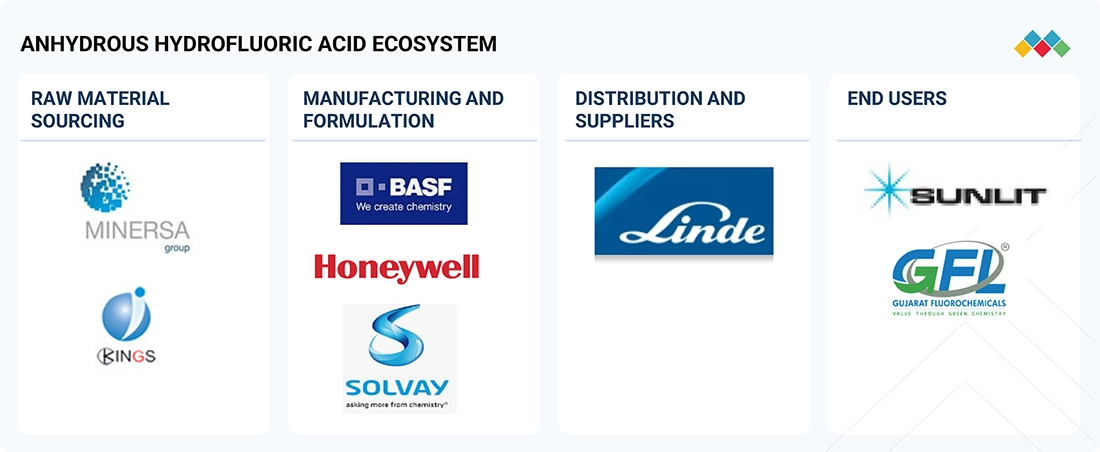
Anhydrous Hydrofluoric Acid Market: COMMERCIAL USE CASES ACROSS INDUSTRIES
| COMPANY | USE CASE DESCRIPTION | BENEFITS |
|---|---|---|
 |
Use as a catalyst in petroleum refining for alkylation processes to produce high-octane gasoline | Efficient and economical production of high-quality fuel | Recyclable catalyst | Improved refinery yields |
 |
Production of fluoropolymers such as Teflon and PTFE for various industrial applications | Exceptional heat resistance | Non-stick and chemically inert properties | Versatile use in aerospace, cookware, and more |
 |
Etching and cleaning silicon wafers in semiconductor manufacturing | Precise creation of microscopic features | Ensures atomically clean surfaces | Supports advanced electronics |
Logos and trademarks shown above are the property of their respective owners. Their use here is for informational and illustrative purposes only.
Related Ecosystem
Bulk Chemicals And Inorganics
- Corrosion Inhibitors
- Glycol Ethers
- Acetic Acid
- Acetone
- Ammonium Nitrate
- Basf se
- DOW CHEMICAL COMPANY
- Exxon Mobil Corporation
- AZELIS HOLDINGS SA
- Sinopec limited
Key Takeaways
- Japan's anhydrous hydrofluoric acid market is valued at USD 1,520.6 million in 2025 and will reach USD 1,828.4 million by 2030.
- Japan's semiconductor and electronics manufacturing industries are primary drivers of anhydrous hydrofluoric acid demand.
- Japan's 3.8% CAGR reflects steady but moderate growth driven by mature industrial applications and regulatory standards.
- Japan's advanced manufacturing infrastructure and quality requirements support premium-grade anhydrous hydrofluoric acid consumption.
Anhydrous Hydrofluoric Acid Market Report Scope
| Report Metric | Details |
|---|---|
| Base Year | 2025 |
| Fastest Growing Segment | NUCLEAR (End-Use Industry) |
| Forecast Period | 2025–2030 |
| Growth Rate | CAGR of 4% from 2025 to 2030 |
| Largest Segment | FLUORITE BASED (Type) |
| Market Size Base Year (Billions) | ~USD 6.94 (2025) |
| Revenue Forecast (Billions) | ~USD 8.44 (2030) |
| Segments Covered | Application, Type, Distribution Channel, Grade, End-Use Industry |
Japan Anhydrous Hydrofluoric Acid Market Report Segmentation
5 segment dimensions are covered across the global market.
By Application
- Etching & Cleaning Agents
- Fuming Agents
- Intermediate In Chemical Reactions
- Material Processing & Surface Treatment
- Ph Control Agents
By Type
- Fluorite Based
- Fluorosilicic Acid Based
By Distribution Channel
- Direct Sales
- Online Retailers
By Grade
- High Purity Grade
- Standard Grade
By End-Use Industry
- Catalyst
- Chemical & Petrochemical
- Fluorocarbons
- Nuclear
- Other End-Use Industries
- Other End-Use Industry
- Pharmaceutical
- Semiconductor & Electronics
JAPAN: ANHYDROUS HYDROFLUORIC ACID MARKET, BY END-USE INDUSTRY, 2025–2030
| Segment | 2025 | 2026 | 2027 | 2028 | 2029 | 2030 | CAGR (%) |
|---|---|---|---|---|---|---|---|
| CATALYST | 916.5 | 942.8 | 974.9 | 1014.2 | 1062.7 | 1106.6 | 3.8 |
| CHEMICAL & PETROCHEMICAL | 51 | 52.9 | 55 | 57.7 | 60.8 | 63.8 | 4.6 |
| FLUOROCARBONS | 231 | 235.9 | 242 | 249.9 | 259.8 | 268.4 | 3 |
| NUCLEAR | 18.2 | 19.1 | 20.2 | 21.4 | 22.8 | 24.3 | 5.9 |
| OTHER END-USE INDUSTRY | 31.6 | 32.3 | 33.2 | 34.3 | 35.6 | 36.7 | 3 |
| PHARMACEUTICAL | 94.2 | 96.6 | 99.7 | 103.4 | 108 | 112.2 | 3.6 |
| SEMICONDUCTOR & ELECTRONICS | 178 | 183.4 | 189.9 | 197.8 | 207.5 | 216.4 | 4 |
| TOTAL | 1520.6 | 1563 | 1614.9 | 1678.6 | 1757.4 | 1828.4 | 3.8 |
Target Audience
- Chemical Manufacturers : Japanese and international chemical producers need market intelligence to optimize production capacity, plan raw material procurement, and identify growth segments within Japan's anhydrous HF market.
- Semiconductor Equipment Suppliers : Equipment manufacturers serving Japan's chip industry require detailed market forecasts to align product development with demand trends for HF-based processing solutions.
- Investment & Private Equity Firms : Investors evaluating opportunities in Japan's chemical sector need validated market data and growth projections to assess portfolio companies and identify acquisition targets.
- Regulatory & Compliance Officers : Japanese regulatory bodies and corporate compliance teams need market insights to develop safety standards, environmental policies, and industry guidelines for anhydrous HF handling.
- Strategic Business Planners : Corporate strategists in Japan's fluorochemical and semiconductor industries require country-specific forecasts to guide capital allocation, expansion plans, and competitive positioning.
Key Companies in the Japan Anhydrous Hydrofluoric Acid Market
| Company | HQ | Ownership | Strongest segments |
|---|---|---|---|
| HONEYWELL INTERNATIONAL INC. | United States | ||
| SOLVAY | Belgium | ||
| LANXESS | Germany | ||
| ZHEJIANG YONGHE REFRIGERANT CO., LTD. | China | Public Company | Fluorocarbon refrigerants and mixed refrigerants,Fluorinated polymer materials and monomers,Fluorinated fine chemicals and intermediates, |
| SRF LIMITED | India | Public Company | Chemicals Business (fluorochemicals, industrial and specialty chemicals, intermediates, fluoropolymers),Performance Films and Foil (polyester films, polypropylene films, aluminum foil),Technical Textiles Business (tyre cord, belting, coated and laminated fabrics, industrial yarns), |
HONEYWELL INTERNATIONAL INC.
Honeywell International Inc. is a diversified technology and manufacturing company headquartered in the United States that operates across aerospace, building technologies, performance materials, and safety solutions. The company serves customers in commercial and consumer markets globally through its portfolio of innovative products and services.
SOLVAY
Solvay is a Belgian chemical company specializing in advanced materials, specialty chemicals, and solutions for various industrial sectors including aerospace, automotive, and consumer goods. The company operates globally with a focus on sustainable and innovative chemical solutions.
LANXESS
Lanxess is a German specialty chemicals company that produces high-performance chemicals, polymers, and intermediates for industries including automotive, construction, and consumer goods. The company operates manufacturing facilities worldwide and focuses on sustainable chemical innovation.
ZHEJIANG YONGHE REFRIGERANT CO., LTD.
Zhejiang Yonghe Refrigerant Co., Ltd. is a Chinese public company founded in 1998 that manufactures refrigerants and fluorochemical products. With 2,938 employees, the company serves the refrigeration and air conditioning industries.
SRF LIMITED
SRF Limited is an Indian public company founded in 1970 with 7,686 employees that manufactures specialty chemicals, fluorochemicals, and polymers. The company serves diverse industries including refrigeration, air conditioning, and industrial applications.
Reasons to Buy this Report
- Precise Market Sizing : Access validated market data specific to Japan with exact valuations for 2025 (USD 1,520.6M) and 2030 (USD 1,828.4M), enabling accurate financial planning and investment decisions.
- Sector-Specific Insights : Understand demand drivers from Japan's semiconductor and fluorochemical industries, identifying growth opportunities within the country's advanced manufacturing ecosystem.
- Competitive Positioning : Benchmark Japan's 3.8% CAGR against global 4% growth rate to assess regional market maturity and identify competitive advantages in the Japanese chemical sector.
- Strategic Market Entry : Develop targeted go-to-market strategies for Japan with country-specific demand forecasts, regulatory considerations, and industry-specific application insights.
- Risk & Opportunity Assessment : Evaluate Japan's stable but moderate growth trajectory to identify supply chain vulnerabilities, expansion opportunities, and long-term investment viability in the region.
Frequently asked questions
What is the market size of anhydrous hydrofluoric acid in Japan in 2025?
Japan's anhydrous hydrofluoric acid market is estimated at USD 1,520.6 million in 2025.
What is the projected market size for anhydrous hydrofluoric acid in Japan by 2030?
Japan's anhydrous hydrofluoric acid market is projected to reach USD 1,828.4 million by 2030.
What is the CAGR for Japan's anhydrous hydrofluoric acid market?
Japan's anhydrous hydrofluoric acid market is expected to grow at a CAGR of 3.8% from 2025 to 2030.
Which industries drive demand for anhydrous hydrofluoric acid in Japan?
Japan's semiconductor fabrication, electronics manufacturing, and specialty chemical production sectors are the primary drivers of anhydrous hydrofluoric acid demand.
What factors influence the anhydrous hydrofluoric acid market in Japan?
Japan's market is influenced by semiconductor industry growth, regulatory compliance requirements, environmental standards, and the country's advanced manufacturing capabilities.
RESEARCH METHODOLOGY
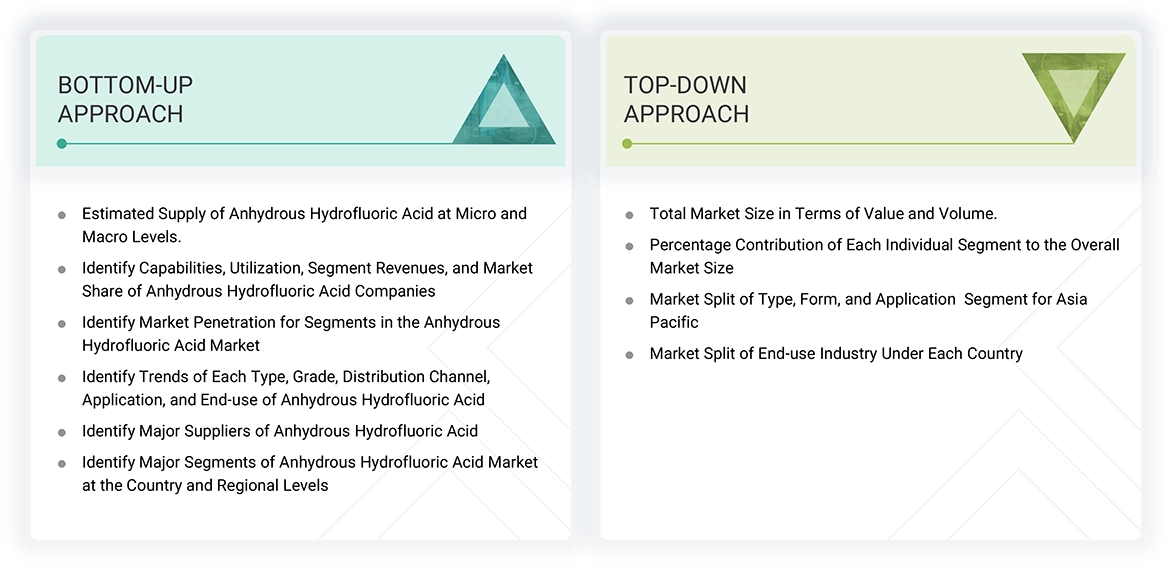
The study involved four major activities in estimating the market size of Anhydrous Hydrofluoric Acid (AHF). Exhaustive secondary research was done to collect information on the market, the peer market, and the parent market. The next step was to validate these findings, assumptions, and sizing with industry experts across the value chain through primary research. Both, top-down and bottom-up approaches were employed to estimate the complete market size. Thereafter, the market breakdown and data triangulation procedures were used to estimate the market size of the segments and subsegments.
Secondary Research
In the secondary research process, various secondary sources have been referred to for identifying and collecting information for this study. These secondary sources include annual reports, press releases, investor presentations of companies, white papers, certified publications, trade directories, certified publications, articles from recognized authors, gold standard and silver standard websites, and databases.
Secondary research has been used to obtain key information about the value chain of the industry, the monetary chain of the market, the total pool of key AHF market classification and segmentation according to industry trends to the bottom-most level, and regional markets. It was also used to obtain information about the key developments from a market-oriented perspective.
Primary Research
AHF comprises several stakeholders in the value chain, which include raw material suppliers, manufacturers, and end users. Various primary sources from the supply and demand sides of the AHF have been interviewed to obtain qualitative and quantitative information. The interviewees from the demand side include key opinion leaders in end-use sectors. The primary sources from the supply side include manufacturers, associations, and institutions involved in the AHF industry.
Interviews with experts were conducted to gather insights such as market statistics, data on revenue collected from the products and services, market breakdowns, market size estimations, market forecasting, and data triangulation. Primary research also helped in understanding the various trends related to chemistry, application, and region. Stakeholders from the demand side, such as CIOs, CTOs, and CSOs, were interviewed to understand the buyer’s perspective on the suppliers, products, component providers, and their current usage of AHF and future outlook of their business, which will affect the overall market.
The breakdown of profiles of the interviews with experts is illustrated in the figure below:
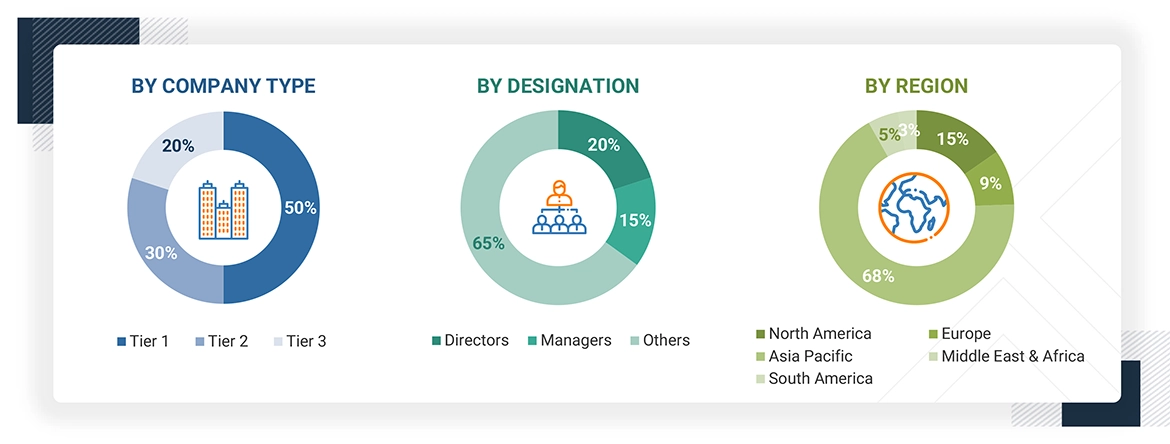
Note: Tier 1, Tier 2, and Tier 3 companies are classified based on their market revenue in 2024 available in the public domain, product portfolios, and geographical presence.
Other designations include sales representatives, production heads, and technicians.
To know about the assumptions considered for the study, download the pdf brochure
Market Size Estimation
The top-down approach was used to estimate and validate the size of various submarkets for AHF for each region. The research methodology used to estimate the market size included the following steps:
- The key players in the industry have been identified through extensive secondary research.
- The supply chain of the industry has been determined through primary and secondary research.
- All percentage shares, splits, and breakdowns based on type, grade, distribution channel, application, end-use industry, and region were determined using secondary sources and verified through primary sources.
- All possible parameters that affect the markets covered in this research study were accounted for, viewed in extensive detail, verified through primary research, and analyzed to get the final quantitative and qualitative data. This data was consolidated and added with detailed inputs and analysis and presented in this report.
Data Triangulation
After arriving at the total market size from the estimation process above, the overall market has been split into several segments and subsegments. To complete the overall market engineering process and arrive at the exact statistics for all the segments and subsegments, the data triangulation and market breakdown procedures have been employed, wherever applicable. The data has been triangulated by studying various factors and trends from both, the demand and supply sides. Along with this, the market size has been validated by using both, the top-down and bottom-up approaches and interviews with experts. Hence, for every data segment, there have been three sources—top-down approach, bottom-up approach, and interviews with experts. The data was assumed correct when the values arrived from the three sources matched.
Market Definition
Anhydrous hydrofluoric acid (AHF) is a colorless, fuming liquid or gaseous form of hydrofluoric acid (HF, see figure below), with a very pungent odor and no water content, and is a very corrosive & toxic substance. AHF consists of both, HF in anhydrous form or as a gas that has undergone purification and distillation to artificially remove water, unlike its aqueous form (HF(a)). Most AHF is produced when fluorspar (calcium fluoride, CaF2), is reacted with sulfuric acid at elevated temperatures (approximately 265°C) to produce hydrogen fluoride (HF). The HF is purified and distilled to remove water to produce AHF, as the absence of water in the environmental form of AHF is desirable. On the other hand, AHF can be produced using fluorosilicic acid (H2SiF6), a by-product of phosphoric acid production in the phosphate fertilizer industry, via a series of specially designed vessels that allow ammoniation, filtration, and calcination to produce AHF. These systems provide sustainability by developing a product from a standard waste by-product that was previously disposed of as waste. AHF is an important raw material for many applications due to its reactivity, and its dissolving power for silicates and oxides. In the chemical and petrochemical industry, AHF acts as an intermediate in chemical reactions, and plays a key role in producing fluorochemicals, such as fluorocarbons (HFCs and HCFCs) and fluoropolymers. Fluorocarbons (HFCs and HCFCs) are used in the manufacture of refrigerants, air conditioning products, and aerosol propellants due to their chemical stability. AHF is also used in the refining of petroleum as a catalyst in the production of alkylation, whereby olefins combine with isobutane to give high-octane gasoline components for improved fuel efficiency.
Stakeholders
- Anhydrous Hydrofluoric Acid Manufacturers
- Anhydrous Hydrofluoric Acid Traders, Distributors, and Suppliers
- Raw Material Type Suppliers
- Government and Private Research Organizations
- Associations and Industrial Bodies
- R&D Institutions
- Environmental Support Agencies
Report Objectives
- To define, describe, and forecast the size of the AHF market, in terms of value and volume
- To provide detailed information regarding the major factors (drivers, opportunities, restraints, and challenges) influencing the growth of the market
- To estimate and forecast the market size based on type, grade, distribution channel, application, end-use industry, and region
- To forecast the size of the market with respect to major regions, namely, North America, Asia Pacific, Europe, Middle East & Africa, South America, along with their key countries
- To strategically analyze micromarkets with respect to individual growth trends, prospects, and their contribution to the overall market
- To analyze opportunities in the market for stakeholders and provide a competitive landscape for market leaders
- To track and analyze recent developments such as product launches, partnerships, acquisitions, and expansions in the market
- To strategically profile key market players and comprehensively analyze their core competencies
Get the Full Anhydrous Hydrofluoric Acid Market Report
Full forecast, segment splits, and company analysis for all Anhydrous Hydrofluoric Acid Market.
- China Anhydrous Hydrofluoric Acid Market
- India Anhydrous Hydrofluoric Acid Market
- South Korea Anhydrous Hydrofluoric Acid Market
- Canada Anhydrous Hydrofluoric Acid Market
- Mexico Anhydrous Hydrofluoric Acid Market
- US Anhydrous Hydrofluoric Acid Market
- Germany Anhydrous Hydrofluoric Acid Market
- Italy Anhydrous Hydrofluoric Acid Market
- France Anhydrous Hydrofluoric Acid Market
- UK Anhydrous Hydrofluoric Acid Market
- Spain Anhydrous Hydrofluoric Acid Market
- South Africa Anhydrous Hydrofluoric Acid Market
- Argentina Anhydrous Hydrofluoric Acid Market
- Brazil Anhydrous Hydrofluoric Acid Market
- Rest Of Europe Anhydrous Hydrofluoric Acid Market
- Rest Of Asia Pacific Anhydrous Hydrofluoric Acid Market
- GCC Countries Anhydrous Hydrofluoric Acid Market
- –Rest Of GCC Anhydrous Hydrofluoric Acid Market
- Rest Of South America Anhydrous Hydrofluoric Acid Market
Need a Tailored Report?
Customize this report to your needs
Get 10% FREE Customization
Customize This Report
