
Japan Armored Vehicles Market (2025-2030)

The Japan Armored Vehicles Market was valued at $2921.6 Million in 2025 and projected to reach to $3779.8 Million by 2030, representing a compound annual growth rate of 5.3%. Japan's armored vehicles market is experiencing robust growth driven by strategic defense modernization initiatives and heightened regional security concerns.


| Market Size in | USD 26.32 MN |
| Market Forecast in | |
| CAGR | |
| Forecast Period | |
| Units Considered | Value (USD MN) |
Japan Armored Vehicles Market Trends and Insights
- This growth trajectory reflects Japan's strategic focus on modernizing its defense capabilities and strengthening regional security posture amid evolving geopolitical dynamics in Asia Pacific.
- Japan's investment in advanced armored vehicle technologies is driven by the need to enhance operational readiness and maintain technological superiority. The armored vehicles market in Japan is characterized by increasing demand for next-generation platforms that offer enhanced protection, mobility, and integrated digital systems.
- Japan's defense procurement strategy emphasizes domestic innovation and partnerships with allied nations to develop cutting-edge armored solutions.
- Between 2025 and 2030, Japan is expected to accelerate its acquisition programs for both wheeled and tracked armored vehicles, supporting both ground self-defense force modernization and export-oriented defense manufacturing initiatives. Japan's market expansion is underpinned by sustained government defense spending, technological advancement in materials and systems integration, and growing emphasis on rapid deployment capabilities.
- The forecast period through 2030 positions Japan as a key growth market within Asia Pacific, with opportunities for both domestic manufacturers and international defense contractors to capture market share in this strategically important region..
Key Market Statistics
- CAGR (2025-2030) 5.3% CAGR
- Market Size, 2025 ~USD 2921.6 Million
- Forecast, 2030 ~USD 3779.8 Million
- Country Japan
Japan Armored Vehicles Market Overview
Market Size & Growth :
Japan's armored vehicles market is valued at USD 2,921.6 million in 2025, expanding at a CAGR of 5.3% through 2030, significantly outpacing the global growth rate of 3.3%.
Defense Modernization Drive :
Japan is prioritizing modernization of its Self-Defense Forces with advanced armored vehicle platforms, reflecting increased defense budgets and strategic military upgrades in response to regional security challenges.
Geopolitical Catalyst :
Evolving Asia-Pacific geopolitical dynamics, including tensions in the region, are driving Japan's investment in next-generation armored vehicle capabilities and domestic defense manufacturing.
Forecast Expansion :
The market is projected to reach USD 3,779.8 million by 2030, representing cumulative growth of approximately 29.4% over the five-year forecast period.
Japan Armored Vehicles Market Dynamics
- The country's commitment to strengthening its Self-Defense Forces capabilities, coupled with increased defense expenditure, is fueling demand for advanced armored vehicle platforms.
- Japan's focus on indigenous defense manufacturing and technology development is creating opportunities for both domestic and international suppliers. Looking ahead, the market will be shaped by Japan's evolving security strategy, technological advancements in vehicle protection systems, and potential procurement programs for next-generation platforms.
- Continued geopolitical tensions in Asia-Pacific and Japan's role as a regional security anchor are expected to sustain investment momentum through 2030, supporting sustained market expansion..
Market Ecosystem
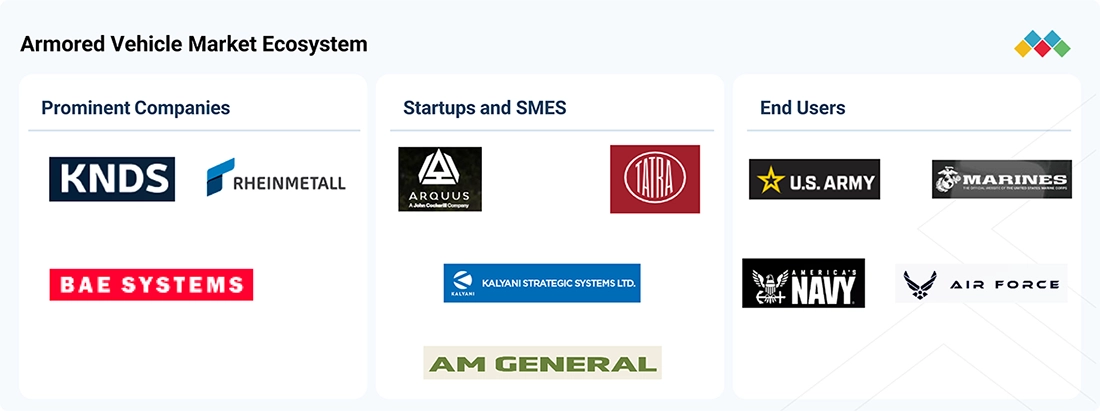
ARMORED VEHICLES MARKET SIZE, SHARE & TRENDS: COMMERCIAL USE CASES ACROSS INDUSTRIES
| COMPANY | USE CASE DESCRIPTION | BENEFITS |
|---|---|---|
 |
General Dynamics Land Systems’ Stryker A1 is used by the U.S. Army as an 8×8 armored vehicle platform for infantry transport and multiple combat-support missions. The upgraded configuration integrates improved survivability, mobility, electrical power, digital architecture, communications, and mission payloads, allowing the platform to support different battlefield roles. | Provides protected mobility while allowing different weapons, sensors, communications, and mission equipment to be integrated on a common vehicle platform. Its upgraded power and digital backbone also support future electronics and battlefield-network requirements. |
 |
KNDS’ LEOPARD 2 main battle tank is used by multiple armed forces for armored combat operations. The platform combines a 120 mm main gun, advanced protection, mobility, optronics, and command-and-information systems, with newer variants incorporating further improvements in survivability and battlefield connectivity. | Provides heavy direct-fire capability, crew protection, and cross-country mobility for high-intensity land operations. Its continuing upgrade path allows users to improve protection, firepower, electronics, and command capabilities without replacing the complete vehicle fleet. |
 |
Rheinmetall’s BOXER is a modular 8×8 armored vehicle used for troop transport, command, medical, engineering, reconnaissance, air-defense, and other mission roles. The platform combines a common drive module with interchangeable mission modules, allowing armed forces to configure vehicles for different operational requirements. | Enables multiple mission variants to use a common vehicle architecture, reducing fleet complexity and supporting common training, maintenance, and logistics. Interchangeable mission modules also allow users to adapt the platform as operational requirements change. |
 |
BAE Systems’ Armored Multi-Purpose Vehicle (AMPV) is being fielded by the U.S. Army to replace legacy M113 vehicles within Armored Brigade Combat Teams. The family supports roles such as general-purpose transport, mission command, medical evacuation, medical treatment, and mortar-carrier operations while operating alongside Abrams and Bradley vehicles. | Improves protection, mobility, reliability, and interoperability compared with the legacy M113 fleet. A common vehicle family also supports multiple battlefield functions while reducing dependence on separate legacy platforms. |
 |
Oshkosh Defense’s JLTV is used by U.S. and allied forces for protected troop transport, reconnaissance, patrol, convoy escort, and weapons-carrier missions. The vehicle combines scalable protection, TAK-4i independent suspension, integrated C4ISR capability, and configurable mission packages for different tactical requirements. | Provides protected tactical mobility across difficult terrain while supporting more than 100 mission-package configurations. Its modular design enables users to integrate weapons, communications, protection kits, and other equipment while maintaining mobility and transportability. |
Logos and trademarks shown above are the property of their respective owners. Their use here is for informational and illustrative purposes only.
Related Ecosystem
Defence Platforms And Systems
- Sensors
- Unmanned Ground Vehicles (UGV)
- Fighter Aircraft
- Special Mission Aircraft
- Antennas
- BAE Systems plc
- Thales group
- LOCKHEED MARTIN CORPORATION
- Northrop Grumman Corporation
- L3Harris Technologies, Inc.
Homeland Security
- Heat Pumps
- Humidifiers
- Ip Cameras
- Monitors
- Navigation Systems
- Thales group
- Elbit Systems Ltd.
- LOCKHEED MARTIN CORPORATION
- L3Harris Technologies, Inc.
- Northrop Grumman Corporation
Key Takeaways
- Japan's armored vehicles market will grow from USD 2,921.6 million in 2025 to USD 3,779.8 million by 2030 at a 5.3% CAGR.
- Japan is prioritizing modernization of ground self-defense force capabilities through advanced armored vehicle procurement and domestic innovation.
- Japan's defense spending and regional security concerns are primary drivers of sustained demand for next-generation armored platforms.
- Japan's market offers significant opportunities for both domestic manufacturers and international defense contractors through 2030.
Armored Vehicles Market Report Scope
| Report Metric | Details |
|---|---|
| Base Year | 2025 |
| Fastest Growing Segment | UNMANNED ARMORED GROUND VEHICLES (Platform) |
| Forecast Period | 2025–2030 |
| Growth Rate | CAGR of 3.3% from 2025 to 2030 |
| Largest Segment | MANNED (Mode Of Operation) |
| Market Size Base Year (Billions) | ~USD 51.6 (2025) |
| Revenue Forecast (Billions) | ~USD 60.7 (2030) |
| Segments Covered | Platform, Type, Mobility, Wheeled Mobility, Mode Of Operation, System, Point Of Sale |
Japan Armored Vehicles Market Report Segmentation
7 segment dimensions are covered across the global market.
By Platform
- Combat Support Vehicles
- Combat Vehicles
- Unmanned Armored Ground Vehicles
By Type
- Conventional
- Conventional Armored Vehicles
- Conventional Armored Vehicles Armored Vehicles
- Electric
- Electric Armored Electric Vehicles
- Electric Armored Vehicles
By Mobility
- Tracked
- Wheeled
By Wheeled Mobility
- 4X4
- 6X6
- 8X8
By Mode Of Operation
- Manned
- Unmanned
By System
- Ammunition Handling Systems
- Armaments
- Ballistic Armors
- Command & Control Systems
- Countermeasure Systems
- Drive Systems
- Engines
- Fire Control Systems
- Hulls/Frames
- Navigation Systems
- Observation & Display Systems
- Power Systems
- Turret Drives
By Point Of Sale
- Aftermarket
- OEM
Target Audience
- Defense Contractors & OEMs : Manufacturers and systems integrators need Japan-specific market data to develop localized product strategies, identify procurement opportunities with Japan's Self-Defense Forces, and assess competitive positioning.
- Government & Military Agencies : Japanese defense officials and procurement teams require detailed market intelligence to support budget planning, capability assessments, and strategic defense modernization program development.
- Investment & Private Equity Firms : Investors evaluating opportunities in Japan's defense sector need market-specific growth projections, market size data, and geopolitical drivers to assess portfolio companies and acquisition targets.
- Supply Chain & Component Suppliers : Subsystem and component manufacturers require Japan market insights to identify growth opportunities, understand customer requirements, and develop supply relationships with Japanese OEMs and integrators.
- Strategic Consultants & Analysts : Consulting firms and research organizations need granular Japan market data to support client advisory work, competitive analysis, and strategic planning in the Asia-Pacific defense sector.
Key Companies in the Japan Armored Vehicles Market
| Company | HQ | Ownership | Strongest segments |
|---|---|---|---|
| QINETIQ GROUP PLC | United Kingdom | Public Company | Test and Training,Mission Support and Operations,Research and Development, |
| WOODWARD, INC. | United States | Public Company | Aerospace OEM controls and actuation,Aerospace aftermarket and MRO services,Industrial turbine and engine controls (OEM), |
| ADLINK TECHNOLOGY INC. | Taiwan | Public Company | Edge computing platforms (industrial PCs, embedded computers, IoT/edge AI gateways, AI smart cameras, robotic controllers, SSDs),Computer-on-modules (COM Express, SMARC, Qseven, OSM, ETX, HPC),Rugged computing and transportation systems (CompactPCI, VPX, PC104, AVA railway, passenger information systems), |
| ENERSYS | United States | Public Company | |
| MEGGITT PLC | United Kingdom | Private Company | |
| CONSTELLIUM N.V | France | Public Company | |
| NORINCO GROUP | China | Private Company | |
| RHEINMETALL AG | Germany | Public Company | |
| GENERAL DYNAMICS CORPORATION | United States | Public Company | |
| OSHKOSH CORPORATION | United States | Public Company | |
| BAE SYSTEMS | United Kingdom | Public Company | |
| HANWHA GROUP | South Korea | Public Company | |
| NORTHROP GRUMMAN | United States | Public Company | |
| LOCKHEED MARTIN CORPORATION | United States | Public Company | |
| THALES | France | Public Company | |
| L3HARRIS TECHNOLOGIES, INC. | United States | Public Company | Space & Mission Systems (SMS),Communications & Spectrum Dominance (CSD),Missile Solutions (MSL), |
| ST ENGINEERING | Singapore | Public Company | Commercial Aerospace (MRO, P2F, aerostructures, asset management),Defence & Public Security (air, land, sea, C4ISR, homeland security),Urban Solutions & Satcom (smart mobility, smart city, energy, digital platforms), |
| ELBIT SYSTEMS LTD. | Israel | Public Company | Aerospace (airborne platforms, UAVs, avionics, training),C4I and Cyber,ISTAR & Electronic Warfare, |
| MITSUBISHI HEAVY INDUSTRIES, LTD. | Japan | Public Company | Thermal Power Generation Systems (Gas Turbine Combined Cycle & Steam),Nuclear Power & Fuel Cycle Solutions,Wind Power & Renewable-Adjacent Systems, |
| HYUNDAI ROTEM COMPANY | South Korea | Public Company | Railway vehicles and rail systems,Defense systems (tanks and armored vehicles),Plants, machinery, and industrial systems, |
| TEXTRON INC. | United States | Public Company | Textron Aviation (business, turboprop, piston, trainer, and defense aircraft plus services),Bell (military and commercial helicopters, tiltrotor, parts and services),Textron Systems (UAS, electronic systems, marine craft, weapons, armored vehicles), |
| OTOKAR OTOMOTIV VE SAVUNMA SANAYI | Turkey | Public Company | Wheeled & tracked armored vehicles,Turrets and defense subsystems,Buses & minibuses (public transportation), |
QINETIQ GROUP PLC
QinetiQ Group PLC is a United Kingdom-based public company founded in 2001, employing 7,378 people. The company operates in the defense and aerospace sectors.
WOODWARD, INC.
Woodward, Inc. is a United States-based public company founded in 1870 with 10,200 employees. The company specializes in aerospace and industrial control systems.
ADLINK TECHNOLOGY INC.
ADLINK Technology Inc. is a Taiwan-based public company founded in 1995 with 342 employees. The company operates in the technology and industrial computing sectors.
ENERSYS
EnerSys is a United States-based public company founded in 1991 with 9,682 employees. The company specializes in energy storage and power conversion solutions.
MEGGITT PLC
Meggitt PLC is a United Kingdom-based private company founded in 1947 with 9,270 employees. The company operates in the aerospace and defense engineering sectors.
CONSTELLIUM N.V
Constellium N.V. is a France-based public company founded in 2010 with 11,500 employees. The company specializes in aluminum rolled and extruded products.
NORINCO GROUP
NORINCO Group is a China-based private company founded in 1999. The company operates in the defense and industrial manufacturing sectors.
RHEINMETALL AG
Rheinmetall AG is a Germany-based public company founded in 1889 with 28,815 employees. The company operates in the defense, automotive, and industrial technology sectors.
GENERAL DYNAMICS CORPORATION
General Dynamics Corporation is a United States-based public company founded in 1899 with 117,000 employees. The company is a major defense contractor serving aerospace, combat systems, and information technology markets.
OSHKOSH CORPORATION
Oshkosh Corporation is a United States-based public company founded in 1915 with 18,400 employees. The company manufactures specialty vehicles and vehicle bodies for defense and commercial markets.
BAE SYSTEMS
BAE Systems is a United Kingdom-based public company founded in 1979 with 111,400 employees. The company is a major defense, aerospace, and security contractor.
HANWHA GROUP
Hanwha Group is a South Korea-based public company founded in 1952 with 3,493 employees. The company operates in the defense and industrial sectors.
NORTHROP GRUMMAN
Northrop Grumman is a United States-based public company founded in 1939 with 95,000 employees. The company is a major defense and aerospace contractor.
LOCKHEED MARTIN CORPORATION
Lockheed Martin Corporation is a United States-based public company founded in 1912 with 123,000 employees. The company is a leading global security and aerospace company.
THALES
Thales is a France-based public company founded in 1893 with 82,111 employees. The company operates in aerospace, defense, and security technology sectors.
L3HARRIS TECHNOLOGIES, INC.
L3Harris Technologies, Inc. is a United States-based public company founded in 1895 with 45,000 employees. The company provides defense and commercial technologies and services.
ST ENGINEERING
ST Engineering is a Singapore-based public company founded in 1967 with 27,000 employees. The company operates in aerospace, defense, and engineering sectors.
ELBIT SYSTEMS LTD.
Elbit Systems Ltd. is an Israel-based public company founded in 1966 with 20,000 employees. The company specializes in defense electronics and aerospace systems.
MITSUBISHI HEAVY INDUSTRIES, LTD.
Mitsubishi Heavy Industries, Ltd. is a Japan-based public company founded in 1884 with 78,793 employees. The company operates in aerospace, defense, power systems, and industrial machinery sectors.
HYUNDAI ROTEM COMPANY
Hyundai Rotem Company is a South Korea-based public company founded in 1977. The company manufactures defense systems and railway vehicles.
TEXTRON INC.
Textron Inc. is a United States-based public company founded in 1923 with 34,000 employees. The company operates in aerospace, defense, and industrial sectors.
OTOKAR OTOMOTIV VE SAVUNMA SANAYI
Otokar Otomotiv ve Savunma Sanayi is a Turkey-based public company founded in 1963 with 3,616 employees. The company manufactures defense vehicles and automotive products.
Reasons to Buy this Report
- Market-Specific Intelligence : Gain detailed insights into Japan's unique armored vehicles market dynamics, including country-specific growth drivers, procurement patterns, and defense spending trends unavailable in global reports.
- Strategic Investment Planning : Leverage accurate market sizing (USD 2,921.6M in 2025) and five-year forecasts to inform investment decisions, market entry strategies, and resource allocation for Japan operations.
- Competitive Positioning : Understand Japan's defense modernization priorities and Self-Defense Forces requirements to identify competitive advantages, partnership opportunities, and differentiation strategies in this high-growth market.
- Geopolitical Context : Access analysis of how Asia-Pacific geopolitical dynamics influence Japan's armored vehicle demand, enabling better risk assessment and long-term market opportunity evaluation.
- Procurement Insights : Identify upcoming defense procurement programs, technology requirements, and regulatory frameworks specific to Japan's market, supporting targeted business development and proposal strategies.
Frequently asked questions
What is the estimated size of Japan's armored vehicles market in 2025?
Japan's armored vehicles market is estimated at USD 2,921.6 million in 2025.
What is the projected market size for Japan's armored vehicles by 2030?
Japan's armored vehicles market is projected to reach USD 3,779.8 million by 2030.
What is the CAGR for Japan's armored vehicles market from 2025 to 2030?
Japan's armored vehicles market is expected to grow at a compound annual growth rate (CAGR) of 5.3% between 2025 and 2030.
What are the primary drivers of growth in Japan's armored vehicles market?
Japan's market growth is driven by defense modernization initiatives, sustained government defense spending, regional security concerns, and technological advancement in armored vehicle systems.
Which segments are expected to drive demand in Japan's armored vehicles market?
Both wheeled and tracked armored vehicles are expected to see increased demand in Japan, supported by ground self-defense force modernization and export-oriented defense manufacturing programs.
RESEARCH METHODOLOGY
The study used four main activities to estimate the current size of the armored vehicles market. First, detailed secondary research was conducted to collect information on military robotic platforms, manufacturers, system types, applications, defense programs, procurement contracts, military budgets, deliveries, deployments, and ongoing development programs. The collected information and key assumptions were then checked through primary interviews with industry participants and experts across the value chain. Demand-side analysis was used to estimate spending on armored vehicles by platform, application, end user, and region. Finally, market breakdown and data triangulation were used to calculate the size of each segment and subsegment.
Secondary Research
Secondary research included information from government procurement portals, defense ministries, armed forces, defense agencies, company annual reports, regulatory filings, investor presentations, product documents, press releases, technical papers, journals and recognized defense databases. Sources such as SIPRI were used to review military spending, equipment transfers and procurement activity, while government budget documents and procurement records were used to track armored vehicle programs, contracts, orders and deliveries. Company filings and official product information were used to study armored vehicle portfolios, revenues, contracts, technologies, applications, customers and geographical presence.
Primary Research
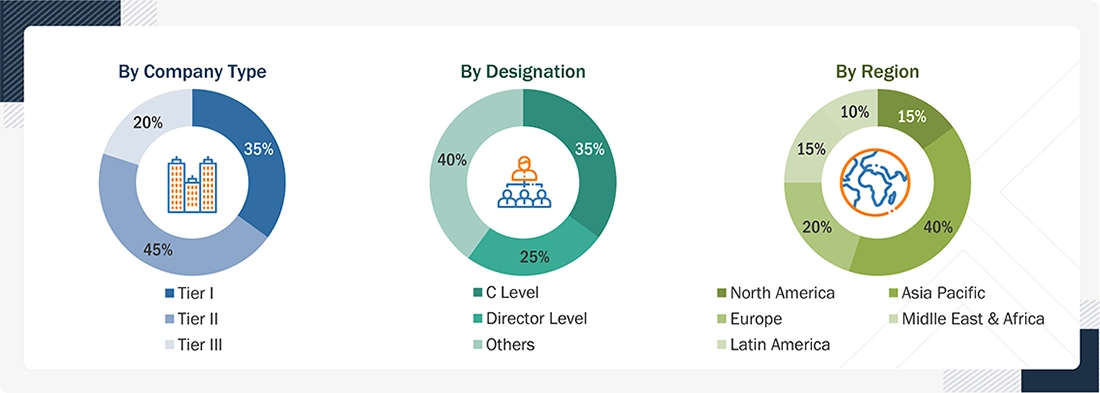
Primary research was conducted after completing the secondary research. Interviews were carried out with unmanned system manufacturers, component and payload suppliers, autonomy and software providers, system integrators, distributors, procurement officials, commercial operators, defense personnel and other industry participants. The interviews covered major countries across North America, Europe, Asia Pacific, the Middle East & Africa, and Latin America. Primary information was collected through questionnaires, emails, and telephone interviews and was used to check market estimates, procurement trends, platform demand, pricing, delivery patterns, applications, adoption rates, and segment-level assumptions.
The following is the breakdown of primary respondents:
To know about the assumptions considered for the study, download the pdf brochure
Market Size Estimation
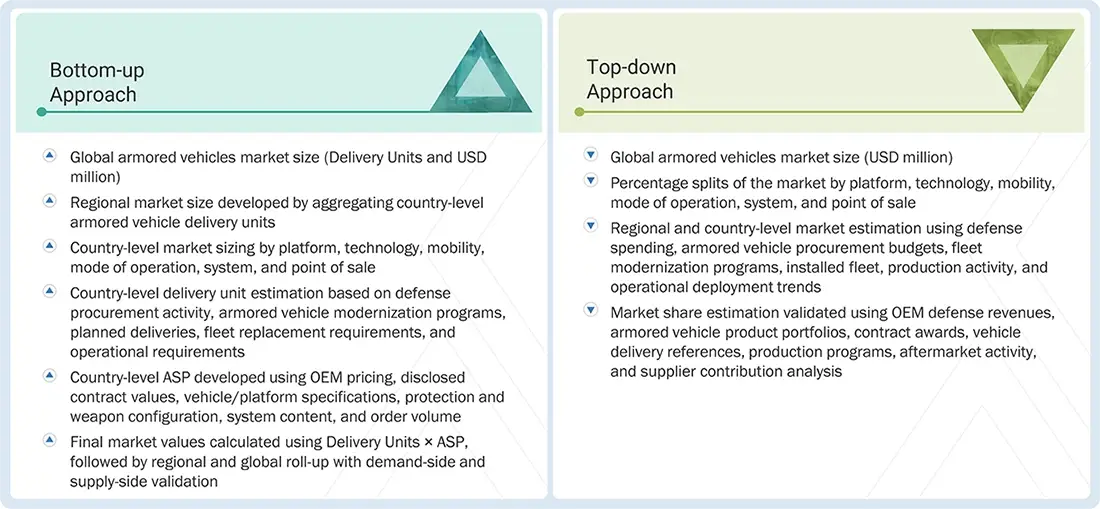
The top-down and bottom-up approaches were used to estimate and validate the size of the armored vehicles market. The research methodology used to estimate the size of the market included the following details:
- Key AV companies were identified through secondary research. Their market positions were estimated using company revenues, armored-vehicle portfolios, contract activity, production volumes, order backlogs, regional presence, and program participation. Annual reports, financial filings, product documents, procurement records, defense ministry sources, government budget documents, and interviews with company executives, engineers, system integrators, suppliers, military users, and other industry participants were used for the analysis. Rheinmetall, for example, reported approximately USD 5.72 billion in vehicle systems sales in 2025, while its segment backlog and vehicle-program order intake were used as additional indicators of market activity.
- Market shares, segment splits, regional shares, and growth rates were first estimated using secondary sources and then checked through primary interviews. The analysis covered the market by platform, by technology, by mobility, by mode of operation, by system, by point of sale, by weight class, and by end user, along with vehicle pricing, procurement volumes, deliveries, modernization programs, installed fleets, replacement cycles, and regional demand patterns.
- Demand for AVs across Army, Navy, Homeland Security, and Air Force users was considered. The analysis included new procurement, fleet modernization, vehicle replacement, survivability upgrades, localized production, sustainment requirements, and battlefield capability needs. For example, the U.S. FY2026 budget includes procurement of 86 Armored Multi-Purpose Vehicles and 91 Amphibious Combat Vehicles, while continuing investment in XM30, M1E3 Abrams, Stryker, Bradley, and other ground-combat programs.
- The collected information was compared and combined through data triangulation. Final market values were calculated using company-level revenues, vehicle delivery volumes, average selling prices, contract values, procurement activity, modernization spending, regional demand, installed fleet information, and primary-interview validation.
Armored Vehicle Market Size: Bottom-Up & Top-Down Approach
Data Triangulation
After determining the overall market size, the armored vehicles market was divided into its main segments and subsegments. Data triangulation and market breakdown were used to develop estimates for each segment and subsegment. The analysis considered factors from both the demand and supply sides, including defense procurement budgets, vehicle deliveries, platform replacement cycles, modernization programs, production capacity, company participation, contract values, vehicle pricing, installed fleets, localization programs, and regional defense requirements. Platform-specific indicators such as procurement of main battle tanks, infantry fighting vehicles, armored personnel carriers, artillery vehicles, engineering vehicles, recovery vehicles, and other protected platforms were also assessed.
Market Definition
The armored vehicles market comprises military and security vehicles designed with ballistic, blast, mine, and other forms of protective armor to safeguard personnel, equipment, and mission-critical systems during combat and security operations. These vehicles are used for a range of applications, including combat, troop transportation, protected mobility, reconnaissance, fire support, command and control, engineering, recovery, logistics, and other specialized missions.
Key Stakeholders
- Defense Ministries & Government Procurement Agencies
- Armies, Marines & Other Military End Users
- Armored Vehicle OEMs & Prime Contractors
- Armor, Weapon, Powertrain & Subsystem Suppliers
- Sensors, Vetronics, Communications & C4ISR Technology Providers
- AI, Autonomy & Software Technology Providers
- System Integrators & Engineering Service Providers
- Defense R&D, Testing & Certification Organizations
- Maintenance, Repair, Overhaul & Lifecycle Support Providers
- Defense Alliances & Standardization Bodies
Report Objectives
- To define, describe, segment, and forecast the size of the armored vehicles market based on platform, technology, mobility, mode of operation, system, point of sale, weight class, end user and region
- To forecast the size of the market segments across five regions: North America, Europe, Asia Pacific, the Middle East & Africa, and Latin America
- To identify and analyze key drivers, restraints, opportunities, and challenges influencing the growth of the market
- To identify industry trends, market trends, and technology trends in the armored vehicles market
- To analyze micro markets with respect to individual technology trends, growth prospects, and their contribution to the overall market
- To strategically profile key market players and analyze their market position and core capabilities
- To provide a detailed competitive landscape of the market and analyze competitive strategies such as product launches, partnerships, agreements, and collaborations adopted by key players
- To assess the financial position of key players along with their key products, unique offerings, and recent developments
Available customizations:
MarketsandMarkets offers the following customizations for this market report:
- Additional country-level analysis of the armored vehicles market
- Profiling of other market players (up to 5)
Product Analysis
- Product matrix, which provides a detailed comparison of the product portfolio of each company in the armored vehicles market
Get the Full Armored Vehicles Market Report
Full forecast, segment splits, and company analysis for all Armored Vehicles Market.
- Canada Armored Vehicles Market
- US Armored Vehicles Market
- UK Armored Vehicles Market
- Germany Armored Vehicles Market
- France Armored Vehicles Market
- Poland Armored Vehicles Market
- India Armored Vehicles Market
- Australia Armored Vehicles Market
- South Korea Armored Vehicles Market
- Saudi Arabia Armored Vehicles Market
- UAE Armored Vehicles Market
- Middle East Armored Vehicles Market
- Rest Of Europe Armored Vehicles Market
- Rest Of Asia Pacific Armored Vehicles Market
- Rest Of Middle East Armored Vehicles Market
Need a Tailored Report?
Customize this report to your needs
Get 10% FREE Customization
Customize This Report
