
Japan AI Platform Market (2025-2030)

The Japan AI Platform Market was valued at $693.8 Million in 2025 and projected to reach to $3928.4 Million by 2030, representing a compound annual growth rate of 41.4%. Japan's AI Platform Market is poised for exceptional growth through 2030, driven by the nation's technological prowess and industrial modernization efforts.


| Market Size in | USD 26.32 MN |
| Market Forecast in | |
| CAGR | |
| Forecast Period | |
| Units Considered | Value (USD MN) |
Japan AI Platform Market Trends and Insights
- Japan is leveraging its advanced technological infrastructure and strong manufacturing base to drive AI platform adoption across enterprise and industrial sectors.
- The market in Japan is benefiting from increased investment in digital transformation, government support for AI innovation, and growing demand from automotive, robotics, and financial services industries. The forecast period through 2030 reflects Japan's strategic positioning as a regional AI hub within Asia Pacific.
- Japan's aging workforce and labor shortages are accelerating AI platform implementation in automation and productivity solutions.
- Enterprise adoption in Japan is accelerating as organizations recognize the competitive advantage of AI-driven insights and operational efficiency.
- Japan's commitment to AI research and development, combined with partnerships between technology vendors and local enterprises, is expected to sustain the market's strong growth trajectory through 2030..
Key Market Statistics
- CAGR (2025-2030) 41.4% CAGR
- Market Size, 2025 ~USD 693.8 Million
- Forecast, 2030 ~USD 3928.4 Million
- Country Japan
Japan AI Platform Market Overview
Rapid Market Expansion :
Japan's AI Platform Market is projected to grow from USD 693.8 million in 2025 to USD 3,928.4 million by 2030, with a robust CAGR of 41.4%, significantly outpacing the global average of 38.9%.
Manufacturing & Industrial Leadership :
Japan's strong manufacturing base and advanced technological infrastructure position the country as a key hub for AI platform adoption in industrial automation, robotics, and smart factory implementations.
Enterprise Digital Transformation :
Japanese enterprises are increasingly investing in AI platforms to enhance operational efficiency, data analytics capabilities, and competitive positioning in global markets, driving sustained market growth.
Government & Innovation Support :
Japan's commitment to digital transformation initiatives and AI research funding creates a favorable ecosystem for AI platform vendors and accelerates technology adoption across sectors.
Japan AI Platform Market Dynamics
- The country's focus on integrating AI solutions into manufacturing, healthcare, and financial services sectors will sustain the 41.4% CAGR.
- Japanese enterprises are prioritizing AI platforms to enhance productivity and maintain competitive advantages in global markets.
- Government support for digital innovation and substantial R&D investments further strengthen market fundamentals.
- The convergence of legacy industrial expertise with cutting-edge AI capabilities positions Japan as a regional leader in platform adoption and development..
Market Ecosystem
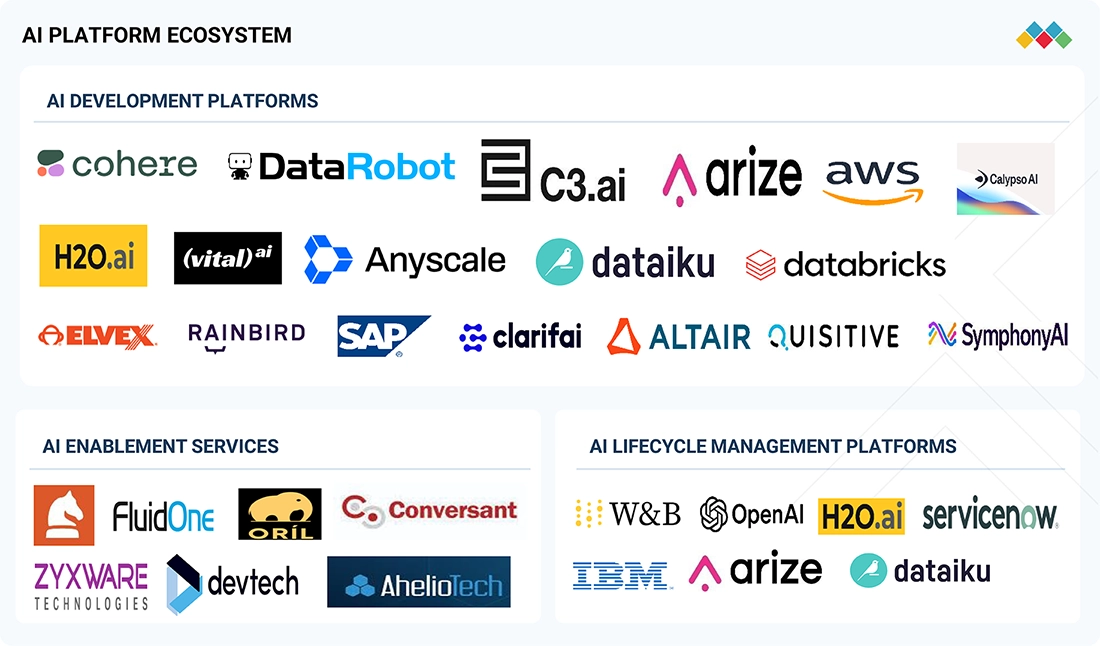
AI Platform Market: COMMERCIAL USE CASES ACROSS INDUSTRIES
| COMPANY | USE CASE DESCRIPTION | BENEFITS |
|---|---|---|
 |
AT&T ’s legacy fraud detection systems were rule-based and reactive, resulting in delayed detection and high false positives. Manual processes also limited their ability to forecast equipment failures and optimize resource allocation. | The implementation of H2O.ai led to an over 80% reduction in fraud-related incidents and saved AT&T an estimated USD 17 million annually through predictive maintenance and process optimization. The platform also enabled quicker rollout of new AI-driven services. |
 |
Handshake faced the challenge of deploying over a dozen LLM use cases in under six months while ensuring safety, reliability, and cost efficiency, but lacked consistent observability and evaluation capabilities to monitor model performance effectively. | By leveraging Arize, Handshake gained unified tracing, evaluation, and monitoring from the start, which enabled faster iteration, reduced hallucination risks, and allowed the company to successfully scale and ship over 15 LLM features in record time. |
 |
Canva faced limitations with its legacy ML infrastructure, which only supported single-machine workloads and made it difficult to efficiently train models on its massive content library or scale AI features to millions of users. | By adopting Anyscale as its modern AI platform, Canva cut cloud costs by nearly 50%, achieved up to 12× faster training speeds, and scaled generative and non-generative AI capabilities seamlessly to over 170 million users. |
 |
Prologis had an outdated setup where data scientists developed models locally and then handed them off for deployment, leading to delays, inconsistencies, and often causing models to be outdated before going live; additionally, AI efforts were highly siloed with only a few experts able to build models, which limited scalability. | By using Dataiku, Prologis democratized AI so that more users, up to approximately 2,000, including analysts, could build, deploy, and maintain ML projects; they increased the number of production-ready AI/ML projects by about 12 times and grew from roughly 5 to 30 active APIs and models in use, integrating with Snowflake and embedding AI into business operations on a much larger scale. |
Logos and trademarks shown above are the property of their respective owners. Their use here is for informational and illustrative purposes only.
Related Ecosystem
Banking
- Image Sensors
- Machine Learning
- Natural Language Processing (NLP)
- Platform as A Service (PaaS)
- Predictive Analytics
- ROLAND BERGER
- Oracle Corporation
- FINASTRA
- SAP SE
- MICROSOFT CORPORATION
Software And Services
- Natural Language Processing (NLP)
- Machine Learning
- Supply Chain Management
- Predictive Analytics
- Image Sensors
- International Business Machines Corporation
- MICROSOFT CORPORATION
- Oracle Corporation
- SAP SE
- Amazon.com, Inc.
Key Takeaways
- Japan's AI Platform Market will grow from USD 693.8M (2025) to USD 3,928.4M (2030) at a 41.4% CAGR, significantly outpacing global growth.
- Japan's demographic challenges and labor shortages are primary drivers pushing enterprises to adopt AI platform solutions for automation and efficiency.
- Japan's strong manufacturing and automotive sectors are leading AI platform adoption, supported by government initiatives and R&D investments.
- By 2030, Japan is positioned as a critical AI innovation hub in Asia Pacific, with enterprise adoption accelerating across financial services, robotics, and industrial applications.
AI Platform Market Report Scope
| Report Metric | Details |
|---|---|
| Base Year | 2025 |
| Fastest Growing Segment | HEALTHCARE & LIFE SCIENCES (Enterprise) |
| Forecast Period | 2025–2030 |
| Growth Rate | CAGR of 38.9% from 2025 to 2030 |
| Largest Segment | ENTERPRISES (End User) |
| Market Size Base Year (Billions) | ~USD 18.24 (2025) |
| Revenue Forecast (Billions) | ~USD 94.31 (2030) |
| Segments Covered | Offering, Functionality, User Type, End User, Enterprise, Enterprise End User |
Japan AI Platform Market Report Segmentation
6 segment dimensions are covered across the global market.
By Offering
- AI Development Platforms
- AI Enablement Services
- AI Lifecycle Management Platforms
By Functionality
- Data Management & Preparation
- Explainability & Bias Tools
- Fine-Tuning & Personalization
- Governance & Compliance
- Model Deployment & Serving
- Model Development & Training
- Model Fine-Tuning & Personalization
- Model Governance & Compliance
- Monitoring & Maintenance
- Security & Privacy
By User Type
- AI Product Managers
- Business Analysts & Citizen Developers
- Data Scientists & ML Engineers
- It & Cloud Architects
- Mlops/AI Engineers
By End User
- Enterprises
- Individual Users
By Enterprise
- Automotive & Mobility
- Bfsi
- Energy & Utilities
- Government & Defense
- Healthcare & Life Sciences
- Manufacturing
- Media & Entertainment
- Other Enterprise End Users
- Retail & E-Commerce
- Software & Technology
- Telecommunications
- Transportation & Logistics
By Enterprise End User
- Automotive & Mobility
- Bfsi
- Energy & Utilities
- Government & Defense
- Healthcare & Life Sciences
- Manufacturing
- Media & Entertainment
- Other Enterprise End Users
- Retail & E-Commerce
- Software & Technology
- Telecommunications
- Transportation & Logistics
Target Audience
- AI Platform Vendors : Vendors need Japan-specific market data to develop localized go-to-market strategies, identify enterprise customers, and understand competitive positioning in this high-growth Asian market.
- Enterprise Decision Makers : Japanese C-suite executives and IT leaders require market insights to benchmark AI platform investments, evaluate vendor options, and align technology adoption with industry trends and peer strategies.
- Investment & Private Equity Firms : Investors targeting Japan's technology sector need comprehensive market sizing and growth forecasts to evaluate portfolio opportunities, assess market attractiveness, and support due diligence processes.
- Management Consultants : Consulting firms advising Japanese clients on digital transformation require detailed market data to support strategic recommendations, validate business cases, and guide technology investment decisions.
- Market Researchers & Analysts : Research professionals covering Japan's ICT sector need granular market data, CAGR projections, and regional insights to produce authoritative reports and support client advisory services.
Key Companies in the Japan AI Platform Market
| Company | HQ | Ownership | Strongest segments |
|---|---|---|---|
| BMC SOFTWARE INC. | United States | Private Company | Mainframe Service Management (MSM),Enterprise Service Management (ESM) – ITSM and ITOM suites,Workload Automation (Control-M and related), |
| ALTRAN | France | Private Company | Engineering & R&D Services,Organization & IT Systems Consulting, |
| ARTIFICIAL SOLUTIONS | Sweden | Public Company | Teneo platform (core orchestration, Teneo Engine, Teneo Data),Contact center and customer service automation (agentless CC, conversational IVR, Voice AI),AI Call Guardian, Accuracy Booster, LLM Orchestrator and add-ons, |
| IBM | United States | Public Company | Software (Hybrid Cloud & AI Platforms),Consulting (Strategy, Technology, Managed Services),Infrastructure (Servers, Storage, Lifecycle Services), |
| INTEL | United States | Public Company | Client and Commercial CPUs (CCG),Data Center and AI (DCAI) – Server CPUs,Data Center and AI – GPUs and Accelerators, |
BMC SOFTWARE INC.
BMC SOFTWARE INC. is a United States-based private company founded in 1980 with 6,700 employees, providing enterprise software solutions.
ALTRAN
ALTRAN is a French private company founded in 1970 with 50,124 employees, operating as a global engineering and consulting firm.
ARTIFICIAL SOLUTIONS
ARTIFICIAL SOLUTIONS is a Swedish public company founded in 2011 that develops conversational AI and natural language processing technologies.
IBM
IBM is a United States-based public company founded in 1911 with 264,300 employees, operating as a global technology and consulting corporation.
INTEL
INTEL is a United States-based public company founded in 1968 with 85,100 employees, specializing in semiconductor design and manufacturing.
Reasons to Buy this Report
- Market Size & Growth Validation : Obtain precise market valuation data for Japan (USD 693.8M in 2025) with verified 41.4% CAGR projections through 2030 to support investment decisions and business planning in this high-growth market.
- Competitive Landscape Intelligence : Understand Japan-specific vendor positioning, market share dynamics, and competitive strategies to identify partnership opportunities and differentiation strategies for market entry or expansion.
- Sector-Specific Adoption Insights : Access detailed analysis of AI platform adoption patterns across Japan's manufacturing, enterprise, and industrial sectors to target high-potential customer segments and tailor solutions effectively.
- Strategic Market Timing : Leverage Japan's outpacing global growth rate (41.4% vs. 38.9%) to identify optimal entry windows and capitalize on early-mover advantages in this rapidly expanding regional market.
- Government & Policy Context : Gain insights into Japan's digital transformation initiatives, regulatory environment, and government support mechanisms that influence market dynamics and create growth opportunities for AI platform providers.
Frequently asked questions
What is the projected size of Japan's AI Platform Market by 2030?
Japan's AI Platform Market is projected to reach USD 3,928.4 million by 2030, growing from USD 693.8 million in 2025 at a CAGR of 41.4%.
What are the main drivers of AI Platform adoption in Japan?
Japan's aging population, labor shortages, government AI initiatives, and strong demand from automotive and manufacturing sectors are primary drivers accelerating AI platform adoption.
Which industries in Japan are leading AI Platform adoption?
Japan's automotive, robotics, manufacturing, and financial services industries are leading AI platform adoption, driven by competitive pressures and operational efficiency needs.
How does Japan's AI Platform Market growth compare to global trends?
Japan's 41.4% CAGR exceeds the global average of 38.9%, positioning Japan as a high-growth market within the Asia Pacific region.
What role does government policy play in Japan's AI Platform Market?
Japan's government actively supports AI innovation through funding, research initiatives, and digital transformation policies that encourage enterprise adoption of AI platforms.
RESEARCH METHODOLOGY
The research study for the AI platform market involved extensive secondary sources, directories, journals, and paid databases. Primary sources were mainly industry experts from the core and related industries, preferred AI platform providers, end users, and other commercial enterprises. In-depth interviews with primary respondents, including key industry participants and subject matter experts, were conducted to obtain and verify critical qualitative and quantitative information and assess the market’s prospects.
Secondary Research
In the secondary research process, various sources were referred to identify and collect information for the study. The secondary sources included annual reports, press releases, investor presentations of companies, white papers, journals, certified publications, and articles from recognized authors, directories, and databases. The data was also collected from other secondary sources, such as AI conferences and related magazines.
Additionally, the AI Platform spending of various countries was extracted from respective sources. Secondary research was used to obtain key information about the industry’s value chain and supply chain to identify key players by solution, service, market classification, and segmentation based on the offerings of major players and industry trends related to offering, functionality, end user, and regions, and key developments from market and technology-oriented perspectives.
Primary Research
In the primary research process, various primary sources from the supply and demand sides were interviewed to obtain qualitative and quantitative information on the market. The primary sources from the supply side included various industry experts, including Chief Experience Officers (CXOs); Vice Presidents (VPs), directors from business development, marketing, and AI Platform expertise, related key executives from AI Platform solution vendors, SIs, managed service providers, and industry associations, and key opinion leaders.
Primary interviews were conducted to gather insights, such as market statistics, revenue data collected from solutions and services, market breakups, market size estimations, market forecasts, and data triangulation.
Primary research also helped understand various trends related to technologies, offerings, business functions, user types, and regions. Stakeholders from the demand side, such as chief information officers (CIOs), chief technology officers (CTOs), chief strategy officers (CSOs), and end users using AI platform solutions, were interviewed to understand the buyer’s perspective on suppliers, products, service providers, and their current usage of AI platform, which would impact the overall AI platform market.
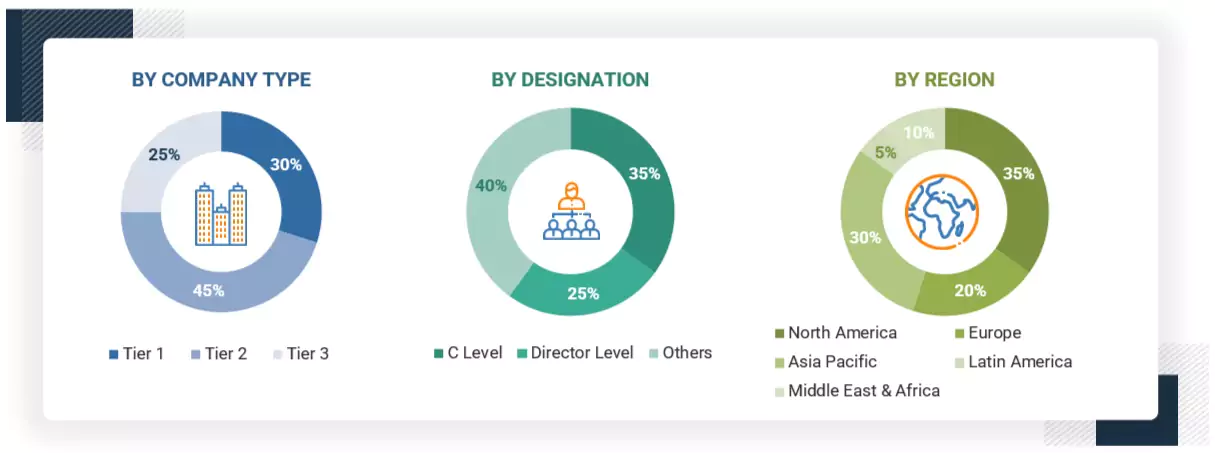
Note: Tier 1 companies account for annual revenue of >USD 10 billion; tier 2 companies’
revenue ranges between USD 1 and 10 billion; and tier 3 companies’ revenue ranges between USD 500 million–USD 1 billion
Source: MarketsandMarkets Analysis
To know about the assumptions considered for the study, download the pdf brochure
Market Size Estimation
Multiple approaches were adopted to estimate and forecast the AI platform market. The first approach involves estimating the market size by summing up the companies’ revenue generated by selling solutions and services.
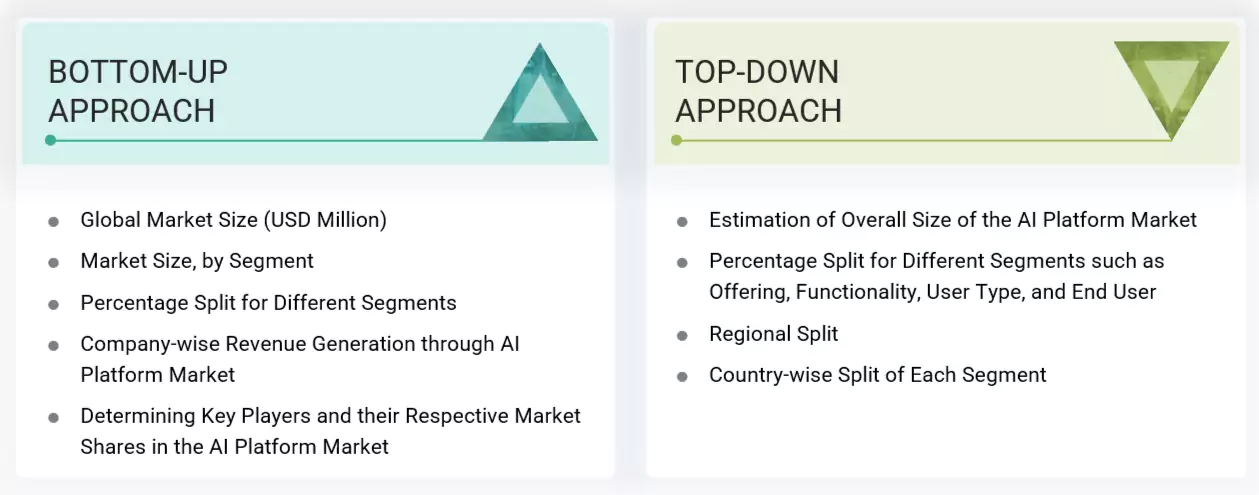
Market Size Estimation Methodology- Top-down approach
In the top-down approach, an exhaustive list of all the vendors offering solutions and services in the AI platform market was prepared. The revenue contribution of the market vendors was estimated through annual reports, press releases, funding, investor presentations, paid databases, and primary interviews. Each vendor’s offerings were evaluated based on the breadth of solutions according to offering, functionality, user type, and end user.
The aggregate of all the companies’ revenue was extrapolated to reach the overall market size. Each subsegment was studied and analyzed for its global market size and regional penetration. The markets were triangulated through primary and secondary research. The primary procedure included extensive interviews for key insights from industry leaders, such as CIOs, CEOs, VPs, directors, and marketing executives. The market numbers were further triangulated with the existing MarketsandMarkets repository for validation.
Market Size Estimation Methodology-Bottom-up approach
In the bottom-up approach, the adoption rate of AI platform solutions and services among different end users in key countries with respect to their regions contributing the most to the market share was identified. For cross-validation, the adoption of AI platform solutions across various industries was identified, along with different use cases specific to their regions. The use cases identified in different regions were weighted for the calculation of market size.
Based on the market numbers, the regional split was determined by primary and secondary sources. The procedure included the analysis of the AI platform market’s regional penetration. Based on secondary research, the regional spending on information and communications technology (ICT), socio-economic analysis of each country, strategic vendor analysis of major AI platform providers, and organic and inorganic business development activities of regional and global players were estimated. With the data triangulation procedure and data validation through primary interviews, the exact values of the overall AI Platform market size and the segments’ size were determined and confirmed using the study.
AI Platform Market : Top-Down and Bottom-Up Approach
Data Triangulation
After arriving at the overall market size using the market size estimation processes explained above, the market was split into several segments and subsegments. To complete the overall market engineering process and determine the exact statistics of each market segment and subsegment, data triangulation and market breakup procedures were employed, wherever applicable. The overall market size was then used in the top-down procedure to estimate the size of other individual markets via percentage splits of the market segmentation.
Market Definition
The AI platforms includes software and infrastructure that enable the development, training, deployment, and management of AI models and applications. These platforms offer tools for machine learning, deep learning, natural language processing, and data processing. They support developers, data scientists, and enterprises in building intelligent systems efficiently.
Stakeholders
- AI platform software developers
- AI training dataset providers
- Business analysts
- Cloud service providers
- Enterprise end users
- Distributors and value-added resellers (VARs)
- Government agencies
- Independent software vendors (ISV)
- Managed service providers
- Market research and consulting firms
- Support & maintenance service providers
- System integrators (SIs)/migration service providers
- Language service providers
- Technology providers
- Academia & research institutions
- Investors & venture capital firms
Report Objectives
- To define, describe, and forecast the AI platform market by offering, functionality, user type, and vertical
- To provide detailed information related to major factors (drivers, restraints, opportunities, and industry-specific challenges) influencing the market growth
- To analyze the micro markets with respect to individual growth trends, prospects, and their contribution to the total market
- To analyze the opportunities in the market for stakeholders by identifying the high-growth segments of the AI platform market
- To analyze opportunities in the market and provide details of the competitive landscape for stakeholders and market leaders
- To forecast the market size of segments for the five main regions: North America, Europe, Asia Pacific, the Middle East & Africa, and Latin America
- To profile the key players and comprehensively analyze their market ranking and core competencies
- To analyze competitive developments, such as partnerships, product launches, and mergers & acquisitions, in the AI platform market
Available Customizations
With the given market data, MarketsandMarkets offers customizations as per your company’s specific needs. The following customization options are available for the report:
Product Analysis
- Product quadrant, which gives a detailed comparison of the product portfolio of each company.
Geographic Analysis as per Feasibility
- Further breakup of the North American AI platform market
- Further breakup of the European AI platform market
- Further breakup of the Asia Pacific AI platform market
- Further breakup of the Middle Eastern & African AI platform market
- Further breakup of the Latin American AI platform market
Company Information
- Detailed analysis and profiling of additional market players (up to five)
Get the Full AI Platform Market Report
Full forecast, segment splits, and company analysis for all AI Platform Market.
- US AI Platform Market
- Canada AI Platform Market
- UK AI Platform Market
- Germany AI Platform Market
- France AI Platform Market
- Italy AI Platform Market
- Spain AI Platform Market
- China AI Platform Market
- India AI Platform Market
- South Korea AI Platform Market
- Saudi Arabia AI Platform Market
- UAE AI Platform Market
- South Africa AI Platform Market
- Turkey AI Platform Market
- Qatar AI Platform Market
- Egypt AI Platform Market
- Kuwait AI Platform Market
- Brazil AI Platform Market
- Mexico AI Platform Market
- Argentina AI Platform Market
- Chile AI Platform Market
- Rest Of Europe AI Platform Market
Need a Tailored Report?
Customize this report to your needs
Get 10% FREE Customization
Customize This Report
