
Rest Of Asia Pacific Artificial Intelligence (AI) in Medical Diagnostics Market (2024-2029)

The Rest Of Asia Pacific Artificial Intelligence (AI) in Medical Diagnostics Market was valued at $72 Million in 2024 and projected to reach to $174.9 Million by 2029, representing a compound annual growth rate of 19.4%. Rest Of Asia Pacific is positioned as a high-growth frontier for AI-driven medical diagnostics, with market dynamics shaped by rapid healthcare digitalization, increasing diagnostic demands, and growing technology adoption across emerging economies.


| Market Size in | USD 26.32 MN |
| Market Forecast in | |
| CAGR | |
| Forecast Period | |
| Units Considered | Value (USD MN) |
Rest Of Asia Pacific Artificial Intelligence (AI) in Medical Diagnostics Market Trends and Insights
- This robust 19.4% compound annual growth rate reflects increasing healthcare digitalization, rising diagnostic accuracy demands, and growing adoption of AI-powered imaging and pathology solutions across Rest Of Asia Pacific.
- The region's expanding middle class, improving healthcare infrastructure, and government initiatives to modernize medical systems are accelerating AI integration in diagnostic workflows. Rest Of Asia Pacific's market growth is driven by a combination of factors unique to the region, including cost-sensitive healthcare delivery models, high disease burden requiring efficient screening, and partnerships between local healthcare providers and global AI vendors.
- Rest Of Asia Pacific countries are increasingly investing in AI capabilities to address diagnostic bottlenecks and improve patient outcomes.
- By 2029, Rest Of Asia Pacific is expected to capture significant market share as regulatory frameworks mature and clinical validation of AI diagnostic tools strengthens across the region..
Key Market Statistics
- CAGR (2024-2029) 19.4% CAGR
- Market Size, 2024 ~USD 72 Million
- Forecast, 2029 ~USD 174.9 Million
- Country Rest Of Asia Pacific
Rest Of Asia Pacific Artificial Intelligence (AI) in Medical Diagnostics Market Overview
Rapid Market Expansion :
Rest Of Asia Pacific's AI medical diagnostics market is experiencing accelerated growth at 19.4% CAGR, expanding from $72.0 million in 2024 to $174.9 million by 2029, driven by healthcare infrastructure modernization across emerging economies.
Healthcare Digitalization Wave :
Increasing adoption of digital health infrastructure in Rest Of Asia Pacific countries is creating substantial opportunities for AI-powered diagnostic solutions, particularly in imaging and pathology applications across hospitals and diagnostic centers.
Diagnostic Accuracy Demand :
Rising patient volumes and limited specialist availability in Rest Of Asia Pacific are driving demand for AI solutions that enhance diagnostic accuracy, reduce turnaround times, and improve clinical outcomes in resource-constrained healthcare settings.
Emerging Market Potential :
Rest Of Asia Pacific represents an untapped growth frontier with developing economies investing heavily in healthcare technology, creating favorable conditions for AI diagnostic tool penetration and market consolidation opportunities.
Rest Of Asia Pacific Artificial Intelligence (AI) in Medical Diagnostics Market Dynamics
- The region's 19.4% CAGR significantly outpaces mature markets, reflecting strong investment in healthcare infrastructure and rising awareness of AI's diagnostic capabilities. Key growth drivers include expanding hospital networks, rising prevalence of chronic diseases, and government initiatives promoting digital health adoption.
- As healthcare providers in Rest Of Asia Pacific seek cost-effective solutions to address specialist shortages and improve diagnostic efficiency, AI-powered imaging and pathology solutions are becoming increasingly critical.
- The market's trajectory suggests sustained expansion through 2029, with opportunities for vendors offering localized, scalable, and affordable diagnostic AI platforms..
Market Ecosystem
Related Ecosystem
Healthcare It
- Computed Tomography (CT)
- Machine Learning
- Magnetic Resonance Imaging (MRI)
- Natural Language Processing (NLP)
- Predictive Analytics
- CERNER CORPORATION
- PHILIPS HEALTHCARE
- Oracle Corporation
- GE HealthCare Technologies Inc.
- Siemens healthineers
Diagnostic Imaging
- Magnetic Resonance Imaging (MRI)
- Computed Tomography (CT)
- CT Scanners
- Nuclear Imaging
- Positron Emission Tomography
- Siemens healthineers
- PHILIPS HEALTHCARE
- CANON INC.
- FUJIFILM Holdings Corporation
- UNITED IMAGING HEALTHCARE CO., LTD.
Key Takeaways
- Rest Of Asia Pacific's AI medical diagnostics market is valued at $72.0 million in 2024 and will reach $174.9 million by 2029, representing a 19.4% CAGR.
- Rest Of Asia Pacific is experiencing accelerated AI adoption driven by healthcare infrastructure modernization, rising diagnostic demand, and cost-effective solution deployment.
- Rest Of Asia Pacific's market growth is supported by increasing partnerships between local healthcare systems and global AI vendors seeking regional expansion.
- Rest Of Asia Pacific is expected to become a key growth engine for AI diagnostics as regulatory frameworks mature and clinical evidence accumulates through 2029.
Artificial Intelligence (AI) in Medical Diagnostics Market Report Scope
| Report Metric | Details |
|---|---|
| Base Year | 2024 |
| Fastest Growing Segment | SERVICES (Component) |
| Forecast Period | 2024-2029 |
| Growth Rate | CAGR of 22.5% from 2024 to 2029 |
| Largest Segment | IN VIVO DIAGNOSTICS (Application) |
| Market Size Base Year (Billions) | ~USD 1.71 (2024) |
| Revenue Forecast (Billions) | ~USD 4.72 (2029) |
| Segments Covered | Component, Type, End User, Modality, Modality Type, Application, Type 2023-2029, Processor Type, Network Type, Type 2017-2022, Segment |
Rest Of Asia Pacific Artificial Intelligence (AI) in Medical Diagnostics Market Report Segmentation
11 segment dimensions are covered across the global market.
By Component
- Hardware
- Services
- Software
By Type
- Adapter
- Adapters
- Asic
- Autoimmune Testing
- Blood Screening & Coagulation
- Cardiology
- Clinical Chemistry
- Ct
- Diagnostic Software
- Endocrinology
- Fpga
- Gpu
- Hematology
- Imaging Software
- Immunoassay
- Infectious Disease
- Interconnect
- Interconnects
- Mammography
- Memory
- Microbiology
- Mpu
- Mri
- Network
- Networks
- Neurology
- Obstetrics/Gynecology
- Oncology
- Ophthalmology
- Other Diagnostic Modalities
- Other Imaging Modalities
- Other In Vitro Applications
- Other In Vitro Diagnostics Applications
- Other In Vivo Applications
- Other In Vivo Diagnostics Applications
- Predictive Analytics
- Predictive Analytics Software
- Processor
- Processors
- Radiology
- Switch
- Switches
- Ultrasound
- X Ray
- X-Ray
By End User
- Diagnostic Imaging Centers
- Diagnostic Laboratories
- Hospitals
- Other End Users
By Modality
- Clinical Chemistry
- Diagnostic Modalities
- Diagnostics Modality
- Hematology
- Imaging Modalities
- Imaging Modality
- Immunoassay
- Microbiology
- Other Diagnostic Modalities
By Modality Type
- Ct
- Mammography
- Mri
- Other Modalities
- Ultrasound
- X-Ray
By Application
- In Vitro Diagnostics
- In Vitro Diagnostics Applications
- In Vivo Diagnostics
- In Vivo Diagnostics Applications
By Type 2023-2029
- Cardiology
- Neurology
- Obstetrics/ Gynecology
- Oncology
- Ophthalmology
- Other In Vivo Applications
- Radiology
By Processor Type
- Asic
- Fpga
- Gpu
- Mpu
By Network Type
- Adapter
- Interconnect
- Switch
By Type 2017-2022
- Cardiology
- Neurology
- Obstetrics/Gynecology
- Oncology
- Ophthalmology
- Other In Vivo Applications
- Radiology
By Segment
- Hardware Component
Target Audience
- Healthcare Technology Vendors : AI diagnostic solution providers need Rest Of Asia Pacific market intelligence to identify growth opportunities, understand regional customer requirements, and develop competitive strategies in this emerging high-growth market.
- Investment & Private Equity Firms : Investors evaluating healthcare technology opportunities require detailed market sizing, growth projections, and competitive analysis for Rest Of Asia Pacific to assess investment viability and portfolio allocation decisions.
- Hospital & Diagnostic Center Operators : Healthcare facility managers need market insights on AI diagnostic adoption trends, vendor capabilities, and ROI benchmarks in Rest Of Asia Pacific to make informed technology procurement and implementation decisions.
- Government & Healthcare Policy Makers : Regulatory bodies and health ministry officials require market data on AI diagnostic adoption, technology gaps, and infrastructure needs in Rest Of Asia Pacific to inform digital health policy and investment priorities.
- Management Consultants & Analysts : Strategy consultants advising healthcare clients need comprehensive Rest Of Asia Pacific market analysis, competitive intelligence, and trend forecasts to develop informed recommendations and business strategies.
Reasons to Buy this Report
- Market Entry Strategy : Gain comprehensive insights into Rest Of Asia Pacific's unique market dynamics, competitive landscape, and growth opportunities to develop targeted market entry strategies and localization approaches for AI diagnostic solutions.
- Investment Decision Support : Access detailed financial projections, CAGR analysis, and market sizing data specific to Rest Of Asia Pacific to support investment decisions, funding allocation, and resource planning for healthcare technology ventures.
- Competitive Positioning : Understand regional market trends, emerging competitors, and customer preferences in Rest Of Asia Pacific to identify competitive advantages, differentiation opportunities, and strategic partnerships for AI diagnostic platforms.
- Regulatory & Adoption Insights : Obtain region-specific intelligence on healthcare regulations, reimbursement models, and AI adoption barriers in Rest Of Asia Pacific to navigate compliance requirements and accelerate market penetration strategies.
- Growth Forecasting : Leverage accurate 5-year market forecasts and segment analysis for Rest Of Asia Pacific to optimize product development roadmaps, sales projections, and long-term business planning in this high-growth region.
Frequently asked questions
What is the market size of AI in medical diagnostics in Rest Of Asia Pacific?
Rest Of Asia Pacific's AI medical diagnostics market was valued at $72.0 million in 2024 and is forecast to reach $174.9 million by 2029.
What is the growth rate for AI medical diagnostics in Rest Of Asia Pacific?
Rest Of Asia Pacific's AI medical diagnostics market is growing at a compound annual growth rate (CAGR) of 19.4% from 2024 to 2029.
What factors are driving AI adoption in Rest Of Asia Pacific's healthcare sector?
Rest Of Asia Pacific's growth is driven by healthcare infrastructure modernization, increasing diagnostic demand, cost-sensitive delivery models, and partnerships with global AI vendors.
Which diagnostic applications are most prevalent in Rest Of Asia Pacific?
Rest Of Asia Pacific is seeing strong adoption of AI-powered imaging analysis, pathology automation, and screening solutions that address high disease burden and diagnostic bottlenecks.
What regulatory developments are shaping Rest Of Asia Pacific's AI diagnostics market?
Rest Of Asia Pacific countries are progressively establishing regulatory frameworks and clinical validation pathways that are expected to accelerate AI diagnostic tool adoption through 2029.
RESEARCH METHODOLOGY
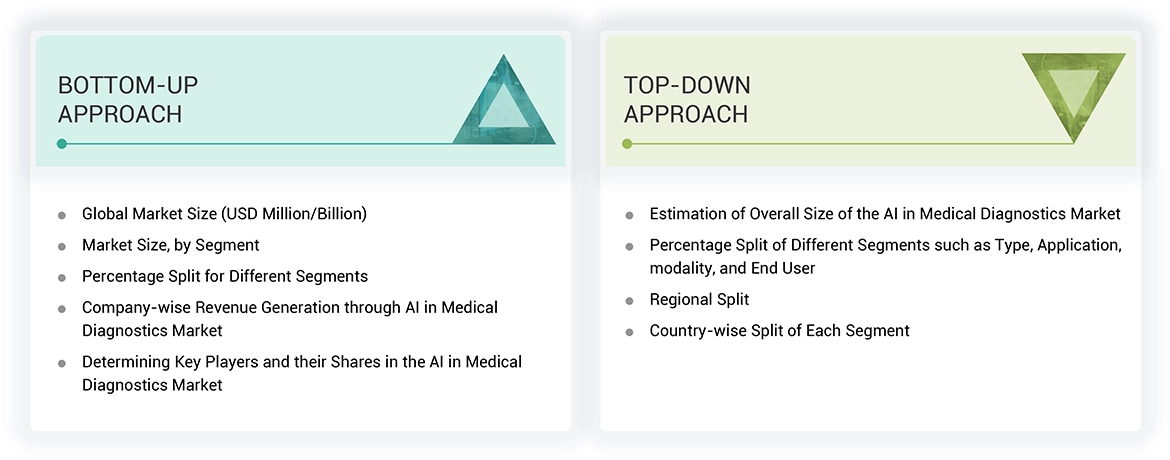
To balance primary and secondary research for the AI in Medical Diagnotics market, different market variables for small and medium-sized businesses and major businesses were analyzed as part of this study. The next step involved primary research with industry experts along the value chain to validate these findings, assumptions, and market sizing. Many different methodologies were used for estimating the overall market size, involving the top-down and bottom-up approaches. The study consists of significant market segments, evolving patterns, regulatory frameworks, and competitive environments. This study also considers leading market players and the strategies they deploy in this market. In conclusion, the total market size was estimated through top-down and bottom-up approaches along with data triangulation to reach the number for the final market size. Primary research was conducted throughout the study to validate and test each hypothesis.
Secondary Research
The secondary sources referred to for this research study include publications from government sources, directories, and databases (Dun & Bradstreet, Bloomberg Businessweek, and Factiva, among others) to identify and collect information useful for the technical, market-oriented, and commercial study of AI in medical diagnostics market. Secondary data was collected and analyzed to arrive at the overall size of the global AI in medical diagnostics market, which was validated through primary research.
Primary Research
Extensive primary research was conducted after acquiring basic knowledge about the global of AI in medical diagnostics market scenario through secondary research. Several primary interviews were conducted with market experts from both the demand side (such as Hospitals, Clinics and Other Healthcare Facilities, Diagnostic laboratories and Diagnostics Imaging Center, Other End Users- Employer Groups and Government Bodies) and supply side (such as C-level and D-level executives, product managers, marketing and sales managers of key manufacturers, distributors, and channel partners, among others) across five major regions—North America, Europe, the Asia Pacific, and Rest of the world. Approximately 70% and 30% of primary interviews were conducted with supply-side and demand-side participants, respectively. This primary data was collected through questionnaires, e-mails, online surveys, personal interviews, and telephonic interviews.
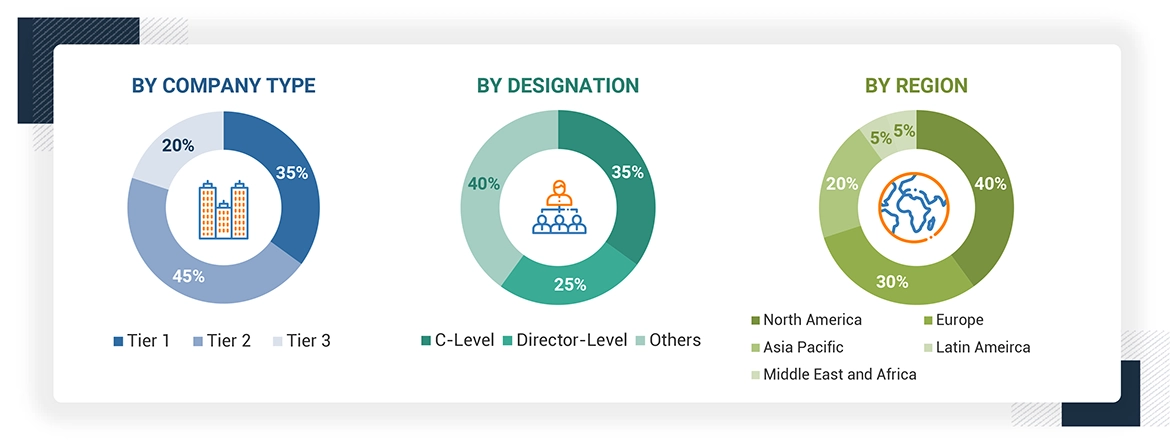
Note 1: C-level primaries include CEOs, CFOs, and COOs.
Note 2: Others include sales managers, marketing managers, business development managers, product managers, distributors, and suppliers.
Note 3: Companies are classified into tiers based on their total revenues. As of 2022, Tier 1 = >USD 2 billion, Tier 2 = USD 50 million to USD 2 billion, and Tier 3 = < USD 50 million.
To know about the assumptions considered for the study, download the pdf brochure
Market Size Estimation
As per the review of prominent companies and their revenue shares, the market size of the global AI in medical diagnostics market was calculated in this report. Key players with significant shares in the market were identified as part of secondary research and their medical diagnostics business revenue was calculated, primaries validated the same. Analyzing the annual and financial reports of the leading market participants was one aspect of secondary research. On the other hand, in-depth interviews with important thought leaders, including directors, CEOs, and marketing executives, were a part of the primary study.
Both top-down and bottom-up approaches were used to estimate and validate the size of the AI in medical diagnostics market and various other dependent submarkets. The research methodology used to estimate the market size includes the following details:
- Revenues of individual companies were gathered from public sources and databases
- The shares of the AI in medical diagnostics market players were gathered from secondary sources to the extent available. In certain cases, the shares of the businesses were ascertained after a detailed analysis of various parameters, including product portfolios, market positioning, selling prices, and geographic reach and strength
- Individual shares or revenue estimates were validated through expert interviews
- All percentage shares, splits, and breakdowns for the global AI in medical diagnostics market were determined by using secondary sources and verified through primary sources
- All key macro indicators affecting the revenue growth of market segments and subsegments have been accounted for, viewed in extensive detail, verified through primary research, and analyzed to get validated and verified quantitative and qualitative data
- The gathered market data was consolidated and added with detailed inputs and analysis and presented in this report
AI in medical diagnostics Market Size: Market Estimation Approach
Data Triangulation
To estimate the overall market size of the AI in medical diagnostics market, a detailed market size estimation process was followed. The market was then segmented into various segments and subsegments for more precise analysis. To ensure accuracy, data triangulation and market breakdown methodologies were applied where applicable. This approach involved analyzing various factors and trends from both the demand and supply sides, providing comprehensive and reliable insights into the market.
Market Definition
Artificial intelligence (AI) refers to the theory and development of computer systems capable of performing tasks that usually require human intelligence. AI involves the study & synthesis of intelligent agents—in this case, a computer system. The system perceives its environment and takes appropriate action to maximize success. AI is being developed to create expert systems and improve human intelligence in machines.
AI is used in the medical diagnostics market to analyze complex data from various imaging modalities and help end users interpret critical data points to diagnose disease conditions.
Stakeholders
- Hospitals
- Diagnostic care centers
- Diagnostic laboratories
- Radiologists and radiology clinics
- Diagnostic imaging AI device manufacturers and suppliers
- Medical research laboratories
- Academic medical centers and universities
Report Objectives
- To define, describe, and forecast artificial intelligence in the medical diagnostics market based on component, application, end user, and region
- To provide detailed information regarding the major factors influencing the market growth (such as drivers, restraints, opportunities, and challenges)
- To strategically analyze micromarkets1 concerning individual growth trends, prospects, and contributions to the overall market
- To analyze the opportunities in the market for stakeholders and provide details of the competitive landscape for market leaders
- To forecast the size of the market segments concerning four main regions—North America, Europe, the Asia Pacific, and the Rest of the World (RoW)2
- To profile the key players and comprehensively analyze their market shares and core competencies
- To track and analyze competitive developments such as acquisitions, product launches/enhancements, expansions, agreements, collaborations, partnerships, and approvals in AI medical diagnostics market
Get the Full Artificial Intelligence (AI) in Medical Diagnostics Market Report
Full forecast, segment splits, and company analysis for all Artificial Intelligence (AI) in Medical Diagnostics Market.
- Canada Artificial Intelligence (AI) in Medical Diagnostics Market
- US Artificial Intelligence (AI) in Medical Diagnostics Market
- Germany Artificial Intelligence (AI) in Medical Diagnostics Market
- France Artificial Intelligence (AI) in Medical Diagnostics Market
- UK Artificial Intelligence (AI) in Medical Diagnostics Market
- Italy Artificial Intelligence (AI) in Medical Diagnostics Market
- Spain Artificial Intelligence (AI) in Medical Diagnostics Market
- China Artificial Intelligence (AI) in Medical Diagnostics Market
- Japan Artificial Intelligence (AI) in Medical Diagnostics Market
- India Artificial Intelligence (AI) in Medical Diagnostics Market
- Brazil Artificial Intelligence (AI) in Medical Diagnostics Market
- Mexico Artificial Intelligence (AI) in Medical Diagnostics Market
- Rest Of Europe Artificial Intelligence (AI) in Medical Diagnostics Market
- GCC Artificial Intelligence (AI) in Medical Diagnostics Market
- Rest Of Latin America Artificial Intelligence (AI) in Medical Diagnostics Market
- GCC Countries Artificial Intelligence (AI) in Medical Diagnostics Market
Need a Tailored Report?
Customize this report to your needs
Get 10% FREE Customization
Customize This Report
