
Brazil Asset Performance Management Market (2026-2031)

The Brazil Asset Performance Management Market was valued at $50.8 Million in 2026 and projected to reach to $107.9 Million by 2031, representing a compound annual growth rate of 13.4%. Brazil's Asset Performance Management market is positioned for accelerated growth as enterprises across manufacturing, energy, and infrastructure sectors prioritize digital transformation.


| Market Size in | USD 26.32 MN |
| Market Forecast in | |
| CAGR | |
| Forecast Period | |
| Units Considered | Value (USD MN) |
Brazil Asset Performance Management Market Trends and Insights
- This represents a compound annual growth rate (CAGR) of 13.4%, significantly outpacing global trends.
- Brazil's market expansion is driven by increasing digital transformation initiatives across manufacturing, energy, and infrastructure sectors, where asset optimization has become critical for operational efficiency and cost reduction. The Brazilian market benefits from a large industrial base and growing adoption of IoT and cloud-based solutions among enterprises.
- Brazil's investment in predictive maintenance technologies and real-time asset monitoring reflects the region's commitment to modernizing legacy systems.
- By 2031, Brazil is expected to consolidate its position as a key growth market within Latin America, with enterprises increasingly recognizing the value of integrated asset performance management platforms in enhancing productivity and reducing downtime..
Key Market Statistics
- CAGR (2026-2031) 13.4% CAGR
- Market Size, 2026 ~USD 50.8 Million
- Forecast, 2031 ~USD 107.9 Million
- Country Brazil
Brazil Asset Performance Management Market Overview
Exceptional Growth Trajectory :
Brazil's APM market is expanding at 13.4% CAGR, significantly outpacing the global rate of 10.3%, demonstrating strong regional momentum and investment appetite in asset optimization technologies.
Manufacturing & Energy Sector Drivers :
Digital transformation initiatives across Brazil's manufacturing, energy, and infrastructure sectors are accelerating APM adoption, with enterprises seeking to optimize operational efficiency and reduce downtime costs.
Market Valuation Growth :
The Brazilian APM market is valued at USD 50.8 million in 2026 and is projected to reach USD 107.9 million by 2031, representing a doubling of market size within five years.
Infrastructure Investment Opportunities :
Brazil's ongoing infrastructure modernization and industrial digitalization initiatives create substantial opportunities for APM solution providers targeting predictive maintenance and asset lifecycle management.
Brazil Asset Performance Management Market Dynamics
- The 13.4% CAGR reflects increasing recognition of APM's value in reducing operational costs, minimizing unplanned downtime, and extending asset lifecycles.
- Government initiatives supporting industrial modernization and private sector investments in automation are key catalysts. By 2031, the market's expansion to USD 107.9 million will be driven by growing adoption of IoT sensors, cloud-based monitoring platforms, and AI-powered predictive analytics.
- Brazilian organizations are increasingly investing in real-time asset visibility and condition-based maintenance strategies.
- This growth trajectory positions Brazil as a high-potential market within Latin America for APM solution providers and technology vendors..
Market Ecosystem
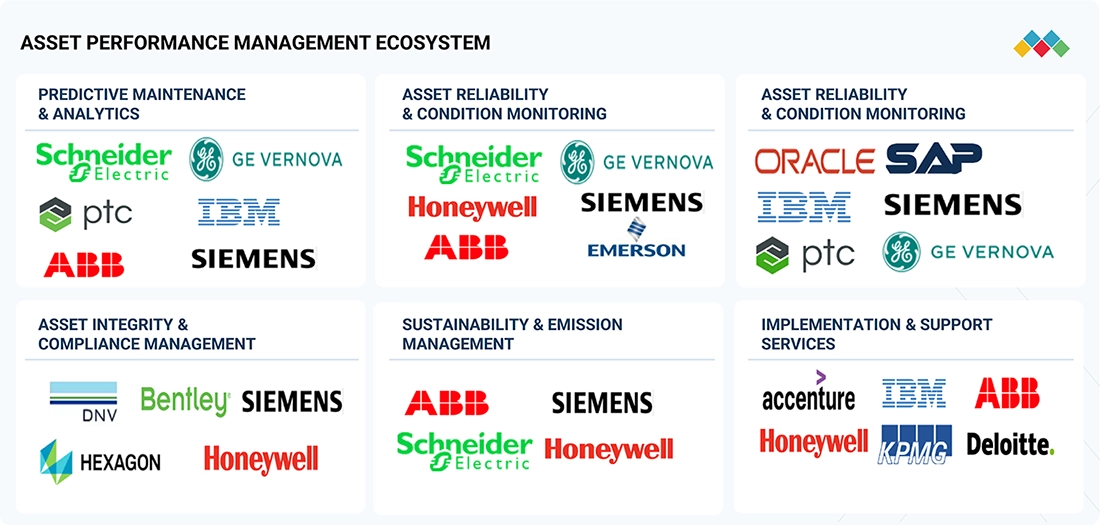
ASSET PERFORMANCE MANAGEMENT MARKET: COMMERCIAL USE CASES ACROSS INDUSTRIES
| COMPANY | USE CASE DESCRIPTION | BENEFITS |
|---|---|---|
 |
Optimize nuclear power generation through predictive asset management at Bruce power | optimized nuclear power generation with improved reliability, efficiency, and safety, reduced unplanned downtime, compliance with regulations |
 |
Enhancing fleet reliability with predictive analytics at Duke Energy | Optimized asset performance through low-cost sensors, improved operations via contextualized insights and predictive analysis, achieved significant financial impact, including USD 34 million saved in a single early-catch event |
 |
Godrej & Boyce elevates asset performance and operational efficiency with HXGN EAM implementation | asset uptime increased from 60% to over 95%, labor Utilization improved by 70%, inventory costs reduced by 45%, managed approximately 95,000 work orders annually, maintained 1.5-million-part references and 125,000 documents of asset data, mobile access for field teams |
 |
SOCAR Turkey achieves world-class asset integrity and extended inspection intervals with Ge Vernova APM implementation | average inspection intervals were extended from 1 year to 5 years for 1,335 assets, average of 20 days of planned inspection downtime was avoided, integration of real-time monitoring and IOWs contributed to world-class asset integrity standards |
 |
Lucid Motors enhances manufacturing efficiency and OEE with Neomatrix ignition-based asset performance management solution | real-time Andon dashboards enabled quick reactions to equipment, automated CMMS integration enhanced accuracy, timeliness, and reduced manual data entry, improved production efficiency, quality, and overall performance |
Logos and trademarks shown above are the property of their respective owners. Their use here is for informational and illustrative purposes only.
Related Ecosystem
Aviation
- Narrow Body Aircraft
- Wide Body Aircraft
- Military Helicopters
- Special Mission Aircraft
- Fighter Aircraft
- HONEYWELL INTERNATIONAL INC.
- COLLINS AEROSPACE
- Thales group
- Safran group
- HEICO Corporation
Cloud Computing
- Software as A Service (SaaS)
- Natural Language Processing (NLP)
- Platform as A Service (PaaS)
- Machine Learning
- Supply Chain Management
- International Business Machines Corporation
- MICROSOFT CORPORATION
- Oracle Corporation
- Amazon.com, Inc.
Digitalization And Iot
- Sensors
- Remote Monitoring
- Supply Chain Management
- Passenger Information System (PIS)
- Platform as A Service (PaaS)
- International Business Machines Corporation
- Cisco Systems, Inc.
- MICROSOFT CORPORATION
- Oracle Corporation
- HUAWEI TECHNOLOGIES CO LTD
Key Takeaways
- Brazil's APM market is valued at USD 50.8 million in 2026 and will reach USD 107.9 million by 2031, growing at 13.4% CAGR.
- Brazil's industrial and energy sectors are primary drivers of APM adoption, leveraging predictive maintenance to optimize asset lifecycles.
- Cloud-based and IoT-enabled APM solutions are gaining traction in Brazil as enterprises pursue digital transformation.
- Brazil's market growth outpaces the global average, positioning it as a strategic growth hub within Latin America for APM vendors.
Asset Performance Management Market Report Scope
| Report Metric | Details |
|---|---|
| Base Year | 2026 |
| Fastest Growing Segment | AI-POWERED APM (Type) |
| Forecast Period | 2026–2031 |
| Growth Rate | CAGR of 10.3% from 2026 to 2031 |
| Largest Segment | TRADITIONAL APM (Type) |
| Market Size Base Year (Billions) | ~USD 2.4 (2026) |
| Revenue Forecast (Billions) | ~USD 3.92 (2031) |
| Segments Covered | Type, Offering, Solution, Asset Type, Deployment Type, Organization Size, Application, Vertical, Service, Professional Service |
Brazil Asset Performance Management Market Report Segmentation
10 segment dimensions are covered across the global market.
By Type
- AI-Powered Apm
- Traditional Apm
By Offering
- Service
- Services
- Solutions
By Solution
- Asset Integrity & Compliance Management
- Asset Reliability & Condition Monitoring
- Asset Strategy & Optimization
- Other Solutions
- Predictive Maintenance & Analytics
- Sustainability & Emission Management
By Asset Type
- Digital/It-Ot Assets
- Fixed Assets
- Linear/Infrastructure Assets
- Mobile Assets
- Rotating Assets
By Deployment Type
- Cloud-Based (SaaS)
- On-Premises
By Organization Size
- Large Enterprises
- Smes
By Application
- Asset Lifecycle Management & Planning
- Operational Support & Resource Management
- Remote Asset Monitoring & Control
- Work Order Automation & Management
By Vertical
- Energy & Utilities
- Government & Defense
- Healthcare & Life Sciences
- It & Telecom
- Manufacturing
- Metal & Mining
- Oil & Gas
- Other Verticals
- Transportation & Logistics
By Service
- Managed Services
- Professional Services
By Professional Service
- Consulting
- Implementation & Integration
- Training & Onboarding
Target Audience
- APM Solution Vendors : Software and technology providers need Brazil-specific market data to develop localized product strategies, pricing models, and sales approaches for the rapidly growing 13.4% CAGR market.
- Manufacturing & Industrial Enterprises : Brazilian manufacturers require market intelligence to benchmark APM adoption, understand competitive technology investments, and justify internal budgets for asset optimization initiatives.
- Energy Sector Operators : Oil, gas, and utilities companies in Brazil need insights into APM market trends and peer adoption patterns to optimize asset reliability, reduce operational costs, and improve safety compliance.
- Infrastructure & Project Developers : Organizations managing Brazil's infrastructure projects require APM market data to evaluate technology solutions, assess vendor capabilities, and plan long-term asset management strategies.
- Investment & Consulting Firms : Private equity, venture capital, and management consultants need Brazil APM market analysis to identify investment opportunities, evaluate portfolio companies, and advise clients on market entry strategies.
Key Companies in the Brazil Asset Performance Management Market
| Company | HQ | Ownership | Strongest segments |
|---|---|---|---|
| GP STRATEGIES CORPORATION | United States | Private Company | Managed Learning Services & Organizational Performance Solutions,Technical Performance & Enterprise Technology Adoption,Automotive Performance Solutions, |
| GE VERNOVA | United States | Public Company | Power (Gas, Nuclear, Hydro, Steam),Wind (Onshore and Offshore),Electrification (Grid, Power Conversion, Software, Solar & Storage), |
| AVEVA | United Kingdom | Private Company | Engineering, Procurement & Construction (EPC) and Design Software,Monitoring, Control, and SCADA / HMI,Asset Performance Management (APM), |
| ABB | Switzerland | Public Company | Electrification,Motion,Automation, |
| IBM | United States | Public Company | Software (Hybrid Cloud & AI Platforms),Consulting (Strategy, Technology, Managed Services),Infrastructure (Servers, Storage, Hybrid Cloud Infrastructure Services), |
| SAP | Germany | Public Company | S/4HANA and core ERP (finance, supply chain, manufacturing),HCM (SAP SuccessFactors) and employee experience,Spend management and Business Network, |
| FLUKE | United States | Private Company | Digital multimeters and basic electrical testers,Clamp meters and power quality / power analyzers,Thermal imagers and infrared cameras, |
| EMERSON | United States | Public Company | Final Control,Measurement & Analytical,Control Systems & Software, |
| ROCKWELL AUTOMATION | United States | Public Company | Intelligent Devices,Software & Control,Lifecycle Services, |
| HONEYWELL | United States | Public Company | Industrial Automation,Building Automation,Energy and Sustainability Solutions (UOP and related), |
| BENTLEY SYSTEMS | United States | Public Company | Open modeling applications (MicroStation, OpenRoads, OpenBuildings, etc.),Open simulation and geoprofessional applications (PLAXIS, Leapfrog, STAAD, SACS, etc.),Infrastructure cloud applications (ProjectWise, SYNCHRO, AssetWise), |
| SIEMENS ENERGY | Germany | Public Company | Gas Services (gas and steam turbines, generators, lifecycle services),Grid Technologies (HVDC, transformers, substations, switchgear, digital grid),Siemens Gamesa (onshore and offshore wind turbines and services), |
| YOKOGAWA ELECTRIC | Japan | Public Company | Control Business (DCS, PLCs, control systems, lifecycle services),Field Instruments (flow, pressure, analyzers),Software, OpreX, and Digital/IIoT Solutions, |
| HEXAGON AB | Sweden | Public Company | Manufacturing Intelligence (metrology, CAD/CAM, CAE, quality software),Geosystems (surveying, mapping, laser scanning, AEC),Autonomous Solutions & Positioning (GNSS, anti-jam, autonomy), |
| BAKER HUGHES | United States | Public Company | Oilfield Services & Equipment,Industrial & Energy Technology – Gas Technology Equipment and Services,Industrial & Energy Technology – Digital, Sensing, and Climate Technology, |
GP STRATEGIES CORPORATION
GP Strategies Corporation is a private U.S. company founded in 1959 that employs 4,343 people. The company provides workforce development and training solutions.
GE VERNOVA
GE Vernova is a publicly traded U.S. company established in 2023 with 78,000 employees. It operates in the energy and power generation sector.
AVEVA
AVEVA is a private U.K.-based company founded in 1967 with 6,500 employees. The company specializes in industrial software solutions.
ABB
ABB is a Swiss multinational public company founded in 1883 with 112,700 employees. It operates in robotics, power, and automation technologies.
IBM
IBM is a U.S. public company founded in 1911 with 264,300 employees. The company provides information technology, cloud computing, and business services.
SAP
SAP is a German public company founded in 1972 with 111,038 employees. It is a leading provider of enterprise resource planning software.
FLUKE
Fluke is a U.S. private company founded in 1948 with 2,525 employees. The company manufactures electronic test and measurement equipment.
EMERSON
Emerson is a U.S. public company founded in 1890 with 71,000 employees. It provides process management and automation solutions for industrial applications.
ROCKWELL AUTOMATION
Rockwell Automation is a U.S. public company founded in 1903 with 26,000 employees. The company specializes in industrial automation and information technology.
HONEYWELL
Honeywell is a U.S. public company founded in 1885 with 101,000 employees. It operates in aerospace, building technologies, and industrial automation.
BENTLEY SYSTEMS
Bentley Systems is a U.S. public company founded in 1984 with 5,800 employees. The company develops infrastructure engineering software solutions.
SIEMENS ENERGY
Siemens Energy is a German public company founded in 1866 with 98,995 employees. It provides power generation, transmission, and distribution technologies.
YOKOGAWA ELECTRIC
Yokogawa Electric is a Japanese public company founded in 1915 with 18,313 employees. The company specializes in industrial automation and control systems.
HEXAGON AB
Hexagon AB is a Swedish public company founded in 1975 with 16,118 employees. It provides digital solutions for industrial and geospatial applications.
BAKER HUGHES
Baker Hughes is a U.S. public company founded in 2016 with 53,000 employees. It provides oilfield services, equipment, and digital solutions for the energy industry.
Reasons to Buy this Report
- Market Size & Growth Validation : Quantified market data for Brazil showing USD 50.8M (2026) expanding to USD 107.9M (2031) at 13.4% CAGR provides concrete evidence of market opportunity and investment potential in the region.
- Competitive Positioning Intelligence : Understand Brazil-specific market dynamics, sector adoption rates, and competitive landscape to develop targeted go-to-market strategies and identify partnership opportunities with local enterprises.
- Sector-Specific Insights : Detailed analysis of APM adoption across Brazil's manufacturing, energy, and infrastructure sectors enables precise customer segmentation and tailored solution positioning for maximum market penetration.
- Investment Decision Support : Comprehensive Brazil market data supports capital allocation decisions, M&A strategies, and resource planning for organizations expanding operations or entering the Brazilian APM market.
- Trend & Driver Analysis : Identify key growth drivers including digital transformation initiatives, IoT adoption, and predictive maintenance investments specific to Brazil to anticipate market shifts and emerging opportunities.
Frequently asked questions
What is the current size of Brazil's Asset Performance Management Market?
Brazil's Asset Performance Management Market is valued at USD 50.8 million in 2026 and is projected to grow to USD 107.9 million by 2031.
What is the expected growth rate for Brazil's APM market?
Brazil's APM market is expected to grow at a compound annual growth rate (CAGR) of 13.4% from 2026 to 2031.
Which industries are driving APM adoption in Brazil?
Manufacturing, energy, utilities, and infrastructure sectors are the primary drivers of APM adoption in Brazil, seeking to optimize asset performance and reduce operational costs.
What technologies are shaping Brazil's APM market?
Cloud-based platforms, IoT sensors, artificial intelligence, and predictive analytics are key technologies transforming Brazil's APM landscape.
How does Brazil's APM market growth compare to global trends?
Brazil's 13.4% CAGR significantly exceeds the global average of 10.3%, making Brazil one of the fastest-growing APM markets in the region.
RESEARCH METHODOLOGY
This research study on the asset performance management market drew on extensive secondary sources, including directories, IEEE Communication-Efficient: Algorithms and Systems, the International Journal of Innovation and Technology Management, and paid databases. Primary sources were mainly industry experts from core and related industries, preferred asset performance management providers, third-party and consulting service providers, end users, and other commercial enterprises. In-depth interviews with primary respondents, including key industry participants and subject matter experts, were conducted to gather and verify critical qualitative and quantitative information and to assess the market’s prospects.
Secondary Research
In the secondary research process, various sources were consulted to identify and collect information for this study. Secondary sources included annual reports, press releases, and investor presentations from companies; white papers, journals, and certified publications; and articles by recognized authors, directories, and databases. Data was also collected from other secondary sources, such as journals, government websites, blogs, and vendors’ websites. Additionally, asset performance management spending for various countries was extracted from the respective sources.
Primary Research
In the primary research process, interviews were conducted with various sources from the supply and demand sides to gather qualitative and quantitative market information. The primary sources from the supply side included industry experts such as Chief Experience Officers (CXOs), Vice Presidents (VPs), and directors specializing in business development, marketing, and asset performance management service providers. It also included key executives from asset performance management vendors, system integrators (SIs), professional service providers, industry associations, and other key opinion leaders.
Breakup of primary profiles:
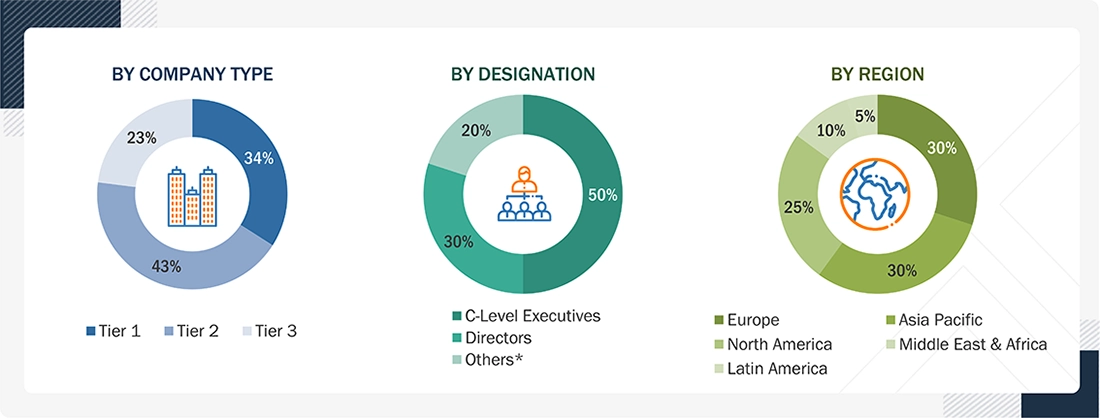
Note: Tier 1 companies’ revenues are more than USD 10 billion; tier 2 companies’ revenues range between USD 1 and 10 billion; and tier 3 companies’ revenues range between USD 500 million and USD 1 billion. Other designations include sales managers, marketing managers, and product managers.
To know about the assumptions considered for the study, download the pdf brochure
Market Size Estimation
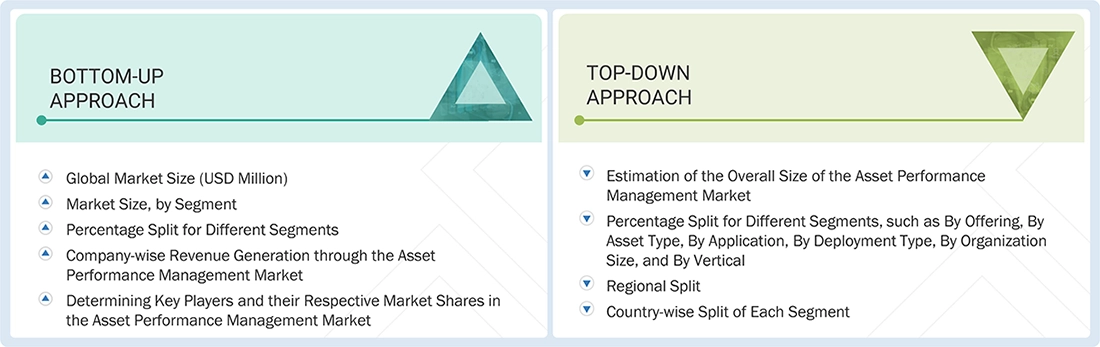
Multiple approaches were adopted to estimate and forecast the asset performance management market. The first approach involved estimating the market size by companies’ revenue generated through the sale of asset performance management products.
Market Size Estimation Methodology: Top-down Approach
The top-down approach prepared an exhaustive list of all the vendors offering products in the asset performance management market. The revenue contribution of the market vendors was estimated through annual reports, press releases, funding, investor presentations, paid databases, and primary interviews. Each vendor’s offerings were evaluated based on platform, degree of customization, type, application, end user, and region. The markets were triangulated through primary and secondary research. The primary procedure included extensive interviews for key insights from industry leaders, such as CIOs, CEOs, VPs, directors, and marketing executives. The market numbers were further triangulated with the existing MarketsandMarkets’ repository for validation.
Market Size Estimation Methodology: Bottom-up Approach
The bottom-up approach identified the adoption rate of the asset performance management products among different verticals in key countries, considering their regions contributing the most to the market share. For cross-validation, the adoption of asset performance management products among enterprises and other use cases for their regions was identified and extrapolated. Use cases identified in different areas were weighed for the market size calculation.
Based on the market numbers, the regional split was determined by primary and secondary sources. The procedure included an analysis of the asset performance management market’s regional penetration. Based on secondary research, the regional spending on Information and Communications Technology (ICT), socioeconomic analysis of each country, strategic vendor analysis of major asset performance management service providers, and organic and inorganic business development activities of regional and global players were estimated.
Asset Performance Management Market : Top-Down and Bottom-Up Approach
Data Triangulation
After determining the overall market size using the market size estimation processes as explained above, the market was split into several segments and subsegments. Data triangulation and market breakup procedures were employed, wherever applicable, to complete the overall market engineering process and arrive at the exact statistics of each market segment and subsegment. The overall market size was then used in the top-down procedure to estimate the size of other individual markets via percentage splits of the market segmentation.
Market Definition
Asset performance management (APM) is the strategic use of data, software, and services to maximize the reliability, availability, and efficiency of physical assets throughout their lifecycle. It goes beyond traditional maintenance by combining predictive analytics, condition monitoring, digital twins, and risk-based assessment to prevent unexpected failures and reduce downtime. APM integrates real-time operational data with enterprise systems, enabling organizations to make informed decisions about maintenance schedules, asset utilization, and resource allocation. By applying machine learning and IoT sensors, APM solutions can predict potential issues before they escalate, extend asset lifespans, and optimize performance. Industries such as manufacturing, energy, utilities, oil & gas, transportation, and mining widely adopt APM to ensure safety, regulatory compliance, and cost control. Ultimately, APM shifts organizations from reactive or time-based maintenance to proactive and predictive asset strategies, driving operational excellence, sustainability, and long-term return on investment.
According to IBM, “APM is a strategic method of managing physical assets that any organization utilizes in their daily business operations. It helps organizations optimize the performance of valuable assets such as buildings, machinery, equipment, vehicles, software, and other technology.
Key Stakeholders
- Asset performance management solution providers
- Asset performance management service providers
- Independent software vendors (ISVs)
- Investors and venture capitalists (VCs)
- Managed service providers
- Support and maintenance service providers
- System integrators (SIs)/Migration service providers
- Value-added resellers (VARs) and distributors
Report Objectives
- To define, describe, and forecast the asset performance management market based on offering, asset type, type, application, deployment type, organization size, vertical, and region
- To forecast the market size of the five major regional segments: North America, Europe, Asia Pacific, the Middle East & Africa, and Latin America
- To strategically analyze the market subsegments with respect to individual growth trends, prospects, and contributions to the total market
- To provide detailed information related to the major factors influencing market growth (drivers, restraints, opportunities, and challenges)
- To strategically analyze macro and micro markets with respect to growth trends, prospects, and their contribution to the overall market
- To analyze industry trends, patents and innovations, and pricing data related to the market
- To analyze the opportunities in the market for stakeholders and provide details of the competitive landscape for major players
- To profile key players in the market and comprehensively analyze their market share/ranking and core competencies
- To track and analyze competitive developments, such as mergers & acquisitions, product developments, and partnerships & collaborations in the market
Available customizations:
With the given market data, MarketsandMarkets offers customizations as per the company’s specific needs. The following customization options are available for the report:
Product Analysis
- The product matrix provides a detailed comparison of the product portfolio of each company.
Geographic Analysis based on feasibility
- Further breakup of the North American asset performance management market
- Further breakup of the European asset performance management market
- Further breakup of the Asia Pacific asset performance management market
- Further breakup of the Middle East & African asset performance management market
- Further breakup of the Latin American asset performance management market
Company Information
- Detailed analysis and profiling of additional market players (up to five)
Get the Full Asset Performance Management Market Report
Full forecast, segment splits, and company analysis for all Asset Performance Management Market.
- Mexico Asset Performance Management Market
- Rest Of Europe Asset Performance Management Market
- Rest Of Asia Pacific Asset Performance Management Market
- US Asset Performance Management Market
- Canada Asset Performance Management Market
- UK Asset Performance Management Market
- Germany Asset Performance Management Market
- France Asset Performance Management Market
- Italy Asset Performance Management Market
- China Asset Performance Management Market
- India Asset Performance Management Market
- Japan Asset Performance Management Market
- South Korea Asset Performance Management Market
- Singapore Asset Performance Management Market
- Saudi Arabia Asset Performance Management Market
- UAE Asset Performance Management Market
- South Africa Asset Performance Management Market
Need a Tailored Report?
Customize this report to your needs
Get 10% FREE Customization
Customize This Report
