
India Brake Friction Products Market (2025-2030)

The India Brake Friction Products Market was valued at $7.5 Million in 2025 and projected to reach to $10.3 Million by 2030, representing a compound annual growth rate of 4.6%. India's brake friction products market is positioned for sustained expansion, with the market growing from USD 7.5 million in 2025 to USD 10.3 million by 2030.


| Market Size in | USD 26.32 MN |
| Market Forecast in | |
| CAGR | |
| Forecast Period | |
| Units Considered | Value (USD MN) |
India Brake Friction Products Market Trends and Insights
- This expansion in India reflects the country's accelerating automotive production, rising vehicle ownership, and increasing demand for aftermarket brake components across commercial and passenger vehicle segments.
- India's market growth outpaces the global average of 2.2% CAGR, driven by infrastructure development, fleet modernization, and heightened safety awareness among consumers and manufacturers. The brake friction products sector in India is characterized by a mix of organized and unorganized players, with growing emphasis on quality standards and regulatory compliance.
- India's automotive aftermarket is increasingly adopting advanced friction material technologies, including semi-metallic and ceramic compounds, to meet evolving performance and environmental requirements.
- Between 2025 and 2030, India is expected to see consolidation among suppliers, expansion of distribution networks, and increased investment in manufacturing capabilities to support both OEM and replacement market demand..
Key Market Statistics
- CAGR (2025-2030) 4.6% CAGR
- Market Size, 2025 ~USD 7.5 Million
- Forecast, 2030 ~USD 10.3 Million
- Country India
India Brake Friction Products Market Overview
Strong CAGR Growth :
India's brake friction products market is growing at 4.6% CAGR from 2025 to 2030, significantly outpacing the global growth rate of 2.2%, driven by rapid motorization and vehicle fleet expansion.
Accelerating Automotive Production :
India's automotive sector is experiencing unprecedented growth with increasing vehicle manufacturing capacity, creating sustained demand for OEM and aftermarket brake friction components across passenger and commercial segments.
Rising Vehicle Ownership :
Growing middle-class population and improved purchasing power in India are driving vehicle ownership rates, directly increasing the demand for replacement brake friction products in the aftermarket segment.
Commercial Vehicle Expansion :
India's commercial vehicle segment, including trucks and buses, is expanding rapidly due to infrastructure development and logistics growth, creating substantial demand for heavy-duty brake friction materials.
India Brake Friction Products Market Dynamics
- This growth trajectory is underpinned by India's status as a global automotive manufacturing hub, coupled with rising domestic vehicle sales and increasing replacement demand.
- The country's improving road infrastructure and logistics sector development further accelerate commercial vehicle adoption. The market outlook remains positive as regulatory standards for vehicle safety intensify, driving OEM specifications for higher-quality brake components.
- Additionally, the growing aftermarket sector, supported by rising vehicle age and maintenance requirements, presents significant opportunities for friction product manufacturers and distributors targeting India's diverse automotive ecosystem..
Market Ecosystem
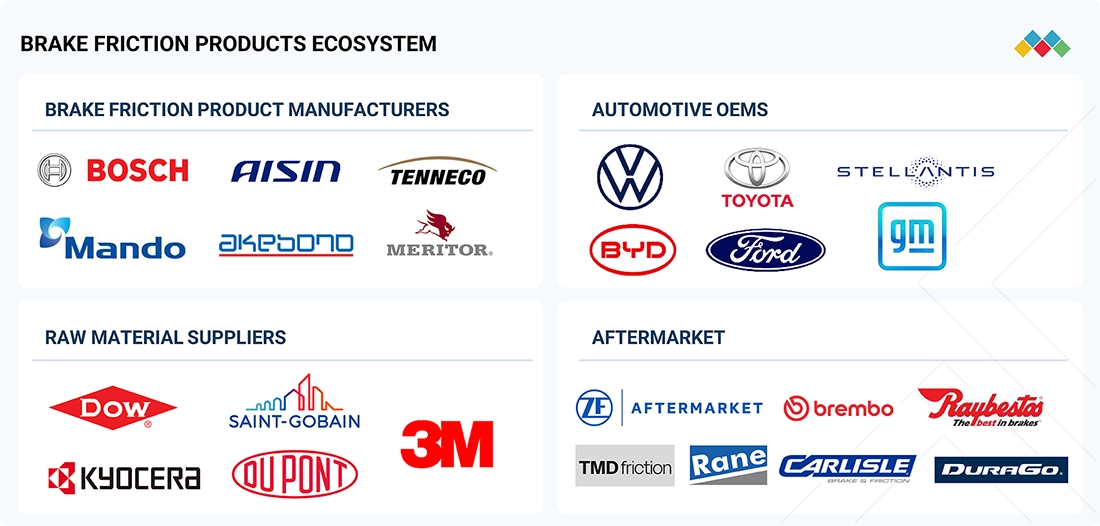
BRAKE FRICTION PRODUCTS MARKET SIZE, SHARE & ANALYSIS: COMMERCIAL USE CASES ACROSS INDUSTRIES
| COMPANY | USE CASE DESCRIPTION | BENEFITS |
|---|---|---|
 |
Design and supply of brake friction systems, including disc pads, linings, and rotors for passenger cars, commercial vehicles, and two-wheelers; integrated with electronic brake control systems. | Ensure high braking performance, durability, reduced noise, vibration, and harshness (NVH), improved safety, and compliance with emission regulations. |
 |
Development and supply of advanced friction materials, including ceramic, metallic, and low-dust formulations for aftermarket and OE applications. | Enable high-performance braking, lower wear rates, reduced particulate emissions, longer service life, and support compliance with Euro 7 and other environmental standards. |
 |
Integration of OE brake friction systems tailored for passenger cars, hybrids, and EVs, including regenerative braking optimization. | Enhance vehicle safety, extend brake component life, reduce maintenance cost, and improve energy efficiency through reduced wear and compatibility with regenerative braking. |
 |
Supply of replacement brake friction products (pads, linings, discs, drums) and complete kits for maintenance and refurbishment across passenger, commercial, and off-highway vehicles. | Maintain braking performance, ensure compliance with OEM standards, extend component lifespan, and offer cost-effective aftermarket solutions. |
Logos and trademarks shown above are the property of their respective owners. Their use here is for informational and illustrative purposes only.
Related Ecosystem
Key Takeaways
- India's brake friction products market is valued at USD 7.5 million in 2025 and is forecast to reach USD 10.3 million by 2030, growing at a 4.6% CAGR.
- India's market growth rate of 4.6% significantly exceeds the global CAGR of 2.2%, reflecting strong domestic automotive demand and aftermarket expansion.
- India's brake friction market is driven by rising vehicle production, fleet modernization, and increasing adoption of advanced friction material technologies.
- India's market consolidation and regulatory compliance focus are reshaping the competitive landscape, with organized players gaining market share through quality and distribution advantages.
Brake Friction Products Market Report Scope
| Report Metric | Details |
|---|---|
| Base Year | 2025 |
| Fastest Growing Segment | BRAKE DISCS (Product Type) |
| Forecast Period | 2025–2030 |
| Growth Rate | CAGR of 2.2% from 2025 to 2030 |
| Largest Segment | PASSENGER CARS (Vehicle Type) |
| Market Size Base Year (Billions) | ~USD 13.33 (2025) |
| Revenue Forecast (Billions) | ~USD 14.86 (2030) |
| Segments Covered | Type, Material Type, Vehicle Type, Application, Product Type, Product |
India Brake Friction Products Market Report Segmentation
6 segment dimensions are covered across the global market.
By Type
- Brake Discs
- Brake Drums
- Brake Liners
- Brake Pads
- Brake Shims
- Brake Shoes
- Dry Disc
- Dry Discs
- Molded Brake Liners
- Wet Disc
- Wet Discs
- Woven Brake Liners
By Material Type
- Ceramic Discs
- Composite Discs
- Metallic Discs
By Vehicle Type
- Battery Electric Vehicles (Bevs)
- Buses
- Heavy Commercial Vehicles (Hcvs)
- Light Commercial Vehicles
- Light Commercial Vehicles (Lcvs)
- Passenger Cars
- Plug-In Hybrid Electric Vehicles (Phevs)
- Trucks
By Application
- Agricultural Tractors
- Construction Equipment
By Product Type
- Brake Discs
- Brake Drums
- Brake Liners
- Brake Pads
- Brake Shims
- Brake Shoes
By Product
- Brake Discs
- Brake Drums
- Brake Liners
- Brake Pads
- Brake Shoes
Target Audience
- Automotive OEM Suppliers : Manufacturers and suppliers need India-specific market data to forecast demand for brake friction components, plan production capacity, and secure contracts with India's growing automotive assembly plants.
- Aftermarket Distributors & Retailers : Aftermarket players require insights into India's replacement brake product demand, vehicle age demographics, and regional distribution opportunities to expand inventory and retail networks profitably.
- Private Equity & Investment Firms : Investors evaluating India's automotive supply chain need market sizing, growth projections, and competitive landscape data to identify acquisition targets and assess portfolio company growth potential.
- Market Entry & Expansion Strategists : Companies planning India market entry or expansion require localized market intelligence, growth drivers, and competitive positioning data to develop effective business strategies and risk assessments.
- Industry Consultants & Analysts : Consulting firms and research professionals need verified India market data and forecasts to support client advisory work, competitive analysis, and strategic recommendations in the automotive sector.
Key Companies in the India Brake Friction Products Market
| Company | HQ | Ownership | Strongest segments |
|---|---|---|---|
| WABCO HOLDINGS INC | Switzerland | Private Company | Electronic and pneumatic braking systems (ABS, EBS, ESC, brake controls, air disc brakes),Transmission automation, suspension, steering, and air management systems,Advanced driver assistance systems and vehicle stability solutions, |
| DORMAN PRODUCTS, INC. | United States | Public Company | Light Duty (engine, undercar, body, hardware),Electronics (modules, clusters, sensors),Heavy Duty and Specialty Vehicle (Dayton Parts, SuperATV, UTV/ATV), |
| MANDO CORPORATION | Japan | Private Company | Men’s hair styling and grooming (GATSBY, LUCIDO, TANCHO, M4),Women’s hair care and styling (LUCIDO-L, related lines),Skincare, body care, and deodorant (Bifesta, Barrier Repair, Happy Deo, Baby Veil), |
| GAZ | Russia | Public Company | Gas business (exploration, production, transport, sales),Oil and refined products,Electric power and heat, |
| TENNECO INC. | United States | Private Company | Ride performance and chassis systems,Powertrain components,Clean air and emissions-control systems, |
| AKEBONO BRAKE INDUSTRY CO., LTD. | Japan | Public Company | Disc brake calipers,Disc brake pads and linings,Drum brake systems and components, |
| CONTINENTAL AG | Germany | Public Company | Passenger and light truck tires,Truck, bus, and specialty vehicle tires,Industrial rubber products (hoses, conveyor belts, air springs, drive belts), |
| ITT INC. | United States | Public Company | Motion Technologies (friction, damping, energy absorption),Industrial Process (pumps, valves, services, monitoring),Connect & Control Technologies (connectors, cable assemblies, motion control), |
| MIBA AG | Austria | Private Company | Engine bearings and friction materials,Sintered components and structural parts,E-mobility and power electronics components, |
| SGL CARBON | Germany | Public Company | Graphite Solutions,Process Technology,Carbon Fibers, |
| CUMMINS INC. | United States | Public Company | Engine,Distribution,Components, |
| HELLA GMBH & CO. KGAA | Germany | Public Company | Lighting,Electronics,Lifecycle Solutions, |
WABCO HOLDINGS INC
WABCO HOLDINGS INC is a Swiss private company founded in 1869 with 13,911 employees, operating in the automotive and commercial vehicle sectors.
DORMAN PRODUCTS, INC.
DORMAN PRODUCTS, INC. is a publicly traded company founded in 1918 in the United States with 3,871 employees, specializing in automotive replacement parts and fasteners.
MANDO CORPORATION
MANDO CORPORATION is a Japanese private company founded in 1927 with 2,587 employees, operating in the automotive components industry.
GAZ
GAZ is a Russian public company founded in 1993 with 468,000 employees, operating as a major automotive manufacturer.
TENNECO INC.
TENNECO INC. is a private company founded in 1930 in the United States with 71,000 employees, operating in the automotive emissions control and ride performance sectors.
AKEBONO BRAKE INDUSTRY CO., LTD.
AKEBONO BRAKE INDUSTRY CO., LTD. is a Japanese public company founded in 1929 with 5,096 employees, specializing in brake systems and components.
CONTINENTAL AG
CONTINENTAL AG is a German public company founded in 1871 with 22,076 employees, operating as a major supplier of automotive parts and systems.
ITT INC.
ITT INC. is a publicly traded United States company founded in 1920 with 11,600 employees, providing engineered products and services across multiple industrial sectors.
MIBA AG
MIBA AG is an Austrian private company founded in 1927, operating in the automotive and industrial sectors.
SGL CARBON
SGL CARBON is a German public company founded in 1878 with 3,577 employees, specializing in carbon-based materials and composites.
CUMMINS INC.
CUMMINS INC. is a publicly traded United States company founded in 1919 with 67,400 employees, manufacturing engines, power generation, and related technologies.
HELLA GMBH & CO. KGAA
HELLA GMBH & CO. KGAA is a German public company founded in 1899 with 37,653 employees, specializing in automotive lighting and electronics.
Reasons to Buy this Report
- Market Size & Growth Validation : Obtain precise market valuation for India (USD 7.5M in 2025) and verified 5-year forecast (USD 10.3M by 2030) to support investment decisions, business planning, and competitive positioning in this high-growth market.
- India-Specific Growth Drivers : Understand localized factors driving 4.6% CAGR—including automotive production acceleration, rising vehicle ownership, and commercial vehicle expansion—to tailor market entry and expansion strategies effectively.
- Competitive Benchmarking : Compare India's growth rate (4.6%) against global performance (2.2%) to identify market opportunity gaps, assess competitive intensity, and prioritize resource allocation across regional markets.
- Segment & Channel Insights : Access detailed analysis of India's OEM and aftermarket brake friction segments, commercial vs. passenger vehicle demand, and distribution channels to optimize product mix and go-to-market strategies.
- Strategic Investment Planning : Leverage India-focused market data to evaluate manufacturing partnerships, distribution network expansion, and M&A opportunities in a rapidly growing automotive market with strong long-term fundamentals.
Frequently asked questions
What is the current size of India's brake friction products market?
India's brake friction products market is valued at USD 7.5 million in 2025 and is expected to grow to USD 10.3 million by 2030.
What is the projected growth rate for India's brake friction products market?
India's brake friction products market is projected to grow at a compound annual growth rate (CAGR) of 4.6% from 2025 to 2030.
How does India's market growth compare to global trends?
India's brake friction products market CAGR of 4.6% significantly outpaces the global CAGR of 2.2%, indicating stronger regional demand and market expansion.
What are the primary drivers of growth in India's brake friction products market?
Key drivers in India include rising vehicle production, increasing vehicle ownership, fleet modernization, infrastructure development, and heightened safety awareness among consumers and manufacturers.
What types of friction materials are gaining adoption in India?
India's market is increasingly adopting advanced friction material technologies, including semi-metallic and ceramic compounds, to meet evolving performance and environmental requirements.
RESEARCH METHODOLOGY
The study involved four major activities in estimating the current size of the brake friction products market. Secondary research was conducted to collect information on the market, peer, and child markets. The next step was to validate these findings and assumptions and size them with industry experts across value chains through primary research. After that, market breakdown and data triangulation processes were used to estimate the market size of segments and subsegments using the top-down and bottom-up approaches.
Secondary Research
In the secondary research process, various secondary sources such as company annual reports/presentations, press releases, industry association publications [for example, International Organization of Motor Vehicle Manufacturers (OICA), National Highway Traffic Safety Administration (NHTSA), International Energy Association (IEA)], articles, directories, technical handbooks, trade websites, technical articles, and databases (for example, Marklines, and Factiva) have been used to identify and collect information useful for an extensive commercial study of the global brake friction products market.
Primary Research
Extensive primary research was conducted after understanding the brake friction products market scenario through secondary research. Several primary interviews were conducted with market experts from demand (OEMs) and supply (component manufacturers) across North America, Europe, and the Asia Pacific. Approximately 100% of primary interviews were conducted with the demand and supply sides. Primary data was collected through questionnaires, emails, and telephonic interviews.
In the canvassing of primaries, various departments within organizations, such as sales, operations, and administration, were covered to provide a holistic viewpoint in this report. After interacting with industry experts, brief sessions with highly experienced independent consultants were also conducted to reinforce the findings from primaries. This and the in-house subject-matter experts’ opinions led to the conclusions described in the remainder of this report.
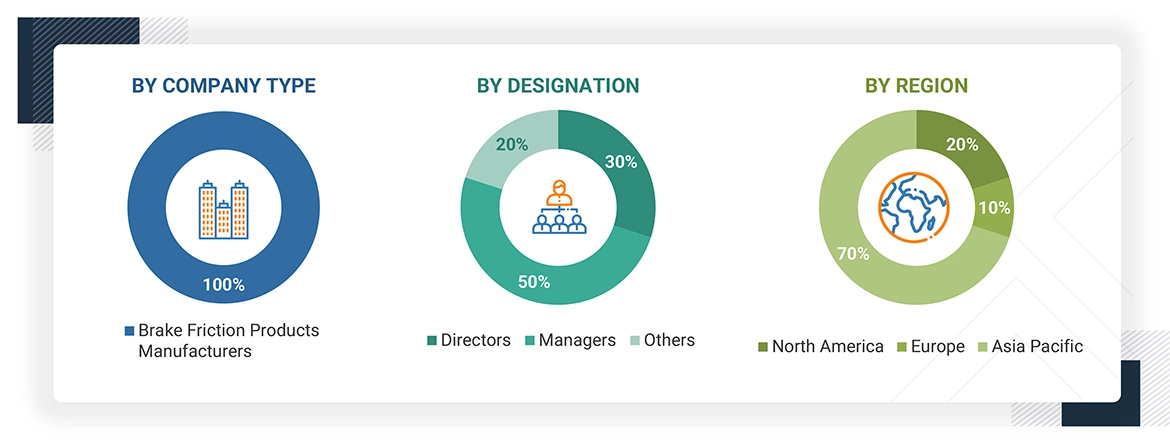
Note: Company tiers are based on the value chain; the company's revenue is not considered.
To know about the assumptions considered for the study, download the pdf brochure
Market Size Estimation
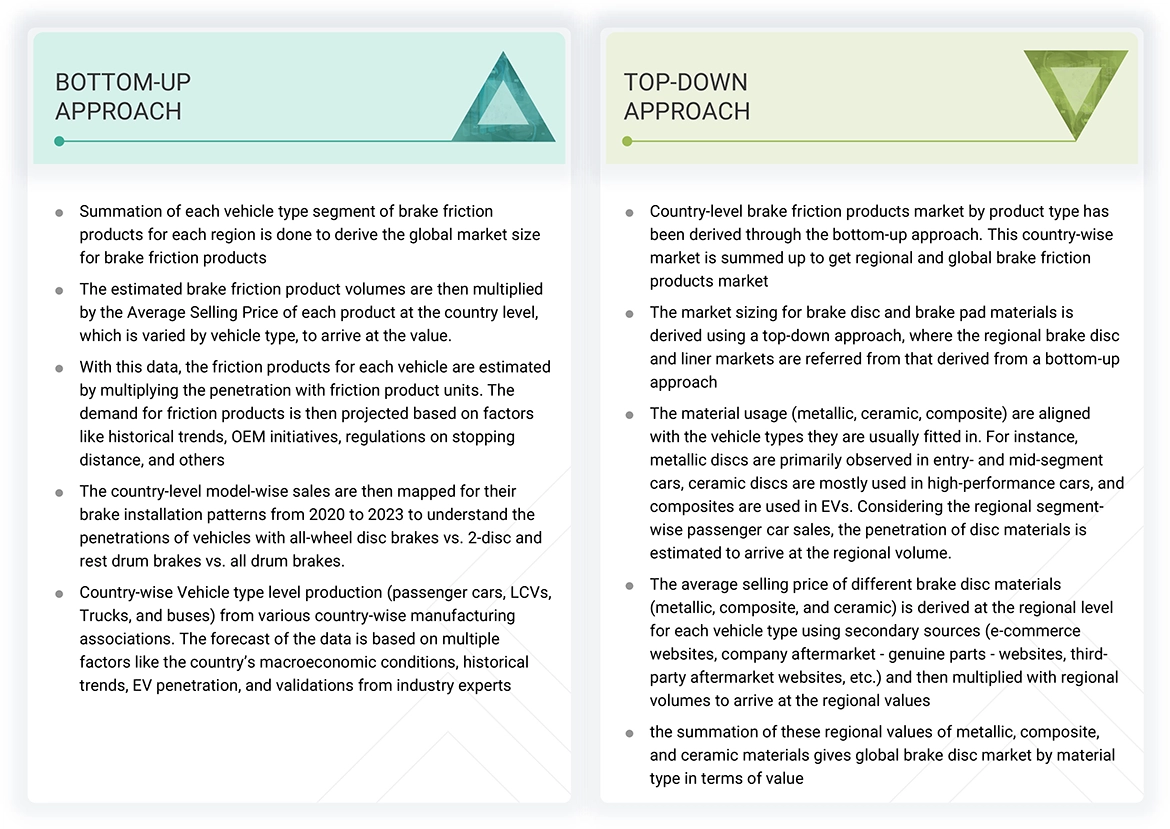
Both top-down and bottom-up approaches were used to estimate and validate the total size of the brake friction products market. These methods were also used extensively to estimate the size of various subsegments in the market. The research methodology used to estimate the market size includes the following:
Brake Friction Products Market : Top-Down and Bottom-Up Approach
Data Triangulation
After arriving at the overall market size, the market was split into several segments and subsegments using the market size estimation processes explained above. Data triangulation and market breakdown procedures were employed to complete the overall market engineering process and arrive at the exact statistics of each market segment and subsegment, wherever applicable. The data was triangulated by studying various factors and trends from both the demand and supply sides.
Market Definition
Brake friction products decelerate a vehicle by converting the car's kinetic energy into heat energy through friction and dissipating heat to the surroundings. Technological advancements in brake systems and friction materials create safe vehicle models running at higher speeds. Brake friction products, including a drum, disc, liner, and brake shoe, generate friction to stop the vehicle and control its speed. The scope of the brake friction study considers the brake pads, liner, brake shoe, brake disc, and brake shims.
Stakeholders
- Automotive OEMs
- Brake friction products manufacturers
- Associations, forums, and alliances related to automobiles
- EV component suppliers
- Raw material suppliers for brake friction products
- Traders and distributors of brake friction products
- Government agencies and policymakers
Report Objectives
- To analyze and forecast the brake friction products market in terms of value (USD million) & volume (million units) from 2021 to 2032
- To segment the market by product type, vehicle type, liner type, material type, off-highway market, application, disc type, electric vehicle brake friction OE market, vehicle type, aftermarket by-products, vehicle type, and region
- To segment and forecast the brake friction products OE market by value and volume
- To segment and forecast brake friction products aftermarket based on product at the country level and vehicle type at the regional level
- To identify and analyze key drivers, challenges, restraints, and opportunities influencing the market growth
- To strategically analyze the market for individual growth trends, prospects, and contributions to the total market
-
To study the following aspects of the market
- Value Chain Analysis
- Ecosystem Analysis
- Technology Analysis
- Trade Analysis
- Investment and Funding Scenario
- Pricing Analysis
- Case Study Analysis
- Patent Analysis
- Regulatory Landscape
- Key Stakeholders and Buying Criteria
- To strategically profile the key players and comprehensively analyze their market share and core competencies
- To analyze the opportunities for stakeholders and the competitive landscape for market leaders
- To track and analyze competitive developments such as deals, product launches/developments, expansions, and other activities undertaken by the key industry participants
Available Customizations
With the given market data, MarketsandMarkets offers customizations based on the company’s needs.
- Additional company profiles (up to 5 companies)
- Detailed analysis of the off-highway brake friction market by product type (Country Level)
- Detailed analysis of the brake friction OE market by vehicle type (Country Level)
Get the Full Brake Friction Products Market Report
Full forecast, segment splits, and company analysis for all Brake Friction Products Market.
- China Brake Friction Products Market
- Japan Brake Friction Products Market
- South Korea Brake Friction Products Market
- Germany Brake Friction Products Market
- France Brake Friction Products Market
- UK Brake Friction Products Market
- Spain Brake Friction Products Market
- US Brake Friction Products Market
- Mexico Brake Friction Products Market
- Canada Brake Friction Products Market
- Russia Brake Friction Products Market
- Brazil Brake Friction Products Market
Need a Tailored Report?
Customize this report to your needs
Get 10% FREE Customization
Customize This Report
