
Europe Automotive Dashcam Market (2026-2031)

The Europe Automotive Dashcam Market was valued at $59.3 Million in 2026 and projected to reach to $91.4 Million by 2031, representing a compound annual growth rate of 6.4%. Europe's automotive dashcam market is poised for sustained growth through 2031, driven by regulatory mandates, insurance incentives, and heightened consumer safety consciousness.


| Market Size in | USD 26.32 MN |
| Market Forecast in | |
| CAGR | |
| Forecast Period | |
| Units Considered | Value (USD MN) |
Europe Automotive Dashcam Market Trends and Insights
- This 6.4% compound annual growth rate reflects Europe's increasing adoption of vehicle safety technologies driven by stringent regulatory frameworks and rising consumer awareness of accident documentation.
- Europe's mature automotive sector and high vehicle ownership rates create a strong foundation for dashcam penetration across both passenger and commercial vehicle segments. The European market benefits from strong insurance industry support and regulatory incentives that encourage dashcam installation.
- Europe's focus on vehicle safety standards and data protection compliance has shaped a sophisticated dashcam ecosystem with premium features and integrated connectivity solutions.
- By 2031, Europe is expected to solidify its position as a key growth region, with expanding aftermarket adoption and OEM integration driving sustained market expansion throughout the forecast period..
Key Market Statistics
- CAGR (2026-2031) 6.4% CAGR
- Market Size, 2026 ~USD 59.3 Million
- Forecast, 2031 ~USD 91.4 Million
- Geography Europe
Europe Automotive Dashcam Market Overview
Regulatory Compliance Driving Adoption :
Europe's stringent safety regulations and insurance incentives are accelerating dashcam adoption across the region. Mandatory vehicle safety standards and accident documentation requirements position dashcams as essential safety devices for European fleet operators and individual drivers.
Premium Market Positioning :
European consumers prioritize high-quality, feature-rich dashcams with advanced driver assistance integration. The region's mature automotive market supports premium pricing strategies, with consumers willing to invest in superior video quality, cloud connectivity, and AI-powered safety features.
Insurance & Legal Incentives :
European insurers increasingly offer premium discounts for dashcam-equipped vehicles, creating strong financial motivation for adoption. Legal recognition of dashcam footage in accident claims across major European markets further validates the technology's value proposition.
Connected Vehicle Integration :
Europe's advanced automotive infrastructure supports seamless dashcam integration with connected vehicle ecosystems. Growing demand for IoT-enabled safety solutions and real-time data sharing capabilities positions dashcams as critical components of modern European vehicle platforms.
Europe Automotive Dashcam Market Dynamics
- The region's mature automotive sector and established distribution networks support accelerated market penetration across both OEM and aftermarket channels.
- Germany, France, and the UK lead adoption rates, with expanding demand in Southern and Eastern European markets creating significant growth opportunities. The 6.4% CAGR reflects Europe's transition toward integrated vehicle safety ecosystems where dashcams serve as foundational components.
- Technological advancements in AI-powered analytics, cloud storage integration, and autonomous vehicle compatibility will drive premium segment expansion.
- Strategic partnerships between automotive manufacturers and dashcam providers will further consolidate market growth through 2031..
Market Ecosystem

AUTOMOTIVE DASHCAM MARKET: COMMERCIAL USE CASES ACROSS INDUSTRIES
| COMPANY | USE CASE DESCRIPTION | BENEFITS |
|---|---|---|
 |
Integration of dashcam functionality with ADAS systems for enhanced situational awareness and safety validation | Bosch camera systems record critical driving scenarios to support ADAS validation and post incident analysis |
 |
Fleet and commercial vehicle monitoring through integrated drive recorders with telematics linkage | A logistics operator uses Denso drive recorder to monitor driver performance and capture accident evidence |
 |
Multi camera systems integrated into vehicles for surround view recording and driver monitoring | An OEM deploys Magna camera modules to enable 360 degree recording and in cabin monitoring for safety applications |
 |
Vision systems combining recording, ADAS support, and driver monitoring for safety and compliance | Valeo systems capture front and interior video to support driver monitoring and regulatory compliance in mobility services |
 |
Personal vehicle safety and incident documentation through compact, high-resolution, GPS-enabled dashcams | A driver uses the Garmin Dash Cam series for continuous front recording and automatic incident capture with GPS location tagging |
Logos and trademarks shown above are the property of their respective owners. Their use here is for informational and illustrative purposes only.
Related Ecosystem
Automotive Advance Technologies
- Battery Electric Vehicle (BEV)
- Light Commercial Vehicles (LCVs)
- Fuel Cell Electric Vehicle (FCEV)
- Hybrid Electric Vehicle (HEV)
- Internal Combustion Engine (ICE)
- BOSCH LIMITED
- Continental ag
- Visteon Corporation
- DENSO Corporation
- ZF FRIEDRICHSHAFEN AG
Automotive Electronics And Electrical Equipment
- Battery Electric Vehicle (BEV)
- Light Commercial Vehicles (LCVs)
- Fuel Cell Electric Vehicle (FCEV)
- Sensors
- Hybrid Electric Vehicle (HEV)
- BOSCH LIMITED
- Continental ag
- DENSO Corporation
- Texas Instruments Incorporated
- Panasonic Holdings Corporation
Automotive Systems
- Light Commercial Vehicles (LCVs)
- Battery Electric Vehicle (BEV)
- Hybrid Electric Vehicle (HEV)
- Agricultural Tractors
- Fuel Cell Electric Vehicle (FCEV)
- BOSCH LIMITED
- DENSO Corporation
- Continental ag
- ZF FRIEDRICHSHAFEN AG
- GORKOVSKY AVTOMOBILNY ZAVOD
Key Takeaways
- Europe's dashcam market grows at 6.4% CAGR from 2026 to 2031, outpacing global growth of 5.8%.
- Market size in Europe expands from USD 59.3 million (2026) to USD 91.4 million (2031), representing 54% absolute growth.
- Europe's regulatory environment and insurance incentives drive higher dashcam adoption compared to global averages.
- Premium features and data protection compliance position Europe as a leader in advanced dashcam technology adoption.
Automotive Dashcam Market Report Scope
| Report Metric | Details |
|---|---|
| Base Year | 2026 |
| Fastest Growing Segment | BEV (Ev Type) |
| Forecast Period | 2026–2031 |
| Growth Rate | CAGR of 5.8% from 2026 to 2031 |
| Largest Segment | AFTERMARKET (Distribution Channel) |
| Market Size Base Year (Billions) | ~USD 4.41 (2026) |
| Revenue Forecast (Billions) | ~USD 5.85 (2031) |
| Segments Covered | Distribution Channel, Ev Type, Product Type, Technology, Vehicle Type, Video Quality |
Europe Automotive Dashcam Market Report Segmentation
6 segment dimensions are covered across the global market.
By Distribution Channel
- Aftermarket
- Oe
By Ev Type
- Bev
- Phev
By Product Type
- Front + Rear + In-Cabin Dashcam
- Front + Rear Dashcam
- Front Dashcam
By Technology
- Advanced Dashcam
- Basic Dashcam
- Smart Dashcam
By Vehicle Type
- Commercial Vehicle
- Passenger Car
By Video Quality
- Full Hd & 4K
- High Definition
- Standard Definition
Target Audience
- Automotive OEMs & Tier-1 Suppliers : Evaluate dashcam integration opportunities within European vehicle platforms. Understand regulatory requirements, consumer demand patterns, and competitive positioning to inform product development roadmaps and supply chain strategies across European manufacturing hubs.
- Aftermarket Dashcam Manufacturers : Assess market sizing, growth trajectories, and competitive dynamics across European countries. Identify distribution channel opportunities, pricing strategies, and feature differentiation requirements to maximize market share in Europe's mature and emerging automotive segments.
- Insurance & Fleet Management Companies : Leverage market intelligence to develop dashcam incentive programs and risk mitigation strategies. Understand adoption rates, consumer preferences, and ROI potential across European markets to optimize insurance product offerings and fleet safety initiatives.
- Technology & Software Providers : Identify integration opportunities for AI analytics, cloud platforms, and connected vehicle solutions within Europe's dashcam ecosystem. Understand regulatory requirements and consumer expectations for data privacy, storage, and real-time analytics capabilities.
- Investment & Private Equity Firms : Evaluate market growth potential, competitive consolidation opportunities, and exit strategies within Europe's automotive dashcam sector. Assess regional variations in market maturity, regulatory tailwinds, and technology adoption to inform investment thesis and portfolio strategy.
Key Companies in the Europe Automotive Dashcam Market
| Company | HQ | Ownership | Strongest segments |
|---|---|---|---|
| MAGNA INTERNATIONAL INC. | Canada | Public Company | Body Exteriors & Structures,Power & Vision (ADAS, electronics, lighting, mirrors),Seating Systems and Interior, |
| VALEO | France | Public Company | Power (thermal systems, EV cooling, battery thermal management, HVAC, air quality),Brain (ADAS sensors, lidar, cameras, domain controllers, connectivity, access),Light (lighting systems and wiper systems), |
| GARMIN LTD. | Switzerland | Public Company | Fitness & Smartwatches (running, cycling, wellness, Garmin Connect/Connect IQ),Outdoor & Adventure (adventure watches, handhelds, satellite communicators, dog devices, golf, dive),Aviation (avionics, integrated flight decks, safety systems, services), |
| ESCORT | United States | Subsidiary | Core hardware / equipment line,Aftermarket parts & consumables,Services, maintenance & support, |
| HYUNDAI MOBIS | South Korea | Public Company | Auto modules (chassis, cockpit, front-end, bumpers),Electrification (power conversion, drive, battery, 48V),Safety, braking, and steering, |
| PIONEER | United States | Private Company | Crude oil,Natural gas liquids (NGLs),Natural gas, |
| MITAC HOLDINGS CORP. | Taiwan | Public Company | |
| JVCKENWOOD CORPORATION | Japan | Public Company | Mobility & Telematics (car AV, navigation, audio, dashcams, in-vehicle devices, telematics solutions),Safety and Security (professional wireless communications, video surveillance, medical image displays),Entertainment (professional cameras, projectors, headphones, home audio, packaged media, content), |
| THINKWARE CORPORATION | South Korea | Public Company | Dash cams and black boxes,ADAS high-precision maps and self-driving platforms,Mobiles, tablets, and location-based devices, |
MAGNA INTERNATIONAL INC.
Magna International Inc. is a Canadian public company founded in 1957 that employs 156,000 people and operates as a major automotive supplier and parts manufacturer.
VALEO
Valeo is a French public company established in 1923 with 87,115 employees, specializing in automotive technology and components.
GARMIN LTD.
Garmin Ltd. is a Swiss public company founded in 1989 with 23,000 employees, known for designing and manufacturing GPS navigation and wireless devices.
ESCORT
Escort is a United States-based subsidiary company founded in 1978.
HYUNDAI MOBIS
Hyundai Mobis is a South Korean public company founded in 1977 that operates as a major automotive parts and components supplier.
PIONEER
Pioneer is a United States-based private company founded in 1997 with 2,213 employees.
MITAC HOLDINGS CORP.
Mitac Holdings Corp. is a Taiwanese public company founded in 1982 that operates in the technology and electronics sector.
JVCKENWOOD CORPORATION
JVCKenwood Corporation is a Japanese public company established in 1927 with 15,229 employees, specializing in audio and visual electronics.
THINKWARE CORPORATION
Thinkware Corporation is a South Korean public company founded in 1997 with 261 employees, specializing in automotive electronics and dashcam technology.
Countries within Europe - compare and drill down
| Country | 2025 size (native) |
|---|---|
| Germany | USD 4119 Million |
| France | USD 3667 Million |
| UK | USD 3091 Million |
| Italy | USD 2654 Million |
| Spain | USD 1685 Million |
| Rest Of Europe | USD 1195 Million |
Country market size visualization
Reasons to Buy this Report
- Country-Level Market Segmentation : Access detailed market sizing and growth projections for Germany, France, UK, Italy, Spain, and Rest of Europe. Understand regional variations in adoption rates, regulatory environments, and consumer preferences to optimize market entry and expansion strategies.
- Regulatory & Compliance Insights : Comprehensive analysis of Europe's evolving safety regulations, insurance incentive structures, and legal frameworks governing dashcam usage. Identify compliance requirements and opportunities across different European jurisdictions to inform product development and market positioning.
- Competitive Landscape Analysis : Detailed assessment of OEM integration strategies, aftermarket player positioning, and emerging technology providers in Europe. Benchmark competitive offerings and identify white-space opportunities in premium, mid-market, and value segments across European markets.
- Consumer Behavior & Adoption Drivers : In-depth understanding of European consumer preferences, purchasing decision factors, and willingness-to-pay across demographics. Leverage insights on insurance incentives, safety consciousness, and connected vehicle expectations to refine marketing and product strategies.
- Strategic Growth Opportunities : Identify high-growth segments, emerging markets within Europe, and technology integration opportunities. Develop data-driven expansion strategies targeting underserved regions and capitalize on regulatory tailwinds and insurance partnerships driving market acceleration.
Frequently asked questions
What is the current size of Europe's automotive dashcam market?
Europe's automotive dashcam market is valued at USD 59.3 million in 2026, with strong growth momentum across the region.
What is the projected market size for Europe's dashcam market by 2031?
Europe's dashcam market is forecast to reach USD 91.4 million by 2031, representing significant expansion over the five-year period.
How does Europe's dashcam market growth compare to global trends?
Europe's 6.4% CAGR exceeds the global average of 5.8%, indicating stronger regional adoption driven by regulatory support and insurance incentives.
What factors are driving dashcam adoption in Europe?
Europe's growth is fueled by stringent safety regulations, insurance industry backing, consumer safety awareness, and data protection compliance requirements.
Which segments are leading Europe's dashcam market expansion?
Both passenger vehicle and commercial fleet segments are expanding in Europe, with OEM integration and premium aftermarket solutions driving market diversification.
RESEARCH METHODOLOGY
The study involved four major activities in estimating the current size of the automotive dashcam market. Exhaustive secondary research was done to collect information on the market, the peer market, and the parent market. The next step was to validate these findings, assumptions, and sizing with the industry experts across value chains through primary research. A top-down approach was employed to estimate the complete market size. Thereafter, market breakdown and data triangulation processes were used to estimate the market size of segments and subsegments.
Secondary Research
Secondary sources referred to for this research study included automotive dashcam industry organizations; corporate filings such as annual reports, investor presentations, and financial statements; trade and business whitepapers and databases; and articles from recognized associations and government publishing sources. The secondary data was collected and analyzed to arrive at the overall market size, which was further validated by primary research.
Primary Research
Extensive primary research has been conducted after acquiring an understanding of this market scenario through secondary research. Several primary interviews have been conducted with market experts from the demand- and supply-side OEMs (in terms of component supply, country-level government associations, and trade associations) and component manufacturers across four major regions, namely, Asia Pacific, Europe, North America, and the Rest of the World. Approximately 60% and 40% of primary interviews have been conducted from the demand and supply side, respectively. Primary data has been collected through questionnaires, emails, LinkedIn, and telephone interviews. In the canvassing of primaries, we have strived to cover various departments within organizations, such as sales, operations, and administration, to provide a holistic viewpoint in our report.
Brief sessions with highly experienced independent consultants were conducted to reinforce findings from primaries after interacting with industry experts. This, along with the in-house subject matter experts’ opinions, led to the findings, as described in the remainder of this report.
In the primary research process, various primary sources from the supply and demand sides were interviewed to obtain qualitative and quantitative information for the report. The primary sources from the supply side included industry experts, such as Vice Presidents (VPs), marketing directors, technology and innovation directors, and related key executives from various key companies and organizations. The primary sources from the demand side included end users, such as Chief Information Officers (CIOs), consultants, service professionals, technicians, technologists, and managers at public and investor-owned utilities.
Breakdown of Primaries
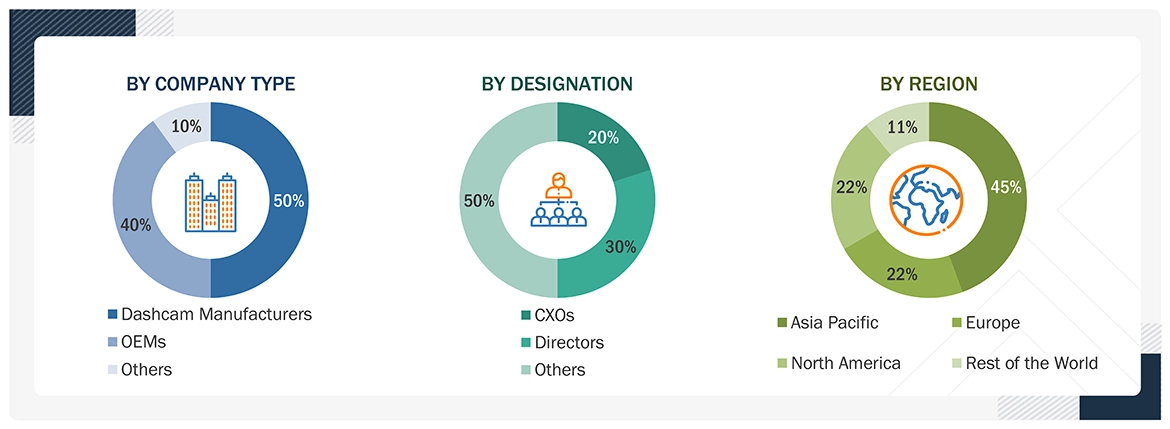
Note: Others include purchase and sales managers, marketing managers, and product managers.
To know about the assumptions considered for the study, download the pdf brochure
Market Size Estimation
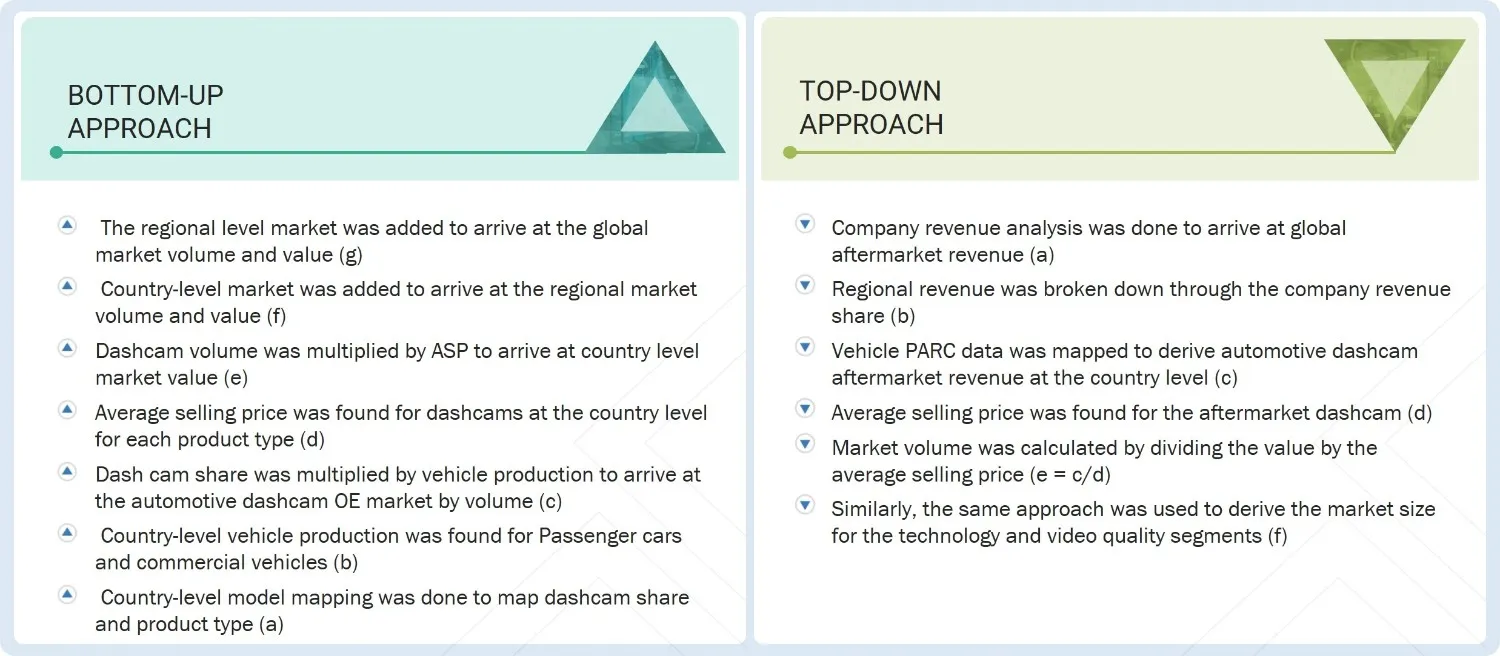
The automotive dashcam OE market is estimated using a bottom-up methodology, where country-level model mapping is conducted to determine dashcam share across product types, followed by assessment of vehicle production for passenger cars and commercial vehicles at the country level. The dashcam penetration rate is applied to vehicle production to derive OE dashcam volume, after which average selling prices are determined for each product category at the country level. The calculated volume is multiplied by the corresponding average selling price to arrive at country level market value, which is then aggregated to derive the regional market size, and further consolidated to estimate the global market volume and value.
The automotive dashcam aftermarket market is estimated using a top-down approach, where company revenue analysis is conducted to derive the global aftermarket revenue, which is then distributed across regions based on company-level revenue share. Vehicle parc data is mapped to estimate country-level aftermarket revenue, reflecting installation potential across existing vehicles. Average selling prices for aftermarket dashcams are determined, and market volume is calculated by dividing the market value by the average selling price. The same methodology is applied to further segment the market by technology and video quality, ensuring consistent estimation across all categories.
Automotive Dashcam Market : Top-Down and Bottom-Up Approach
Data Triangulation
After arriving at the overall market size using the market size estimation processes as explained above, the market was split into several segments and subsegments. To complete the overall market engineering process and arrive at the exact statistics of each market segment and subsegment, data triangulation and market breakdown procedures were employed, wherever applicable. The data was triangulated by studying various factors and trends from both the demand and supply sides.
Market Definition
A dash cam, or dashboard camera, is a video recording device that’s mounted onto the dashboard or windshield of a vehicle. In the trucking industry, dash cams have become increasingly popular as a means of recording evidence in the event of an accident or other incident on the road. These devices are designed to capture video footage of the road ahead, as well as the driver and passengers in the vehicle.
Report Objectives
- To segment and forecast the automotive dashcam market in terms of volume (thousand units) and value (USD million)
- OE Product Type (Front Dashcam, Front + Rear Dashcam, Front + Rear + In cabin Dashcam)
- Aftermarket Product Type (Front Dashcam, Front + Rear Dashcam, Front + Rear + In cabin Dashcam)
- OE Technology (Basic, Advanced, Smart)
- Aftermarket Technology (Basic, Advanced, Smart)
- OE Video Quality (Standard Definition, High Definition, Full HD & 4K)
- Aftermarket Video Quality (Standard Definition, High Definition, Full HD & 4K)
- OE Vehicle Type (Passenger Car, Commercial Vehicle)
- Aftermarket Vehicle Type (Passenger Car, Commercial Vehicle)
- OE EV Type (BEV, PHEV)
- EV Type Aftermarket (BEV, PHEV)
- Distribution Channel (OE, Aftermarket)
- Region (Asia Pacific, Europe, North America, and the Rest of the World)
- To analyze regional markets for growth trends, prospects, and their contribution to the overall market
- To define, describe, and forecast the size of the automotive dashcam market with respect to growth trends and prospects, and determine the contribution of the segments to the total market
- To provide detailed information regarding the major factors (drivers, challenges, restraints, and opportunities) influencing market growth
- To strategically analyze markets with respect to individual growth trends, prospects, and contribution to the total market
- To analyze opportunities for stakeholders and the competitive landscape for market leaders
- To study the following with respect to the market -
- Supply chain analysis
- Ecosystem analysis
- Pricing analysis
- Technology analysis
- HS code
- Case study analysis
- Patent analysis
- Impact of 2025 India-EU Trade Deal
- Regulatory landscape
- Key stakeholders and buying criteria
- Funding, by application
- Key conferences & events
- To strategically profile key players and comprehensively analyze their market share and core competencies
- To analyze the impact of AI on the market
- To track and analyze competitive developments such as deals (mergers & acquisitions, partnerships, collaborations), product developments, and other activities carried out by key industry participants
Available customizations:
With the given market data, MarketsandMarkets offers customizations in line with company-specific needs.
- Automotive dashcam market, by application, at the regional level (For regions covered in the report)
- Automotive dashcam market, by vehicle type, at the country level (For the countries not covered in the report)
Company Information
- Profiling of Additional Market Players (Up to 5)
Get the Full Automotive Dashcam Market Report
Full forecast, segment splits, and company analysis for all Automotive Dashcam Market.
- China Automotive Dashcam Market
- India Automotive Dashcam Market
- Japan Automotive Dashcam Market
- South Korea Automotive Dashcam Market
- Germany Automotive Dashcam Market
- France Automotive Dashcam Market
- Italy Automotive Dashcam Market
- Spain Automotive Dashcam Market
- UK Automotive Dashcam Market
- Canada Automotive Dashcam Market
- Mexico Automotive Dashcam Market
- US Automotive Dashcam Market
- Brazil Automotive Dashcam Market
- South Africa Automotive Dashcam Market
- Rest Of Europe Automotive Dashcam Market
- Rest Of Asia Pacific Automotive Dashcam Market
Need a Tailored Report?
Customize this report to your needs
Get 10% FREE Customization
Customize This Report
