
Italy Automotive Fuel Tank Market (2026-2033)

The Italy Automotive Fuel Tank Market was valued at $640 Million in 2026 and projected to reach to $724 Million by 2033, representing a compound annual growth rate of 1.8%. Italy's automotive fuel tank market faces a period of gradual consolidation as the country's mature automotive sector navigates the transition from traditional combustion engines to alternative powertrains.


| Market Size in | USD 26.32 MN |
| Market Forecast in | |
| CAGR | |
| Forecast Period | |
| Units Considered | Value (USD MN) |
Italy Automotive Fuel Tank Market Trends and Insights
- This modest growth trajectory reflects Italy's mature automotive sector and the gradual transition toward alternative fuel technologies.
- Italy's fuel tank market remains anchored in traditional internal combustion engine (ICE) vehicles, though the country is experiencing increasing regulatory pressure to adopt cleaner propulsion systems. The Italian automotive fuel tank market faces headwinds from the European Union's stringent emissions regulations and the accelerating shift toward electric vehicles (EVs).
- Italy's market growth is constrained by declining new vehicle registrations in the traditional fuel tank segment, as manufacturers pivot toward battery electric and hybrid platforms.
- However, Italy's established automotive supply chain and continued demand for replacement fuel tanks in the existing vehicle fleet provide stability through the forecast period to 2033. Italy's position within Europe's broader automotive landscape underscores the country's reliance on legacy fuel tank technologies.
- Despite the 1.8% CAGR, Italy's market will continue to serve the substantial installed base of conventional vehicles while gradually accommodating hybrid and alternative fuel architectures through 2033..
Key Market Statistics
- CAGR (2026-2033) 1.8% CAGR
- Market Size, 2026 ~USD 640 Million
- Forecast, 2033 ~USD 724 Million
- Country Italy
Italy Automotive Fuel Tank Market Overview
Modest Growth Trajectory :
Italy's automotive fuel tank market is estimated at USD 640 million in 2026 and projected to reach USD 724 million by 2033, with a CAGR of 1.8%, reflecting a mature and stabilizing market.
Mature Automotive Sector :
Italy's established automotive industry, dominated by legacy manufacturers and suppliers, continues to rely heavily on traditional internal combustion engine (ICE) vehicles, sustaining steady fuel tank demand.
Transition to Alternative Fuels :
The gradual shift toward electric vehicles, hybrid technologies, and alternative fuel systems is moderating traditional fuel tank growth, creating a transitional market dynamic in Italy.
Below-Global Growth Rate :
Italy's 1.8% CAGR significantly lags the global market's 4.4% CAGR, indicating slower adoption of new technologies and a conservative replacement cycle in the Italian automotive sector.
Italy Automotive Fuel Tank Market Dynamics
- While legacy vehicle production and aftermarket demand will sustain the market through 2033, the adoption of electric and hybrid vehicles is expected to moderate growth rates.
- Regulatory pressures from EU emissions standards and increasing consumer interest in sustainable mobility will further influence market dynamics, creating opportunities for manufacturers specializing in lightweight, efficient tank solutions compatible with hybrid systems. The Italian market will likely benefit from its strong position in premium and specialty vehicle manufacturing, where fuel tank innovation remains relevant.
- However, the overall market growth will remain constrained compared to global trends, with manufacturers needing to adapt strategies toward both traditional fuel systems and emerging alternative fuel technologies to maintain competitiveness in this transitional period..
Market Ecosystem
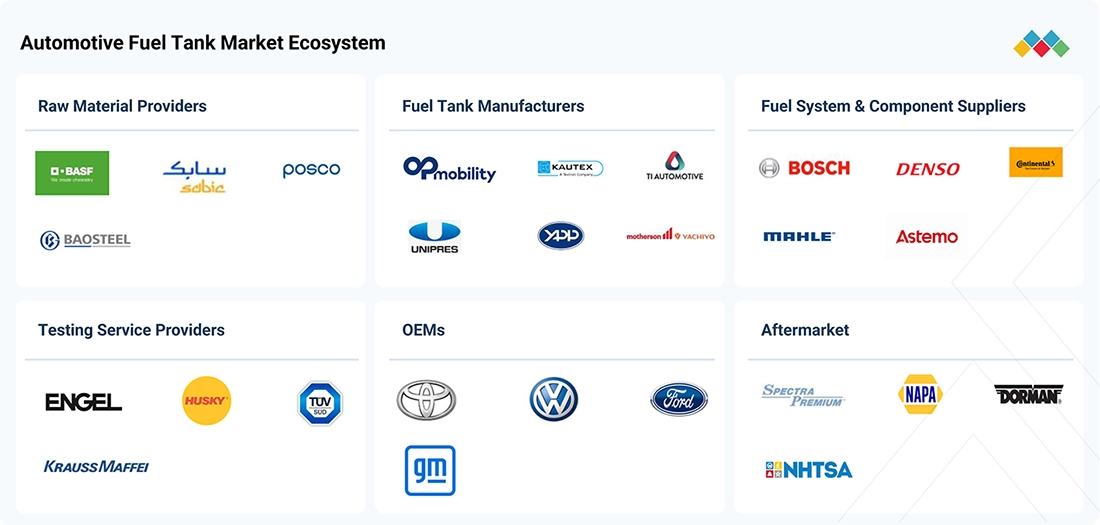
AUTOMOTIVE FUEL TANK MARKET SIZE, SHARE & ANALYSIS: COMMERCIAL USE CASES ACROSS INDUSTRIES
| COMPANY | USE CASE DESCRIPTION | BENEFITS |
|---|---|---|
 |
Develops plastic fuel tanks, hybrid pressure resistant tanks, SCR systems, and integrated fuel systems for passenger and commercial vehicles | Lightweighting, lower permeation, improved packaging, and greater system integration |
 |
Supplies conventional and pressurized plastic fuel systems, including multilayer and hybrid fuel tanks for cars, light trucks, and hybrid vehicles | Reduced weight and emissions, flexible tank geometry, improved packaging, and hybrid compatibility |
 |
Provides fuel tank systems, filler pipes, pumps, and modules for gasoline, diesel, flex fuel, and hybrid applications | Integrated fuel storage and delivery, reduced evaporative emissions, lightweight construction, and packaging flexibility |
 |
Develops plastic automotive fuel tanks and fuel system components for OEM vehicle platforms, with focus on lightweight and emission compliant designs | Weight reduction, corrosion resistance, packaging flexibility, and improved emission performance |
 |
Manufactures multilayer plastic fuel tanks, including six-layer EVOH barrier tanks and pressure resistant tanks for hybrid applications | Low hydrocarbon permeation, lightweight construction, pressure management, and hybrid compatibility |
Logos and trademarks shown above are the property of their respective owners. Their use here is for informational and illustrative purposes only.
Related Ecosystem
Automotive Materials
- Light Commercial Vehicles (LCVs)
- Battery Electric Vehicle (BEV)
- Hybrid Electric Vehicle (HEV)
- Fuel Cell Electric Vehicle (FCEV)
- Agricultural Tractors
- AISIN CORPORATION
- GORKOVSKY AVTOMOBILNY ZAVOD
- Continental ag
- Basf se
- BOSCH LIMITED
Key Takeaways
- Italy's automotive fuel tank market is valued at USD 640 million in 2026 and will reach USD 724 million by 2033, growing at a 1.8% CAGR.
- Italy's market growth is constrained by EU emissions regulations and the accelerating transition to electric and hybrid vehicles.
- Italy's established automotive supply chain and aftermarket demand for replacement fuel tanks provide market stability despite regulatory headwinds.
- Italy's fuel tank market remains predominantly focused on traditional ICE vehicles, with gradual adoption of alternative fuel tank architectures through 2033.
Automotive Fuel Tank Market Report Scope
| Report Metric | Details |
|---|---|
| Base Year | 2026 |
| Fastest Growing Segment | TYPE 2 (Type) |
| Forecast Period | 2026-2030 |
| Growth Rate | CAGR of 4.4% from 2026 to 2030 |
| Largest Segment | PLASTIC (Material) |
| Market Size Base Year (Billions) | ~USD 16.92 (2026) |
| Revenue Forecast (Billions) | ~USD 20.1 (2030) |
| Segments Covered | Vehicle Type, Capacity, Type, Propulsion, Tank Type, Material, Capacity Type |
Italy Automotive Fuel Tank Market Report Segmentation
7 segment dimensions are covered across the global market.
By Vehicle Type
- Heavy Commercial Vehicle
- Heavy Commercial Vehicles
- Light Commercial Vehicle
- Light Commercial Vehicles
- Passenger Car
- Passenger Cars
By Capacity
- 45-70L
- <45L
- >70L
By Type
- Type 1
- Type 2
- Type 3
- Type 4
By Propulsion
- Alternate Fuel
- Diesel
- Gasoline
By Tank Type
- Contoured
- Rectangular
- Saddle
By Material
- Aluminum
- Other Materials
- Plastic
- Steel
By Capacity Type
- 45-70 Liters
- 45-70L
- <45L
- >70L
Target Audience
- Automotive Suppliers & Manufacturers : Italian and international fuel tank manufacturers need Italy-specific market data to optimize production capacity, plan supply chain investments, and align product portfolios with local demand trends.
- OEM Strategy & Planning Teams : Original equipment manufacturers operating in Italy require detailed market forecasts to guide procurement strategies, supplier negotiations, and long-term vehicle platform development decisions.
- Private Equity & Investment Firms : Investors evaluating acquisition or expansion opportunities in the Italian automotive supply sector need comprehensive market analysis to assess growth potential and valuation benchmarks.
- Market Entry & Business Development : Companies planning to enter or expand in the Italian fuel tank market require localized insights on competitive dynamics, regulatory requirements, and market sizing to minimize risk.
- Consulting & Strategic Advisory : Management consultants and business advisors serving automotive clients in Italy need authoritative market data to support client recommendations on market positioning and growth strategies.
Reasons to Buy this Report
- Italy-Specific Market Sizing : Obtain precise market valuations for Italy (USD 640M in 2026, USD 724M in 2033) with detailed CAGR analysis to support accurate business planning and investment decisions in the Italian automotive sector.
- Competitive Landscape Intelligence : Understand Italy's mature automotive supply chain, identify key local and international manufacturers, and assess competitive positioning within the Italian fuel tank market segment.
- Regulatory & Technology Insights : Gain clarity on how EU emissions standards, alternative fuel mandates, and the transition to electric vehicles specifically impact Italy's fuel tank market and future demand patterns.
- Strategic Market Entry Planning : Leverage Italy-focused data to evaluate market entry strategies, identify growth pockets in hybrid and specialty vehicles, and determine optimal positioning for new product launches.
- Investment & Risk Assessment : Make informed investment decisions by understanding Italy's below-global growth rate (1.8% vs. 4.4%), market maturity factors, and long-term viability of fuel tank manufacturing in the region.
Frequently asked questions
What is the current size of Italy's automotive fuel tank market?
Italy's automotive fuel tank market is estimated at USD 640 million in 2026 and is projected to grow to USD 724 million by 2033.
What is the growth rate of Italy's fuel tank market?
Italy's automotive fuel tank market is expected to grow at a compound annual growth rate (CAGR) of 1.8% from 2026 to 2033.
What factors are driving growth in Italy's fuel tank market?
Growth in Italy's fuel tank market is driven by continued demand for replacement fuel tanks in the existing vehicle fleet and gradual adoption of hybrid and alternative fuel technologies.
What challenges does Italy's fuel tank market face?
Italy's fuel tank market faces headwinds from EU emissions regulations, declining new vehicle registrations in the traditional fuel tank segment, and the accelerating shift toward electric vehicles.
How is Italy's fuel tank market adapting to the EV transition?
Italy's fuel tank market is gradually accommodating hybrid and alternative fuel tank architectures, while maintaining demand from the substantial installed base of conventional vehicles through 2033.
RESEARCH METHODOLOGY
Various secondary sources, directories, and databases were used to identify and collect information for an extensive automotive fuel tank market study. The study involved four main activities in estimating the current size of the market: secondary research, validation through primary research, assumptions, and market analysis. The research study involved various secondary sources, such as company annual reports/presentations, industry association publications, automotive wiring harness magazine articles, directories, technical handbooks, World Economic Outlook, trade websites, technical articles, and databases, which were used to identify and collect information for an extensive study of the automotive fuel tank market. Primary sources experts from automotive OEMs, Tier 1 suppliers, and fuel tank manufacturers were interviewed to obtain and verify critical information and assess prospects and market estimations.
Secondary Research
Secondary sources referred to for this research study included automotive fuel tank industry organizations; corporate filings such as annual reports, investor presentations, and financial statements; trade and business whitepapers and databases; and articles from recognized associations and government publishing sources. The secondary data was collected and analyzed to arrive at the overall market size, which was further validated by primary research.
Primary Research
Extensive primary research was conducted after acquiring an understanding of this market scenario through secondary research. Several primary interviews were conducted with market experts from the demand- and supply-side OEMs (in terms of component supply, country-level government associations, and trade associations) and component manufacturers across four major regions, namely, Asia Pacific- 40%, Europe- 25%, North America- 20%, and Rest of the World-15%. Approximately 60% and 40% of primary interviews were conducted from the demand and supply side, respectively. Primary data were collected through questionnaires, emails, LinkedIn, and telephonic interviews. In the canvassing of primary interviews, various departments within organizations, such as sales, operations, and administration, were covered to provide a holistic viewpoint in the report.
Brief sessions with highly experienced independent consultants were conducted to reinforce findings from primaries after interacting with industry experts. This, along with the in-house subject matter experts’ opinions, led to the findings, as described in the remainder of this report.
In the primary research process, various primary sources from the supply and demand sides were interviewed to obtain qualitative and quantitative information for the report. The primary sources from the supply side included industry experts, such as Vice Presidents (VPs), marketing directors, technology and innovation directors, and related key executives from various key companies and organizations. The primary sources from the demand side included end users, such as Chief Information Officers (CIOs), consultants, service professionals, technicians and technologists, and managers at public and investor-owned utilities.
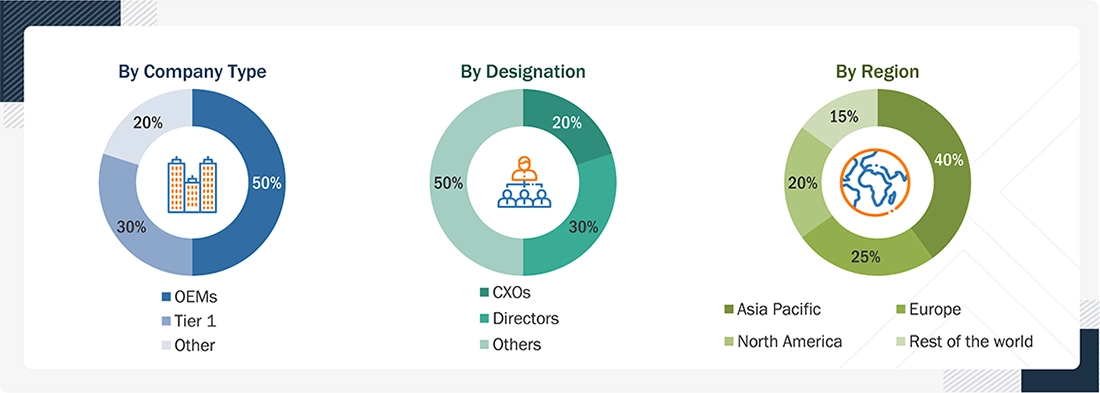
Note: Tier 1 suppliers include automotive system and component suppliers using test equipment for component and system validation.
To know about the assumptions considered for the study, download the pdf brochure
Market Size Estimation
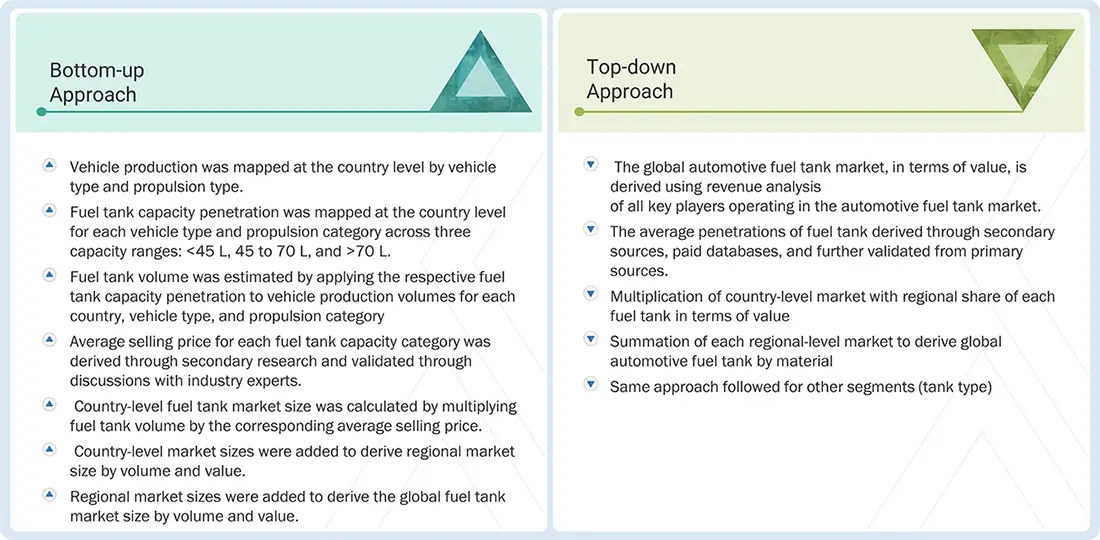
The automotive fuel tank market was estimated and validated using both top-down and bottom-up approaches. In the top-down approach, the global market value was derived through revenue analysis of key fuel tank manufacturers. Average fuel tank penetration was established using secondary sources, paid databases, and primary research. Country-level market values were allocated based on the regional share of fuel tank segments, with regional values aggregated to derive the global market by material type and other segments. In the bottom-up approach, fuel tank-equipped vehicle production units were considered at the country level. Fuel tank penetration was identified through OEM model mapping, vehicle production data, company disclosures, and secondary research across passenger cars, LCVs, and HCVs. Fuel tank-equipped vehicles are segmented by vehicle type, propulsion, and tank capacity. Average fuel tank value per vehicle was determined through primary and secondary research, considering capacity, material, configuration, and vehicle application. Country-level volumes were multiplied by the average tank value to determine market value, which was aggregated to regional and global levels.
Data Triangulation
After arriving at the overall market size using the market size estimation processes as explained above, the market was split into several segments and subsegments. To complete the overall market engineering process and arrive at the exact statistics of each market segment and subsegment, data triangulation and market breakdown procedures were employed, wherever applicable. The data was triangulated by studying various factors and trends from both the demand and supply sides.
Market Definition
Automotive fuel tanks refer to fuel storage systems designed to safely store and supply fuel to internal combustion engines and hybrid vehicles while meeting requirements for safety, emissions, durability, and vehicle packaging. The market encompasses plastic fuel tanks, steel fuel tanks, aluminum fuel tanks, multilayer plastic tanks, pressure-resistant hybrid tanks, CNG tanks, saddle tanks, rectangular tanks, contoured tanks, and other specialized tank designs. These systems support gasoline, diesel, CNG, and hybrid vehicle applications across passenger cars, LCVs, and HCVs. The market also includes integrated fuel tank solutions incorporating fuel delivery, vapor management, venting, sensing, valves, leak detection, and pressure management, while excluding hydrogen storage systems and fuel tanks for two-wheelers.
Key Stakeholders
- Automotive OEMs
- Tier 1 Automotive Fuel System and Component Suppliers
- Automotive Fuel Tank Manufacturers
- Plastic, Steel, and Aluminum Material Suppliers
- Polymer and Barrier Material Manufacturers
- Fuel Pump, Valve, and Fuel Delivery Suppliers
- Vapor Management and EVAP System Suppliers
- Fuel Level, Pressure, and Leak Detection Sensor Suppliers
- CNG Fuel System and Tank Manufacturers
- Automotive Testing, Inspection, and Certification Companies
- Independent Fuel Tank Testing and Validation Service Providers
- Automotive R&D and Engineering Centers
- Automotive Manufacturing and Assembly Plants
- Fuel Tank Tooling and Blow Molding Equipment Suppliers
- Fuel Tank Component and Closure Manufacturers
- Automotive Aftermarket Fuel Tank Suppliers
- Commercial Vehicle and Fleet Operators
- Fuel and CNG Infrastructure Providers
- Government and Automotive Regulatory Authorities
- Automotive Standards and Certification Organizations
- Technical Universities and Research Institutes
- Automotive Engineering and Consulting Firms
- Automotive Quality and Compliance Service Providers
Report Objectives
- To segment and forecast the automotive fuel tank market in terms of value (USD million)
- By vehicle type
- By propulsion
- By Tank Capacity
- SCR Tank By Vehicle Type
- Region (Asia Pacific, Europe, North America, and Rest of the World)
- To segment and forecast the automotive fuel tank market in terms of volume (thousand units)
- By Tank Type
- By Material Type
- By CNG Tank Type
- To analyze regional markets for growth trends, prospects, and their contribution to the overall market
- To define, describe, and forecast the size of the market with respect to growth trends and prospects, and determine the contribution of the segments to the total market
- To provide detailed information regarding the major factors (drivers, challenges, restraints, and opportunities) influencing market growth
- To strategically analyze markets with respect to individual growth trends, prospects, and contribution to the total market
- To analyze opportunities for stakeholders and the competitive landscape for market leaders
- To study the following with respect to the market -
- Supply Chain Analysis
- Ecosystem Analysis
- Pricing Analysis
- Technology Analysis
- HS Code
- Case Study Analysis
- Patent Analysis
- Impact of 2025 India-EU Trade Deal
- Regulatory Landscape
- Key Stakeholders and Buying Criteria
- Key Conferences & Events
- To strategically profile key players and comprehensively analyze their market share and core competencies
- To track and analyze competitive developments such as deals (mergers & acquisitions, partnerships, collaborations), product developments, and other activities carried out by key industry participants
Available customizations:
With the given market data, MarketsandMarkets offers customizations in line with company-specific needs.
- Automotive fuel tank market, by propulsion, at the country level
- Additional country mapping (up to 3 in the report)
Company Information
- Profiling of additional market players (up to 5)
Get the Full Automotive Fuel Tank Market Report
Full forecast, segment splits, and company analysis for all Automotive Fuel Tank Market.
- China Automotive Fuel Tank Market
- Japan Automotive Fuel Tank Market
- India Automotive Fuel Tank Market
- South Korea Automotive Fuel Tank Market
- Thailand Automotive Fuel Tank Market
- Indonesia Automotive Fuel Tank Market
- Germany Automotive Fuel Tank Market
- France Automotive Fuel Tank Market
- Spain Automotive Fuel Tank Market
- UK Automotive Fuel Tank Market
- Russia Automotive Fuel Tank Market
- Canada Automotive Fuel Tank Market
- Mexico Automotive Fuel Tank Market
- US Automotive Fuel Tank Market
- Brazil Automotive Fuel Tank Market
- Iran Automotive Fuel Tank Market
- South Africa Automotive Fuel Tank Market
- Rest Of Europe Automotive Fuel Tank Market
- Rest Of Asia Pacific Automotive Fuel Tank Market
Need a Tailored Report?
Customize this report to your needs
Get 10% FREE Customization
Customize This Report