
Germany Automotive Gears Market (2024-2029)

The Germany Automotive Gears Market was valued at $91859.6 Million in 2024 and projected to reach to $102582.9 Million by 2029, representing a compound annual growth rate of 1.9%. Germany's automotive gears market is poised for steady expansion through 2029, supported by the country's robust manufacturing infrastructure and continued demand from premium vehicle producers.


| Market Size in | USD 26.32 MN |
| Market Forecast in | |
| CAGR | |
| Forecast Period | |
| Units Considered | Value (USD MN) |
Germany Automotive Gears Market Trends and Insights
- Germany maintains a significant position in Europe's automotive sector, driven by its established manufacturing base and engineering expertise in powertrain components.
- The market in Germany reflects steady but moderate expansion, influenced by the country's transition toward electrification and the continued demand for traditional transmission systems in conventional vehicles. The automotive gears sector in Germany is characterized by mature market dynamics and technological advancement.
- Germany's automotive gears market benefits from strong OEM relationships and a robust supply chain ecosystem that supports both legacy combustion engine platforms and emerging electric vehicle architectures.
- Between 2024 and 2029, Germany is expected to experience incremental growth as manufacturers balance production of conventional gearboxes with investment in e-drive and hybrid transmission technologies. Germany's position as a global automotive hub ensures continued relevance of its gears market despite industry headwinds.
- The country's focus on precision engineering and quality standards maintains competitive advantage in the automotive gears sector through 2029..
Key Market Statistics
- CAGR (2024-2029) 1.9% CAGR
- Market Size, 2024 ~USD 91859.6 Million
- Forecast, 2029 ~USD 102582.9 Million
- Country Germany
Germany Automotive Gears Market Overview
Market Valuation :
Germany's automotive gears market reached $91.86 billion in 2024, reflecting the country's dominant position as Europe's largest automotive manufacturing hub with world-class powertrain expertise.
Projected Growth :
The market is forecasted to expand to $102.58 billion by 2029, driven by steady demand from Germany's premium automotive manufacturers and continued investment in transmission technologies.
Growth Rate :
Germany's automotive gears market exhibits a CAGR of 1.9% (2024-2029), reflecting moderate but stable growth compared to the global average of 3%, indicating a mature yet resilient market.
Manufacturing Leadership :
Germany's established engineering base and precision manufacturing capabilities position it as a critical supplier of high-performance gears to global OEMs and tier-1 automotive suppliers.
Germany Automotive Gears Market Dynamics
- The 1.9% CAGR reflects a mature market navigating the transition toward electrification and hybrid powertrains, which require advanced gear technologies.
- Investment in R&D for efficient transmission systems and lightweight components will sustain growth. The market faces headwinds from shifting powertrain architectures, as electric vehicles require fewer traditional gears.
- However, Germany's automotive sector remains committed to hybrid solutions and performance optimization, ensuring sustained demand for specialized gearing systems.
- Strategic partnerships between OEMs and suppliers will drive innovation in next-generation transmission technologies..
Market Ecosystem
Related Ecosystem
Automotive Materials
- Light Commercial Vehicles (LCVs)
- Battery Electric Vehicle (BEV)
- Hybrid Electric Vehicle (HEV)
- Fuel Cell Electric Vehicle (FCEV)
- Agricultural Tractors
- AISIN CORPORATION
- GORKOVSKY AVTOMOBILNY ZAVOD
- Continental ag
- Basf se
- BOSCH LIMITED
Key Takeaways
- Germany's automotive gears market is valued at $91.86 billion in 2024 with projected growth to $102.58 billion by 2029.
- Germany's market growth rate of 1.9% CAGR reflects mature market dynamics and the transition to electric vehicle powertrains.
- Germany's established OEM relationships and supply chain infrastructure support both conventional and emerging transmission technologies.
- Germany maintains competitive advantage through precision engineering and quality standards in the automotive gears sector.
Automotive Gears Market Report Scope
| Report Metric | Details |
|---|---|
| Base Year | 2024 |
| Fastest Growing Segment | WORM GEARS (Gear Type) |
| Forecast Period | 2024-2029 |
| Growth Rate | CAGR of 3% from 2024 to 2029 |
| Largest Segment | METALLIC GEARS (Material Type) |
| Market Size Base Year (Billions) | ~USD 42.54 (2024) |
| Revenue Forecast (Billions) | ~USD 49.32 (2029) |
| Segments Covered | Gear Type, Application, Material Type, Vehicle Type, Transmission Type |
Germany Automotive Gears Market Report Segmentation
5 segment dimensions are covered across the global market.
By Gear Type
- Bevel Gears
- Helical Gears
- Hypoid Gears
- Non-Metallic Gears
- Pinion Gears
- Planetary Gears
- Rack & Pinion Gears
- Rack And Pinion Gears
- Spur Gears
- Worm Gears
By Application
- Differential
- Other Applications
- Steering
- Transmission
By Material Type
- Metallic Gears
- Non-Metallic Gears
By Vehicle Type
- Heavy Commercial Vehicles
- Light Commercial Vehicles
- Passenger Cars
By Transmission Type
- Automated Manual Transmission
- Automatic Transmission
- Dual-Clutch Transmission
- Manual Transmission
Target Audience
- Automotive OEMs : German and international vehicle manufacturers need detailed market intelligence on gears demand, supply chain dynamics, and technology trends to optimize powertrain sourcing and production planning in Germany.
- Tier-1 & Tier-2 Suppliers : Automotive component suppliers require Germany-specific market data to identify growth opportunities, benchmark against competitors, and align product development with OEM requirements in Europe's largest automotive market.
- Investment & Private Equity Firms : Investors evaluating automotive sector opportunities need precise Germany market valuations, growth forecasts, and competitive landscape analysis to assess acquisition targets and portfolio company performance.
- Market Researchers & Consultants : Research professionals and strategy consultants require authoritative Germany market data to support client advisory work, competitive analysis, and strategic planning in the automotive gears sector.
- Government & Trade Organizations : German economic development agencies and industry associations need market intelligence to support policy decisions, export promotion, and strategic initiatives for the automotive manufacturing sector.
Reasons to Buy this Report
- Market Size & Valuation Data : Access precise market sizing for Germany's $91.86B automotive gears sector with detailed 2024-2029 forecasts, enabling accurate investment planning and competitive benchmarking in Europe's largest automotive economy.
- Regional Growth Insights : Understand Germany-specific growth drivers and market dynamics with 1.9% CAGR analysis, distinguishing between premium OEM demand, tier-1 supplier trends, and emerging electrification impacts unique to the German market.
- Competitive Positioning : Identify market opportunities and competitive gaps specific to Germany's automotive ecosystem, including supplier concentration, manufacturing capabilities, and technology leadership in precision gear manufacturing.
- Strategic Decision Support : Make informed decisions on market entry, expansion, or partnership strategies in Germany with country-specific data on market maturity, growth trajectories, and sector-specific challenges in powertrain technology.
- Trend & Forecast Accuracy : Leverage Germany-focused forecasts through 2029 to anticipate market shifts driven by hybrid vehicle adoption, transmission efficiency demands, and German OEM innovation strategies in the evolving automotive landscape.
Frequently asked questions
What is the current size of Germany's automotive gears market?
Germany's automotive gears market was valued at $91.86 billion in 2024 according to verified market data.
What is the projected market size for Germany's automotive gears by 2029?
Germany's automotive gears market is forecast to reach $102.58 billion by 2029, representing growth from the 2024 baseline.
What is the CAGR for Germany's automotive gears market?
Germany's automotive gears market is expected to grow at a compound annual growth rate of 1.9% between 2024 and 2029.
Why is Germany's automotive gears market growth rate lower than global averages?
Germany's 1.9% CAGR reflects a mature automotive market with established production capacity and the industry's gradual transition toward electric vehicle architectures.
What factors influence Germany's automotive gears market dynamics?
Germany's market is influenced by OEM demand, electrification trends, supply chain strength, precision manufacturing capabilities, and the balance between conventional and hybrid transmission production.
RESEARCH METHODOLOGY
The study encompassed four primary tasks to determine the present scope of the automotive gears market. Initially, extensive secondary research was conducted to gather data on the market, its related sectors, and overarching industries. Subsequently, these findings and assumptions were corroborated and validated through primary research involving industry experts across the value chain. Employing both bottom-up and top-down methodologies, the complete market size was estimated. Following this, a market breakdown and data triangulation approach were utilized to determine the size of specific segments and subsegments within the market.
Secondary Research
The secondary sources referred to for the study of the automotive gears market are directly dependent on end-use industry growth. Market sales and end-use industry demand are derived through secondary sources such as the International Organization of Motor Vehicle Manufacturers (OICA), European Automobile Manufacturers Association (ACEA), International Council on Clean Transportation (ICCT), Automotive Component Manufacturers Association of India (ACMA), Japan Automobiles Manufacturers Association (JAMA), corporate filings such as annual reports, investor presentations, and financial statements, and paid repository. Historical production data has been collected and analyzed, and the industry trend is considered to arrive at the forecast, further validated by primary research.
Primary Research
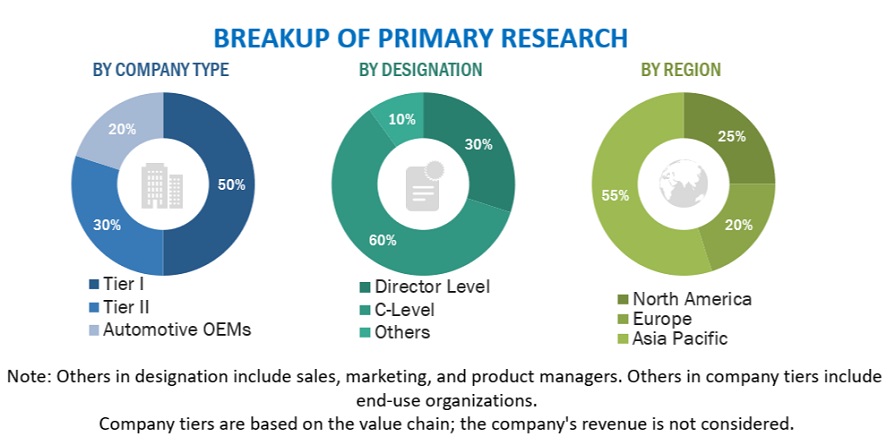
In the primary research process, various primary sources from both the supply and demand sides were interviewed to obtain qualitative and quantitative information on the market. The primary sources from the supply side included various industry experts, such as CXOs, vice presidents, directors from business development, marketing, product development/innovation teams, and related key executives from various key companies. Various system integrators, industry associations, independent consultants/industry veterans, and key opinion leaders were also interviewed.
Primary interviews have been conducted to gather insights such as automotive gears market sizing estimation and forecast, future technology trends, and upcoming technologies in the market. Data triangulation of all these points was done using the information gathered from secondary research and model mapping. Stakeholders from the demand and supply sides have been interviewed to understand their views on the aforementioned points.
Primary interviews have been conducted with market experts from the demand-side (end-use industries) and supply-side (automotive gears providers) across four regions: North America, Europe, Asia Pacific, and the Rest of the World. Approximately 50% and 50% of the primary interviews were conducted on the OEMs and component manufacturer sides. Primary data has been collected through questionnaires, emails, and telephonic interviews. After communicating with primaries, we have strived to cover various departments within organizations, such as sales and operations, to provide a holistic viewpoint in our report. After interacting with industry experts, we have also conducted brief sessions with highly experienced independent consultants to reinforce the findings from our primaries. This and the in-house subject matter experts’ opinions have led us to the conclusions described in the remainder of this report.
To know about the assumptions considered for the study, download the pdf brochure
Market Size Estimation
As mentioned below, a detailed market estimation approach was followed to estimate and validate the value of the automotive gears market and other dependent submarkets.
- Key players in the automotive gears market were identified through secondary research, and their global market ranking was determined through primary and secondary research.
- The research methodology included a study of annual and quarterly financial reports, regulatory filings of major market players (public), and interviews with industry experts for detailed market insights.
- All vehicle level penetration rates, percentage shares, splits, and breakdowns for the market were determined using secondary sources and verified through primary sources.
- All key macro indicators affecting the revenue growth of the market segments and subsegments were accounted for, viewed in extensive detail, verified through primary research, and analyzed to obtain validated and verified quantitative and qualitative data.
- The gathered market data was consolidated, enhanced with detailed inputs, analyzed, and presented in this report.
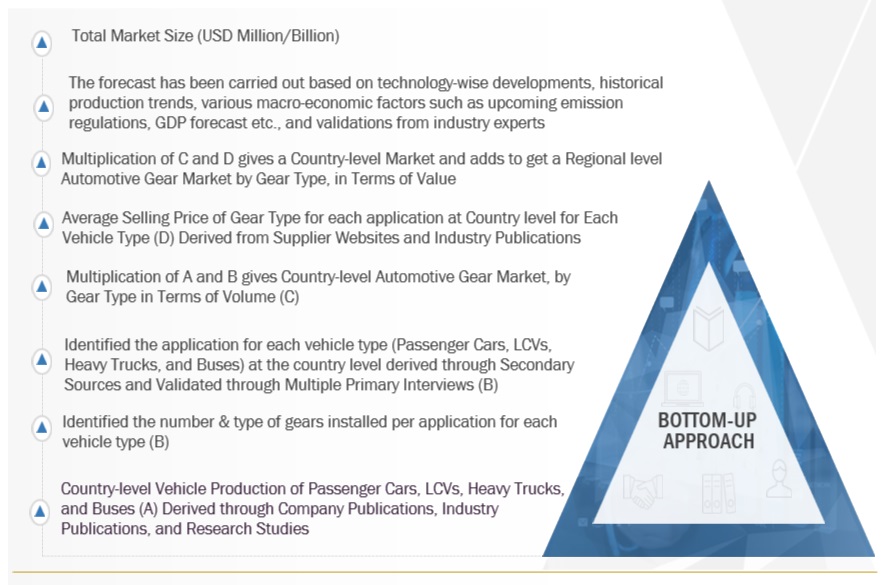
Global Automotive Gears Market Size: Bottom-Up Approach By Vehicle Type and Country
To know about the assumptions considered for the study, Request for Free Sample Report
Data Triangulation
All percentage shares, splits, and breakdowns have been determined using secondary sources and verified by primary sources. All parameters that affect the markets covered in this research study have been accounted for, viewed in extensive detail, and analyzed to obtain the final quantitative and qualitative data. This data has been consolidated and enhanced with detailed inputs and analysis from MarketsandMarkets and presented in the report.
Market Definition
Automotive Gear: A gear is a roller-shaped component with teeth along its outer edge, used in machines to transfer speed and torque between vehicle shafts. Gears enable different torque and speed ratios and can change the direction of the driven or driving shaft—the teeth on the gear wheel interlock to facilitate the transfer of speed and torque. Automotive Gears are mainly used in automotive transmissions, differentials, steering systems, and other applications.
Key Stakeholders
- Senior Management
- End User Finance/Procurement Department
- R&D Department
Report Objectives
-
To define, describe, and forecast the size of the automotive gears market in terms of value (USD million) and volume (thousand units) between 2024 and 2030 based on the following segments:
- By Application (Transmission System, Differential System, Steering System, and Other Automotive Applications)
- By Vehicle Type (Passenger Cars, Light Commercial Vehicles, and Heavy Commercial vehicles)
- By Material Type (Metallic and Non-metallic)
- By Gear Type (Planetary gears, Bevel gears, Rack and Pinion gears, Hypoid gears, Worm gears, Helical gears, Spur gears, Pinion gears and Non-metallic gears)
- Hybrid Vehicle gear market by application (Transmission System, Differential System, Steering System, and Other Automotive Applications)
- Transmission gear market by transmission type (Automatic transmission, Automated manual transmission, Manual transmission, and Dual clutch transmission)
- Differential Gears market by Gear type (Bevel gears, Pinion gears, Hypoid gears, Helical gears, Worm gears and Spur gears)
- By Region (Asia Pacific, Europe, North America, and Rest of the World)
- To identify and analyze key drivers, restraints, opportunities, and challenges influencing the market
- To analyze the market share of leading players in the automotive gears market and evaluate competitive leadership mapping.
- To strategically analyze key player strategies and company revenue analysis
-
To study the following with respect to the market
- Trends and Disruptions Impacting Customers’ Businesses
- Market Ecosystem
- Technology Analysis
- Supply Chain Analysis
- Patent Analysis
- Regulatory Landscape
- Case Study Analysis
- Key Stakeholders and Buying Criteria
- Key Conferences and Events
- Trade Analysis
- Investment and Funding Scenario
- Pricing Analysisn
- To analyze recent developments, including product launches, partnerships, acquisitions, expansions, and other developments undertaken by key industry participants in the market
- To give a brief understanding of the automotive gears market in the recommendations chapter
AVAILABLE CUSTOMIZATIONS
With the given market data, MarketsandMarkets offers customizations in accordance with the company’s specific needs.
TRANSMISSION GEARS MARKET, BY TRANSMISSION TYPE AND COUNTRY
- Automatic Transmission
- Automated Manual Transmission
- Manual Transmission
- Dual Clutch Transmission
Note: The transmission type market can be provided for each vehicle type in terms of volume and value at the country level.
DIFFERENTIAL GEARS MARKET BY GEAR TYPE AND COUNTRY
- Bevel Gears
- Spur Gears
- Worm Gears
- Hypoid Gears
- Helical Gears
- Pinion gears
Note: The market for each differential gear type can be provided for each mentioned vehicle type in terms of volume and value at the country level.
TRANSMISSION GEARS MARKET BY GEAR TYPE
- Planetary Gears
- Spur Gears
- Helical Gears
Get the Full Automotive Gears Market Report
Full forecast, segment splits, and company analysis for all Automotive Gears Market.
- China Automotive Gears Market
- India Automotive Gears Market
- Japan Automotive Gears Market
- South Korea Automotive Gears Market
- France Automotive Gears Market
- UK Automotive Gears Market
- Spain Automotive Gears Market
- Italy Automotive Gears Market
- Mexico Automotive Gears Market
- Canada Automotive Gears Market
- US Automotive Gears Market
- Brazil Automotive Gears Market
- South Africa Automotive Gears Market
- Rest Of Asia Pacific Automotive Gears Market
- Other Countries In Row Automotive Gears Market
Need a Tailored Report?
Customize this report to your needs
Get 10% FREE Customization
Customize This Report
