
Mexico Automotive HUD Market (2026-2031)

The Mexico Automotive HUD Market was valued at $228 Million in 2026 and projected to reach to $861 Million by 2031, representing a compound annual growth rate of 20.9%. Mexico's automotive HUD market is poised for transformative growth through 2031, driven by the convergence of vehicle electrification, ADAS integration, and rising consumer demand for premium safety features.


| Market Size in | USD 26.32 MN |
| Market Forecast in | |
| CAGR | |
| Forecast Period | |
| Units Considered | Value (USD MN) |
Mexico Automotive HUD Market Trends and Insights
- This represents a compound annual growth rate of 20.9%, significantly outpacing global market trends.
- Mexico's rapid adoption of advanced driver-assistance systems and increasing vehicle electrification are driving demand for HUD technology across both domestic and export-oriented automotive manufacturing sectors. The Mexican automotive industry's integration of HUD systems reflects broader regional trends toward vehicle digitalization and enhanced driver safety features.
- Mexico's position as a major automotive manufacturing hub in North America positions the country as a critical market for HUD innovation and deployment.
- By 2031, Mexico is expected to capture substantial market share as OEMs and suppliers invest in next-generation display technologies to meet consumer expectations and regulatory requirements..
Key Market Statistics
- CAGR (2026-2031) 20.9% CAGR
- Market Size, 2026 ~USD 228 Million
- Forecast, 2031 ~USD 861 Million
- Country Mexico
Mexico Automotive HUD Market Overview
Exceptional Growth Trajectory :
Mexico's automotive HUD market is expanding at 20.9% CAGR, nearly double the global rate of 10.1%, reflecting strong regional demand and accelerating technology adoption among Mexican automotive manufacturers and consumers.
Rapid Market Expansion :
The market is projected to grow from $228.0 million in 2026 to $861.0 million by 2031, representing a 277% increase over five years and positioning Mexico as a high-growth automotive technology hub in Latin America.
Vehicle Electrification Driver :
Increasing vehicle electrification in Mexico is accelerating HUD adoption, as electric vehicles integrate advanced driver-assistance systems and premium infotainment features that rely on head-up display technology.
ADAS Integration Momentum :
Mexican automotive manufacturers are rapidly adopting advanced driver-assistance systems, creating substantial demand for HUD solutions that enhance safety, navigation, and real-time vehicle information display.
Mexico Automotive HUD Market Dynamics
- Major automotive manufacturers operating in Mexico are increasingly incorporating HUD technology into new vehicle platforms, while local suppliers are developing competitive solutions to capture market share.
- Government incentives for electric vehicle adoption and manufacturing expansion further accelerate this trend. The market's 20.9% CAGR significantly outpaces global benchmarks, positioning Mexico as a critical growth market for HUD technology providers.
- Investment in manufacturing infrastructure, partnerships with OEMs, and localized product development will be essential for capturing opportunities in this rapidly expanding segment through 2031..
Market Ecosystem

AUTOMOTIVE HUD MARKET SIZE, SHARE & ANALYSIS: COMMERCIAL USE CASES ACROSS INDUSTRIES
| COMPANY | USE CASE DESCRIPTION | BENEFITS |
|---|---|---|
 |
Integration of HUD systems with vehicle electronics for real-time information projection | Enhances driver awareness and reduces distraction through critical data display |
 |
Development of advanced HUD solutions integrated with vehicle data systems | Enables seamless access to navigation and safety information for improved driving efficiency |
 |
Deployment of windshield HUD systems in passenger vehicles | Provides clear visualization of driving data, improving safety and user experience |
 |
Development of AR-based HUD integrated with digital cockpit platforms | Enhances navigation and real-time visualization through augmented reality features |
 |
Integration of next-generation HUDs with connected vehicle ecosystems | Improves user interaction with contextual and real-time driving information |
Logos and trademarks shown above are the property of their respective owners. Their use here is for informational and illustrative purposes only.
Related Ecosystem
Automotive Advance Technologies
- Battery Electric Vehicle (BEV)
- Light Commercial Vehicles (LCVs)
- Fuel Cell Electric Vehicle (FCEV)
- Hybrid Electric Vehicle (HEV)
- Internal Combustion Engine (ICE)
- BOSCH LIMITED
- Continental ag
- Visteon Corporation
- DENSO Corporation
- ZF FRIEDRICHSHAFEN AG
Automotive Electronics And Electrical Equipment
- Battery Electric Vehicle (BEV)
- Light Commercial Vehicles (LCVs)
- Fuel Cell Electric Vehicle (FCEV)
- Sensors
- Hybrid Electric Vehicle (HEV)
- BOSCH LIMITED
- Continental ag
- DENSO Corporation
- Texas Instruments Incorporated
- Panasonic Holdings Corporation
Key Takeaways
- Mexico's HUD market will grow from $228.0M (2026) to $861.0M (2031), a 20.9% CAGR.
- Mexico's automotive manufacturing dominance drives accelerated HUD adoption across vehicle segments.
- Mexico's integration of ADAS and electrification technologies fuels demand for advanced display solutions.
- Mexico's strategic position in North America makes it a critical hub for HUD technology deployment and innovation.
Automotive HUD Market Report Scope
| Report Metric | Details |
|---|---|
| Base Year | 2026 |
| Fastest Growing Segment | ECONOMY CAR (Vehicle Class) |
| Forecast Period | 2026–2031 |
| Growth Rate | CAGR of 10.1% from 2026 to 2031 |
| Largest Segment | SEMI-AUTONOMOUS CAR (Level Of Autonomy) |
| Market Size Base Year (Billions) | ~USD 2.4 (2026) |
| Revenue Forecast (Billions) | ~USD 3.89 (2031) |
| Segments Covered | Combiner Hud Display Size, Ev Type, Technology, Hud Type, Level Of Autonomy, Offering, Propulsion Type, Sales Channel, Vehicle Class, Vehicle Type |
Mexico Automotive HUD Market Report Segmentation
10 segment dimensions are covered across the global market.
By Combiner Hud Display Size
- < 6 Inches
- > 6 Inches
By Ev Type
- Bev
- Phev
By Technology
- 2D Hud
- 3D Hud
- Ar Hud
By Hud Type
- Combiner Hud
- Windshield Hud
By Level Of Autonomy
- Autonomous Car
- Non-Autonomous Car
- Semi-Autonomous Car
By Offering
- Hardware
- Software
By Propulsion Type
- Electric Vehicle
- ICE Vehicle
By Sales Channel
- Aftermarket
- Oe
By Vehicle Class
- Economy Car
- Luxury Car
- Mid-Segment Car
By Vehicle Type
- Commercial Vehicle
- Passenger Car
Target Audience
- Automotive OEMs : Mexican and international vehicle manufacturers need market intelligence to integrate HUD technology into new platforms, optimize supply chain partnerships, and capitalize on the 20.9% growth opportunity.
- HUD Technology Suppliers : Display manufacturers and HUD system providers require Mexico-specific demand forecasts and competitive landscape data to guide product development, manufacturing expansion, and go-to-market strategies.
- Automotive Investors : Private equity firms, venture capital, and institutional investors need quantified growth projections and market dynamics to evaluate investment opportunities in Mexico's high-growth automotive technology sector.
- Component & Parts Suppliers : Tier-1 and Tier-2 suppliers of optical, electronic, and mechanical components need Mexico market data to forecast demand, plan capacity expansion, and secure long-term OEM contracts.
- Market Consultants & Analysts : Business strategists and research firms require detailed Mexico cutout data to support client advisory services, competitive benchmarking, and strategic planning in the automotive technology space.
Key Companies in the Mexico Automotive HUD Market
| Company | HQ | Ownership | Strongest segments |
|---|---|---|---|
| JABIL | United States | Public Company | Windshield HUD electronics and sub-assemblies,Combiner HUD electronics and legacy platforms,AR HUD and 3D/VR-related HUD subsystems, |
| INNOLUX CORP | Taiwan | Public Company | Windshield HUD display/optical engines,Combiner HUD display modules,AR/3D-capable HUD panels and optics, |
| KYOCERA CORPORATION | Japan | Public Company | Windshield HUD components (optics, displays, packages),Combiner HUD components,AR HUD / 3D-capable optics and modules, |
| ALPS ELECTRIC | Japan | Public Company | Windshield HUD,Combiner HUD,2D HUD Technology, |
| CALSONIC KANSEI | Japan | Private Company | Windshield HUD,Combiner HUD,2D HUD Technology, |
| DELPHI AUTOMOTIVE | Ireland | Public Company | Windshield HUD,Combiner HUD,2D HUD Technology, |
| LATTICE SEMICONDUCTOR | United States | Public Company | Windshield HUD – AR-capable (Nexus/Avant-based),Windshield HUD – 2D/3D non-AR,Combiner HUD – entry and mid, |
| SRG GLOBAL | Australia | Public Company | Maintenance and Industrial Services,Engineering and Construction,Digital and AI Solutions (Orbix, HAIstack, drones, AI modeling), |
| AT&S | Austria | Public Company | Windshield HUD manufacturing automation and test lines,AR and 3D HUD advanced assembly, calibration, and digital factory solutions,Combiner HUD and legacy 2D HUD automation, |
| TOYODA GOSEI CO., LTD | Japan | Public Company | Windshield HUD components,Combiner HUD components,AR/3D-capable optical and structural parts, |
| ALTRAN | France | Private Company | Windshield HUD engineering and integration,Combiner HUD and cost-optimized platforms,AR HUD and 3D/HMI software, |
| NITTO DENKO CORPORATION | Japan | Public Company | Windshield HUD optical and adhesive materials,Combiner HUD films and tapes,AR HUD–grade advanced optical layers, |
| NIPPON SEIKI CO., LTD. | Japan | Public Company | Windshield HUD,Combiner HUD,2D HUD Technology, |
| AUMOVIO SE | Germany | Public Company | Windshield HUD hardware and integration,Combiner HUD and retrofit solutions,AR/3D HUD software and HMI platforms, |
| DENSO CORPORATION | Japan | Public Company | Windshield HUD,Combiner HUD,2D HUD Technology, |
| ROBERT BOSCH GMBH | Germany | Private Company | Windshield HUD,Combiner HUD,2D Conventional HUD, |
| FORYOU CORPORATION | China | Public Company | Windshield HUD,Combiner HUD,AR / 3D HUD, |
| VISTEON CORPORATION | United States | Public Company | Windshield HUD,Combiner HUD,HUD-related Software & Middleware (SmartCore Runtime, UX, AR/AI), |
| HYUNDAI MOBIS | South Korea | Public Company | Windshield HUD – 2D,Windshield HUD – AR-capable,Combiner HUD, |
| LG ELECTRONICS | South Korea | Public Company | Windshield HUD,Combiner HUD,2D HUD Technology, |
| HARMAN INTERNATIONAL | United States | Private Company | Windshield HUD,Combiner HUD,2D HUD Technology, |
JABIL
Jabil is a United States-based public company founded in 1966 that employs 135,000 people. The company operates as a global manufacturing and supply chain solutions provider.
INNOLUX CORP
Innolux Corp is a Taiwan-based public company founded in 2003 with 44,813 employees. The company is a major manufacturer of display panels and related technologies.
KYOCERA CORPORATION
Kyocera Corporation is a Japanese public company founded in 1946 that employs 73,856 people. The company manufactures ceramics, electronics, and related industrial products.
ALPS ELECTRIC
Alps Electric is a Japanese public company founded in 1948 with 25,924 employees. The company manufactures electronic components and automotive parts.
CALSONIC KANSEI
Calsonic Kansei is a Japanese private company founded in 1938 with 21,987 employees. The company specializes in automotive parts and thermal management systems.
DELPHI AUTOMOTIVE
Delphi Automotive is an Ireland-based public company founded in 2011 that employs 140,000 people. The company is a global supplier of automotive parts and technologies.
LATTICE SEMICONDUCTOR
Lattice Semiconductor is a United States-based public company founded in 1983 with 1,174 employees. The company designs and manufactures semiconductor products.
SRG GLOBAL
SRG Global is an Australia-based public company founded in 1961. The company provides manufacturing and engineering services.
AT&S
AT&S is an Austria-based public company founded in 1978 with 7,000 employees. The company manufactures printed circuit boards and related technologies.
TOYODA GOSEI CO., LTD
Toyoda Gosei Co., Ltd. is a Japanese public company founded in 1949 with 41,304 employees. The company manufactures automotive parts and plastic products.
ALTRAN
Altran is a France-based private company founded in 1970 with 50,124 employees. The company provides engineering and consulting services.
NITTO DENKO CORPORATION
Nitto Denko Corporation is a Japanese public company founded in 1918 with 26,477 employees. The company manufactures industrial materials, films, and adhesive products.
NIPPON SEIKI CO., LTD.
Nippon Seiki Co., Ltd. is a Japanese public company founded in 1946 with 13,246 employees. The company manufactures automotive instruments and electronic components.
AUMOVIO SE
Aumovio SE is a Germany-based public company founded in 2024 with 31,054 employees.
DENSO CORPORATION
Denso Corporation is a Japanese public company founded in 1949 that employs 154,716 people. The company is a major global supplier of automotive components and systems.
ROBERT BOSCH GMBH
Robert Bosch GmbH is a Germany-based private company founded in 1886 that employs 412,774 people. The company is a global supplier of automotive, industrial, and consumer products.
FORYOU CORPORATION
Foryou Corporation is a China-based public company founded in 1993 with 9,481 employees. The company manufactures automotive electronics and related components.
VISTEON CORPORATION
Visteon Corporation is a United States-based public company founded in 2000 with 10,500 employees. The company supplies automotive electronics and connected car solutions.
HYUNDAI MOBIS
Hyundai Mobis is a South Korea-based public company founded in 1977. The company is a major supplier of automotive parts and components.
LG ELECTRONICS
LG Electronics is a South Korea-based public company founded in 1958 with 34,884 employees. The company manufactures consumer electronics and related products.
HARMAN INTERNATIONAL
Harman International is a United States-based private company founded in 1980 with 26,000 employees. The company manufactures audio, infotainment, and connected car technologies.
Reasons to Buy this Report
- Market Entry Strategy : Comprehensive Mexico-specific data enables manufacturers and suppliers to develop targeted market entry strategies, identify key OEM partnerships, and allocate resources effectively in this high-growth automotive segment.
- Competitive Positioning : Detailed insights into Mexico's 20.9% CAGR and market dynamics help competitors benchmark performance, identify gaps in the supply chain, and develop differentiated HUD solutions for Mexican manufacturers.
- Investment Decision Support : Investors and stakeholders gain quantified growth projections ($228M to $861M) and regional drivers to evaluate capital allocation opportunities, facility expansion, and partnership development in Mexico's automotive sector.
- Supply Chain Optimization : Component suppliers and logistics providers can optimize distribution networks and production capacity planning based on Mexico-specific demand forecasts and electrification trends through 2031.
- Technology Roadmap Planning : OEMs and technology developers can align product development roadmaps with Mexico's ADAS adoption rates and electrification momentum, ensuring solutions meet regional market requirements and regulatory standards.
Frequently asked questions
What is the current size of Mexico's automotive HUD market?
Mexico's automotive HUD market is valued at $228.0 million in 2026 and is projected to reach $861.0 million by 2031.
What is the growth rate of Mexico's HUD market?
Mexico's automotive HUD market is growing at a compound annual growth rate (CAGR) of 20.9% from 2026 to 2031.
Why is Mexico's HUD market growing faster than the global average?
Mexico's HUD market growth is driven by its position as a major automotive manufacturing hub, increasing adoption of ADAS technologies, vehicle electrification trends, and rising consumer demand for advanced safety features.
Which vehicle segments are driving HUD adoption in Mexico?
Both domestic and export-oriented vehicle segments in Mexico are adopting HUD technology, with particular emphasis on premium and mid-range vehicles incorporating advanced driver-assistance systems.
What factors will influence Mexico's HUD market through 2031?
Key factors include regulatory requirements for vehicle safety, OEM investment in digitalization, supply chain integration with North American manufacturers, and consumer preferences for enhanced in-vehicle display technologies.
RESEARCH METHODOLOGY
The study involved four major activities in estimating the current size of the automotive HUD market. Exhaustive secondary research was done to collect information on the market, the peer market, and the parent market. The next step was to validate these findings, assumptions, and sizing with the industry experts across value chains through primary research. The top-down approach was employed to estimate the complete market size. Thereafter, market breakdown and data triangulation processes were used to estimate the market size of segments and subsegments.
Secondary Research
Secondary sources referred to for this research study included automotive HUD industry organizations; corporate filings such as annual reports, investor presentations, and financial statements; trade and business whitepapers and databases; and articles from recognized associations and government publishing sources. The secondary data was collected and analyzed to arrive at the overall market size, which was further validated by primary research.
Primary Research
Extensive primary research was conducted after acquiring an understanding of this market scenario through secondary research. Several primary interviews were conducted with market experts from the demand- and supply-side OEMs (in terms of component supply, country-level government associations and trade associations) and component manufacturers across four major regions: Asia Pacific, Europe and North America. Approximately 60% and 40% of primary interviews were conducted from the demand and supply sides, respectively. Primary data was collected through questionnaires, emails, LinkedIn, and telephonic interviews. In the canvassing of primaries, we have strived to cover various departments within organizations to provide a holistic viewpoint in our report. Some of these departments are sales, operations, and administration.
Brief sessions with highly experienced independent consultants were conducted to reinforce findings from primaries after interacting with industry experts. This, along with the in-house subject matter experts’ opinions, led to the findings, as described in the remainder of this report.
In the primary research process, various primary sources from the supply and demand sides were interviewed to obtain qualitative and quantitative information for the report. The primary sources from the supply side included industry experts, such as Vice Presidents (VPs), marketing directors, technology and innovation directors, and related key executives from various key companies and organizations. The primary sources from the demand side included end users, such as Chief Information Officers (CIOs), consultants, service professionals, technicians, technologists, and managers at public and investor-owned utilities.
Breakdown of Primaries:
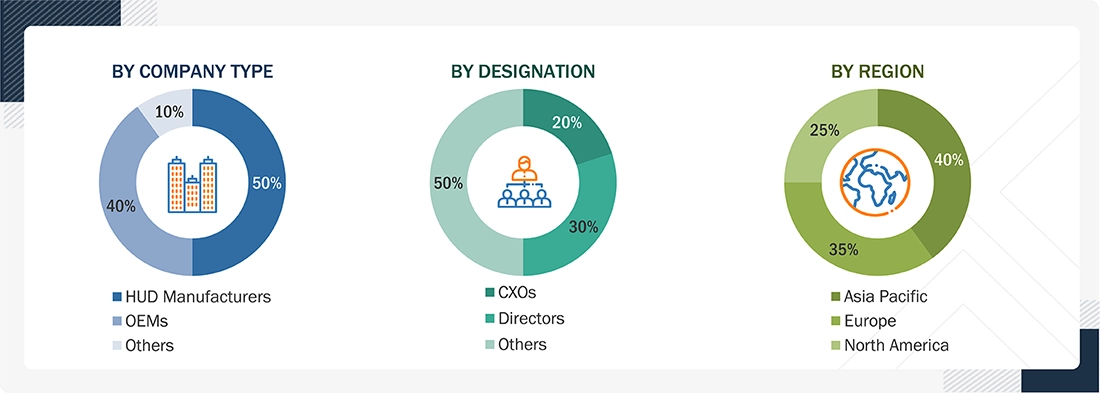
Note: Others include Purchase and Sales Managers, Marketing Managers, and Product Managers.
To know about the assumptions considered for the study, download the pdf brochure
Market Size Estimation
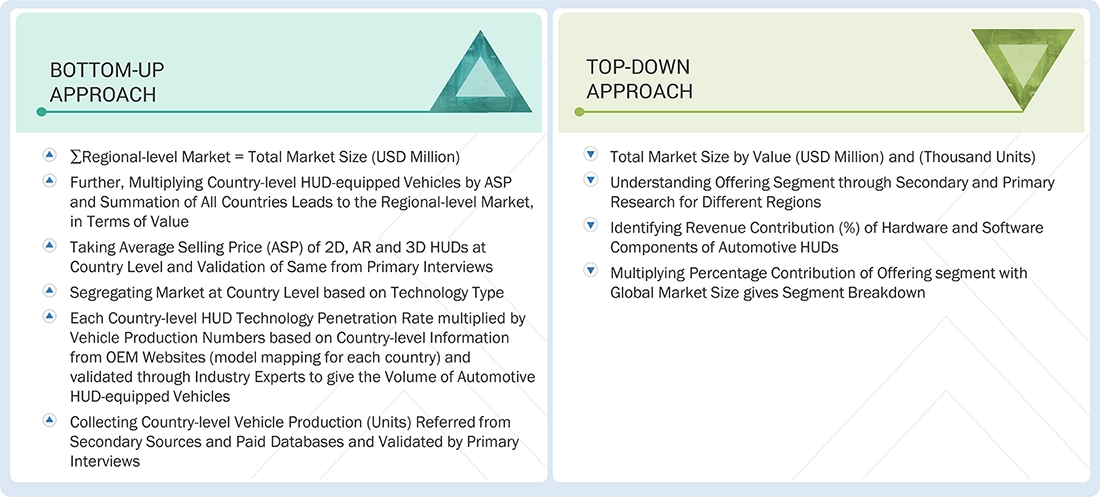
The automotive HUD OE market was estimated using a bottom-up methodology, where country-level model mapping was done to determine HUD penetration across vehicle segments, followed by assessment of vehicle production for passenger cars and commercial vehicles at the country level. The HUD penetration rate was applied to vehicle production to derive OE HUD volume, after which average selling prices were determined for each technology category at the country level. The calculated volume was multiplied by the corresponding average selling price to arrive at country-level market value, which was then aggregated to derive regional market size, and further consolidated to estimate the global market volume and value.
The automotive HUD aftermarket was estimated using a top-down approach, where company revenue analysis was conducted to derive the global aftermarket revenue, which was then distributed across regions based on company-level revenue share. Market size breakdown was then validated through discussion with industry participants. A similar methodology was applied to further segment the market by technology and vehicle class, ensuring consistent estimation across all categories.
Automotive HUD Market : Top-Down and Bottom-Up Approach
Data Triangulation
After arriving at the overall market size using the market size estimation processes as explained above, the market was split into several segments and subsegments. To complete the overall market engineering process and arrive at the exact statistics of each market segment and subsegment, data triangulation and market breakdown procedures were employed, wherever applicable. The data was triangulated by studying various factors and trends from the demand and supply sides.
Market Definition
As per Continental AG (Germany), an automotive HUD is an automotive component that shows vehicle information, such as speed, warning signals, and indicator arrows, for navigation without looking down at the instrument cluster or the secondary display.
Report Objectives
- To analyze and forecast the automotive HUD market in terms of value (USD million) & volume (thousand units) from 2022 to 2033
- To segment and forecast the market, by value & volume, based on region (Asia Pacific, Europe, North America)
- To segment and forecast the market, by value & volume, based on HUD type (windshield HUD, combiner HUD)
- To segment and forecast the market, by value & volume, based on technology (2D HUD, AR HUD, 3D HUD)
- To segment and forecast the market, by value & volume, based on vehicle class (mid-segment car, luxury car, and economy car)
- To segment and forecast the market, by value & volume, based on vehicle type (passenger car, commercial vehicle)
- To segment and forecast the market, by value & volume, based on the level of autonomy (non-autonomous car, semi-autonomous car, autonomous car)
- To segment and forecast the market, by value & volume, based on propulsion type (ICE vehicle, electric vehicle)
- To segment and forecast the market, by value & volume, based on electric vehicle type [battery electric vehicles (BEVs), and plug-in hybrid electric vehicles (PHEVs)]
- To segment the market, by value, based on offering (hardware, software)
- To segment the market by value, based on sales channel (OE, Aftermarket)To segment the market by value, based on combiner HUD display size (< 6 Inch, > 6 Inch)
- To provide detailed information about the factors influencing the market growth (drivers, challenges, restraints, and opportunities)To strategically analyze the market with respect to individual growth trends, prospects, and contributions to the total market
-
To study the following with respect to the market
- Supply Chain Analysis
- Ecosystem Analysis
- Technology Analysis
- Case Study Analysis
- Patent Analysis
- Tariff and Regulatory Landscape
- Average Selling Price Analysis
- Buying Criteria
- Supplier Analysis
- OEM Analysis by Vehicle Model
- Bill of Materials (BOM) and cost structure
- Future Applications
- Impact of AI
- HUD Provider Product Comparison
- To strategically profile the key players and comprehensively analyze their market share and core competencies
- To analyze the opportunities for stakeholders and the competitive landscape for market leaders
- To track and analyze competitive developments such as deals, product launches/developments, expansions, and other activities undertaken by the key industry participants
Available customizations:
With the given market data, MarketsandMarkets offers customizations in line with company-specific needs.
- Automotive HUD Market, by Technology (EV Type), at the regional level (For regions covered in the report)
- Automotive HUD Market, by Level of Autonomy Type, at the country level (For the countries not covered in the report)
Company Information
- Profiling of Additional Market Players (Up to 5)
Get the Full Automotive HUD Market Report
Full forecast, segment splits, and company analysis for all Automotive HUD Market.
- Canada Automotive HUD Market
- US Automotive HUD Market
- France Automotive HUD Market
- Germany Automotive HUD Market
- Italy Automotive HUD Market
- Spain Automotive HUD Market
- UK Automotive HUD Market
- China Automotive HUD Market
- India Automotive HUD Market
- Japan Automotive HUD Market
- South Korea Automotive HUD Market
Need a Tailored Report?
Customize this report to your needs
Get 10% FREE Customization
Customize This Report
