
Brazil Automotive Pump Market (2024-2029)

The Brazil Automotive Pump Market was valued at $1147.5 Million in 2024 and projected to reach to $1239.7 Million by 2029, representing a compound annual growth rate of CAGR 3.9%. Brazil's automotive pump market is positioned for moderate but consistent growth, driven by the country's established manufacturing infrastructure and its role as a regional automotive hub.


| Market Size in | USD 26.32 MN |
| Market Forecast in | |
| CAGR | |
| Forecast Period | |
| Units Considered | Value (USD MN) |
Brazil Automotive Pump Market Trends and Insights
- This growth trajectory reflects Brazil's position as Latin America's largest automotive manufacturing hub, where demand for fuel pumps, water pumps, and oil pumps remains steady across both domestic and export-oriented vehicle production.
- Brazil's automotive sector continues to modernize, with increasing adoption of advanced pump technologies driven by stricter emissions regulations and the transition toward more efficient engine designs. The Brazilian market benefits from a robust supply chain and established relationships between local manufacturers and global automotive OEMs.
- Brazil's automotive pump market is supported by rising vehicle production volumes and aftermarket replacement demand, particularly in the commercial vehicle and light-duty segments.
- Between 2024 and 2029, Brazil is anticipated to see sustained growth as the country balances traditional internal combustion engine production with emerging electrification trends, creating diverse opportunities across conventional and hybrid pump applications..
Key Market Statistics
- CAGR (2024-2029) CAGR 3.9%
- Market Size, 2024 ~USD 1147.5 Million
- Forecast, 2029 ~USD 1239.7 Million
- Country Brazil
Brazil Automotive Pump Market Overview
Latin America's Manufacturing Powerhouse :
Brazil dominates automotive manufacturing in Latin America, with established production facilities from major OEMs driving consistent demand for automotive pumps across fuel, water, and oil applications.
Steady Growth Trajectory :
The Brazilian automotive pump market is projected to grow from USD 1,147.5 million in 2024 to USD 1,239.7 million by 2029, with a CAGR of 3.9%, outpacing the global growth rate of 0.5%.
Export-Oriented Production :
Brazil's automotive sector serves both domestic consumption and regional export markets, creating sustained demand for high-quality pump components from local and international suppliers.
Diversified Pump Applications :
The market encompasses fuel pumps, water pumps, and oil pumps across passenger vehicles, commercial vehicles, and industrial applications, providing multiple revenue streams for market participants.
Brazil Automotive Pump Market Dynamics
- The 3.9% CAGR reflects steady demand from both domestic vehicle production and the export sector, supported by ongoing investments in automotive technology and supply chain development.
- Economic stabilization and increased vehicle production are expected to sustain market expansion through 2029. Future growth will be influenced by technological advancements in pump efficiency, electrification trends in the automotive sector, and Brazil's competitive advantage in regional manufacturing.
- Supply chain resilience and local component sourcing will remain critical factors.
- Market participants should focus on innovation, cost competitiveness, and strategic partnerships with major OEMs to capitalize on Brazil's growing automotive ecosystem..
Market Ecosystem

AUTOMOTIVE PUMP MARKET: COMMERCIAL USE CASES ACROSS INDUSTRIES
| COMPANY | USE CASE DESCRIPTION | BENEFITS |
|---|---|---|
 |
Supplies electronically controlled coolant pumps for vehicle thermal circuits, including battery cooling and electric-axle cooling in high-performance EVs | Enables demand-based coolant flow, supports fast-charging thermal loads, and improves thermal-system efficiency |
 |
Provides electric coolant pumps for passenger cars and electrified powertrains, with controllable coolant circulation for engine and thermal management | Reduces mechanical losses and fuel consumption and supports efficient thermal control |
 |
Uses electric water pumps for battery cooling and electric oil pumps to spray lubricant onto EV motors for thermal control | Prevents component overheating, improves motor durability, and supports stable EV powertrain performance |
 |
Deploys electronic coolant pumps for boosted engines, start-stop systems, hybrids, EVs, and fuel-cell vehicles, including cooling of batteries and power electronics | Provides precise on-demand cooling, reduces parasitic losses, and supports multi-application thermal management |
 |
Supplies fuel, coolant, and thermal-management pump technologies for passenger and commercial vehicle powertrains | Improves fluid-delivery reliability, supports engine efficiency, and enhances vehicle thermal performance |
Logos and trademarks shown above are the property of their respective owners. Their use here is for informational and illustrative purposes only.
Related Ecosystem
Automotive Materials
- Light Commercial Vehicles (LCVs)
- Battery Electric Vehicle (BEV)
- Hybrid Electric Vehicle (HEV)
- Fuel Cell Electric Vehicle (FCEV)
- Agricultural Tractors
- GORKOVSKY AVTOMOBILNY ZAVOD
- AISIN CORPORATION
- Continental ag
- Basf se
- BOSCH LIMITED
Key Takeaways
- Brazil's automotive pump market is projected to grow from USD 1,147.5M in 2024 to USD 1,239.7M by 2029 at a 3.9% CAGR.
- Brazil maintains the largest automotive manufacturing base in Latin America, driving consistent demand for pump components across OEM and aftermarket channels.
- Brazil's market growth is supported by modernization of vehicle fleets and increasing adoption of advanced pump technologies to meet emissions standards.
- Brazil's transition toward electrification and hybrid vehicles is creating new opportunities for specialized pump applications alongside traditional engine technologies.
Automotive Pump Market Report Scope
| Report Metric | Details |
|---|---|
| Base Year | 2024 |
| Fastest Growing Segment | FUEL CELL ELECTRIC VEHICLES (Ev Type) |
| Forecast Period | 2024–2029 |
| Growth Rate | CAGR of 0.5% from 2024 to 2029 |
| Largest Segment | OEM (Sales Channel) |
| Market Size Base Year (Billions) | ~USD 12.27 (2024) |
| Revenue Forecast (Billions) | ~USD 12.58 (2029) |
| Segments Covered | Type, Technology, Displacement, Style, Application, Vehicle Type, Ev Type, Sales Channel |
Brazil Automotive Pump Market Report Segmentation
8 segment dimensions are covered across the global market.
By Type
- Fuel Injection Pumps
- Fuel Pumps
- Headlight Washer Pumps
- Oil Transmission Pumps
- Steering Pumps
- Transmission Oil Pumps
- Vacuum Pumps
- Water Pumps
- Windshield Washer Pumps
By Technology
- Electric Pumps
- Mechanical Pumps
By Displacement
- Fixed Displacement Pumps
- Variable Displacement Pumps
By Style
- External Gear Pumps
- Gerotor Pumps
- Vane Pumps
By Application
- Body & Interior
- Engine & Hvac
- Powertrain
By Vehicle Type
- Buses
- Light Commercial Vehicles
- Passenger Cars
- Trucks
By Ev Type
- Battery Electric Vehicles
- Fuel Cell Electric Vehicles
- Hybrid Electric Vehicles
- Plug-In Hybrid Electric Vehicles
By Sales Channel
- Aftermarket
- OEM
Target Audience
- Automotive Component Suppliers : Suppliers need Brazil-specific market data to assess demand for fuel, water, and oil pumps, identify OEM partnerships, and plan manufacturing or distribution expansion in Latin America's largest automotive market.
- OEM Procurement Teams : Original equipment manufacturers require detailed market insights to optimize supply chain sourcing, negotiate with local pump suppliers, and forecast component costs for Brazilian vehicle production.
- Investment & Private Equity Firms : Investors evaluating automotive sector opportunities in Brazil need market sizing, growth projections, and competitive landscape data to assess acquisition targets and portfolio company performance.
- Market Entry & Business Development : Companies planning market entry into Brazil's automotive sector require localized market intelligence, growth drivers, and competitive positioning to develop go-to-market strategies and feasibility assessments.
- Industry Analysts & Consultants : Research professionals and consultants need verified Brazil automotive pump market data to support client advisory, competitive benchmarking, and strategic recommendations for automotive industry stakeholders.
Key Companies in the Brazil Automotive Pump Market
| Company | HQ | Ownership | Strongest segments |
|---|---|---|---|
| GAZ | Russia | Public Company | Pipeline Gas (domestic and export),Oil and Refined Products,Gas Processing & Petrochemical Products, |
| NEXTEER AUTOMOTIVE GROUP LIMITED | United States | Public Company | Electric Power Steering (EPS),Steering Columns & Intermediate Shafts,Driveline (Half Shafts and Related), |
| GRACO INC. | United States | Public Company | Contractor,Industrial,Expansion Markets, |
| NIDEC CORPORATION | Japan | Public Company | Small-size and precision motors, fans, and blowers,Medium- and large-size motors, units, and modules,Automotive components and e-mobility systems, |
| GATES CORPORATION | United States | Public Company | Power Transmission – Automotive Aftermarket,Power Transmission – Industrial,Fluid Power – Hydraulics (hoses, tubing, couplings, assemblies), |
| FEDERAL-MOGUL CORPORATION | United States | Private Company | Light vehicle OE powertrain components,Medium- and heavy-duty commercial vehicle components,Off-highway, agricultural, and construction equipment, |
| WILO SE | Germany | Private Company | Building Services Residential,Building Services Commercial,Original Equipment Manufacturers (OEM), |
| LINAMAR | Canada | Public Company | Mobility – driveline, transmission, and engine components,Mobility – electrified products and hydrogen storage,Industrial – aerial work platforms (Skyjack), |
| LG CHEM LTD. | South Korea | Public Company | Ethylene-based synthetic resins (EVA, HDPE, LDPE, LLDPE, POE, metallocene PE, UNIQABLE),Styrene-based resins (ABS, ASA, EPS, PS, SAN),Polycarbonate and high-performance plastics (KEYFLEX, LUCEL, LUCON, LUMID/LUXY, LUMILOY, LUMIPLAS, LUPOL, LUPOS, LUPOX/LUMAX, LUPOY, LUSEP), |
| DAYCO | United States | Private Company | Light Duty OE Engine and Drive Systems,Heavy Duty OE (Truck, Construction, Agriculture),Hybrid System Solutions, |
| DENSO CORPORATION | Japan | Public Company | Thermal and HVAC systems,Powertrain systems (gasoline, diesel, hybrid, EV, fuel cell),Safety and cockpit systems, |
| AISIN CORPORATION | Japan | Public Company | Automatic, CVT, and manual transmissions,eAxle and electrified driveline components,Brakes, steering, and chassis systems, |
| CONTINENTAL AG | Germany | Public Company | Passenger car and light truck tires,Truck, bus, and specialty vehicle tires,Industrial rubber products (hoses, conveyor and drive belts, air springs), |
| ROBERT BOSCH GMBH | Germany | Private Company | Mobility (powertrain, chassis, electronics, aftermarket, steering),Industrial Technology (drive, control, factory automation, packaging),Consumer Goods (power tools, appliances, garden, measuring), |
| MITSUBISHI ELECTRIC CORPORATION | Japan | Public Company | Building systems (elevators, escalators, building management),Air conditioning, refrigeration, and home equipment,Factory automation systems and FA digital solutions, |
| VALEO | France | Public Company | Power (thermal systems, EV battery and comfort management),Brain (ADAS, sensors, LiDAR, connectivity, access),Light (lighting and wiper systems), |
| JOHNSON ELECTRIC HOLDINGS LIMITED | Hong Kong | Public Company | Automotive actuators, pumps, valves, and starters,DC and EC (brushless) motors, gearmotors, and gearboxes,Switches, relays, solenoids, and haptic motion products, |
| SHW AG | United States | Public Company | Paint Stores Group (architectural & protective via company stores),Consumer Brands Group (retail and private-label architectural),Performance Coatings Group (industrial, refinish, coil, packaging), |
| ZF FRIEDRICHSHAFEN AG | Germany | Private Company | Passenger car driveline, chassis, and safety systems,Commercial vehicle, truck, trailer, bus, and fleet solutions,Industrial applications (construction, agriculture, marine, wind, rail, material handling, industrial gearboxes), |
| RHEINMETALL AG | Germany | Public Company | Vehicle Systems (combat, logistics, support, special vehicles),Weapon and Ammunition (artillery, direct fire, protection, propellants),Electronic Solutions (sensors, C2, soldier systems, training & simulation), |
| MAGNA INTERNATIONAL INC. | Canada | Public Company | Body Exteriors & Structures,Power & Vision (ADAS, cameras, radar, control modules),Seating Systems and Interior/Exterior Modules, |
| MIKUNI CORPORATION | Japan | Public Company | Automotive powertrain components (throttle bodies, intake manifolds, VVT, pumps, valves),Motorcycle, outboard, and personal watercraft systems,Gas and water control devices, fuel cell accessories, humidifiers, |
| PRICOL LIMITED | India | Public Company | Instrument clusters and driver information solutions (LCD/TFT/hybrid),Connected vehicle and infotainment solutions (display, telematics),Sensors (reed and TFR type) and battery management systems, |
GAZ
GAZ is a Russian public company founded in 1993 with approximately 468,000 employees.
NEXTEER AUTOMOTIVE GROUP LIMITED
Nexteer Automotive Group Limited is a publicly traded automotive company founded in 1906 in the United States, with 12,500 employees.
GRACO INC.
Graco Inc. is a publicly traded company founded in 1926 in the United States, employing 4,400 people.
NIDEC CORPORATION
Nidec Corporation is a Japanese public company founded in 1973 with 104,285 employees.
GATES CORPORATION
Gates Corporation is a publicly traded company founded in 1911 in the United States, with 13,000 employees.
FEDERAL-MOGUL CORPORATION
Federal-Mogul Corporation is a private company founded in 1899 in the United States, employing 44,275 people.
WILO SE
Wilo SE is a private company founded in 1872 in Germany with 8,442 employees.
LINAMAR
Linamar is a Canadian public company founded in 1964 with 36,000 employees.
LG CHEM LTD.
LG Chem Ltd. is a South Korean public company founded in 1947 with 14,019 employees.
DAYCO
Dayco is a private company founded in 2009 in the United States, employing 15,600 people.
DENSO CORPORATION
Denso Corporation is a Japanese public company founded in 1949 with 154,716 employees.
AISIN CORPORATION
Aisin Corporation is a Japanese public company founded in 1943 with 113,292 employees.
CONTINENTAL AG
Continental AG is a German public company founded in 1871 with 22,076 employees.
ROBERT BOSCH GMBH
Robert Bosch GmbH is a private company founded in 1886 in Germany with 412,774 employees.
MITSUBISHI ELECTRIC CORPORATION
Mitsubishi Electric Corporation is a Japanese public company founded in 1921 with 150,386 employees.
VALEO
Valeo is a French public company founded in 1923 with 87,115 employees.
JOHNSON ELECTRIC HOLDINGS LIMITED
Johnson Electric Holdings Limited is a publicly traded company founded in 1959 in Hong Kong, with 30,000 employees.
SHW AG
SHW AG is a publicly traded company founded in 1866 in the United States with 64,249 employees.
ZF FRIEDRICHSHAFEN AG
ZF Friedrichshafen AG is a private company founded in 1915 in Germany with 145,909 employees.
RHEINMETALL AG
Rheinmetall AG is a German public company founded in 1889 with 28,815 employees.
MAGNA INTERNATIONAL INC.
Magna International Inc. is a Canadian public company founded in 1957 with 156,000 employees.
MIKUNI CORPORATION
Mikuni Corporation is a Japanese public company founded in 1948 with 4,750 employees.
PRICOL LIMITED
Pricol Limited is an Indian public company founded in 1975 with 1,758 employees.
Reasons to Buy this Report
- Market Size & Growth Data : Access precise valuation of Brazil's automotive pump market with verified 2024 baseline (USD 1,147.5M) and 2029 forecast (USD 1,239.7M), enabling accurate financial planning and investment decisions.
- Competitive Positioning Intelligence : Understand Brazil's 3.9% CAGR relative to global 0.5% growth, identifying it as an outperforming market opportunity for suppliers and manufacturers seeking high-growth regions in Latin America.
- Segment & Application Insights : Gain detailed breakdown of fuel pumps, water pumps, and oil pumps across domestic and export-oriented production, supporting targeted product development and market entry strategies.
- Manufacturing Hub Opportunity : Leverage insights into Brazil's position as Latin America's largest automotive manufacturing hub to identify supply chain partnerships, OEM relationships, and regional distribution opportunities.
- Strategic Market Planning : Make informed decisions on market expansion, capacity investment, and product portfolio optimization based on Brazil-specific demand drivers and growth projections through 2029.
Frequently asked questions
What is the current size of Brazil's automotive pump market?
Brazil's automotive pump market is valued at USD 1,147.5 million in 2024 and is expected to reach USD 1,239.7 million by 2029.
What is the projected growth rate for Brazil's automotive pump market?
Brazil's automotive pump market is projected to grow at a compound annual growth rate (CAGR) of 3.9% from 2024 to 2029.
What factors are driving growth in Brazil's automotive pump market?
Growth in Brazil's automotive pump market is driven by rising vehicle production volumes, stricter emissions regulations, modernization of vehicle fleets, and the transition toward hybrid and electrified powertrains.
Which pump types are most in demand in Brazil's automotive market?
Brazil's automotive pump market includes fuel pumps, water pumps, and oil pumps, with demand distributed across light-duty vehicles, commercial vehicles, and export-oriented production.
How does Brazil's automotive pump market compare to other Latin American countries?
Brazil maintains the largest automotive manufacturing base in Latin America, making it the dominant market for automotive pumps in the region with the most established supply chains and OEM relationships.
RESEARCH METHODOLOGY
The study involved four major activities in estimating the current size of the automotive pumps market. Exhaustive secondary research was conducted to collect information on the market, peer, and child markets. The next step was to validate these findings and assumptions and size them with industry experts across value chains through primary research. The top-down and bottom-up approaches were employed to estimate the complete market size. Thereafter, market breakdown and data triangulation processes were used to estimate the market size of segments and subsegments.
Secondary Research
In the secondary research process, various secondary sources such as company annual reports/presentations, press releases, industry association publications [for example, International Organization of Motor Vehicle Manufacturers (OICA), National Highway Traffic Safety Administration (NHTSA), International Energy Association (IEA)], articles, directories, technical handbooks, trade websites, technical articles, and databases (for example, MarkLines, and Factiva) were used to identify and collect information useful for an extensive commercial study of the global automotive pumps market.
Primary Research
Extensive primary research was conducted after understanding the scenario of the automotive pumps market through secondary research. Several primary interviews were conducted with market experts from both demand (OEMs) and supply (component manufacturers) sides across North America, Europe, Asia Pacific, and the Rest of the World. Approximately 52% and 48% of primary interviews were conducted from the demand and supply sides. Primary data were collected through questionnaires, emails, and telephonic interviews.
In the canvassing of primaries, various departments within organizations, such as sales, operations, and administration, were covered to provide a holistic viewpoint in this report. After interacting with industry experts, brief sessions with highly experienced independent consultants were also conducted to reinforce the findings from primary data. This and the in-house subject-matter experts’ opinions led to the findings described in the remainder of this report.
Breakdown of Primary Interviews
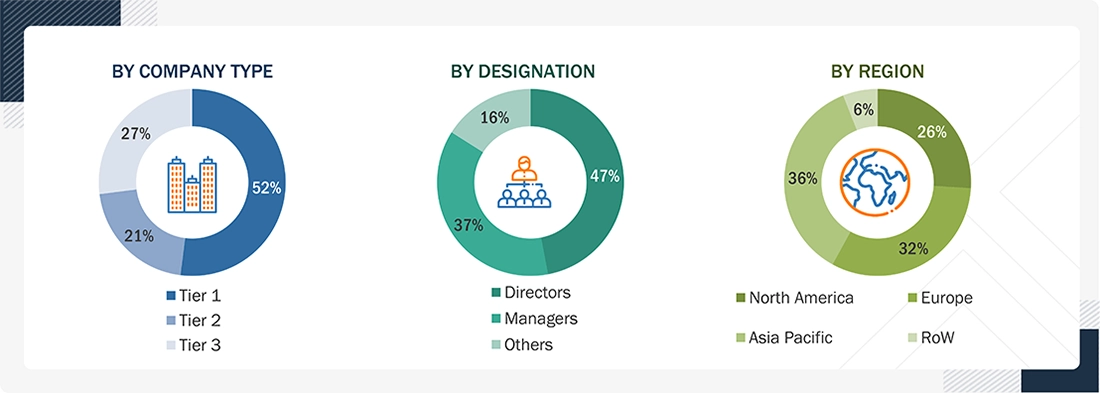
Note: Others include sales, managers, and product managers.
Company tiers are based on the value chain; revenue of the company is not considered.
To know about the assumptions considered for the study, download the pdf brochure
Market Size Estimation
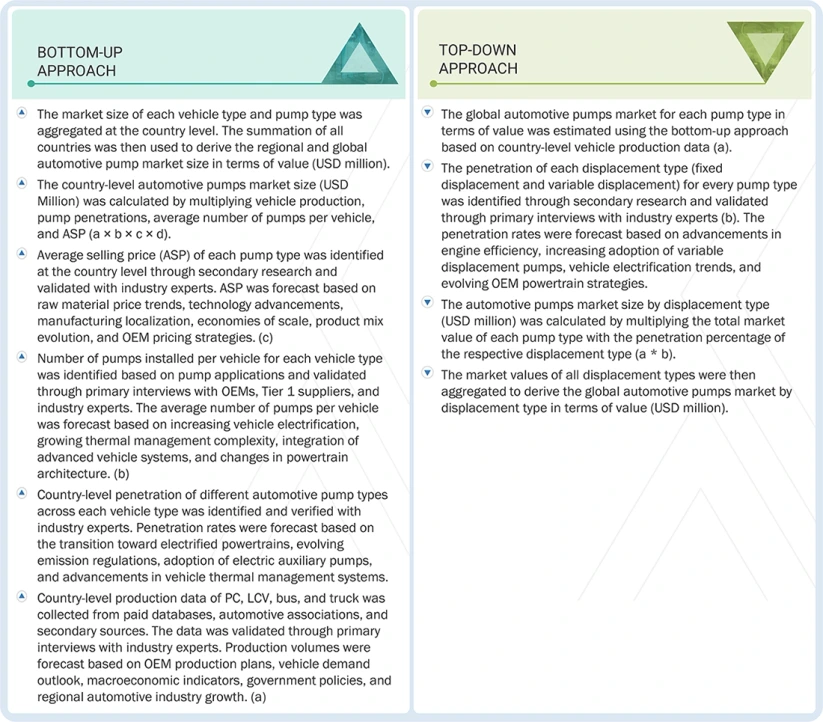
Both top-down and bottom-up approaches were used to estimate and validate the total size of the automotive pumps market. These methods were also used extensively to estimate the size of various subsegments in the market. The research methodology used to estimate the market size includes the following:
Automotive Pump Market : Top-Down and Bottom-Up Approach
Data Triangulation
After arriving at the overall market size—using the market size estimation processes as explained above—the market was split into several segments and subsegments. To complete the overall market engineering process and arrive at the exact statistics of each market segment and subsegment, data triangulation and market breakdown procedures were employed, wherever applicable. The data was triangulated by studying various factors and trends from both the demand and supply sides.
Market Definition
An automotive pump is a mechanical device used to perform different functions, including raising, compressing, or transferring fluids by mechanical action, and facilitating the circulation of fluids around a system for a vehicle’s operational performance.
Key Stakeholders
- Automotive component manufacturers
- Associations, forums, and alliances related to automobiles
- Automobile organizations/associations
- Automotive original equipment manufacturers
- Automotive investors
- Automotive pump component suppliers
- Automotive pump manufacturers
- Automotive sensor manufacturers
- EV battery manufacturers
- EV charging equipment manufacturers
- EV component manufacturers
- EV manufacturers
- Government agencies and policymakers
- Raw material suppliers for automotive pumps
- Traders and distributors of automotive pumps
Report Objectives
- To define, segment, and forecast the size of the automotive pump market in terms of value (USD million) based on the following categories:
- Type (fuel pumps, fuel injection pumps, water pumps, headlight washer pumps, vacuum pumps, steering pumps, windshield washer pumps, and oil transmission pumps)
- Technology (electric pumps and mechanical pumps)
- Application (body & interior, engine & HVAC, and powertrain)
- Displacement (variable displacement pumps and fixed displacement pumps)
- Vehicle type (passenger car, light commercial vehicle, bus, and truck)
- EV type (battery electric vehicles, hybrid electric vehicles, and plug-in hybrid electric vehicles)
- Off-highway vehicle type (construction equipment and mining equipment)
- Sales channel (OEM and aftermarket)
- Oil transmission and steering pump (displacement type, technology, vehicle type, and flow rate & vehicle type)
- To segment and forecast the size of the market, by volume and value, based on region
- By region (Asia Pacific, Europe, North America, and Rest of the World)
- To cover fuel cell electric vehicles qualitatively under the EV type segments
- To evaluate the key market dynamics influencing the automotive pump market, including strategic drivers, restraints, opportunities, challenges, and emerging technology trends shaping future market growth across ICE, hybrid, and electric vehicles
-
To study the following with respect to the market
- Supply chain analysis
- Ecosystem analysis
- Bill of materials
- Technology analysis
- Trade analysis
- Investment and funding scenario
- Pricing analysis
- Case study analysis
- Patent analysis
- Regulatory landscape
- Aftermarket and remanufacturing opportunities for automotive pumps
- Emergence of intelligent thermal control systems
- Evolution of electric pump technologies
- Europe-India trade deals: impact analysis
- Israel-Iran war impact on automotive industry
- Strategic considerations for OEMs and Tier 1 suppliers
- Impact of AI on automotive pumps market
- Key stakeholders and buying criteria
- To benchmark the competitive positioning of key players in the market through a comprehensive analysis of market share, revenue performance, strategic initiatives, innovation capabilities, product differentiation, and competitive strengths across the automotive pump value chain
- To map the competitive ecosystem of the automotive pump market by categorizing market participants into stars, emerging leaders, pervasive players, and participants using a robust evaluation framework based on the strength of their automotive pump portfolio, business strategy, innovation capability, geographic footprint, and market presence
- To assess the competitive landscape of the market by profiling leading global manufacturers based on their business overview, automotive pump product portfolio, geographic presence, financial performance, and recent strategic developments such as product launches, partnerships, acquisitions, capacity expansions, and technological advancements
Available customizations:
With the given market data, MarketsandMarkets offers customizations in accordance with the company’s specific needs.
- Additional Company Profiles
- Detailed Analysis of the Automotive Pumps Market, By Electric Commercial Vehicle Type
- Detailed Analysis of the Automotive Pumps Market, By Displacement, By Pump Type
Get the Full Automotive Pump Market Report
Full forecast, segment splits, and company analysis for all Automotive Pump Market.
- China Automotive Pump Market
- India Automotive Pump Market
- Japan Automotive Pump Market
- South Korea Automotive Pump Market
- Thailand Automotive Pump Market
- France Automotive Pump Market
- Germany Automotive Pump Market
- Russia Automotive Pump Market
- Spain Automotive Pump Market
- Turkey Automotive Pump Market
- UK Automotive Pump Market
- Canada Automotive Pump Market
- Mexico Automotive Pump Market
- US Automotive Pump Market
- Iran Automotive Pump Market
- South Africa Automotive Pump Market
Need a Tailored Report?
Customize this report to your needs
Get 10% FREE Customization
Customize This Report
