
Singapore Autonomous Forklift Market (2026-2031)

The Singapore Autonomous Forklift Market was valued at $72 Million in 2026 and projected to reach to $172 Million by 2031, representing a compound annual growth rate of 13.4%. Singapore's autonomous forklift market is positioned for sustained growth as the nation's logistics infrastructure modernizes to meet increasing global trade demands.


| Market Size in | USD 26.32 MN |
| Market Forecast in | |
| CAGR | |
| Forecast Period | |
| Units Considered | Value (USD MN) |
Singapore Autonomous Forklift Market Trends and Insights
- This acceleration reflects Singapore's strategic position as a global logistics and port hub, where automation adoption is critical to maintaining operational efficiency and competitiveness.
- Singapore's advanced infrastructure, high labor costs, and strong regulatory framework create an ideal environment for autonomous material handling solutions. The forecast period from 2026 to 2031 will see Singapore emerge as a key market for autonomous forklift deployment across warehousing, port operations, and manufacturing sectors.
- Singapore's commitment to Industry 4.0 and smart port initiatives drives demand for autonomous technologies that enhance safety and reduce operational costs.
- The market's 13.4% CAGR significantly outpaces global growth, underscoring Singapore's leadership in adopting cutting-edge logistics automation and positioning the nation as a regional innovation center for autonomous material handling..
Key Market Statistics
- CAGR (2026-2031) 13.4% CAGR
- Market Size, 2026 ~USD 72 Million
- Forecast, 2031 ~USD 172 Million
- Country Singapore
Singapore Autonomous Forklift Market Overview
Rapid Market Expansion :
Singapore's autonomous forklift market is projected to grow from $72.0 million in 2026 to $172.0 million by 2031, driven by the nation's role as a critical global logistics and port hub requiring advanced automation solutions.
Strong CAGR Performance :
At 13.4% CAGR, Singapore's market growth significantly outpaces the global average of 9.7%, reflecting accelerated adoption of autonomous material handling technologies across the region's warehousing and port operations.
Port and Logistics Hub Dynamics :
Singapore's strategic position as Southeast Asia's premier transshipment center drives demand for autonomous forklifts to enhance operational efficiency, reduce labor costs, and maintain competitive advantage in high-volume cargo handling.
Automation Adoption Imperative :
Rising labor costs, space constraints, and the need for 24/7 operational continuity in Singapore's port and warehouse facilities are accelerating the shift toward autonomous material handling equipment adoption.
Singapore Autonomous Forklift Market Dynamics
- The market's 13.4% CAGR reflects strong investment in automation technologies across port terminals, distribution centers, and manufacturing facilities seeking operational excellence and cost optimization. Key drivers include Singapore's labor market tightness, rising operational costs, and government initiatives promoting Industry 4.0 adoption.
- As a leading transshipment hub, Singapore's competitive advantage depends on technological innovation in material handling.
- The projected expansion to $172.0 million by 2031 underscores growing confidence in autonomous forklift solutions as essential infrastructure for maintaining Singapore's logistics leadership in the region..
Market Ecosystem
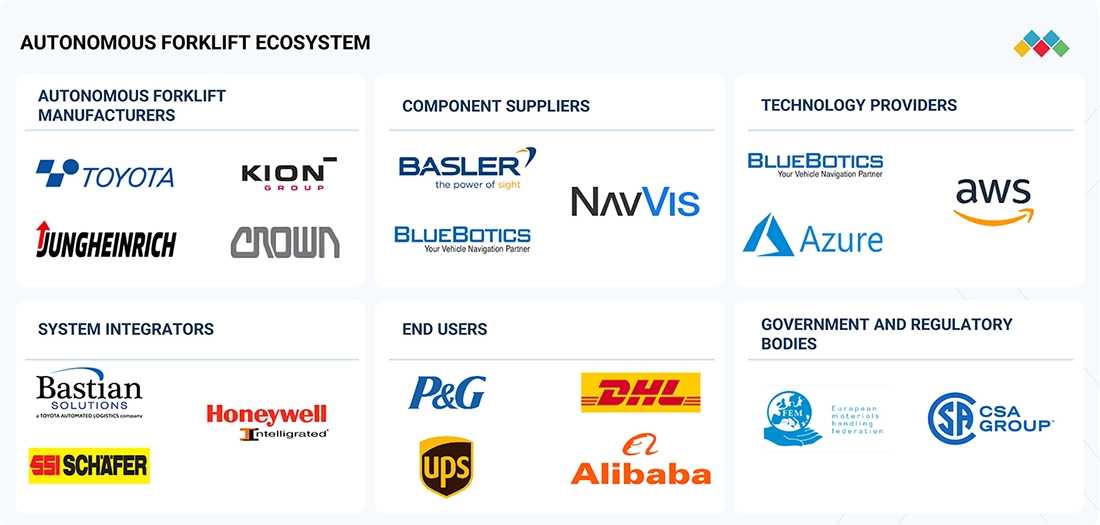
AUTONOMOUS FORKLIFT MARKET: COMMERCIAL USE CASES ACROSS INDUSTRIES
| COMPANY | USE CASE DESCRIPTION | BENEFITS |
|---|---|---|
 |
Smart warehouse automation through autonomous forklift fleets connected with WMS and enterprise systems | Higher throughput, lower labor costs, and improved operational visibility |
 |
End-to-end automated material flow using autonomous forklifts and warehouse automation solutions | Faster order fulfillment, optimized warehouse utilization, and reduced downtime |
 |
Autonomous pallet transport and intralogistics automation for manufacturing and distribution facilities | Improved productivity, lower operating costs, and enhanced process reliability |
 |
AI-enabled autonomous forklift deployment for repetitive and high-volume material handling tasks | Reduced human intervention, increased accuracy, and improved warehouse safety |
 |
Connected autonomous forklift ecosystems leveraging analytics and real-time fleet optimization | Better fleet utilization, predictive maintenance, and improved ROI on automation investments |
Logos and trademarks shown above are the property of their respective owners. Their use here is for informational and illustrative purposes only.
Related Ecosystem
Logistics And Transportation
- Internal Combustion Engine (ICE)
- Crawler Excavator
- Fuel Cell
- Light Commercial Vehicles (LCVs)
- Sensors
- Siemens ag
- Alstom s.a.
- Hitachi, Ltd.
- Godrej Industries Limited
- ABB India Limited
On Highway Off Highway Vehicles
- Internal Combustion Engine (ICE)
- Agricultural Tractors
- Crawler Excavator
- Battery Electric Vehicle (BEV)
- Excavators
- Visteon Corporation
- Deere & Company
- Honda Motor Co., Ltd.
- AB VOLVO PENTA
- Komatsu Ltd.
Key Takeaways
- Singapore's autonomous forklift market will grow from $72.0M (2026) to $172.0M (2031) at a 13.4% CAGR, outpacing global growth.
- Singapore's role as a major logistics and port hub drives accelerated adoption of autonomous material handling technologies.
- High labor costs and advanced infrastructure in Singapore create strong economic incentives for automation investment.
- Singapore's Industry 4.0 initiatives and smart port programs position the nation as a regional leader in autonomous logistics solutions.
Autonomous Forklift Market Report Scope
| Report Metric | Details |
|---|---|
| Base Year | 2026 |
| Fastest Growing Segment | OUTDOOR (Type) |
| Forecast Period | 2026–2031 |
| Growth Rate | CAGR of 9.7% from 2026 to 2031 |
| Largest Segment | INDOOR (Type) |
| Market Size Base Year (Billions) | ~USD 3.17 (2026) |
| Revenue Forecast (Billions) | ~USD 5.04 (2031) |
| Segments Covered | Tonnage Capacity, Navigation Technology, Application, End-Use Industry, Fuel Source, Type, Forklift Type, Sales Channel |
Singapore Autonomous Forklift Market Report Segmentation
8 segment dimensions are covered across the global market.
By Tonnage Capacity
- 3–5 Tons
- <3 Tons
- >5 Tons
- Above 5 Tons
- Below 3 Tons
By Navigation Technology
- Inductive Guidance
- Laser Guidance
- Magnetic Guidance
- Optical Tape Guidance
- Other Navigation Technologies
- Slam
- Vision Guidance
By Application
- Logistics & Freight
- Manufacturing
- Material Handling
- Other Applications
- Warehousing
By End-Use Industry
- Automotive
- Aviation
- Chemical
- E-Commerce
- Food & Beverage
- Healthcare
- Metals & Heavy Machinery
- Other End-Use Industries
- Paper & Pulp
- Semiconductor & Electronics
- Third-Party Logistics
By Fuel Source
- Electric
- ICE & Alternate Fuel
By Type
- Indoor
- Outdoor
By Forklift Type
- Pallet Jack
- Pallet Stacker
By Sales Channel
- In-House Purchase
- Leasing
Target Audience
- Autonomous Forklift Manufacturers : Manufacturers need Singapore-specific market data to identify growth opportunities, assess competitive positioning, and develop localized product strategies for this high-value logistics hub with strong automation adoption.
- Port and Terminal Operators : Port authorities and terminal operators require detailed market insights to evaluate autonomous forklift investments, benchmark operational efficiency gains, and plan capital expenditure for modernization initiatives.
- Logistics and Warehouse Companies : 3PL providers and warehouse operators need Singapore market analysis to justify automation investments, understand ROI timelines, and stay competitive in a rapidly modernizing logistics ecosystem.
- Investment and Private Equity Firms : Investors targeting Singapore's logistics and automation sectors require market-specific data to evaluate investment opportunities, assess growth potential, and identify acquisition targets in the autonomous material handling space.
- Technology Solution Providers : Software and IoT solution providers need Singapore market intelligence to understand autonomous forklift integration opportunities, identify customer segments, and develop complementary service offerings for the region.
Key Companies in the Singapore Autonomous Forklift Market
| Company | HQ | Ownership | Strongest segments |
|---|---|---|---|
| VISTEON CORPORATION | United States | Public Company | Instrument Clusters (2-D/3-D),Information Displays and Cockpit Displays,Infotainment & Connected Car (incl. Android, voice AI), |
| TOYOTA INDUSTRIES CORPORATION | Japan | Public Company | Materials handling equipment and warehouse solutions,Automobile parts and car electronics,Automobiles and engines, |
| KION GROUP AG | Germany | Public Company | Electric and IC counterbalance trucks,Warehouse and narrow aisle trucks,Supply chain automation (Dematic: AGVs, AS/RS, conveyors, sorters, palletizers), |
| LOGISNEXT CO., LTD. | Japan | Private Company | Electric forklifts,Engine-powered forklifts,Container carriers and transfer cranes, |
| JUNGHEINRICH AG | Germany | Public Company | New material handling & warehousing equipment,Automation systems & mobile robots,Rental, used trucks & services, |
| HYSTER-YALE, INC. | United States | Public Company | Counterbalance lift trucks (IC and electric),Warehouse trucks and fleet management services,Attachments, forks, masts, lift tables (Bolzoni, Auramo, Meyer), |
| SWISSLOG HOLDING AG | Switzerland | Private Company | Warehouse & Distribution Solutions,Healthcare Solutions, |
| OCEANEERING INTERNATIONAL, INC. | United States | Public Company | Subsea Robotics,Manufactured Products,Offshore Projects Group, |
| HD HYUNDAI CONSTRUCTION EQUIPMENT CO., LTD. | Korea, South | Public Company | Excavators (mini to large),Wheel loaders,Compact equipment (skid steer, compact track, backhoe), |
| BALYO | France | Private Company | Robotic pallet and reach trucks,Tuggers, stackers, and counterbalanced stackers,Very narrow aisle solutions, |
| ANHUI HELI CO., LTD. | China | Public Company | Complete industrial vehicles (forklifts, tractors, port and special vehicles),Spare parts and components,Aftermarket services, |
VISTEON CORPORATION
Visteon Corporation is a publicly traded American company founded in 2000 with 10,500 employees. The company operates in the automotive industry.
TOYOTA INDUSTRIES CORPORATION
Toyota Industries Corporation is a Japanese public company founded in 1926 with 81,808 employees. The company is a major player in industrial manufacturing and automotive-related sectors.
KION GROUP AG
KION Group AG is a German public company founded in 2006 with 41,974 employees. The company operates in the industrial equipment and logistics sectors.
LOGISNEXT CO., LTD.
LogisNext Co., Ltd. is a Japanese private company founded in 1937 with 11,161 employees. The company operates in the logistics and industrial equipment industry.
JUNGHEINRICH AG
Jungheinrich AG is a German public company founded in 1953 with 21,438 employees. The company specializes in material handling equipment and logistics solutions.
HYSTER-YALE, INC.
Hyster-Yale, Inc. is an American public company founded in 1991 with 7,500 employees. The company manufactures and sells lift trucks and material handling equipment.
SWISSLOG HOLDING AG
Swisslog Holding AG is a Swiss private company founded in 1900 with 2,372 employees. The company provides automation and logistics solutions.
OCEANEERING INTERNATIONAL, INC.
Oceaneering International, Inc. is an American public company founded in 1964 with 11,100 employees. The company operates in the offshore and industrial services sectors.
HD HYUNDAI CONSTRUCTION EQUIPMENT CO., LTD.
HD Hyundai Construction Equipment Co., Ltd. is a South Korean public company founded in 1985 with 1,059 employees. The company manufactures construction equipment.
BALYO
Balyo is a French private company founded in 2004 with 207 employees. The company operates in the robotics and automation sector.
ANHUI HELI CO., LTD.
Anhui Heli Co., Ltd. is a Chinese public company founded in 1958 with 11,419 employees. The company manufactures material handling equipment.
Reasons to Buy this Report
- Market-Specific Growth Projections : Access detailed forecasts showing Singapore's autonomous forklift market expanding from $72M to $172M (2026-2031), enabling precise investment and expansion planning tailored to this high-growth regional market.
- Competitive Benchmarking Data : Understand how Singapore's 13.4% CAGR compares to the global 9.7% average, providing critical insights into regional market dynamics and competitive positioning within Southeast Asia's logistics sector.
- Port and Logistics Hub Insights : Gain specialized intelligence on automation adoption patterns specific to Singapore's port terminals, distribution centers, and transshipment facilities driving autonomous forklift demand.
- Regulatory and Infrastructure Context : Understand Singapore-specific factors including labor market conditions, government Industry 4.0 initiatives, and operational constraints shaping autonomous forklift adoption strategies.
- Strategic Market Entry Planning : Leverage Singapore-focused market analysis to develop targeted go-to-market strategies, identify key customer segments, and optimize product positioning for this premium, high-growth logistics market.
Frequently asked questions
What is the market size of autonomous forklifts in Singapore in 2026?
Singapore's autonomous forklift market is estimated at $72.0 million in 2026, reflecting strong early adoption in the region's logistics sector.
What is the projected market size for Singapore by 2031?
Singapore's autonomous forklift market is forecast to reach $172.0 million by 2031, representing more than a doubling of market value over the five-year period.
What is the CAGR for Singapore's autonomous forklift market?
Singapore's autonomous forklift market is projected to grow at a compound annual growth rate of 13.4% from 2026 to 2031, significantly exceeding the global average.
Why is Singapore's autonomous forklift market growing faster than the global average?
Singapore's high labor costs, advanced port infrastructure, commitment to Industry 4.0, and role as a global logistics hub accelerate adoption of autonomous material handling solutions.
Which sectors in Singapore are driving autonomous forklift adoption?
Key sectors include port operations, warehousing, manufacturing, and e-commerce logistics, all of which benefit from Singapore's smart port and automation initiatives.
RESEARCH METHODOLOGY
The study involved four major activities in estimating the current size of the autonomous forklift market. Exhaustive secondary research was conducted to collect information on the market, peer, and parent markets. The next step was to validate these findings and assumptions and size them with industry experts across value chains through primary research. The bottom-up and top-down approaches were employed to estimate the complete market size. Thereafter, market breakdown and data triangulation processes were used to estimate the market size of segments and subsegments.
Secondary Research
In the secondary research process, various secondary sources such as company websites, press releases, industry association publications, intralogistics magazine articles, directories, technical handbooks, World Economic Outlook, trade websites, and technical articles were used to identify and collect information useful for an extensive commercial study of the autonomous forklift market.
Primary Research
Extensive primary research has been conducted after understanding the autonomous forklift market scenario through secondary research. Several primary interviews have been conducted with market experts from the supply side (autonomous forklift OEMs) and demand side (dealers, e-commerce companies, warehouses, etc.) across major regions, namely, North America, Europe, and the Asia Pacific. Approximately 70% and 30% of primary interviews have been conducted from the demand and supply sides, respectively. Primary data has been collected through questionnaires, emails, and telephonic interviews. In the canvassing of primaries, we have strived to cover various departments within organizations, such as sales, operations, design, and marketing, to provide a holistic viewpoint in our report.
After interacting with industry participants, we conducted brief sessions with highly experienced independent consultants to reinforce the findings from our primaries. This, along with the opinions of the in-house subject-matter experts, led us to the findings described in this report.
Breakdown of Primaries:
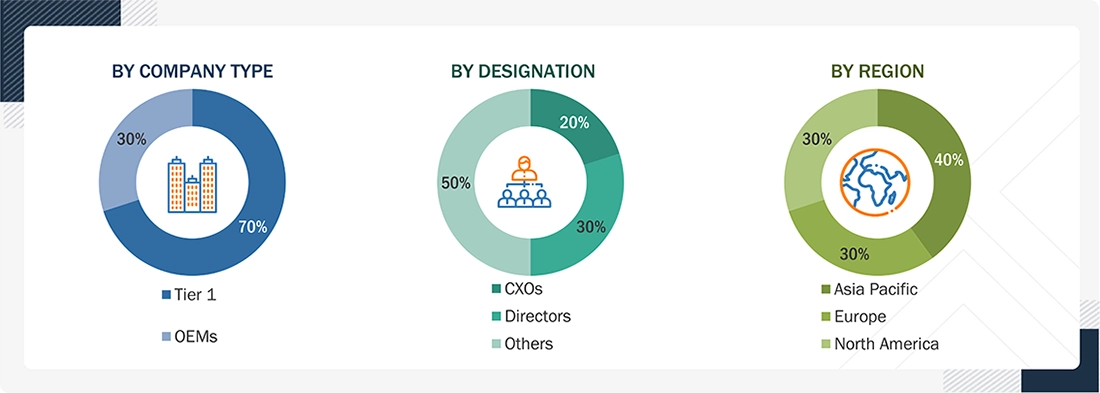
Note: Others include sales, marketing, and product managers.
To know about the assumptions considered for the study, download the pdf brochure
Market Size Estimation
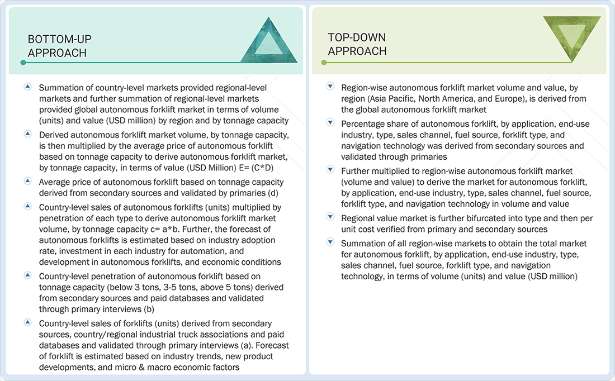
The bottom-up approach was used to estimate and validate the size of the autonomous forklift market by tonnage capacity and region. The top-down approach was used to derive market size by navigation technology, type, application, forklift type, propulsion, sales channel, tonnage capacity, and end-use industry. To determine the autonomous forklift market size by tonnage capacity, the country-level estimated value share of autonomous forklifts for each tonnage capacity was multiplied by the average selling price (below 3 tons, 3-5 tons, above 5 tons). The country-level market sizes were summed up to arrive at the regional market size, which was further added to derive the autonomous forklift market size.
Autonomous Forklift Market: Top-down Approach
The top-down approach was followed to determine the market size by application, end-use industry, type, sales channel, fuel source, forklift type, tonnage capacity, and navigation technology in terms of volume and value for autonomous forklifts. The region-wise autonomous forklift market volume and value by region (Asia Pacific, North America, Europe, Rest of the World) were derived from the global autonomous forklift market. The percentage share of autonomous forklifts by application, industry, type, sales channel, fuel source, forklift type, and navigation technology was derived from secondary sources and validated through primary sources. It was further multiplied by the region-wise autonomous forklift market volume and value. The market volume and value for autonomous forklifts by application, industry, type, sales channel, fuel source, forklift type, paper & pulp by tonnage capacity, and navigation technology were derived through this. The summation of all region-wise markets was carried out to obtain the total market for autonomous forklifts by type and industry in terms of volume (units) and value (USD million)
Autonomous Forklift Market : Top-Down and Bottom-Up Approach
Data Triangulation
All percentage shares, splits, and breakdowns were determined using secondary sources and verified through primary sources. All parameters that are expected to affect the markets covered in this research study were accounted for, viewed in extensive detail, verified through primary research, and analyzed to obtain the final quantitative and qualitative data. This data was consolidated, supplemented with detailed inputs and analysis from MarketsandMarkets, and presented in the report.
Market Definition
According to Toyota Industries Corporation (Japan), an autonomous forklift is a driverless forklift equipped with unique autopilot technology that enables reliable, accurate operation for transporting, stacking, or picking. The autopilot system can operate independently and alongside manually operated equipment.
Key Stakeholders
- OEMs
- Autonomous technology providers
- Hardware & software providers
- Dealer/distributors
- Battery manufacturers
- Robotic providers
Report Objectives
-
To define, describe, and forecast the autonomous forklift market in terms of value (USD million) and volume (units) based on the following segments:
- By tonnage capacity (below 3 tons, 3-5 tons, and above 5 tons)
- By application (manufacturing, warehousing, material handling, logistics, freight, and others)
- By navigation technology (laser guidance, magnetic guidance, vision guidance, inductive guidance, optical tape guidance, SLAM, and others)
- By industry (third-party logistics, food and beverages, automotive, paper and pulp, metals and heavy machinery, e-commerce, aviation, semiconductors and electronics, healthcare, and others)
- By fuel source (electric, ICE, and alternate fuels)
- By sales channel (in-house purchase and leasing)
- By forklift type (pallet jacks and pallet stackers)
- By type (indoor and outdoor)
- By region (Asia Pacific, Europe, North America, and the Rest of the World)
Available customizations:
Along with the market data, MarketsandMarkets offers customizations per company-specific needs.
The following customization options are available for the report
Get the Full Autonomous Forklift Market Report
Full forecast, segment splits, and company analysis for all Autonomous Forklift Market.
- Germany Autonomous Forklift Market
- UK Autonomous Forklift Market
- France Autonomous Forklift Market
- Russia Autonomous Forklift Market
- Italy Autonomous Forklift Market
- Spain Autonomous Forklift Market
- Poland Autonomous Forklift Market
- Mexico Autonomous Forklift Market
- Canada Autonomous Forklift Market
- US Autonomous Forklift Market
- China Autonomous Forklift Market
- India Autonomous Forklift Market
- Japan Autonomous Forklift Market
- South Korea Autonomous Forklift Market
- Thailand Autonomous Forklift Market
- Malaysia Autonomous Forklift Market
Need a Tailored Report?
Customize this report to your needs
Get 10% FREE Customization
Customize This Report
