
US Ballistic Protection Market (2026-2031)

The US Ballistic Protection Market was valued at $2855.4 Million in 2026 and projected to reach to $3928.2 Million by 2031, representing a compound annual growth rate of 6.6%. The US ballistic protection market is positioned for sustained growth through 2031, supported by continuous defense modernization cycles and geopolitical security concerns.


| Market Size in | USD 26.32 MN |
| Market Forecast in | |
| CAGR | |
| Forecast Period | |
| Units Considered | Value (USD MN) |
US Ballistic Protection Market Trends and Insights
- The US market is driven by sustained defense spending, modernization of military platforms, and increasing demand for advanced protective systems across federal and state agencies.
- The US ballistic protection sector benefits from technological innovation in materials science and integration with next-generation combat systems. Growth in the US market is supported by heightened geopolitical tensions, ongoing military operations, and the need for enhanced personnel and vehicle protection.
- The US maintains the world's largest defense budget, creating substantial opportunities for ballistic protection manufacturers and suppliers.
- Between 2026 and 2031, the US market will experience accelerated adoption of lightweight composite armor, ceramic plates, and integrated protection solutions across military and law enforcement applications..
Key Market Statistics
- CAGR (2026-2031) 6.6% CAGR
- Market Size, 2026 ~USD 2855.4 Million
- Forecast, 2031 ~USD 3928.2 Million
- Country US
US Ballistic Protection Market Overview
Market Valuation Growth :
The US ballistic protection market is valued at $2,855.4 million in 2026 and is projected to reach $3,928.2 million by 2031, demonstrating robust expansion driven by federal defense priorities and modernization initiatives.
Strong CAGR Performance :
The US market exhibits a 6.6% CAGR from 2026 to 2031, outpacing the global growth rate of 5.3%, indicating accelerated adoption of advanced ballistic protection technologies within the American defense ecosystem.
Defense Spending Momentum :
Sustained US defense budgets and military platform modernization programs are primary growth catalysts, with increased allocations for personnel protection systems across Army, Navy, Air Force, and Marine Corps operations.
Multi-Agency Demand :
Beyond military applications, federal and state law enforcement agencies, homeland security departments, and civilian protection sectors are driving incremental demand for ballistic protection solutions across the United States.
US Ballistic Protection Market Dynamics
- Federal spending on advanced protective equipment, body armor systems, and vehicle-mounted ballistic solutions will remain robust as military branches upgrade aging platforms and personnel protection capabilities.
- State and local law enforcement agencies are increasingly investing in ballistic protection technologies, expanding the addressable market beyond traditional defense procurement channels.
- Innovation in lightweight composite materials and integrated protection systems will drive premium pricing and market expansion..
Market Ecosystem
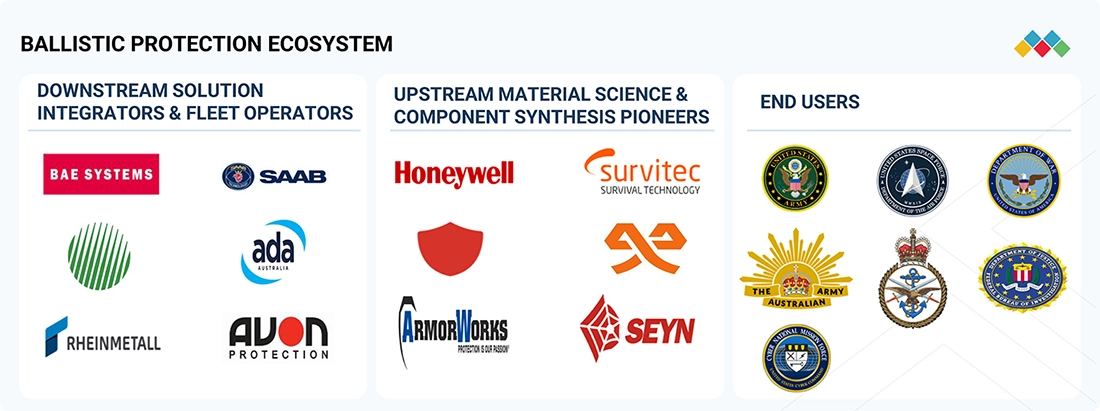
BALLISTIC PROTECTION MARKET SIZE, SHARE, TRENDS & GROWTH ANALYSIS: COMMERCIAL USE CASES ACROSS INDUSTRIES
| COMPANY | USE CASE DESCRIPTION | BENEFITS |
|---|---|---|
 |
BAE Systems supplies advanced structural hull plating and modular armor kits for heavy tactical vehicles under large-scale military fleet deployment programs | It supports land system survivability, protects crew compartments from high-velocity kinetic impacts, and secures structural integrity during frontline combat operations | Enhances crew survival rates | Minimizes vehicle structural damage | Allows field teams to interchange modular plates based on changing threat environments |
 |
Rheinmetall AG integrates high-performance composite strike faces and add-on ballistic shielding for armored main battle tanks and tactical transport platforms | It supports heavy mechanized infantry protection, vehicle survivability against armor-piercing ammunition, and defensive coverage during high-intensity conflict scenarios | Offers multi-hit protection capability | Lowers vehicle deadweight via advanced composite integration | Helps mechanized units maintain operational maneuverability and defense |
 |
Avon Protection manufactures ultra-lightweight advanced ballistic helmets, body armor inserts, and tactical personal equipment for dismounted infantry units | It supports individual personnel survivability, head and torso protection against high-velocity shrapnel, and modular combat gear integration during high-risk field operations | Decreases individual physical fatigue | Ensures high-grade trauma reduction | Allows combat teams to maintain situational awareness and mobility in rugged terrains |
Logos and trademarks shown above are the property of their respective owners. Their use here is for informational and illustrative purposes only.
Related Ecosystem
Key Takeaways
- The US ballistic protection market will grow from $2,855.4M (2026) to $3,928.2M (2031) at a 6.6% CAGR, outpacing the global average of 5.3%.
- US defense modernization initiatives and military platform upgrades are primary drivers of sustained market expansion through 2031.
- The US market benefits from advanced R&D capabilities and integration of next-generation materials in ballistic protection systems.
- Law enforcement and homeland security agencies in the US represent a growing secondary market segment for ballistic protection solutions.
Ballistic Protection Market Report Scope
| Report Metric | Details |
|---|---|
| Base Year | 2026 |
| Fastest Growing Segment | AIRCRAFT CARRIER (Naval & Marine Platforms) |
| Forecast Period | 2026-2031 |
| Growth Rate | CAGR of 5.3% from 2026 to 2031 |
| Largest Segment | MILITARY (End User) |
| Market Size Base Year (Billions) | ~USD 12.58 (2026) |
| Revenue Forecast (Billions) | ~USD 16.29 (2031) |
| Segments Covered | Armor Technology, Threat Level, Application, Personnel, Land Vehicles, Aircraft, Naval & Marine Platforms, Fixed Sites & Infrastructure, End User, Military, Product, Body Armor & Wearables, Armor Kits & Panels, Transparent Armor, Spall & Fragmentation Protection |
US Ballistic Protection Market Report Segmentation
15 segment dimensions are covered across the global market.
By Armor Technology
- Aramid Fibers
- Bulletproof Glass
- Ceramics
- Composites & Hybrid Armor
- Metals & Alloys
- Uhmwpe
By Threat Level
- Armor-Piercing Rounds
- Fragments & Shrapnel
- Handgun Rounds
- Medium-Caliber Cannon Rounds
- Rifle Rounds
- Shotgun Threats
By Application
- Aircraft
- Fixed Sites & Infrastructure
- Land Vehicles
- Naval & Marine Platforms
- Personnel
By Personnel
- Law Enforcement Officers
- Military Personnel
By Land Vehicles
- Armored Personnel Carrier
- Armored Supply Truck
- Infantry Fighting Vehicle
- Main Battle Tank
- Mine-Resistant Ambush-Protected Vehicle
- Unmanned Ground Vehicle
By Aircraft
- Fixed-Wing Aircraft
- Helicopters
- Uavs
By Naval & Marine Platforms
- Aircraft Carrier
- Corvette
- Destroyer
- Frigate
- Mine-Warfare Vessel
- Patrol Vessel
By Fixed Sites & Infrastructure
- Government Facilities
- Military Bases
By End User
- Government & Law Enforcement
- Military
By Military
- Air Force
- Army
- Navy
By Product
- Armor Kits & Panels
- Body Armor & Wearables
- Shields, Barriers, And Enclosures
- Spall & Fragmentation Protection
- Transparent Armor
By Body Armor & Wearables
- Ballistic Helmets
- Bomb Suits
- Hard Body Armor
- Integrated Personnel Armor Kits
- Soft Body Armor
By Armor Kits & Panels
- Add-On/Appliqué Armor Kits
- Aircraft Armor Panels
- Naval Armor Panels
- Structural Armor Panels
- Vehicle Armor Panels
By Transparent Armor
- Ballistic Glass
- Transparent Armor Inserts
By Spall & Fragmentation Protection
- Anti-Spall Backing Systems
- Eod Blankets
- Fragmentation Liners
- Spall Liners
- Underbody Protection
Target Audience
- Defense Contractors & Manufacturers : US-based and international defense companies need market intelligence to identify growth opportunities, optimize product portfolios for American procurement standards, and develop competitive strategies for federal and state contracts.
- Military & Defense Procurement Officers : Pentagon, military branch procurement teams, and defense acquisition professionals require market data to justify budget requests, evaluate supplier capabilities, and make informed decisions on ballistic protection system investments.
- Law Enforcement & Homeland Security Agencies : Federal, state, and local law enforcement agencies need market insights to assess ballistic protection options, understand technology advancements, and optimize procurement budgets for personnel and facility protection.
- Investment & Private Equity Firms : Investors evaluating opportunities in the US defense and security sectors require detailed market analysis to identify acquisition targets, assess growth potential, and make informed capital allocation decisions in ballistic protection.
- Strategic Consultants & Analysts : Management consulting firms and market research professionals need comprehensive US market data to support client strategy development, competitive analysis, and market entry planning in the ballistic protection sector.
Reasons to Buy this Report
- US-Specific Market Sizing : Obtain precise valuation data for the US ballistic protection market with detailed 2026-2031 forecasts, enabling accurate budget allocation and investment decisions tailored to the American defense landscape.
- Competitive Landscape Intelligence : Identify leading US-based and international suppliers competing in the ballistic protection sector, understand market share dynamics, and benchmark your position against key competitors in federal and state procurement channels.
- Growth Driver Analysis : Understand the specific factors accelerating US market growth including defense modernization priorities, federal spending trends, and emerging demand from law enforcement and homeland security agencies.
- Procurement Opportunity Mapping : Discover high-value procurement opportunities across US military branches, federal agencies, and state/local law enforcement, with insights into budget cycles and acquisition timelines specific to American government contracting.
- Technology & Innovation Trends : Access detailed analysis of advanced ballistic protection technologies gaining traction in the US market, including lightweight materials, integrated systems, and next-generation solutions driving premium market segments.
Frequently asked questions
What is the current size of the US ballistic protection market?
The US ballistic protection market is estimated at $2,855.4 million in 2026 and is expected to reach $3,928.2 million by 2031.
What is the growth rate of the US ballistic protection market?
The US ballistic protection market is projected to grow at a compound annual growth rate (CAGR) of 6.6% from 2026 to 2031.
What are the main drivers of growth in the US ballistic protection market?
Key drivers include sustained US defense spending, military modernization programs, geopolitical tensions, and increased demand from law enforcement and homeland security agencies.
Which segments dominate the US ballistic protection market?
The US market is dominated by military applications, including body armor, vehicle protection, and aircraft ballistic systems, with growing adoption in law enforcement.
How does the US market compare to global ballistic protection trends?
The US market grows at 6.6% CAGR, exceeding the global average of 5.3%, reflecting higher defense investment and technological advancement in the United States.
RESEARCH METHODOLOGY
The study involved four major activities to estimate the current size of the ballistic protection market. Exhaustive secondary research was conducted to gather information on the ballistic protection market, its adjacent markets, and its parent market. The next step was to validate these findings, assumptions, and sizing with industry experts across the value chain through primary research. Demand-side analysis was conducted to estimate the overall market size. Thereafter, data triangulation procedures were employed to estimate the sizes of various segments and subsegments within the ballistic protection market.
Secondary Research
During the secondary research process, various sources were consulted to identify and collect information for this study. The secondary sources included government sources, such as SIPRI; corporate filings, including annual reports, press releases, and investor presentations; white papers, journals, and certified publications; and articles from recognized authors, directories, and databases.
Primary Research
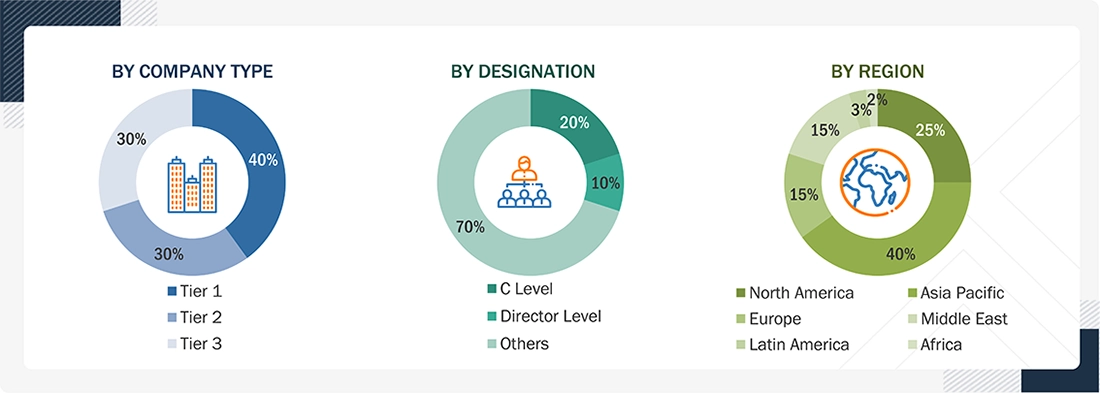
Extensive primary research was conducted after acquiring information on the ballistic protection market through secondary research. Several primary interviews were conducted with market experts from the demand and supply sides across major countries of North America, Europe, the Asia Pacific, the Middle East, Latin America, and Africa. Primary data was collected through questionnaires, emails, and telephonic interviews.
To know about the assumptions considered for the study, download the pdf brochure
Market Size Estimation
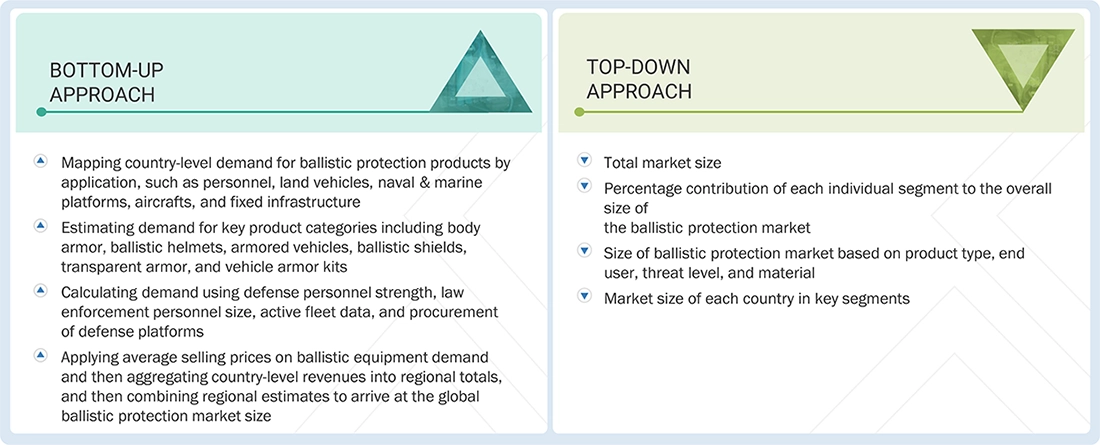
Top-down and bottom-up approaches were used to estimate and validate the size of the ballistic protection market. The research methodology used to estimate the size of the market included the following details:
- Key players in the ballistic protection market were identified through secondary research, and their market shares were determined through a combination of primary and secondary research. This included a study of the annual and financial reports of the top market players, as well as extensive interviews with leaders, including directors, engineers, marketing executives, and other key stakeholders of leading companies operating in the market.
- All percentage shares, splits, and breakdowns were determined using secondary sources and verified through primary sources.
- All possible parameters that affect the markets covered in this research study were accounted for, viewed in extensive detail, verified through primary research, and analyzed to obtain the final quantitative and qualitative data on the ballistic protection market. This data was consolidated, enhanced with detailed input, analyzed by MarketsandMarkets, and presented in this report.
Ballistic Protection Market : Top-Down and Bottom-Up Approach
Data Triangulation
After determining the overall market size, the total market was classified into several segments and subsegments. The data triangulation and market breakdown procedures explained below were implemented, wherever applicable, to complete the overall market engineering process and arrive at the estimated market numbers for the market segments and subsegments. The data was triangulated by examining various factors and trends on both the demand and supply sides. Additionally, the market size was validated using top-down and bottom-up approaches.
Market Definition
The ballistic protection market comprises products designed to protect personnel, vehicles, aircraft, naval platforms, and fixed infrastructure from bullets, fragments & shrapnel, and other kinetic projectile threats.
Key Stakeholders
- Armor Manufacturers and Integrators
- Platform Manufacturers
- End Users
- Regulatory and Certification Bodies
- Maintenance and Support Providers
- Technology and Component Suppliers
Report Objectives
- To define, describe, and forecast the ballistic protection market based on product type, application, armor technology, threat level, end use, and region in terms of value
- To forecast the size of various segments of the market across North America, Europe, the Asia Pacific, the Middle East & Africa, and Latin America in terms of value
- To identify and analyze the drivers, restraints, opportunities, and challenges influencing the growth of the market
- To identify industry trends, market trends, and technology trends currently prevailing in the market
- To analyze micromarkets with respect to growth trends, prospects, and their contribution to the overall market
- To analyze opportunities in the market for stakeholders by identifying key market trends
- .
- To profile key market players and comprehensively analyze their market share and core competencies
- To evaluate the degree of competition in the market by analyzing recent developments, such as contracts, agreements, and acquisitions adopted by leading market players
- To identify key products and unique selling points of leading companies in the market
- To provide a detailed competitive landscape of the market, along with market share analysis and revenue analysis of key players
Available customizations:
MarketsandMarkets offers the following customizations for this market report:
- Additional country-level analysis of the ballistic protection market
- Profiling of other market players (up to five)
Product Analysis
- Product matrix, which provides a detailed comparison of the product portfolios of each company in the ballistic protection market
Get the Full Ballistic Protection Market Report
Full forecast, segment splits, and company analysis for all Ballistic Protection Market.
- Israel Ballistic Protection Market
- Turkey Ballistic Protection Market
- South Africa Ballistic Protection Market
- Brazil Ballistic Protection Market
- Mexico Ballistic Protection Market
- Rest Of Europe Ballistic Protection Market
- Rest Of Asia Pacific Ballistic Protection Market
- Canada Ballistic Protection Market
- UK Ballistic Protection Market
- France Ballistic Protection Market
- Germany Ballistic Protection Market
- Italy Ballistic Protection Market
- China Ballistic Protection Market
- India Ballistic Protection Market
- Japan Ballistic Protection Market
- South Korea Ballistic Protection Market
- Australia Ballistic Protection Market
- UAE Ballistic Protection Market
- Saudi Arabia Ballistic Protection Market
Need a Tailored Report?
Customize this report to your needs
Get 10% FREE Customization
Customize This Report
