
Rest Of Europe Battery Energy Storage System (BESS) Market (2025-2030)

The Rest Of Europe Battery Energy Storage System (BESS) Market was valued at $2330 Million in 2025 and projected to reach to $4420 Million by 2030, representing a compound annual growth rate of 13.6%. Rest Of Europe's Battery Energy Storage System market is poised for significant expansion, growing from $2,330 million in 2025 to $4,420 million by 2030.


| Market Size in | USD 26.32 MN |
| Market Forecast in | |
| CAGR | |
| Forecast Period | |
| Units Considered | Value (USD MN) |
Rest Of Europe Battery Energy Storage System (BESS) Market Trends and Insights
- Rest Of Europe is capitalizing on renewable energy integration, grid modernization initiatives, and supportive regulatory frameworks that drive demand for energy storage solutions.
- Rest Of Europe's market growth is underpinned by increasing investments in distributed energy resources, decarbonization targets, and the need for grid stability as wind and solar penetration accelerates across the region. Rest Of Europe demonstrates strong momentum in both utility-scale and behind-the-meter storage deployments.
- Rest Of Europe's diverse energy landscape-spanning multiple countries with varying renewable capacity and grid infrastructure-creates differentiated opportunities for BESS providers.
- Rest Of Europe's forecast period (2025-2030) will see accelerated adoption driven by falling battery costs, enhanced energy independence priorities, and the transition toward net-zero economies..
Key Market Statistics
- CAGR (2025-2030) 13.6% CAGR
- Market Size, 2025 ~USD 2330 Million
- Forecast, 2030 ~USD 4420 Million
- Country Rest Of Europe
Rest Of Europe Battery Energy Storage System (BESS) Market Overview
Strong Regional Growth :
Rest Of Europe's BESS market is expanding at 13.6% CAGR, driven by aggressive renewable energy targets and grid stability requirements across smaller EU markets and non-EU European nations.
Grid Modernization Push :
Increasing investments in smart grid infrastructure and decentralized energy systems across Rest Of Europe are creating substantial demand for battery storage solutions to balance intermittent renewable generation.
Regulatory Support Framework :
Supportive government policies, EU energy directives, and national climate commitments are accelerating BESS adoption, with incentives for both utility-scale and distributed storage installations.
Renewable Integration Catalyst :
Rising penetration of wind and solar capacity in Rest Of Europe necessitates reliable energy storage systems, positioning BESS as critical infrastructure for achieving carbon neutrality goals.
Rest Of Europe Battery Energy Storage System (BESS) Market Dynamics
- This 13.6% CAGR reflects the region's commitment to renewable energy integration and grid modernization, supported by favorable regulatory environments and increasing investment in clean energy infrastructure.
- The market benefits from diverse national energy policies and growing recognition of storage's role in energy security. Key growth drivers include the transition away from fossil fuels, enhanced grid reliability requirements, and falling battery technology costs.
- Rest Of Europe's smaller markets are increasingly adopting BESS solutions to support distributed renewable generation and improve grid resilience.
- Strategic partnerships between energy providers and storage manufacturers, combined with EU-wide sustainability initiatives, will continue to propel market expansion through 2030..
Market Ecosystem
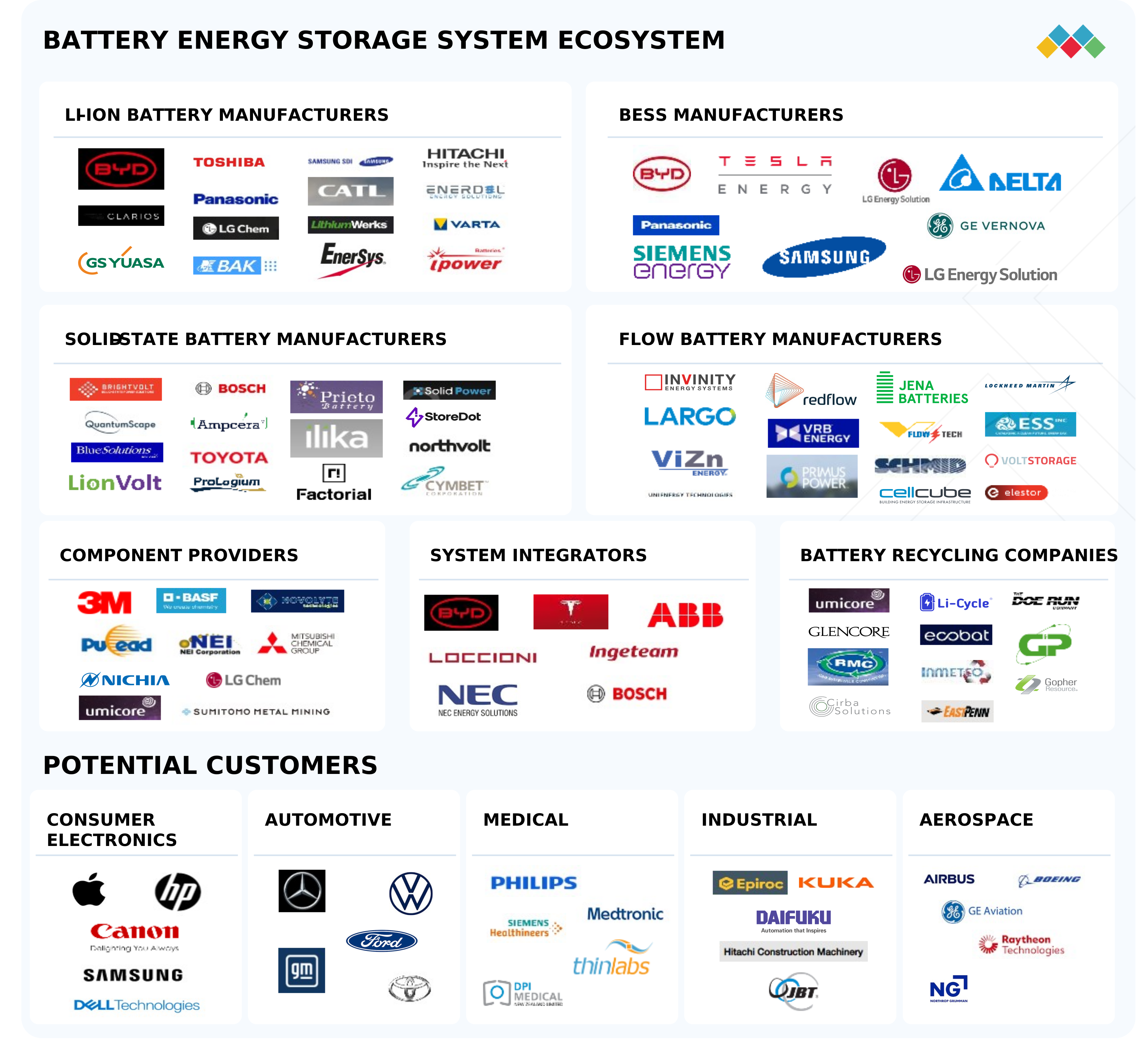
BATTERY ENERGY STORAGE SYSTEM (BESS) MARKET: COMMERCIAL USE CASES ACROSS INDUSTRIES
| COMPANY | USE CASE DESCRIPTION | BENEFITS |
|---|---|---|
 |
Blade battery and LFP-based BESS for commercial, industrial, and utility-scale energy management | Superior safety| Long lifecycle| High thermal stability| Reliable power delivery |
 |
Lithium-ion BESS solutions for grid-scale, C&I, and renewable integration projects | High energy density| Strong performance in harsh conditions| Advanced safety systems| Optimized cost-efficiency |
 |
Utility-scale and C&I BESS with advanced lithium-ion chemistries for renewable integration and backup | High efficiency| Advanced safety features| Customizable modular design| Cost-effective large-scale deployment |
 |
Scalable lithium-ion BESS for renewable energy projects, microgrids, and backup power solutions | Proven technology reliability| Long cycle life| Integration with solar/wind| Efficient energy management |
 |
Megapack and Powerpack BESS for utility-scale renewable integration, grid balancing, and commercial applications | High-capacity storage| Rapid deployment| Modular scalability| Enhanced grid stability |
Logos and trademarks shown above are the property of their respective owners. Their use here is for informational and illustrative purposes only.
Related Ecosystem
Defence Platforms And Systems
- Sensors
- Unmanned Ground Vehicles (UGV)
- Fighter Aircraft
- Special Mission Aircraft
- Antennas
- BAE Systems plc
- Thales group
- LOCKHEED MARTIN CORPORATION
- Northrop Grumman Corporation
- L3Harris Technologies, Inc.
Decarbonization
- Battery Electric Vehicle (BEV)
- Energy Management Systems
- Fuel Cell
- Fuel Cell Electric Vehicle (FCEV)
- Geographical Information System (GIS)
- TotalEnergies SE
- Siemens ag
- Mitsui & Co., Ltd.
- General Electric Company
- Thyssenkrupp ag
Energy Storage
- Energy Harvesting
- HVAC System
- Applicant Tracking System
- Battery Electric Vehicle (BEV)
- Carboxymethyl Cellulose (CMC)
- MOMENTIVE PERFORMANCE MATERIALS INC.
- Panasonic Holdings Corporation
- Lg corp
- ABB India Limited
- Byd company ltd.
Key Takeaways
- Rest Of Europe's BESS market will nearly double from $2,330M (2025) to $4,420M (2030) at a 13.6% CAGR.
- Rest Of Europe is driven by renewable energy targets, grid stability requirements, and EU decarbonization mandates.
- Rest Of Europe shows strong potential in both utility-scale and distributed energy storage segments.
- Rest Of Europe's diverse regulatory environment and energy mix create varied growth opportunities across sub-regions.
Battery Energy Storage System (BESS) Market Report Scope
| Report Metric | Details |
|---|---|
| Base Year | 2025 |
| Fastest Growing Segment | SODIUM-ION BATTERY (Battery Type) |
| Forecast Period | 2025-2030 |
| Growth Rate | CAGR of 15.8% from 2025 to 2030 |
| Largest Segment | LITHIUM-ION BATTERY (Battery Type) |
| Market Size Base Year (Billions) | ~USD 50.89 (2025) |
| Revenue Forecast (Billions) | ~USD 105.96 (2030) |
| Segments Covered | Battery Type, Installed Capacity, Connection Type, Energy Capacity, Application, Ownership |
Rest Of Europe Battery Energy Storage System (BESS) Market Report Segmentation
6 segment dimensions are covered across the global market.
By Battery Type
- Advanced Lead-Acid Battery
- Flow Battery
- Lithium-Ion Battery
- Sodium-Ion Battery
By Installed Capacity
- Installed Capacity
By Connection Type
- Off-Grid
- On-Grid
By Energy Capacity
- 30 Kwh-10 Mwh
- Above 10 Mwh
- Below 30 Kwh
By Application
- Commercial
- Commercial & Industrial
- Residential
- Utility
By Ownership
- Customer-Owned
- Third-Party-Owned
- Utility-Owned
Target Audience
- Energy Storage Manufacturers : Need regional market intelligence to assess Rest Of Europe's growth potential, identify customer segments, and develop localized product strategies for battery storage systems.
- Utility & Grid Operators : Require market forecasts and demand drivers specific to Rest Of Europe to plan grid modernization investments, storage procurement, and renewable integration initiatives.
- Investment & Private Equity Firms : Seek detailed regional market data on Rest Of Europe's BESS sector to evaluate investment opportunities, assess portfolio companies, and identify acquisition targets.
- Policy & Regulatory Bodies : Need market insights on Rest Of Europe's BESS adoption trends to inform energy policy development, incentive programs, and grid infrastructure planning.
- System Integrators & Project Developers : Require regional market forecasts and growth drivers for Rest Of Europe to identify project opportunities, assess demand, and plan deployment strategies.
Reasons to Buy this Report
- Regional Market Sizing : Obtain precise market valuation and forecasts specific to Rest Of Europe, enabling accurate business planning and investment decisions tailored to this distinct regional market segment.
- Growth Trajectory Analysis : Understand the 13.6% CAGR dynamics and identify expansion opportunities unique to Rest Of Europe's energy landscape, regulatory environment, and infrastructure development priorities.
- Competitive Positioning : Benchmark your BESS solutions against regional demand patterns and market drivers specific to Rest Of Europe, informing product development and market entry strategies.
- Investment Decision Support : Access data-driven insights on Rest Of Europe's renewable integration pace and grid modernization initiatives to justify capital allocation and partnership development in the region.
- Regulatory & Policy Context : Gain clarity on supportive frameworks and incentive structures driving BESS adoption across Rest Of Europe, essential for compliance and strategic market positioning.
Frequently asked questions
What is the market size of BESS in Rest Of Europe in 2025?
Rest Of Europe's BESS market is valued at $2,330 million in 2025, reflecting strong regional demand for energy storage solutions.
What is the projected BESS market size for Rest Of Europe by 2030?
Rest Of Europe's BESS market is forecast to reach $4,420 million by 2030, driven by renewable integration and grid modernization.
What is the CAGR for the BESS market in Rest Of Europe?
Rest Of Europe's BESS market is expected to grow at a compound annual growth rate of 13.6% from 2025 to 2030.
What are the primary drivers of BESS growth in Rest Of Europe?
Rest Of Europe's BESS growth is driven by renewable energy targets, grid stability needs, decarbonization policies, and declining battery costs.
Which segments dominate the BESS market in Rest Of Europe?
Rest Of Europe's market includes both utility-scale storage for grid support and behind-the-meter systems for commercial and residential applications.
RESEARCH METHODOLOGY
The study involved four major activities in estimating the current size of the battery energy storage system market. Exhaustive secondary research has been conducted to gather information on the market, adjacent markets, and the overall BESS landscape. These findings, along with assumptions and projections, were validated through primary research involving interviews with industry experts and key stakeholders across the value chain. Both top-down and bottom-up approaches were utilized to estimate the overall market size. Subsequently, market breakdown and data triangulation techniques were applied to determine the sizes of various segments and subsegments. Two key sources, secondary and primary, were leveraged to conduct a comprehensive technical and commercial assessment of the battery energy storage system (BESS) market.
Secondary Research
Various secondary sources were consulted during the secondary research process to identify and collect relevant information for this study. The secondary sources include annual reports, press releases, and investor presentations of companies; white papers; journals and certified publications; and articles from recognized authors, websites, directories, and databases. Secondary research has been conducted to obtain key information about the industry’s supply chain, the market’s value chain, the total pool of key players, market segmentation according to the industry trends (to the bottom-most level), regional markets, and key developments from market- and technology-oriented perspectives. The secondary data has been collected and analyzed to determine the overall market size, further validated by primary research.
Primary Research
Extensive primary research was conducted after gaining knowledge about the current scenario of the battery energy storage system (BESS) market through secondary research. Several primary interviews were conducted with experts from the demand and supply sides across four major regions: North America, Europe, Asia Pacific, and RoW. This primary data was collected through questionnaires, emails, and telephone interviews.

Note: Three tiers of companies are defined based on their total revenue as of 2024: tier 3 = revenue less than USD 500 million; tier 2 = revenue between USD 500 million and USD 5 billion; and tier 1 = revenue more than USD 5 billion. Other designations include sales managers, marketing managers, and product managers.
To know about the assumptions considered for the study, download the pdf brochure
Market Size Estimation
Both top-down and bottom-up approaches have been used to estimate and validate the total size of the battery energy storage system market. These methods have also been used extensively to estimate the size of various subsegments in the market. The following research methodology has been used to estimate the market size:
- Major players in the industry and markets have been identified through extensive secondary research.
- The industry’s value chain and market size (in terms of value) have been determined through primary and secondary research processes.
- All percentage shares, splits, and breakdowns have been determined using secondary sources and verified through primary sources.
Battery Energy Storage System (BESS) Market: Top-Down and Bottom-Up Approach

Data Triangulation
After arriving at the overall size of the battery energy storage system (BESS) market from the market size estimation process explained above, the total market has been split into several segments and subsegments. Data triangulation and market breakdown procedures have been employed, wherever applicable, to complete the overall market engineering process and arrive at the exact statistics for all segments and subsegments of the market. The data has been triangulated by studying various factors and trends from both the demand and supply sides. Along with this, the market size has been validated using both top-down and bottom-up approaches.
Market Definition
A battery energy storage system is embedded with a rechargeable battery in the form of battery packs and modules. The system stores energy from solar arrays, wind, or the electric grid and then discharges that energy later to provide electricity or other grid services when needed. Rechargeable batteries are typically more expensive but have a lower environmental impact compared to non-rechargeable (disposable) batteries. Rechargeable batteries incur high upfront costs but can be charged several times after the initial purchase. Battery energy storage systems are used during low-peak periods to store surplus energy and provide it to end users during periods of high peak demand for electricity.
Key Stakeholders
- Battery Energy Storage System Manufacturers
- Technology Providers
- Material Providers
- Government Bodies and Industry Associations
- Research Institutes and Organizations
- Battery Cell and Battery Pack Manufacturers
- Equipment Suppliers
- System Integrators
- Energy Storage Solution and Service Providers
- Energy Storage Research Institutions
- Government and Research Organizations
- Grid Operators
- Retail Service Providers
- Lithium-ion Batteries, Electrochemical Capacitors, and Other Energy Storage Product Manufacturers
- Utility Providers
- Power Distribution and IT Consultants
Report Objectives
- To define, describe, and forecast the battery energy storage system (BESS) market in terms of battery type, energy capacity, ownership, connection type, application, and region.
- To describe and forecast the market, in terms of value, with regard to four main regions: North America, Europe, Asia Pacific, and RoW, along with their respective countries
- To provide detailed information regarding major factors influencing the market growth (drivers, restraints, opportunities, and challenges)
- To offer a detailed overview of the value chain of the battery energy storage system market.
- To strategically analyze micromarkets with respect to individual growth trends, prospects, and contributions to the battery energy storage system market
- To study opportunities in the market for stakeholders by identifying high-growth segments of the battery energy storage system market.
- To strategically profile key players and comprehensively analyze their market position in terms of ranking and core competencies, along with detailing the competitive landscape for market leaders
- To analyze competitive strategies, such as product launches, expansions, mergers, and acquisitions, adopted by key market players in the battery energy storage system market.
Available Customizations
With the market data given, MarketsandMarkets offers customizations according to the company’s specific needs. The following customization options are available for the report:
Company Information:
- Detailed analysis and profiling of additional market players (up to 5)
Get the Full Battery Energy Storage System (BESS) Market Report
Full forecast, segment splits, and company analysis for all Battery Energy Storage System (BESS) Market.
- GCC Countries Battery Energy Storage System (BESS) Market
- Rest Of Middle East Battery Energy Storage System (BESS) Market
- US Battery Energy Storage System (BESS) Market
- Canada Battery Energy Storage System (BESS) Market
- Mexico Battery Energy Storage System (BESS) Market
- Germany Battery Energy Storage System (BESS) Market
- UK Battery Energy Storage System (BESS) Market
- France Battery Energy Storage System (BESS) Market
- Italy Battery Energy Storage System (BESS) Market
- China Battery Energy Storage System (BESS) Market
- Japan Battery Energy Storage System (BESS) Market
- South Korea Battery Energy Storage System (BESS) Market
- Australia Battery Energy Storage System (BESS) Market
- India Battery Energy Storage System (BESS) Market
- Rest Of Asia Pacific Battery Energy Storage System (BESS) Market
Need a Tailored Report?
Customize this report to your needs
Get 10% FREE Customization
Customize This Report
