
North America Battery Materials Market (2025-2030)

The North America Battery Materials Market was valued at $10243.1 Million in 2025 and projected to reach to $15960.3 Million by 2030, representing a compound annual growth rate of 9.3%. North America's battery materials market is positioned for robust growth, expanding from $10,243.1 million in 2025 to $15,960.3 million by 2030 at a 9.3% CAGR.


| Market Size in | USD 26.32 MN |
| Market Forecast in | |
| CAGR | |
| Forecast Period | |
| Units Considered | Value (USD MN) |
North America Battery Materials Market Trends and Insights
- This growth trajectory reflects North America's critical role in the global energy transition, driven by increasing electric vehicle adoption, renewable energy storage deployment, and domestic battery manufacturing initiatives.
- North America's market growth rate of 9.3% CAGR demonstrates the region's commitment to securing supply chains and reducing dependence on foreign battery material sources. The North America battery materials sector benefits from substantial government incentives, including the Inflation Reduction Act and similar regional policies that encourage domestic production of lithium-ion and alternative battery technologies.
- North America's established automotive and technology sectors are accelerating demand for advanced cathode, anode, and electrolyte materials.
- Between 2025 and 2030, North America is expected to consolidate its position as a key hub for battery material innovation and manufacturing, supported by investments in mining, processing, and recycling infrastructure..
Key Market Statistics
- CAGR (2025-2030) 9.3% CAGR
- Market Size, 2025 ~USD 10243.1 Million
- Forecast, 2030 ~USD 15960.3 Million
- Geography North America
North America Battery Materials Market Overview
EV Adoption Driving Demand :
North America's electric vehicle market is accelerating rapidly, with major OEMs investing heavily in domestic battery production. This surge in EV adoption directly increases demand for critical battery materials including lithium, cobalt, and nickel across the region.
Domestic Manufacturing Expansion :
Government incentives and supply chain reshoring initiatives are spurring battery manufacturing facilities across the US and Canada. This localization trend reduces import dependency and creates substantial opportunities for battery material suppliers within North America.
Renewable Energy Storage Growth :
Large-scale energy storage systems for grid stabilization and renewable integration are expanding throughout North America. Battery materials demand is intensifying as utilities and commercial operators deploy stationary storage solutions to support clean energy infrastructure.
Strategic Policy Support :
The Inflation Reduction Act and similar North American policies provide tax credits and subsidies for battery material production and EV manufacturing. These regulatory frameworks are accelerating market growth and attracting significant capital investment in the region.
North America Battery Materials Market Dynamics
- The region's growth is underpinned by aggressive EV electrification targets, substantial government support through the Inflation Reduction Act, and strategic investments in domestic battery manufacturing capacity.
- Major automotive manufacturers are establishing production facilities across the US and Canada, creating sustained demand for lithium, cobalt, nickel, and other critical materials. The North American market benefits from technological innovation in battery chemistry, increasing focus on supply chain security, and growing consumer demand for electric vehicles.
- Recycling initiatives and circular economy practices are emerging as key growth drivers, enabling material recovery and reducing reliance on virgin resources.
- As the region strengthens its position in the global energy transition, battery materials suppliers are expected to capture significant market opportunities through strategic partnerships with manufacturers and investment in advanced processing capabilities..
Market Ecosystem
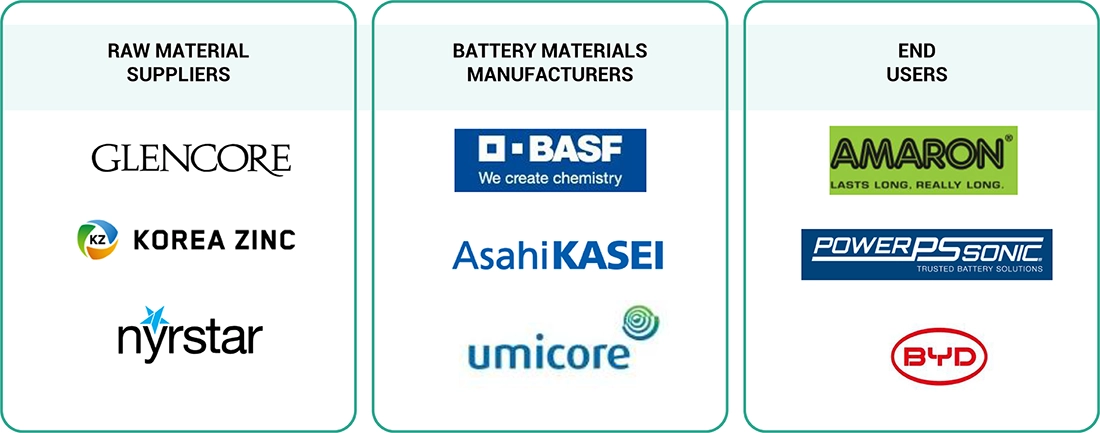
Battery Materials Market: COMMERCIAL USE CASES ACROSS INDUSTRIES
| COMPANY | USE CASE DESCRIPTION | BENEFITS |
|---|---|---|
 |
Production of high-nickel cathode active materials (NCM & NCMA) and synthetic graphite anodes for EV and ESS batteries. | Higher energy density, longer driving range, enhanced charging speed, stable supply chain integration. |
 |
Supplies high-quality nickel and cobalt materials used in NCA and NMC cathodes for leading EV battery makers. | Ensures consistent cathode performance, high thermal stability, supports high-capacity and long-life batteries. |
 |
Development of battery separators (Hipore™ polyolefin microporous membrane) widely used in lithium-ion batteries. | Superior safety (prevents short-circuits), high ionic conductivity, thinner and more efficient separators enabling higher energy density. |
 |
Development of next-gen cathode active materials with reduced cobalt content. | Cost reduction, improved sustainability, optimized battery performance. |
 |
Cathode material production (NMC and NCA) for multiple EV manufacturers. | Sustainable sourcing, improved performance, and recycling integration. |
Logos and trademarks shown above are the property of their respective owners. Their use here is for informational and illustrative purposes only.
Related Ecosystem
Bulk Chemicals And Inorganics
- Corrosion Inhibitors
- Glycol Ethers
- Acetic Acid
- Acetone
- Ammonium Nitrate
- Basf se
- DOW CHEMICAL COMPANY
- Exxon Mobil Corporation
- AZELIS HOLDINGS SA
- Sinopec limited
Key Takeaways
- North America's battery materials market will grow from $10.2B (2025) to $16.0B (2030) at a 9.3% CAGR, reflecting strong regional demand.
- Government policies like the Inflation Reduction Act are driving North America's domestic battery material production and supply chain resilience.
- North America's EV and energy storage sectors are primary demand drivers for advanced cathode, anode, and electrolyte materials through 2030.
- North America is investing heavily in battery recycling and circular economy initiatives to secure long-term material availability.
Battery Materials Market Report Scope
| Report Metric | Details |
|---|---|
| Base Year | 2025 |
| Fastest Growing Segment | OTHER BATTERY TYPES (Battery Type) |
| Forecast Period | 2025-2030 |
| Growth Rate | CAGR of 13.7% from 2025 to 2030 |
| Largest Segment | LITHIUM-ION (Battery Type) |
| Market Size Base Year (Billions) | ~USD 77.85 (2025) |
| Revenue Forecast (Billions) | ~USD 147.93 (2030) |
| Segments Covered | Material, Type, Application, Battery Type, Battery Material, Cathode Material, Anode Material, Battery Materials |
North America Battery Materials Market Report Segmentation
8 segment dimensions are covered across the global market.
By Material
- Anode
- Cathode
- Electrolyte
By Type
- Artificial
- Lco
- Lfp
- Lmo
- Lto
- Natural
- Nca
- Nmc
By Application
- Automotive
- Electric Vehicles
- Industrial
- Other Applications
- Portable Devices
By Battery Type
- Lead-Acid
- Lithium-Ion
- Other Battery Types
By Battery Material
- Anode
- Cathode
- Electrolyte
- Other Battery Materials
By Cathode Material
- Lco
- Lfp
- Lmo
- Nca
- Nmc
By Anode Material
- Artificial
- Natural
By Battery Materials
- Anode
- Cathode
- Electrolyte
- Other Battery Materials
Target Audience
- Battery Manufacturers & OEMs : Automotive and energy storage manufacturers need North American market data to optimize sourcing strategies, plan capacity expansion, and navigate regional supply chain dynamics for battery material procurement.
- Material Suppliers & Processors : Lithium, cobalt, nickel, and other material producers require detailed North American demand forecasts to guide production investments, identify growth segments, and develop regional distribution strategies.
- Investment & Private Equity Firms : Investors evaluating North American battery material companies need market sizing, growth projections, and competitive analysis to support due diligence, valuation, and portfolio strategy decisions.
- Government & Policy Makers : Regulatory bodies and government agencies use market intelligence to assess policy effectiveness, plan industrial development initiatives, and ensure supply chain security for critical battery materials.
- Recycling & Circular Economy Operators : Battery recycling companies and circular economy businesses require North American market data to identify material recovery opportunities, assess demand for recycled content, and plan facility expansion.
Countries within North America - compare and drill down
| Country | 2025 size (native) |
|---|---|
| US | USD 1448.7 Million |
| Rest Of North America | USD 355 Million |
Country market size visualization
Reasons to Buy this Report
- Regional Market Sizing & Forecasts : Obtain precise market valuations for North America ($10.2B in 2025) with detailed 5-year projections through 2030. Understand country-level breakdowns for the US and Rest of North America to identify high-growth segments and investment opportunities.
- Competitive Landscape Analysis : Gain insights into North American battery material suppliers, manufacturers, and key players. Identify competitive positioning, market share dynamics, and strategic partnerships shaping the regional supply chain.
- Policy & Regulatory Intelligence : Access comprehensive analysis of North American government incentives, the Inflation Reduction Act, and regional regulations impacting battery material production. Understand how policy frameworks influence market dynamics and investment decisions.
- Supply Chain & Sourcing Strategies : Evaluate domestic sourcing opportunities, recycling initiatives, and supply chain resilience across North America. Identify critical material bottlenecks and strategic sourcing alternatives for battery manufacturers and material suppliers.
- Investment & Growth Opportunities : Identify high-potential segments, emerging technologies, and geographic hotspots for battery material expansion in North America. Support strategic planning, M&A decisions, and capital allocation with data-driven market intelligence.
Frequently asked questions
What is the projected size of North America's battery materials market by 2030?
North America's battery materials market is projected to reach $15,960.3 million by 2030, up from $10,243.1 million in 2025.
What is the CAGR for North America's battery materials market?
North America's battery materials market is expected to grow at a compound annual growth rate (CAGR) of 9.3% between 2025 and 2030.
Which factors are driving growth in North America's battery materials market?
Key drivers include electric vehicle adoption, renewable energy storage deployment, government incentives like the Inflation Reduction Act, and domestic manufacturing expansion in North America.
What battery materials are most in demand in North America?
North America shows strong demand for lithium, cobalt, nickel, and manganese for cathodes, as well as graphite for anodes and advanced electrolyte materials.
How is North America addressing battery material supply chain challenges?
North America is investing in domestic mining, processing facilities, battery recycling infrastructure, and circular economy initiatives to reduce supply chain vulnerabilities.
RESEARCH METHODOLOGY
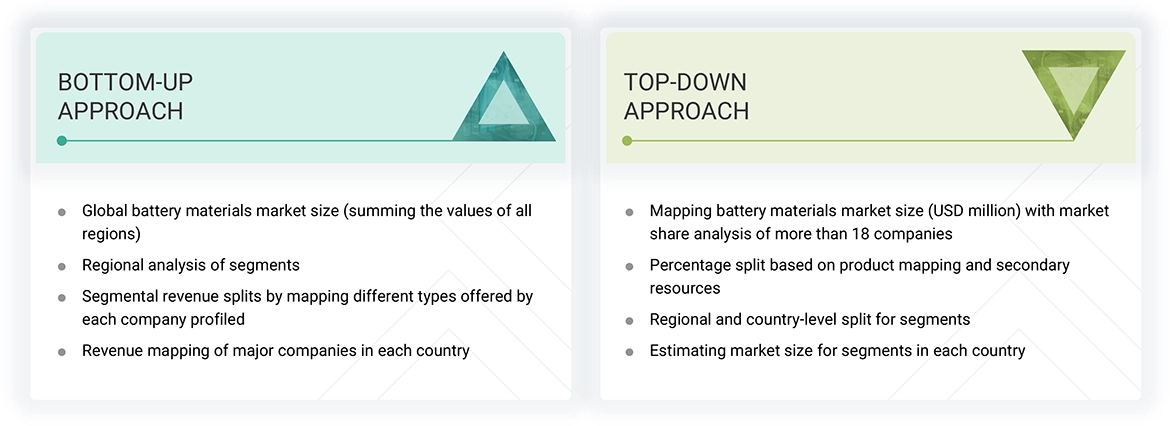
The research involved four main steps to assess the current market size of battery materials. Extensive secondary research was carried out to collect information on the market, related peer markets, and parent markets. The next phase was to verify these findings, assumptions, and measurements with industry experts across the battery materials value chain through primary research. The overall market size was determined using both top-down and bottom-up approaches. Then, market segmentation analysis and data triangulation were used to define the sizes of different market segments and sub-segments.
Secondary Research
The research approach used to evaluate and forecast the battery materials market starts with collecting revenue data from leading suppliers through secondary research. During this process, multiple sources such as Hoovers, Bloomberg BusinessWeek, Factiva, the World Bank, and industry magazines were employed to gather information for this study. These secondary sources included annual reports, press releases, investor presentations from companies, white papers, reputable periodicals, writings by respected authors, regulatory agency announcements, trade directories, and databases. Vendor offerings were examined to determine market segmentation.
Primary Research
The battery materials market involves various stakeholders, such as manufacturers, suppliers, traders, associations, and regulatory organizations within the supply chain. The demand side is driven by the growth of electric vehicles, portable devices, industrial, and other applications. On the supply side, technological advancements are prominent. To gather qualitative and quantitative data, interviews were conducted with several key sources from both the supply and demand sides of the market.
The following outlines the primary respondents:
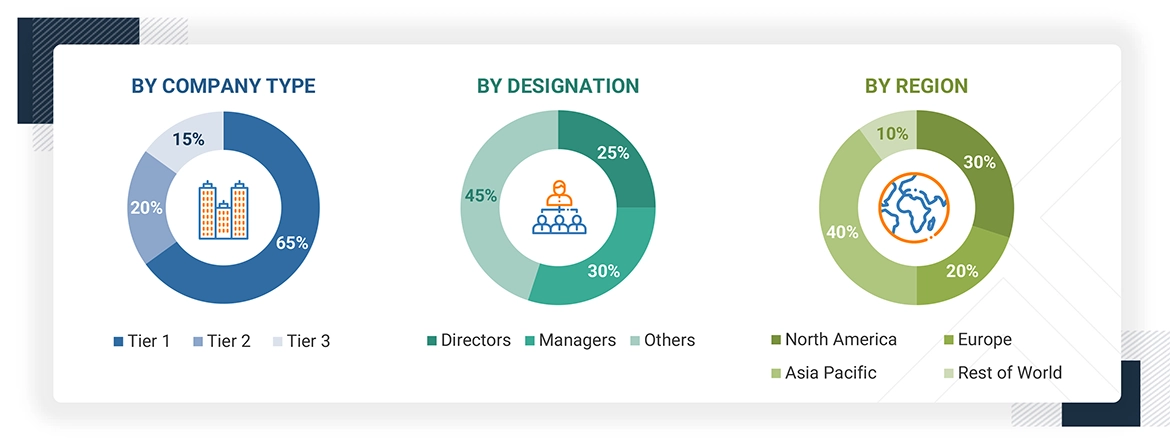
To know about the assumptions considered for the study, download the pdf brochure
Market Size Estimation
Both the top-down and bottom-up approaches were employed to estimate and verify the overall size of the battery materials market. These methods were also widely used to determine the size of various sub-segments within the market. The research methodology used to estimate the market size included the following:
- The key players were identified through extensive primary and secondary research.
- The value chain and market size of the battery materials market, in terms of value, were determined through primary and secondary research.
- All percentage shares, splits, and breakdowns were determined using secondary sources and verified through primary sources.
- All possible parameters that affect the market covered in this research study were accounted for, viewed in extensive detail, verified through primary research, and analyzed to obtain the final quantitative and qualitative data.
- The research included the study of reports, reviews, and newsletters of top market players, along with extensive interviews for opinions from key leaders, such as CEOs, directors, and marketing executives.
Global Battery Materials Market Size: Bottom-up and Top-down Approach
Data Triangulation
After estimating the overall market size using the methods described above, the market was divided into various segments and sub-segments. To complete the market engineering process and determine precise statistics for each segment and sub-segment, data triangulation and market breakdown procedures were used where applicable. The global market size was then calculated by adding together the data from individual countries and regions.
Market Definition
Batteries utilize various elements that are mined from the Earth's crust. Each battery consists of four main components: anode, cathode, electrolyte, and separators. There are also several other important parts, such as binders, current collectors, and packaging materials. Different raw materials are used in manufacturing batteries for different types. In this study, materials used in making rechargeable lead-acid batteries, lithium-ion batteries, and others (such as sodium-based, nickel-based, and flow batteries) are examined.
Stakeholders
- Battery material manufacturers
- Battery material suppliers
- Battery material traders, distributors, and suppliers
- Investment banks and private equity firms
- Raw material suppliers
- Government and research organizations
- Consulting companies/consultants in the chemicals and materials sectors
- Industry associations
- Contract manufacturing organizations (CMOs)
- NGOs, governments, investment banks, venture capitalists, and private equity firms
Report Objectives
- To define, describe, and forecast the size of the global battery materials market in terms of volume and value
- To provide detailed information regarding the key factors, such as drivers, restraints, opportunities, and industry-specific challenges, influencing the growth of the global battery materials market
- To analyze and forecast the size of various segments (raw material and application) of the battery materials market based on four major regions—North America, Asia Pacific, Europe, and Rest of World, along with key countries in each of these regions
- To analyze recent developments and competitive strategies, such as agreements, partnerships, product launches, and joint ventures, to draw the competitive landscape of the market
- To strategically profile the key players in the market and comprehensively analyze their core competencies
Get the Full Battery Materials Market Report
Full forecast, segment splits, and company analysis for all Battery Materials Market.
- US Battery Materials Market
- Rest Of North America Battery Materials Market
- Germany Battery Materials Market
- UK Battery Materials Market
- France Battery Materials Market
- Rest Of Europe Battery Materials Market
- China Battery Materials Market
- Japan Battery Materials Market
- South Korea Battery Materials Market
- India Battery Materials Market
- Rest Of Asia Pacific Battery Materials Market
- Brazil Battery Materials Market
- Rest Of World Battery Materials Market
Need a Tailored Report?
Customize this report to your needs
Get 10% FREE Customization
Customize This Report
