
UK Battery Materials Market (2025-2030)

The UK Battery Materials Market was valued at $127.5 Million in 2025 and projected to reach to $179.7 Million by 2030, representing a compound annual growth rate of 7.1%. The UK battery materials market is poised for sustained growth through 2030, supported by the government's net-zero commitments and substantial investments in EV infrastructure.


| Market Size in | USD 26.32 MN |
| Market Forecast in | |
| CAGR | |
| Forecast Period | |
| Units Considered | Value (USD MN) |
UK Battery Materials Market Trends and Insights
- The UK's battery materials sector is driven by the nation's commitment to electric vehicle adoption, renewable energy storage infrastructure, and domestic battery manufacturing initiatives.
- The UK's strategic position in Europe's clean energy transition supports sustained demand for lithium-ion components, cathode materials, and electrolyte solutions through 2030. The UK battery materials market benefits from government incentives, including subsidies for EV production and battery recycling programs that create secondary material supply chains.
- The UK's regulatory framework emphasizing carbon neutrality and circular economy principles encourages investment in advanced battery chemistries and sustainable sourcing practices.
- By 2030, the UK market is expected to consolidate around key manufacturing hubs and supply chain partnerships that align with European battery directives and net-zero commitments..
Key Market Statistics
- CAGR (2025-2030) 7.1% CAGR
- Market Size, 2025 ~USD 127.5 Million
- Forecast, 2030 ~USD 179.7 Million
- Country UK
UK Battery Materials Market Overview
Market Valuation :
The UK battery materials market is valued at $127.5 million in 2025, with projections reaching $179.7 million by 2030, representing a steady 7.1% CAGR over the forecast period.
EV Adoption Driver :
The UK's aggressive electric vehicle adoption targets and government incentives are accelerating demand for advanced battery materials, positioning the nation as a key growth market in Europe.
Domestic Manufacturing Growth :
Strategic battery manufacturing initiatives and gigafactory developments across the UK are creating substantial demand for locally-sourced and imported battery materials and components.
Renewable Energy Integration :
Expansion of renewable energy storage infrastructure and grid-scale battery systems are driving diversified demand for battery materials beyond the automotive sector in the UK market.
UK Battery Materials Market Dynamics
- The establishment of domestic battery manufacturing facilities will create consistent demand for cathode, anode, and electrolyte materials.
- Additionally, the UK's renewable energy transition and energy storage requirements will diversify market opportunities beyond automotive applications.
- Supply chain localization initiatives and partnerships with European manufacturers will strengthen the market's competitive position and resilience..
Market Ecosystem
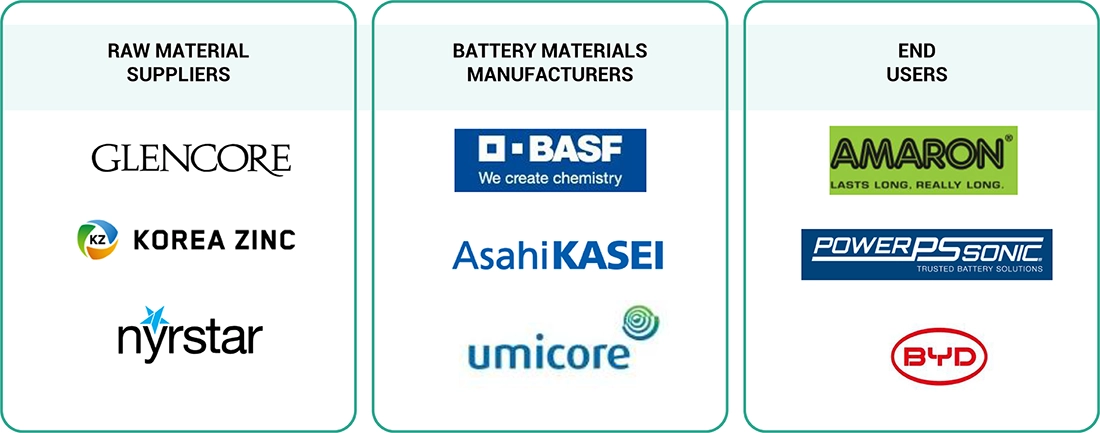
Battery Materials Market: COMMERCIAL USE CASES ACROSS INDUSTRIES
| COMPANY | USE CASE DESCRIPTION | BENEFITS |
|---|---|---|
 |
Production of high-nickel cathode active materials (NCM & NCMA) and synthetic graphite anodes for EV and ESS batteries. | Higher energy density, longer driving range, enhanced charging speed, stable supply chain integration. |
 |
Supplies high-quality nickel and cobalt materials used in NCA and NMC cathodes for leading EV battery makers. | Ensures consistent cathode performance, high thermal stability, supports high-capacity and long-life batteries. |
 |
Development of battery separators (Hipore™ polyolefin microporous membrane) widely used in lithium-ion batteries. | Superior safety (prevents short-circuits), high ionic conductivity, thinner and more efficient separators enabling higher energy density. |
 |
Development of next-gen cathode active materials with reduced cobalt content. | Cost reduction, improved sustainability, optimized battery performance. |
 |
Cathode material production (NMC and NCA) for multiple EV manufacturers. | Sustainable sourcing, improved performance, and recycling integration. |
Logos and trademarks shown above are the property of their respective owners. Their use here is for informational and illustrative purposes only.
Related Ecosystem
Bulk Chemicals And Inorganics
- Corrosion Inhibitors
- Glycol Ethers
- Acetic Acid
- Acetone
- Ammonium Nitrate
- Basf se
- DOW CHEMICAL COMPANY
- Exxon Mobil Corporation
- AZELIS HOLDINGS SA
- Sinopec limited
Key Takeaways
- The UK battery materials market is valued at $127.5M in 2025 and will reach $179.7M by 2030, growing at 7.1% CAGR.
- The UK's EV adoption targets and renewable energy storage demand are primary growth catalysts for battery materials consumption.
- The UK's circular economy regulations and battery recycling mandates create opportunities for secondary material recovery and sustainable sourcing.
- The UK market is increasingly integrated with European supply chains, positioning it as a critical node in the continent's battery value chain.
Battery Materials Market Report Scope
| Report Metric | Details |
|---|---|
| Base Year | 2025 |
| Fastest Growing Segment | OTHER BATTERY TYPES (Battery Type) |
| Forecast Period | 2025-2030 |
| Growth Rate | CAGR of 13.7% from 2025 to 2030 |
| Largest Segment | LITHIUM-ION (Battery Type) |
| Market Size Base Year (Billions) | ~USD 77.85 (2025) |
| Revenue Forecast (Billions) | ~USD 147.93 (2030) |
| Segments Covered | Material, Type, Application, Battery Type, Battery Material, Cathode Material, Anode Material, Battery Materials |
UK Battery Materials Market Report Segmentation
8 segment dimensions are covered across the global market.
By Material
- Anode
- Cathode
- Electrolyte
By Type
- Artificial
- Lco
- Lfp
- Lmo
- Lto
- Natural
- Nca
- Nmc
By Application
- Automotive
- Electric Vehicles
- Industrial
- Other Applications
- Portable Devices
By Battery Type
- Lead-Acid
- Lithium-Ion
- Other Battery Types
By Battery Material
- Anode
- Cathode
- Electrolyte
- Other Battery Materials
By Cathode Material
- Lco
- Lfp
- Lmo
- Nca
- Nmc
By Anode Material
- Artificial
- Natural
By Battery Materials
- Anode
- Cathode
- Electrolyte
- Other Battery Materials
Target Audience
- Battery Material Manufacturers : Producers of cathode, anode, and electrolyte materials need UK-specific demand forecasts and market sizing to optimize production capacity and supply chain investments in the region.
- EV & Battery Manufacturers : Automotive and battery OEMs establishing UK operations require detailed material market intelligence to secure supply contracts and plan manufacturing facility requirements.
- Investment & Private Equity Firms : Investors evaluating opportunities in UK battery supply chain companies need market data to assess growth potential, valuation benchmarks, and exit opportunities in this sector.
- Government & Policy Bodies : UK government agencies and policy makers use market intelligence to inform industrial strategy, manufacturing incentives, and supply chain resilience initiatives for battery materials.
- Logistics & Supply Chain Providers : Companies managing battery material distribution and supply chains in the UK need market forecasts to plan infrastructure, warehousing, and logistics network expansion.
Reasons to Buy this Report
- UK-Specific Market Sizing : Access precise valuation data for the UK battery materials market with detailed forecasts through 2030, enabling accurate business planning and investment decisions tailored to the British market.
- Competitive Landscape Intelligence : Understand the UK's unique competitive dynamics, including domestic manufacturers, supply chain players, and regulatory frameworks that differentiate it from broader European markets.
- Growth Driver Analysis : Identify and quantify the specific factors driving UK market growth—EV adoption rates, government policies, manufacturing investments, and renewable energy targets—to inform strategic positioning.
- Investment Opportunity Assessment : Evaluate market entry points, partnership opportunities, and expansion strategies specific to the UK's battery materials ecosystem and manufacturing infrastructure development.
- Regulatory & Policy Insights : Stay informed on UK-specific regulations, net-zero commitments, and government incentives that directly impact battery materials demand and supply chain development.
Frequently asked questions
What is the current size of the UK battery materials market?
The UK battery materials market is estimated at $127.5 million in 2025 and is projected to grow to $179.7 million by 2030.
What is the growth rate of the UK battery materials market?
The UK battery materials market is expected to grow at a compound annual growth rate (CAGR) of 7.1% from 2025 to 2030.
What are the main drivers of growth in the UK battery materials market?
Key drivers include the UK's electric vehicle adoption targets, renewable energy storage infrastructure expansion, government EV subsidies, and battery recycling regulations aligned with circular economy principles.
Which battery materials are most in demand in the UK?
The UK market shows strong demand for lithium-ion components, cathode materials, electrolyte solutions, and secondary materials derived from battery recycling programs.
How does the UK battery materials market compare to Europe?
The UK battery materials market grows at 7.1% CAGR, slightly below the global average of 13.7%, reflecting its mature market status and integration within European supply chains.
RESEARCH METHODOLOGY
The research involved four main steps to assess the current market size of battery materials. Extensive secondary research was carried out to collect information on the market, related peer markets, and parent markets. The next phase was to verify these findings, assumptions, and measurements with industry experts across the battery materials value chain through primary research. The overall market size was determined using both top-down and bottom-up approaches. Then, market segmentation analysis and data triangulation were used to define the sizes of different market segments and sub-segments.
Secondary Research
The research approach used to evaluate and forecast the battery materials market starts with collecting revenue data from leading suppliers through secondary research. During this process, multiple sources such as Hoovers, Bloomberg BusinessWeek, Factiva, the World Bank, and industry magazines were employed to gather information for this study. These secondary sources included annual reports, press releases, investor presentations from companies, white papers, reputable periodicals, writings by respected authors, regulatory agency announcements, trade directories, and databases. Vendor offerings were examined to determine market segmentation.
Primary Research
The battery materials market involves various stakeholders, such as manufacturers, suppliers, traders, associations, and regulatory organizations within the supply chain. The demand side is driven by the growth of electric vehicles, portable devices, industrial, and other applications. On the supply side, technological advancements are prominent. To gather qualitative and quantitative data, interviews were conducted with several key sources from both the supply and demand sides of the market.
The following outlines the primary respondents:
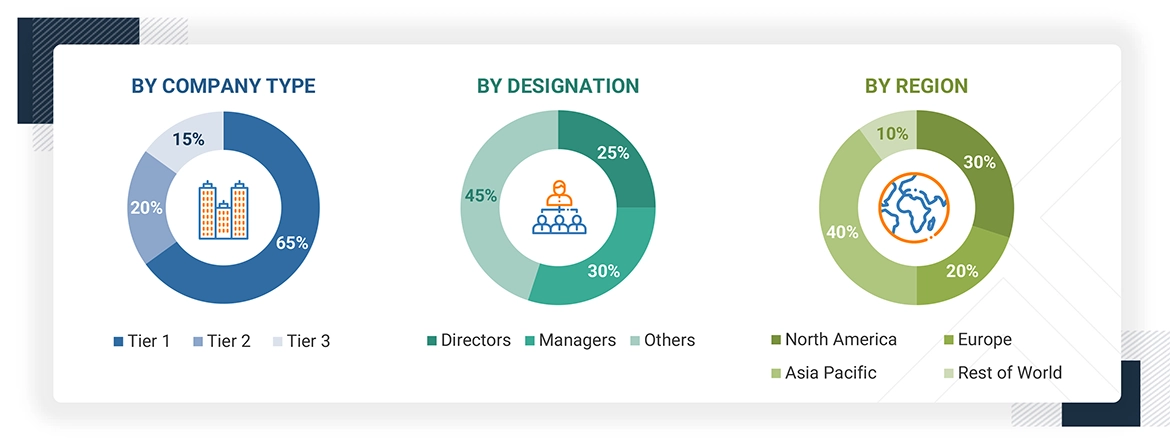
To know about the assumptions considered for the study, download the pdf brochure
Market Size Estimation
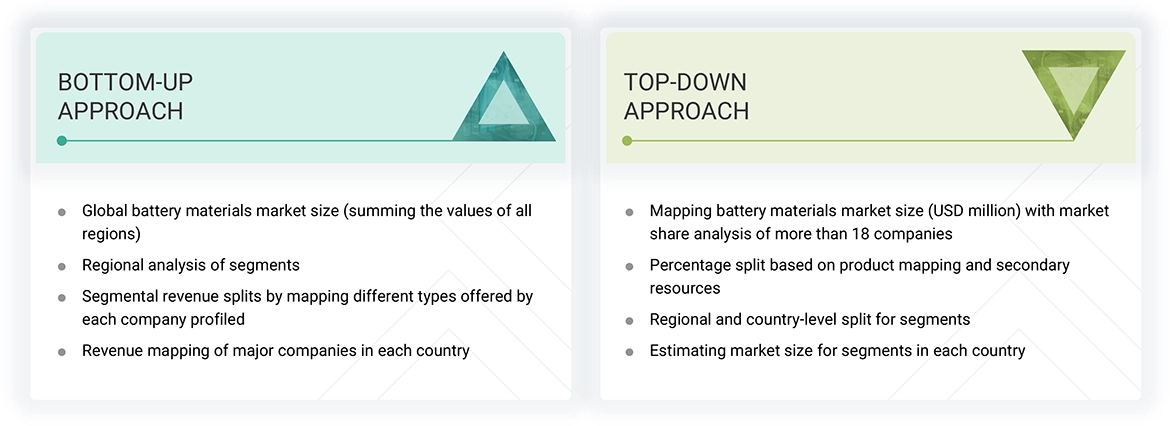
Both the top-down and bottom-up approaches were employed to estimate and verify the overall size of the battery materials market. These methods were also widely used to determine the size of various sub-segments within the market. The research methodology used to estimate the market size included the following:
- The key players were identified through extensive primary and secondary research.
- The value chain and market size of the battery materials market, in terms of value, were determined through primary and secondary research.
- All percentage shares, splits, and breakdowns were determined using secondary sources and verified through primary sources.
- All possible parameters that affect the market covered in this research study were accounted for, viewed in extensive detail, verified through primary research, and analyzed to obtain the final quantitative and qualitative data.
- The research included the study of reports, reviews, and newsletters of top market players, along with extensive interviews for opinions from key leaders, such as CEOs, directors, and marketing executives.
Global Battery Materials Market Size: Bottom-up and Top-down Approach
Data Triangulation
After estimating the overall market size using the methods described above, the market was divided into various segments and sub-segments. To complete the market engineering process and determine precise statistics for each segment and sub-segment, data triangulation and market breakdown procedures were used where applicable. The global market size was then calculated by adding together the data from individual countries and regions.
Market Definition
Batteries utilize various elements that are mined from the Earth's crust. Each battery consists of four main components: anode, cathode, electrolyte, and separators. There are also several other important parts, such as binders, current collectors, and packaging materials. Different raw materials are used in manufacturing batteries for different types. In this study, materials used in making rechargeable lead-acid batteries, lithium-ion batteries, and others (such as sodium-based, nickel-based, and flow batteries) are examined.
Stakeholders
- Battery material manufacturers
- Battery material suppliers
- Battery material traders, distributors, and suppliers
- Investment banks and private equity firms
- Raw material suppliers
- Government and research organizations
- Consulting companies/consultants in the chemicals and materials sectors
- Industry associations
- Contract manufacturing organizations (CMOs)
- NGOs, governments, investment banks, venture capitalists, and private equity firms
Report Objectives
- To define, describe, and forecast the size of the global battery materials market in terms of volume and value
- To provide detailed information regarding the key factors, such as drivers, restraints, opportunities, and industry-specific challenges, influencing the growth of the global battery materials market
- To analyze and forecast the size of various segments (raw material and application) of the battery materials market based on four major regions—North America, Asia Pacific, Europe, and Rest of World, along with key countries in each of these regions
- To analyze recent developments and competitive strategies, such as agreements, partnerships, product launches, and joint ventures, to draw the competitive landscape of the market
- To strategically profile the key players in the market and comprehensively analyze their core competencies
Get the Full Battery Materials Market Report
Full forecast, segment splits, and company analysis for all Battery Materials Market.
- US Battery Materials Market
- Rest Of North America Battery Materials Market
- Germany Battery Materials Market
- France Battery Materials Market
- Rest Of Europe Battery Materials Market
- China Battery Materials Market
- Japan Battery Materials Market
- South Korea Battery Materials Market
- India Battery Materials Market
- Rest Of Asia Pacific Battery Materials Market
- Brazil Battery Materials Market
- Rest Of World Battery Materials Market
Need a Tailored Report?
Customize this report to your needs
Get 10% FREE Customization
Customize This Report
