
China Behavioural/Mental Health Software Market (2021-2026)

The China Behavioural/Mental Health Software Market was valued at $27 Million in 2021 and projected to reach to $59.3 Million by 2026, representing a compound annual growth rate of 17.0%. China's behavioural and mental health software market is positioned for sustained growth as the nation prioritizes mental wellness within its broader healthcare modernization agenda.


| Market Size in | USD 26.32 MN |
| Market Forecast in | |
| CAGR | |
| Forecast Period | |
| Units Considered | Value (USD MN) |
China Behavioural/Mental Health Software Market Trends and Insights
- This growth trajectory reflects China's increasing recognition of mental health as a critical healthcare priority and rising digital adoption across urban and semi-urban populations.
- China's market is driven by government initiatives promoting mental health awareness, growing smartphone penetration, and expanding telemedicine infrastructure that enables remote mental health consultations. The market in China is characterized by a shift toward digital-first mental health solutions, including AI-powered chatbots, therapy platforms, and mood-tracking applications.
- China's regulatory environment is gradually opening to private mental health technology providers, though state-backed initiatives remain dominant.
- Between 2021 and 2026, China is expected to see accelerated investment from both domestic tech giants and specialized healthcare startups seeking to address the nation's substantial mental health treatment gap..
Key Market Statistics
- CAGR (2021-2026) 17.0% CAGR
- Market Size, 2021 ~USD 27 Million
- Forecast, 2026 ~USD 59.3 Million
- Country China
China Behavioural/Mental Health Software Market Overview
Rapid Market Expansion :
China's behavioural and mental health software market is growing at 17% CAGR, expanding from $27.0 million in 2021 to $59.3 million by 2026, driven by government mental health initiatives and digital healthcare transformation.
Government Policy Support :
Chinese government initiatives prioritizing mental health as a critical healthcare component are accelerating adoption of digital mental health solutions across public and private healthcare systems.
Urban Digital Adoption :
Rising digital adoption in China's urban and semi-urban populations is creating strong demand for accessible, technology-enabled behavioural and mental health platforms and telemedicine solutions.
Market Valuation Growth :
The market is projected to more than double in value over five years, reflecting China's shift toward preventive mental healthcare and increased investment in digital health infrastructure.
China Behavioural/Mental Health Software Market Dynamics
- Government support, coupled with increasing urbanization and smartphone penetration, creates a favorable environment for digital mental health solutions.
- The market's 17% CAGR reflects growing acceptance of telepsychiatry, AI-powered mental health assessments, and mobile health applications among Chinese consumers. Key growth drivers include rising awareness of mental health conditions, workplace stress management initiatives, and integration of mental health services into existing healthcare platforms.
- As China's middle class expands and healthcare spending increases, investment in behavioural health software will accelerate.
- The convergence of regulatory support, technological advancement, and cultural shifts toward mental health acceptance positions China as a high-growth market within the Asia-Pacific region..
Market Ecosystem
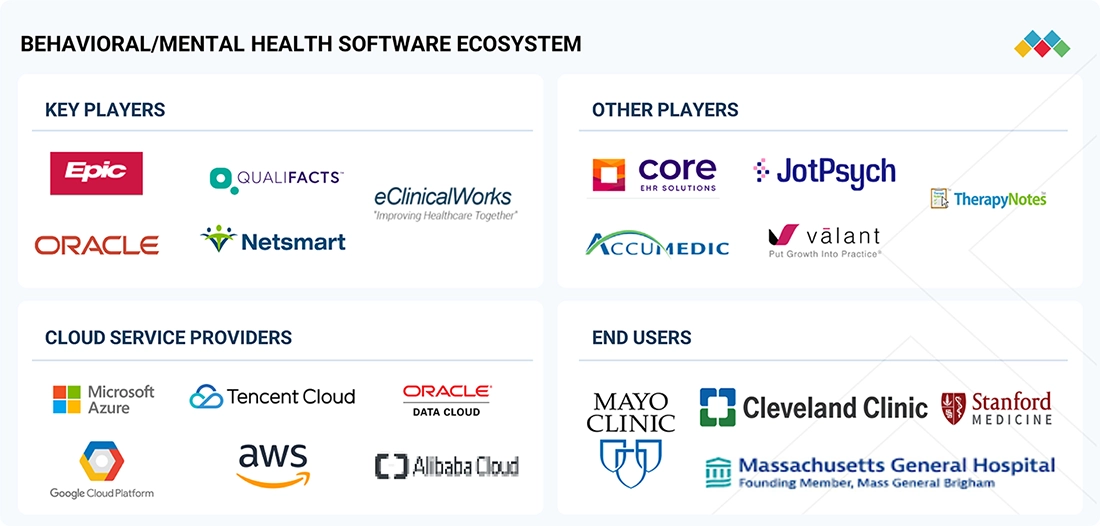
BEHAVIORAL/MENTAL HEALTH SOFTWARE MARKET: COMMERCIAL USE CASES ACROSS INDUSTRIES
| COMPANY | USE CASE DESCRIPTION | BENEFITS |
|---|---|---|
 |
AI-enabled behavioral health EHR with clinical documentation, treatment planning, telehealth, and interoperable care management | Improved care coordination, streamlined workflows, and enhanced clinical efficiency. |
 |
Integrated behavioral health EHR supporting psychiatry workflows, collaborative care, patient engagement, and telepsychiatry | Better care continuity, standardized documentation, and improved patient outcomes |
 |
Behavioral health EHR with AI-powered documentation, care coordination, telehealth, and population health management | Enhanced care coordination, reduced clinician burden, optimized operational efficiency |
 |
Behavioral health EHR integrating measurement-based care, telehealth, analytics, and practice management | Improved treatment outcomes, data-driven decisions, and increased provider productivity |
 |
Cloud-based behavioral health EHR with AI documentation, telehealth, patient engagement, and ePrescribing | Faster documentation, improved workflow efficiency, and enhanced patient access |
Logos and trademarks shown above are the property of their respective owners. Their use here is for informational and illustrative purposes only.
Related Ecosystem
Healthcare It
- Computed Tomography (CT)
- Machine Learning
- Magnetic Resonance Imaging (MRI)
- Natural Language Processing (NLP)
- Predictive Analytics
- CERNER CORPORATION
- PHILIPS HEALTHCARE
- Oracle Corporation
- GE HealthCare Technologies Inc.
- Siemens healthineers
Key Takeaways
- China's behavioural/mental health software market will more than double from $27.0M (2021) to $59.3M (2026), representing a 17.0% CAGR.
- China is leveraging digital health infrastructure and government mental health initiatives to expand access to behavioural health services.
- China's market growth is fueled by rising smartphone adoption, telemedicine expansion, and increasing mental health awareness among younger demographics.
- China's competitive landscape includes both state-backed platforms and private technology companies developing AI-driven mental health solutions.
Behavioural/Mental Health Software Market Report Scope
| Report Metric | Details |
|---|---|
| Base Year | 2021 |
| Fastest Growing Segment | SUPPORT SERVICES (Component) |
| Forecast Period | 2021-2026 |
| Growth Rate | CAGR of 19.6% from 2021 to 2026 |
| Largest Segment | SUBSCRIPTION MODELS (Delivery Model) |
| Market Size Base Year (Billions) | ~USD 2 (2021) |
| Revenue Forecast (Billions) | ~USD 4.9 (2026) |
| Segments Covered | Component, Type, Delivery Model, Functionality, End User |
China Behavioural/Mental Health Software Market Report Segmentation
5 segment dimensions are covered across the global market.
By Component
- Software
- Support Services
By Type
- Accounts Payable/General Ledger
- Business Intelligence
- Business Intelligence (Bi)
- Care Plans
- Case Management
- Cds
- Clinical Decision Support (Cds)
- Document/Image Management
- E-Prescribing
- Ehrs
- Electronic Health Records (Ehrs)
- Integrated Software
- Managed Care
- Patient/Client Scheduling
- Payroll
- Rcm
- Revenue Cycle Management (Rcm)
- Standalone Software
- Telehealth
- Workforce Management
By Delivery Model
- Ownership Models
- Subscription Models
By Functionality
- Administrative Functionality
- Clinical Functionality
- Financial Functionality
By End User
- Community Clinics
- Hospitals
- Private Practices
Target Audience
- Healthcare Software Vendors : Vendors need China-specific market data to develop localized mental health software products, understand competitive landscape, and identify distribution channels within China's regulated healthcare environment.
- Investment & Private Equity Firms : Investors require validated market sizing and growth forecasts for China to evaluate portfolio opportunities, assess risk-return profiles, and identify acquisition targets in the high-growth mental health tech sector.
- Healthcare Providers & Hospital Networks : Chinese healthcare institutions need market intelligence to make informed software procurement decisions, benchmark against peers, and align digital mental health investments with government initiatives.
- Government & Policy Makers : Chinese health authorities and policymakers use market data to evaluate digital health infrastructure investments, assess market maturity, and design regulations supporting mental health software adoption.
- Consulting & Strategy Firms : Consultants advising healthcare clients in China require detailed market segmentation, growth drivers, and competitive analysis to develop strategic recommendations and market entry strategies.
Reasons to Buy this Report
- Market Size & Growth Validation : Quantified market data for China showing 17% CAGR and $32.3M growth opportunity (2021-2026) enables accurate business planning, investment decisions, and revenue projections specific to this high-growth market.
- Government Initiative Insights : Understand how Chinese government policies are reshaping the mental health software landscape, identifying regulatory tailwinds, compliance requirements, and partnership opportunities with state-backed healthcare programs.
- Competitive Positioning Strategy : Benchmark your solutions against China's market dynamics, identify white space opportunities in urban vs. semi-urban segments, and develop localized go-to-market strategies for maximum market penetration.
- Investment & Funding Decisions : Data-driven market forecasts support funding pitches, M&A evaluations, and resource allocation decisions for companies entering or expanding within China's rapidly expanding mental health software ecosystem.
- Digital Adoption Trends : Leverage insights on China's rising digital adoption patterns to identify emerging opportunities in mobile-first solutions, AI integration, and telemedicine platforms aligned with consumer behaviour shifts.
Frequently asked questions
What is the current size of China's behavioural/mental health software market?
China's behavioural/mental health software market was valued at $27.0 million in 2021 and is forecast to reach $59.3 million by 2026.
What is the projected growth rate for China's mental health software market?
China's market is expected to grow at a compound annual growth rate (CAGR) of 17.0% from 2021 to 2026.
What factors are driving growth in China's behavioural health software sector?
Key drivers include government mental health initiatives, rising smartphone penetration, expanding telemedicine infrastructure, and increasing mental health awareness, particularly among younger populations in China.
Who are the main players in China's mental health software market?
China's market includes state-backed mental health platforms, domestic technology giants entering the mental health space, and specialized healthcare startups developing AI-powered solutions.
How does China's mental health software market compare to global trends?
China's 17.0% CAGR is competitive with global growth, though China's market is characterized by unique regulatory dynamics, state involvement, and rapid digital health infrastructure development.
RESEARCH METHODOLOGY
The study involved significant activities in estimating the current size of the behavioral/mental health software market. Exhaustive secondary research was done to collect information on the behavioral/mental health software market. The next step was to validate these findings, assumptions, and sizing with industry experts across the value chain using primary research. Different approaches, such as top-down and bottom-up, were employed to estimate the total market size. After that, the market breakup and data triangulation procedures were used to estimate the market size of the segments and subsegments of the behavioral/mental health software market.
Secondary Research
This research study involved the wide use of secondary sources, directories, and databases such as Dun & Bradstreet, Bloomberg Businessweek, and Factiva; white papers, annual reports, and companies’ house documents; investor presentations; and the SEC filings of companies. The market for companies offering behavioral/mental health software solutions is derived from secondary data available through paid and unpaid sources, by analyzing the product portfolios of major companies in the ecosystem, and by rating the companies based on their performance and quality. Various sources were referred to in the secondary research process to identify and collect information for this study. The secondary sources include annual reports, press releases, companies' investor presentations, white papers, journals, certified publications, articles by recognized authors, directories, and databases.
Various secondary sources were referred to in the secondary research process to identify and collect information related to the study. These sources included annual reports, press releases, investor presentations from behavioral/mental health software vendors, forums, certified publications, and white papers. Secondary research was used to obtain critical information on the industry’s value chain, the pool of key players, market classification, and segmentation from market- and technology-oriented perspectives.
Primary Research
In the primary research process, various sources from both the supply and demand sides were interviewed to obtain qualitative and quantitative information for this report. Primary sources are mainly industry experts from the core and related industries and preferred suppliers, manufacturers, distributors, technology developers, researchers, and organizations related to all segments of this industry’s value chain. In-depth interviews were conducted with various primary respondents, including key industry participants, subject-matter experts (SMEs), C-level executives of key market players, and industry consultants, among other experts, to obtain and verify the critical qualitative and quantitative information as well as assess prospects.
Primary research was conducted to identify segmentation types; industry trends; key players; and key market dynamics such as drivers, restraints, opportunities, challenges, industry trends, and strategies adopted by key players.
After the complete market engineering (calculations for market statistics, market breakdown, market size estimations, market forecasting, and data triangulation), extensive primary research was conducted to gather information and verify and validate the critical numbers arrived at.
In the complete market engineering process, the top-down and bottom-up approaches and several data triangulation methods were extensively used to perform the market estimation and market forecasting for the overall market segments and subsegments listed in this report. Extensive qualitative and quantitative analysis was performed on the complete market engineering process to list the key information/insights throughout the report.
Breakdown of the Primary Respondents:
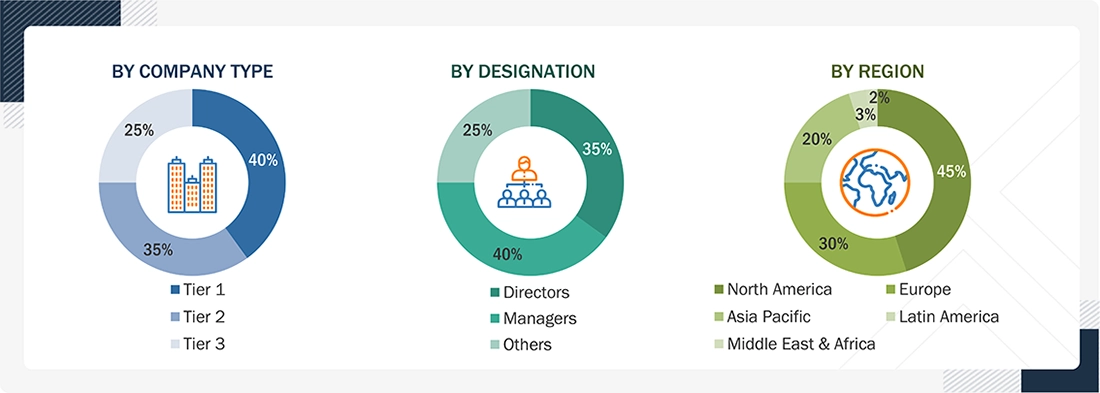
Note: Other designations include sales managers, marketing managers, and product managers.
Note: Tiers are defined based on a company’s total revenue as of 2025: Tier 1 = >USD 1 billion, Tier 2 = USD 500 million to USD 1 billion, and Tier 3 = <USD 500 million.
To know about the assumptions considered for the study, download the pdf brochure
Market Size Estimation
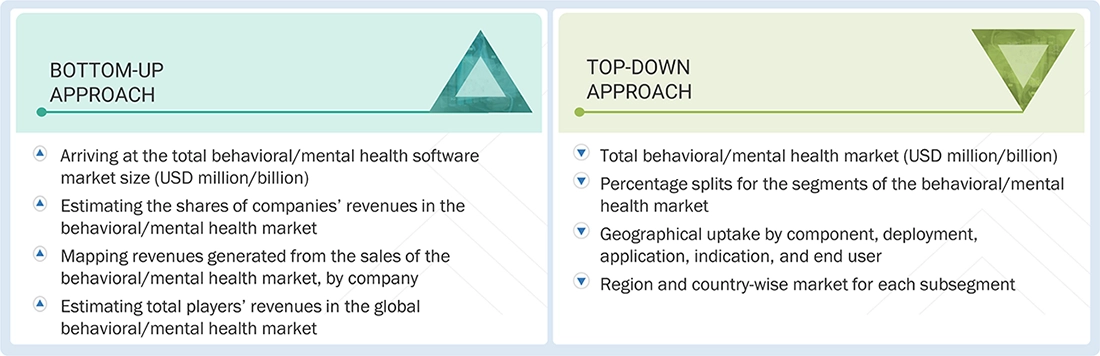
The market size estimates and forecasts provided in this study are derived through a mix of the bottom-up approach (revenue share analysis of leading players) and top-down approach (assessment of utilization/adoption/penetration trends by component, deployment, application, indication, end user, and region.
Behavioral/Mental Health Software Market : Top-Down and Bottom-Up Approach
Data Triangulation
After arriving at the overall market size—using the market size estimation processes—the market was split into several segments and subsegments. To complete the overall market engineering process and arrive at the exact statistics of each market segment and subsegment, the data triangulation and market breakdown procedures were employed, wherever applicable. The data was triangulated by studying various factors and trends from both the demand and supply sides in the behavioral/mental health software market.
Market Definition
After arriving at the overall market size—using the market size estimation processes—the market was split into several segments and subsegments. To complete the overall market engineering process and arrive at the exact statistics of each market segment and subsegment, the data triangulation and market breakdown procedures were employed, wherever applicable. The data was triangulated by studying various factors and trends from both the demand and supply sides in the behavioral/mental health software market.
Key Stakeholders
- Behavioral/mental health software vendors
- Independent software vendors (ISVs)
- Platform providers
- Technology providers
- System integrators
- Cloud service providers
- Healthcare IT service providers
- Hospitals & clinics
- Certified community behavioral health clinics
- Academic institutes and research centers
- Forums, alliances, and associations
- Government organizations
- Institutional investors and investment banks
- Investors/Shareholders
- Venture capitalists
Report Objectives
- To define, describe, and forecast the global behavioral/mental health software market based on component, deployment, application, indication, and region
- To provide detailed information regarding the factors influencing the growth of the market (such as the drivers, restraints, opportunities, and challenges)
- To strategically analyze micromarkets with respect to individual growth trends, prospects, and contributions to the overall behavioral/mental health software market
- To analyze market opportunities for stakeholders and provide details of the competitive landscape for market leaders
- To forecast the size of the behavioral/mental health software market in five main regions (along with their respective key countries): North America, Europe, the Asia Pacific, Latin America, and the Middle East & Africa
- To profile key players and comprehensively analyze their product portfolios, market positions, and core competencies in the market
- To track and analyze competitive developments such as product & service launches, expansions, partnerships, agreements, collaborations, and acquisitions in the behavioral/mental health software market
- To benchmark players within the behavioral/mental health software market using the Company Evaluation Matrix framework, which analyzes market players on various parameters within the broad categories of business strategy, market share, and product offering
Available customizations:
With the given market data, MarketsandMarkets offers customizations as per your company’s specific needs. The following customization options are available for the report:
Regional Analysis
- Further breakdown of the Rest of Europe behavioral/mental health software market into Denmark and Norway, among others
- Further breakdown of the Rest of Asia Pacific behavioral/mental health software market into Vietnam, New Zealand, Australia, and South Korea, among others
Company Information
- Detailed analysis and profiling of additional market players (up to 5)
Get the Full Behavioural/Mental Health Software Market Report
Full forecast, segment splits, and company analysis for all Behavioural/Mental Health Software Market.
- Canada Behavioural/Mental Health Software Market
- US Behavioural/Mental Health Software Market
- UK Behavioural/Mental Health Software Market
- Germany Behavioural/Mental Health Software Market
- France Behavioural/Mental Health Software Market
- Japan Behavioural/Mental Health Software Market
- India Behavioural/Mental Health Software Market
- Roe Behavioural/Mental Health Software Market
- Roa Behavioural/Mental Health Software Market
Need a Tailored Report?
Customize this report to your needs
Get 10% FREE Customization
Customize This Report
