Sweden Biomethane Market (2025-2030)

The Sweden Biomethane Market was valued at $655.2 Million in 2025 and projected to reach to $2326.2 Million by 2030, representing a compound annual growth rate of 28.8%. Sweden's biomethane market is positioned for exceptional growth through 2030, supported by the country's world-class waste management systems and strong government incentives for renewable gas production.


| Market Size in | USD 26.32 MN |
| Market Forecast in | |
| CAGR | |
| Forecast Period | |
| Units Considered | Value (USD MN) |
Sweden Biomethane Market Trends and Insights
- Sweden has emerged as a regional leader in renewable gas adoption, driven by stringent EU climate regulations and the country's commitment to carbon neutrality.
- The 28.8% compound annual growth rate reflects Sweden's strategic investments in anaerobic digestion infrastructure and waste-to-energy initiatives. Sweden's biomethane sector benefits from well-established waste management systems and strong government incentives for renewable energy transition.
- By 2030, Sweden is expected to significantly expand its biomethane production capacity, leveraging agricultural residues, food waste, and wastewater treatment facilities.
- Sweden's advanced regulatory framework and sustainability focus position the country as a key growth market within Europe's broader biomethane expansion. The Swedish biomethane market is supported by increasing demand from transport, heating, and industrial applications.
- Sweden's integration of biomethane into existing natural gas infrastructure and vehicle fuel networks accelerates market penetration.
- Continued investment in biogas upgrading technology and circular economy initiatives will sustain Sweden's market momentum through 2030..
Key Market Statistics
- CAGR (2025-2030) 28.8% CAGR
- Market Size, 2025 ~USD 655.2 Million
- Forecast, 2030 ~USD 2326.2 Million
- Country Sweden
Sweden Biomethane Market Overview
Market Valuation Growth :
Sweden's biomethane market is valued at USD 655.2 million in 2025 and is projected to reach USD 2,326.2 million by 2030, representing a 255% increase over five years.
Regional Leadership Position :
Sweden has established itself as a Nordic and European leader in renewable gas adoption, leveraging its advanced waste management infrastructure and biogas production capabilities.
Strong CAGR Performance :
The Swedish market is growing at 28.8% CAGR, outpacing the global average of 28%, driven by aggressive climate policies and carbon neutrality commitments.
EU Regulatory Tailwinds :
Stringent EU climate regulations and Sweden's own carbon neutrality targets are accelerating biomethane adoption across transportation, heating, and industrial sectors.
Sweden Biomethane Market Dynamics
- The transition toward carbon neutrality is driving investments in anaerobic digestion facilities and biomethane infrastructure, particularly in the transportation and heating sectors.
- Industrial players are increasingly adopting biomethane as a sustainable alternative to fossil fuels, creating new revenue streams. The market outlook remains highly positive as Sweden continues to strengthen its regulatory framework and expand biomethane production capacity.
- Strategic partnerships between waste management companies, energy providers, and technology innovators are accelerating market penetration.
- With favorable policy support and growing consumer demand for sustainable energy solutions, Sweden is expected to maintain its position as a European biomethane hub through 2030 and beyond..
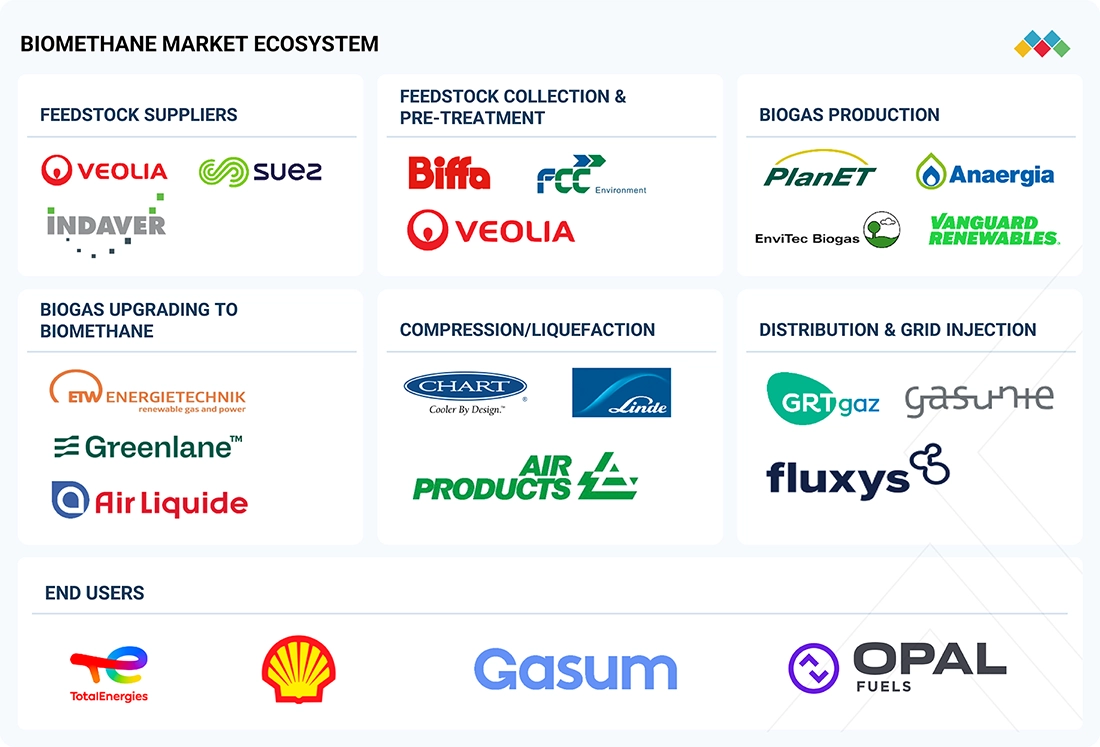
Market Ecosystem
BIOMETHANE MARKET: COMMERCIAL USE CASES ACROSS INDUSTRIES
| COMPANY | USE CASE DESCRIPTION | BENEFITS |
|---|---|---|
 |
The Landfill of Steuben County, New York, in the past, was a significant source of methane emissions. Unfortunately, there was no gas recovery and valorization system in place. The landfill gas escape occurred without the necessary infrastructure for capturing and utilizing it, thereby contributing to global warming and the loss of a renewable energy source. The local governments did not have a reliable renewable fuel supply for the energy grids in the area. | The Steuben County Landfill biomethane project offered environmental, economic, and energy system benefits. The substantial methane emission reduction resulting from the gas capturing and upgrading process not only directly cuts down on greenhouse gas impacts but also aids in achieving regional climate goals. The landfill gas converted into pipeline-quality biomethane is a new and steady source of renewable energy for local use, thereby increasing energy security. The project is a public-private partnership at its best, as it has allowed for the incineration of waste in a cost-effective manner while generating long-term economic value. Moreover, advanced technology for upgrading is used in the project, thereby revealing a model that is not only scalable but also replicable among landfills in need of accelerating the gas production from renewable sources. |
 |
AstraZeneca aimed to significantly reduce greenhouse gas emissions from its US operations, but faced difficulties obtaining the low-carbon fuel supplies necessary for large-scale use. The use of traditional energy sources and fossil gas was a challenge for the company in achieving its sustainability targets and reducing its Scope 1/2 emissions in the long run. | The AstraZeneca–Vanguard Renewables biomethane project delivers strong environmental, operational, and strategic benefits. By securing a long-term supply of renewable natural gas, AstraZeneca significantly reduces Scope 1 and 2 emissions while advancing its corporate net-zero commitments. The project converts organic waste into clean energy, diverting waste from landfills and lowering methane emissions. It provides a stable, large-scale low-carbon fuel solution without requiring changes to existing infrastructure. Additionally, the partnership demonstrates how on-farm anaerobic digestion can be scaled to support corporate decarbonization goals while creating value for agricultural communities and strengthening circular economy practices. |
Logos and trademarks shown above are the property of their respective owners. Their use here is for informational and illustrative purposes only.
Related Ecosystem
Decarbonization
- Battery Electric Vehicle (BEV)
- Energy Management Systems
- Fuel Cell
- Fuel Cell Electric Vehicle (FCEV)
- Geographical Information System (GIS)
- TotalEnergies SE
- Siemens ag
- Mitsui & Co., Ltd.
- General Electric Company
- Thyssenkrupp ag
Key Takeaways
- Sweden's biomethane market will grow from USD 655.2M (2025) to USD 2,326.2M (2030) at a 28.8% CAGR, outpacing global growth rates.
- Sweden leads Europe in biomethane adoption due to advanced waste management infrastructure and strong climate policy commitments.
- Transport, heating, and industrial sectors drive demand for biomethane in Sweden, supported by integrated gas distribution networks.
- Sweden's circular economy initiatives and biogas upgrading investments position the country as a regional innovation hub for renewable gas technology.
Biomethane Market Report Scope
| Report Metric | Details |
|---|---|
| Base Year | 2025 |
| Fastest Growing Segment | THERMAL GASIFICATION (Production Process) |
| Forecast Period | 2025–2030 |
| Growth Rate | CAGR of 28% from 2025 to 2030 |
| Largest Segment | ANAEROBIC DIGESTION & FERMENTATION (Production Process) |
| Market Size Base Year (Billions) | ~USD 16.48 (2025) |
| Revenue Forecast (Billions) | ~USD 56.64 (2030) |
| Segments Covered | Feedstock, Production Process, End-Use Application |
Sweden Biomethane Market Report Segmentation
3 segment dimensions are covered across the global market.
By Feedstock
- Agricultural Residues & Animal Manure
- Energy Crops
- Municipal Waste
- Other Feedstocks
By Production Process
- Anaerobic Digestion & Fermentation
- Other Production Processes
- Thermal Gasification
By End-Use Application
- Industrial
- Power Generation
- Transportation
Target Audience
- Energy & Utility Companies : Swedish and international energy providers need detailed market data to develop biomethane supply strategies, optimize distribution networks, and capitalize on Sweden's renewable gas transition.
- Waste Management Operators : Waste management companies operating in Sweden require market insights to monetize organic waste through biomethane production and align operations with circular economy regulations.
- Investment & Private Equity Firms : Investors seeking exposure to Nordic renewable energy need comprehensive Sweden-specific data to evaluate biomethane project viability, assess market growth potential, and structure funding strategies.
- Technology & Equipment Manufacturers : Biogas technology providers and equipment manufacturers need Sweden market intelligence to identify customer segments, forecast demand for anaerobic digestion systems, and plan product localization.
- Government & Policy Makers : Swedish government agencies and policymakers require market analysis to evaluate the effectiveness of biomethane incentives, refine carbon neutrality strategies, and optimize renewable gas infrastructure investments.
Key Companies in the Sweden Biomethane Market
| Company | HQ | Ownership | Strongest segments |
|---|---|---|---|
| SHELL | United Kingdom | Public Company | Energy Crops Feedstock,Agriculture Residues & Animal Manure Feedstock,Municipal Waste Feedstock, |
| GASUM LTD | Finland | Private Company | Biomethane for Transportation,Biomethane for Power Generation,Biomethane for Industrial Use, |
| AIR LIQUIDE | United States | Public Company | By Feedstock – Municipal Waste,By Feedstock – Agriculture Residues & Animal Manure,By Feedstock – Energy Crops, |
| BP P.L.C. | United Kingdom | Public Company | Energy Crops Feedstock,Agriculture Residues & Animal Manure Feedstock,Municipal Waste Feedstock, |
| VERBIO SE | Germany | Public Company | Biomethane from agriculture residues & animal manure (Anaerobic Digestion),Biomethane from municipal and commercial organic waste (Anaerobic Digestion),Biomethane from energy crops (Anaerobic Digestion), |
| TOTALENERGIES | France | Public Company | Feedstock – Municipal Waste,Feedstock – Agriculture Residues & Animal Manure,Feedstock – Energy Crops, |
| OPAL FUELS | United States | Public Company | RNG Fuel (Transportation end-use, mainly anaerobic digestion from agriculture residues & animal manure and municipal waste),Fuel Station Services (CNG/RNG and emerging hydrogen stations for transportation),Renewable Power (biogas-to-power from municipal waste and agricultural feedstock), |
| CHEVRON CORPORATION | United States | Public Company | Energy Crops Feedstock,Agriculture Residues & Animal Manure Feedstock,Municipal Waste Feedstock, |
| E.ON SE | Germany | Public Company | Feedstock: Municipal Waste,Feedstock: Agriculture Residues & Animal Manure,Feedstock: Energy Crops, |
| ENGIE | France | Public Company | Municipal Waste-based Biomethane,Agriculture Residues & Animal Manure-based Biomethane,Energy Crops-based Biomethane, |
| VEOLIA | France | Public Company | Municipal Waste Feedstock – Anaerobic Digestion,Agriculture Residues & Animal Manure – Anaerobic Digestion,Energy Crops – Anaerobic Digestion, |
| KINDER MORGAN | United States | Public Company | Energy Crops Feedstock-linked Biomethane,Agriculture Residues & Animal Manure-linked Biomethane,Municipal Waste-linked Biomethane, |
| AMERESCO | United States | Public Company | Municipal Waste Feedstock Biomethane,Agriculture Residues & Animal Manure Biomethane,Energy Crops Biomethane, |
| CLEAN ENERGY FUELS | United States | Public Company | Transportation RNG (including credits),CNG/LNG fossil and blended fuels,Power generation and industrial RNG, |
SHELL
Shell is a United Kingdom-based public company founded in 1897 with 84,000 employees, operating as a major global energy corporation.
GASUM LTD
Gasum Ltd is a Finnish private company established in 1994 with 379 employees, operating in the energy sector.
AIR LIQUIDE
Air Liquide is a United States-based public company founded in 1902 with 65,000 employees, providing industrial gases and related services.
BP P.L.C.
BP P.L.C. is a United Kingdom-based public company founded in 1908 with 93,700 employees, operating as a major international oil and gas enterprise.
VERBIO SE
Verbio SE is a German public company founded in 2006 with 1,394 employees, specializing in renewable energy and biofuel production.
TOTALENERGIES
TotalEnergies is a French public company founded in 1924 with 94,847 employees, operating as a major global energy producer and provider.
OPAL FUELS
Opal Fuels is a United States-based public company founded in 1998 with 331 employees, operating in the alternative fuels sector.
CHEVRON CORPORATION
Chevron Corporation is a United States-based public company founded in 1879 with 43,039 employees, operating as a major global energy company.
E.ON SE
E.ON SE is a German public company founded in 1923 with 78,996 employees, providing energy and utility services.
ENGIE
ENGIE is a French public company founded in 1880 with 84,809 employees, operating as a major global energy and services provider.
VEOLIA
Veolia is a French public company founded in 1853 with 203,100 employees, providing environmental and waste management services globally.
KINDER MORGAN
Kinder Morgan is a United States-based public company founded in 1997 with 11,028 employees, operating in energy infrastructure and transportation.
AMERESCO
Ameresco is a United States-based public company founded in 2000 with 1,601 employees, specializing in energy efficiency and renewable energy solutions.
CLEAN ENERGY FUELS
Clean Energy Fuels is a United States-based public company founded in 2001 with 503 employees, providing alternative fuel solutions.
Reasons to Buy this Report
- Precise Market Sizing for Sweden : Obtain accurate valuation data specific to the Swedish biomethane market with detailed 2025-2030 projections, enabling confident investment and expansion planning in this high-growth Nordic market.
- Competitive Intelligence : Understand Sweden's unique market dynamics, regulatory environment, and competitive landscape to identify opportunities and benchmark against regional leaders in renewable gas adoption.
- Strategic Investment Guidance : Leverage detailed market insights to guide capital allocation decisions, identify high-potential segments, and prioritize geographic expansion within Sweden's biomethane ecosystem.
- Regulatory & Policy Insights : Access comprehensive analysis of EU climate regulations and Sweden's carbon neutrality commitments that are driving market growth, helping stakeholders navigate compliance and capitalize on incentives.
- Growth Opportunity Identification : Discover emerging segments and untapped opportunities within Sweden's 28.8% CAGR market, from waste-to-energy projects to transportation fuel applications and industrial heating solutions.
Frequently asked questions
What is the projected size of Sweden's biomethane market by 2030?
Sweden's biomethane market is projected to reach USD 2,326.2 million by 2030, growing from USD 655.2 million in 2025 at a 28.8% CAGR.
What are the primary drivers of biomethane growth in Sweden?
Sweden's biomethane growth is driven by EU climate regulations, government renewable energy incentives, advanced waste management systems, and increasing demand from transport and heating sectors.
Which sectors consume biomethane in Sweden?
Sweden's biomethane is consumed across transport (vehicle fuel), heating (residential and commercial), and industrial applications, supported by integrated natural gas infrastructure.
How does Sweden's biomethane market compare to Europe?
Sweden's 28.8% CAGR positions it as a regional leader in biomethane adoption, driven by superior waste management infrastructure and stronger climate policy implementation than many European peers.
What role does waste management play in Sweden's biomethane production?
Sweden's well-established waste management systems enable efficient collection of agricultural residues, food waste, and wastewater for anaerobic digestion, supporting sustainable biomethane production.
RESEARCH METHODOLOGY
The research encompassed significant efforts to determine the present scale of the biomethane market. Thorough secondary research was conducted to gather data on both peer and parent markets. Subsequently, these findings, assumptions, and sizing were validated through primary research involving industry experts throughout the value chain. A comprehensive approach, combining top-down and bottom-up methodologies, was applied to ascertain the overall market size. Following this, market breakdown and data triangulation techniques were employed to calculate the market size of individual segments and subsegments, ensuring a comprehensive and reliable assessment.
Secondary Research
This research on the biomethane market utilized a comprehensive range of secondary sources, including directories and databases such as Hoovers, Bloomberg, Businessweek, Factiva, International Energy Agency, and BP Statistical Review of World Energy. These sources were instrumental in identifying and gathering information essential for conducting a technical, market-oriented, and commercial study of the market. Other secondary sources encompassed annual reports, press releases, and investor presentations from companies, as well as white papers, certified publications, articles by reputable authors, manufacturer associations, trade directories, and databases.
Primary Research
The biomethane market encompasses various stakeholders, including manufacturers of biomass power generation, providers of manufacturing technology, and technical support providers throughout the supply chain. On the demand side, there is a noticeable increase in the demand for biomass power generation across applications such as generation, transmission, and distribution. On the supply side, there is a growing demand for contracts from the industrial sector, and significant activity in terms of mergers and acquisitions among major players. To gather qualitative and quantitative information, interviews were conducted with numerous primary sources from both the supply and demand sides of the market.
The breakdown of primary respondents is as follows:
To know about the assumptions considered for the study, download the pdf brochure
Market Size Estimation
Both top-down and bottom-up approaches were used to estimate and validate the total size of the biomethane market. These methods were also used extensively to estimate the size of various subsegments in the market. The research methodology used to estimate the market size includes the following:
- The key players in the industry and market have been identified through extensive secondary research, and their market share in the respective regions have been determined through both primary and secondary research.
- The industry’s value chain and market size, in terms of value, have been determined through primary and secondary research processes.
- All percentage shares, splits, and breakdowns have been determined using secondary sources and verified through primary sources
Data Triangulation
The previously mentioned approaches were used to calculate the total market size before the market was divided into numerous segments and subsegments. Methods of data triangulation and market segmentation were used as needed to complete the thorough market analysis and acquire accurate statistics for each market segment and subsegment. Through an analysis of numerous variables and patterns from the supply and demand sides of the biomethane market ecosystem, data triangulation was achieved.
Market Definition
The biomethane market refers to the industry involved in the production, distribution, and utilization of biomethane, a renewable and sustainable natural gas derived from the anaerobic digestion or fermentation of organic materials such as agricultural residues, municipal solid waste, wastewater, and organic by-products. Biomethane, also known as renewable natural gas (RNG), is a clean energy source that can be seamlessly integrated into existing natural gas infrastructure, used for power generation, heating, and as a transportation fuel. The market encompasses various stakeholders, including biomethane producers, technology providers, and entities involved in the entire supply chain. Key drivers for the market include the global emphasis on reducing greenhouse gas emissions, government initiatives promoting renewable energy, advancements in biomethane production technologies, and a growing awareness of sustainable waste management practices. The market is characterized by a dynamic landscape with increasing investments, partnerships, and technological innovations to further enhance the efficiency and sustainability of biomethane production and utilization.
Key Stakeholders
- Analytics Vendors
- Communication Vendors
- Consulting Companies In The Energy And Power Sector
- Electric Utilities
- Energy & Power Sector Consulting Companies
- Energy Regulators
- Government & Research Organizations
- Government Utility Providers
- Independent Power Producers
Objectives of the Study
- To describe, segment, and forecast the biomethane market based on feedstock, distribution mode, production process, end-use application, end user type and region, in terms of value
- To describe and forecast the market for five key regions: North America, Europe, Asia Pacific, Rest of the World, along with their country-level market sizes, in terms of value
- To provide detailed information regarding key drivers, restraints, opportunities, and challenges influencing the growth of the market
- To provide the supply chain analysis, trends/disruptions impacting the customer’s business, market map, pricing analysis, and regulatory analysis of the market
- To analyze opportunities for stakeholders and draw a competitive landscape of the market
- To strategically analyze the micromarkets with respect to individual growth trends, upcoming expansions, and their contribution to the overall market
- To strategically analyze the ecosystem, tariffs and regulations, patent landscape, trade landscape, Porter’s five forces, and case studies pertaining to the market under study
- To benchmark market players using the company evaluation quadrant, which analyzes market players on broad categories of business and product strategies adopted by them.
Available Customizations:
With the given market data, MarketsandMarkets offers customizations according to the specific requirements of companies. The following customization options are available for the report:
Product Analysis
- Product Matrix, which provides a detailed comparison of the product portfolio of each company
Company Information
- Detailed analyses and profiling of additional market players
Get the Full Biomethane Market Report
Full forecast, segment splits, and company analysis for all Biomethane Market.
- US Biomethane Market
- Canada Biomethane Market
- Mexico Biomethane Market
- Germany Biomethane Market
- UK Biomethane Market
- France Biomethane Market
- Denmark Biomethane Market
- Italy Biomethane Market
- China Biomethane Market
- India Biomethane Market
- Rest Of Europe Biomethane Market
- Rest Of Asia Pacific Biomethane Market
Need a Tailored Report?
Customize this report to your needs
Get 10% FREE Customization
Customize This Report
