
India Bioplastics & Biopolymers Market (2025-2030)

The India Bioplastics & Biopolymers Market was valued at $772.8 Million in 2025 and projected to reach to $2172.5 Million by 2030, representing a compound annual growth rate of CAGR 23.0%. India's bioplastics and biopolymers market is poised for exceptional growth through 2030, driven by stringent government policies against single-use plastics and increasing corporate sustainability commitments.


| Market Size in | USD 26.32 MN |
| Market Forecast in | |
| CAGR | |
| Forecast Period | |
| Units Considered | Value (USD MN) |
India Bioplastics & Biopolymers Market Trends and Insights
- India's market expansion is driven by increasing regulatory pressure on single-use plastics, rising consumer awareness of sustainable materials, and government initiatives promoting circular economy practices.
- The Indian bioplastics sector benefits from the country's strong agricultural base, which provides abundant feedstock for bio-based polymer production, positioning India as a key player in the Asia Pacific region. India's bioplastics market growth outpaces the global average of 20.7% CAGR, reflecting the nation's accelerated shift toward sustainable packaging and manufacturing solutions.
- Between 2025 and 2030, India is expected to witness significant adoption across packaging, automotive, consumer goods, and textile applications.
- Government policies, including plastic bans and incentives for bio-based material adoption, coupled with growing foreign investment in biopolymer production facilities, are accelerating India's market transformation and positioning the country as a regional hub for sustainable polymer innovation..
Key Market Statistics
- CAGR (2025-2030) CAGR 23.0%
- Market Size, 2025 ~USD 772.8 Million
- Forecast, 2030 ~USD 2172.5 Million
- Country India
India Bioplastics & Biopolymers Market Overview
Market Valuation Growth :
India's bioplastics and biopolymers market is valued at USD 772.8 million in 2025, with projections reaching USD 2,172.5 million by 2030, demonstrating strong market expansion potential.
Regulatory Drivers :
Government initiatives targeting single-use plastic bans and stringent environmental regulations are accelerating the adoption of bioplastics and biopolymers across India's manufacturing and packaging sectors.
Consumer Awareness Surge :
Rising consumer consciousness regarding sustainable materials and eco-friendly products is driving demand for bioplastics in India, particularly among urban populations and environmentally conscious brands.
Industry Leadership Position :
India's 23% CAGR outpaces the global growth rate of 20.7%, positioning the country as a high-growth market for bioplastics and biopolymers in the Asia-Pacific region.
India Bioplastics & Biopolymers Market Dynamics
- The market's 23% CAGR reflects strong demand from packaging, automotive, and consumer goods industries seeking eco-friendly alternatives.
- Rising middle-class consumption and enhanced environmental awareness among Indian consumers further accelerate market penetration. Key growth catalysts include government incentives for green manufacturing, investments in biopolymer production infrastructure, and collaborations between domestic and international players.
- The market will likely see increased adoption in flexible packaging, rigid containers, and industrial applications.
- However, cost competitiveness with conventional plastics and scaling of domestic production capacity remain critical factors shaping India's bioplastics market trajectory through the forecast period..
Market Ecosystem
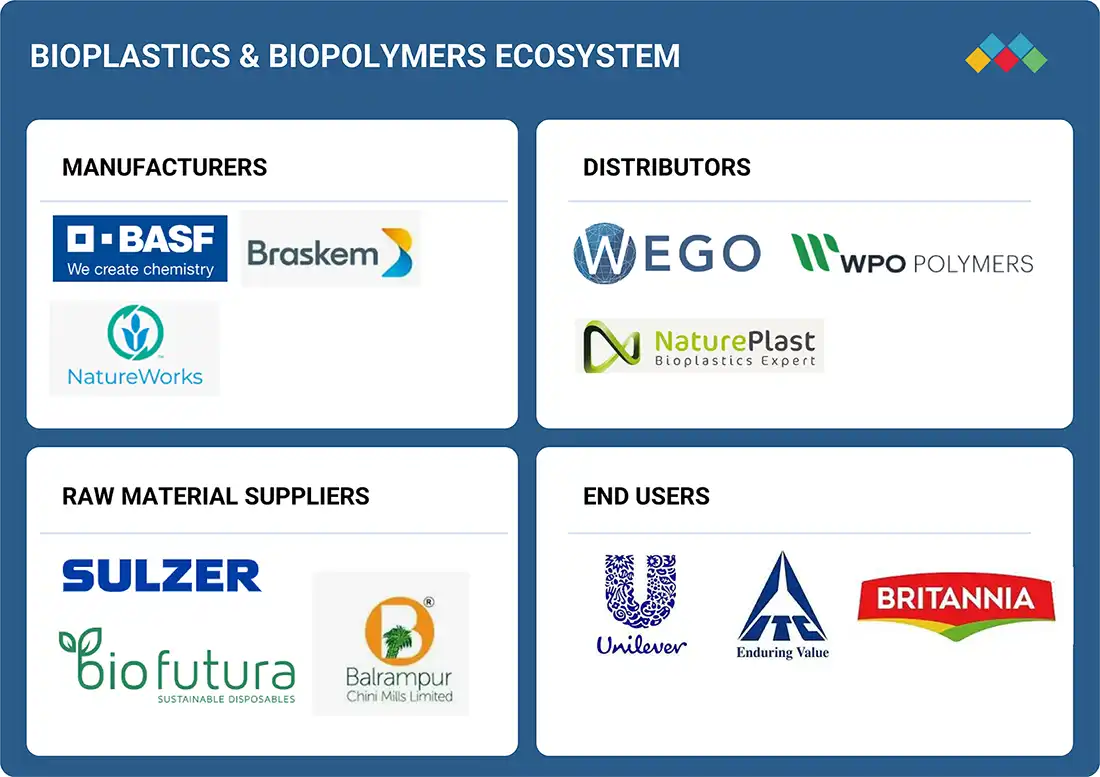
Bioplastics & Biopolymers Market: COMMERCIAL USE CASES ACROSS INDUSTRIES
| COMPANY | USE CASE DESCRIPTION | BENEFITS |
|---|---|---|
 |
Biopolymer-based cartons using sugarcane-derived plastics) | Renewable sourcing, lower carbon footprint, recyclable, compliance with bans. |
 |
Compostable and recyclable bio-based food wrappers and bottles | Reduced landfill waste, eco-friendly branding, consumer trust. |
 |
Bio-based packaging for personal care & food products | Compliance with plastic regulations, brand sustainability, lower emissions. |
 |
Bioplastics in snack packaging, beverage bottles, and films | Lower plastic pollution, cost-efficient scaling, improved circular economy. |
Logos and trademarks shown above are the property of their respective owners. Their use here is for informational and illustrative purposes only.
Related Ecosystem
Agricultural Biologicals
- Bionematicides
- Auxins
- Cytokinins
- Ethylene
- Humic Substances
- NICHINO INDIA PVT LTD.
- Corteva, Inc.
- Basf se
- AZELIS HOLDINGS SA
- BAYER AG
Automotive Electronics And Electrical Equipment
- Battery Electric Vehicle (BEV)
- Light Commercial Vehicles (LCVs)
- Fuel Cell Electric Vehicle (FCEV)
- Sensors
- Hybrid Electric Vehicle (HEV)
- BOSCH LIMITED
- Continental ag
- DENSO Corporation
- Panasonic Holdings Corporation
- Texas Instruments Incorporated
Green Bio Chemicals
- Animal-Based Sealants
- Bacterial Fermentation
- Corrosion Inhibitors
- Hydrogen Peroxide
- Nitrile Butadiene Rubber (NBR)
- Basf se
- Evonik industries ag
- Solvay sa
- AZELIS HOLDINGS SA
- CARGILL, INCORPORATED
Key Takeaways
- India's bioplastics market is valued at USD 772.8 million in 2025 and will reach USD 2,172.5 million by 2030, growing at 23.0% CAGR.
- India's growth rate exceeds the global CAGR of 20.7%, driven by regulatory mandates and sustainability initiatives across the country.
- India's abundant agricultural feedstock and government support position the nation as a regional manufacturing and innovation hub for biopolymers.
- Packaging, automotive, and consumer goods sectors in India are primary growth drivers for bioplastics adoption through 2030.
Bioplastics & Biopolymers Market Report Scope
| Report Metric | Details |
|---|---|
| Base Year | 2025 |
| Fastest Growing Segment | -PHA (Product Type) |
| Forecast Period | 2025-2030 |
| Growth Rate | CAGR of 20.7% from 2025 to 2030 |
| Largest Segment | PACKAGING (End-Use Industry) |
| Market Size Base Year (Billions) | ~USD 17.58 (2025) |
| Revenue Forecast (Billions) | ~USD 45.04 (2030) |
| Segments Covered | Raw Material, Product Type, End-Use Industry |
India Bioplastics & Biopolymers Market Report Segmentation
3 segment dimensions are covered across the global market.
By Raw Material
- Cassava
- Corn Starch
- Other Raw Materials
- Potato/Tapioca
- Sugarcane/Sugar Beet
- Switchgrass
- Vegetable Oil
- Wheat
By Product Type
- Biodegradable
- Non-Biodegradable/Bio-Based
- -Bio-Pa
- -Bio-Pe
- -Bio-Pet
- -Bio-Pp
- -Bio-Ptt
- -Cellulose Film
- -Other Biodegradable Types
- -Other Non-Biodegradable Types
- -Pbat
- -Pbs
- -Pef
- -Pha
- -Pla
- -Starch-Based
By End-Use Industry
- Agriculture & Horticulture
- Automotive & Transport
- Building & Construction
- Coatings & Adhesives
- Consumer Goods
- Electronics & Electricals
- Other End-Use Industries
- Packaging
- Textiles
- -Flexible
- -Rigid
INDIA: BIOPLASTICS & BIOPOLYMERS MARKET, BY END-USE INDUSTRY, 2025–2030
| Segment | 2025 | 2026 | 2027 | 2028 | 2029 | 2030 | CAGR (%) |
|---|---|---|---|---|---|---|---|
| AGRICULTURE & HORTICULTURE | 76 | 98.2 | 127.2 | 151.2 | 196.6 | 285.4 | 30.3 |
| AUTOMOTIVE & TRANSPORT | 40.4 | 44.3 | 48.5 | 48.8 | 53.6 | 65.9 | 10.2 |
| BUILDING & CONSTRUCTION | 13.6 | 15.3 | 17.2 | 17.8 | 20.1 | 25.4 | 13.2 |
| COATINGS & ADHESIVES | 41.9 | 48.9 | 57.3 | 61.6 | 72.4 | 95 | 17.8 |
| CONSUMER GOODS | 82.9 | 101.5 | 124.5 | 140.1 | 172.6 | 237.4 | 23.4 |
| ELECTRONICS & ELECTRICALS | 19.2 | 23.2 | 28.2 | 31.4 | 38.3 | 52.1 | 22.1 |
| OTHER END-USE INDUSTRIES | 22.8 | 27.8 | 34 | 38.2 | 46.9 | 64.2 | 23 |
| PACKAGING | 404.3 | 504.3 | 627.7 | 714.7 | 887.7 | 1227.2 | 24.9 |
| TEXTILES | 71.8 | 79 | 86.9 | 87.8 | 97.1 | 119.8 | 10.8 |
| –FLEXIBLE | 229.9 | 289.8 | 363.2 | 415.4 | 517.1 | 715 | 25.5 |
| –RIGID | 174.3 | 214.6 | 264.5 | 299.3 | 370.6 | 512.2 | 24.1 |
| TOTAL | 772.8 | 942.6 | 1151.5 | 1291.6 | 1585.5 | 2172.5 | 23 |
Target Audience
- Packaging Manufacturers : Packaging companies need India-specific bioplastics data to develop sustainable product lines, meet regulatory requirements, and respond to brand demand for eco-friendly packaging solutions in India's growing consumer market.
- Chemical & Material Producers : Biopolymer manufacturers require detailed India market insights to identify production opportunities, assess demand from end-use industries, and plan capacity expansion in this high-growth regional market.
- Investment & Private Equity Firms : Investors evaluating India's bioplastics sector need comprehensive market data, growth projections, and regulatory analysis to identify promising investment targets and assess portfolio opportunities in sustainable materials.
- Consumer Goods & FMCG Companies : FMCG brands operating in India need market intelligence on bioplastics adoption trends, consumer preferences, and supply chain options to transition packaging to sustainable materials and enhance brand positioning.
- Government & Policy Bodies : Indian government agencies and policymakers require market data to evaluate the effectiveness of sustainability initiatives, plan incentive programs, and develop strategies supporting domestic bioplastics industry growth.
Reasons to Buy this Report
- Market Size & Growth Validation : Obtain precise valuation data for India's bioplastics market (USD 772.8M in 2025) and verified forecasts through 2030, enabling accurate business planning and investment decisions in this high-growth segment.
- Regulatory Landscape Intelligence : Understand India-specific government policies, single-use plastic bans, and compliance requirements driving market adoption, helping businesses align strategies with regulatory frameworks and capitalize on policy-driven opportunities.
- Competitive Positioning Strategy : Benchmark your organization against India's market dynamics and identify growth opportunities within packaging, automotive, and consumer goods sectors experiencing rapid bioplastics adoption.
- Consumer Demand Insights : Access detailed analysis of India's rising consumer awareness for sustainable materials, enabling targeted marketing strategies and product development aligned with evolving preferences in urban and emerging markets.
- Investment & Expansion Planning : Leverage India-specific market data to evaluate expansion opportunities, assess manufacturing feasibility, and identify partnership prospects in a market growing at 23% CAGR—significantly above global averages.
Frequently asked questions
What is the current market size of bioplastics in India?
India's bioplastics and biopolymers market is valued at USD 772.8 million in 2025 and is projected to grow to USD 2,172.5 million by 2030.
What is the CAGR for India's bioplastics market?
India's bioplastics market is growing at a CAGR of 23.0% from 2025 to 2030, outpacing the global average of 20.7%.
What are the main drivers of bioplastics growth in India?
Key drivers include government plastic bans, regulatory pressure on single-use plastics, rising consumer sustainability awareness, abundant agricultural feedstock, and foreign investment in production facilities across India.
Which sectors are driving bioplastics adoption in India?
Packaging, automotive, consumer goods, and textile sectors are the primary growth drivers for bioplastics adoption in India through 2030.
Why is India's bioplastics market growing faster than the global average?
India's accelerated growth is driven by strong government support for circular economy initiatives, abundant agricultural resources for feedstock, increasing regulatory mandates, and rising foreign investment in biopolymer manufacturing facilities.
RESEARCH METHODOLOGY
The study involved four main activities to estimate the current size of the global bioplastics & biopolymers market. Extensive secondary research was performed to gather information on the market, related product markets, and the parent product group market. The next step was to validate these findings, assumptions, and market sizes with industry experts across the bioplastics & biopolymers value chain through primary research. Both top-down and bottom-up approaches were used to estimate the overall market size. Afterward, market segmentation and data triangulation procedures were applied to determine the sizes of various segments and sub-segments of the market.
Secondary Research
In the secondary research process, various sources such as Hoovers, Factiva, Bloomberg BusinessWeek, and Dun & Bradstreet were used to gather information for this study on the bioplastics & biopolymers market. These sources included annual reports, press releases, and investor presentations of companies, white papers, certified publications, articles by recognized authors, regulatory bodies, trade directories, and databases.
Primary Research
The bioplastics & biopolymers market includes several stakeholders in the supply chain, such as raw material suppliers, equipment providers, distributors, end-product manufacturers, buyers, and regulatory agencies. Various primary sources from both the supply and demand sides have been interviewed to gather both qualitative and quantitative data. On the demand side, key participants include opinion leaders, executives, vice presidents, and CEOs of companies in the bioplastics & biopolymers market. On the supply side, primary sources include associations and institutions involved in the market, as well as key opinion leaders and processing companies.
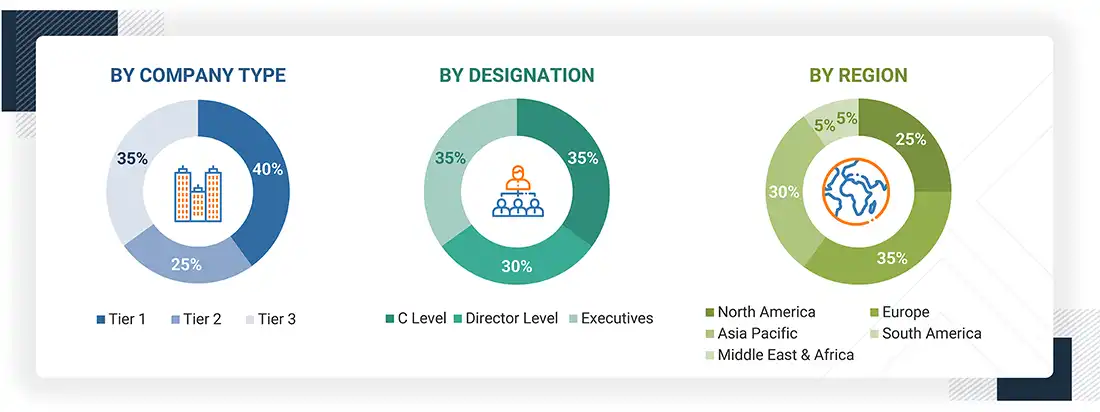
The following is the breakdown of primary respondents:
To know about the assumptions considered for the study, download the pdf brochure
Market Size Estimation
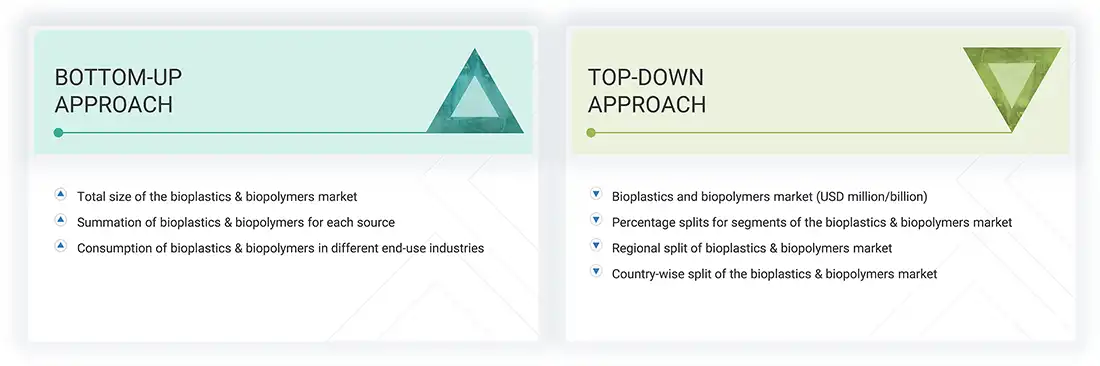
The bottom-up and top-down approaches have been used to estimate the bioplastics & biopolymers market by raw material, product type, end-use industry, and region. The research methodology used to calculate the market size includes the following steps:
- The key players in the industry and markets were identified through extensive secondary research.
- In terms of value, the industry’s supply chain and market size were determined through primary and secondary research processes.
- All percentage shares, splits, and breakdowns were determined using secondary sources and verified through primary sources.
- All possible parameters that affect the markets covered in this research study were accounted for, viewed in extensive detail, verified through primary research, and analyzed to obtain the final quantitative and qualitative data.
- The research included studying reports, reviews, and newsletters of top market players and extensive interviews with leaders, such as directors and marketing executives, to obtain opinions.
The following figure illustrates the overall market size estimation process employed for this study.
Data Triangulation
After estimating the overall size of the bioplastics & biopolymers market described above, the total market was divided into several segments and sub-segments. Data triangulation and market breakdown methods were used, where applicable, to complete the overall market analysis and determine precise statistics for all segments and subsegments. The data was triangulated by examining various factors and trends from both the demand and supply sides. Additionally, the market size was validated using both top-down and bottom-up approaches.
Market Definition
Bioplastics & biopolymers are made from renewable resources like corn, sugarcane, cassava, and other plant-based sources, making them an environmentally friendly alternative to petroleum plastics. These materials are lightweight, strong, and versatile, with properties that can be customized for specific uses such as packaging, agriculture, automotive, and consumer products.
Stakeholders
- Bioplastics & Biopolymers Manufacturers
- Raw Material Suppliers
- Equipment suppliers
- Regulatory Bodies and Government Agencies
- Distributors and Suppliers
- End-Use Industries
- Associations and Industrial Bodies
Report Objectives
- To define, describe, and forecast the size of the bioplastics & biopolymers market in terms of value and volume
- To provide detailed information regarding the key factors influencing the growth of the market (drivers, restraints, opportunities, and challenges)
- To forecast the market size based on product type, raw material, end-use industry, and region
- To forecast the market size for the five main regions—North America, Europe, the Asia Pacific, South America, and the Middle East & Africa—along with their key countries.
- To strategically analyze micro markets with respect to individual growth trends, prospects, and contributions to the total market.
- To analyze the opportunities in the market for stakeholders and provide details of the competitive landscape for the market leaders.
- To strategically profile leading players and comprehensively analyze their key developments, such as new product launches, expansions, and deals in the bioplastics & biopolymers market.
- To strategically profile key players and comprehensively analyze their market shares and core competencies.
- To study the impact of AI/Gen AI on the market under study, along with the macroeconomic outlook.
Get the Full Bioplastics & Biopolymers Market Report
Full forecast, segment splits, and company analysis for all Bioplastics & Biopolymers Market.
- US Bioplastics & Biopolymers Market
- Canada Bioplastics & Biopolymers Market
- Mexico Bioplastics & Biopolymers Market
- Germany Bioplastics & Biopolymers Market
- France Bioplastics & Biopolymers Market
- Spain Bioplastics & Biopolymers Market
- UK Bioplastics & Biopolymers Market
- Italy Bioplastics & Biopolymers Market
- Greece Bioplastics & Biopolymers Market
- China Bioplastics & Biopolymers Market
- Japan Bioplastics & Biopolymers Market
- South Korea Bioplastics & Biopolymers Market
- Thailand Bioplastics & Biopolymers Market
- South Africa Bioplastics & Biopolymers Market
- Brazil Bioplastics & Biopolymers Market
- Argentina Bioplastics & Biopolymers Market
- Rest Of Europe Bioplastics & Biopolymers Market
- Rest Of Asia Pacific Bioplastics & Biopolymers Market
- GCC Bioplastics & Biopolymers Market
- -Rest Of GCC Bioplastics & Biopolymers Market
- Rest Of South America Bioplastics & Biopolymers Market
Need a Tailored Report?
Customize this report to your needs
Get 10% FREE Customization
Customize This Report
