
Western Europe Bromine Market (2025-2030)

The Western Europe Bromine Market was valued at $27.1 Million in 2025 and projected to reach to $31.2 Million by 2030, representing a compound annual growth rate of CAGR 2.9%. Western Europe's bromine market demonstrates moderate but consistent growth, supported by established industrial infrastructure and stringent regulatory frameworks that drive demand for high-quality bromine compounds.


| Market Size in | USD 26.32 MN |
| Market Forecast in | |
| CAGR | |
| Forecast Period | |
| Units Considered | Value (USD MN) |
Western Europe Bromine Market Trends and Insights
- Rest Of Middle East & Africa's bromine sector remains relatively modest compared to global markets, yet demonstrates steady expansion driven by increasing industrial applications in flame retardants, water treatment, and pharmaceutical manufacturing.
- The region's growth trajectory reflects rising demand from emerging economies and gradual industrialization across the Rest Of Middle East & Africa. Rest Of Middle East & Africa's bromine market is characterized by limited domestic production capacity, with most supply sourced through imports from established bromine-producing nations.
- The forecast period (2025–2030) indicates that Rest Of Middle East & Africa will experience moderate but consistent market development, supported by infrastructure investments and regulatory shifts toward safer chemical alternatives.
- Rest Of Middle East & Africa's strategic position in global trade networks and growing end-user industries position the region for incremental market gains through 2030..
Key Market Statistics
- CAGR (2025-2030) CAGR 2.9%
- Market Size, 2025 ~USD 27.1 Million
- Forecast, 2030 ~USD 31.2 Million
- Country Western Europe
Western Europe Bromine Market Overview
Steady Regional Growth :
Western Europe's bromine market is estimated at USD 27.1 million in 2025, with projected growth to USD 31.2 million by 2030, reflecting a CAGR of 2.9% driven by regulatory compliance and industrial modernization.
Flame Retardant Dominance :
The region's bromine consumption is primarily driven by flame retardant applications in textiles, electronics, and construction materials, supported by stringent EU fire safety regulations and building codes.
Regulatory Environment :
Western Europe's strict environmental and chemical regulations, including REACH compliance, shape bromine sourcing and application strategies, creating both challenges and opportunities for market participants.
Industrial Diversification :
Beyond flame retardants, Western European bromine applications extend to water treatment, pharmaceuticals, and specialty chemicals, reflecting the region's advanced industrial base and innovation focus.
Western Europe Bromine Market Dynamics
- The region's mature manufacturing sector, particularly in flame retardants and specialty chemicals, continues to sustain market expansion despite slower growth compared to global averages. Future growth will be shaped by sustainability initiatives, circular economy principles, and the transition toward safer, more environmentally compliant bromine alternatives.
- Investment in R&D for innovative applications and compliance with evolving EU chemical regulations will be critical for market participants seeking competitive advantage in this stable, well-regulated market..
Market Ecosystem
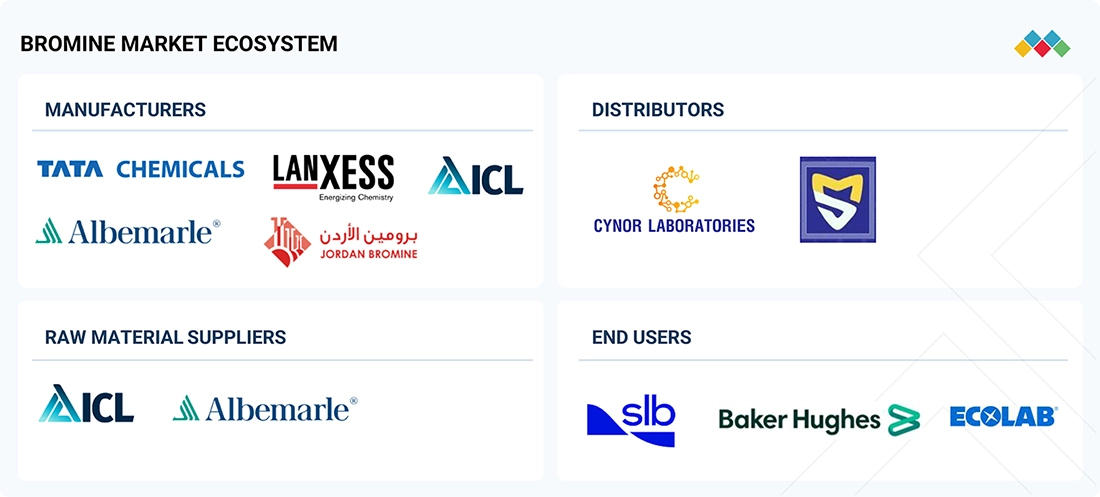
BROMINE MARKET: COMMERCIAL USE CASES ACROSS INDUSTRIES
| COMPANY | USE CASE DESCRIPTION | BENEFITS |
|---|---|---|
 |
Manufactures and supplies elemental bromine and bromine derivatives including organobromines and clear brine fluids used in flame retardants, oil & gas drilling fluids, water treatment solutions, and specialty chemical intermediates. | Enhances fire safety performance in polymers and electronics, supports wellbore stability in drilling operations, improves water treatment efficiency, and enables high-performance specialty chemical formulations. |
 |
Produces brominated flame retardants, bromine-based specialty chemicals, and high-purity bromine derivatives used in electronics, automotive components, construction materials, and energy storage applications. | Improves material safety and thermal stability, supports compliance with fire safety standards, enhances product durability, and enables advanced energy and electronic system performance. |
 |
Develops bromine-based flame retardant solutions and specialty additives tailored for engineering plastics, electrical components, and industrial applications requiring enhanced fire resistance. | Strengthens mechanical and thermal properties of materials, ensures regulatory compliance, enhances product consistency, and supports sustainable material development. |
 |
Produces elemental bromine and a range of bromine derivatives including clear brine fluids and hydrogen bromide for oil & gas, pharmaceutical, and industrial chemical applications. | Provides reliable supply of high-density drilling fluids, supports chemical synthesis processes, enables high-purity applications, and enhances operational efficiency in industrial processes. |
 |
Engages in the production and distribution of bromine derivatives for use in water treatment, agriculture chemicals, flame retardants, and specialty industrial applications. | Supports disinfection and biocidal efficiency, enhances safety standards in end-use materials, improves agricultural chemical formulation performance, and ensures supply chain accessibility across regional markets. |
Logos and trademarks shown above are the property of their respective owners. Their use here is for informational and illustrative purposes only.
Related Ecosystem
Agrochemicals
- Phosphatic Fertilizers
- Potassic Fertilizers
- Fungicides
- Anticoagulant Rodenticides
- Ammonium Nitrate
- AZELIS HOLDINGS SA
- Basf se
- Origin Enterprises plc
- MITSUI AGRO BUSINESS SACO
- SNF HOLDING COMPANY INC.
Bulk Chemicals And Inorganics
- Corrosion Inhibitors
- Glycol Ethers
- Acetic Acid
- Acetone
- Ammonium Nitrate
- Basf se
- DOW CHEMICAL COMPANY
- Exxon Mobil Corporation
- AZELIS HOLDINGS SA
- Sinopec limited
Energy Storage
- Energy Harvesting
- HVAC System
- Applicant Tracking System
- Battery Electric Vehicle (BEV)
- Carboxymethyl Cellulose (CMC)
- MOMENTIVE PERFORMANCE MATERIALS INC.
- Panasonic Holdings Corporation
- Lg corp
- ABB India Limited
- FDK Corporation
Key Takeaways
- Rest Of Middle East & Africa's bromine market is valued at USD 27.1 million in 2025 and will reach USD 31.2 million by 2030.
- Rest Of Middle East & Africa exhibits a 2.9% CAGR, reflecting moderate but steady growth compared to faster-expanding global markets.
- Rest Of Middle East & Africa relies heavily on bromine imports, with limited domestic production infrastructure.
- Rest Of Middle East & Africa's market growth is driven by flame retardants, water treatment, and pharmaceutical applications.
Bromine Market Report Scope
| Report Metric | Details |
|---|---|
| Base Year | 2025 |
| Fastest Growing Segment | HYDROGEN BROMIDE (Derivative) |
| Forecast Period | 2025–2030 |
| Growth Rate | CAGR of 5.6% from 2025 to 2030 |
| Largest Segment | ORGANOBROMINE (Derivative) |
| Market Size Base Year (Billions) | ~USD 2.86 (2025) |
| Revenue Forecast (Billions) | ~USD 3.76 (2030) |
| Segments Covered | Derivative, Application |
Western Europe Bromine Market Report Segmentation
2 segment dimensions are covered across the global market.
By Derivative
- Clear Brine Fluids
- Hydrogen Bromide
- Organobromine
By Application
- Butyl Rubber
- Flame Retardants
- Hydrogen Bromide Flow Batteries
- Mercury Emission Control
- Oil & Gas Drilling
- Other Applications
- Pesticides
- Pharmaceutical
- Plasma Etching
- Pta Synthesis
- Water Treatment & Biocides
Target Audience
- Chemical Manufacturers & Producers : Need detailed Western Europe market data to optimize production capacity, identify regional demand trends, and develop targeted product portfolios for flame retardants and specialty bromine compounds.
- Industrial Buyers & Procurement Teams : Require market intelligence on bromine pricing, supplier availability, regulatory compliance requirements, and supply chain dynamics specific to Western European sourcing and procurement strategies.
- Investment & Private Equity Firms : Seek comprehensive market analysis to evaluate acquisition targets, assess growth potential, and identify consolidation opportunities within Western Europe's bromine and specialty chemicals sector.
- Regulatory & Compliance Consultants : Need region-specific insights on EU chemical regulations, REACH compliance, fire safety standards, and environmental requirements affecting bromine applications and market dynamics in Western Europe.
- Strategic Business Planners : Require market forecasts, competitive positioning data, and trend analysis to develop go-to-market strategies, expansion plans, and long-term business decisions for Western European operations.
Key Companies in the Western Europe Bromine Market
| Company | HQ | Ownership | Strongest segments |
|---|---|---|---|
| ICL | Israel | Public Company | Potash,Phosphate Solutions,Growing Solutions, |
| ALBEMARLE CORPORATION | United States | Public Company | Energy Storage (lithium carbonate, hydroxide, chloride),Specialties (bromine and lithium specialties, cesium, zirconium/barium/titanium),Ketjen (clean fuels and performance catalysts), |
| LANXESS | Germany | Public Company | Consumer Protection (material protection, disinfectants, hygiene, preservatives, flavors, fragrances, liquid purification),Specialty Additives (additives, lubricants, flame retardants, plasticizers, bromine derivatives),Advanced Intermediates (basic and fine chemicals, organometallics, inorganic pigments), |
| TOSOH CORPORATION | Japan | Public Company | Basic chemicals and chlor-alkali (caustic soda, sodium bicarbonate, related),Vinyls, petrochemicals, and polymers (VCM, PVC pastes, polyethylene, synthetic rubbers),Advanced materials (battery materials, quartzware, silica glass, thin films, zeolites, zirconia, fine beads), |
| TETRA TECHNOLOGIES, INC. | United States | Public Company | Government water, environment, and resilient infrastructure (GSG),Commercial and international sustainable infrastructure (CIG),Climate, energy management, and GHG services, |
| GULF RESOURCES, INC. | China | Public Company | Bromine,Crude Salt,Chemical Products (oilfield, papermaking, inorganic, antibiotic materials), |
| TATA CHEMICALS | India | Public Company | Soda ash (dense, light, high purity, industrial, natural & synthetic),Allied basic chemicals (caustic soda, chlorine, bromine products, gypsum, salts, calcium chloride),Specialty chemicals & materials (nano zinc oxide, silica, prebiotics, dietary fibers), |
| SOLSTICE ADVANCED MATERIALS INC. | United States | Public Company | Refrigerants & Applied Solutions (RAS),Electronic & Specialty Materials (ESM), |
| CHEMCON SPECIALITY CHEMICALS LIMITED | India | Public Company | Oilfield bromide chemicals (CaBr2, NaBr, ZnBr2),Pharmaceutical silanes and intermediates (HMDS, TMCS, HMDSO, CMIC, bromobenzene),Agro-chemical and fragrance intermediates, |
| NEOGEN CHEMICALS LTD. | India | Public Company | Organo bromine compounds,Organo lithium compounds,Speciality chloro and mixed halogen compounds, |
ICL
ICL is a public company based in Israel, founded in 1968, with 12,000 employees. The company operates in the chemical and minerals sector.
ALBEMARLE CORPORATION
Albemarle Corporation is a public company headquartered in the United States, founded in 1887, with 7,800 employees. The company is a leading producer of specialty chemicals and materials.
LANXESS
Lanxess is a public company based in Germany, founded in 1863, with 11,630 employees. The company specializes in specialty chemicals and advanced materials.
TOSOH CORPORATION
Tosoh Corporation is a public company headquartered in Japan, founded in 1935, with 14,850 employees. The company is a diversified chemical and materials manufacturer.
TETRA TECHNOLOGIES, INC.
Tetra Technologies, Inc. is a public company based in the United States, founded in 1966, with 25,000 employees. The company provides specialized products and services to the energy sector.
GULF RESOURCES, INC.
Gulf Resources, Inc. is a public company based in China with 367 employees. The company operates in the chemical and resources sector.
TATA CHEMICALS
Tata Chemicals is a public company headquartered in India, founded in 1927, with 4,437 employees. The company is a producer of chemicals, fertilizers, and consumer products.
SOLSTICE ADVANCED MATERIALS INC.
Solstice Advanced Materials Inc. is a public company based in the United States, founded in 2025, with 4,100 employees. The company operates in the advanced materials sector.
CHEMCON SPECIALITY CHEMICALS LIMITED
Chemcon Speciality Chemicals Limited is a public company based in India, founded in 1988, with 237 employees. The company specializes in specialty chemicals.
NEOGEN CHEMICALS LTD.
Neogen Chemicals Ltd. is a public company headquartered in India, founded in 1989, with 779 employees. The company produces specialty chemicals and chemical intermediates.
Reasons to Buy this Report
- Regional Market Sizing & Forecasts : Obtain precise market valuation for Western Europe (USD 27.1M in 2025) with detailed 5-year projections to 2030, enabling accurate budget allocation and investment planning specific to this mature market.
- Regulatory & Compliance Insights : Understand REACH, EU fire safety standards, and regional chemical regulations that directly impact bromine sourcing, product formulation, and market entry strategies in Western Europe.
- Application-Specific Demand Analysis : Identify growth drivers across flame retardants, water treatment, pharmaceuticals, and specialty chemicals sectors unique to Western Europe's industrial landscape and consumer preferences.
- Competitive Landscape Assessment : Benchmark against regional competitors and understand market consolidation trends, supplier dynamics, and differentiation opportunities within Western Europe's bromine sector.
- Strategic Growth Opportunities : Discover emerging applications, sustainability-driven innovations, and market gaps in Western Europe that align with circular economy trends and next-generation chemical solutions.
Frequently asked questions
What is the current size of the bromine market in Rest Of Middle East & Africa?
The Rest Of Middle East & Africa bromine market is estimated at USD 27.1 million in 2025.
What is the projected bromine market size for Rest Of Middle East & Africa by 2030?
Rest Of Middle East & Africa's bromine market is forecast to reach USD 31.2 million by 2030.
What is the CAGR for the bromine market in Rest Of Middle East & Africa?
Rest Of Middle East & Africa's bromine market is expected to grow at a CAGR of 2.9% from 2025 to 2030.
What are the primary applications driving bromine demand in Rest Of Middle East & Africa?
Rest Of Middle East & Africa's bromine demand is primarily driven by flame retardants, water treatment chemicals, and pharmaceutical manufacturing.
Does Rest Of Middle East & Africa produce bromine domestically?
Rest Of Middle East & Africa has limited domestic bromine production capacity and relies significantly on imports from established global producers.
RESEARCH METHODOLOGY
This research encompassed four primary actions to assess the current market size of bromine. Comprehensive secondary research was conducted to gather information on the market, the peer market, and the parent market. The subsequent stage involved corroborating these findings, assumptions, and dimensions with industry specialists across the oil value chain through primary research. The total market size is ascertained with both top-down and bottom-up methodologies. Subsequently, market segmentation analysis and data triangulation were employed to ascertain the dimensions of the market segments and sub-segments.
Secondary Research
The research approach employed to assess and project the bromine market initiates with the collection of revenue data from prominent suppliers using secondary research. During the secondary research, many sources, including D&B Hoover's, Bloomberg BusinessWeek, Factiva, the World Bank, and industry magazines, were used to identify and compile information for this study. The secondary sources comprised annual reports, press releases, and investor presentations from corporations; white papers; accredited periodicals; writings by esteemed authors; announcements from regulatory agencies; trade directories; and databases. Vendor offerings have been considered to ascertain market segmentation.
Primary Research
The bromine market comprises several stakeholders in the supply chain, including manufacturers, suppliers, traders, associations, and regulatory organizations. On the demand side, the market includes flame retardant manufacturers, oil & gas service companies using clear brine fluids, pharmaceutical and agrochemical producers, water treatment solution providers, semiconductor manufacturers utilizing high-purity hydrogen bromide for plasma etching, polymer and rubber manufacturers producing brominated butyl rubber, and textile and electronics manufacturers incorporating brominated compounds to enhance material performance and safety characteristics. Demand is further supported by automotive component producers, construction material manufacturers, and industrial processors that rely on bromine-based formulations for functional properties such as flame resistance, biocidal activity, and chemical reactivity in synthesis processes. On the supply side, the market consists primarily of companies engaged in the extraction of bromine from natural brine reservoirs and saline resources, followed by integrated chemical manufacturers that convert elemental bromine into derivatives such as organobromines, clear brine fluids, and hydrogen bromide. Specialty chemical producers formulate application-specific brominated compounds tailored for industrial and high-purity requirements. In addition, distributors, trading companies, and logistics providers facilitate storage, transportation, and regional market access, particularly in areas without local production facilities. Regulatory agencies and environmental authorities also play a role in shaping supply practices through compliance standards and chemical usage guidelines, influencing both production processes and product specifications within the bromine market ecosystem. Various primary sources from both the supply and demand sides of the market were interviewed to obtain qualitative and quantitative information. The following is the breakdown of the primary respondents:
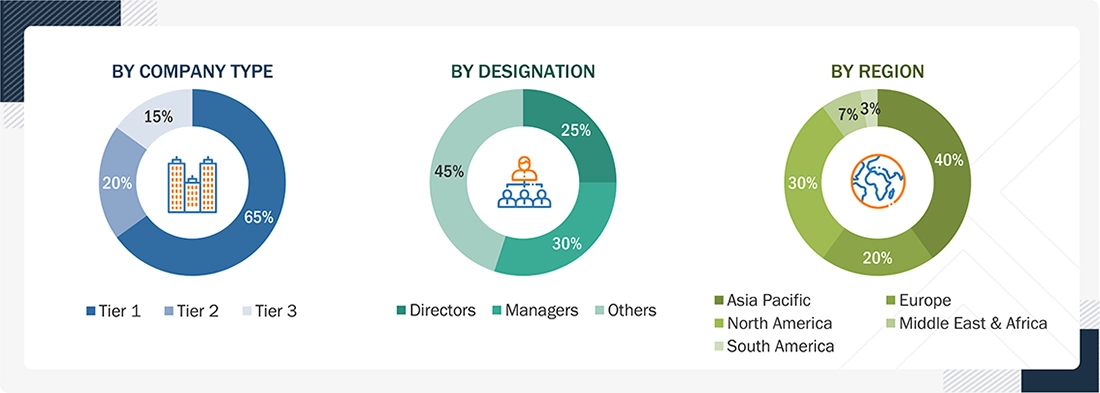
To know about the assumptions considered for the study, download the pdf brochure
Market Size Estimation
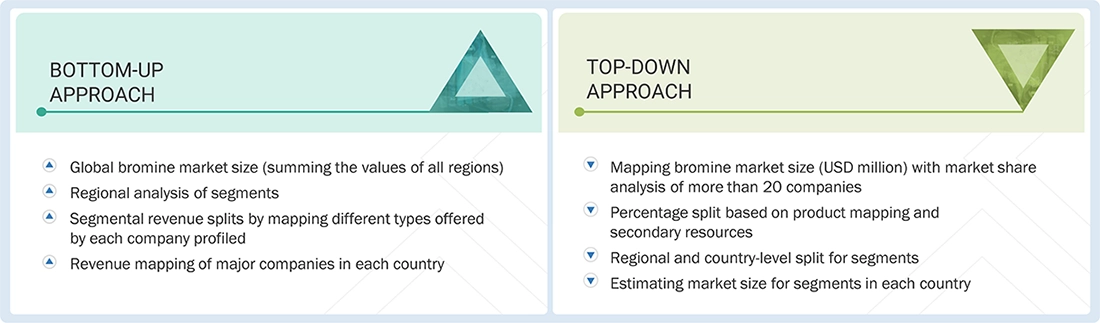
Both the top-down and bottom-up approaches were used to estimate and validate the total size of the bromine market. These methods were also widely used to determine the sizes of various market sub-segments. The research methodology used to estimate the market size included the following:
- The key players were identified through extensive primary and secondary research.
- The value chain and market size of the bromine market, in terms of value, were determined through primary and secondary research.
- All percentage shares, splits, and breakdowns were determined using secondary sources and verified through primary sources.
- All possible parameters that affect the market covered in this research study were accounted for, viewed in extensive detail, verified through primary research, and analyzed to obtain the final quantitative and qualitative data.
- The research included analyzing reports, reviews, and newsletters from top market players, along with extensive interviews with key leaders, including CEOs, directors, and marketing executives, to gather opinions.
Bromine Market : Top-Down and Bottom-Up Approach
Data Triangulation
After arriving at the overall market size using the market size estimation processes as explained above, the market was split into several segments and sub-segments. To complete the overall market engineering process and obtain the exact statistics for each market segment and subsegment, data triangulation and market breakdown procedures were employed, as applicable. The market size was calculated globally by summing country- and regional-level data.
Market Definition
Bromine is a naturally occurring halogen element primarily extracted from bromide-rich brine reservoirs and saline water sources, where it exists in dissolved salt form before being processed into commercially valuable derivatives. As a highly reactive reddish-brown liquid at room temperature, bromine serves as an essential chemical intermediate across a wide range of industrial applications. It is converted into key derivatives, such as organobromines, clear brine fluids, and hydrogen bromide, each of which supports distinct end uses. These derivatives collectively serve diverse application areas, including flame retardants, water treatment & biocides, mercury emission control, oil & gas drilling, PTA synthesis, flow batteries, pesticides, plasma etching, pharmaceuticals, and butyl rubber production. Consequently, bromine demand is closely linked to end-user industries such as oil & gas, electrical & electronics, automotive, agriculture, pharmaceuticals, textiles, cosmetics, and other industrial sectors, reflecting its broad industrial integration and strategic importance in global manufacturing value chains.
Key Stakeholders
- Bromine Manufacturers
- Bromine Suppliers
- Bromine Traders, Distributors, and Suppliers
- Investment Banks and Private Equity Firms
- Raw Material Suppliers
- Government and Research Organizations
- Consulting Companies/Consultants in the Chemicals and Materials Sectors
- Industry Associations
- Contract Manufacturing Organizations (CMOs)
- NGOs, Governments, Investment Banks, Venture Capitalists, and Private Equity Firms
Report Objectives
- To define, describe, and forecast the size of the global bromine market in terms of value
- To provide detailed information regarding the key factors, such as drivers, restraints, opportunities, and industry-specific challenges, influencing the growth of the global bromine market
- To analyze and forecast the size of various segments (derivative and application) of the bromine market based on six major regions—North America, Asia Pacific, Western Europe, Central & Eastern Europe, the Middle East & Africa, and South America, along with key countries in each of these regions
- To strategically profile the key players in the market and comprehensively analyze their core competencies
Available customizations:
With the given market data, MarketsandMarkets offers customizations according to client-specific needs.
The following customization options are available for the report:
? Additional country-level analysis of the bromine market
? Profiling of additional market players (up to 5)
Product Analysis
- Product matrix, which gives a detailed comparison of the product portfolio of each company
Get the Full Bromine Market Report
Full forecast, segment splits, and company analysis for all Bromine Market.
- China Bromine Market
- Japan Bromine Market
- India Bromine Market
- South Korea Bromine Market
- Taiwan Bromine Market
- US Bromine Market
- Canada Bromine Market
- Mexico Bromine Market
- Germany Bromine Market
- France Bromine Market
- UK Bromine Market
- Russia Bromine Market
- Turkey Bromine Market
- Saudi Arabia Bromine Market
- UAE Bromine Market
- South Africa Bromine Market
- Brazil Bromine Market
- Argentina Bromine Market
- South America Bromine Market
- Rest Of Asia Pacific Bromine Market
- GCC Countries Bromine Market
- –Rest Of GCC Countries Bromine Market
Need a Tailored Report?
Customize this report to your needs
Get 10% FREE Customization
Customize This Report
