
Rest Of South America Busbar Market (2025-2035)

The Rest Of South America Busbar Market was valued at $302.3 Million in 2025 and projected to reach to $468.8 Million by 2035, representing a compound annual growth rate of 4.5%. Rest Of South America's busbar market is positioned for consistent growth driven by infrastructure modernization initiatives and renewable energy adoption across the region.


| Market Size in | USD 26.32 MN |
| Market Forecast in | |
| CAGR | |
| Forecast Period | |
| Units Considered | Value (USD MN) |
Rest Of South America Busbar Market Trends and Insights
- Rest Of South America is experiencing steady demand for busbar solutions driven by infrastructure modernization, renewable energy integration, and industrial expansion across the region.
- The market in Rest Of South America reflects growing investments in power distribution networks and electrical infrastructure upgrades to support economic development. Rest Of South America's busbar market growth is supported by increasing electrification initiatives and the transition toward sustainable energy systems.
- Rest Of South America's industrial and commercial sectors are adopting advanced busbar technologies to enhance operational efficiency and grid reliability.
- Over the forecast period from 2025 to 2035, Rest Of South America is expected to see accelerated adoption of busbar systems in utility-scale projects, manufacturing facilities, and data centers, positioning the region as a key growth market within South America's broader energy infrastructure landscape..
Key Market Statistics
- CAGR (2025-2035) 4.5% CAGR
- Market Size, 2025 ~USD 302.3 Million
- Forecast, 2035 ~USD 468.8 Million
- Country Rest Of South America
Rest Of South America Busbar Market Overview
Market Size & Growth :
Rest Of South America's busbar market is valued at USD 302.3 million in 2025, with a projected CAGR of 4.5% through 2035, reaching USD 468.8 million. This steady growth outpaces several regional markets and reflects increasing infrastructure investments across the region.
Infrastructure Modernization :
Aging electrical infrastructure across Rest Of South America is driving demand for upgraded busbar systems. Countries in the region are investing in grid modernization projects to improve reliability, efficiency, and capacity to support growing industrial and commercial sectors.
Renewable Energy Integration :
Expanding renewable energy projects, including hydroelectric, wind, and solar installations, require advanced busbar solutions for efficient power distribution. Rest Of South America's abundant natural resources are spurring renewable capacity additions that necessitate modern electrical infrastructure.
Industrial & Economic Expansion :
Industrial growth in mining, manufacturing, and processing sectors across Rest Of South America is creating sustained demand for reliable busbar systems. Economic development initiatives are driving investments in power distribution networks to support industrial competitiveness and operational efficiency.
Rest Of South America Busbar Market Dynamics
- Governments and private sector investments in electrical grid upgrades, coupled with industrial expansion in key sectors, will sustain demand for advanced busbar solutions through 2035.
- The region's focus on energy efficiency and grid reliability creates opportunities for innovative busbar technologies and integrated power distribution systems. Key growth drivers include increasing electrification rates, expansion of renewable energy capacity, and modernization of aging electrical infrastructure.
- As Rest Of South America continues to develop economically, the demand for reliable, efficient power distribution systems will remain strong.
- Market players should focus on localized solutions, cost-effective offerings, and partnerships with regional utilities and industrial operators to capitalize on emerging opportunities..
Market Ecosystem
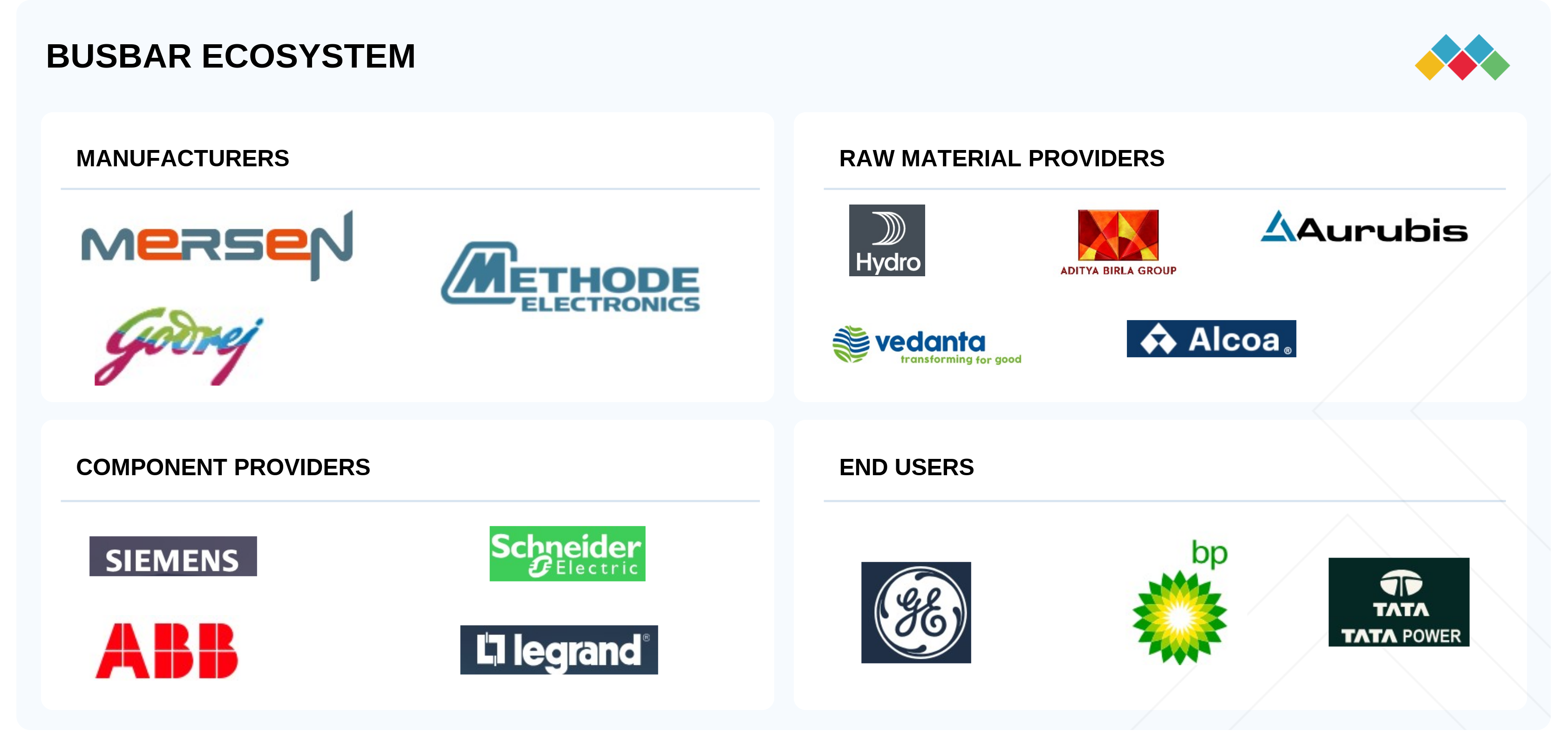
busbar market: COMMERCIAL USE CASES ACROSS INDUSTRIES
| COMPANY | USE CASE DESCRIPTION | BENEFITS |
|---|---|---|
 |
Deploys Armor Clad Busway systems in industrial plants and commercial facilities to distribute electricity effectively, connecting to transformers, panelboards, and switchgear for high-demand applications | Enhanced safety through protection against physical damage and electrical faults |
 |
Implements busbar systems in power generation and oil & gas facilities to ensure reliable power distribution to equipment and machinery across refineries and production sites | Improved reliability of power supply|Reduced energy losses|Lower operational costs |
 |
Installs busbar systems in compact and vertical substations integrated within high-rise buildings and urban networks to supply electricity efficiently in space-constrained areas | Increased grid resilience |Efficient renewable energy integration|Decreased utility costs |
Logos and trademarks shown above are the property of their respective owners. Their use here is for informational and illustrative purposes only.
Related Ecosystem
Key Takeaways
- Rest Of South America's busbar market is valued at USD 302.3 million in 2025 and will reach USD 468.8 million by 2035, growing at a 4.5% CAGR.
- Rest Of South America is witnessing increased demand for busbar solutions due to infrastructure modernization and renewable energy integration initiatives.
- Rest Of South America's industrial and commercial sectors are driving adoption of advanced busbar technologies for improved grid efficiency and reliability.
- Rest Of South America represents a steady growth opportunity within South America, supported by electrification and sustainable energy transition trends.
Busbar Market Report Scope
| Report Metric | Details |
|---|---|
| Base Year | 2025 |
| Fastest Growing Segment | LAMINATED (Insulation) |
| Forecast Period | 2025-2035 |
| Growth Rate | CAGR of 5.8% from 2025 to 2035 |
| Largest Segment | BARE (Insulation) |
| Market Size Base Year (Billions) | ~USD 15.77 (2025) |
| Revenue Forecast (Billions) | ~USD 27.71 (2035) |
| Segments Covered | Material, Power Rating, Insulation, Manufacturing Process, End-Use Application |
Rest Of South America Busbar Market Report Segmentation
5 segment dimensions are covered across the global market.
By Material
- Aluminum
- Copper
By Power Rating
- High
- Low
- Medium
By Insulation
- Bare
- Laminated
- Powder-Coated
By Manufacturing Process
- Flexible
- Hybrid
- Molded
- Stamped
By End-Use Application
- Automotive
- Commercial & Residential
- Data Centers
- Industrial
- Locomotive
- Renewables
- Residential & Commercial
- Utilities
Target Audience
- Busbar Manufacturers & Suppliers : Manufacturers need regional market data to identify expansion opportunities, assess competitive landscapes, and develop localized product strategies for Rest Of South America's growing infrastructure and industrial sectors.
- Electrical Utilities & Grid Operators : Utility companies require market insights to plan infrastructure upgrades, evaluate busbar technology options, and optimize power distribution systems for modernization projects across Rest Of South America.
- Industrial & Commercial Enterprises : Industrial operators and facility managers need to understand busbar market trends to make informed procurement decisions, evaluate supplier options, and plan electrical system upgrades for operational efficiency.
- Investment & Private Equity Firms : Investors evaluating opportunities in Rest Of South America's energy sector require detailed market analysis to assess growth potential, identify acquisition targets, and evaluate returns in the busbar and power distribution space.
- Government & Policy Makers : Regional government agencies and energy regulators need market data to inform infrastructure policies, renewable energy integration strategies, and grid modernization initiatives across Rest Of South America.
Key Companies in the Rest Of South America Busbar Market
| Company | HQ | Ownership | Strongest segments |
|---|---|---|---|
| PENTAIR PLC | United Kingdom | Public Company | Pool,Flow,Water Solutions, |
| GODREJ GROUP | India | Private Company | Home appliances (refrigerators, washing machines, ACs, microwaves, coolers, disinfecting appliances),Commercial appliances and cooling (medical refrigerators, deep freezers, vending, personal cooling),Locks, architectural hardware, kitchen fittings, home and institutional security, |
| ABB | Switzerland | Public Company | Electrification,Motion,Automation, |
| EATON | Ireland | Public Company | Electrical components, power distribution and assemblies,Power quality, connectivity, and circuit protection,Hazardous duty, emergency lighting, fire detection, structural support, |
| ROGERS CORPORATION | Canada | Public Company | Wireless services & devices,Cable & broadband (internet, TV, telephony),Media, sports & financial services, |
| LITTELFUSE, INC. | United States | Public Company | Electronics (fuses, TVS, Si/SiC MOSFETs, IGBTs, sensing),Transportation (fuses, power distribution modules, sensors),Industrial (fuses, relays, contactors, protection devices), |
| TE CONNECTIVITY | Ireland | Public Company | Transportation Solutions (automotive, e-mobility, commercial and industrial vehicles, autosport, rail),Industrial Solutions (automation, aerospace and defense, energy, intelligent buildings, medical, rail, oil and gas/marine),Data and Devices (5G, wireless, data centers, IoT connectivity, personal electronics, connected home), |
| SALZER | India | Public Company | Industrial components (switches, ducts, relays, control panels, plugs/sockets),Motor control and protection (contactors, MPCB, MCB, CTs, coils, transformers, EV chargers),Residential and building electricals (MCB, DBs, modular and smart switches, sensors, house wires), |
| DHANALAXMI STEEL DISTRIBUTORS | India | Private | Long products (TMT bars, structural sections, angles, channels),Flat products (HR/CR coils, sheets, plates),Value-added / processed (cut-to-length, slitting, customized sizes), |
PENTAIR PLC
Pentair PLC is a United Kingdom-based public company founded in 1966 with approximately 9,000 employees. The company operates as an established industrial enterprise with a significant global workforce.
GODREJ GROUP
Godrej Group is an Indian private company founded in 1897 with 13,316 employees. The company represents a major industrial conglomerate with over a century of business operations.
ABB
ABB is a Swiss public company founded in 1883 with 111,900 employees. As a large multinational enterprise, ABB operates across multiple industrial sectors with a substantial global workforce.
EATON
Eaton is an Irish-registered public company founded in 1911 with 97,303 employees. The company operates as a major multinational industrial enterprise with extensive global operations.
ROGERS CORPORATION
Rogers Corporation is a Canadian public company founded in 1960 with 25,000 employees. The company operates as a significant industrial enterprise with a substantial workforce.
LITTELFUSE, INC.
Littelfuse, Inc. is a United States-based public company founded in 1927 with 17,000 employees. The company operates as an established industrial manufacturer with a considerable global workforce.
TE CONNECTIVITY
TE Connectivity is an Ireland-registered public company founded in 1941 with 80,000 employees. The company operates as a major multinational enterprise with extensive global operations.
SALZER
Salzer is an Indian public company founded in 1985 with 924 employees. The company operates as a mid-sized industrial enterprise with regional market presence.
DHANALAXMI STEEL DISTRIBUTORS
Insufficient data provided for company description.
Reasons to Buy this Report
- Regional Market Specificity : Gain detailed insights specific to Rest Of South America's busbar market dynamics, excluding Brazil and other major markets. Understand unique regional drivers, challenges, and opportunities that differ from broader Latin American trends.
- Growth Opportunity Identification : Identify high-potential segments within Rest Of South America's 4.5% CAGR market growth trajectory. Pinpoint emerging sectors and geographic pockets where busbar demand is accelerating fastest through 2035.
- Infrastructure Investment Tracking : Monitor ongoing and planned infrastructure modernization projects across Rest Of South America. Access data on grid upgrades, renewable energy integration projects, and industrial expansion initiatives driving busbar procurement.
- Competitive Positioning Strategy : Develop targeted market entry and expansion strategies for Rest Of South America. Understand local competition, customer preferences, regulatory requirements, and distribution channels specific to the region.
- Investment & Partnership Decisions : Make informed decisions on joint ventures, acquisitions, and partnerships in Rest Of South America's busbar sector. Evaluate market maturity, growth potential, and strategic fit based on comprehensive regional analysis.
Frequently asked questions
What is the current market size of the busbar market in Rest Of South America?
Rest Of South America's busbar market is estimated at USD 302.3 million in 2025.
What is the projected market size for Rest Of South America's busbar market by 2035?
Rest Of South America's busbar market is projected to reach USD 468.8 million by 2035.
What is the CAGR for the busbar market in Rest Of South America?
Rest Of South America's busbar market is expected to grow at a compound annual growth rate (CAGR) of 4.5% from 2025 to 2035.
What are the primary drivers of busbar market growth in Rest Of South America?
Rest Of South America's busbar market growth is driven by infrastructure modernization, renewable energy integration, industrial expansion, and increasing electrification initiatives across the region.
Which sectors are driving busbar adoption in Rest Of South America?
Rest Of South America's industrial, commercial, utility-scale, manufacturing, and data center sectors are the primary drivers of busbar system adoption and investment.
RESEARCH METHODOLOGY
The study involved major activities in estimating the current size of the busbar market. Exhaustive secondary research was done to collect information on the peer and parent markets. The next step was to validate these findings, assumptions, and sizing with industry experts across the value chain through primary research. Both top-down and bottom-up approaches were employed to estimate the complete market size. Thereafter, market breakdown and data triangulation were used to estimate the market size of the segments and subsegments.
Secondary Research
This research study on the busbar market involved the use of extensive secondary sources, directories, and databases, such as Hoovers, Bloomberg, Businessweek, Factiva, International Energy Agency, and BP Statistical Review of World Energy, to identify and collect valuable information for a technical, market-oriented, and commercial study of the global busbar market. The other secondary sources included annual reports, press releases, and investor presentations of companies, white papers, certified publications, articles by recognized authors, manufacturer associations, trade directories, and databases.
Primary Research
The busbar market comprises stakeholders, including busbar manufacturers, technology providers, and support providers, throughout the supply chain. On the demand side, the market is driven by growing adoption of busbar systems in various sectors, including data centers, renewable energy, industrial, and commercial applications, due to their high energy efficiency, compact design, and superior performance compared to conventional power distribution systems. Rising infrastructure development and urbanization in emerging economies further fuel demand for busbar solutions. On the supply side, manufacturers are witnessing increasing opportunities through contracts from utility and industrial distribution networks, as well as strategic initiatives, such as mergers, acquisitions, and partnerships, by market players to expand their footprint and enhance technological capabilities. Various primary sources from both the supply and demand sides of the market were interviewed to obtain qualitative and quantitative information. The following is the breakdown of primary respondents:
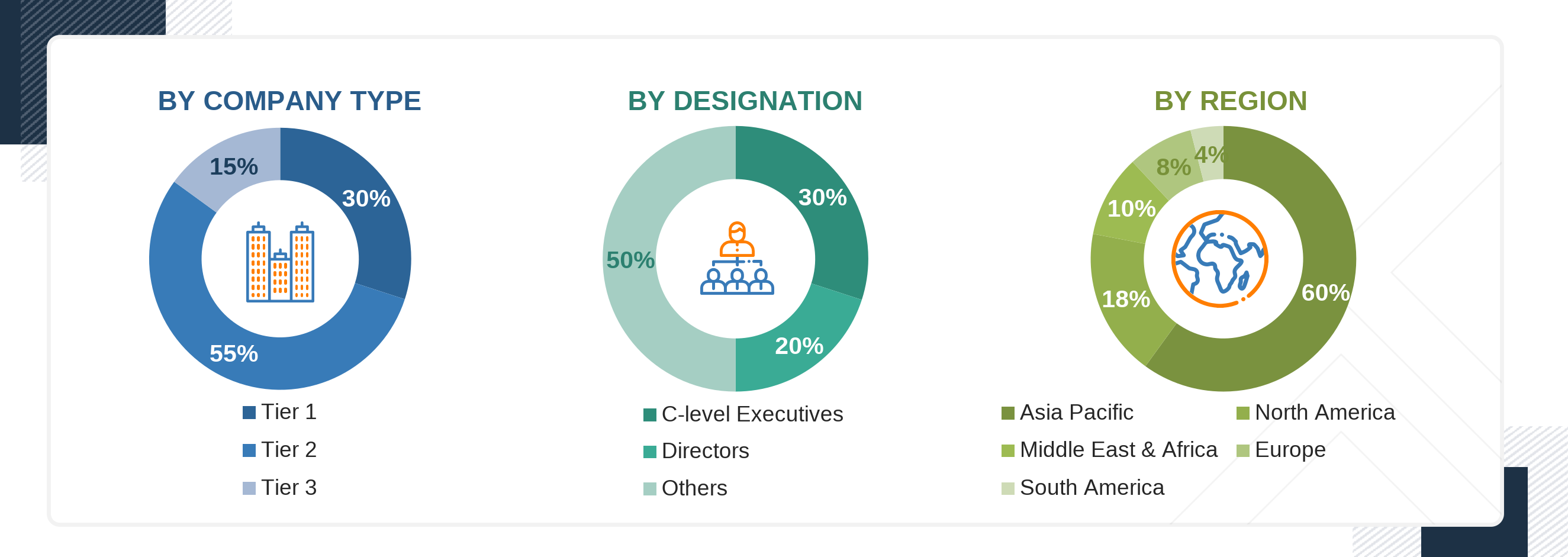
Note: “Others” include sales managers, engineers, and regional managers.
The tiers of the companies are defined based on their total revenue as of 2024: Tier 1: >USD 1 billion, Tier 2: USD 500 million–1 billion,
and Tier 3:
To know about the assumptions considered for the study, download the pdf brochure
Market Size Estimation
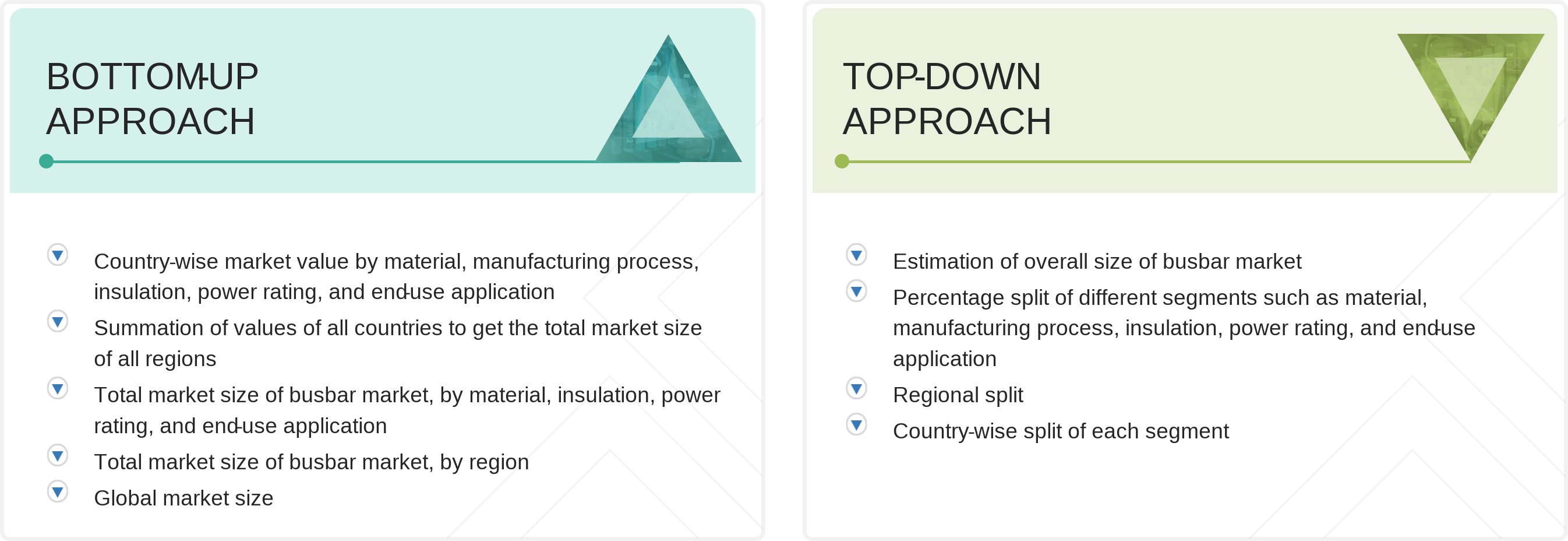
Both the top-down and bottom-up approaches were used to estimate and validate the size of the busbar market and its dependent submarkets. The key players in the market were identified through secondary research, and their market share in the respective regions was determined through a combination of primary and secondary research. The research methodology involves analyzing the annual and financial reports of top market players and conducting interviews with industry experts, including chief executive officers, vice presidents, directors, sales managers, and marketing executives, to gather key quantitative and qualitative insights related to the busbar market.
Busbar Market : Top-Down and Bottom-Up Approach
Data Triangulation
After determining the overall market size through the estimation process explained above, the total market was divided into several segments and subsegments. To complete the overall market engineering process and obtain the exact statistics for all segments and subsegments, the data triangulation and market breakdown processes were employed, as applicable. The data was triangulated by studying various factors and trends from both the demand and supply sides. Additionally, the market size was validated using both top-down and bottom-up approaches.
Market Definition
A busbar is an electrical element that simplifies complex power distributions, making them more affordable and flexible. It is a metallic strip or bar, typically housed inside switchgear, panel boards, and busway enclosures for local high-current power distribution. The bus bar system consists of an isolator and a circuit breaker. It allows new circuits to branch off anywhere along the busway route, rather than branching the main supply at a single location. A busbar is an electrical junction that collects electric power from incoming feeders and distributes it to the outgoing feeders. The primary purpose of a busbar is to carry electricity and distribute it. It is used to make the systems more efficient. They can be an excellent solution for complicated electrical systems.
Stakeholders
- Government & research organizations
- Institutional investors
- Investors/Shareholders
- Environmental research institutes
- Manufacturers’ associations
- Busbar manufacturers, dealers, and suppliers
- Organizations, forums, alliances, and associations
- Renewable power generation and equipment manufacturing companies
- Public & private power generation, transmission & distribution companies (utilities)
- Substation equipment manufacturing companies
- Smart grid project developers
- Switchgear and power cable manufacturing companies
- State and national regulatory authorities
- Venture capital firms
Report Objectives
- To describe and forecast the busbar market, by material, power rating, insulation, manufacturing process, end-use application, and region, in terms of value
- To describe and forecast the busbar market for various segments with respect to five main regions: North America, Europe, Asia Pacific, South America, and the Middle East & Africa, in terms of value
- To describe and forecast the busbar market, by region, in terms of volume
- To provide detailed information regarding drivers, restraints, opportunities, and challenges influencing the growth of the market
- To provide a detailed overview of the busbar supply chain analysis, use case analysis, key stakeholders and buying criteria, patent analysis, trade analysis, tariff analysis, regulations, macroeconomic outlook, pricing analysis, Porter’s five forces analysis, impact of gen AI/AI, and the 2024 US tariff impact
- To strategically analyze micromarkets1 with respect to individual growth trends, prospects, and contributions to the total market
- To analyze opportunities in the market for various stakeholders by identifying high-growth segments
- To strategically profile key players and comprehensively analyze their market position in terms of ranking and core competencies1, along with detailing the market’s competitive landscape.
- To analyze growth strategies, such as acquisitions, investments, expansions, and product launches, adopted by market players in the busbar market
1 Micromarkets are defined as the segments and subsegments of the busbar market included in the report.
2 Core competencies of companies are defined in terms of key developments and strategies adopted to sustain their positions in the busbar market.
Available Customizations
MarketsandMarkets offers customizations tailored to the specific needs of companies, utilizing the provided market data.
The following customization options are available for the report:
Product Analysis
- Product matrix, which gives a detailed comparison of the product portfolio of each company
Geographic Analysis as per Feasibility
- Further breakdown of the busbar market, by country
Company Information
- Detailed analysis and profiling of additional market players (up to five)
Get the Full Busbar Market Report
Full forecast, segment splits, and company analysis for all Busbar Market.
- Argentina Busbar Market
- Brazil Busbar Market
- Canada Busbar Market
- China Busbar Market
- France Busbar Market
- GCC Busbar Market
- Germany Busbar Market
- India Busbar Market
- Italy Busbar Market
- Japan Busbar Market
- Mexico Busbar Market
- Qatar Busbar Market
- Rest Of Asia Pacific Busbar Market
- Rest Of Europe Busbar Market
- Rest Of GCC Busbar Market
- Saudi Arabia Busbar Market
- South Africa Busbar Market
- South Korea Busbar Market
- UAE Busbar Market
- UK Busbar Market
- US Busbar Market
Need a Tailored Report?
Customize this report to your needs
Get 10% FREE Customization
Customize This Report
