
US Cardiac Monitoring & Rhythm Management Devices Market (2026-2031)

The US Cardiac Monitoring & Rhythm Management Devices Market was valued at $2458.7 Million in 2026 and projected to reach to $3313.1 Million by 2031, representing a compound annual growth rate of 6.1%. The US cardiac monitoring and rhythm management devices market is poised for sustained growth driven by an aging population, increasing prevalence of atrial fibrillation and heart failure, and technological advancements in wearable and implantable devices.


| Market Size in | USD 26.32 MN |
| Market Forecast in | |
| CAGR | |
| Forecast Period | |
| Units Considered | Value (USD MN) |
US Cardiac Monitoring & Rhythm Management Devices Market Trends and Insights
- The US market benefits from advanced healthcare infrastructure, high adoption of remote monitoring technologies, and strong reimbursement frameworks that support device deployment across hospitals and outpatient settings.
- Aging demographics and rising prevalence of atrial fibrillation and heart failure in the US are driving sustained demand for implantable cardioverter-defibrillators (ICDs), pacemakers, and continuous monitoring solutions. In the US, innovation in wearable cardiac devices and integration with digital health platforms are reshaping the competitive landscape between 2026 and 2031.
- The US market is characterized by significant investment in artificial intelligence-enabled diagnostics and remote patient monitoring, which enhance clinical outcomes and reduce hospital readmissions.
- Regulatory support from the FDA and favorable reimbursement policies position the US as a leading market for next-generation rhythm management technologies..
Key Market Statistics
- CAGR (2026-2031) 6.1% CAGR
- Market Size, 2026 ~USD 2458.7 Million
- Forecast, 2031 ~USD 3313.1 Million
- Country US
US Cardiac Monitoring & Rhythm Management Devices Market Overview
Market Valuation :
The US cardiac monitoring and rhythm management devices market is valued at $2,458.7 million in 2026 and is projected to reach $3,313.1 million by 2031, demonstrating robust growth trajectory.
Advanced Healthcare Infrastructure :
The US benefits from state-of-the-art healthcare facilities, widespread adoption of remote monitoring technologies, and sophisticated digital health ecosystems that accelerate device deployment and patient outcomes.
Strong Reimbursement Framework :
Favorable Medicare and private insurance reimbursement policies in the US support widespread adoption of cardiac monitoring devices across hospitals, clinics, and home care settings, driving market expansion.
Growth Rate :
The US market is expected to grow at a CAGR of 6.1% from 2026 to 2031, slightly below the global CAGR of 6.3%, reflecting mature market dynamics with steady innovation-driven expansion.
US Cardiac Monitoring & Rhythm Management Devices Market Dynamics
- Remote patient monitoring adoption continues to accelerate, supported by favorable reimbursement policies and integration with electronic health records systems.
- Healthcare providers are increasingly investing in connected device ecosystems to improve patient outcomes and reduce hospital readmissions. Key growth drivers include FDA approvals for innovative monitoring solutions, expansion of telehealth services, and growing consumer awareness of cardiac health management.
- The competitive landscape remains dynamic with established medical device manufacturers and emerging digital health companies investing heavily in AI-enabled diagnostics and predictive analytics.
- Regulatory support for remote monitoring technologies and value-based care models will continue to shape market opportunities through 2031..
Market Ecosystem
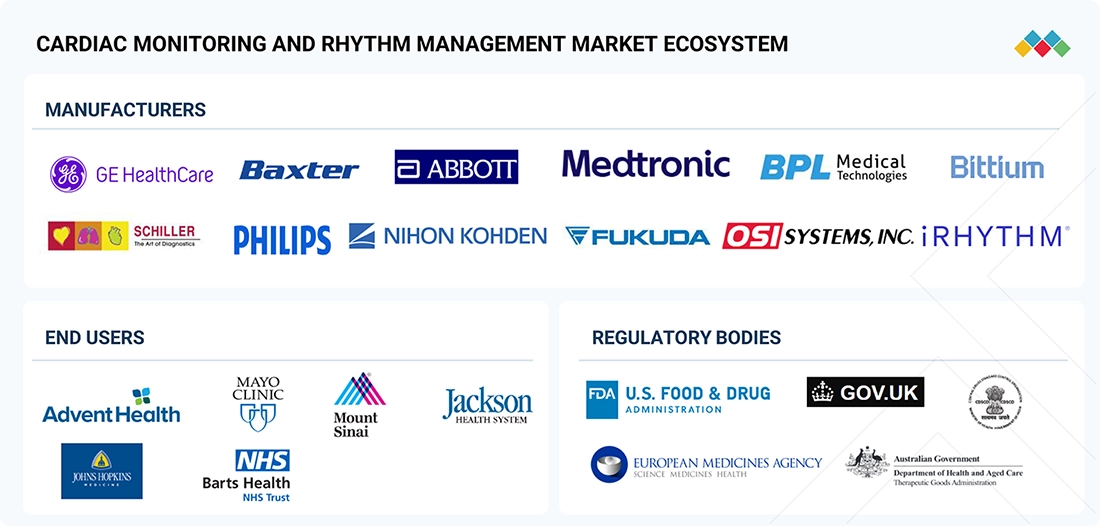
CARDIAC MONITORING & CARDIAC RHYTHM MANAGEMENT DEVICES MARKET: GROWTH, SIZE, SHARE, AND TRENDS: COMMERCIAL USE CASES ACROSS INDUSTRIES
| COMPANY | USE CASE DESCRIPTION | BENEFITS |
|---|---|---|
 |
Implantable cardiac rhythm management devices (pacemakers, ICDs, CRT), remote cardiac monitoring systems | Improved arrhythmia management, reduced sudden cardiac death risk, advanced remote patient monitoring |
 |
Pacemakers, implantable loop recorders, cardiac monitors, and CRM systems | Long device longevity, continuous rhythm monitoring, enhanced diagnostic accuracy |
 |
Pacemakers, ICDs, CRT devices, wearable and implantable cardiac monitors | Reliable rhythm control, improved heart failure outcomes, strong physician adoption |
 |
Ambulatory ECG monitoring, cardiac telemetry, patient monitoring systems | Continuous cardiac surveillance, early arrhythmia detection, integrated hospital workflows |
 |
Holter monitors, ECG systems, cardiac telemetry and patient monitoring platforms | High-quality signal acquisition, scalable monitoring solutions, broad hospital adoption |
Logos and trademarks shown above are the property of their respective owners. Their use here is for informational and illustrative purposes only.
Related Ecosystem
Medical Devices
- Polymerase Chain Reaction (PCR)
- Magnetic Resonance Imaging (MRI)
- Disposable Autoinjectors
- Pulse Oximeters
- Blood Pressure Monitors
- Medtronic plc
- Abbott Laboratories
- Stryker Corporation
- Becton, Dickinson and Company
- JOHNSON & JOHNSON
Key Takeaways
- The US cardiac monitoring market will expand from $2,458.7M (2026) to $3,313.1M (2031) at a 6.1% CAGR, driven by aging populations and rising arrhythmia prevalence.
- Remote monitoring and wearable technologies are accelerating adoption in the US, enabling real-time patient data collection and reducing clinical intervention costs.
- FDA approval pathways and robust reimbursement coverage in the US support rapid commercialization of innovative ICD, pacemaker, and monitoring device solutions.
- The US market is increasingly competitive, with major players investing in AI-powered diagnostics and cloud-based platforms to differentiate offerings and improve patient outcomes.
Cardiac Monitoring & Rhythm Management Devices Market Report Scope
| Report Metric | Details |
|---|---|
| Base Year | 2026 |
| Fastest Growing Segment | HOME CARE SETTINGS (End User) |
| Forecast Period | 2026–2031 |
| Growth Rate | CAGR of 6.3% from 2026 to 2031 |
| Largest Segment | ARRHYTHMIAS (Application) |
| Market Size Base Year (Billions) | ~USD 27.91 (2026) |
| Revenue Forecast (Billions) | ~USD 37.88 (2031) |
| Segments Covered | Type, Application, End User, Type 2024–2031 |
US Cardiac Monitoring & Rhythm Management Devices Market Report Segmentation
4 segment dimensions are covered across the global market.
By Type
- Ambulatory Cardiac Monitors
- Automated External Defibrillators (Aed)
- Automated External Defibrillators (Aeds)
- Cardiac Resynchronization Therapy (Crt)
- Cardiac Resynchronization Therapy Defibrillators
- Cardiac Resynchronization Therapy Pacemakers (Crt-P)
- Cardiac Resynchronization Therapy Pacemakers(Crt-P)
- Cardiac Resynchronization Therapy- Defibrillators (Crt-Ds)
- Crt- Pacemaker
- Defibrillators
- Dual-Chamber Icds
- Dual-Chamber Implantable Cardioverter-Defibrillators (Icds)
- Dual-Chamber Pacemakers
- Electrocardiogram (Ecg / Ekg) Monitors
- Electrocardiogram (Ecg/Ekg) Monitors
- Event Monitors
- External Defibrillation Devices
- External Defibrillators
- Handheld/ Smart Ecg Monitors
- Handheld/Smart Ecg Monitors
- Holter Monitors
- Holter Monitors (Short Term)
- Implantable Cardioverter-Defibrillators (Icds)
- Invasive Cardiac Monitoring Devices
- Leadless Chamber Pacemakers
- Long-Term Continuous Ecg Monitors
- Manual External Defibrillator / Monitor Units
- Manual External Defibrillator /Monitor Units
- Manual External Defibrillators
- Mobile Cardiac Telemetry (Mct) Devices
- Mobile Cardiac Telemetry Devices (Mct)
- Non-Invasive Cardiac Monitoring Devices
- Pacemakers
- Patch-Based Ecg Monitors (Long Term, Extended Wear)
- Single- Chamber Icds
- Single- Chamber Pacemakers
- Single-Chamber Implantable Cardioverter-Defibrillators (Icds)
- Single-Chamber Pacemakers
- Standard 12-Lead Ecg Machines (Resting Ecg Monitors)
- Stress Ecg System
- Stress Ecg Systems
- Subcutaneous Icds
- Subcutaneous Implantable Cardioverter-Defibrillators (Icds)
- Wearable Cardioverter Defibrillators (Wcds)
- Wearable Cardioverter-Defibrillators (Wcds)
By Application
- Arrhythmias
- Heart Failure
- Heart Failure (Hf)
- Myocardial Infarction (Mi)
- Myocardial Infraction (Mi)
- Other Applications
By End User
- Ambulatory Surgical Centers
- Ambulatory Surgical Centres
- Cardiac Centers
- Cardiac Centres
- Home Care Settings
- Hospitals
- Other End Users
- Primary Care Centers
- Primary Care Centres
By Type 2024–2031
- Event Monitors
- Holter Monitors
- Long-Term Continuous Ecg Monitors
- Mobile Cardiac Telemetry (Mct) Devices
US: CARDIAC MONITORING AND RHYTHM MANAGEMENT DEVICES MARKET, BY END USER, 2024–2031
| Segment | 2024 | 2025 | 2026 | 2027 | 2028 | 2029 | 2030 | 2031 | CAGR (%) |
|---|---|---|---|---|---|---|---|---|---|
| AMBULATORY SURGICAL CENTERS | 428.2 | 458.9 | 485.3 | 513.9 | 544.7 | 578.2 | 614.3 | 653.4 | 6.1 |
| CARDIAC CENTERS | 2211.5 | 2414.6 | 2601.6 | 2806.2 | 3030.4 | 3276.6 | 3546.3 | 3843.1 | 8.1 |
| HOME CARE SETTINGS | 685.7 | 753.9 | 817.9 | 888.3 | 965.9 | 1051.6 | 1146 | 1250.6 | 8.9 |
| HOSPITALS | 4372.7 | 4676.2 | 4934.9 | 5213.6 | 5514.3 | 5839.8 | 6190.6 | 6570.8 | 5.9 |
| OTHER END USERS | 844.3 | 895.9 | 936.6 | 978.6 | 1021.7 | 1066.1 | 1111.2 | 1157.1 | 4.3 |
| PRIMARY CARE CENTERS | 1584.3 | 1726.3 | 1856.1 | 1998 | 2153 | 2323.2 | 2509.2 | 2713.5 | 7.9 |
| TOTAL | 10126.8 | 10925.8 | 11632.5 | 12398.5 | 13230 | 14135.4 | 15117.6 | 16188.5 | 6.8 |
Target Audience
- Medical Device Manufacturers : US-based and international device manufacturers need detailed market intelligence to develop go-to-market strategies, identify distribution partnerships, and optimize product portfolios for the American healthcare system.
- Healthcare Providers & Hospital Systems : Hospital networks, cardiology clinics, and healthcare systems require market data to evaluate device procurement decisions, assess reimbursement viability, and plan technology infrastructure investments.
- Digital Health & MedTech Startups : Emerging companies in remote monitoring and connected health need US market insights to validate business models, identify funding opportunities, and understand regulatory pathways for market entry.
- Healthcare Investors & Private Equity : Investment firms evaluating cardiac device companies and healthcare technology platforms need comprehensive US market data to assess growth potential, valuation benchmarks, and exit opportunities.
- Healthcare Consultants & Analysts : Management consulting firms and research organizations require detailed US market segmentation and forecasts to support client advisory services, competitive analysis, and strategic planning engagements.
Key Companies in the US Cardiac Monitoring & Rhythm Management Devices Market
| Company | HQ | Ownership | Strongest segments |
|---|---|---|---|
| KINDRED HEALTHCARE INC. | United States | Private Company | Long-term acute care hospital services,Inpatient rehabilitation facilities,Contract rehabilitation and ancillary services, |
| CONMED CORPORATION | United States | Public Company | Orthopedic & Sports Medicine (BioBrace, Y-Knot, Hall power tools, arthroscopy ecosystem),General Surgery (AirSeal, Buffalo Filter, endomechanical, electrosurgical systems),Endoscopic Technologies (GI therapeutic/diagnostic) & Patient Monitoring, |
| HENRY SCHEIN | United States | Public Company | Global Distribution & Value-Added Services,Global Specialty Products,Global Technology, |
| ST JUDE MEDICAL, INC | United States | Private Company | Cardiac Rhythm Management (pacemakers, ICDs, CRT devices),Heart Failure & Hemodynamic Monitoring (CRT-HF, VADs, CardioMEMS HF system),Atrial Fibrillation & Electrophysiology (catheters, mapping, ablation, LAA closure), |
| ZOLL MEDICAL CORPORATION | United States | Private Company | Defibrillators and monitors (hospital and EMS),Automated external defibrillators (public access and professional),LifeVest and wearable defibrillation solutions, |
| SANOFI | France | Public Company | Pediatric and Combination Vaccines (polio, pertussis, Hib, hexavalent),Other Vaccines (RSV, hepatitis A, typhoid, yellow fever, rabies),Immunology and Inflammation Therapies, |
| AT&S | Canada | Public Company | Turnkey automated manufacturing and assembly systems,Pre- and post-automation lifecycle services,Software and digital solutions, |
| X-FAB | Belgium | Public Company | Analog/mixed-signal CMOS ICs,MEMS (sensors and actuators),Silicon carbide and gallium nitride, |
| MERIT MEDICAL | United States | Public Company | Cardiovascular (cardiac intervention, peripheral intervention, hemodynamic monitoring, fluid management, hemostasis),Oncology and Spine (soft tissue biopsy, embolotherapy, vertebral augmentation, RFA, bone biopsy),Endoscopy (gastroenterology and pulmonary products, stents, balloon dilators, cryoballoon devices), |
| GE HEALTHCARE | United States | Public Company | Imaging,Advanced Visualization Solutions (Ultrasound and Interventional),Patient Care Solutions, |
| KONINKLIJKE PHILIPS N.V. | Netherlands | Public Company | Diagnostic Imaging (MR, CT, X-ray, Ultrasound),Image Guided Therapy Systems and Devices,Monitoring and Enterprise Informatics, |
| BOSTON SCIENTIFIC CORPORATION | United States | Public Company | Cardiovascular (structural heart, CRM, peripheral, electrophysiology),MedSurg – Endoscopy (GI, pancreaticobiliary, infection prevention, single-use scopes),MedSurg – Urology and Pelvic Health, |
| MEDTRONIC | Ireland | Public Company | Cardiovascular Portfolio,Neuroscience Portfolio,Medical Surgical Portfolio (incl. Diabetes), |
| SHENZHEN MINDRAY BIO-MEDICAL ELECTRONICS CO., LTD. | China | Public Company | Patient monitoring & life-support (including ventilators, defibrillation, AED, anesthesia),Ultrasound & medical imaging (including radiology, emergency ultrasound, endoscope camera systems),In-vitro diagnostics (CLIA, chemistry, hematology), |
| ABBOTT | United States | Public Company | Diagnostic Products,Medical Devices,Nutritional Products, |
| STRYKER | United States | Public Company | Orthopaedics (hips, knees, shoulder, ankle, trauma and extremities, Mako Shoulder),MedSurg (surgical equipment, patient handling, emergency medical equipment, intensive care disposables),Neurotechnology and Spine (stroke, hemorrhagic, venous thromboembolism, brain surgery, orthobiologics, biosurgery), |
| NIHON KOHDEN CORPORATION | Japan | Public Company | Patient monitors & clinical information systems,Physiological measuring equipment (EEG/ECG/EMG and related),Defibrillators, AEDs, ventilators, anesthesia and therapeutic devices, |
| MICROPORT SCIENTIFIC CORPORATION | China | Public Company | Cardiovascular Devices,Orthopedics Devices,Cardiac Rhythm Management, |
| FUKUDA DENSHI | Japan | Public Company | Resting ECG and Stress Test Systems,Patient Monitoring Systems (bedside, central, transmitters),Vascular Screening and Data Management Software, |
| OSI SYSTEMS, INC. | United States | Public Company | Security (Rapiscan, S2 turnkey solutions),Healthcare (Spacelabs patient and connected monitoring),Optoelectronics and Manufacturing (devices, EMS, LCDs), |
| IRHYTHM INC. | United States | Public Company | Zio XT System (long-term continuous ECG monitoring services),Zio Monitor System and Zio ECG Utilization Software,Zio AT System (mobile cardiac telemetry and near-real-time monitoring), |
| LEPU MEDICAL TECHNOLOGY (BEIJING) CO., LTD. | China | Public Company | Cardiac interventional and cardiovascular devices,In vitro diagnostics and ultrasound imaging,Peripheral vascular, blood purification, and surgical instruments, |
KINDRED HEALTHCARE INC.
Kindred Healthcare Inc. is a private healthcare company founded in 1985 in the United States, operating with a workforce of 64,200 employees.
CONMED CORPORATION
CONMED Corporation is a public medical device company established in 1970 in the United States, employing 3,900 people.
HENRY SCHEIN
Henry Schein is a public company founded in 1932 in the United States with 25,000 employees, operating in the healthcare distribution sector.
ST JUDE MEDICAL, INC
St Jude Medical, Inc. is a private medical device company established in 1976 in the United States with 18,000 employees.
ZOLL MEDICAL CORPORATION
ZOLL Medical Corporation is a private medical device manufacturer founded in 1980 in the United States with 1,908 employees.
SANOFI
Sanofi is a public pharmaceutical company founded in 1994 in France with 74,846 employees.
AT&S
AT&S is a public company founded in 1978 in Canada with 7,000 employees.
X-FAB
X-FAB is a public semiconductor company founded in 1992 in Belgium with 4,300 employees.
MERIT MEDICAL
Merit Medical is a public medical device company founded in 1987 in the United States with 7,500 employees.
GE HEALTHCARE
GE Healthcare is a public healthcare company founded in 2022 in the United States with 54,000 employees.
KONINKLIJKE PHILIPS N.V.
Koninklijke Philips N.V. is a public multinational company founded in 1891 in the Netherlands with 64,317 employees.
BOSTON SCIENTIFIC CORPORATION
Boston Scientific Corporation is a public medical device company founded in 1979 in the United States with 59,000 employees.
MEDTRONIC
Medtronic is a public medical technology company founded in 1949 in Ireland with 95,000 employees.
SHENZHEN MINDRAY BIO-MEDICAL ELECTRONICS CO., LTD.
Shenzhen Mindray Bio-Medical Electronics Co., Ltd. is a public medical device manufacturer founded in 1991 in China with 21,288 employees.
ABBOTT
Abbott is a public healthcare company founded in 1888 in the United States with 115,000 employees.
STRYKER
Stryker is a public medical device and pharmaceutical company founded in 1941 in the United States with 56,000 employees.
NIHON KOHDEN CORPORATION
Nihon Kohden Corporation is a public medical device company founded in 1951 in Japan with 6,116 employees.
MICROPORT SCIENTIFIC CORPORATION
MicroPort Scientific Corporation is a public medical device company founded in 1998 in China with 6,547 employees.
FUKUDA DENSHI
Fukuda Denshi is a public medical device manufacturer founded in 1939 in Japan with 3,497 employees.
OSI SYSTEMS, INC.
OSI Systems, Inc. is a public technology company founded in 1987 in the United States with 7,337 employees.
IRHYTHM INC.
iRhythm Inc. is a public digital health company founded in 2006 in the United States with 2,400 employees.
LEPU MEDICAL TECHNOLOGY (BEIJING) CO., LTD.
Lepu Medical Technology (Beijing) Co., Ltd. is a public medical device company founded in 1999 in China with 8,689 employees.
Reasons to Buy this Report
- US-Specific Market Sizing : Obtain precise valuation data for the US market ($2,458.7M in 2026) with detailed forecasts through 2031, enabling accurate budgeting and resource allocation for US-focused business strategies.
- Reimbursement & Regulatory Insights : Understand US-specific Medicare, Medicaid, and private insurance reimbursement frameworks that directly impact device adoption rates, pricing strategies, and market entry decisions for cardiac monitoring solutions.
- Competitive Landscape Analysis : Identify key US market players, their market share, product portfolios, and competitive positioning within the American healthcare system to inform partnership and competitive strategy decisions.
- Technology Adoption Trends : Analyze US adoption patterns for remote monitoring, wearable devices, and AI-enabled diagnostics, including healthcare provider preferences and patient acceptance rates specific to the American market.
- Growth Opportunity Identification : Discover high-growth segments within the US market, emerging applications, and underserved patient populations to prioritize product development and commercial expansion initiatives.
Frequently asked questions
What is the current size of the US cardiac monitoring and rhythm management devices market?
The US market is valued at $2,458.7 million in 2026 and is expected to reach $3,313.1 million by 2031, growing at a 6.1% CAGR.
What are the primary drivers of growth in the US cardiac monitoring market?
Key drivers in the US include an aging population, rising prevalence of atrial fibrillation and heart failure, adoption of remote monitoring technologies, and strong FDA regulatory support with favorable reimbursement policies.
Which device types dominate the US cardiac monitoring market?
The US market is led by implantable cardioverter-defibrillators (ICDs), pacemakers, and continuous cardiac monitoring systems, with growing adoption of wearable and remote monitoring devices.
How is digital health transforming the US cardiac monitoring landscape?
In the US, integration of artificial intelligence, cloud-based platforms, and real-time data analytics is enabling remote patient monitoring, reducing hospital readmissions, and improving clinical decision-making between 2026 and 2031.
What competitive advantages do US-based manufacturers have in this market?
US manufacturers benefit from advanced R&D capabilities, streamlined FDA approval processes, established reimbursement networks, and strong healthcare infrastructure that accelerates device adoption and market penetration.
RESEARCH METHODOLOGY
The study involved four major activities in estimating the current size of the cardiac monitoring and cardiac rhythm management devices market. Exhaustive secondary research was conducted to gather information on the market and its subsegments. The next step was to validate these findings, assumptions, and sizing with industry experts across the value chain through primary research. Both top-down and bottom-up approaches were employed to estimate the complete market size. After that, market breakdown and data triangulation procedures were used to estimate the market size of the segments and subsegments.
Secondary Research
In the secondary research process, various secondary sources such as annual reports, press releases & investor presentations of companies, white papers, certified publications, articles by recognized authors, gold-standard & silver-standard websites, regulatory bodies, and databases (such as D&B Hoovers, Bloomberg Business, and Factiva) were referred to identify and collect information for this study.
Primary Research
Extensive primary research was conducted after acquiring knowledge about the global market scenario through secondary research. Primary interviews were conducted from both the demand (cardiologists, Surgeons, Cardiac consultants) and supply sides (cardiac monitoring & cardiac rhythm management devices providers and distributors).
The following is a breakdown of the primary respondents:
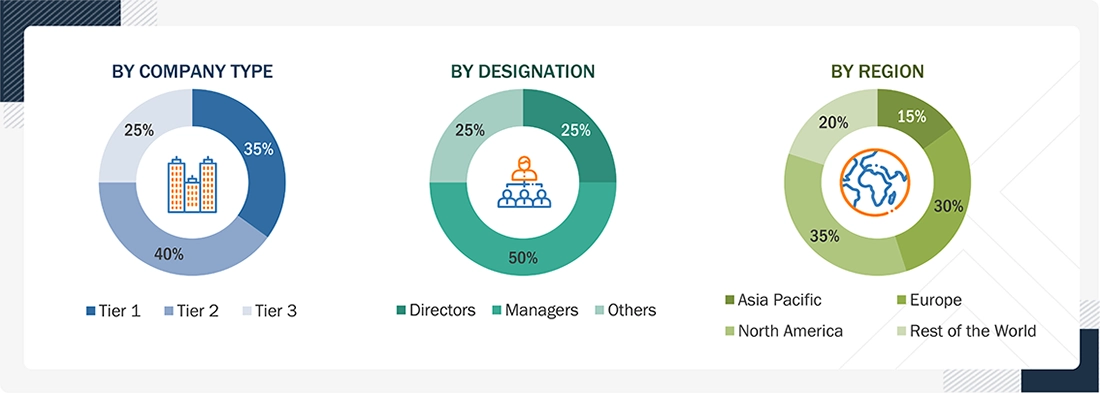
Note 1: Others include sales managers, marketing managers, and product managers.
Note 2. Tiers of companies are defined based on their total revenue. As of 2025: Tier 1 = >USD 5 billion, Tier 2 = USD 500 million to USD 5 billion, and Tier 3 = < USD 500 million.
To know about the assumptions considered for the study, download the pdf brochure
Market Size Estimation
Both top-down and bottom-up approaches were used to estimate and validate the total size of the cardiac monitoring & cardiac rhythm management devices Market. These methods were also used extensively to estimate the size of various subsegments in the market. The research methodology used to estimate the market size includes the following:
- The key players in the industry and markets have been identified through extensive secondary research
- The industry’s supply chain and market size, in terms of value, have been determined through primary and secondary research processes
- All percentage shares, splits, and breakdowns have been determined using secondary sources and verified through primary sources
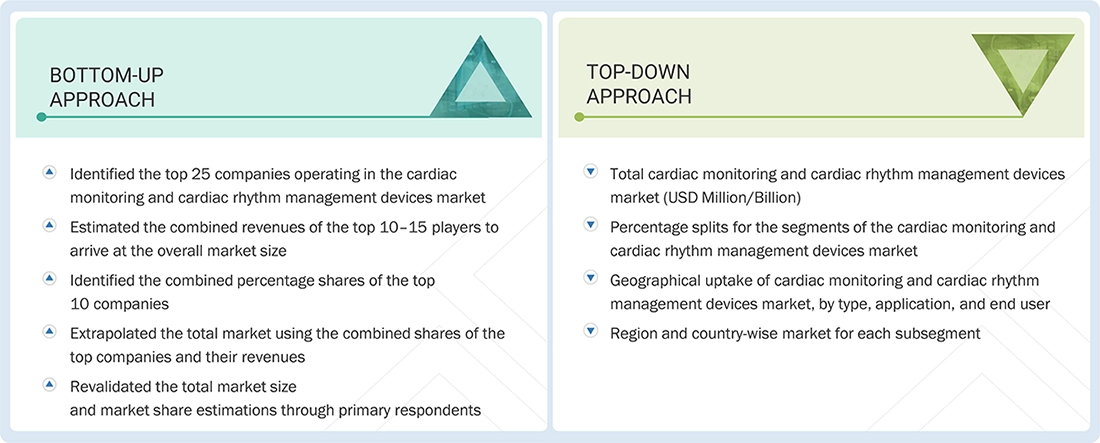
Data Triangulation
After arriving at the overall market size through market sizing processes, the market was split into several segments and subsegments. To complete the overall market engineering process and arrive at the exact statistics of each market segment and subsegment, the data triangulation and market breakdown procedures were employed, wherever applicable. The data was triangulated by examining various factors and trends on both the demand and supply sides of the cardiac monitoring & cardiac rhythm management devices industry.
Market Definition
Cardiac monitoring is the continuous monitoring of cardiac activity using devices such as electrocardiographs, recording devices, and visual/audible recorders. These devices are used to identify or rule out a cardiac rhythm disorder and determine the appropriate course of treatment. Cardiac rhythm management devices include implantable devices (defibrillators and pacemakers), leads, and external devices used to treat and manage arrhythmia-related diseases. The major end users of implantable pacemakers and defibrillators are hospitals, cardiac centers, clinics, and ambulatory surgery centers.
Stakeholders
- Manufacturers of cardiac monitoring devices and rhythm management devices
- Distributors of cardiac monitoring devices and rhythm management devices
- Hospitals, primary care centers, and cardiac centers
- Ambulatory surgical centers
- Non-government organizations
- Government regulatory authorities
- Contract manufacturers & third-party suppliers
- Research laboratories & academic institutes
- Clinical research organizations (CROs)
- Government & non-governmental regulatory authorities
- Market research & consulting firms
Report Objectives
- To define, describe, segment, and forecast the global cardiac monitoring and cardiac rhythm management devices market, by type, application, end user, and region
- To provide detailed information regarding the major factors influencing market growth (such as drivers, restraints, opportunities, and challenges)
- To strategically analyze the regulatory scenario, value chain analysis, supply chain analysis, Porter’s Five Forces analysis, ecosystem analysis, trade analysis, pricing analysis, patent analysis, impact of AI, case study analysis, unmet needs/end-user expectations, impact of US tariffs, and trends/disruption impacting customers’ business in the market.
- To strategically analyze micromarkets1 with respect to individual growth trends, prospects, and contributions to the overall market
- To analyze the opportunities in the market for stakeholders and provide details on the competitive landscape for market leaders
- To strategically analyze the cardiac monitoring and cardiac rhythm management devices market in five regions: North America, Europe, the Asia Pacific, Latin America, and the Middle East & Africa
- To track and analyze competitive developments, including acquisitions, product & service launches, partnerships, and expansions, in the cardiac monitoring and cardiac rhythm management (CM & CRM) devices market.
- To track and analyze competitive developments such as acquisitions, product launches & enhancements, partnerships, agreements, contracts, & collaborations, and R&D activities in the CM & CRM devices market.
Get the Full Cardiac Monitoring & Rhythm Management Devices Market Report
Full forecast, segment splits, and company analysis for all Cardiac Monitoring & Rhythm Management Devices Market.
- Canada Cardiac Monitoring & Rhythm Management Devices Market
- Austria Cardiac Monitoring & Rhythm Management Devices Market
- France Cardiac Monitoring & Rhythm Management Devices Market
- Germany Cardiac Monitoring & Rhythm Management Devices Market
- Italy Cardiac Monitoring & Rhythm Management Devices Market
- Netherlands Cardiac Monitoring & Rhythm Management Devices Market
- Spain Cardiac Monitoring & Rhythm Management Devices Market
- Sweden Cardiac Monitoring & Rhythm Management Devices Market
- UK Cardiac Monitoring & Rhythm Management Devices Market
- China Cardiac Monitoring & Rhythm Management Devices Market
- India Cardiac Monitoring & Rhythm Management Devices Market
- Japan Cardiac Monitoring & Rhythm Management Devices Market
- South Korea Cardiac Monitoring & Rhythm Management Devices Market
- Australia Cardiac Monitoring & Rhythm Management Devices Market
- Brazil Cardiac Monitoring & Rhythm Management Devices Market
- Colombia Cardiac Monitoring & Rhythm Management Devices Market
- Mexico Cardiac Monitoring & Rhythm Management Devices Market
- UAE Cardiac Monitoring & Rhythm Management Devices Market
Need a Tailored Report?
Customize this report to your needs
Get 10% FREE Customization
Customize This Report
