
Asia Pacific Care Management Solutions Market (2026-2031)

The Asia Pacific Care Management Solutions Market was valued at $4098.5 Million in 2026 and projected to reach to $8394.6 Million by 2031, representing a compound annual growth rate of 15.4%. The Asia Pacific care management solutions market is poised for exceptional growth through 2031, driven by converging demographic, economic, and technological factors.


| Market Size in | USD 26.32 MN |
| Market Forecast in | |
| CAGR | |
| Forecast Period | |
| Units Considered | Value (USD MN) |
Asia Pacific Care Management Solutions Market Trends and Insights
- Asia Pacific's market growth is driven by aging populations, increasing chronic disease prevalence, and rising healthcare digitalization across the region.
- The 15.4% compound annual growth rate reflects Asia Pacific's accelerating adoption of integrated care platforms and remote patient monitoring technologies. Asia Pacific's healthcare systems are increasingly investing in care management solutions to improve patient outcomes and reduce operational costs.
- Between 2026 and 2031, Asia Pacific is expected to see significant expansion in cloud-based care coordination platforms and AI-enabled patient engagement tools.
- Asia Pacific's market dynamics are shaped by regulatory reforms, growing healthcare expenditure, and the region's large patient populations requiring coordinated chronic disease management. Key markets within Asia Pacific, including China, India, Japan, and Southeast Asia, are driving innovation in care management delivery models.
- Asia Pacific's competitive landscape features both established global vendors and emerging regional players adapting solutions to local healthcare infrastructure and reimbursement models..
Key Market Statistics
- CAGR (2026-2031) 15.4% CAGR
- Market Size, 2026 ~USD 4098.5 Million
- Forecast, 2031 ~USD 8394.6 Million
- Geography Asia Pacific
Asia Pacific Care Management Solutions Market Overview
Rapid Market Expansion :
Asia Pacific care management solutions market is projected to double from $4,098.5 million in 2026 to $8,394.6 million by 2031, demonstrating exceptional growth momentum driven by regional healthcare transformation initiatives.
Aging Population Dynamics :
Accelerating demographic shifts across Asia Pacific, particularly in Japan, China, and South Korea, are creating unprecedented demand for integrated care management platforms to address chronic disease management and elderly care needs.
Digital Healthcare Adoption :
Rising healthcare digitalization across Asia Pacific nations is enabling widespread implementation of cloud-based care management solutions, electronic health records, and remote patient monitoring technologies.
Outpacing Global Growth :
Asia Pacific's 15.4% CAGR significantly exceeds the global average of 13.6%, positioning the region as the fastest-growing market for care management solutions worldwide through 2031.
Asia Pacific Care Management Solutions Market Dynamics
- Aging populations across developed economies like Japan and South Korea, combined with rising chronic disease prevalence in emerging markets like India and China, are creating substantial demand for integrated care management platforms.
- Healthcare systems across the region are increasingly investing in digital transformation to improve patient outcomes and operational efficiency. Government initiatives promoting healthcare digitalization, coupled with growing private sector investment in health technology infrastructure, will accelerate market penetration.
- The region's diverse healthcare landscape presents both opportunities and challenges, requiring localized solutions that address varying regulatory frameworks and healthcare delivery models.
- By 2031, Asia Pacific is expected to become a dominant force in the global care management solutions market, with sustained 15.4% annual growth reflecting the region's strategic importance in healthcare innovation..
Market Ecosystem
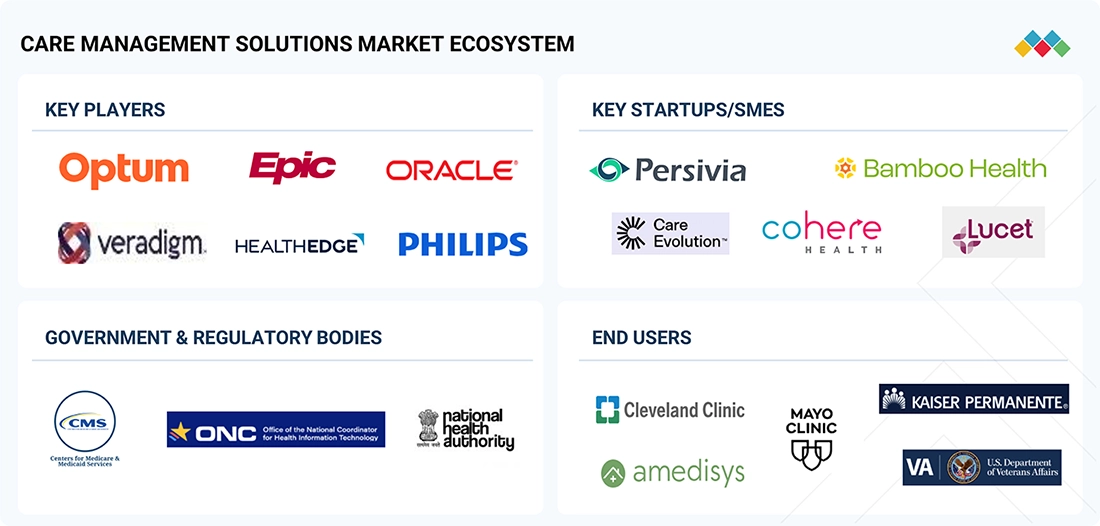
CARE MANAGEMENT SOLUTIONS MARKET: COMMERCIAL USE CASES ACROSS INDUSTRIES
| COMPANY | USE CASE DESCRIPTION | BENEFITS |
|---|---|---|
 |
Provides AI-enabled care management, population health management, risk stratification, utilization management, and care coordination solutions through Optum Insight and Optum Health platforms | Supports providers and payers in identifying high-risk populations, managing chronic conditions, and improving value-based care performance | Improved care coordination reduced total cost of care, enhanced population health outcomes, proactive risk management, optimized resource utilization, and improved quality performance |
 |
Delivers integrated care management capabilities through Healthy Planet, Care Everywhere, and MyChart, enabling chronic disease management, care coordination, transitional care, patient engagement, and population health management within a unified electronic health record ecosystem | Improved continuity of care, enhanced patient engagement, better chronic disease management, streamlined care transitions, reduced hospital readmissions, and improved clinical outcomes |
 |
Offers enterprise care management, population health, and care coordination capabilities through Oracle Health, integrating clinical, financial, and operational data to support longitudinal patient management, value-based care initiatives, and multidisciplinary care delivery | Enterprise-wide patient visibility, improved care coordination, enhanced interoperability, optimized care planning, improved operational efficiency, and better value-based care performance |
 |
Delivers data-driven care management, quality improvement, and population health solutions that integrate clinical and claims data to support chronic disease management, care gap identification, value-based care, and performance measurement across provider organizations | Improved quality reporting, enhanced population health management, better care gap closure, data-driven clinical insights, improved reimbursement performance, and stronger value-based care outcomes |
 |
Provides connected care solutions integrating remote patient monitoring, virtual care, chronic disease management, and care coordination through the Philips Connected Care portfolio, enabling continuous patient monitoring across hospital, home, and community care settings | Improved patient outcomes, reduced avoidable hospitalizations, enhanced care continuity, increased patient engagement, optimized remote care delivery, and improved operational efficiency |
Logos and trademarks shown above are the property of their respective owners. Their use here is for informational and illustrative purposes only.
Related Ecosystem
Healthcare It
- Computed Tomography (CT)
- Machine Learning
- Magnetic Resonance Imaging (MRI)
- Natural Language Processing (NLP)
- Predictive Analytics
- CERNER CORPORATION
- PHILIPS HEALTHCARE
- Oracle Corporation
- GE HealthCare Technologies Inc.
- Siemens healthineers
Key Takeaways
- Asia Pacific's care management solutions market will double from $4,098.5M (2026) to $8,394.6M (2031), representing a 15.4% CAGR.
- Asia Pacific's aging demographics and rising chronic disease burden are primary catalysts for care management solution adoption across the region.
- Asia Pacific is witnessing rapid digital transformation in healthcare, with cloud-based and AI-enabled care coordination platforms gaining significant traction.
- Asia Pacific's market includes diverse healthcare systems requiring localized solutions, creating opportunities for both global and regional vendors.
Care Management Solutions Market Report Scope
| Report Metric | Details |
|---|---|
| Base Year | 2026 |
| Fastest Growing Segment | HEALTHCARE PAYERS (End User) |
| Forecast Period | 2026-2031 |
| Growth Rate | CAGR of 13.6% from 2026 to 2031 |
| Largest Segment | SOFTWARE (Component) |
| Market Size Base Year (Billions) | ~USD 22.53 (2026) |
| Revenue Forecast (Billions) | ~USD 42.62 (2031) |
| Segments Covered | Component, Type, Deployment Model, Application, End User, Segment |
Asia Pacific Care Management Solutions Market Report Segmentation
6 segment dimensions are covered across the global market.
By Component
- Services
- Software
By Type
- Ambulatory Care Centers
- Government Payers
- Home-Based Care Providers
- Hospitals & Health Systems
- Integrated Care Management Solutions
- Private Payers
- Standalone Care Management Solutions
- Third-Party Administrators (Tpas)
By Deployment Model
- Cloud-Based
- On-Premises
By Application
- Chronic Care Management
- Preventive Care Management
- Transitional Care Management
- Utilization Management
By End User
- Healthcare Payers
- Healthcare Providers
- Other End Users
By Segment
- Third-Party Administrators(Tpa)
Target Audience
- Healthcare Technology Vendors : Care management software providers and health IT companies need Asia Pacific-specific market data to identify expansion opportunities, assess competitive landscapes, and develop localized product strategies for the region's diverse healthcare systems.
- Healthcare Providers & Systems : Hospitals, clinics, and integrated healthcare networks across Asia Pacific require market intelligence to benchmark their care management capabilities, identify best-in-class solutions, and plan digital transformation investments.
- Private Equity & Investment Firms : Investors targeting healthcare technology and services in Asia Pacific need detailed market sizing and growth forecasts to evaluate investment opportunities, identify acquisition targets, and assess portfolio company growth potential.
- Government & Healthcare Policymakers : Regional health ministries and regulatory bodies need market insights to inform healthcare digitalization policies, funding allocations, and strategic initiatives supporting care management infrastructure development.
- Management Consultants & Analysts : Strategy consultants and business analysts advising healthcare clients in Asia Pacific require authoritative market data and regional insights to support client recommendations, competitive analysis, and market entry strategies.
Countries within Asia Pacific - compare and drill down
| Country | 2025 size (native) |
|---|---|
| China | USD 2677.4 Million |
| Japan | USD 1980.2 Million |
| India | USD 1770.4 Million |
| Australia | USD 531.7 Million |
| South Korea | USD 390.7 Million |
| Rest Of Asia Pacific | USD 1044.2 Million |
Country market size visualization
Reasons to Buy this Report
- Regional Market Sizing & Forecasts : Obtain precise market valuations for Asia Pacific ($4.1B in 2026) with detailed 5-year forecasts through 2031, enabling accurate business planning and investment decisions specific to the region's growth trajectory.
- Country-Level Intelligence : Access granular market data across major Asia Pacific economies including China, Japan, India, Australia, and South Korea, allowing targeted market entry strategies and competitive positioning by geography.
- Growth Driver Analysis : Understand the specific factors propelling Asia Pacific's 15.4% CAGR—aging demographics, chronic disease prevalence, and healthcare digitalization—to identify market opportunities and develop region-appropriate solutions.
- Competitive Benchmarking : Compare Asia Pacific's 15.4% growth rate against the global 13.6% CAGR to assess regional market attractiveness and identify where to allocate resources for maximum ROI in the fastest-growing healthcare market.
- Strategic Investment Guidance : Leverage comprehensive Asia Pacific market insights to guide M&A strategies, partnership development, and product localization initiatives in a region projected to double in market value by 2031.
Frequently asked questions
What is the projected market size for care management solutions in Asia Pacific by 2031?
Asia Pacific's care management solutions market is projected to reach $8,394.6 million by 2031, growing from $4,098.5 million in 2026.
What is the CAGR for Asia Pacific's care management solutions market?
Asia Pacific's care management solutions market is expected to grow at a compound annual growth rate of 15.4% between 2026 and 2031.
What factors are driving growth in Asia Pacific's care management solutions market?
Asia Pacific's market growth is driven by aging populations, increasing chronic disease prevalence, healthcare digitalization, regulatory reforms, and rising healthcare expenditure across the region.
Which countries are key markets within Asia Pacific for care management solutions?
Key markets within Asia Pacific include China, India, Japan, and Southeast Asian nations, each with distinct healthcare infrastructure and adoption patterns for care management solutions.
What types of care management solutions are gaining traction in Asia Pacific?
Asia Pacific is seeing increased adoption of cloud-based care coordination platforms, remote patient monitoring technologies, and AI-enabled patient engagement tools for integrated care delivery.
RESEARCH METHODOLOGY
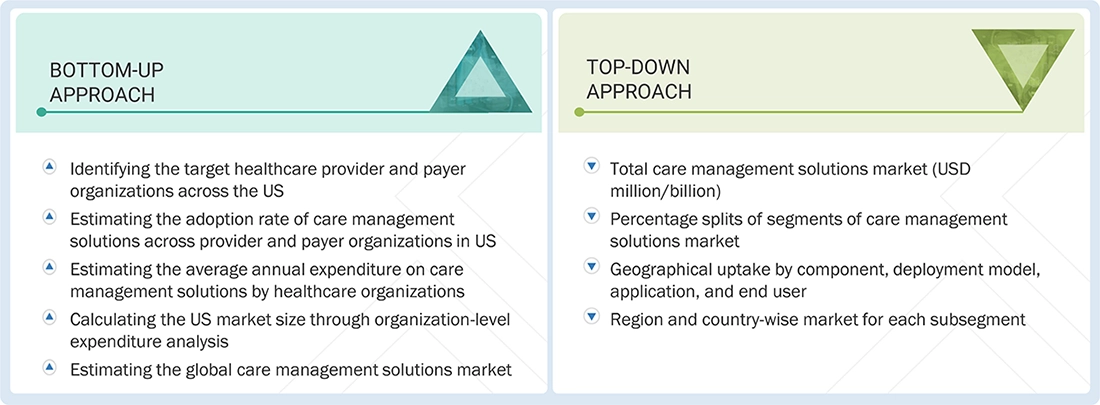
The study involved five major activities to estimate the current size of the care management solutions market. Exhaustive secondary research was conducted to collect information on the market and its subsegments. The next step was to validate these findings, assumptions, and sizing with industry experts across the value chain through primary research. Both top-down and bottom-up approaches were employed to estimate the total market size. Thereafter, market breakdown and data triangulation procedures were used to estimate the market size of the segments and subsegments.
Secondary Research
This research study relied extensively on secondary sources, including directories, databases such as Bloomberg Business, Factiva, and Dun & Bradstreet, white papers, annual reports, company house documents, investor presentations, and SEC filings. Secondary research was used to identify and collect valuable information for this study. It was also used to obtain important information about the key players, market classification and segmentation according to industry trends down to the bottom-most level, and key market & technology developments. A database of the key industry leaders was also prepared using secondary research.
Some of the key secondary sources referred to for this study include:
- Healthcare Information and Management Systems Society (HIMSS)
- Centers for Medicare & Medicaid Services (CMS)
- American Medical Informatics Association (AMIA)
- Agency for Healthcare Research and Quality (AHRQ)
- National Committee for Quality Assurance (NCQA)
- Organization for Economic Co-operation and Development (OECD)
- World Health Organization (WHO)
- Centers for Disease Control and Prevention (CDC)
- European Federation for Medical Informatics (EFMI)
- Australian Healthcare and Hospitals Association
- Investor Presentations, SEC Filings, and Company Annual Reports
- White Papers, Journals/Magazines, and News Articles
- Paid Databases, such as Factiva, D&B Hoovers, and Bloomberg Business
Primary Research
Extensive primary research was conducted after acquiring basic knowledge of the global care management solutions market through secondary research. Several primary interviews were conducted with market experts from both the demand side (hospital directors, hospital vice presidents, department heads, and critical care specialists) and the supply side (C- and D-level executives, technology experts, product managers, marketing and sales managers, among others) across five major regions - North America, Europe, the Asia Pacific, Latin America, the Middle East, and Africa. This primary data was collected through questionnaires, emails, online surveys, personal interviews, and telephone interviews. In the primary research process, various supply and demand sources were interviewed to obtain qualitative and quantitative information for this report. Primary sources mainly included industry experts from core and related industries, solution providers, technology vendors, system integrators, researchers, and organizations across all segments of this industry’s value chain. In-depth interviews were conducted with various primary respondents, including key industry participants, subject-matter experts (SMEs), C-level executives of key market players, and industry consultants, among others, to obtain and verify critical qualitative and quantitative information and assess prospects. Primary research was conducted to identify segmentation types, industry trends, key players, and key market dynamics such as drivers, restraints, opportunities, challenges, and strategies adopted by key players.
The following is a breakdown of the primary respondents:
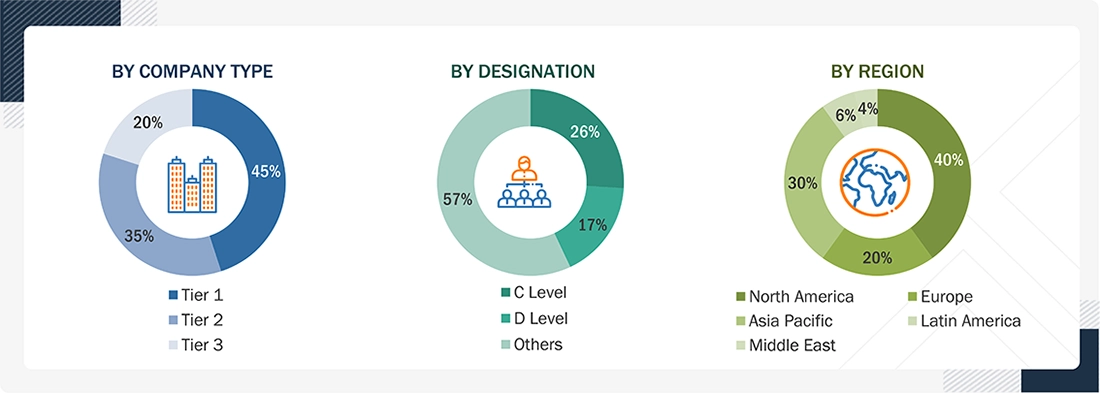
Note 1: C-level primaries include CEOs, CFOs, and COOs.
Note 2: Others include sales managers, marketing managers, business development managers, product managers, distributors, and suppliers.
Note 3: Companies are classified into tiers based on their total revenues. As of 2024, Tier 1 = >USD 2 billion, Tier 2 = USD 50 million to USD 2 billion, and Tier 3 = <USD 50 million.
To know about the assumptions considered for the study, download the pdf brochure
Market Size Estimation
Both top-down and bottom-up approaches were used to estimate and validate the total size of the care management solutions market. These methods were also used extensively to estimate the size of various market subsegments.
Care Management Solutions Market : Top-Down and Bottom-Up Approach
Data Triangulation
After determining the overall market size using the market size estimation processes, the market was split into several segments and subsegments. To complete the overall market engineering process and arrive at the exact statistics for each market segment and subsegment, data triangulation and market breakdown procedures were employed wherever applicable. The data was triangulated by studying various factors and trends from both the demand and supply sides in the care management solutions market.
Market Definition
Care management solutions are healthcare information technology (HCIT) platforms that support the planning, coordination, monitoring, and delivery of patient care across the continuum of care. These solutions enable care teams to manage chronic diseases, coordinate care transitions, identify high-risk populations, and improve patient engagement through integrated clinical, administrative, and population health workflows. They help healthcare organizations improve clinical outcomes, optimize resource utilization, reduce healthcare costs, and support value-based care delivery.
Key Stakeholders
- Care Management Solutions and related Solutions Provider Companies
- Hospitals (Public and Private)
- Ambulatory Care Centers
- Home-based Care Providers
- Payers (Commercial and Government)
- Integrated Delivery Networks (IDNs)
- Healthcare Startups
- Government Healthcare Agencies
Report Objectives
- To define, describe, and forecast the global care management solutions market based on component, deployment model, application, end user, and region
- To provide detailed information regarding the major factors (such as drivers, restraints, opportunities, and challenges) influencing the market growth
- To strategically analyze micro-markets with respect to individual growth trends, prospects, and contributions to the overall care management solutions market
- To analyze opportunities in the market for stakeholders and provide details of the competitive landscape for market leaders
- To strategically analyze the market structure profile of the key players of the care management solutions market and comprehensively analyze their core competencies
- To forecast the size of the market segments with respect to five regions, namely, North America, Europe, Asia Pacific, Latin America, and the Middle East & Africa
- To track and analyze competitive developments such as product launches and enhancements and investments, partnerships, collaborations, acquisitions, expansions, agreements, sales contracts, and alliances in the care management solutions market during the forecast period
Available customizations:
With the given market data, MarketsandMarkets offers customizations as per the company’s specific needs. The following customization options are available for the report:
Product Analysis
- Product matrix, which gives a detailed comparison of the product portfolios of each company
Geographic Analysis
- Further breakdown of the Latin American care management solutions market into specific countries, the Middle East & Africa care management solutions market into specific countries, and further breakdown of the European care management solutions market into specific countries.
Get the Full Care Management Solutions Market Report
Full forecast, segment splits, and company analysis for all Care Management Solutions Market.
- Rest Of Latin America Care Management Solutions Market
- GCC Care Management Solutions Market
- Rest Of GCC Care Management Solutions Market
- Canada Care Management Solutions Market
- US Care Management Solutions Market
- Germany Care Management Solutions Market
- UK Care Management Solutions Market
- France Care Management Solutions Market
- Italy Care Management Solutions Market
- Spain Care Management Solutions Market
- China Care Management Solutions Market
- Japan Care Management Solutions Market
- India Care Management Solutions Market
- Australia Care Management Solutions Market
- South Korea Care Management Solutions Market
- Brazil Care Management Solutions Market
- Mexico Care Management Solutions Market
- Saudi Arabia Care Management Solutions Market
- UAE Care Management Solutions Market
- South Africa Care Management Solutions Market
- Rest Of Europe Care Management Solutions Market
- Rest Of Asia Pacific Care Management Solutions Market
Need a Tailored Report?
Customize this report to your needs
Get 10% FREE Customization
Customize This Report
